


After 2022 the case looked closed: stocks and bonds fell together, and the 40% that was supposed to cushion the fall made it worse. But look at what actually broke. It was not the idea of holding bonds next to stocks. It was the habit of holding the same bonds in every regime — usually long-dated Treasuries — as if the bond half needed no decision.

Nobody runs the stock half that way. Investors move between tech and value, growth and defensives, depending on rates, growth and inflation. The bond half needs the same regime call. Long bonds are the right tool in one regime and the wrong one in another, and there are instruments built for exactly the regimes where long bonds fail.
Closelooknet on Google
Get our reads first in Top Stories and AI answers. One tap, no account needed here.
Four regimes, four different winners
We split the years since January 2020 into the rate regimes the market went through and measured the main bond tools in each — total return, distributions reinvested, from monthly closes. The pattern is plain: every regime had a different winner.
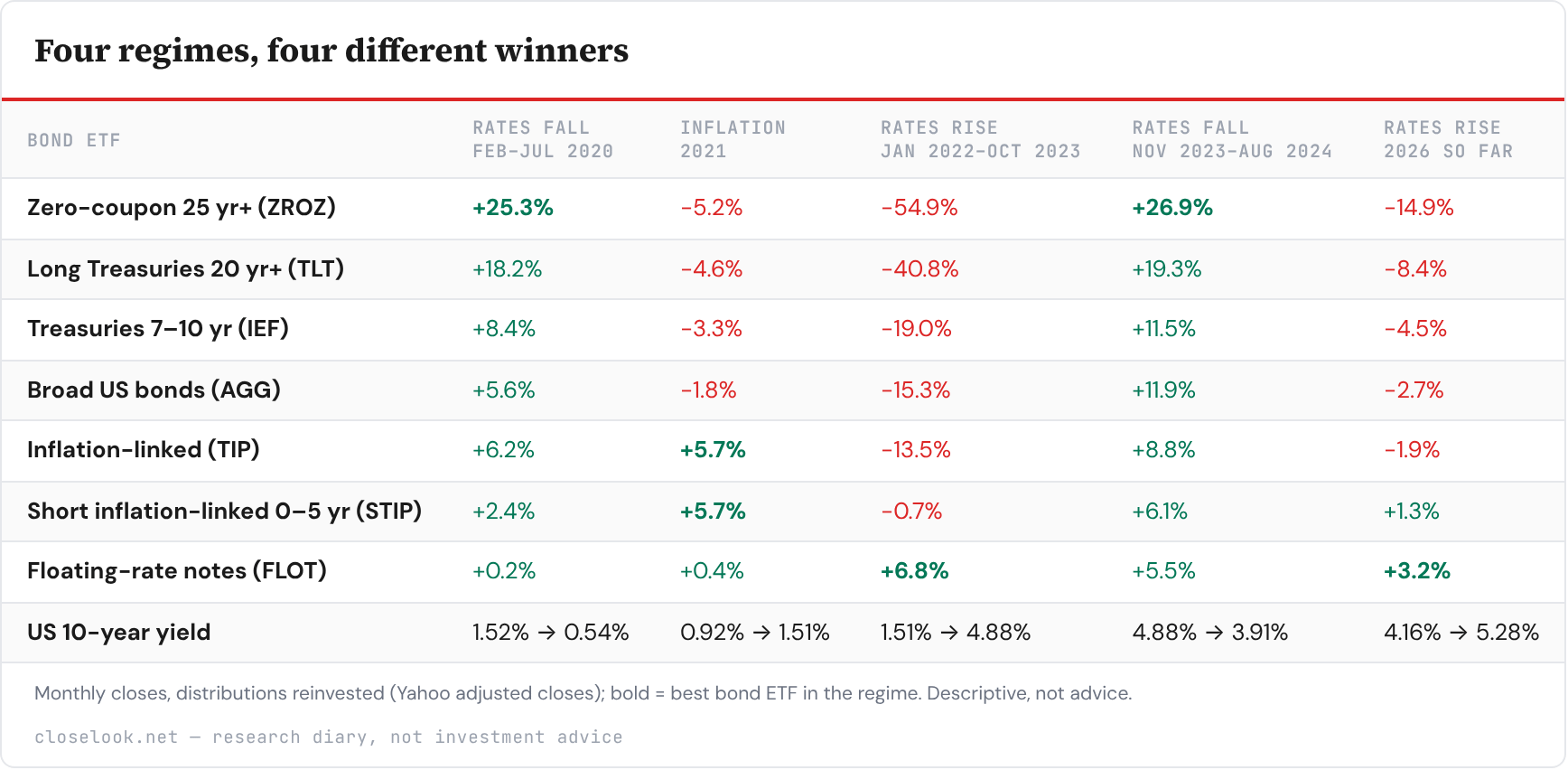
Table as text
Monthly closes, distributions reinvested (Yahoo adjusted closes); bold = best bond ETF in the regime. Descriptive, not advice.
When rates fall hard, length pays. A bond’s price moves against its yield, and the longer the bond, the bigger the move. The extreme case is a zero-coupon bond: it pays nothing until it matures, so all of its value sits far in the future. The zero-coupon fund ZROZ gained 25.3% in the first half of 2020 and 26.9% when rates came down from late 2023. We do not show it as the normal tool — it is the far end of the scale. It shows the direction: in a falling-rate regime, the bond half gets longer.
When rates climb, length kills. The same zero-coupon fund lost 54.9% between January 2022 and October 2023; long Treasuries (TLT) lost 40.8%. Today ZROZ is 64.7% below its July 2020 high, the deepest point of the whole period. The tool for this regime sits at the other end: floating-rate notes. Their coupon is reset every few months to the short-term rate plus a fixed margin, so when the central bank hikes, the income rises with it and the price barely moves. The floating-rate fund FLOT gained 6.8% while long bonds lost 40%.
Inflation protection is not rate protection. Inflation-linked Treasuries (TIPS) did their job in 2021, when inflation took off: +5.7%. But the broad TIPS fund TIP still lost 13.5% in 2022–23, because its bonds are long and rising rates hit them too. Short TIPS (STIP, up to five years) kept the inflation link without the rate risk and lost only 0.7%.
The bond half has to match the stock half
The regime call is not made for each half separately. A hot economy with rising rates — the 2023 AI boom, and 2026 so far — is good for the companies selling into the boom and bad for long bonds. In that regime the two halves that fit together are tech or the Nasdaq-100 on the stock side and floating-rate notes or short TIPS on the bond side. The mix that suffers is the old defensive one: long Treasuries next to value or non-tech growth stocks, because both depend on rates coming down.
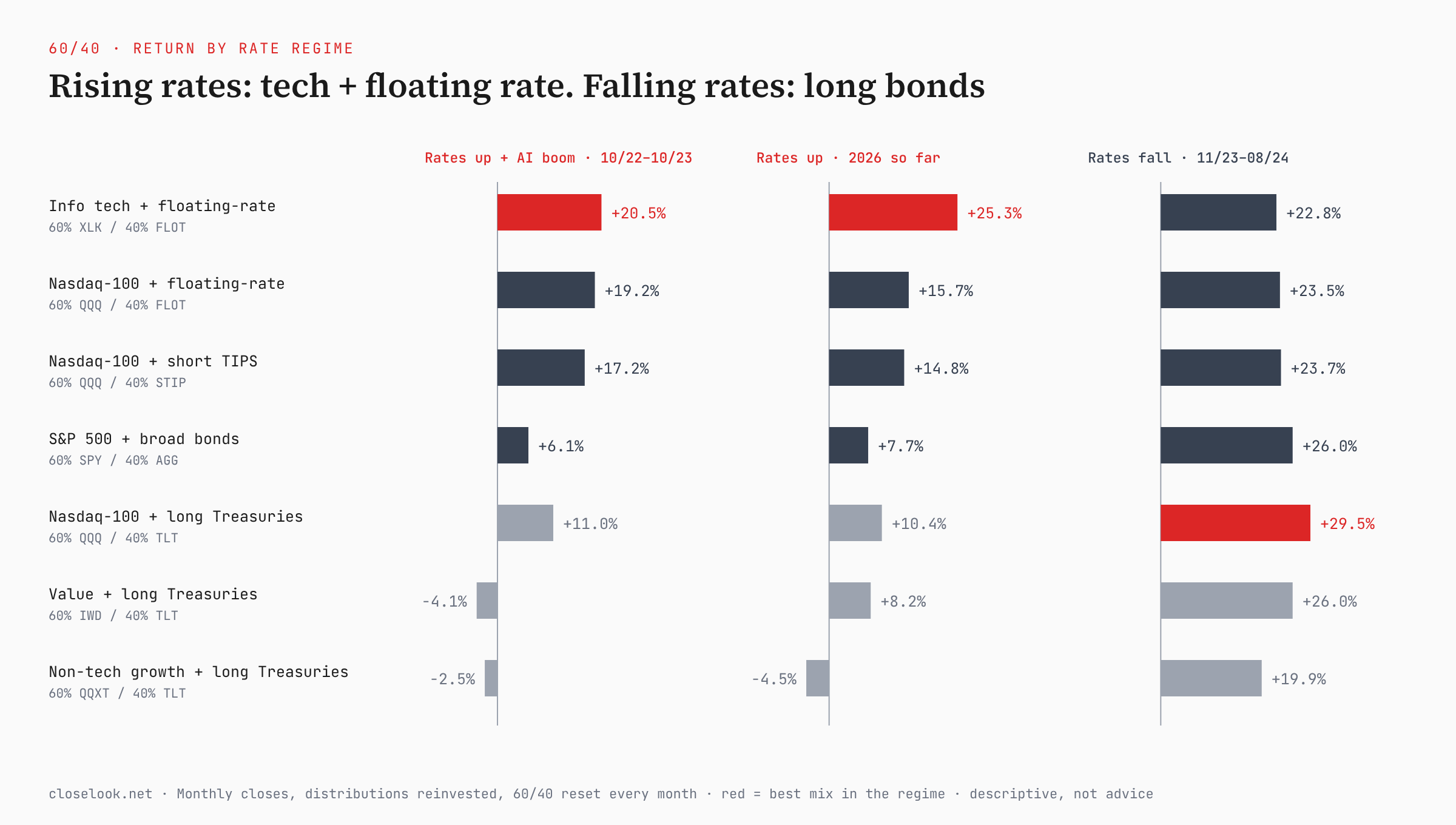
In the rising-rate AI boom from October 2022 to October 2023, 60% info tech (XLK) with 40% floating-rate notes returned 20.5%, and the Nasdaq-100 with floating-rate notes 19.2%. The Nasdaq-100 with long Treasuries made 11.0% — same stocks, half the return, because of the bond half. Value stocks with long Treasuries lost 4.1%, non-tech growth (the Nasdaq-100 without its tech companies, QQXT) with long Treasuries lost 2.5%.
2026 so far is the same regime and the same order: info tech with floating-rate notes +25.3%, Nasdaq-100 with floating-rate notes +15.7%, Nasdaq-100 with short TIPS +14.8%, Nasdaq-100 with long Treasuries +10.4%. Non-tech growth with long Treasuries is down 4.5%.
The pairing also mattered in the worst year. In the 2022 rate shock almost everything fell, but the Nasdaq-100 with floating-rate notes lost 18.4% while the Nasdaq-100 with long Treasuries lost 31.2% — the bond half that was meant to protect added to the loss.
The counter-case: when rates fall, long bonds win
This is not a case against long bonds. From November 2023 to August 2024 rates came down and the order flipped: the Nasdaq-100 with long Treasuries returned 29.5%, the best of the seven mixes, while the floating-rate pairings made about 23%. Floating-rate notes are built for rising rates; when the central bank cuts, their income falls with it and they gain nothing on price. That is exactly why the bond half needs a regime call rather than a fixed answer in either direction.
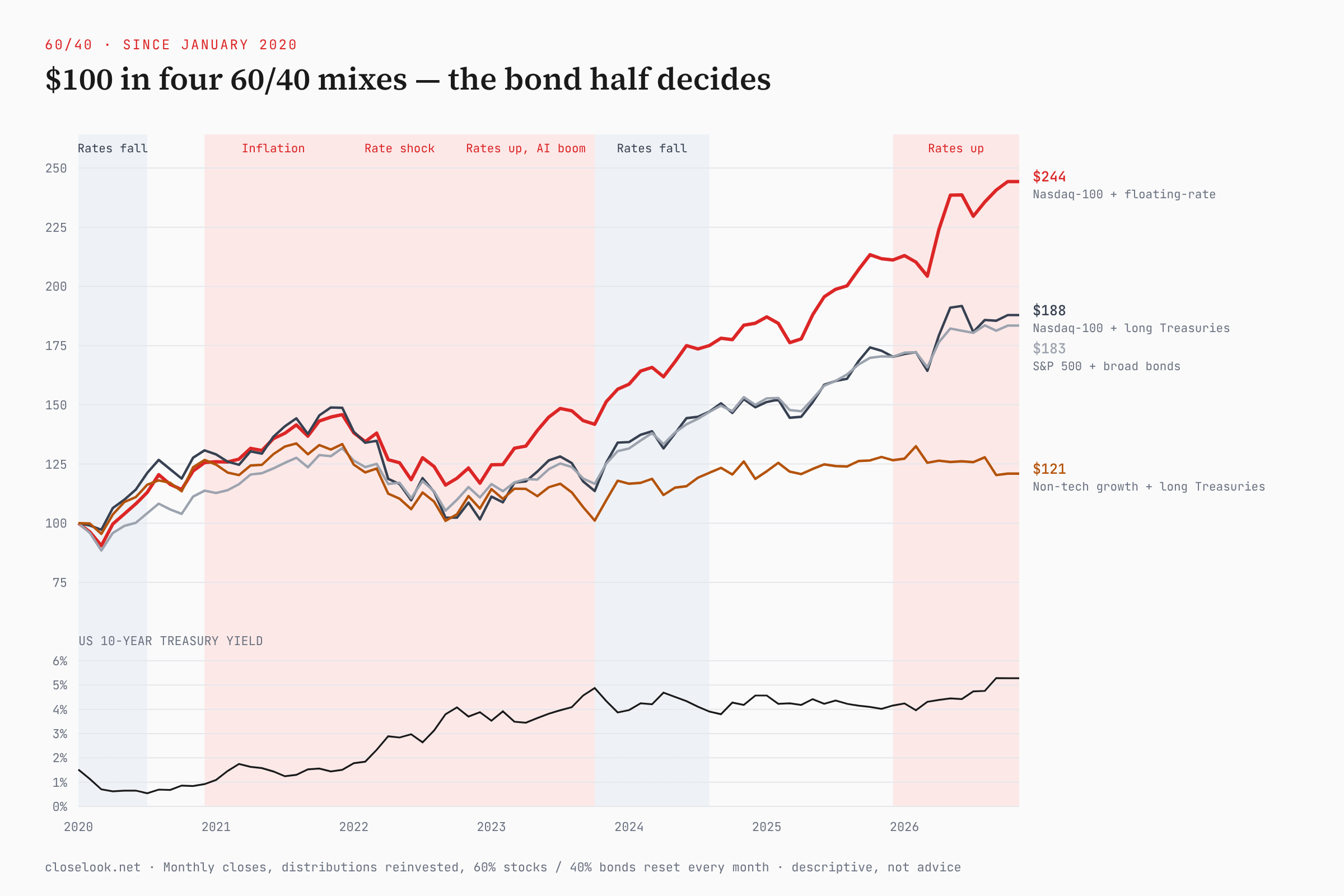
Over the whole stretch since January 2020 — a period in which the 10-year yield went from 1.52% to 5.28% — the gap is large. $100 in the Nasdaq-100 with floating-rate notes grew to $244; the same Nasdaq-100 with long Treasuries to $188. Same stock half, different bond half, $56 apart. Part of the overall result is hindsight — tech had an exceptional run over these years — but the comparison between the two Nasdaq-100 mixes is clean: the only difference is the bond half.
Where the regime stands now
Today’s signals point one way. The 10-year yield has risen from 4.16% at the end of 2025 to 5.28%. The Fed raised its key rate in September to 3.75–4.00%, and the minutes published on Wednesday say most officials expect another increase by year-end. They named oil near $100 a barrel and the AI build-out as inflation risks. The three-month Treasury bill yields 4.04%, close to the policy rate — the income a floating-rate note resets to.
In this regime the data favour the short, floating and inflation-linked end of the bond half, next to the companies driving the boom: so far in 2026 floating-rate notes +3.2%, short TIPS +1.3%, long Treasuries −8.4%, zero-coupon −14.9%.
What would turn it: a Fed that stops hiking and starts cutting, a run of weak jobs reports — September added only 29,000 — and a 10-year yield that breaks lower instead of making new highs. Then the regime call moves step by step toward length: from floating-rate notes and short TIPS to intermediate Treasuries, to long Treasuries, and, at the extreme, to zero-coupon bonds. We will name the shift here when the data show it — not before.
This is a diary of how we read the rate regimes and what the data show for each, not a recommendation to buy or sell any fund.