


It is tempting to read that as “AI hardware is back”. Our numbers say something else.

We follow the AI trade through three indices — the Rubin Build-Out (126 hardware companies in 24 sectors), the Agentic Ecosystem (34 infrastructure-software companies) and the Agentic Winners 40 (the applications) — and every sector has its own equal-weight index. Read them side by side, and AI hardware is not one trade. It is two dozen of them, and most are still below where they stood in June.
Closelooknet on Google
Get our reads first in Top Stories and AI answers. One tap, no account needed here.
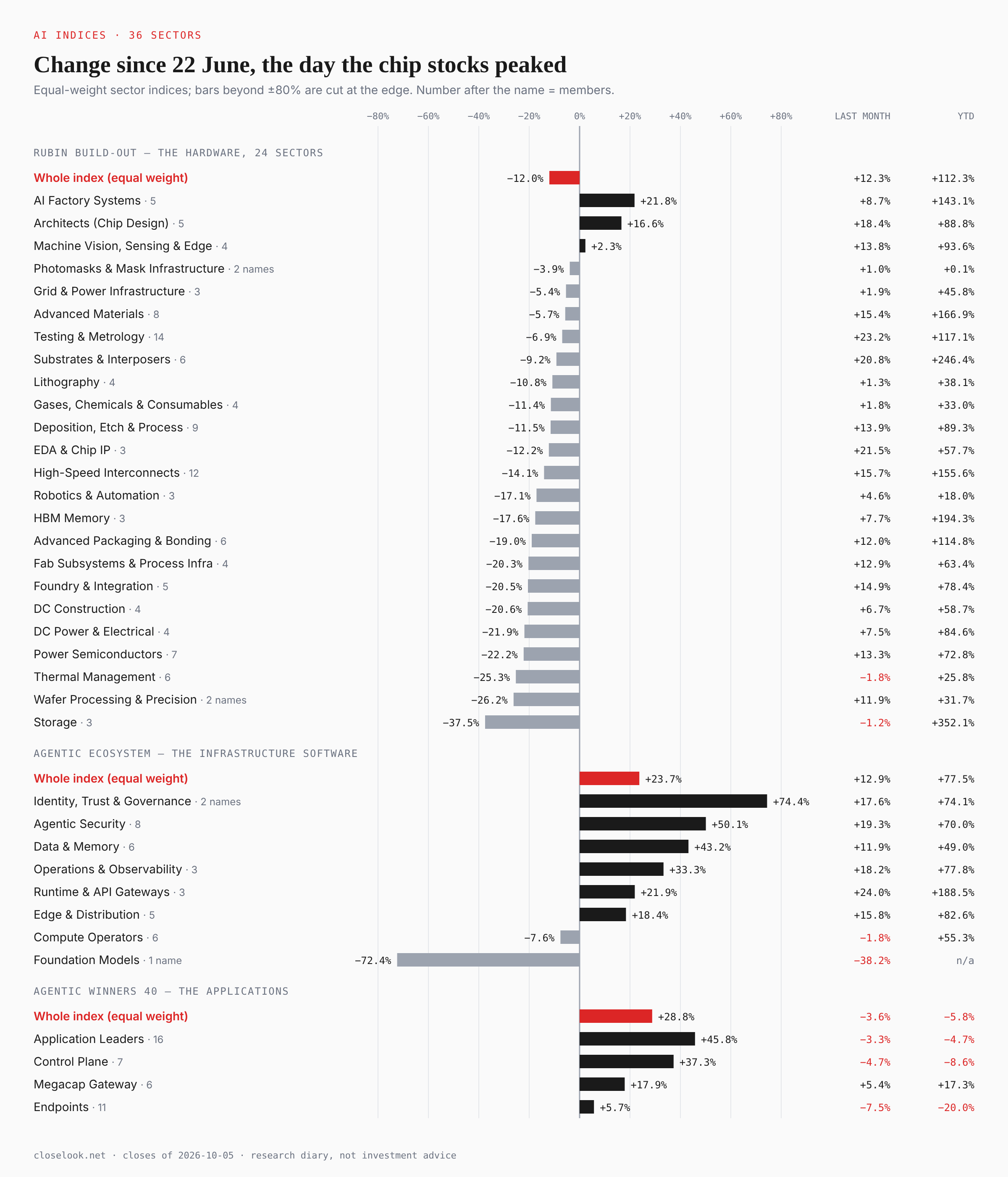
Three indices, three different years
The three indices tell three stories depending on where you start counting. This year the hardware is far ahead. Since the June peak in the chip stocks, software has led. Over the last month, hardware and infrastructure software rose together while the applications slipped.
The three AI indices at Monday’s close
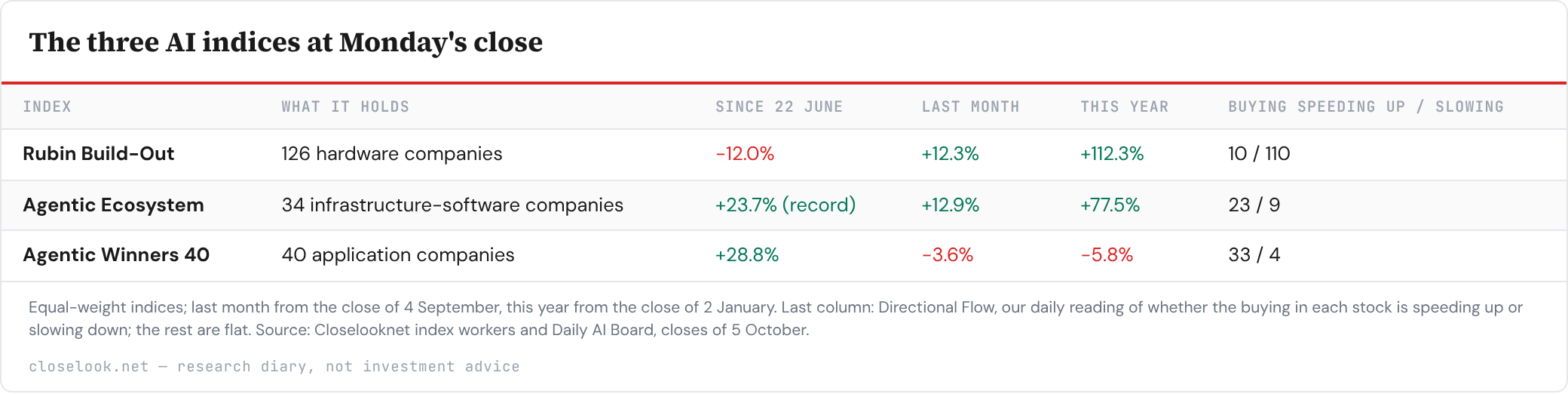
Table as text
Equal-weight indices; last month from the close of 4 September, this year from the close of 2 January. Last column: Directional Flow, our daily reading of whether the buying in each stock is speeding up or slowing down; the rest are flat. Source: Closelooknet index workers and Daily AI Board, closes of 5 October.
The last column matters most for the next few weeks. In the hardware index, 105 of 126 stocks are still rising, but the buying behind them is slowing — the pattern of a move that is getting older. In software and applications it is the other way round: most names are gaining speed from a lower level. Nvidia’s record does not change that count. It is one name of 126.
Hardware: 3 sectors above June, 21 below
Every one of the 24 hardware sectors is up this year, from photomasks (+0.1%) to storage (+352.1%). Since 22 June, only three are higher: the server and rack makers (AI Factory Systems, +21.8%, at a record on Monday), the chip designers (Architects, +16.6%) and machine vision (+2.3%).
Close behind are grid equipment (−5.4%), advanced materials (−5.7%), testing and metrology (−6.9%) and substrates (−9.2%). At the bottom sit the parts of the build-out that ran hardest in the first half: storage (−37.5%), wafer processing (−26.2%), cooling (−25.3%), power chips (−22.2%), data-centre power and construction (−21.9% and −20.6%), foundries (−20.5%) and memory (−17.6%).
The September rebound did not lift them evenly either. Over the last month testing and metrology rose 23.2%, chip-design software 21.5%, substrates 20.8% and the chip designers 18.4%. Storage (−1.2%), cooling (−1.8%), photomasks (+1.0%), lithography (+1.3%) and grid equipment (+1.9%) barely moved.
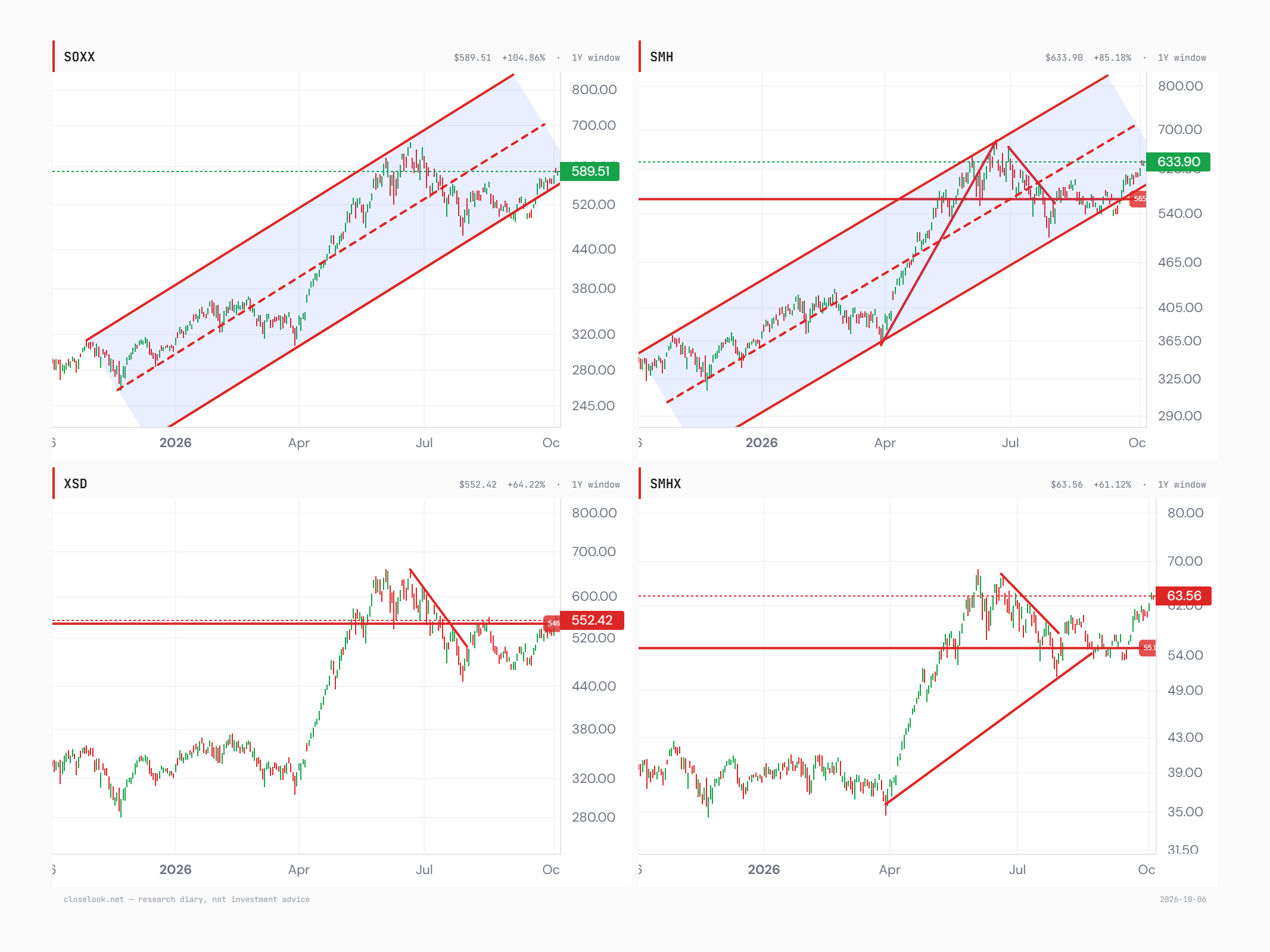
The chip funds show the same order by size. On the editor’s charts, SMH — where Nvidia and TSMC weigh most — is 5.2% below its June high and back above its 565 line. The fabless fund SMHX is 6.3% below and has broken its downtrend from June. SOXX is 10.0% below, in the lower half of its rising channel.
The equal-weight XSD, where every chip maker counts the same, is 15.0% below its June high and pressing on its 546 line. The bigger the name, the closer to the high.
Inside each sector: a leader and a long tail
Even inside one sector, the stocks went different ways. In almost every hardware group there is one company at or near a record and others 20% to 45% below their June levels. The table puts the leader and the laggard of ten sectors next to each other.
Leader and laggard since 22 June, by hardware sector
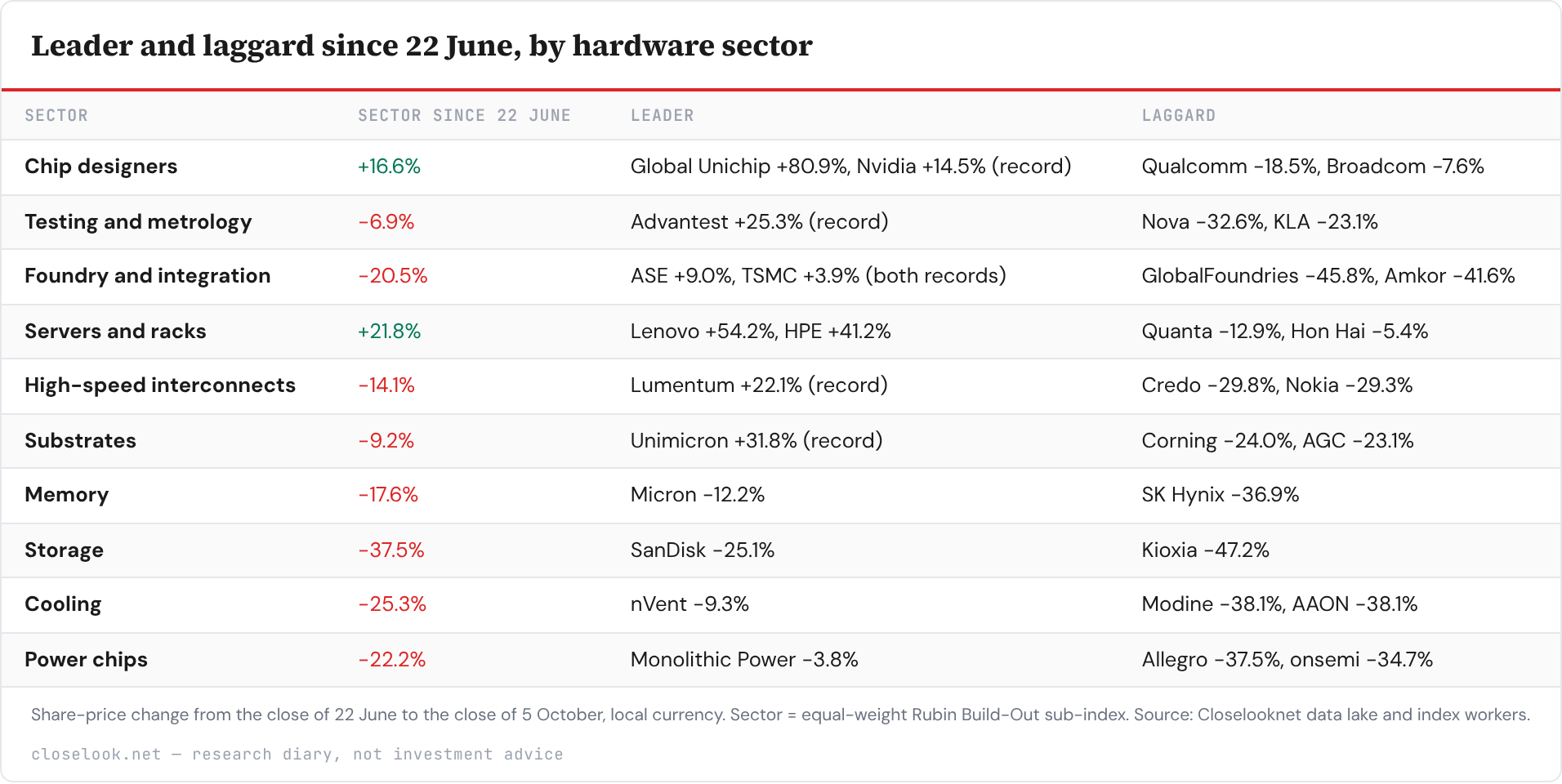
Table as text
Share-price change from the close of 22 June to the close of 5 October, local currency. Sector = equal-weight Rubin Build-Out sub-index. Source: Closelooknet data lake and index workers.
Three readings stand out. First, the chip designers are not Nvidia alone: Nvidia is up only 26.5% this year, AMD 182.7% and Global Unichip, TSMC’s design partner, 293.6%. Nvidia’s record moves the big cap-weighted indices because of its size; in our equal-weight view it sits in the middle of its own group.
Second, the testers are not the measuring-machine makers. Advantest rose another 3.8% in Tokyo on Tuesday to ¥41,850, a new record, while KLA and Nova, which measure the chips during production, are still far below June. Test is paid per chip shipped; measurement is paid when new factories are built — the split we described in Monday’s Pulse.
Third, memory and storage are this year’s biggest winners and the summer’s biggest losers at the same time. SanDisk is up 519% this year, Kioxia 450% and Micron 237%, and all three are 12% to 47% below June. On Tuesday SK Hynix fell another 3.7% and Kioxia 2.0% as Korea reopened after its holiday.
Infrastructure software: security and data at records, GPU renters left behind
The Agentic Ecosystem closed at a record on Monday, up 23.7% since June. Six of its eight sectors with members are higher since June. Identity companies rose 74.4% (Okta +88.3%), agentic security 50.1% (Rubrik +73.9%, SentinelOne +72.5%, CrowdStrike +61.5% at a record), data 43.2% (Everpure +86.8%, Elastic +61.6%, Snowflake +49.6%) and observability 33.3% (Dynatrace +48.8%, at a record).
The exceptions are the companies that rent out computing power. Compute Operators fell 7.6% since June: IREN −28.8%, CoreWeave −21.5%, Nebius −18.0%. They own GPUs and data centres, and the market trades them like hardware, not software. The one listed model maker in the index, Zhipu AI in Hong Kong, is down 72.4% since June and still about five times its January listing price. Inside the data group, MongoDB (+12.6% since June) is still down 10.1% this year.
Applications: up 29% since June, still down this year
The Agentic Winners 40 rose 28.8% since 22 June — three days before the low point of the software sell-off — but the last month took 3.6% back and the index is still 5.8% below where it started the year. Only one of its four sectors is up on the year: the Megacap Gateway (+17.3%), where Microsoft closed at a record of 525.18 on Monday.
The application leaders show the widest spread of all. Atlassian is up 145.9% since June and closed at a record; Veeva rose 85.1%. Intuit (−54.8%), CoStar (−57.9%) and HubSpot (−42.3%) are still the year’s worst. In the last month the large business-software names slipped again: Salesforce −11.4%, Intuit −14.4%, Adobe −10.4%.
The best name of the week is a takeover, not a market verdict. PTC, the industrial-design software company, jumped 33.5% on Monday after Schneider Electric agreed to buy it for $205 a share in cash, about $22.6 billion. Schneider, a Rubin member for its data-centre power equipment, fell 10.0% the same day — the worst hardware name of the week. A hardware supplier paying a 42% premium for application software is its own kind of signal about where the AI value is expected to sit.
What we watch
Europe on Tuesday showed the same split. By late morning the Stoxx 600 was up 0.7%, but inside the hardware names the moves ran both ways: the chip-packaging machine maker BESI fell 5.3%, while STMicroelectronics rose 2.3%, Infineon 1.0% and ASML 0.8%. Schneider Electric lost another 2.8% after Monday’s 10% drop. US futures pointed 0.3% to 0.4% higher.
The question for the next weeks is whether the hardware rebound broadens or stays with the leaders. A broadening would show as storage, memory, cooling and power chips joining the September move, and as the Directional Flow count in the Rubin index turning back up. The next hard numbers arrive quickly:
By 10 October: September revenue from TSMC and the Taiwan chain.
14 October: ASML’s third quarter — the first view of how many new factories come in 2027.
15 October: TSMC’s third quarter.
28 October: Advantest’s second quarter.
This is a research diary, not investment advice.
C · members block
Into tomorrow
Today: Accenture’s earnings window closes at the US close; Penguin Solutions reports after the bell. This week: Fed minutes on Wednesday, PepsiCo on Thursday, Delta on Friday, Taiwan’s September revenue by Saturday. Next week: ASML on 14 October, TSMC on 15 October. The lines: Rubin −12.0% from its 22 June high; Ecosystem at a record; Winners −8.6% from its January high.
The signals behind thisEach line links to the tool it comes from
Daily AI Board — Rubin, Ecosystem, Winners and Jensen side by side→
IndicesRubin Build-Out — the 24 hardware sectors→
IndicesAgentic Ecosystem — infrastructure software at a record→
IndicesAgentic Winners 40 — the applications→
Morning 10Nasdaq — record close while the chip funds sit 5–15% below June