


On Tuesday Anthropic released Claude Opus 5.5 at $4 per million input tokens and $20 per million output tokens. By the company’s own benchmark table it matches or beats Claude Fable 5.1 — its flagship until this week — on most tasks. Fable 5.1 costs $10 and $50. The same work, on the maker’s numbers, now costs 60% less. On the same day the market sold Adobe, Intuit, Visa, Mastercard and the big banks and bought SanDisk and Micron. Both are the same story: a unit of machine intelligence keeps getting cheaper, and the market is sorting companies by whether that is their input or their competitor.

The price
Four models, one maker, list prices per million tokens. The 40% figure in much of Tuesday’s coverage compares Opus 5.5 with its predecessor Opus 5 at default settings, where the new model also uses fewer tokens per task; the per-token list price against Opus 5 is 20% lower. Against Fable 5.1, the model it is said to match, the list price is 60% lower on both input and output.
Model, Input $/M, Output $/M, vs Fable 5.1
Claude Fable 5.1,10.00, 50.00
Claude Opus 5, 5.00, 25.00, -50%
Claude Opus 5.5, 4.00, 20.00, -60%
Claude Sonnet 5, 2.00, 10.00, -80%
On Terminal-Bench 4.0, a test of agents working in a command line, Anthropic’s table puts Opus 5.5 at 66.4% against 55.8% for Fable 5.1, 52.3% for Opus 5 and 57.9% for OpenAI’s GPT-6 Astra; on SWE-bench Pro, a coding test, at 89.9%. These are the maker’s own numbers and have not been independently reproduced. Opus 5.5 arrived less than two months after Opus 5. Prompt-cache reads, the price of re-reading a long document, fell 60% to $0.20 per million.
Closelooknet on Google
Get our reads first in Top Stories and AI answers. One tap, no account needed here.
Capacity and fees
Sort Tuesday’s movers by what a cheaper, more capable agent does to them. The first column is capacity: every task an agent runs consumes memory and compute, so falling prices per task mean more tasks and more hardware. The second column is fees: companies that charge a person for doing something an agent could do for them, or that take a toll on a transaction an agent might route differently. Meta’s Muse agent, launched on 8 September, shops and books on a user’s behalf; on Tuesday the reports on software, card networks and banks all reached for it as the reason.
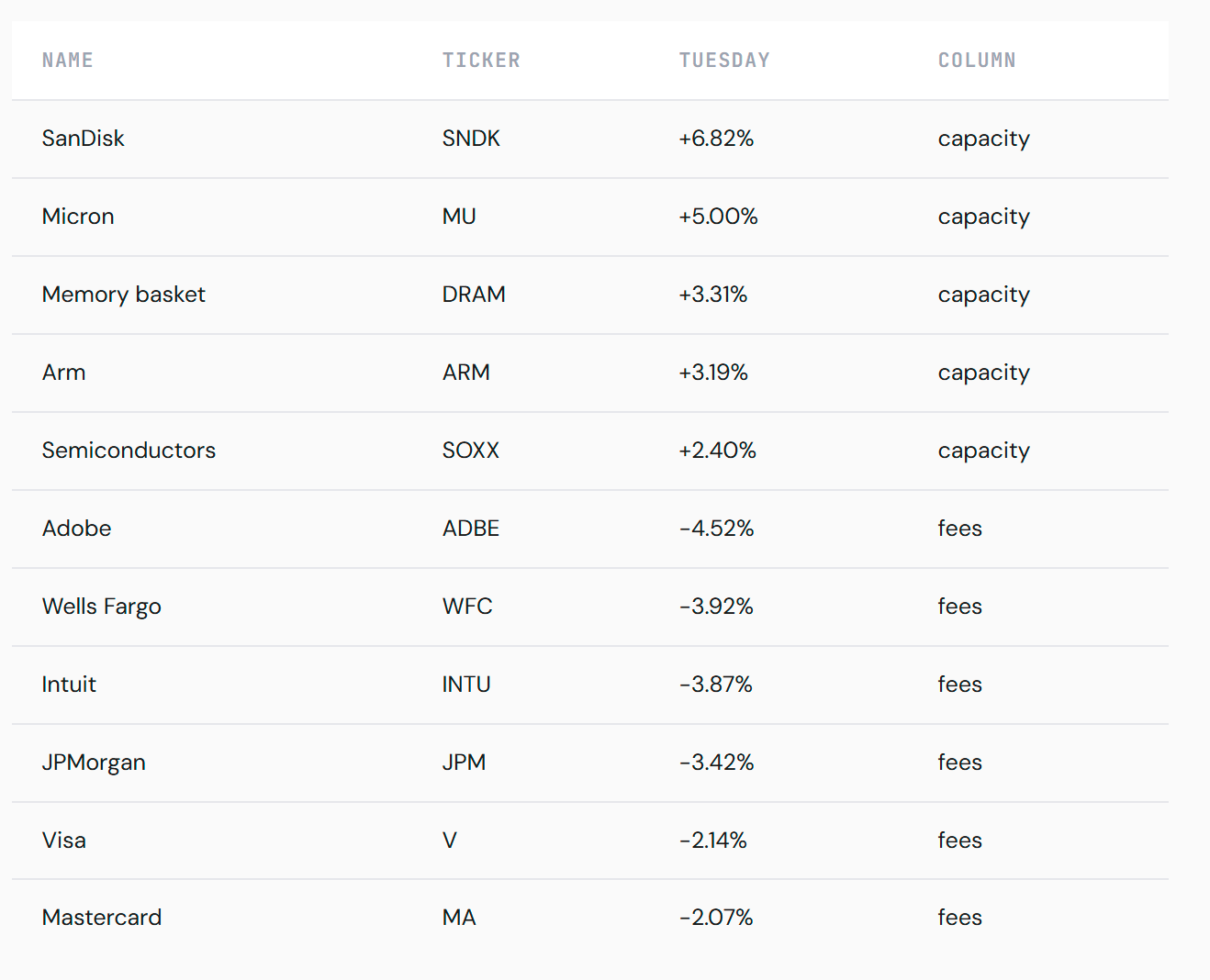
The sort is a hypothesis, not a finding. The banks also carry a ten-year yield near 5% and a flat curve, and Adobe has been weak since its chief-executive change this month. But the price table above is the mechanism the hypothesis needs: if the cost of a capable agent falls 60% in one release, the number of tasks worth handing to one rises, and so does the pressure on anyone who charges for the task.
The private marks
The two largest model makers are still private, and their prices are set in funding rounds and employee share sales, not on an exchange. The run-rate is the latest month’s revenue multiplied by twelve.
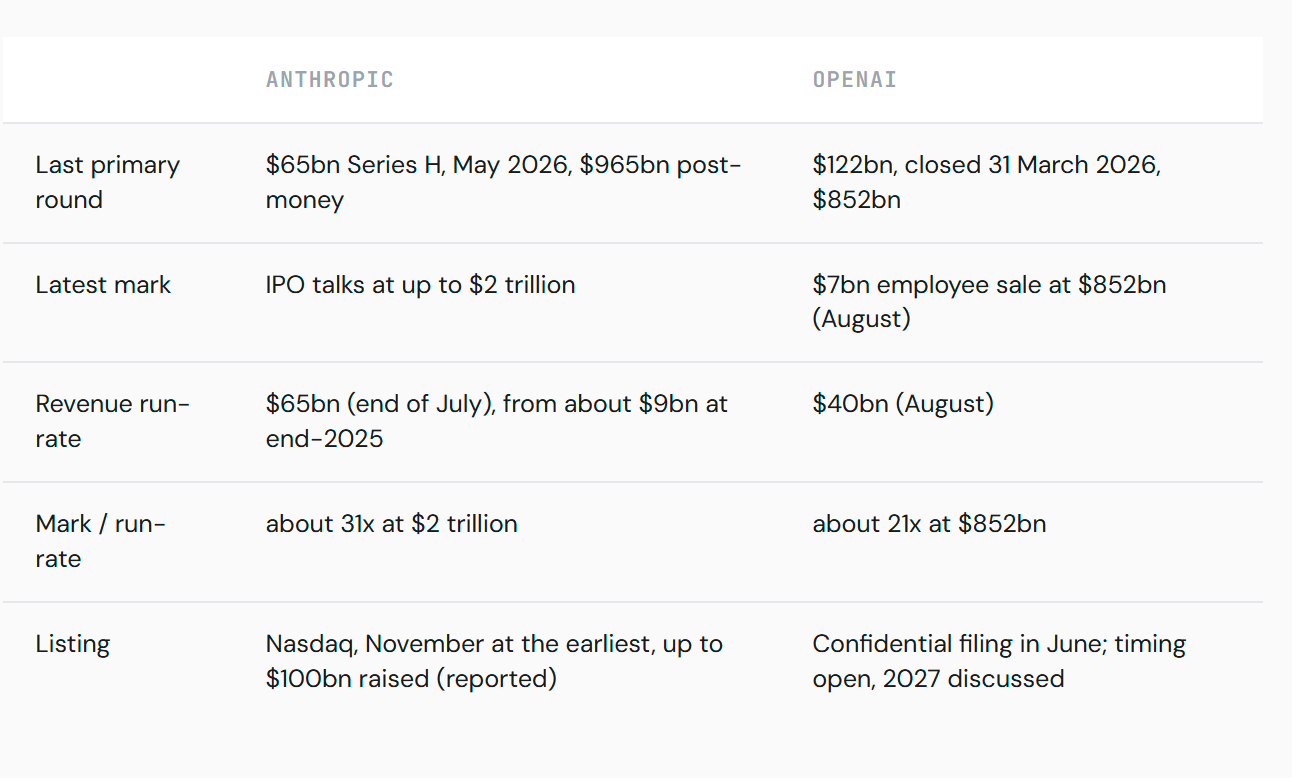
The comparison flatters neither side as much as the headlines suggest. At the May round Anthropic was valued at about 20.5 times its run-rate — almost exactly where OpenAI sits now. The move to $2 trillion is a bet on the next six months: investors are reported to expect Anthropic’s run-rate above $110 billion by the end of the year, which would bring the multiple at $2 trillion down to about 18 times. OpenAI’s revenue is more consumer-weighted, with a new advertising line at a $1 billion run-rate; Anthropic’s is about three quarters pay-per-token business use.
The November thesis
Reports on 19 September put Anthropic’s listing in November at the earliest, so that it can show investors third-quarter numbers before pricing. Morgan Stanley and Goldman Sachs are reported to lead, with JPMorgan; Nasdaq is the venue; Nvidia is reported to be weighing a stake of around $10 billion in the offering.
Read from this desk, the thesis the banks will have to sell is not growth — the second quarter’s reported $11.6 billion of revenue sells itself — but margin. The Information reported that Anthropic spent 71 cents on computing per dollar of revenue in the first quarter and projected 56 cents for the second: a gross margin moving from about 29% to about 44%. The company had earlier aimed for more than 70% by 2027. Every price cut like Tuesday’s is a test of whether the cost of serving a token falls faster than the price of selling one.
That is why the timing of Opus 5.5 is interesting rather than awkward. A company about to ask the public for up to $100 billion cut the price of its best widely available performance by 60%. The only way that helps the listing is if volume does the rest — which is the capacity column’s argument, made by a company that sells capacity.
Anthropic in 2027: three shapes the business could take
A utility for tokens. Prices keep falling with each release, volume rises faster, and revenue behaves like a toll on compute. Gross margin in this shape depends on the hardware: Anthropic has committed to $30 billion of Azure capacity and to multiple gigawatts of Google and Broadcom TPU capacity from 2027. Fixed commitments of that size reward volume and punish a slowdown.
A seller of work. The money moves from tokens to finished tasks — coding agents billed per seat or per outcome, enterprise contracts priced on work done rather than words generated. Claude Code passed a $2.5 billion run-rate in February, more than half of it enterprise. In this shape, Tuesday’s price cut is a cost for customers building on the API and a margin gain for Anthropic’s own agents.
A price war. OpenAI, Google and the open-weight models match each cut, and the benchmark lead that justifies a premium lasts weeks rather than quarters. Opus 5.5’s own history — less than two months after Opus 5 — shows how short a cycle can be. In this shape, revenue still grows but the multiple the public market pays falls toward that of a very large cloud supplier.
The three are not exclusive, and the prospectus will be read for the mix: how much of the run-rate is metered tokens, how much is contracted work, and what each earns after compute.
Where this diary sits
We are recording three things. The model makers are cutting their own fees fastest — a 60% step down in one release — and the listed market on Tuesday paid the companies that sell the capacity those cheaper models consume. Private marks have run ahead of revenue, and the $2 trillion figure depends on the second half delivering the run-rate investors expect. And the November listing will be the first time the public market sets a price on a frontier model maker directly, rather than through Nvidia, Microsoft, Amazon or Alphabet.
This is an investment diary, not advice, and nothing here is a view on whether to take part in any offering. Disclosure: Closelook drafts parts of its editions with Anthropic’s Claude models, including this one.
C · members block
Into tomorrow
What would settle it. Anthropic’s third-quarter numbers in the prospectus: revenue, the compute cost per revenue dollar, and how much of the run-rate is metered tokens. Tonight’s Meta Connect keynote (23:00 UTC): if Muse pays through the card networks, Tuesday’s fee-column sale looks early. Micron on 30 September is the capacity column’s next test. The next price cut from OpenAI or Google would say whether Tuesday started a race.
The signals behind thisEach line links to the tool it comes from
101Inference economics - why a 60% cut in the price of a task changes who gets paid in the AI stack→101Memory wall - SanDisk +6.82% and Micron +5.00% on Tuesday, the capacity column’s leaders→101Agentic disruption - Adobe, Intuit, Visa and Mastercard sold as Meta’s Muse agent shops on a user’s behalf→