


This week the search trade rediscovered it and drew the obvious conclusion: own facts the machine cannot generate, and the machine has to cite you. The tape has been running the same experiment for a year, with real money, and it reached a different verdict. The companies that own the facts are 20–40% below their highs. The two companies that own the answer box are near theirs.

The leak, and what it does and does not say
The attribute is real. In the May 2024 Content Warehouse leak, contentEffort sits in a page-quality module and is described as an “LLM-based effort estimation for article pages”; a separate attribute scores original content. Google’s AI answers are retrieval-based — they assemble from indexed sources rather than generate freely — and Google holds a patent on ranking documents by how much new information they add to what a user has already seen.
Two things in the popular version are not in the documents. The words “originality” and “talent or skill” come from Google’s guidelines for human quality raters, not from fields next to contentEffort in the API. And nothing in the leak says the score gates AI Overviews; the documents predate that product’s rollout and describe attribute names, not weights or whether anything is live.
So the heuristic survives — if a prompt can rebuild your page in ten seconds, the machine has no reason to cite you — but as a heuristic, not a mechanism. The market’s version of the same test is more instructive, because it has prices attached.
Closelooknet on Google
Get our reads first in Top Stories and AI answers. One tap, no account needed here.
The table
Twenty-two listed companies whose business is, in one form or another, owning information. Distance from each one’s 52-week high and year-to-date change, on Monday’s US close and Tuesday morning’s London and Amsterdam prices.
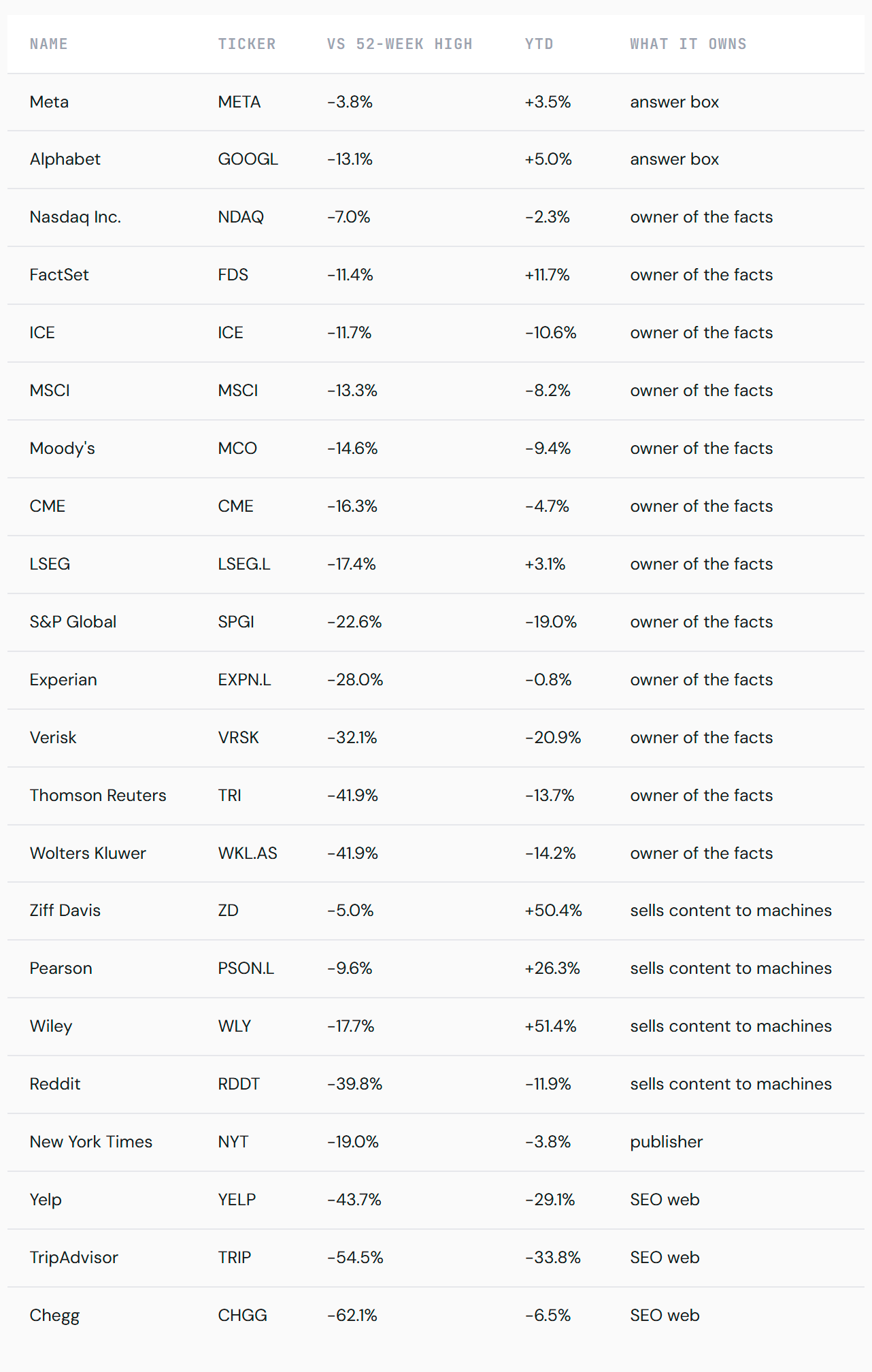
The grouping is ours and it is deliberately blunt. “Owner of the facts” is a company whose product is proprietary data, ratings, benchmarks or exchange records — exactly the kind of content a language model cannot manufacture. “SEO web” is a company whose traffic came from ranking in Google for questions a model can now answer directly. “Sells content to machines” is a company with a disclosed AI licensing line.
The owners of the facts are the ones being sold
S&P Global is 22.6% below its 52-week high and 19.0% lower on the year. Verisk is 32.1% below. Thomson Reuters and Wolters Kluwer are each 41.9% below. Moody’s is 14.6% below, MSCI 13.3%, FactSet 11.4%. The exchanges — ICE, CME, Nasdaq, LSEG — sit 7% to 17% under their highs.
The trigger for the latest leg is on the record. S&P Global guided 2026 earnings per share to $19.40–$19.65 against a $19.96 consensus, and the shares fell to their lowest in more than two years; Moody’s fell 6.8% the same day and Verisk nearly 5% on nothing of their own. Reporting tied the sector’s slide to fear that frontier models marketed for financial research make the data layer cheaper to obtain elsewhere, and FactSet made multi-year lows on the same argument.
Notice what the market is and is not pricing. Nobody thinks a language model can issue a credit rating or own the S&P 500 benchmark. The fear is narrower and sharper: that the terminal — the aggregation, the screens, the analytics wrapped around the facts — can be rebuilt by a model with an API key. The facts are proprietary. The presentation of them is not, and the presentation is where much of the margin lived.
The SEO web is the case the leak predicted
Chegg is the cleanest specimen. It sued Google on 24 February 2025, arguing that publishers cannot stay visible in search without feeding AI Overviews that answer the same questions for free. Its non-subscriber traffic fell 49% between January 2024 and January 2025; it cut 22% of staff in May 2025 and 45% of what remained in October, and it has been exploring alternatives to staying public.
The stock is $0.72, 62.1% below a 52-week high of $1.90. TripAdvisor is 54.5% below its high, Yelp 43.7%. These are businesses whose content a model can reconstruct — a homework answer, a hotel summary, a restaurant consensus — and the tape has treated them exactly the way the leak’s logic says it should.
Getting paid is not the same as getting re-rated
Reddit is the company that did what the SEO crowd now recommends: it owns conversation a model cannot fabricate, and it charges for it. Google pays about $60 million a year under a February 2024 licence; OpenAI pays roughly $70 million more; both come up for renewal this year, and Wells Fargo has argued the combined figure could reach around $550 million. Reddit is also reported to be weighing whether to renew with Google at all, because AI Overviews have cut the referrals it gets in return.
The stock is 39.8% below its 52-week high and 11.9% lower on the year, despite a 5.2% gain this month. Wiley is the other clean case: $49 million of AI licensing revenue in the year to April, lifetime AI revenue above $110 million, net income up 163% on flat revenue. The stock is up 51.4% year-to-date — and still 17.7% below its high. Ziff Davis is up 50.4% on the year, Pearson 26.3%.
The pattern across the four is consistent. The market pays for AI licensing when it appears as a line in the accounts. It does not pay for “information gain” as a concept, and it will not pay a company for being cited if the citation does not come with a cheque or a customer.
What is obvious is obviously wrong
The obvious read of the leak is a two-step: own facts the machine cannot generate, get cited, win. The tape says the chain has three links, not two, and most of the table is missing at least one.
The machine has to need your content. It has to be unable to route around you — to rebuild your product from the facts it already has. And you have to own either the distribution or the licence, so that being needed converts into being paid. The owners of the facts have the first link and are being repriced on doubts about the second. The SEO web never had the second. Reddit and Wiley have all three and are still well below their highs, because the cheques are small next to the traffic that left.
Only two companies in the table hold every link, and they are the two that own the answer box. Meta is 3.8% below its 52-week high after rising 11.3% this month on an agent that reached the top of the App Store — the day the Nasdaq made its first record close since June. Alphabet is 13.1% below its high and 5.0% higher on the year. Everyone else is being priced on which link they lack.
Where this diary sits
We run the same test on ourselves. Every page here either carries a number that exists because we computed it — a layer spread inside the Rubin index, a dispersion reading from the board, a print-record card, a tracking difference from our own data lake — or it is a page a prompt could rebuild, and we know which is which. The leak did not change that discipline. The table above is a reminder of what it is worth and what it is not: being uncopyable is the entry ticket, not the prize.
Investment diary, not advice. Closelook Venture GmbH is not a licensed investment adviser. Prices are Monday’s US closes and Tuesday morning’s European prices; 52-week highs from the exchange record. Company figures as reported; the S&P Global, Chegg, Reddit and Wiley details are from published guidance, filings and dated reporting.
C · members block
Into tomorrow
What would settle it. The data owners’ next prints, not the leak: S&P Global, Moody’s, MSCI and FactSet either show the terminal margin holding or they do not, and the 20–40% gap to their highs is the market’s bet that it does not. Reddit’s Google renewal is the cleanest live test of what a citation is worth in cash — a walk-away would say the referrals matter more than the $60 million. Meta Connect opens Wednesday: if Muse ships on hardware, the answer-box thesis gets its second product; if it stays an app-store week, the 11.3% month is a rumour re-rated. The house test stays the same — could a prompt rebuild this page in ten seconds — and the table is what the market pays for passing it: entry, not prize.
The signals behind thisEach line links to the tool it comes from
IndicesRubin 100 +2.66% Monday and +7.79% on the week — the hardware layer the AI bid is tested on, and 11–15% of room in the chip funds behind it→SignalsBoard A: breadth clean at 69% above the 50-day, dispersion fired at 23.89% against a 19.61% floor — the record was made by a handful→LabMoney Temperature composite 63 on Monday’s closes — the warm side of neutral, not a signal by construction→