


This week the price followed. The builder index fell 3.4% with four of its 36 sub-indices green; the applications index rose 4.9% with all nine green; the runner between them closed at a record. Security, observability and data software led, Schneider Electric bought PTC at a 42% premium, and a report on OpenAI’s revenue sent the chip names down. Five winners and five losers of the week, the supply gauges cooling, and ASML and TSMC on Wednesday and Thursday with a new question — not how much was sold this year, but how much will be spent next year.

1 · This Week’s Action
The week in one line: the flow came true. A week ago the house Directional Flow score — which measures whether each stock’s trend is gaining or losing force — said the builders were rising on tired legs (110 of 126 members of the builder index losing strength) and the applications were turning while they fell (33 of 40 getting stronger). This week the price did what the flow said. Capex (Rubin Build-Out) −3.44% to 2,094.58; opex (Agentic Ecosystem) +2.76% to a record 1,786.36; applications (Agentic Winners 40) +4.91% to 942.64. The builder had four of 36 sub-indices green; the applications index had all nine.
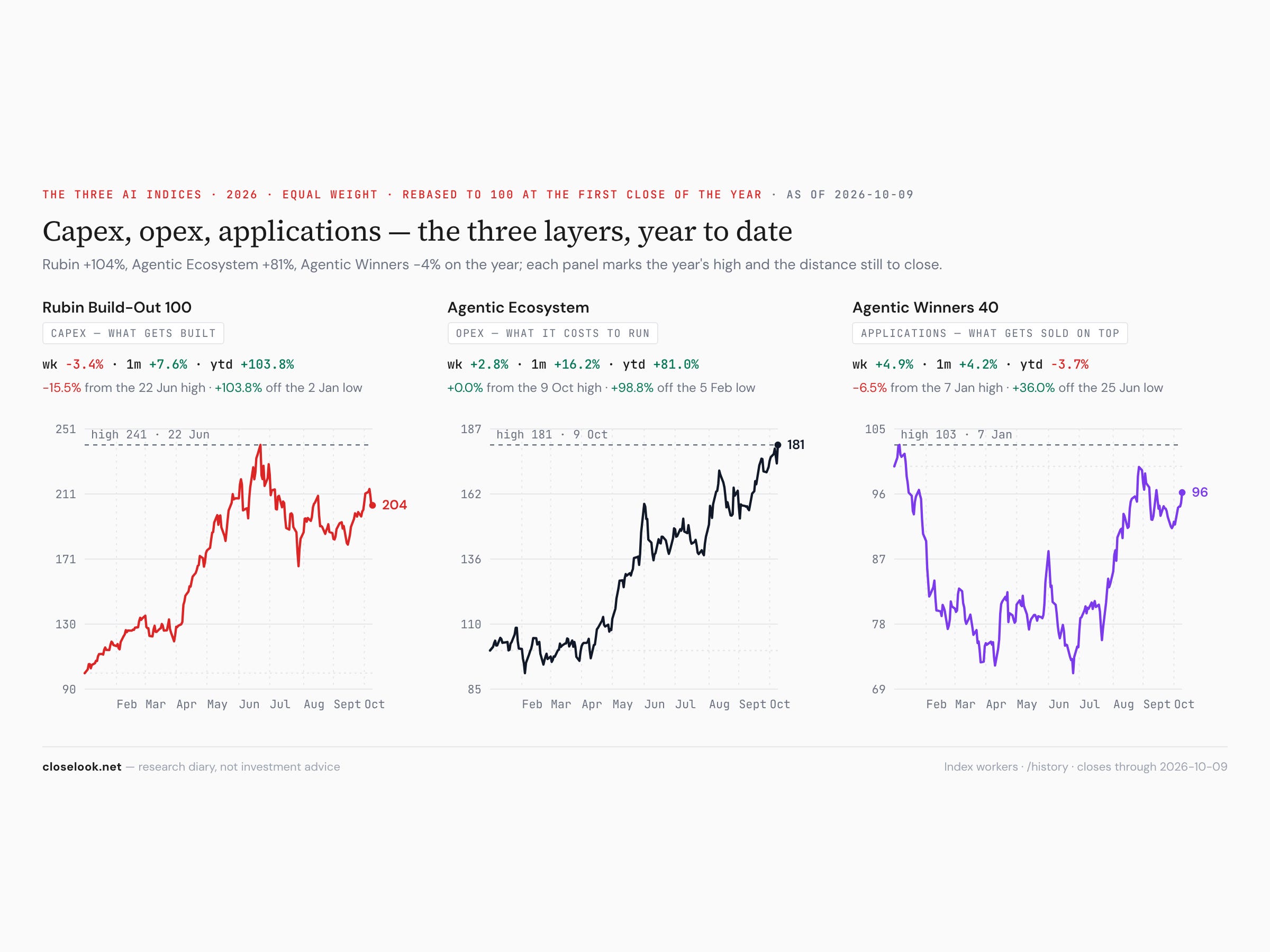
What moved it. Two things, one on each side. On Thursday a report put OpenAI’s annual revenue nearer 50 billion dollars than 70 billion, and the market asked whether AI’s biggest buyer earns enough to keep buying: the chip index fell 3.4% that day, Broadcom 4.4%, Micron 4.8%, CoreWeave 7.8%. On the other side the software that runs, watches and secures AI was bought all week — and on Monday Schneider Electric agreed to buy PTC, the industrial design software maker, for 205 dollars a share in cash, a 42% premium and 22.6 billion dollars, the clearest price tag this year on a software company the market had marked down as an AI loser.
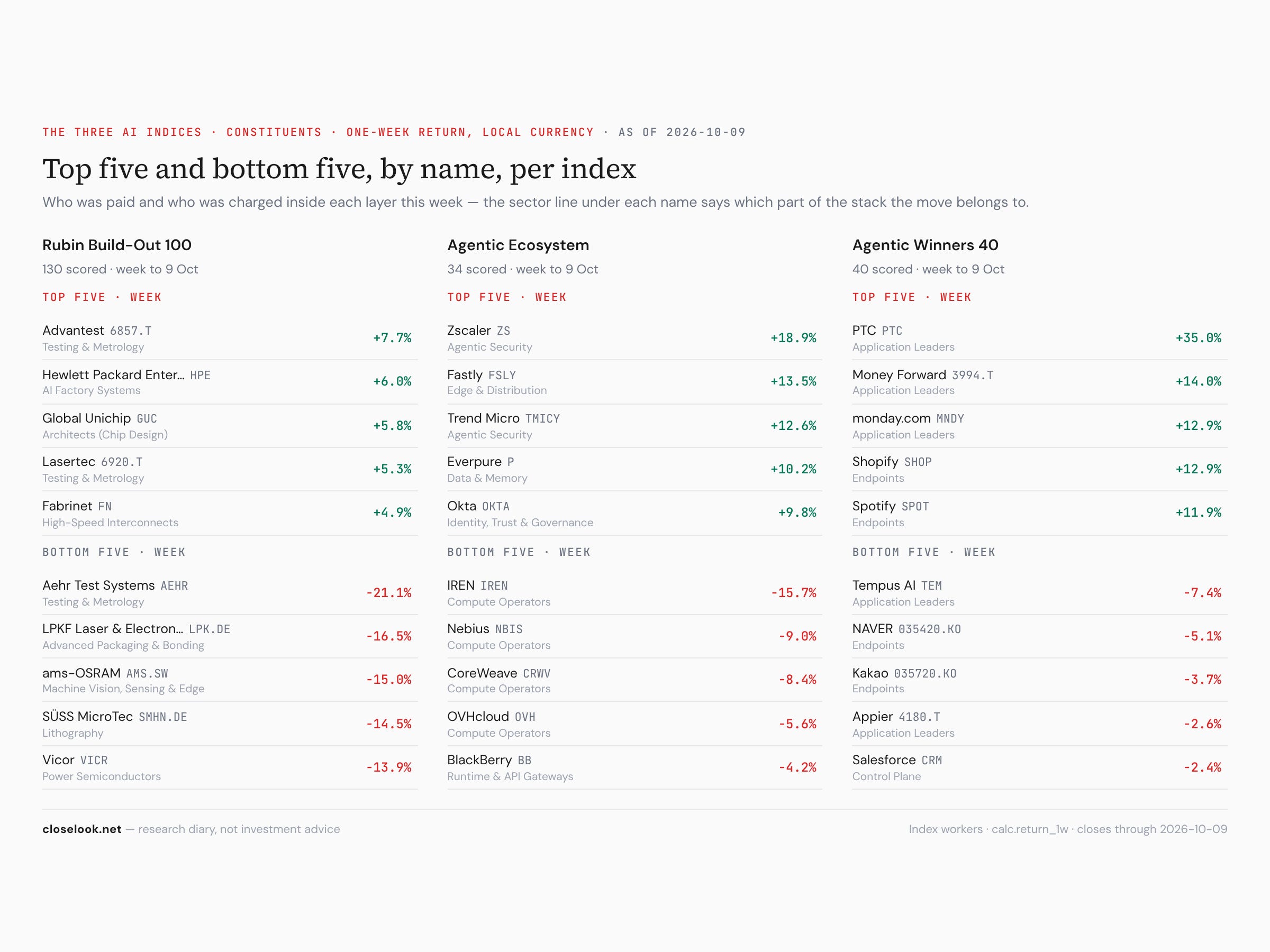
The ten best of the week, across all three indices — security, data and software. PTC +35.0%, Zscaler +18.9%, Money Forward +14.0%, Fastly +13.5%, monday.com +12.9%, Shopify +12.8%, Trend Micro +12.6%, Spotify +11.9%, MercadoLibre +11.4%, Palantir +10.8%. Three security companies (Zscaler, Trend Micro, with Fastly’s edge network), three software platforms (PTC, monday.com, Money Forward), three consumer and commerce platforms (Shopify, Spotify, MercadoLibre) and Palantir. Not one makes or builds the physical layer of AI.
The ten worst — the tools, the power and the neoclouds. Aehr Test Systems −21.1%, LPKF Laser −16.5%, IREN −15.7%, ams-OSRAM −15.0%, SÜSS MicroTec −14.5%, Vicor −13.9%, Arm −13.4%, BE Semiconductor −12.4%, Amkor −12.3%, Intel −12.3%. Test, laser and bonding tools (Aehr, LPKF, SÜSS, BESI), packaging (Amkor), power delivery (Vicor, sold with the power and cooling suppliers on Wednesday), a GPU renter (IREN) and two chip designers (Arm, Intel). Last week’s winners list — the testers, the packagers and the optics — is this week’s losers list, almost name for name: LPKF and ams-OSRAM were on both.
2 · The Three Functional Indices — index, sectors, stocks
We read the three together because they are three stages of one spend: capex (what gets built), opex (what it costs to run), applications (what gets sold on top). HALO, the growth index with no AI thesis, is the control.
Rubin Build-Out — capex
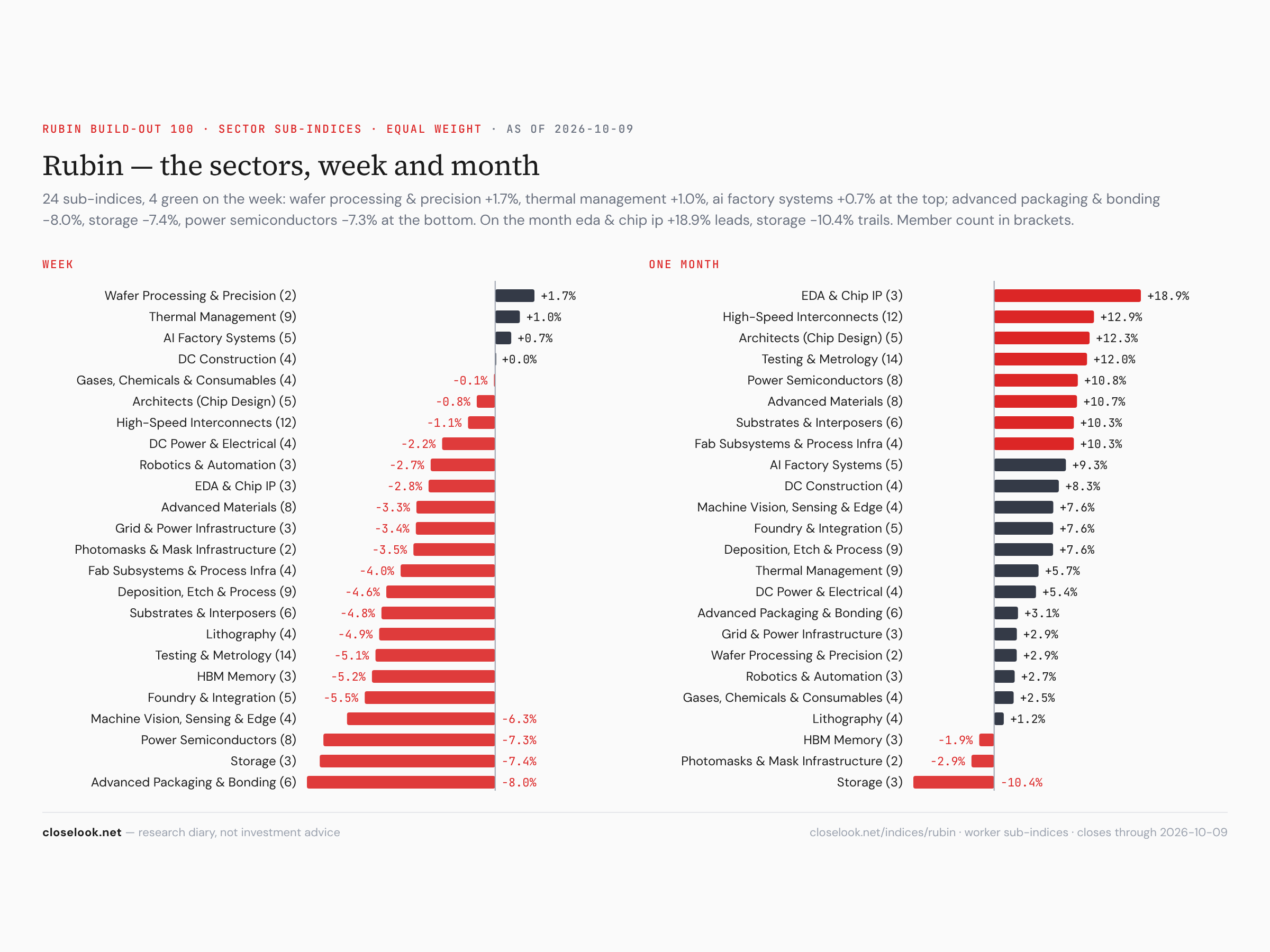
−3.44% to 2,094.58: 2,180.40, 2,198.00, 2,147.89, 2,087.49, 2,094.58 — two up days, then 5.0% lost on Wednesday and Thursday. 41 of 130 members rose, the median member −2.99%. 15.5% under the June 22 high, 22.7% above the July 29 low, +103.8% on the year. Four of 36 sub-indices green: wafer processing +1.7%, thermal management +1.0%, AI factory systems +0.7%, data-centre construction flat. The worst: advanced packaging and bonding −8.0%, Europe’s constituents −7.8%, storage −7.4%, power semiconductors −7.3%, machine vision −6.3%. Over the month the design layer still leads: EDA and chip IP +18.9%, the design layer +14.7%, high-speed interconnects +12.9%, the chip architects +12.3%.
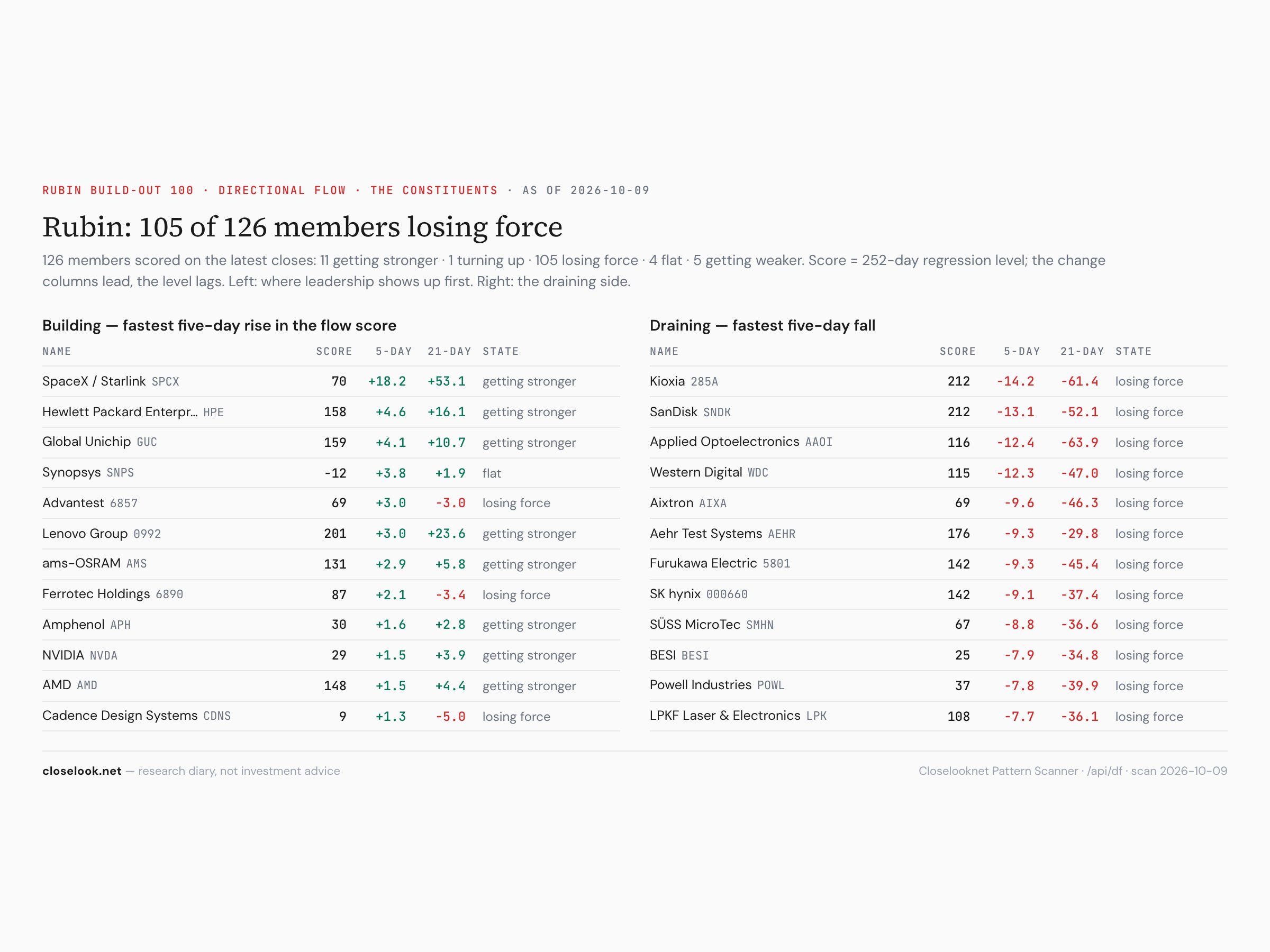
The flow — 12 stronger, 110 weaker. Average 68.2, down 2.9 points in five sessions and 17.3 in twenty-one, the trend falling. Last week the flow was the warning; this week the price agreed with it. The flow has not turned yet — the builders are still losing force, now with a falling price.
Agentic Ecosystem — opex
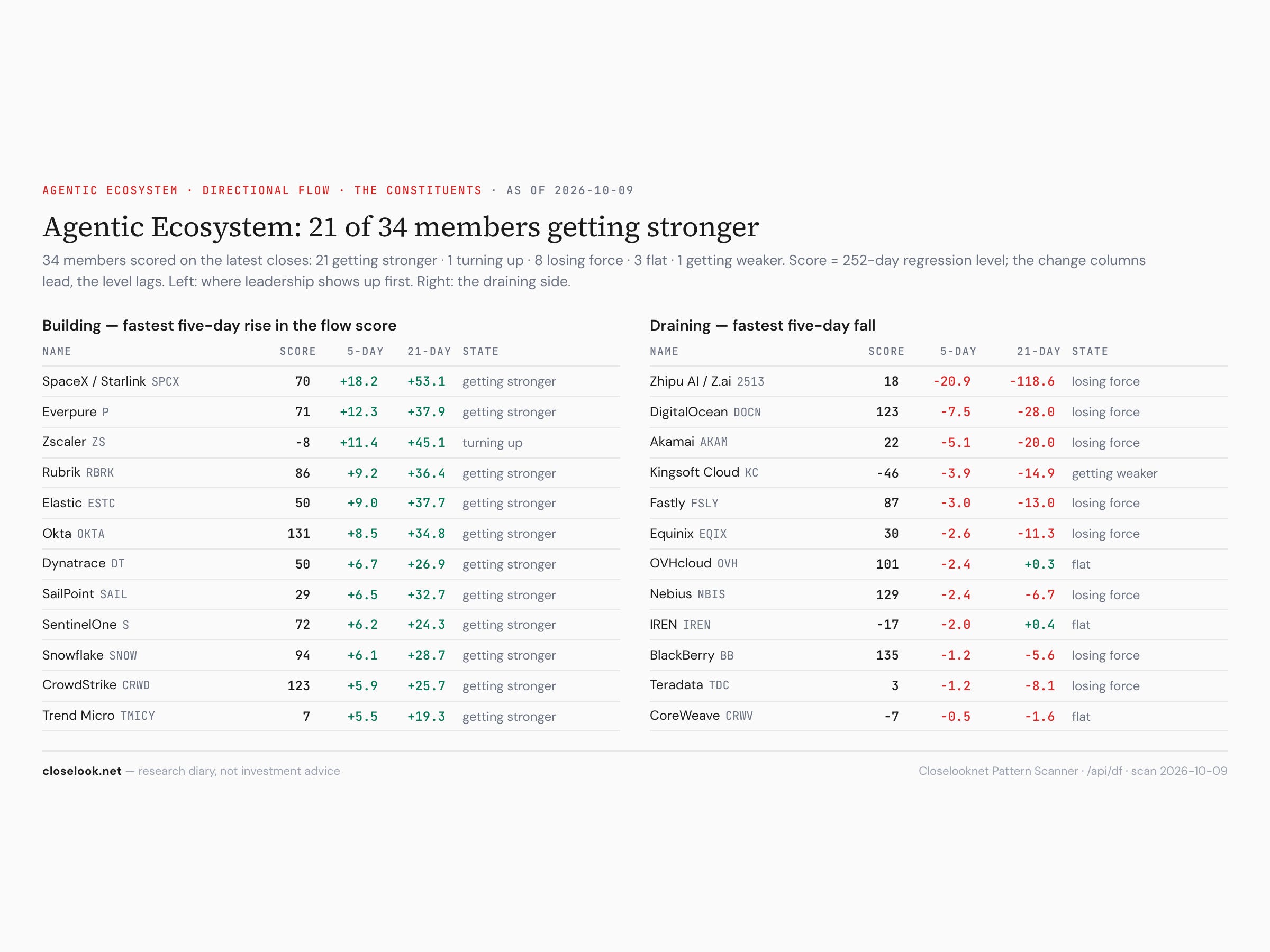
+2.76% to a record 1,786.36, +81.0% on the year, 24 of 34 members up, the median +3.40%, +4.2% on Friday alone. Ten of fourteen sub-indices green: agentic security +7.0%, govern and secure +6.7%, operations and observability +6.6%, data and memory +6.2%, identity and trust +5.7%. The red four: Europe’s constituents −7.5%, compute operators −6.8%, runtime and API gateways −3.2%, substrate −1.8%. The index split along the line the market drew everywhere this week: the software layers rose, the compute operators who rent out GPUs fell with the builders.
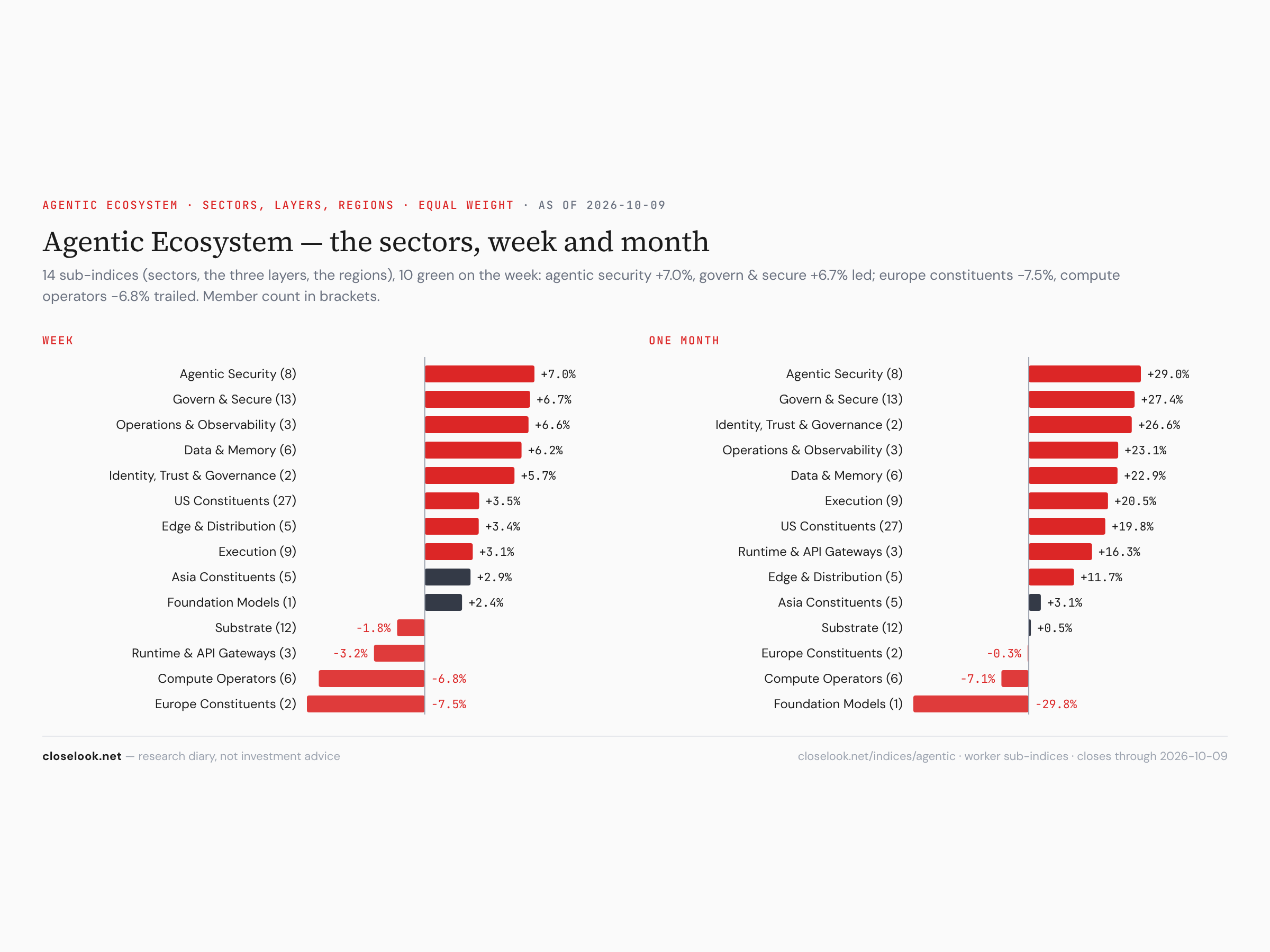
The flow — 22 stronger, 9 weaker. Average 63.9, up 2.5 in five sessions and 9.1 in twenty-one, trend rising. The runner’s price and flow agree for a second week.
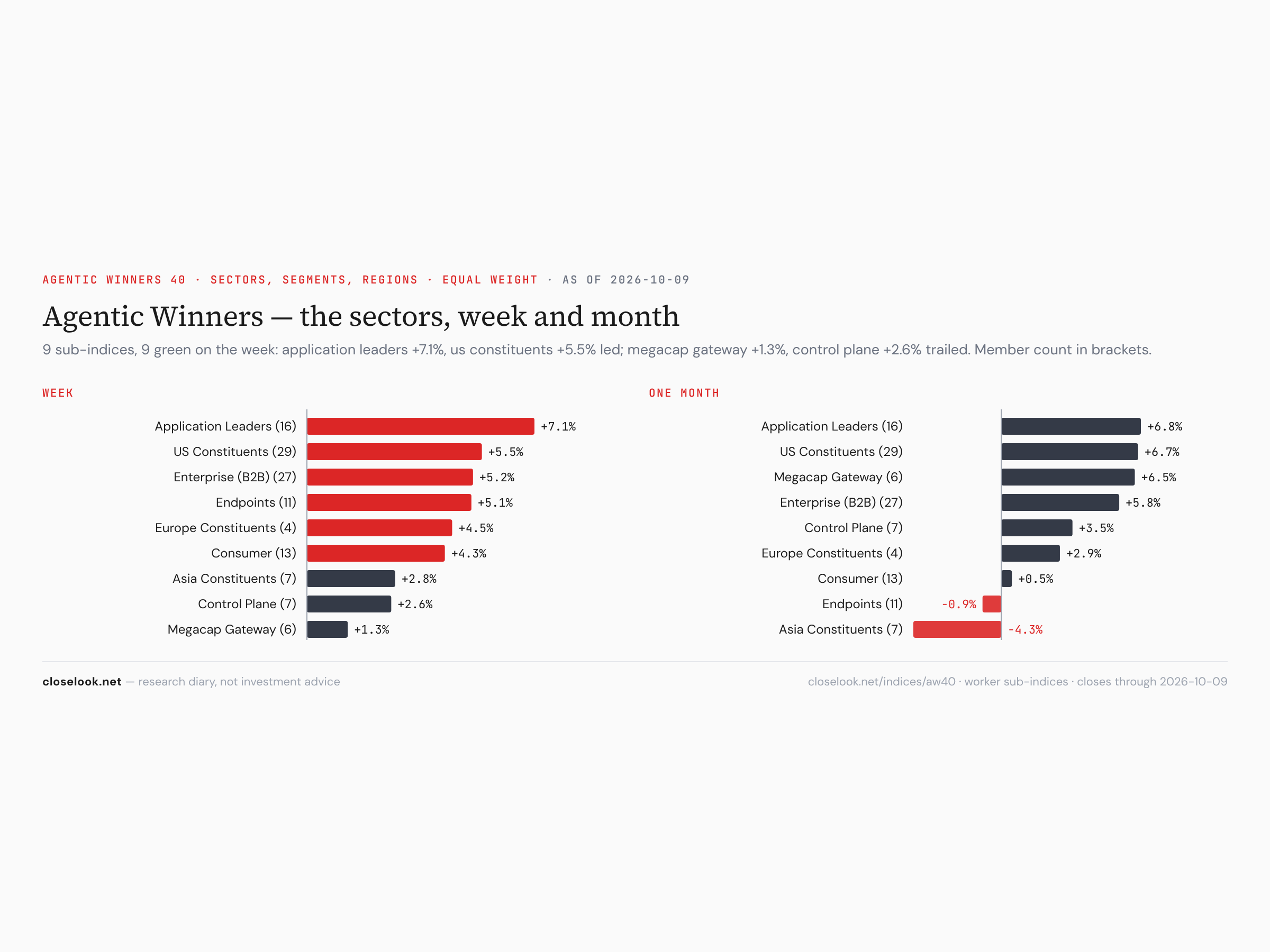
Agentic Winners 40 — applications
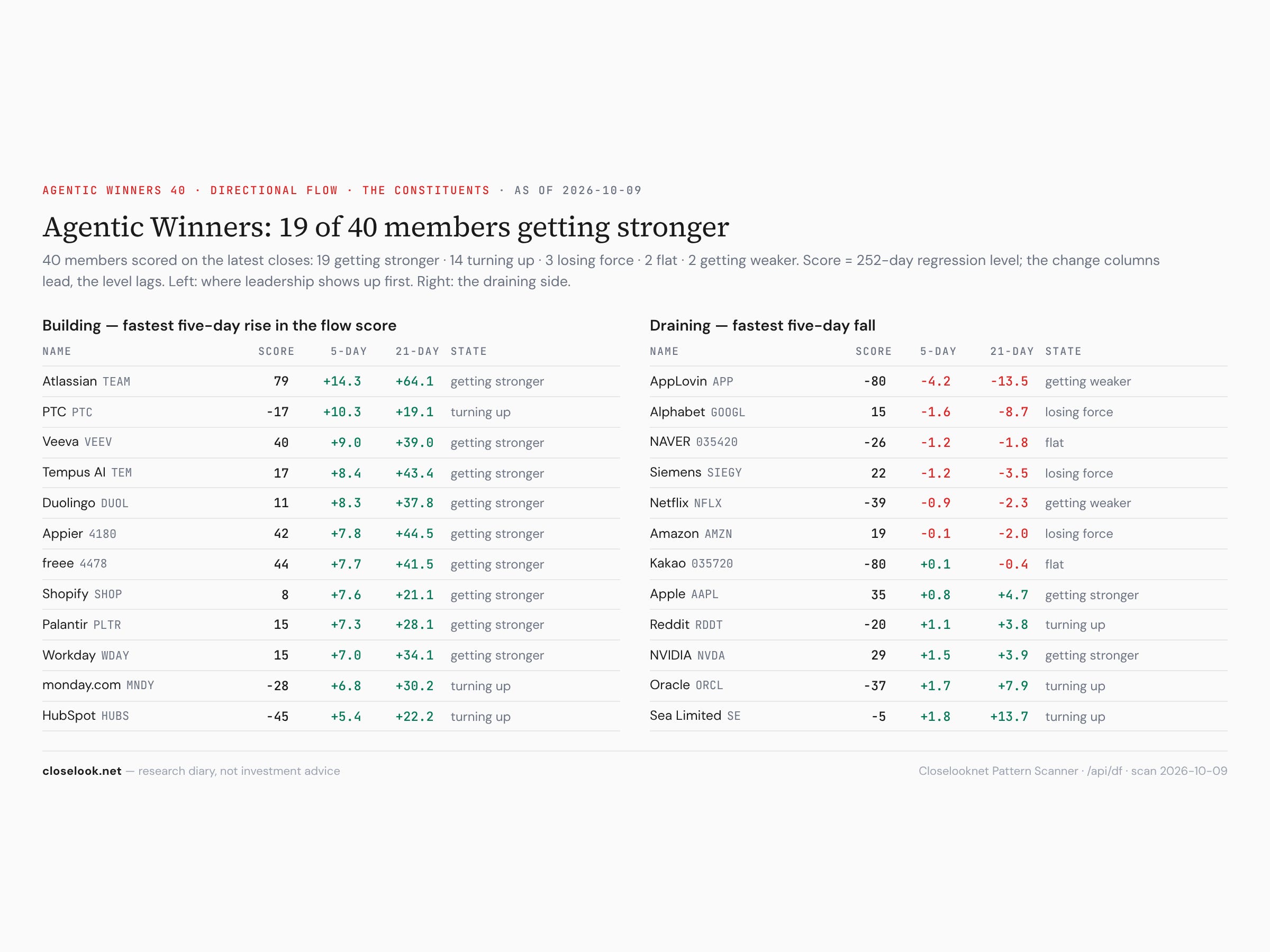
+4.91% to 942.64, up every day of the week, −3.7% on the year, 6.5% under its January high and 36.0% above its June low. 31 of 40 members up, the median +4.34%. All nine sub-indices green: application leaders +7.1%, US constituents +5.5%, enterprise +5.2%, endpoints +5.1%, Europe’s constituents +4.5%, consumer +4.3%, Asia’s +2.8%, the control plane +2.6%, the megacap gateway +1.3%. Last week one sub-index of nine rose.
The flow — 33 stronger, 5 weaker. Average −2.0, up 3.9 in five sessions and 16.9 in twenty-one, trend rising. Still just under zero — the trends are not yet pointing up — but up 16.9 points in a month. Last week this letter wrote that the group had stopped being sold before it started being bought. This week it was bought.
The control group. HALO slipped 0.23%, 52 of 100 members up. §5 has the detail.
3 · The AI Board — the stack, instrument by instrument
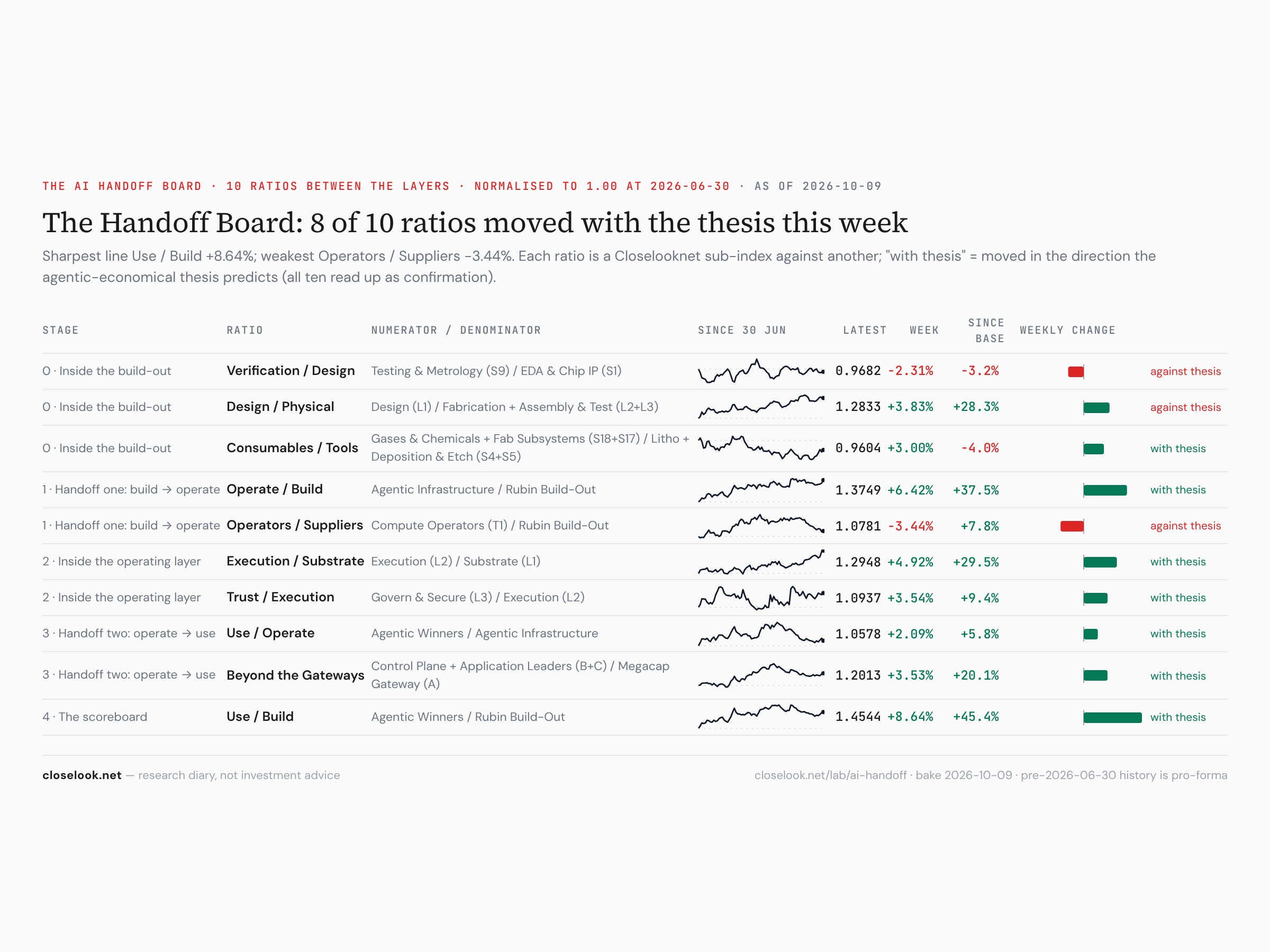
The Handoff Board — the handoff resumed. The house AI Handoff Board tracks the money moving from one layer of the stack to the next. Last week the money went back down the stack. This week it moved up: operate over build +6.42%, execution over substrate +4.92%, design over physical +3.83%, trust over execution +3.54%, consumables over tools +3.00%. Against the thesis: operators over suppliers −3.44% — the neoclouds fell harder than the chips they rent — and verification over design −2.31%, the testers giving back last week’s lead.
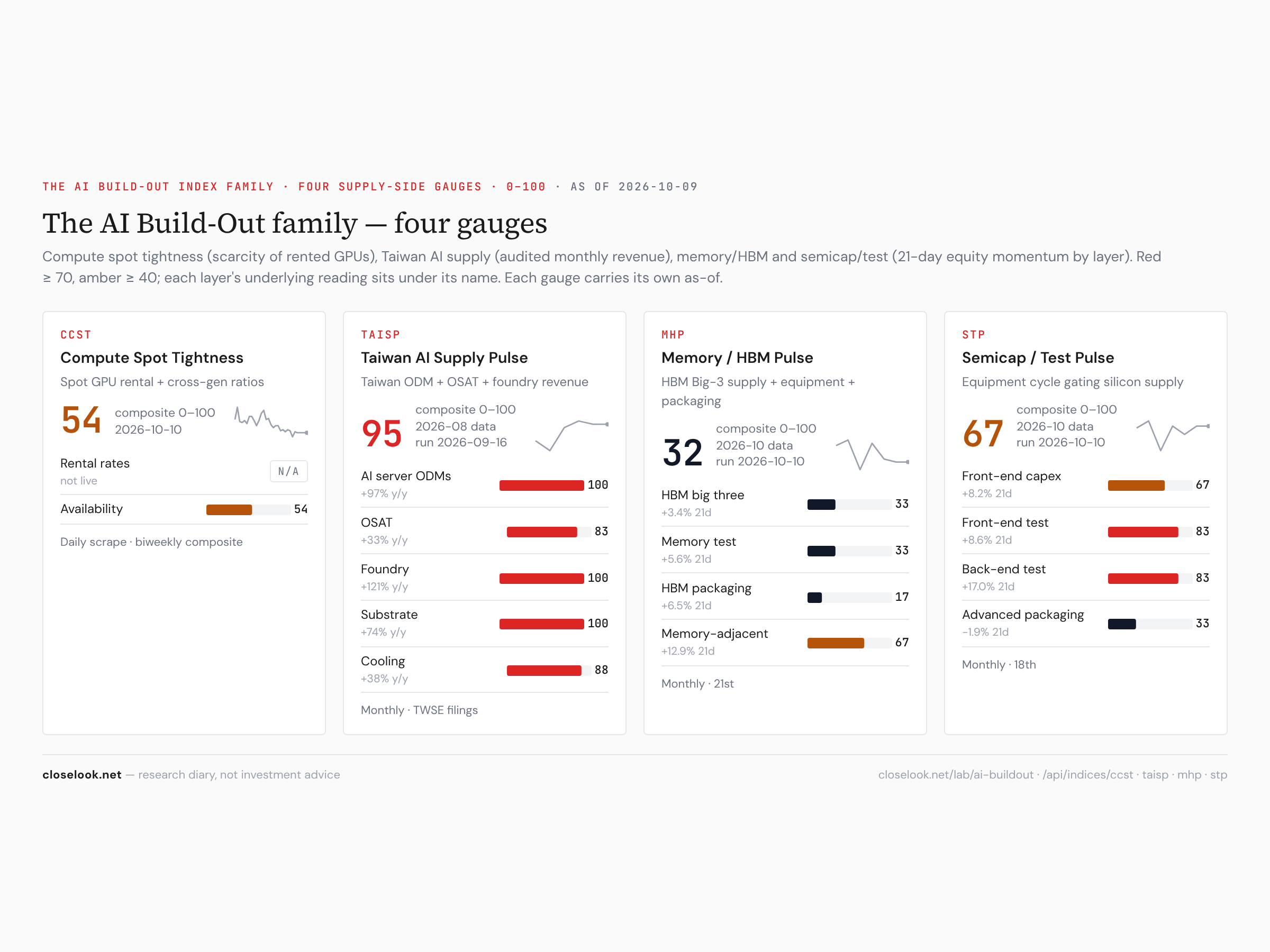
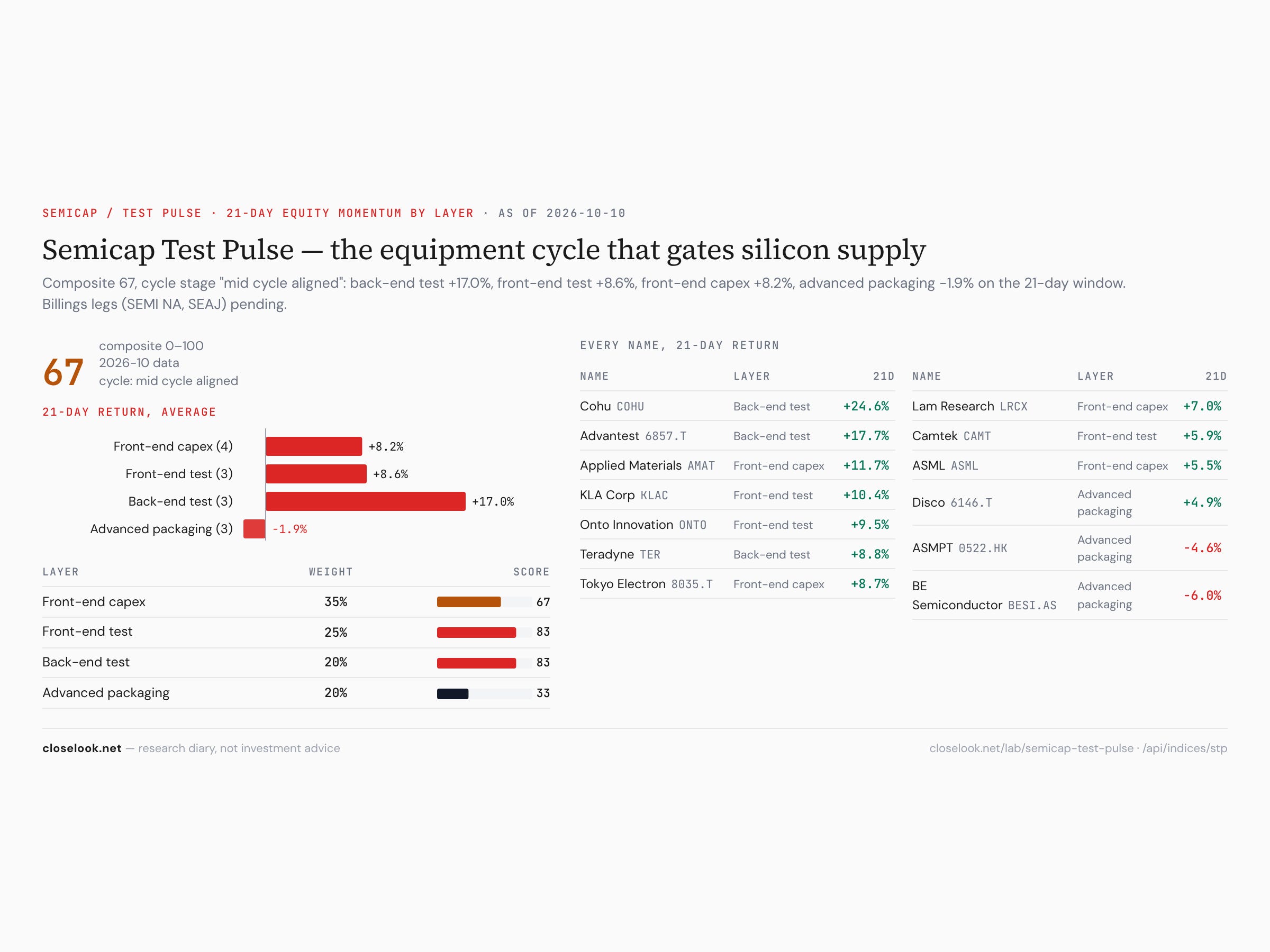
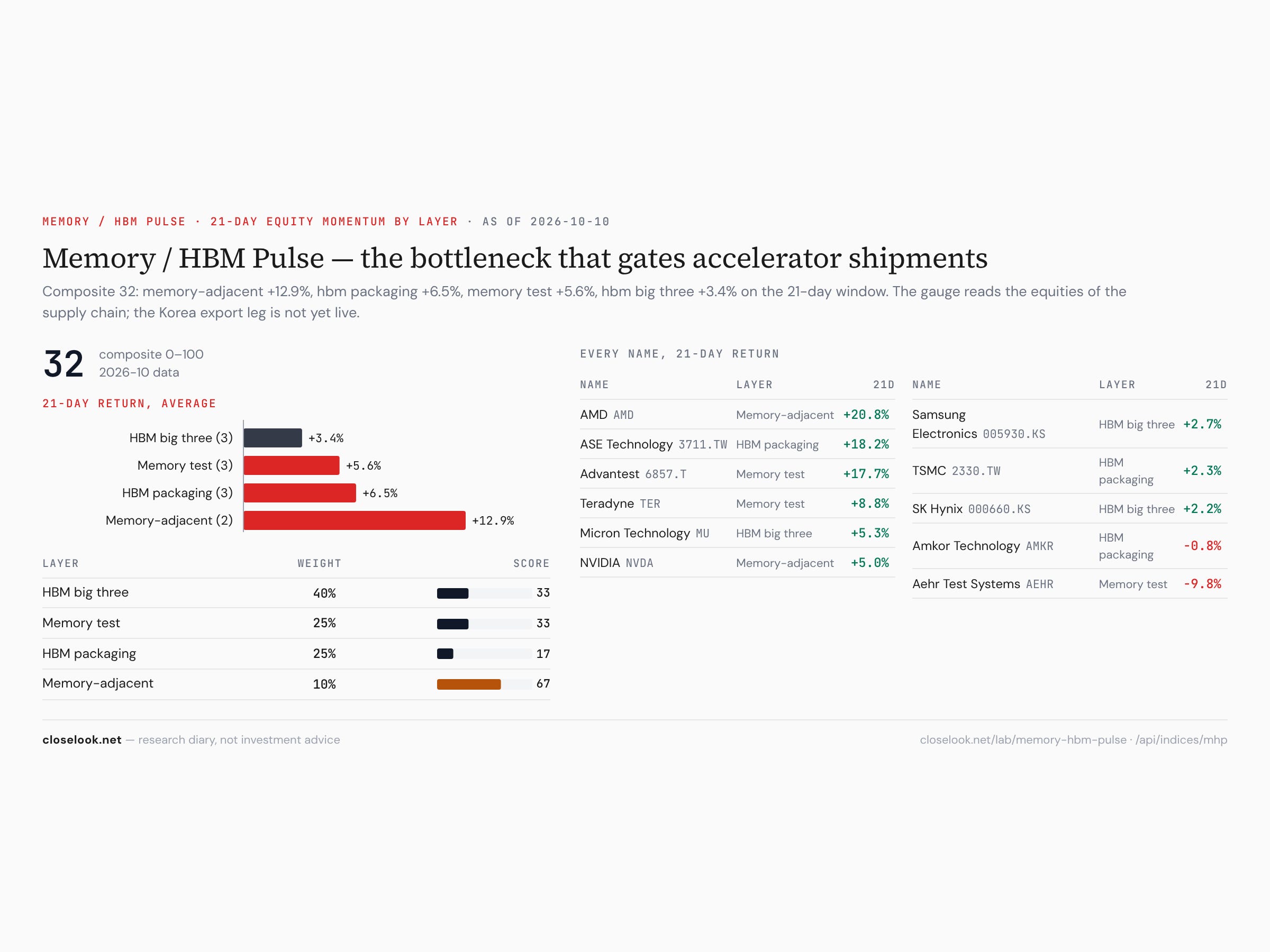
The supply gauges — cooling from the top. The four supply-side gauges of the AI Build-Out family: the Semicap / Test Pulse at 67, from 84 a week ago; the Memory / HBM Pulse at 32, from 55; compute spot tightness at 54, from 57; the Taiwan AI Supply Pulse at 95, unchanged. Three of four lower, the memory gauge most. The family composite reads 62. The gauges read prices and momentum, so they follow the stocks; what they add is the order — the equipment and memory trade cooled first, Taiwan’s filed revenue has not.
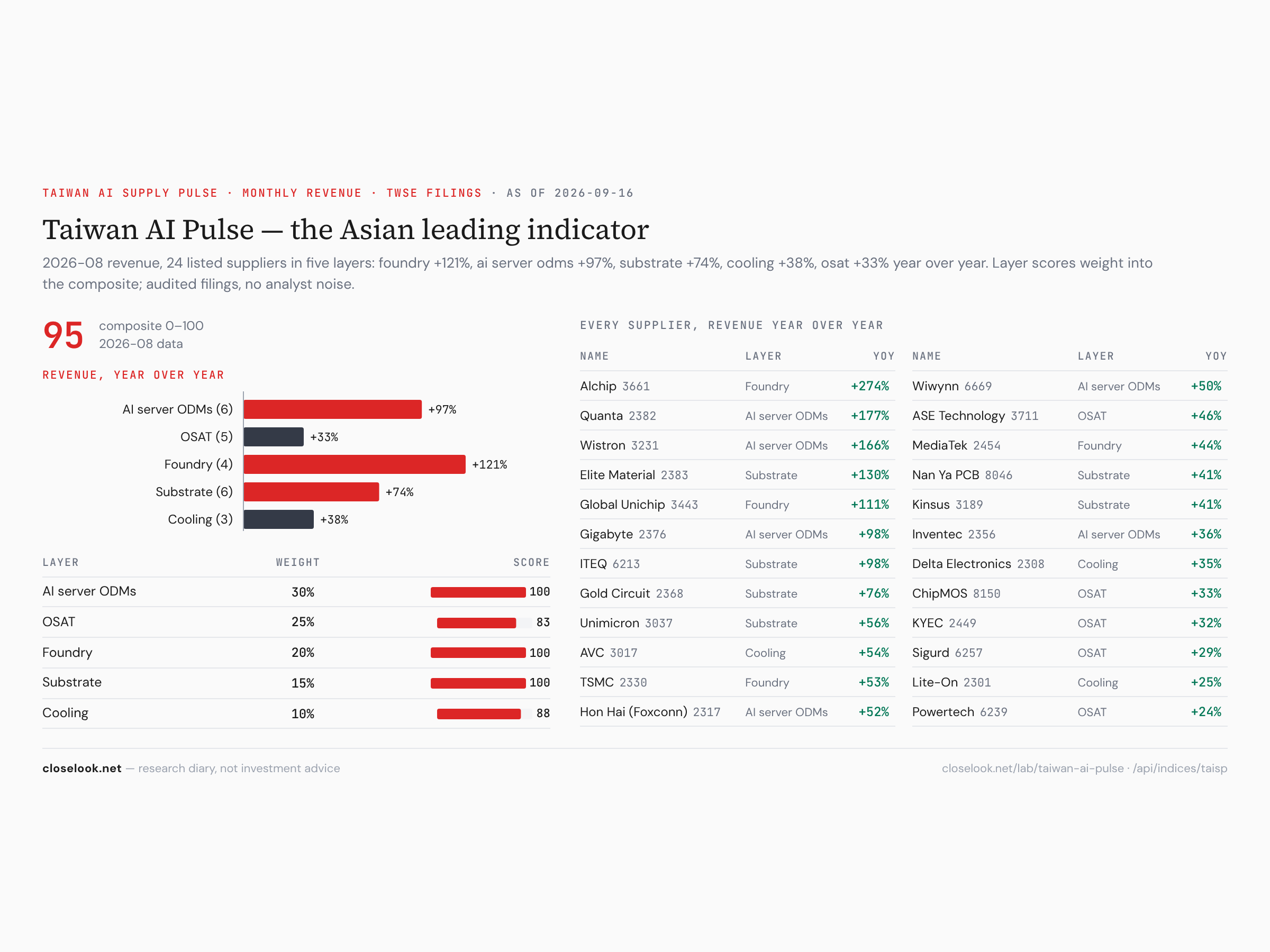
Taiwan — the number came, and it was strong. TSMC’s September sales: 511.9 billion Taiwan dollars, +54.6% on the year, −0.6% on August; the third quarter +51%. The Taiwan pulse stays at 95. The number confirms that the build-out was paid for in the third quarter. The market sold the chips anyway, because Thursday’s question was about next year.
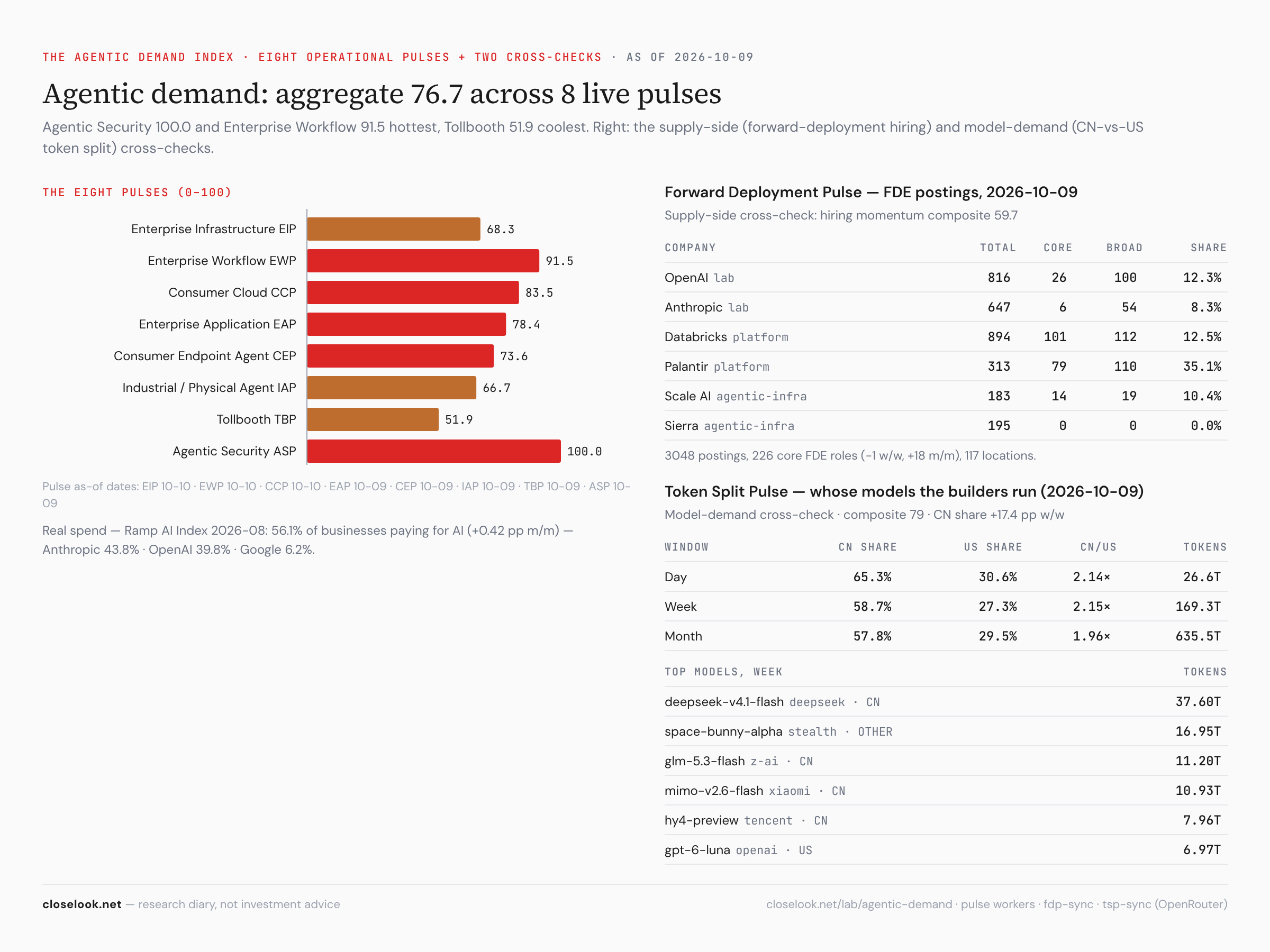
The demand side — the software pulses lit up. The house Agentic Demand pulses read what companies say about AI demand on their earnings calls. After this week’s refresh of the transcript cache, the Enterprise Workflow Pulse reads 91.5 with all six modules live — ServiceNow and Datadog now among the live modules — and the Enterprise Infrastructure Pulse 68.3 with five of six, Broadcom, Marvell and Arista on the networking module at 92 to 98. The companies selling AI into the enterprise are describing demand at the top of the scale.
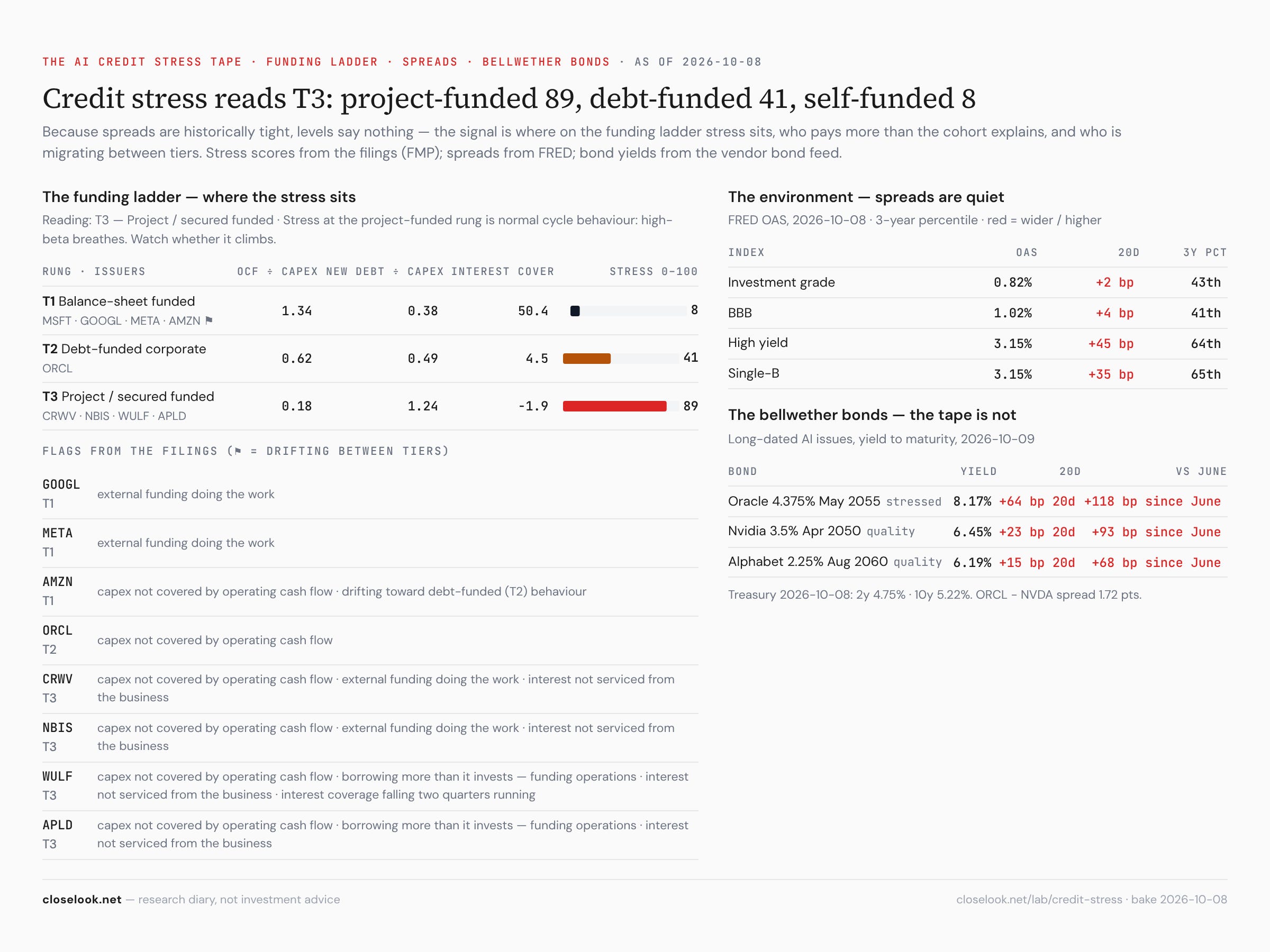
The credit tape. The house AI Credit Stress tape reads the funding behind the build-out. Oracle fell 0.6% on the week despite a strong Friday; CoreWeave −8.4%, IREN −15.7%. The neoclouds are where a funding question would show first, and this week they led the losers.
4 · The Outlook
The fourth quarter — the handoff, earlier than expected. This letter’s frame, shared with the Global and US letters: the fourth quarter is the strongest stretch of the calendar and this letter expects it to be positive for the AI trade. Last week it wrote that the flow said the money was closer to moving from the builders to the users than the price showed. This week the move started. If it continues, the fourth quarter’s leg is the one where the sellers of AI catch up with the builders — the applications index is still down for the year while the builder has doubled.
