


Much of the gap is accounting: OpenAI counts only the revenue it keeps and leaves out sales through cloud partners, while Anthropic includes them. However one explains it, it matters. The whole AI build-out is priced on the belief that the buyers at the end of the chain earn enough to pay for the chips, the data centres and the power — and the biggest buyer turned out to earn less than assumed.

The market answered precisely. The chip index fell 3.4%, Broadcom 4.4%, Micron 4.8%, Oracle 5.5%, the data-centre builders CoreWeave 7.8% and Nebius 7.4%, the power suppliers Vicor 7.2% and Vistra 6.4%. The software that uses AI went the other way: Atlassian +4.0%, Adobe +3.6%, Snowflake +3.2%, the cloud-software fund WCLD +1.5%. That pattern is the thesis this diary has followed since spring.
Closelooknet on Google
Get our reads first in Top Stories and AI answers. One tap, no account needed here.
The thesis: capex first, then opex, then applications
In February our report on agentic infrastructure software drew the line: hardware is a one-time, capex-heavy purchase with cyclical risk — a chip is bought once and depreciates — while the software that runs agents is operating spend, usage-based, and compounds with adoption. On 30 June the Daily Pulse The Opex Handover called the turn: the AI trade was not running out of air, it was relocating from the capex layer to the layer that gets paid when the chips are actually used. The wikifolio AI Cycle 2030 is built on the same three overlapping phases: AI capex and physical bottlenecks, AI opex revenues, AI applications.
We track the chain with three of our own equal-weight indices: Rubin Build-Out for the builders, Agentic Infrastructure for the operating layer, Agentic Winners 40 for the companies that use AI in their products. The AI Handoff Board measures the money moving between them every day.
The confirmation: price action since the June chip high
The chip funds peaked on 22 June. Since then the three stages have split cleanly.
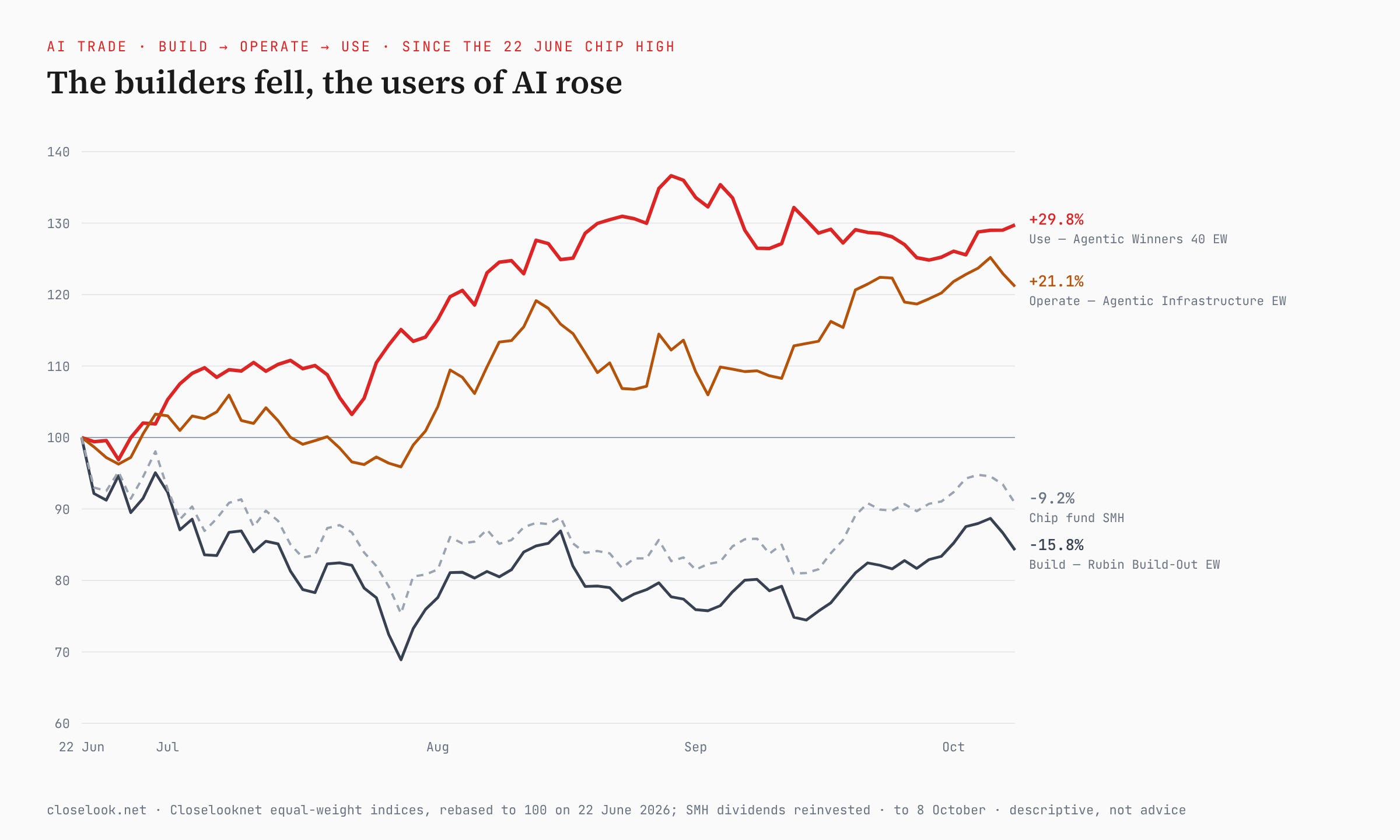
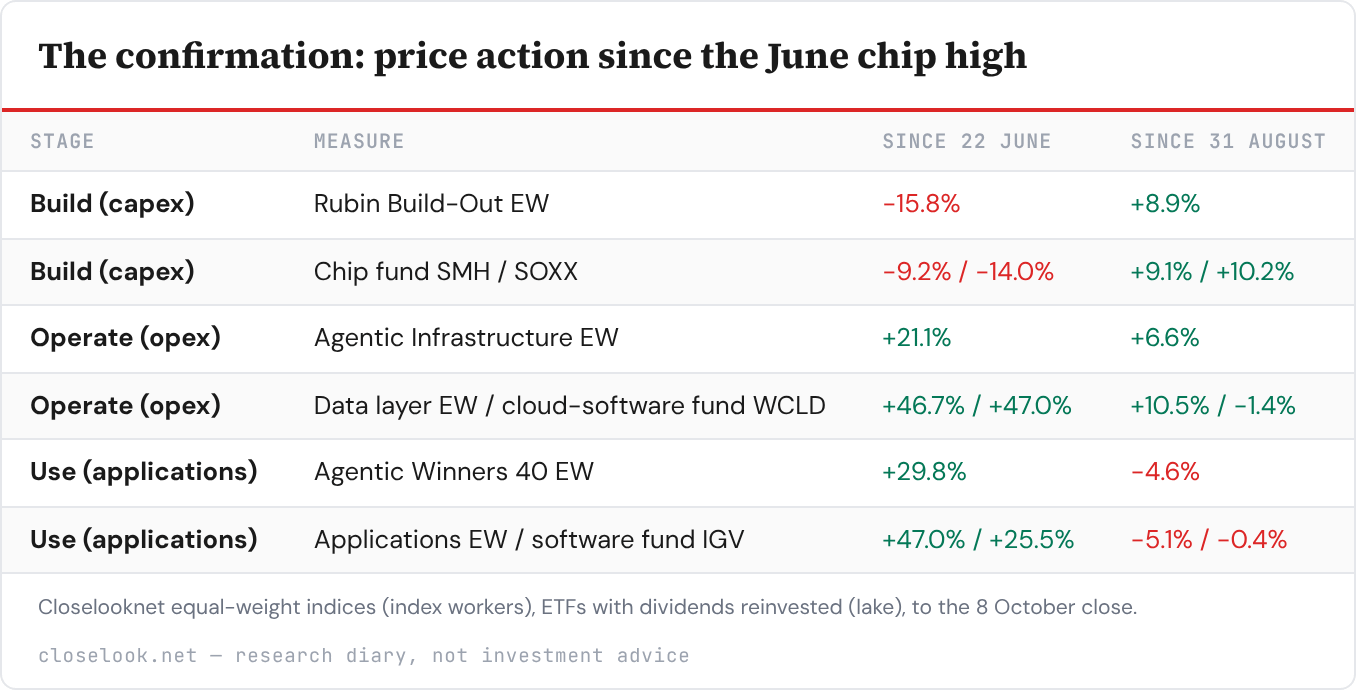
Table as text
Closelooknet equal-weight indices (index workers), ETFs with dividends reinvested (lake), to the 8 October close.
The second column is the honest caveat. From the end of August the chips staged a comeback — the build-out indices rose about 9% while the application baskets slipped 5%. Thursday reversed that in one session. One day does not make a trend; the four months since June do.
History: the profits move to the users
Every big technology wave went through the same order. In the internet build-out of the late 1990s the money first went to the companies laying the network — routers, fibre, telecom carriers. Cisco was briefly the world’s most valuable company in March 2000 and then lost close to 90% by October 2002. The lasting profits of the internet were made by the companies that used the network: Amazon, Google, later Facebook. Cloud computing repeated the pattern: the server and storage makers stayed a low-margin business, while the platforms and the software sold on top of them — the cloud services, Salesforce, ServiceNow — captured the profit pool. In mobile, the handset leaders of 2007 lost their markets, and the value went to the platform and the apps running on it.
The lesson for today is not that the builders were bad businesses — the first phase is necessary and often very profitable for a while. It is that the profit pool moves down the chain as the technology is adopted. If that pattern holds for AI, the sell-off in AI capex is no reason to leave technology. It is a reason to look further along the chain, to the operators and users.
Demo or real? The leading indicators
The hand-off only works if the operating and application layers earn real money, not just demos. We built the Agentic Demand family to test exactly that. Three of its pulses read the money directly:
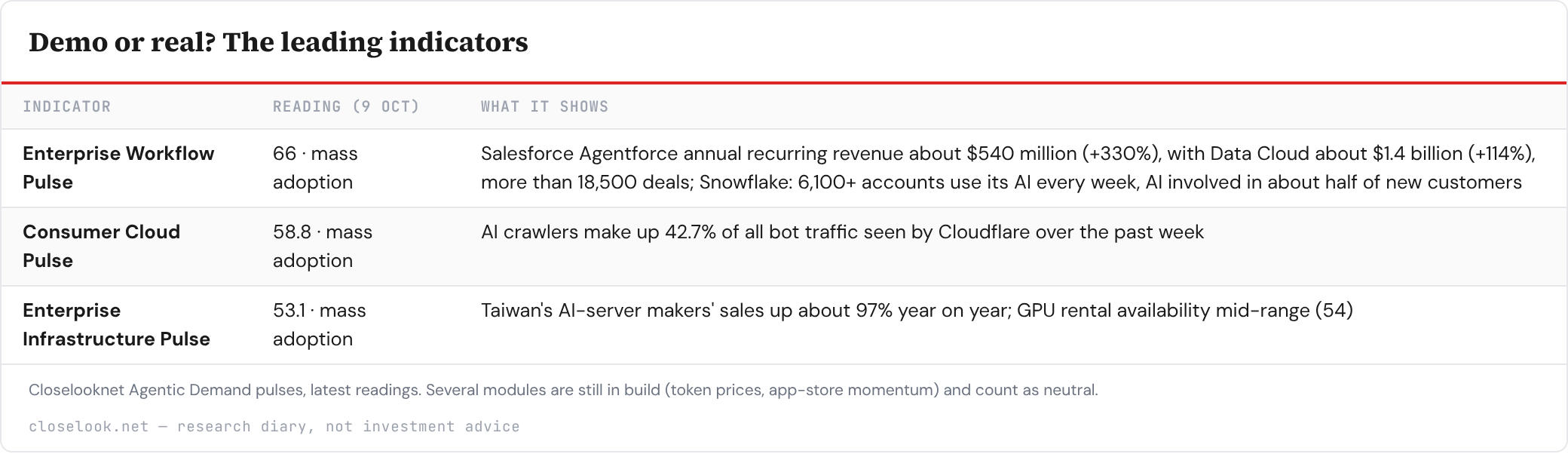
Table as text
Closelooknet Agentic Demand pulses, latest readings. Several modules are still in build (token prices, app-store momentum) and count as neutral.
The readings say real, not demo — enterprise AI spending shows up as recurring revenue, not just pilots. But they are early numbers: half a billion dollars of agent revenue at the largest software vendor is real money and small next to the build-out.
The risk: a gap like fibre in 2000
The one scenario in which the hand-off fails is a gap between what is built and what is earned. That is what happened with fibre. Carriers laid far more capacity than traffic could pay for; for years only a small share of the installed fibre was in use, the debt-funded builders went bankrupt — Global Crossing in January 2002, WorldCom in July 2002 — and the Nasdaq fell 78% from its March 2000 peak. The users of the network were not the problem; the build-out simply ran years ahead of the revenue.
Today’s numbers show why the question is fair. The six largest cloud spenders are expected to invest about $870 billion this year and about $1.3 trillion in 2027 (S&P Global estimates, as reported by the Motley Fool). The biggest AI lab reports annualised revenue of about $50 billion — and its own suppliers are reported to help finance its chip purchases. As long as operating and application revenue grows fast enough to close that gap, the hand-off continues and tech stays the place where the profits are made. If the gap widens instead, the builders who borrowed to build would face a fibre moment, and a bear market in AI infrastructure would be possible.
The signals to watch: the Agentic Demand pulses moving from mass adoption back towards pilots; the borrowed-money builders on our credit stress board; and the capex plans from ASML on 14 October and TSMC on 15 October. This is a diary of how we read the cycle, not a recommendation to buy or sell anything.
C · members block
Into next week
Today: Delta’s results before the open; Penguin Solutions’ earnings window closes tonight. Next week: US bank results from Tuesday, ASML on 14 October, TSMC on 15 October. The lines: since 22 June Build −15.8%, Operate +21.1%, Use +29.8%; Enterprise Workflow Pulse 66; chip fund SMH 9.2% below its June high.
The signals behind thisEach line links to the tool it comes from
LabAI Handoff Board — where AI’s value is moving, every day→LabAgentic Demand — demo or real? The leading indicators→Morning 10AI capex sold after OpenAI’s revenue comes in at $50 billion, not $70 billion→LabAI credit stress board — who funds the build-out, and how