


But both are customers too. They buy machines to build factories, and they hand work to test houses, packaging plants, substrate makers and design partners.

Those suppliers report earlier or more often — in Taiwan every listed company has to publish its revenue by the 10th of the next month — so their numbers show up before Micron’s and TSMC’s own. Read the chain from the back, and you see the AI trade a few weeks ahead.
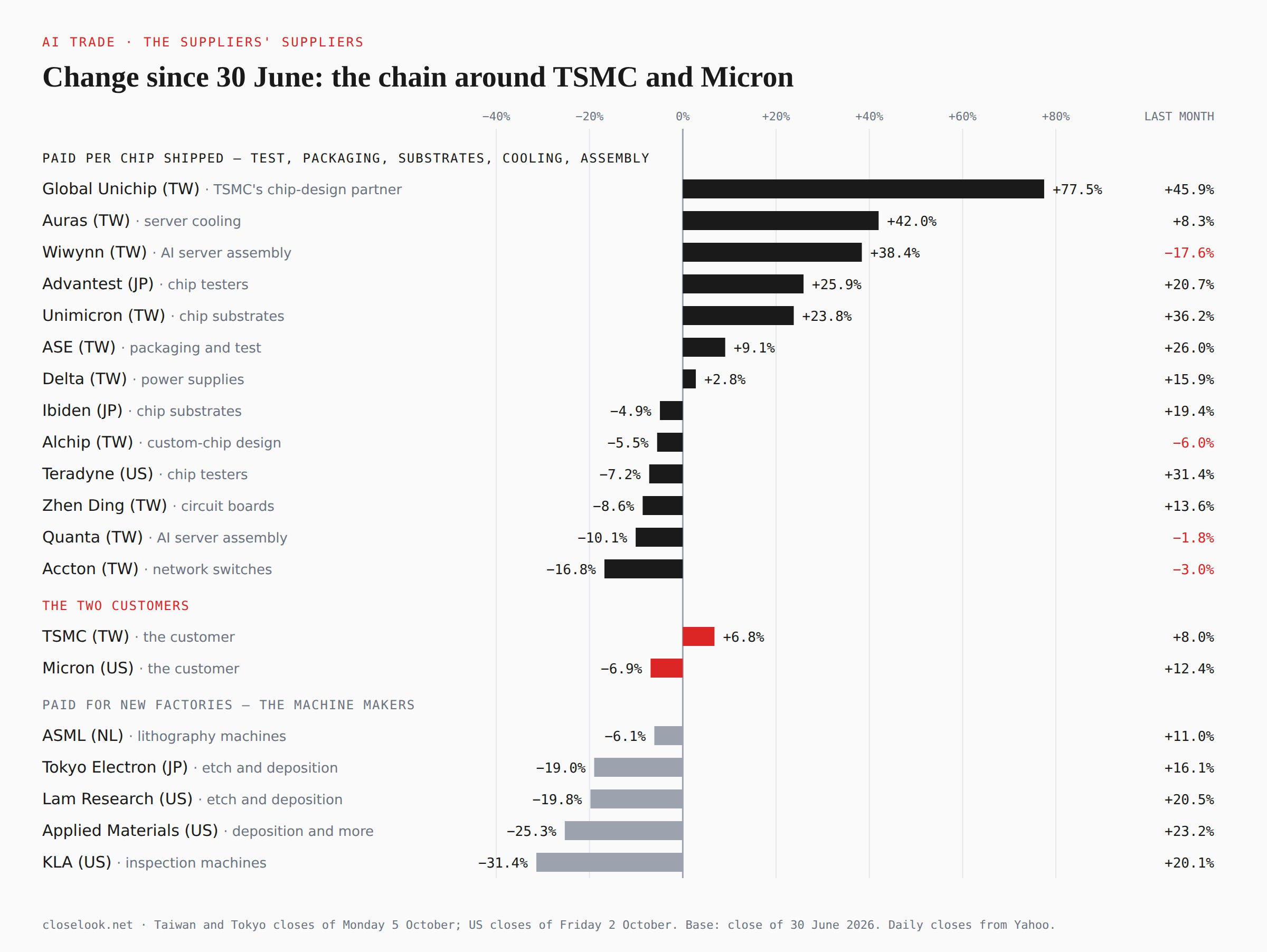
Two kinds of supplier, two different clocks
The companies TSMC and Micron pay fall into two groups, and they tell you different things.
Paid per chip shipped. Every AI chip has to be tested (Advantest in Tokyo, Teradyne in the US), mounted on a substrate (Unimicron in Taiwan, Ibiden in Japan) and packaged (ASE). TSMC’s design partner Global Unichip and the custom-chip designer Alchip are paid per project. Further down sit the server builders, cooling and power suppliers. These companies see volume as it happens — their monthly revenue is the closest thing to a live count of AI chips leaving the factory.
Paid for new factories. ASML, Applied Materials, Lam Research, KLA and Tokyo Electron sell the machines that make chips. They are paid when TSMC and Micron decide to add capacity, often a year or two before that capacity produces anything. Their orders show what the two customers expect demand to be in 2027 and 2028.
Since the end of June the two groups have split. The per-chip suppliers with the most AI exposure are at or near record highs: Global Unichip is up 77.5%, Auras 42.0%, Advantest 25.9%, Unimicron 23.8%. The machine makers fell: KLA −31.4%, Applied Materials −25.3%, Lam −19.8%, Tokyo Electron −19.0%. The market paid for chips being shipped today and doubted the factories being planned for tomorrow.
Closelooknet on Google
Get our reads first in Top Stories and AI answers. One tap, no account needed here.
What the Taiwan chain says now
Our AI-Order Signal Board reads the Taiwan chain twice: daily from share prices, monthly from the revenue filings. The last monthly reading covers June to August, against the same three months a year earlier, counting only the AI share of each company’s sales. Every layer is growing fast, and only one slowed.
Taiwan’s AI chain — revenue June to August against a year earlier
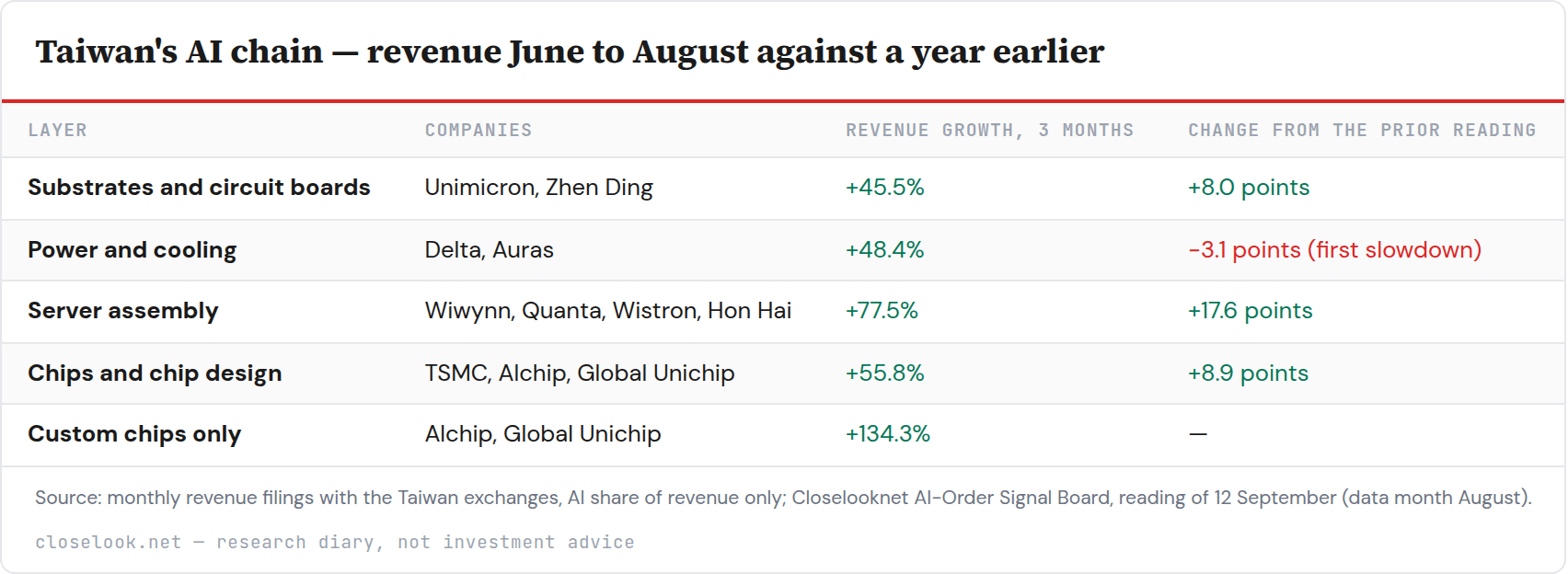
Table as text
Source: monthly revenue filings with the Taiwan exchanges, AI share of revenue only; Closelooknet AI-Order Signal Board, reading of 12 September (data month August).
The daily side agrees. On Friday none of the board’s five price warnings was lit: 13 of 16 Taiwan suppliers traded above their 50-day average, and the companies at the front of the chain — substrates, power, cooling — were still outrunning the server builders at the back. That order matters. When orders thin out, the front of the chain feels it first while finished servers keep shipping from the backlog. We see the opposite.
The one thing to watch is the custom-chip pair. Revenue at Alchip and Global Unichip more than doubled, but the share prices went opposite ways: Global Unichip +77.5% since June, Alchip −5.5%. Inside the same business, the market is picking which designs win.
Why the machine makers turned in September
The doubt about the machine makers was a doubt about spending: how long can TSMC and Micron keep building? Both have now answered.
TSMC raised its 2026 capital spending plan in July to $60–64 billion, from $52–56 billion, and its finance chief said spending over the next three years will rise meaningfully from the last three.
Micron said last Wednesday it will spend about $11.5 billion in the current quarter and about $25 billion in the first half of its new fiscal year — close to the roughly $27 billion it spent in the whole of the year just ended — and more in the second half. Most of the increase goes into new clean-room space for late 2028 and beyond. It has also sold most of its 2027 supply of high-bandwidth memory, the stacked chips that sit next to Nvidia’s processors, at higher prices.
The machine makers rose 11% to 23% in the last month, and Tokyo Electron added 5% on Monday alone. They are still well below their June levels. Micron’s own stock went the other way: down 6.9% since June, and at 1,074.89 on Friday it sits between the lines of our earnings card, which closes tonight. For investors in Micron, the factory plan is a cost. For its suppliers, it is an order.
The calendar: four reads before the end of October
By 10 October: September revenue from TSMC and the Taiwan chain. The AI-Order board updates the monthly reading right after.
14 October: ASML’s third-quarter report and its view of 2027 — the earliest word on how many new factories are coming.
15 October: TSMC’s third quarter, and whether the $60–64 billion spending plan moves again.
28 October: Advantest’s second quarter. In July it raised its forecast for the tester market by about a fifth, to $13.0–14.5 billion for 2026, on demand for inference chips.
The order we read them in: Taiwan’s monthly revenue first, because it is the most frequent; the machine makers next, because they see furthest ahead; TSMC and Micron last, because by the time they report, their suppliers have usually already told us. This is a research diary, not investment advice.
C · members block
Into next week
Today: Micron and Jabil are graded on our earnings card at the US close; ISM services at 16:00 CEST. This week: Taiwan’s September revenue filings by Saturday 10 October, TSMC among them; Fed minutes on Wednesday. Next week: ASML on 14 October, TSMC on 15 October. The lines: Micron 1,033.16 / 1,097.06; the AI-Order board at 0 of 5 warnings.
The signals behind thisEach line links to the tool it comes from
LabAI-Order Signal Board — Taiwan’s AI supply chain, daily prices against monthly revenue→LabSemicap / Test Pulse — the machine and tester makers→LabTaiwan AI Pulse — the island’s AI chain every day→Print RecordMicron — graded at tonight’s close→Morning 10Asia — Nikkei back near 70,000, Taiwan +2.4%; euro at a 17-month low