


Closelooknet is a reader-supported publication — to receive new posts and support the work, become a free or paid subscriber.

This week’s edition of Closelook@Global Stock Markets, dated July 07, 2026.
For weeks, we have described the US tape as narrow — a handful of names carrying a wide index. This week, we widen the lens to the whole world and find the same fingerprint.
The international rally that shows up green on every screen is not broad. It has been a concentrated bet on the AI hardware supply chain, wearing a benchmark’s clothing — and the moment you count the participants rather than read the headline, the concentration is impossible to miss.
The read below holds that this is rotation, not risk-off, and that the concentration is the single most important thing to understand about global equities right now.
1 · This Week’s Action
Three boards, top to bottom: the cross-asset backdrop, the global sectors, then the regions and factors. Each is sorted by Weighted Alpha, with leaders at the top.
The cross-asset backdrop. The bellwethers set the tone before equities open. This week, bonds softened as yields firmed (the long end down more than the belly), the dollar drifted lower, gold held, and the risk-seeking corners — bitcoin, silver, copper — pushed higher. A backdrop that leans risk-friendly, with no haven bid anywhere in it.
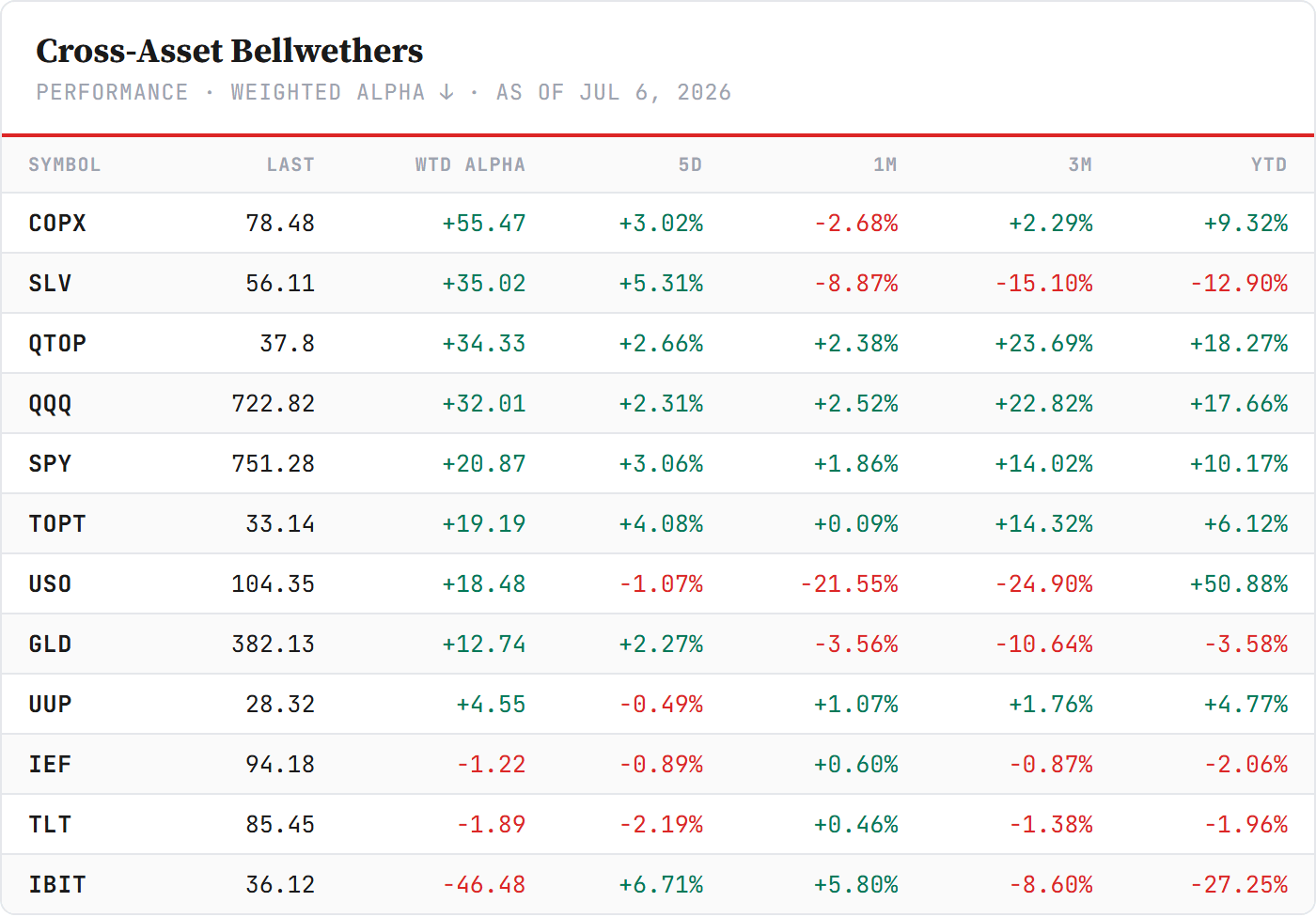
The tell is what is absent: no scramble for protection, no credit stress, no bid for bonds. The risk assets led, and the safe assets lagged — the signature of repositioning, not de-risking.
The global sectors. Read top to bottom, the global sector board carries the same split we flagged in the US, one level up. Financials led the world on the week; industrials, telecom, and materials followed; global technology finished near the bottom of the green — up, less than one percent, while financials ran four-and-a-half. The defensives and the rate-proxies — staples, utilities, energy, REITs — sat in the red.
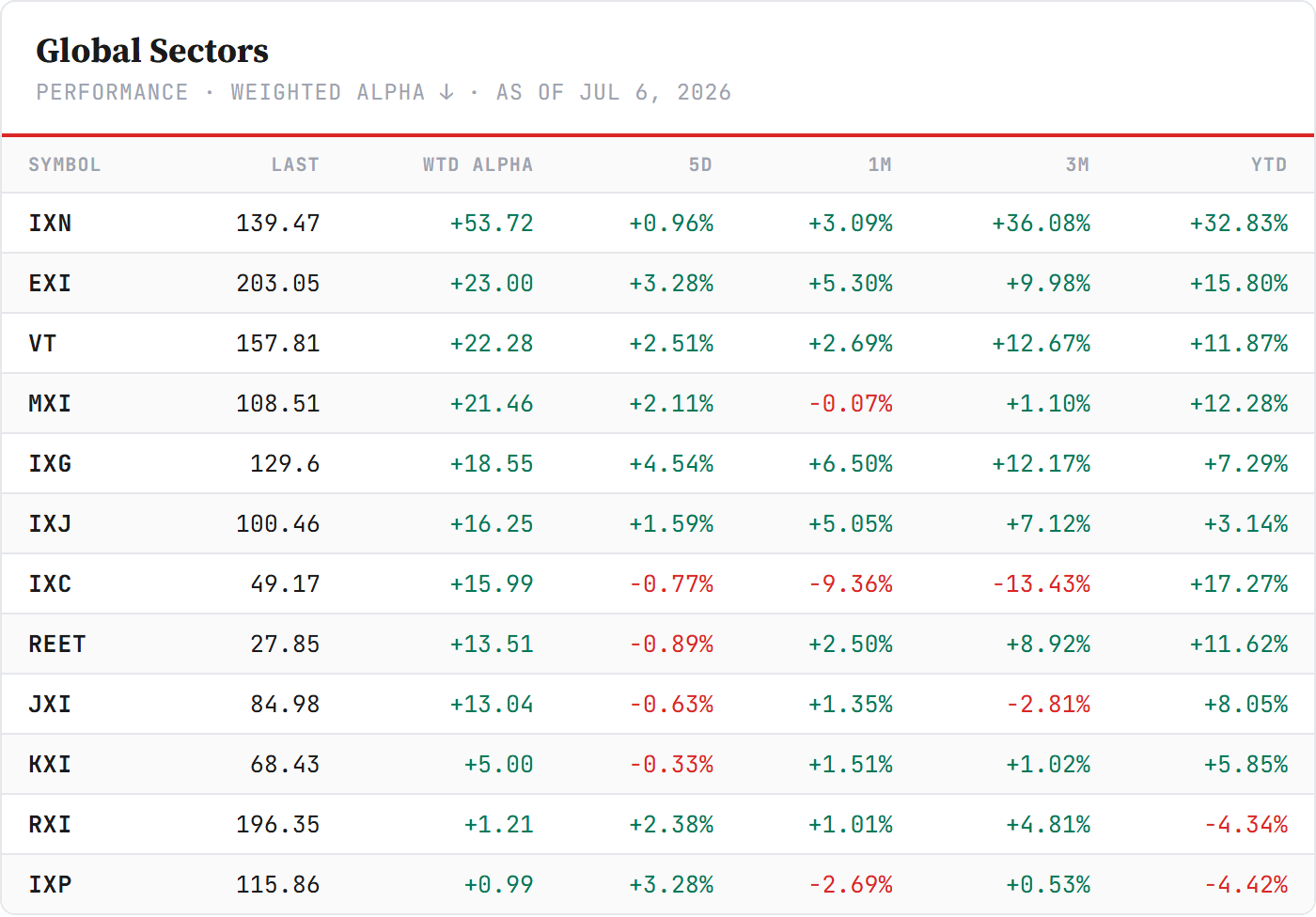
The anomaly is the same as in the US: global tech’s flat week hides the strongest trend on the board. Its Weighted Alpha is the highest of any sector and its three-month gain the largest — this is a leader resting, not a leader breaking. The rotation ran from the crowded winner into the laggards, not out of risk.
The regions and factors. Here is the week’s real story, and it is a story about concentration. The board is a sea of green — but read it the way it deserves to be read, and the green is misleading.
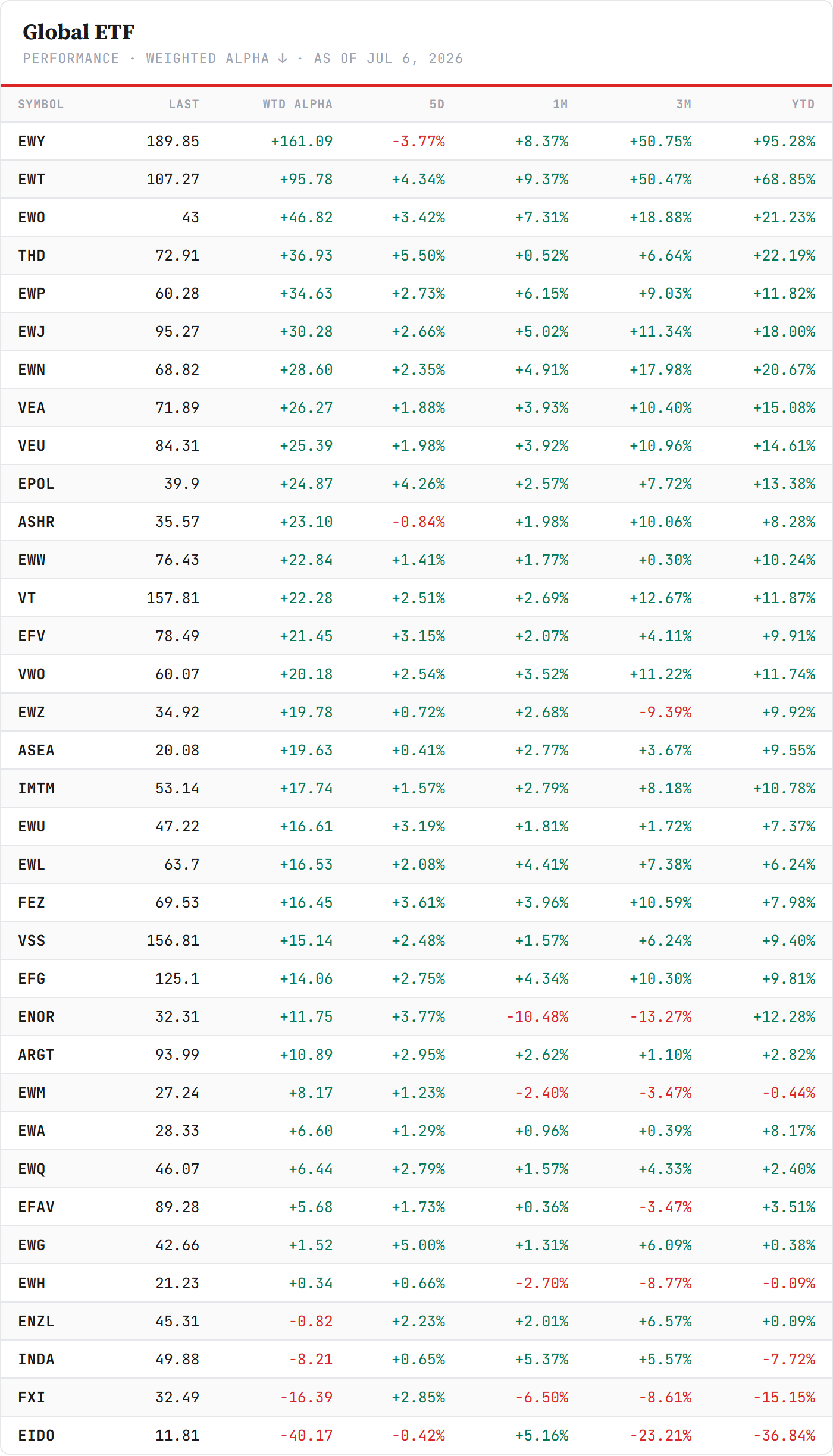
Count the participants. Of the twenty-six single-country and regional ETFs on the board, twenty-one finished the year to date positive and five negative — but only six have beaten the ex-US benchmark (VEU, +14.6% YTD): Korea (+95%), Taiwan (+69%), Thailand, Austria, the Netherlands and Japan.
Twenty of twenty-six lag the very index they compose. And the two that carry it — Korea and Taiwan — are the semiconductor economies (Samsung and SK Hynix; TSMC), with the Netherlands (ASML) close behind. The ex-US benchmark’s return, stripped of narrative, is the AI hardware supply chain. Everywhere else — China (−15% YTD), India (−8%), Indonesia (−37%) — is flat to falling. This is not a broad international bull. It is the US concentration story, translated into regions.
2 · The State
The global market map. The single structural read of global equities right now is concentration. The broad, democratic slices of the market are lagging the cap-weighted ones — and that gap is the whole story.
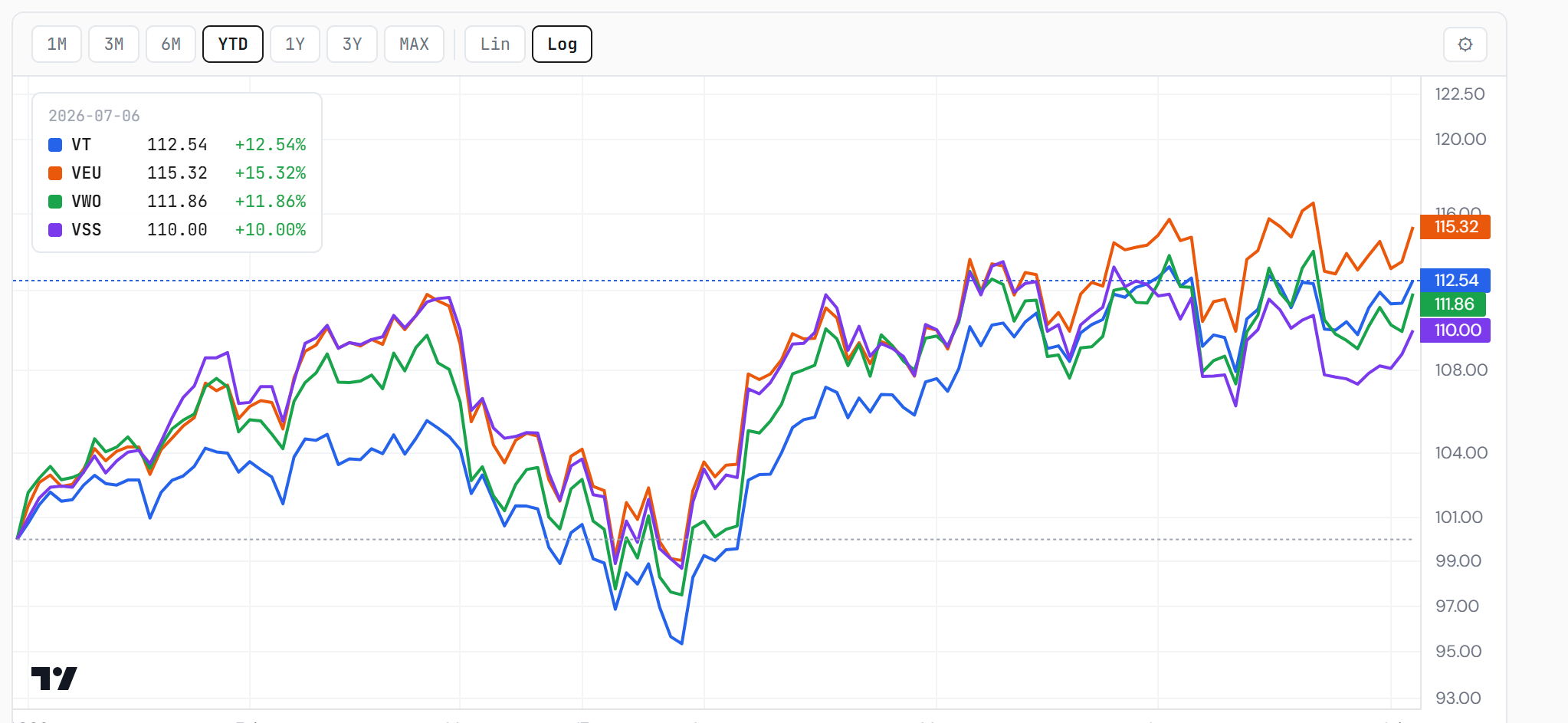
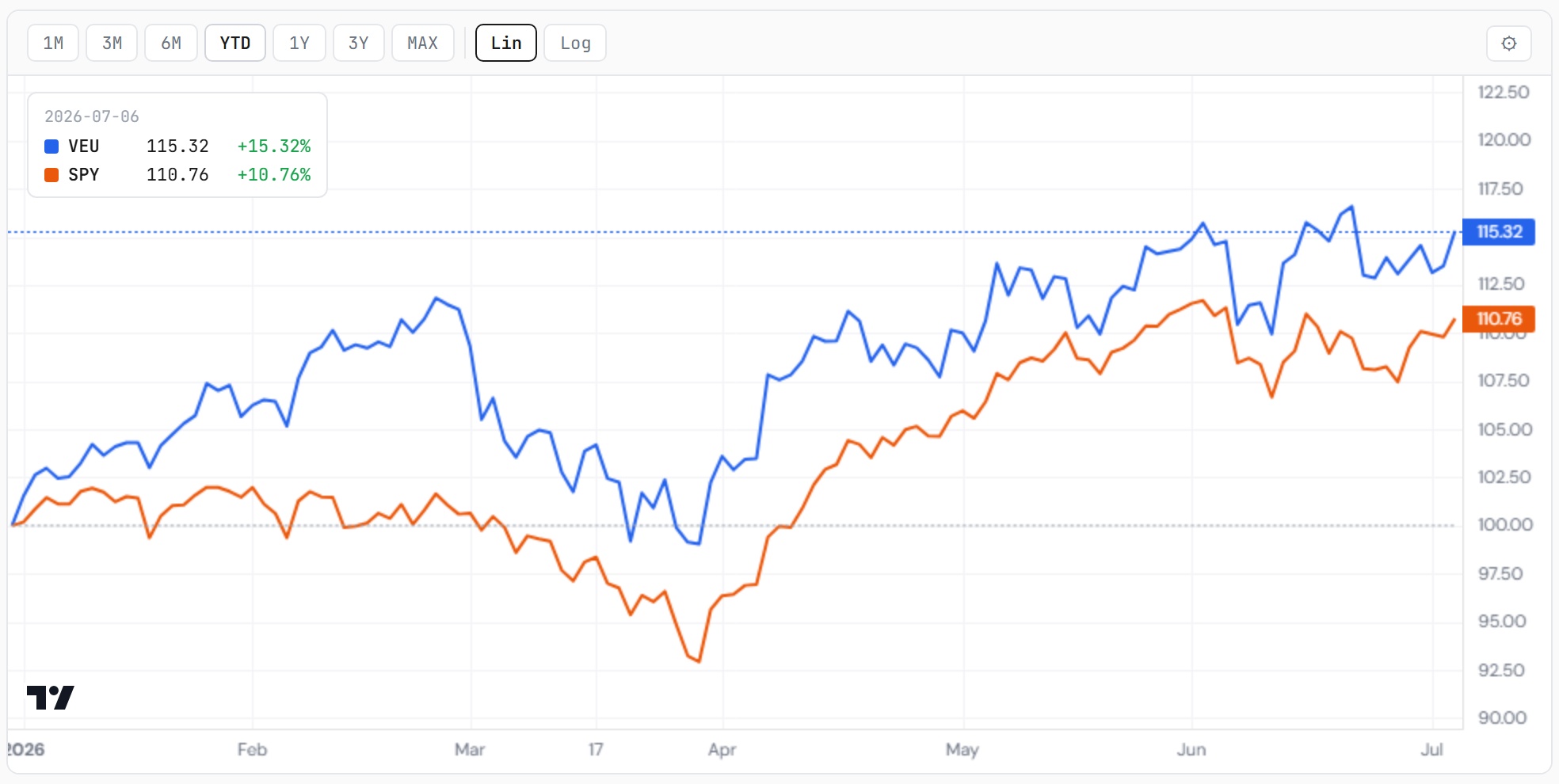
The clearest proof sits in one chart. Rebase the four Vanguard slices to a common start and the concentration is visible: the ex-US benchmark (VEU) leads at +15% year to date, but the broad ex-US small-cap fund (VSS) trails at +10% — a five-point gap, with emerging markets (VWO) and even the total-world fund (which contains the US) in between. When the democratic basket of everything trails the cap-weighted index by five points, a handful of large names are doing the work and the average stock is being left behind.
That is the Bessembinder skew — a few winners create the wealth, the median destroys relative value — showing up not in a spreadsheet of individual stocks but on the face of the market itself.
The thesis. The tape is risk-on and rotating, but the leadership is both narrow and unresolved. Two facts sit in tension and we hold both:
Concentration is the structure. The gains are carried by the AI-chip complex — the same barbell we live on in the US, now visible in which countries win. Own the two right regions and you beat the world; own the average region and you lag it.
Ex-US leadership is a trend the US briefly out-ran. Measured over the year, the ex-US funds carry the stronger momentum — Weighted Alpha ranks developed-ex-US and all-world-ex-US above the total-world fund, and VEU (+14.6% YTD) has beaten the S&P (+10.2%). But this week the US quietly held serve: the total-world fund (which contains the US) edged the ex-US fund, and the S&P out-ran VEU on the five-day. The international-leadership trade is real on the trend and paused on the week.
Factors say offense. Inside the ex-US universe, value and growth both out-ran min-vol this week, with the low-volatility factor dead last — the posture of a market repricing, not retreating. But the same skew applies: the median factor tilt still lags the concentrated winner.
The VT/SPY read — international vs US. The co-leadership question resolves cleanly by horizon: year to date, ex-US leads (VEU > S&P); this week, the US led (S&P and total-world > ex-US). A weakening dollar quietly helps the non-US books underneath — a tailwind for the international trend if it holds, a headwind removed if the dollar turns.
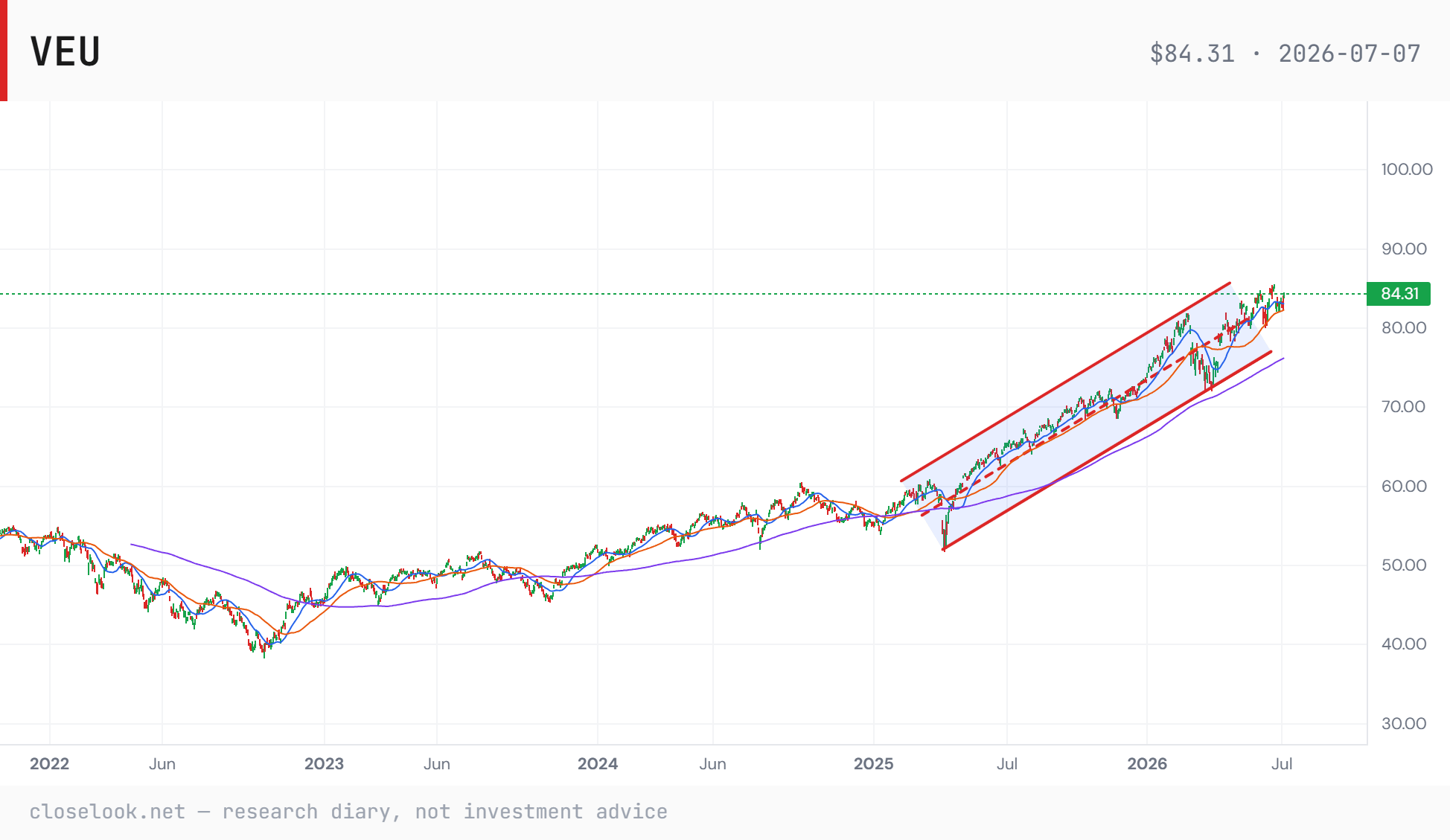
The structural read — the ex-US benchmark’s channel. The multi-year picture on the ex-US benchmark (VEU) is a clean ascending channel off the 2025 base, and price now rides the upper rail — the uptrend intact and, if anything, stretched. The read stays constructive while VEU holds the channel; the rising midline and the lower rail are where a pullback gets bought, and a decisive close below the channel is what would flip the trend.
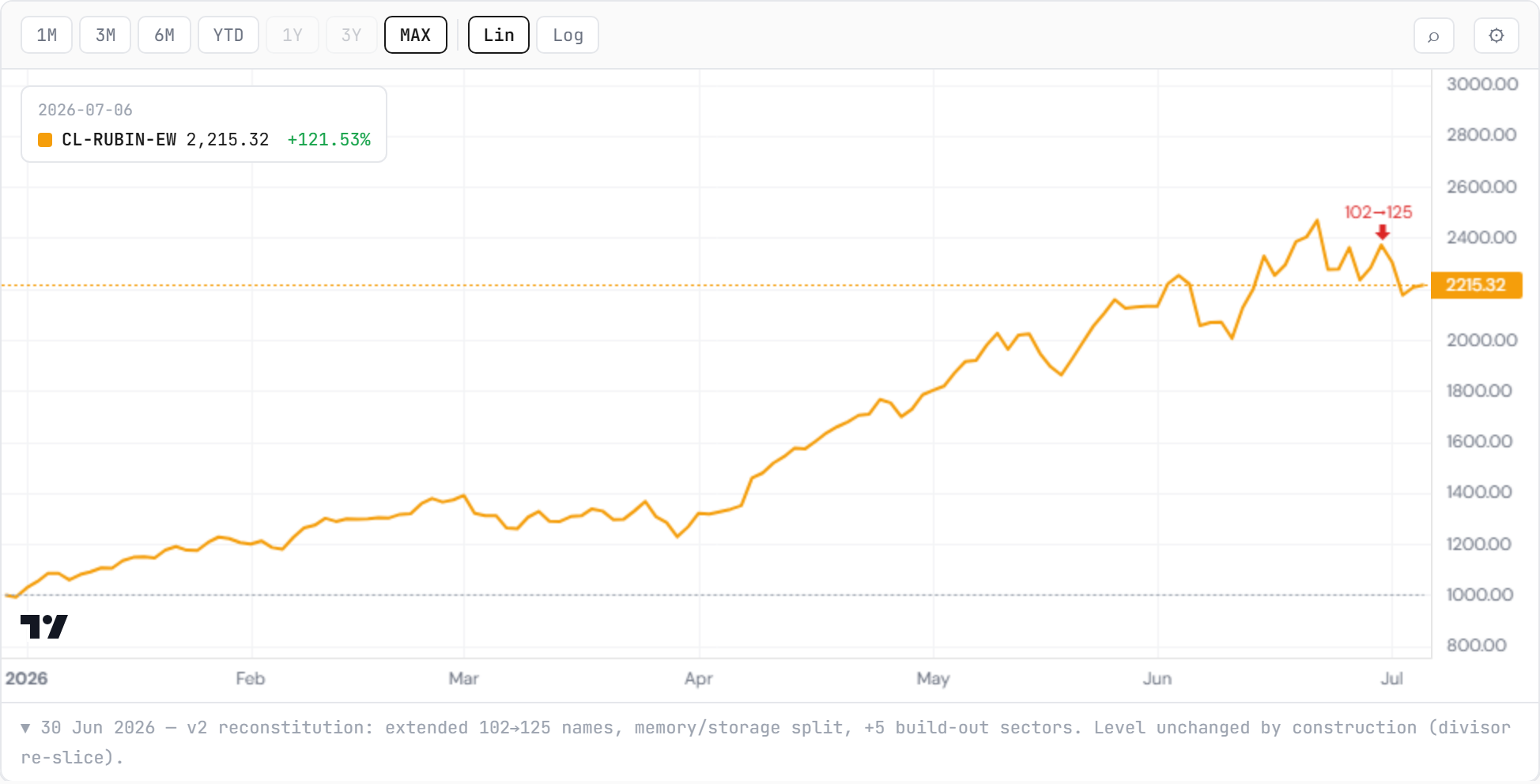
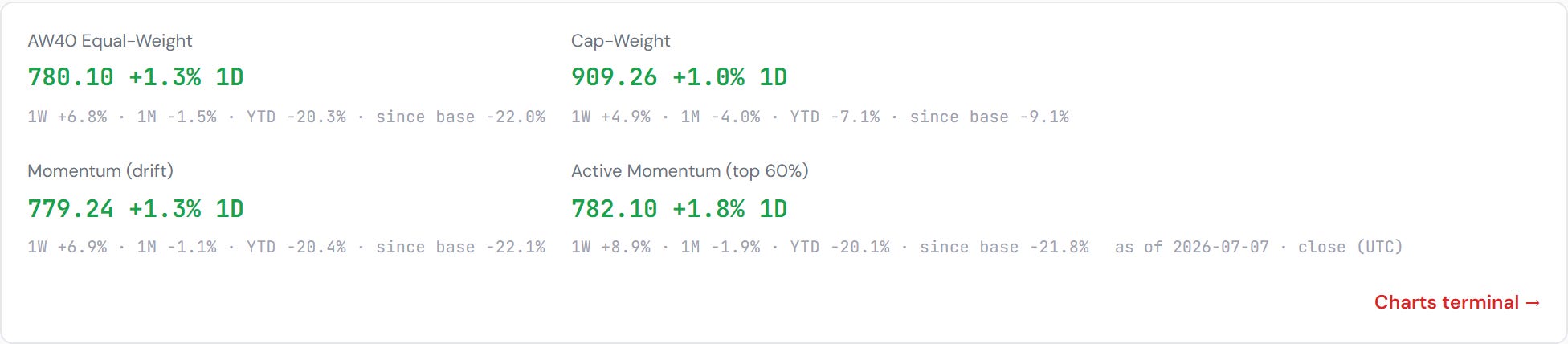
The internals behind the map. The same picture, read through our own indices below: which side of the AI trade — build-out or deployment — is leading, and whether the concentration is broadening or narrowing.
3 · The Outlook
The forward read we hold lightly and reset each week — price tells us before the narrative does. This week the question is whether the concentration broadens or breaks: does the rest of the world’s tape join Taiwan and Korea, or do the two leaders roll over and take the benchmark with them.
The four indices — the clearest read we have. We track this cycle through four functional indices, and they cut the AI trade into its parts.
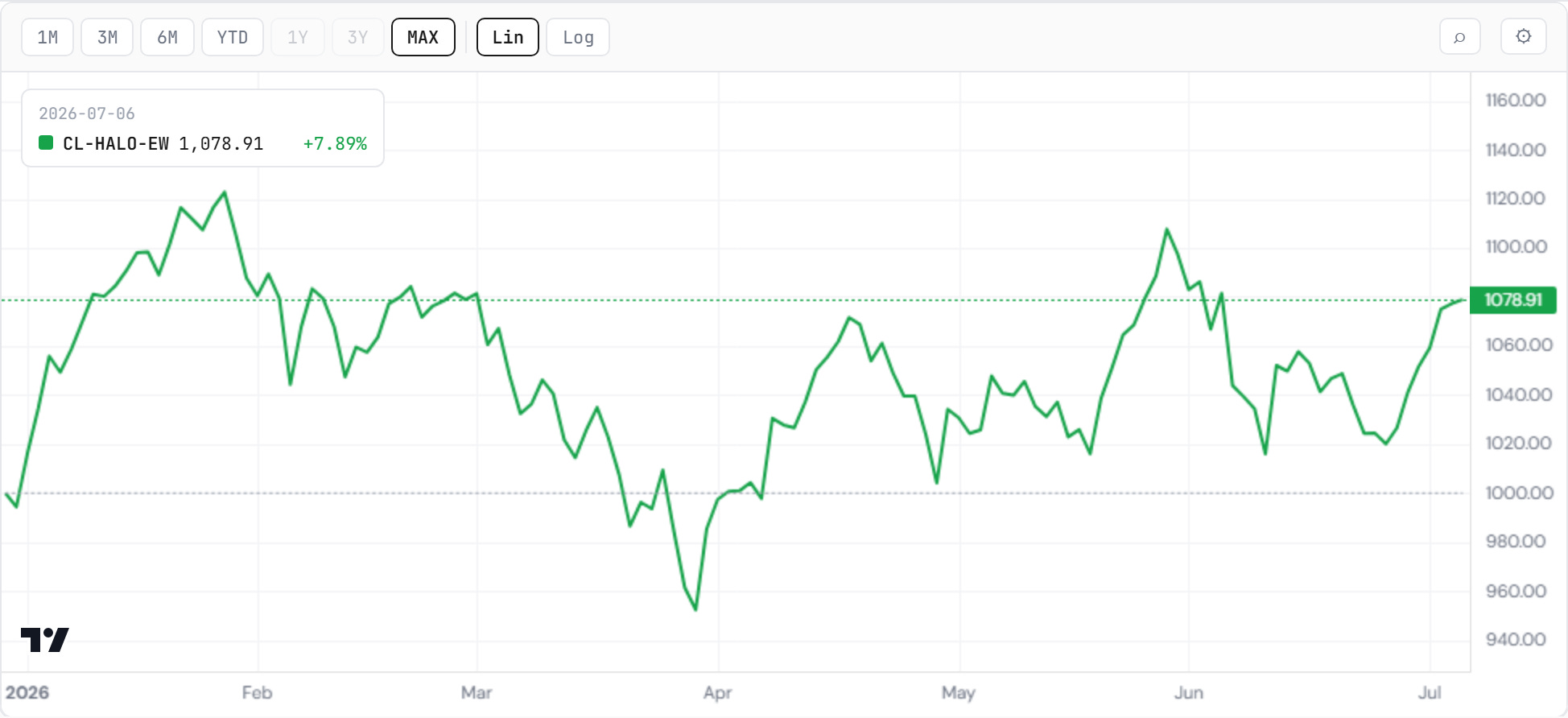
The build-out side (Rubin) is the semiconductor and infrastructure core — the same complex that is the Taiwan-and-Korea concentration on the regional board. The deployment side — the agentic-opex index (AEI), the agentic winners (AW40) and functional growth (HALO) — is the application layer that runs on it.
Last week the split was clean: the build-out side lagged on the semis’ rest while the deployment indices led — and that is the tell worth flagging. HALO and AW40 are the cohorts that lagged the build-out through the past months of the AI-hardware run; their turning up now is relative-laggard outperformance — a mean-reversion signal, leadership rotating into what had been left behind rather than a new theme. It is the single-stock version of the same broadening we are watching for across regions.
Two scenarios into the seasonally softer late-summer window:
The broadening one — the world’s laggard regions and the small-cap basket begin to close the gap to Taiwan and Korea, and the rally stops being a two-country story. That is the healthy shape, and the one that would take the concentration risk off the table. It would be the regional echo of what the US cohorts are already doing: if the deployment laggards (HALO, AW40) can turn up against the build-out, the underperforming regions — China, India, Indonesia, the twenty that trail the benchmark — can turn up against the crowded Korea-and-Taiwan leaders. Watch the laggard regions the way we watch HALO and AW40 at home: the first sign of the concentration broadening.
The narrowing one — the two leaders keep carrying the benchmark alone, the median region keeps lagging, and the index rises on ever-thinner participation. That is the classic late-cycle setup — a rising benchmark that is quietly one trade.
Either way, we expect the earnings season to be the referee. The risk we watch is not price but expectations: the AI-hardware names that are the concentration carry the highest bar of the cycle, and a small miss into a bar that high reprices fast — the same conclusion we reach in this week’s US edition, from the other direction.
The macro frame sits underneath all of it — whether the inflation impulse is cresting or entrenching decides how much multiple the concentrated winners get to keep, and firmer yields this week are a small vote for caution on the long-duration leaders.

The point is not to chase Taiwan and Korea but to watch the breadth: the asymmetry into next quarter lies in whether the world’s other twenty regions turn up to join them, or whether the benchmark keeps rising on two.
🔒 Be Informed — the rest is for subscribers. Free: the LinkedIn newsletter + closelook.net. C+ (paid): real-time push on every portfolio move → closelook.net/subscribe.
