

Bitcoin Weekly Signal: 38/100 — But the Corrective Pattern May Be Ending
The biggest geopolitical shock in years. No new low. What the structure is telling us.

Bitcoin scored 38 out of 100 in this week’s signal.
🔴 Regime Change. Five of eight quantitative dimensions below 50. By every systematic measure, this remains a hostile environment for Bitcoin longs.
And yet.
This weekend, the Iran-US war escalated to a level nobody expected. Coordinated US-Israeli strikes killed Supreme Leader Khamenei. Iran retaliated across the Gulf — hitting bases in seven countries. The Strait of Hormuz closure was threatened. Dubai and Abu Dhabi closed their stock exchanges. $128 billion was wiped from the crypto market in minutes.
Bitcoin dropped to $63,000. Then it bounced. Hard. It spiked to $68,200 on the Khamenei confirmation, settled around $66,000, and — crucially — did not make a new low.
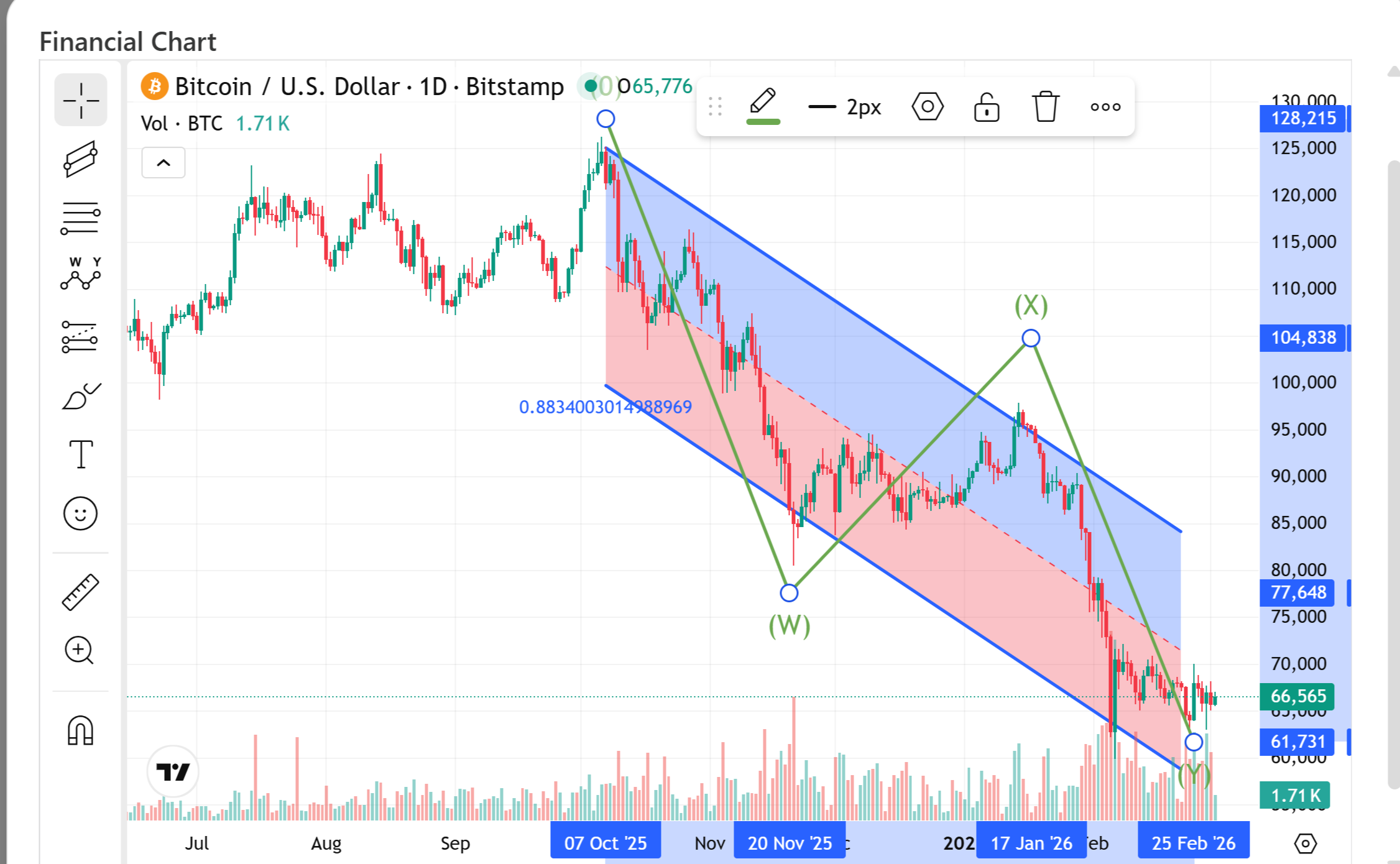
The Feb 28 intraday low of $63,068 held above the Feb 25 low of $60,187. That’s the first time since October 2025 that BTC absorbed a major shock without printing a lower low.
Why does this matter structurally?
Look at the chart. Since the all-time high at ~$128,000 in October 2025, Bitcoin has been tracing a WXY corrective pattern inside a descending channel:
- **(W)** bottomed near $78,000 — the initial impulse down
- **(X)** retraced to ~$105,000 — the relief rally that everyone mistook for a new bull run
- **(Y)** has been grinding lower since January, tagging the lower channel boundary near $60-63,000
The 0.883 Fibonacci retracement of the entire 2023-2025 bull run sits right in this zone. The descending channel’s lower boundary converges here. And now, the biggest exogenous shock of the cycle failed to push price through it.
Corrective patterns end when the final wave exhausts selling pressure. That’s what this price action looks like.
The data underneath
The Fear & Greed Index reads 14 — deep Extreme Fear. The last five readings at this level preceded meaningful bounces. Not guaranteed, but historically significant.
Spot Bitcoin ETFs recorded over $1 billion in net inflows across three consecutive sessions last week, snapping a five-week outflow streak. Institutional money was already repositioning before the war headlines hit.
BTC dominance sits at 58.5%. The altcoin market is being destroyed — 87% of tokens down in the last 24 hours. When dominance is high and altcoins bleed, it typically means we’re in the capitulation phase where weak hands exit everything and strong hands accumulate the asset with the strongest liquidity.
Gold just printed $5,375. The rotation from “digital gold” to physical gold has been the defining macro trade of early 2026 — $16 billion into gold ETFs vs $4.5 billion out of BTC ETFs year-to-date. But that divergence is also what creates the eventual mean-reversion trade when the fear subsides.
What the signal says vs. what the structure says:
The signal says 38. Red. The systematic framework reads the current state of the market as broken — trend down, momentum negative, macro regime hostile.
But signals score the present. Structure anticipates the turn. And the structure says this corrective pattern is running out of room. The channel converges. The Fibonacci support holds. The war didn’t break it.
I’m not calling a bottom. The $60,000 level has been tested three times and a break below opens the door to $53-55K. Monday’s US equity open is the real test — ETF flows will determine whether this bounce has institutional backing or fades.
But the fact that the worst geopolitical weekend in years produced no new low at a major structural support zone? That’s the kind of non-event that matters.
This week’s key levels
- Support: $63,000 (weekend low) → $60,187 (Feb cycle low) → $55,000 (channel extension)
- Resistance: $70,000 (psychological) → $72,600 (200-day EMA) → $80,700 (SuperTrend sell trigger)
- Invalidation: Weekly close below $60,000 ends the corrective completion thesis
The full signal with all nine dimension scores and the complete Elliott Wave overlay is published at closelook.net/weekly/ — free, no paywall.
The Weekly Signal publishes every Monday.