


Salve, cari subscripti!
Thank you for reading this week's edition of Closelook@Global Stock Markets, dated October 26, 2024 👋. The next edition will be published on November 02, 2024, at 2.00 p.m. ET.
The next edition of Closelook@US Stock Markets will be published on October 27, 2024, at 2.00 p.m. ET.
The next edition of Closelook@Hypergrowth will be published on October 30, 2024, at 2.00 p.m. ET.
A Closelook At This Edition
This Week's Action: Global Stocks In Consolidation Mode
Global Stock Markets: Comprehensive Overview Of 30 Global Stock Markets
Macro Insights: Bond Vigilantes Are Back
The ETF Portfolio: Some Good, Some Bad, Some Need Polishing
This Week's ETF Spotlight: Two New ETFs To Form The Core Of The Portfolio
Knowledge Corner: What Are Bond Vigilantes And Why Do They Matter?
Upcoming Transactions: 10 Days Until Election
Final Words: Presidents Come And Go, But This Election May Matter More Than Other Ones
This Week's Action: Global Stocks In Consolidation Mode
The week spanning from Monday, October 21 to Friday, October 25, 2024, presented another consolidation week for the global bull market narrative.
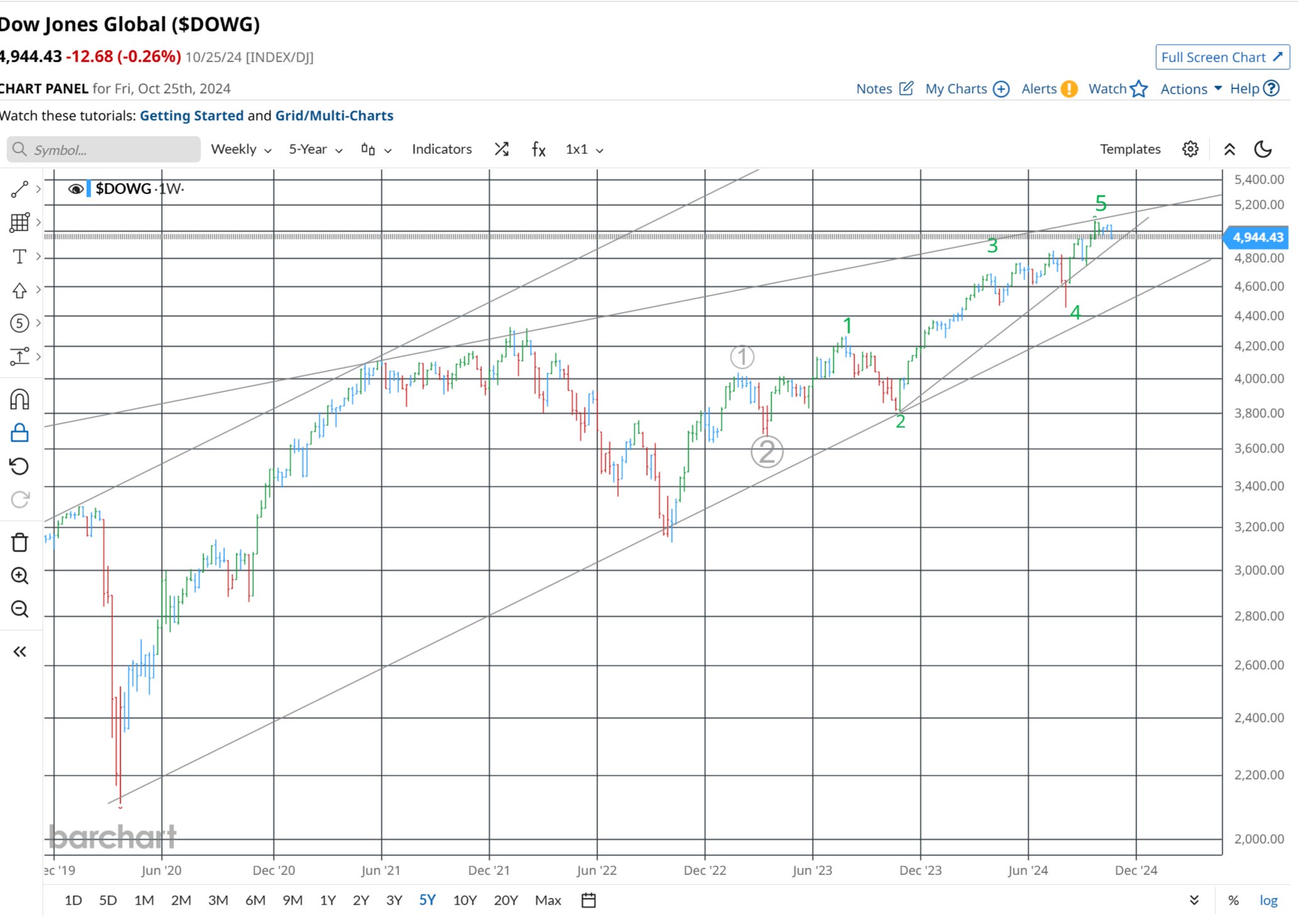
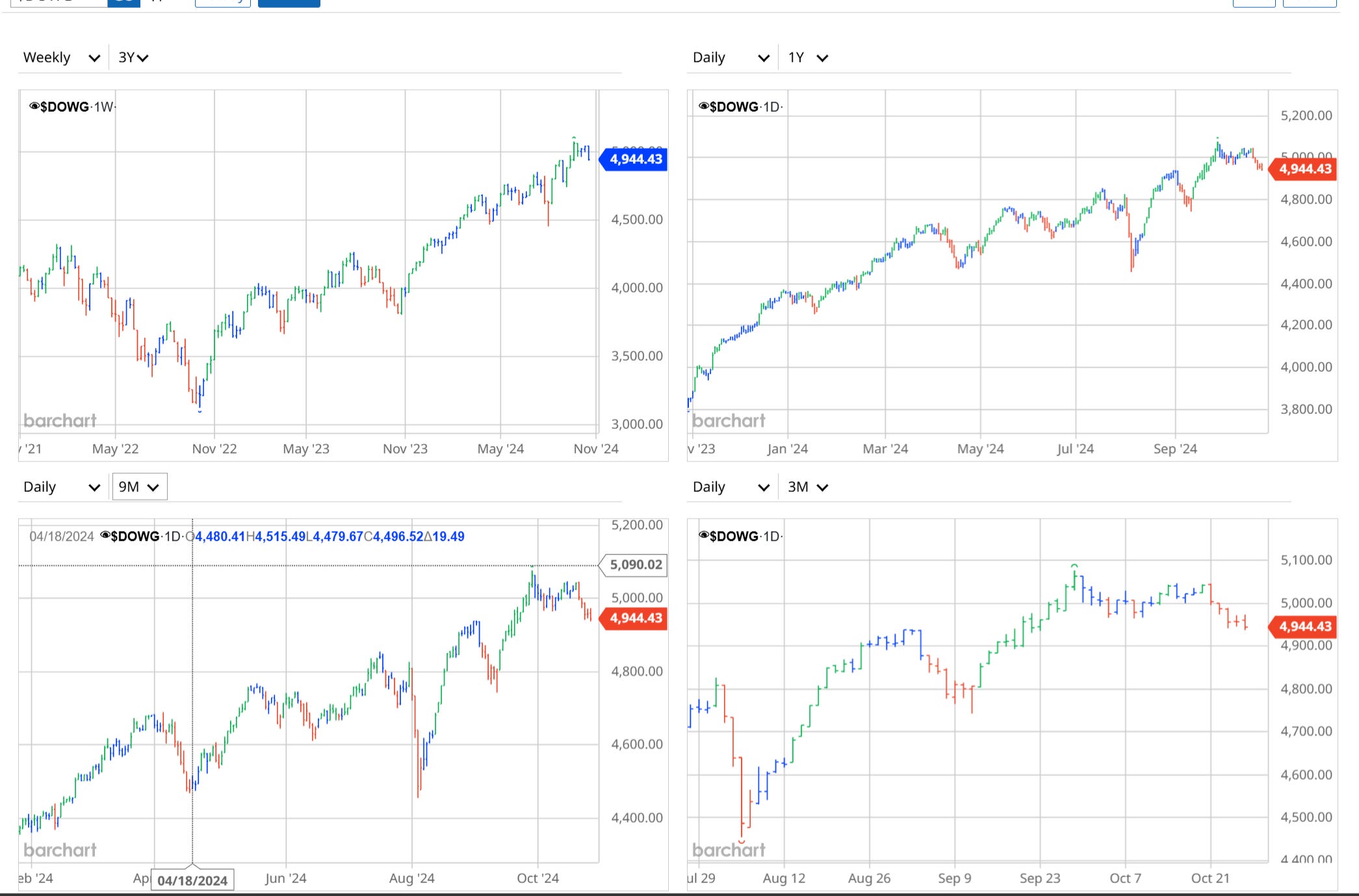
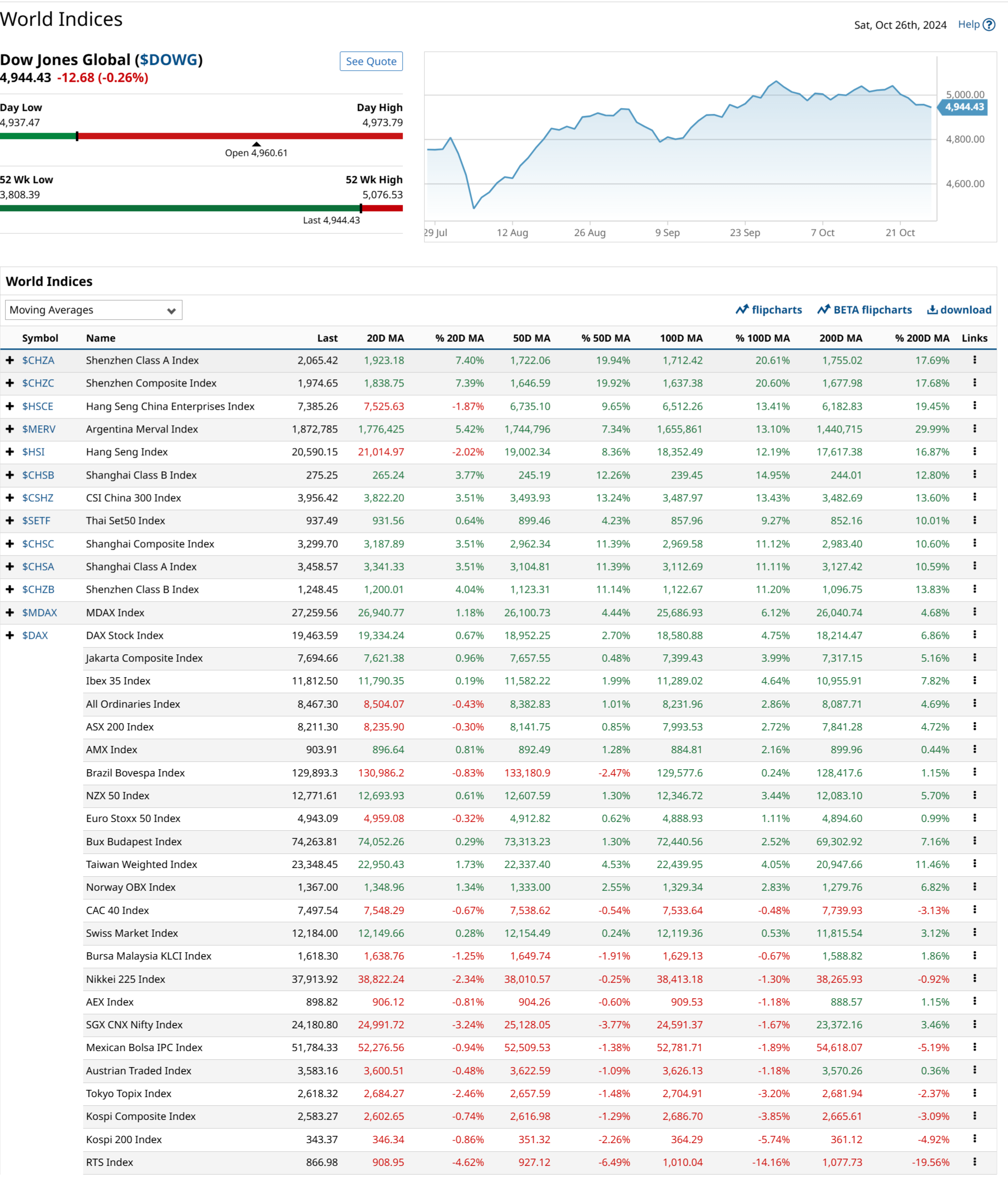
The Dow Jones Global Index moved down, potentially setting up for another bull market leg later this year.
The long-term bull market channel was not violated. The index currently tests support around the 4940 - 4950 level and may even go lower to test the 4800 level.
Taking a very long-term view, the bull is already stretched. It has touched the decade-long upward-sloping upper trend line.
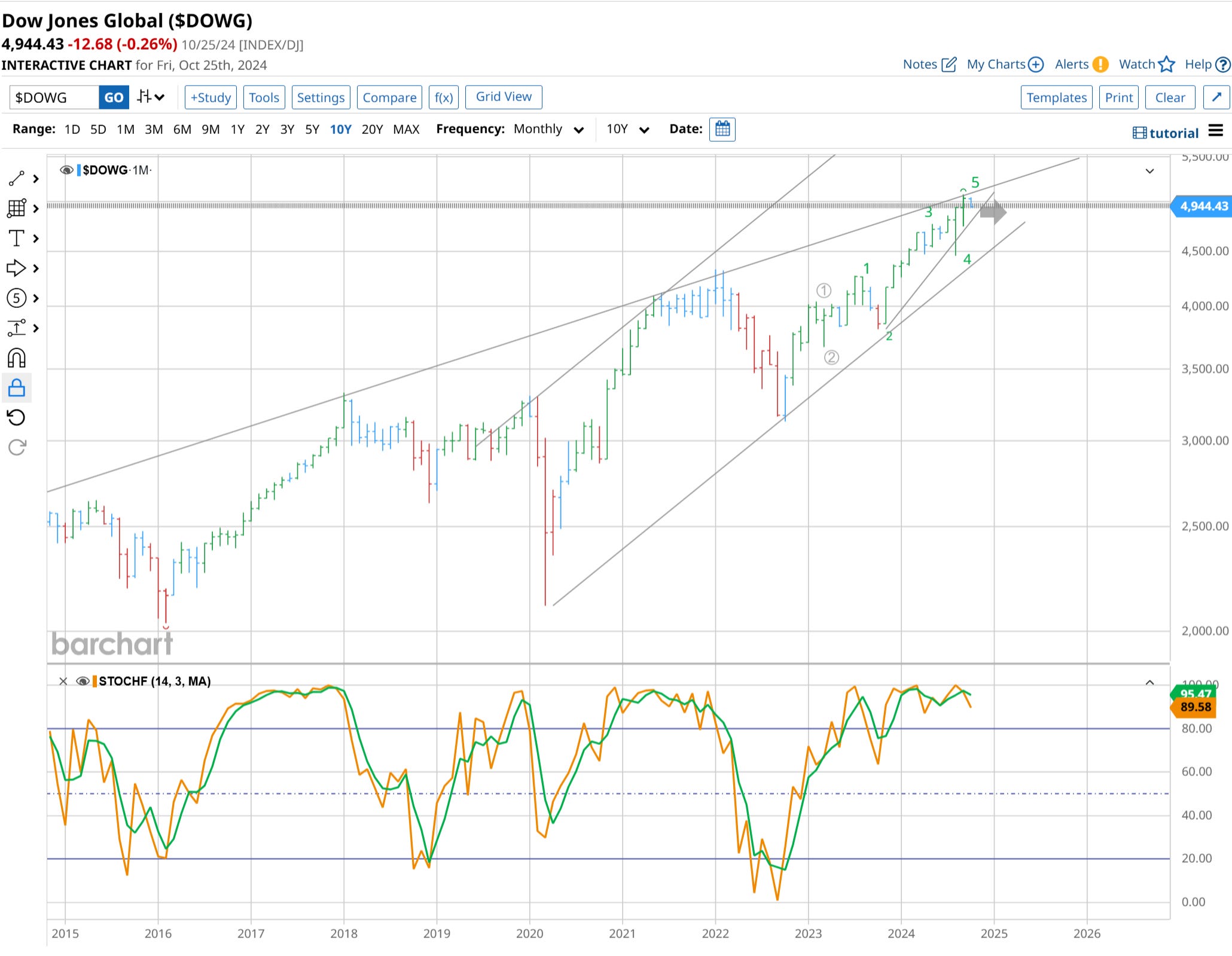
The index may be about to form a long-term bearish wedge. Right now, it appears to be incomplete, suggesting there is more upside to the bull narrative.
Global Stock Markets: Comprehensive Overview Of 30 Global Stock Markets
Argentina, Taiwan, Spain, Germany (DAX), and Hungary continue to be the five best-performing global stock markets outside the US, taking a one-year perspective.
The table below displays 36 global stock markets. Laggards are France, Thailand, and Mexico.
The only index in the red, the worst-performing index globally, taking a 1-year perspective, has been the Russian RTS Index.
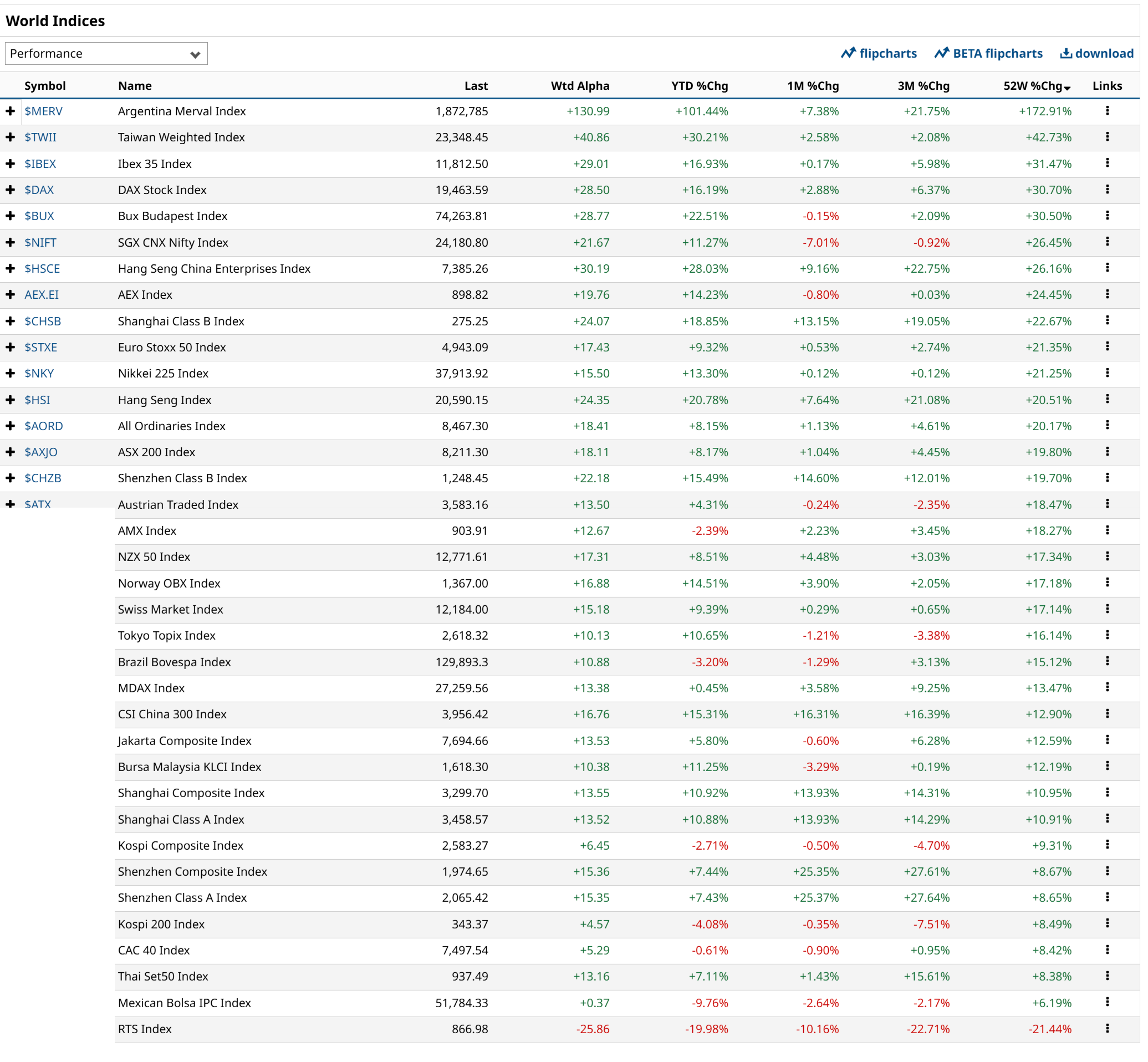
Taking a 90-day view, laggards have become top performers, with the mainland Chinese and Hong Kong markets leading.
Argentina is the best-performing country outside China's mainland indices, followed by Thailand, the German MDax and Dax indices, and the Indonesian stock market.
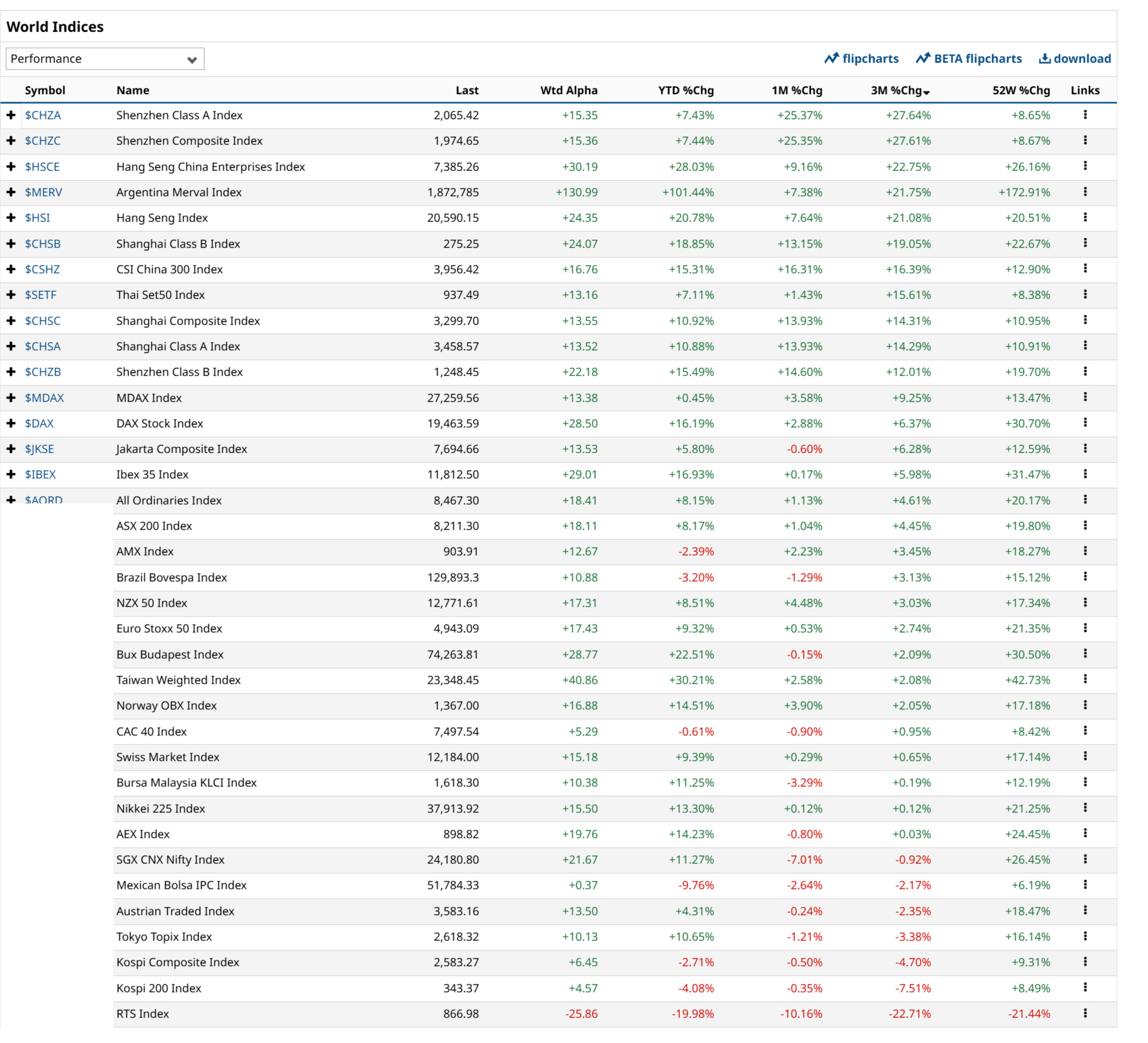
Russia is still the worst performer. However, South Korea, the Tokyo Topix Index, the Austrian Traded Index, the Mexican Bolsa IPC Index, and the Indian Nifty Fifty indices have been negative during the last 90 days.
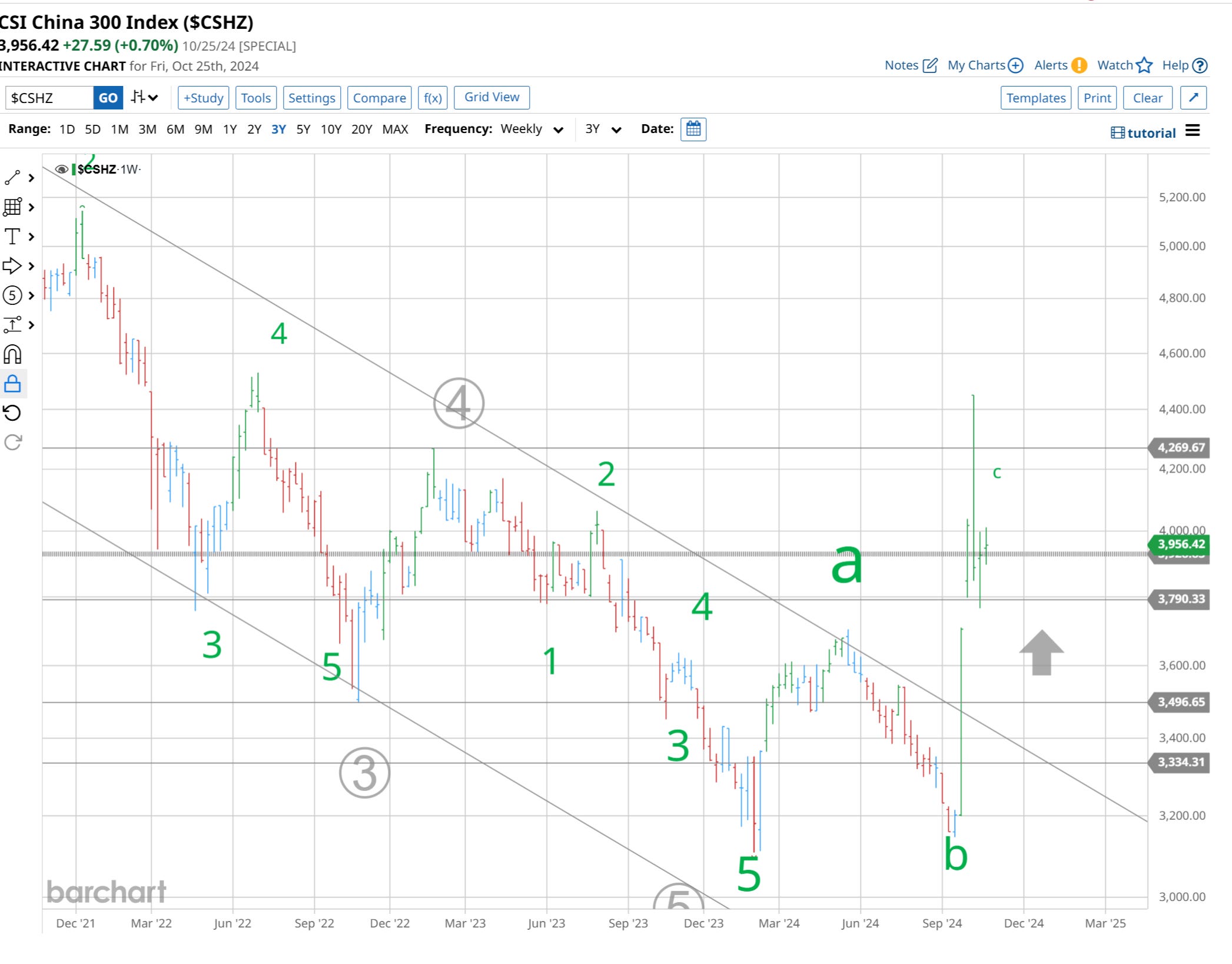
I expect another bull market leg to occur in China soon. I will be cutting China's exposure and selling on the anticipated rise.
I will be adding to the existing India positions. I expected another leg down in the Indian market first last week. This seems to be unfolding. I will be adding to the current positions on any meaningful dip.
The Euro Stoxx 50 Index moved sideways/slightly lower during the past week. It looks primed for advancing later this year, which I also advise selling. There is resistance at the spring 2024 tops.
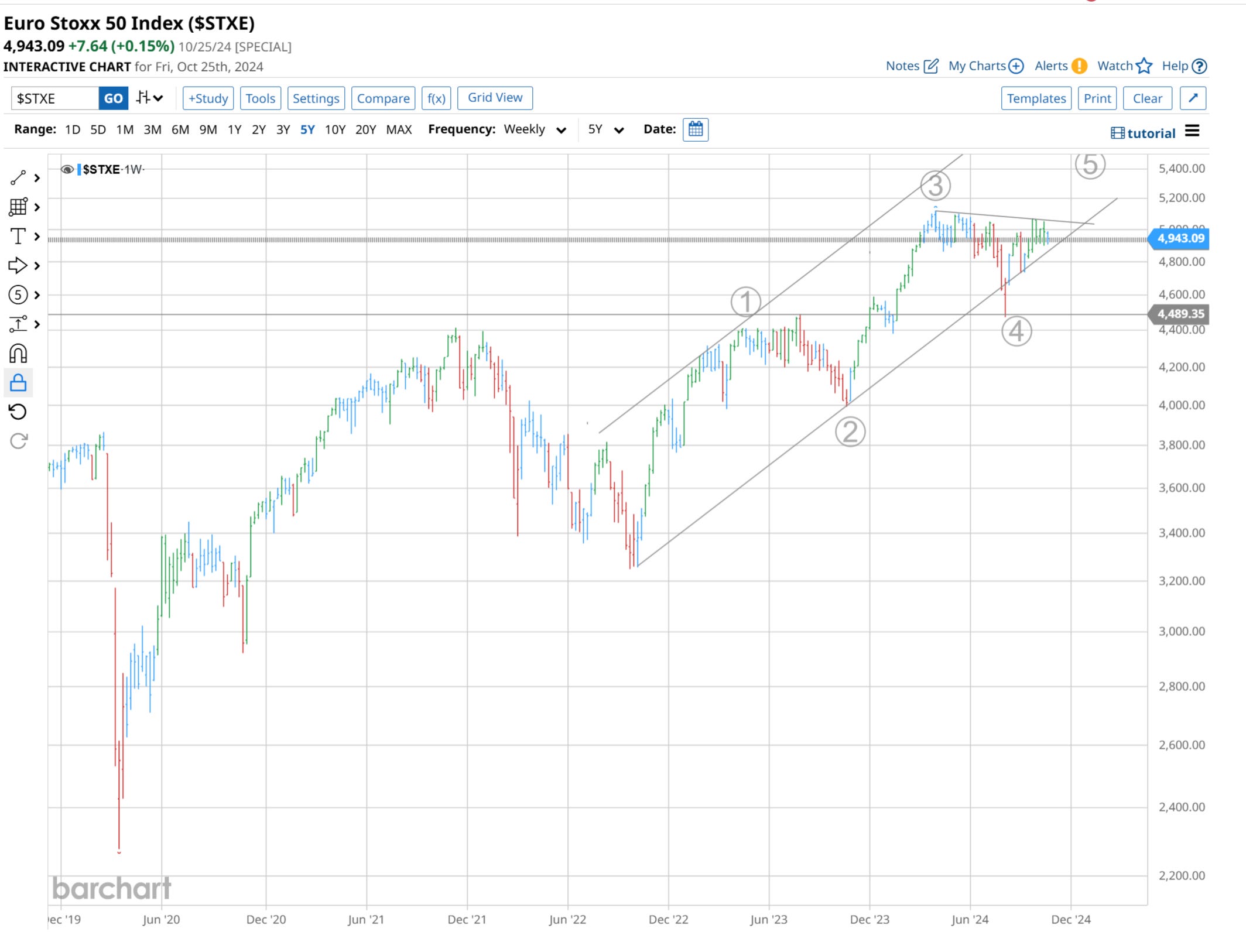
The index may see a new 52-week high, but the move looks like the final move up (for quite some time).
Macro Insights: Bond Vigilantes Are Back
The bond market has started to vote early, sending a clear message ahead of the November 5 US presidential and congressional elections.
Since the Federal Reserve's September 17-18 meeting, the 10-year US Treasury bond yield has surged by 64 basis points to 4.26% before settling down slightly and closing at 4.24 %.
This significant increase reflects the Bond Vigilantes' concerns about Fed Chair Jerome Powell's dovish monetary policy and the potential for economic overheating.
Market Reaction and Analysis
The Bond Vigilantes appear to be voting against the Fed's recent actions, particularly the 50 basis point rate cut on September 18. Their concern stems from the perception that the economy is already running hot and further easing could lead to overheating.
This market reaction was not entirely unexpected. On September 2, Ed Yardeni predicted that positive economic indicators might unsettle the bond market.
In his September 22 commentary, he further highlighted the possibility of diverging yields, with the 2-year yield potentially decreasing due to Fed easing while the 10-year yield might rise on concerns about economic overheating.
Fiscal Policy Concerns and Challenges
The Bond Vigilantes' reaction may also reflect apprehension about future fiscal policies, regardless of which party wins the upcoming elections. Some are concerned that continued expansionary fiscal policies could further inflate the substantial federal budget deficit and fuel inflation.
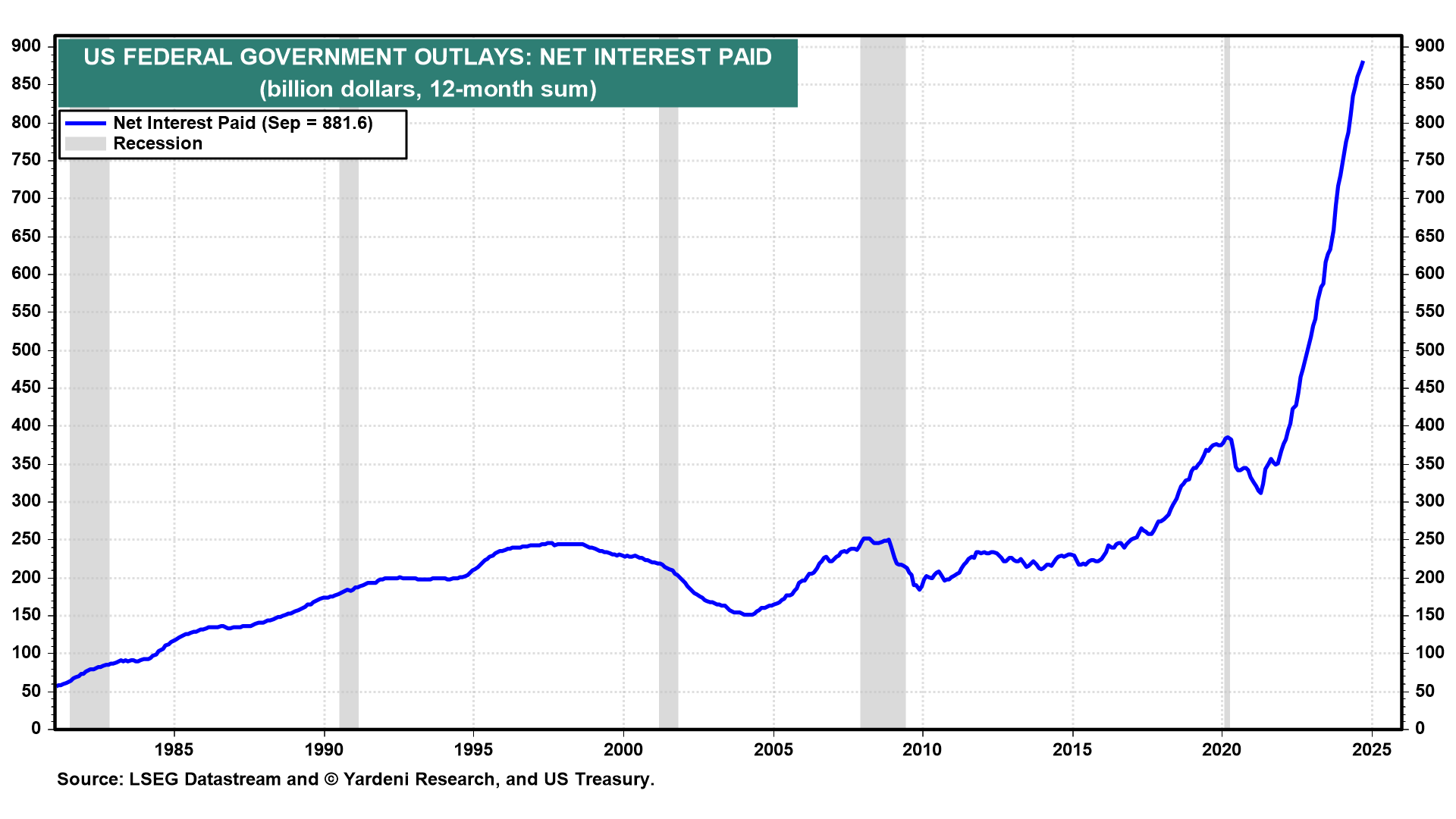
The next administration will face significant fiscal challenges, particularly regarding debt servicing:
The next administration will face net interest outlays of over $1 trillion on the ballooning federal debt.
This underscores the growing burden of interest payments on the federal debt, likely influencing future fiscal and monetary policy decisions.
The ETF Portfolio: Some Good, Some Bad, Some Need Polishing
The ETF portfolio has moved slightly lower during the week after reaching an all-time in mid-October. It has been up since starting on 1 August 2024.
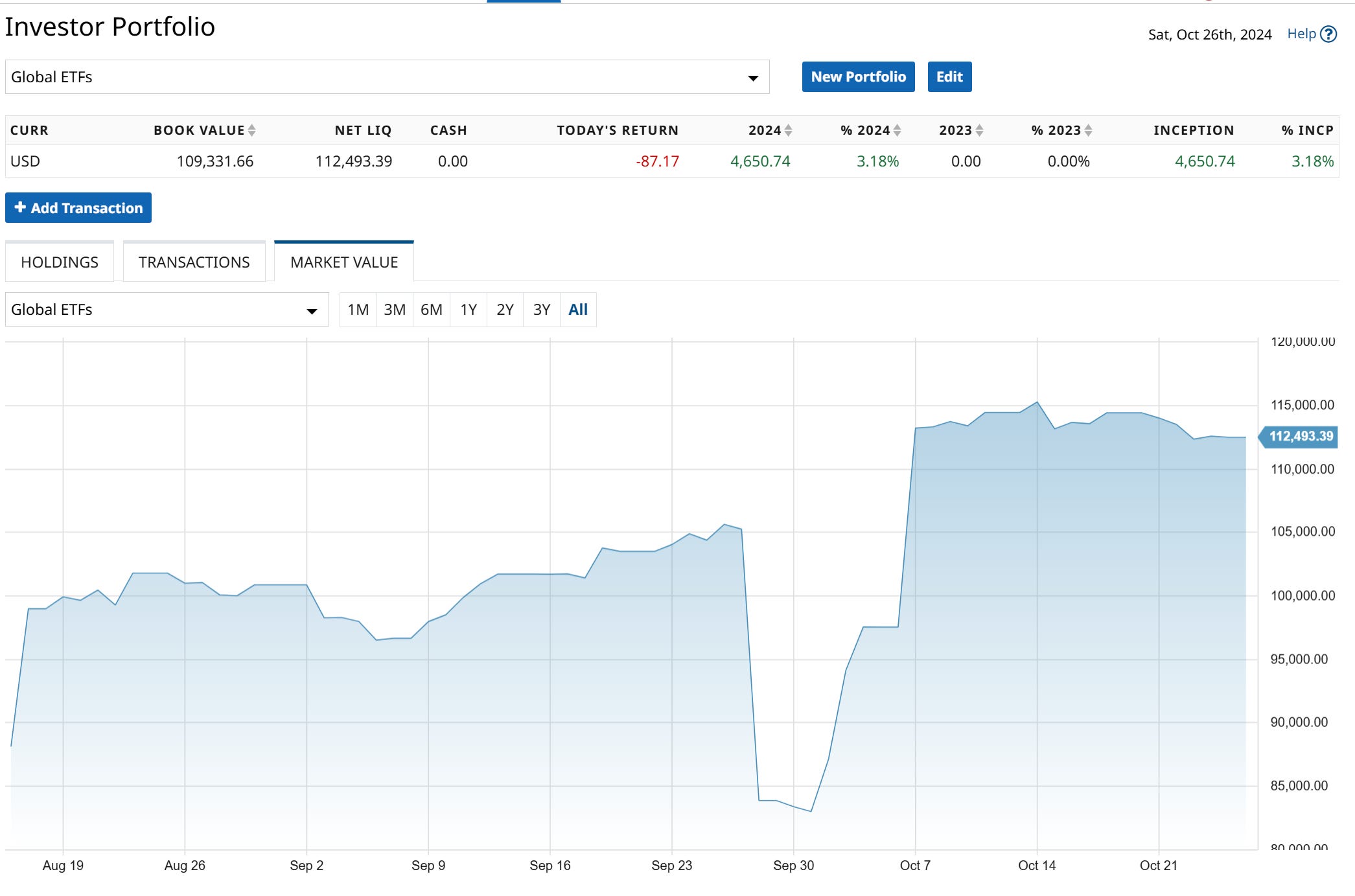
All ETFs except the two Indian ETFs and the China Kranes CSI Internet ETF trade higher than where I bought and recommended them.
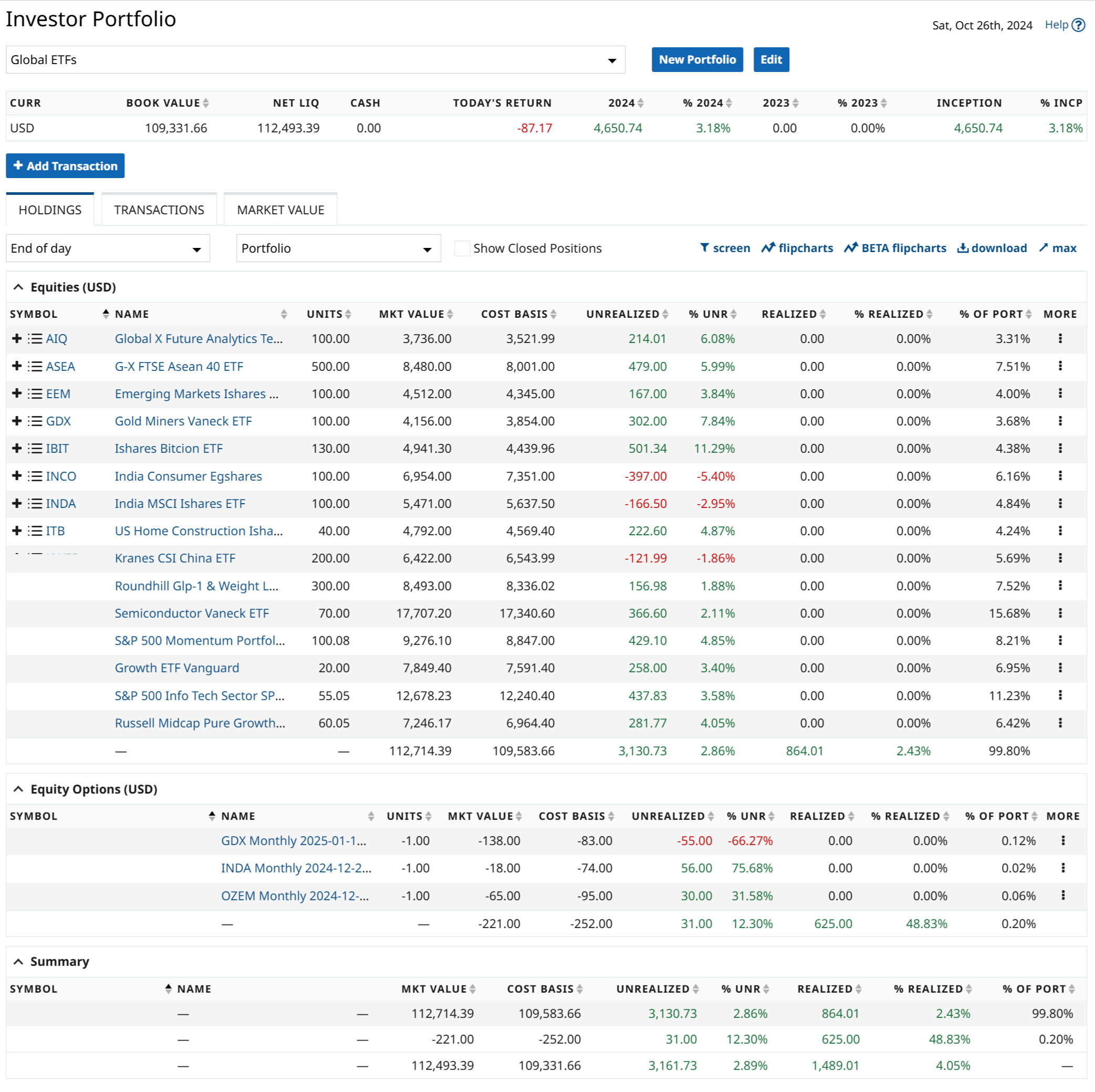
I did not buy or sell any ETFs during the week. I want to add two new ETFs to the portfolio starting next week (see next section for more information on these ETFs):
iShares Top 20 U.S. Stocks ETF and
iShares Nasdaq Top 30 Stocks ETF.
This Week's ETF Spotlight: Two New ETFs To Form The Core Of The Portfolio
Blackrock has just launched three new exchange-traded funds, including two that offer exposure to the largest U.S. stocks.
(1) iShares Nasdaq Top 30 Stocks ETF
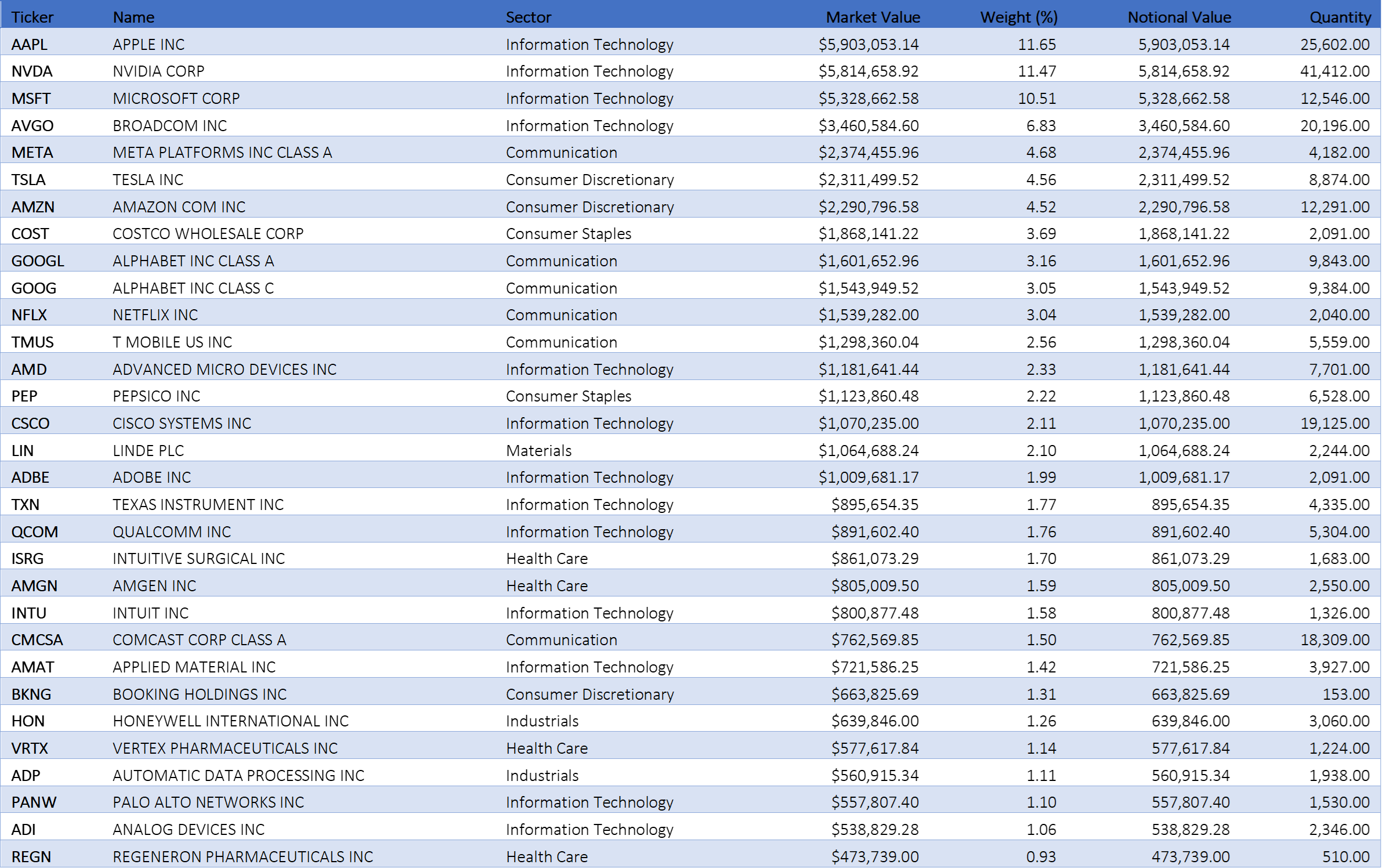
The iShares Nasdaq Top 30 Stocks ETF (QTOP.O) lets investors hold the 30 biggest non-financial stocks, including mega-cap tech. It has secured backing from the University of California's investing arm.
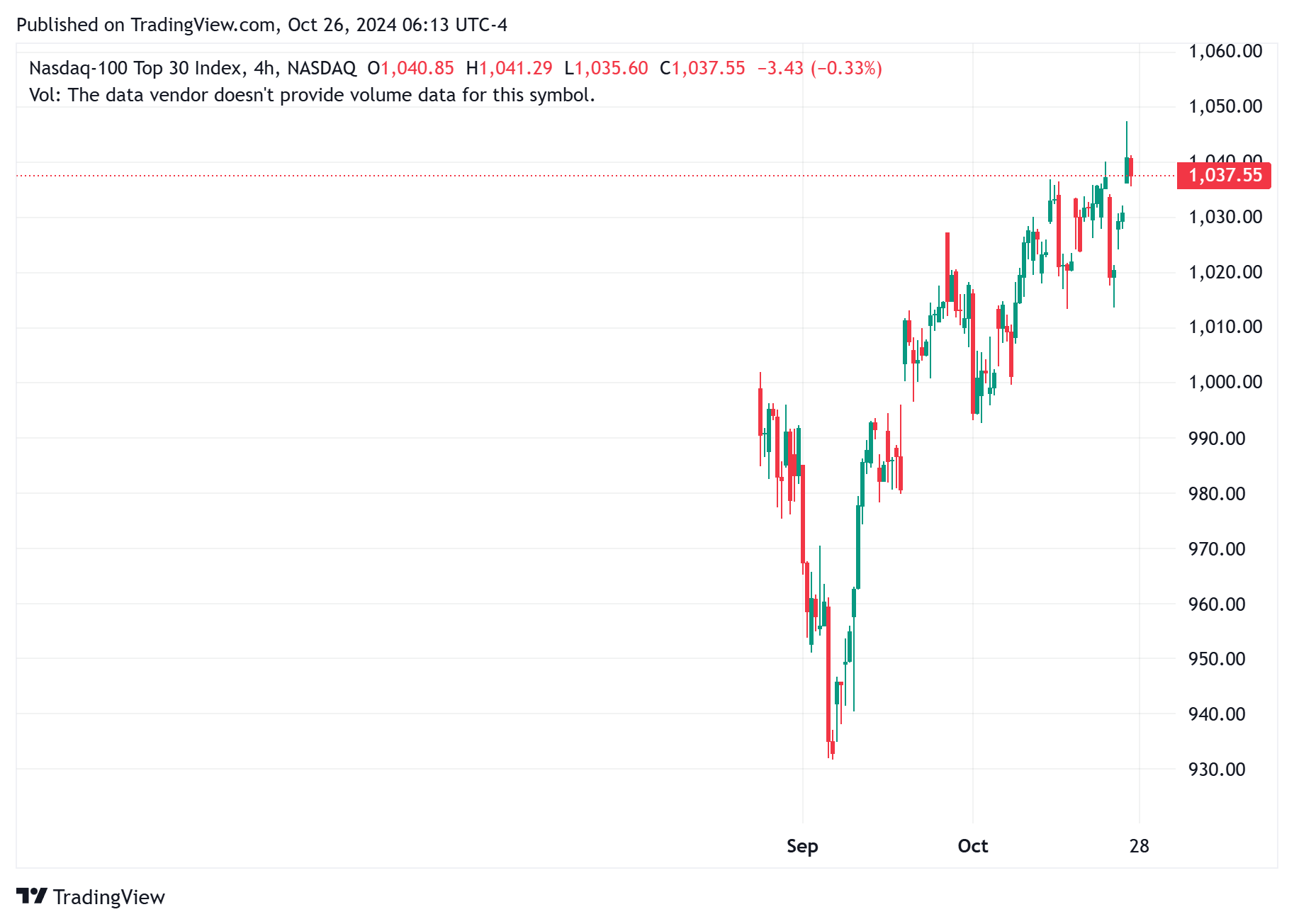
iShares Nasdaq Top 30 Stocks ETF (QTOP)
Fund Objective: Invests in the 30 largest companies by market capitalization within the Nasdaq 100 index.
Number of Holdings: 30.
Top Three Holdings: Apple (AAPL), Nvidia (NVDA), and Microsoft (MSFT).
Expense Fee: 0.20%.
The expense ratio is 0.20%. The holdings as of 24 October are:
(2) iShares Top 20 U.S. Stocks ETF
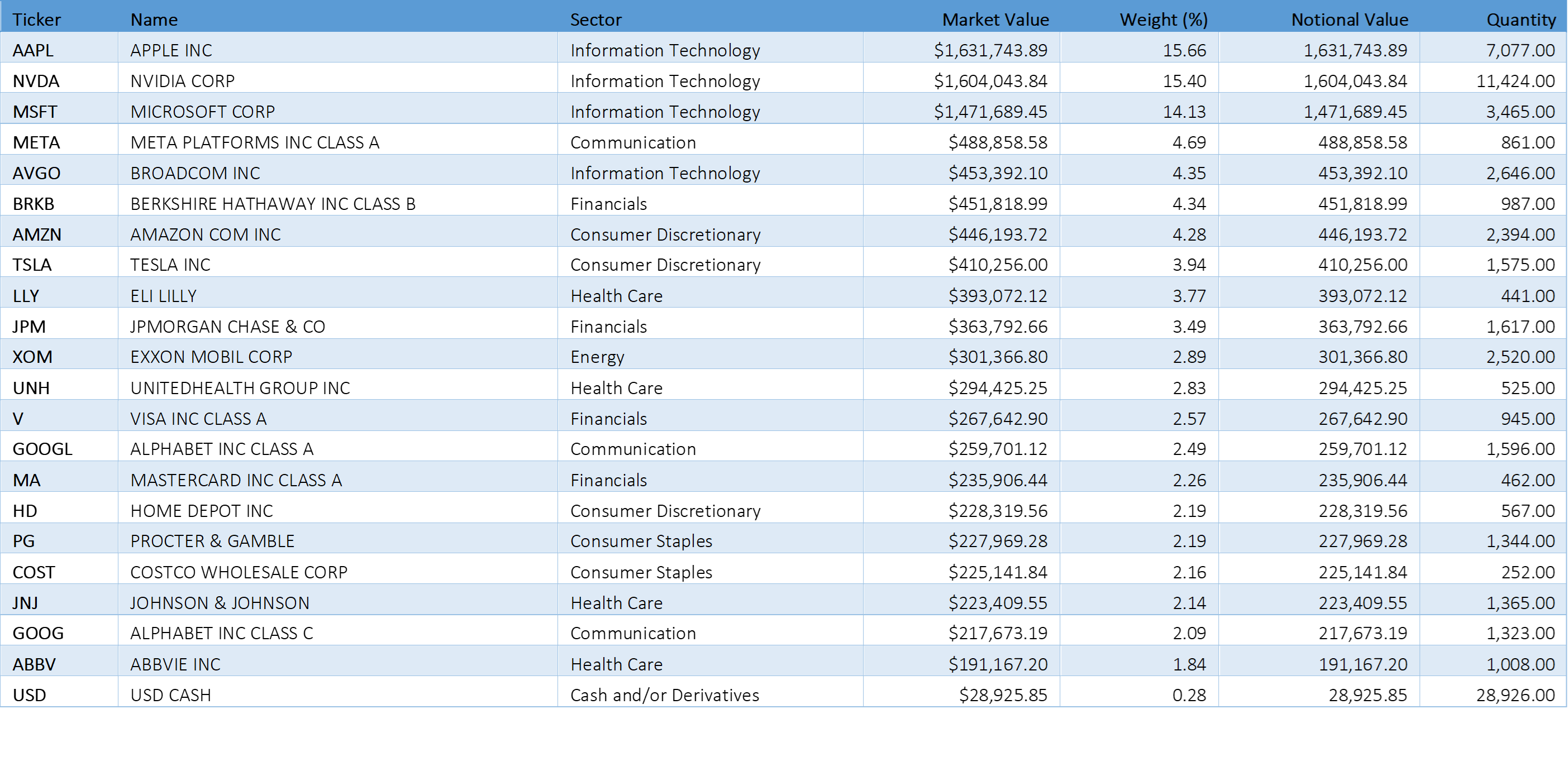
The iShares Top 20 U.S. Stocks ETF offers access to the 20 largest U.S. companies.
iShares Top 20 U.S. Stocks ETF (TOPT)
Fund Objective: Invests in the 20 largest U.S. companies by market capitalization within the S&P 500 index.
Number of Holdings: 20.
Top Three Holdings: Apple (AAPL), Nvidia (NVDA), and Microsoft (MSFT).
Expense Fee: 0.20%.
The top 20 companies in the S&P 500 have contributed to more than two-thirds of the index's returns over the past three years.
The iShares Top 20 U.S. Stocks ETF (TOPT) and iShares Nasdaq Top 30 Stocks ETF (QTOP) are rebalanced quarterly.
This schedule allows the funds to adjust their holdings according to the top U.S. and Nasdaq-listed companies' current market values and rankings in their respective portfolios, ensuring alignment with their indices. These quarterly adjustments help the ETFs maintain their target exposure to the largest companies within their focus areas.
I want to add the two ETFs to the portfolio starting next week.
(3) iShares Nasdaq-100 ex Top 30 ETF
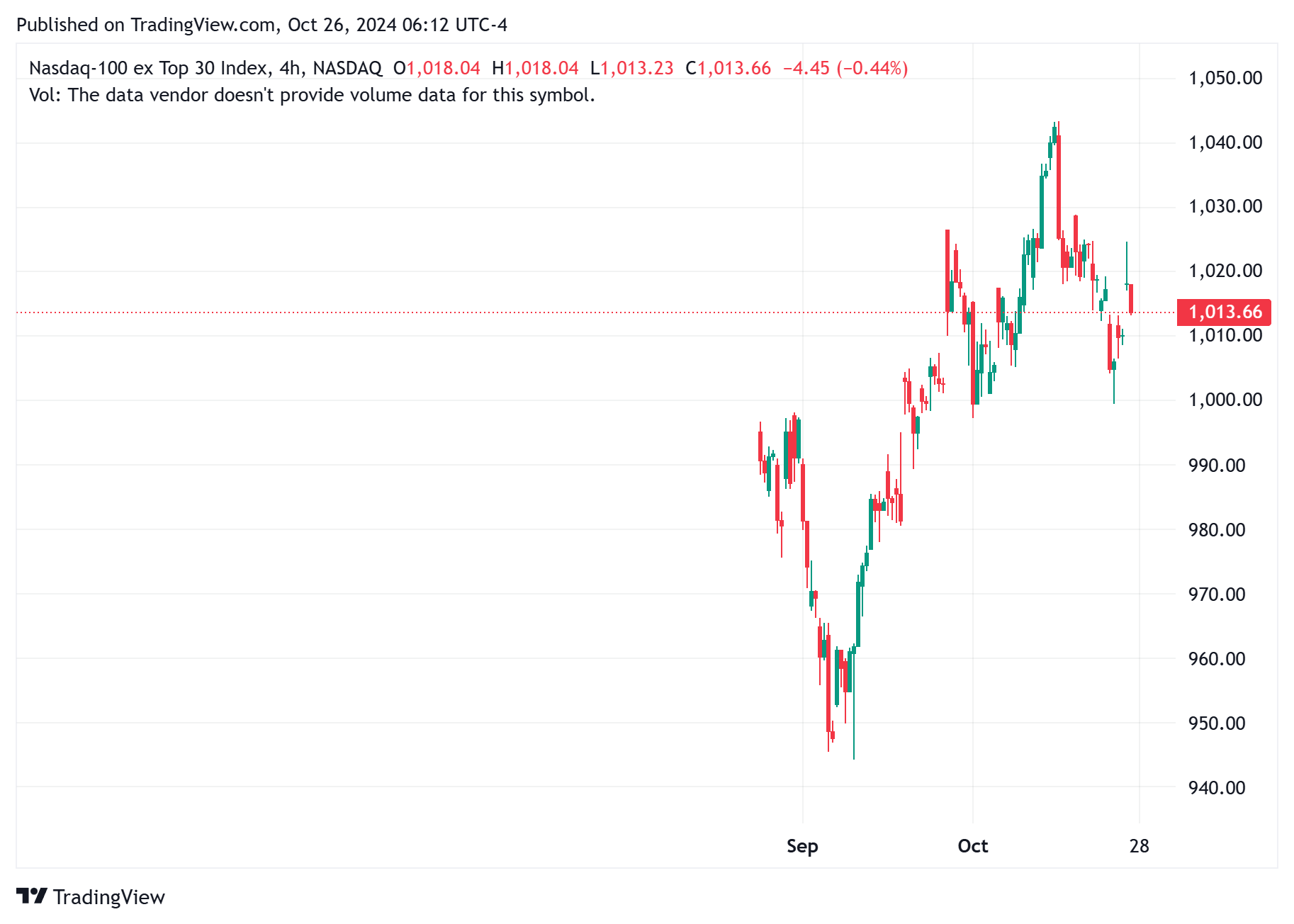
The iShares Nasdaq-100 ex Top 30 ETF (QNXT.O) will invest beyond the Nasdaq 100 behemoths to capture the growth of relatively more minor growth firms.
iShares Nasdaq-100 ex-Top 30 ETF (QNXT)
Fund Objective: Invests in the 31st to 100th largest companies by market capitalization within the Nasdaq 100 index.
Number of Holdings: 30.
Top Three Holdings: Micron Technology (MU), Starbucks (SBUX), and Gilead Sciences (GILD).
Expense Fee: 0.20%.
BlackRock recently said it had also launched two new funds centered on technology growth and artificial intelligence.
iShares A.I. Innovation and Tech Active ETF (NYSEARCA:BAI)
Fund Objective: Invests in a concentrated portfolio of 20-40 global AI and technology stocks across all markets.
Number of Holdings: 34
Top Three Holdings: Nvidia (NVDA), Meta Platforms (META), and Microsoft (MSFT).
Expense Fee: 0.68%.
iShares Technology Opportunities Active ETF (NYSE:TEK)
Fund Objective: Invests in global technology companies across semiconductors, software, hardware, internet, services, content and infrastructure, and new industries.
Number of Holdings: 57
Top Three Holdings: Nvidia (NVDA), Microsoft (MSFT), and Apple (AAPL).
Expense Fee: 0.75%.
BAI and TEK will be the latest ETFs to join several existing funds that are focused on AI and technology, including:
KraneShares Artificial Intelligence and Technology ETF (AGIX)
GX Artificial Intelligence & Tech ETF (AIQ)
GX Robotics & Artificial Intelligence ETF (BOTZ)
ALPS Disruptive Technologies ETF (DTEC)
First Trust NASDAQ Artificial Intelligence and Robotics ETF (ROBT)
Robo Global Artificial Intelligence ETF (THNQ)
Roundhill Generative AI & Technology ETF (CHAT)
I will discuss these ETFs in the next edition next week.
