


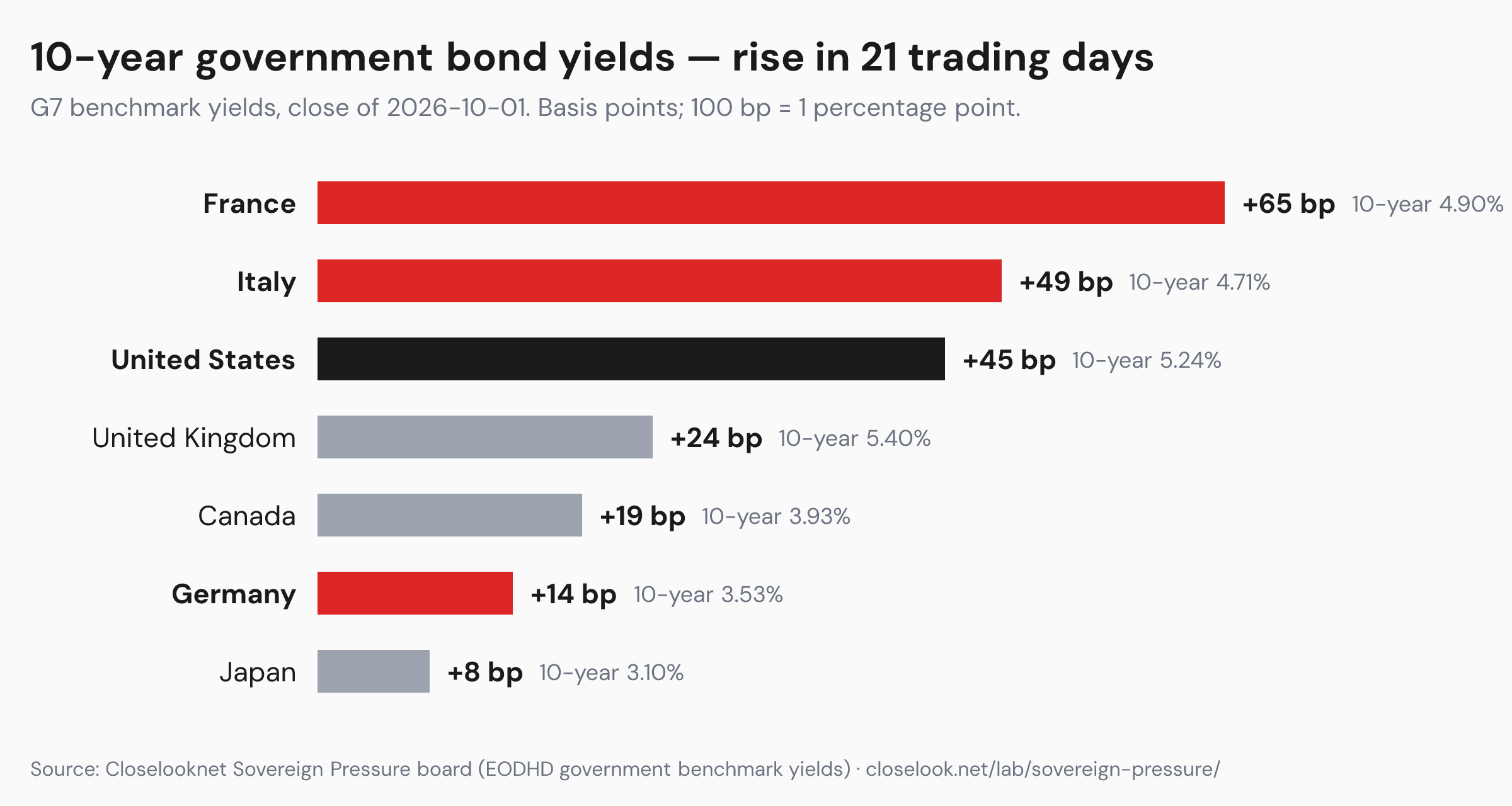
In the 21 trading days to Thursday, the US 10-year Treasury yield rose 45 basis points to 5.24%, France’s 65 to 4.90%, Italy’s 49 to 4.71% and Germany’s 14 to 3.53%. The engines are different. In the United States yields rise because the economy runs hot. In Europe they rise because governments borrow too much while growth stays weak. For stocks that difference matters more than the level.

America: rates up because growth is strong
Ed Yardeni calls it “growthflation”: strong growth plus inflation stuck around 3%. On Thursday the 10-year Treasury yield briefly touched 5.33% and the 30-year 5.68%, both 24-year highs. His numbers from this week’s data:
Nominal GDP — growth before inflation is taken out — rose 6.3% on the year in the second quarter.
Jobs: first-time jobless claims fell to 197,000, near a 57-year low; continuing claims to 1.70 million, the lowest since March 2023. Announced job cuts (Challenger) fell to 43,281, the lowest September since 2022. ADP counted 90,000 new private jobs.
Factories: the ISM manufacturing survey stayed at 54.5, its ninth month above 50, the line between growth and contraction. Its prices-paid index rose to 77.9.
Building: construction spending rose 0.9% in August; office construction, which includes data centres, jumped 4.6% in a month.
Yardeni’s point: a 5.2% bond yield does not choke an economy whose nominal output grows 6.3%. It only bites if yields rise above that growth rate, which he does not expect. AI spending works like a private stimulus programme, and the bond market is pricing it.
Closelooknet on Google
Get our reads first in Top Stories and AI answers. One tap, no account needed here.
Europe: rates up because of debt
Europe’s mirror image looks different. Growth is modest: in the second quarter the economy of the euro area grew 1.0% on the year, Germany 1.0%, Italy 1.0% and France only 0.5% (Eurostat). Factory surveys have improved — the euro-area manufacturing PMI reached 52.9 in September, a four-year high, on orders for AI and defence equipment, with Germany at 53.9 but France at 50.6 and Italy at 50.4. Inflation, however, jumped on energy: 3.3% in Germany, 3.4% in France and 4.2% in Italy in September, after the oil and gas shock from the Strait of Hormuz. The European Central Bank has raised its deposit rate twice, to 2.5%.
What separates the three countries is their debt:
France runs a budget deficit of about 5.4% of GDP this year and its debt reaches a record 119.3% of GDP. Prime Minister Sébastien Lecornu wants €54 billion of savings in the 2027 budget, through a deeply divided parliament. On our board France now pays 4.90% for ten years — more than Italy’s 4.71% — and its yield rose the most in the G7 in the last 21 trading days.
Italy carries debt of about 138.5% of GDP and pays about 4.6% of GDP in interest, but its deficit is below 3%. Its yield rose almost as fast as France’s.
Germany starts from debt of about 62.5% of GDP, but is borrowing for defence and infrastructure: debt is seen near 80% by 2029, and private investors have to absorb a record €234 billion of new Bunds this year. Its yield rose the least of the three: the market still trusts German credit.
Same rise, different engines — the United States against Germany, France and Italy
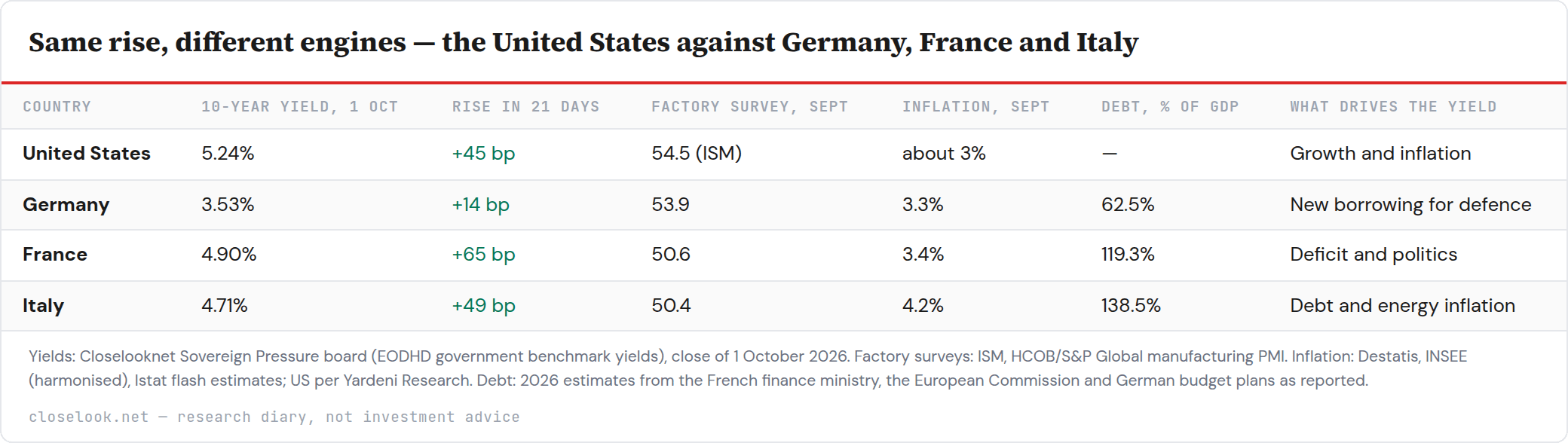
Table as text
Yields: Closelooknet Sovereign Pressure board (EODHD government benchmark yields), close of 1 October 2026. Factory surveys: ISM, HCOB/S&P Global manufacturing PMI. Inflation: Destatis, INSEE (harmonised), Istat flash estimates; US per Yardeni Research. Debt: 2026 estimates from the French finance ministry, the European Commission and German budget plans as reported.
The arithmetic that separates them
A simple test tells a healthy rise in yields from a dangerous one: compare the interest rate a country pays with how fast its economy grows in money terms. If the economy grows faster than the interest bill, debt shrinks relative to income over time. If the rate is higher, debt grows on its own.
In the United States, nominal growth of 6.3% sits above a 5.24% yield. For France the rough arithmetic runs the other way: real growth of 0.5% plus inflation of around 3% gives nominal growth of roughly 3.5%, well below the 4.90% it now pays for ten years. Germany, with roughly 4% nominal growth against 3.53%, still has room. Italy is about even. These are rough figures — inflation is a September reading, growth a second-quarter one — but the gap for France is large enough to survive the rounding. That is why the market charges France more than Italy.
Our read
For US stocks, a yield driven by growth arrives together with earnings; the risk is the level, and the long-bond fund TLT still sits below 78. For European stocks, a yield driven by debt arrives without the earnings. That was visible on Thursday: Wall Street recovered into the close while Paris’s CAC 40 fell 1.6% and Frankfurt’s DAX 1.0%. Europe’s growth sits in narrow pockets — the AI and defence orders behind the factory survey, the names in our Euro-AI 50 — not in its bond market. Today’s US jobs report tests the American side of the story; the French budget fight tests the European one. This is a diary of what we watch, not advice.
C · members block
Into next week
Today: the US jobs report at 14:30 CEST, about 90,000 expected, unemployment 4.1%. Next week: the French budget debate and the start of the US earnings season. The lines: US 10-year 5.24% (24-year high 5.33% intraday on 1 Oct); France 10-year 4.90% against Italy 4.71%; TLT 78 from below.
The signals behind thisEach line links to the tool it comes from
LabSovereign Pressure — G7 government bond yields every day→Morning 10Jobs day — futures +0.3% before payrolls; Nike −8.7% after hours→IndexEuro-AI 50 — Europe’s AI and defence suppliers, reset to equal weight→LabRates — the long end, TLT and the 30-year every day→