Broadening, Not Rotation — Power Semi Joins, Agentics Recovers
Power Semiconductors just took the one-week lead inside Rubin. Six of seven AW25 sub-sectors completed a synchronized V-shape. Hyperscalers never participated in the crash. Nothing handed over — every

Edition · April 23, 2026 · KW 17
Thank you for reading this week’s edition of Closelook@Hypergrowth, dated April 23, 2026 👋. The next edition will be published on April 29, 2026.
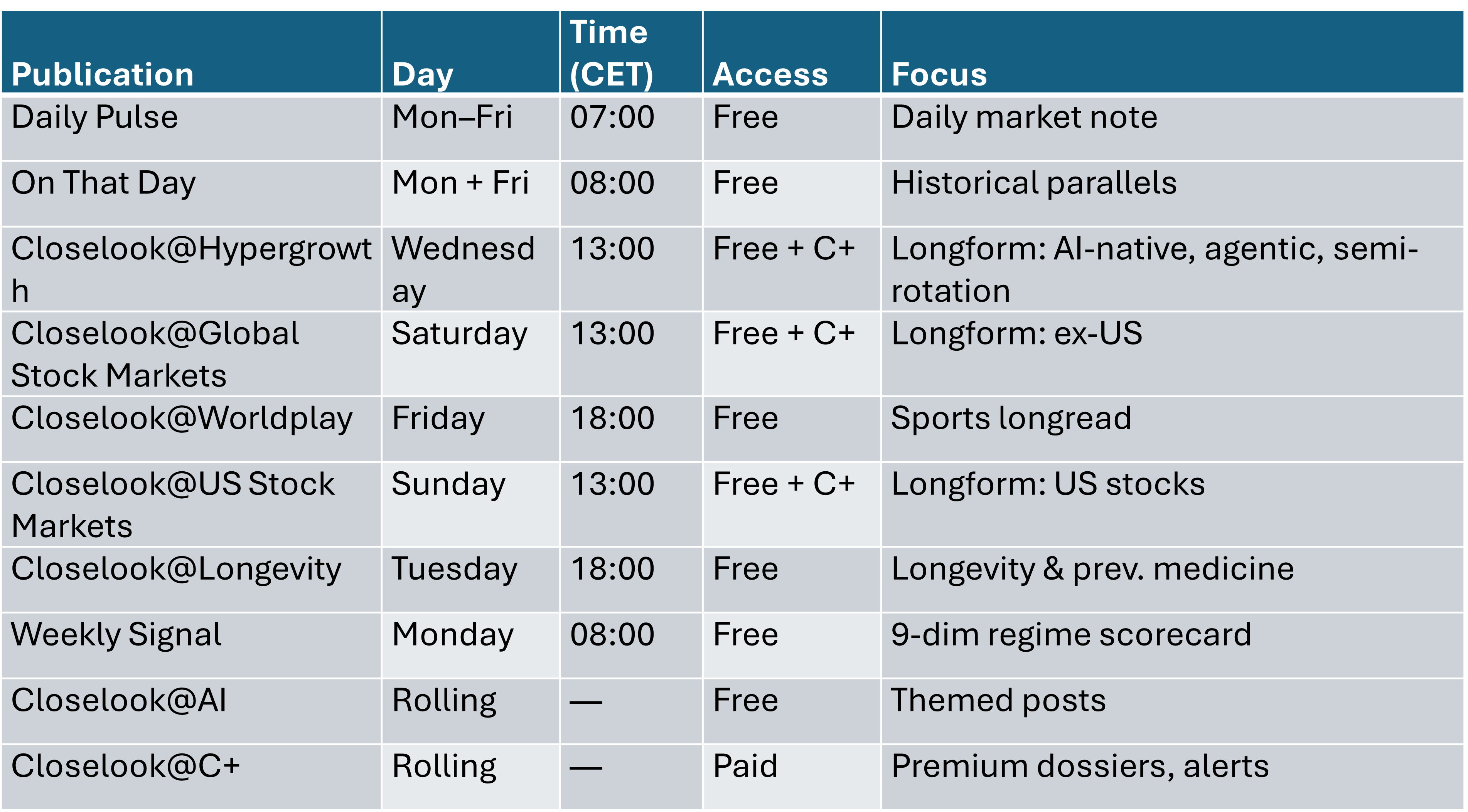
This edition is thematic: a deep read on where capital is moving inside the AI hardware supply chain and inside agentic software — two places, one signal. For the schedule of our other publications, please check the publishing schedule at the end.
Table of Contents
3. The State — Broadening, Not Rotation
4. The Outlook — Where the Wave Runs Next
5. What May Lie Ahead: Macro Setup
6. What May Lie Ahead: Technical Setup
7. The Hypergrowth Portfolio: What We Did
8. The Hypergrowth Portfolio: What We Plan To Do
9. Knowledge Corner: Broadening vs. Rotation
10. Upcoming Transactions: Be Informed
11. What May Go Wrong: Risk & Change Triggers
12. Final Words
(1) This Week’s Action
The easy read this week is that NVIDIA compounded again, and semis kept running. The accurate read is different: Power Semiconductors just took the one-week lead within our Rubin 100 index, AW25 Agentic completed a synchronized V-shape recovery across six of seven sub-sectors (potentially a mean-reversion type only), and hyperscalers never actually participated in the agentic crash.
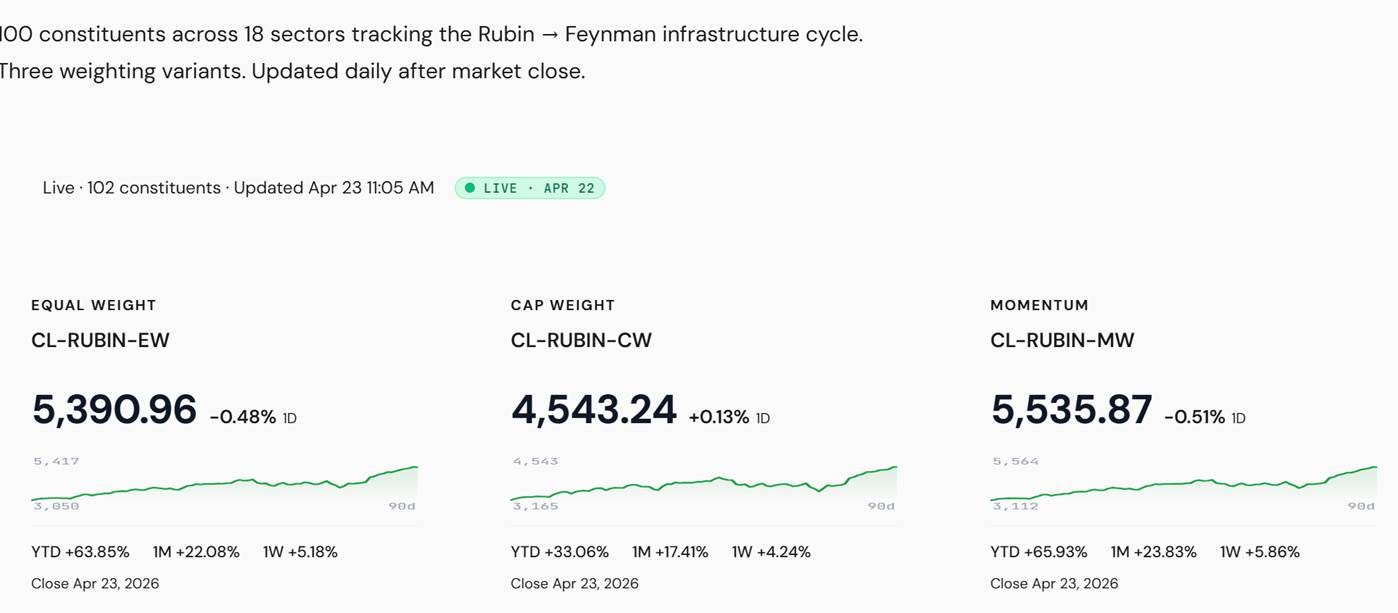
Rubin sector indices — week at a glance
Chart 1 — Rubin Sector Indices Across Three Timeframes
None of the earlier leaders are handing over. New ones are joining on top. That is broadening, not rotation — and it has a specific shape.
Rubin 100 sector indices compared across YTD, 1-month and 1-week views
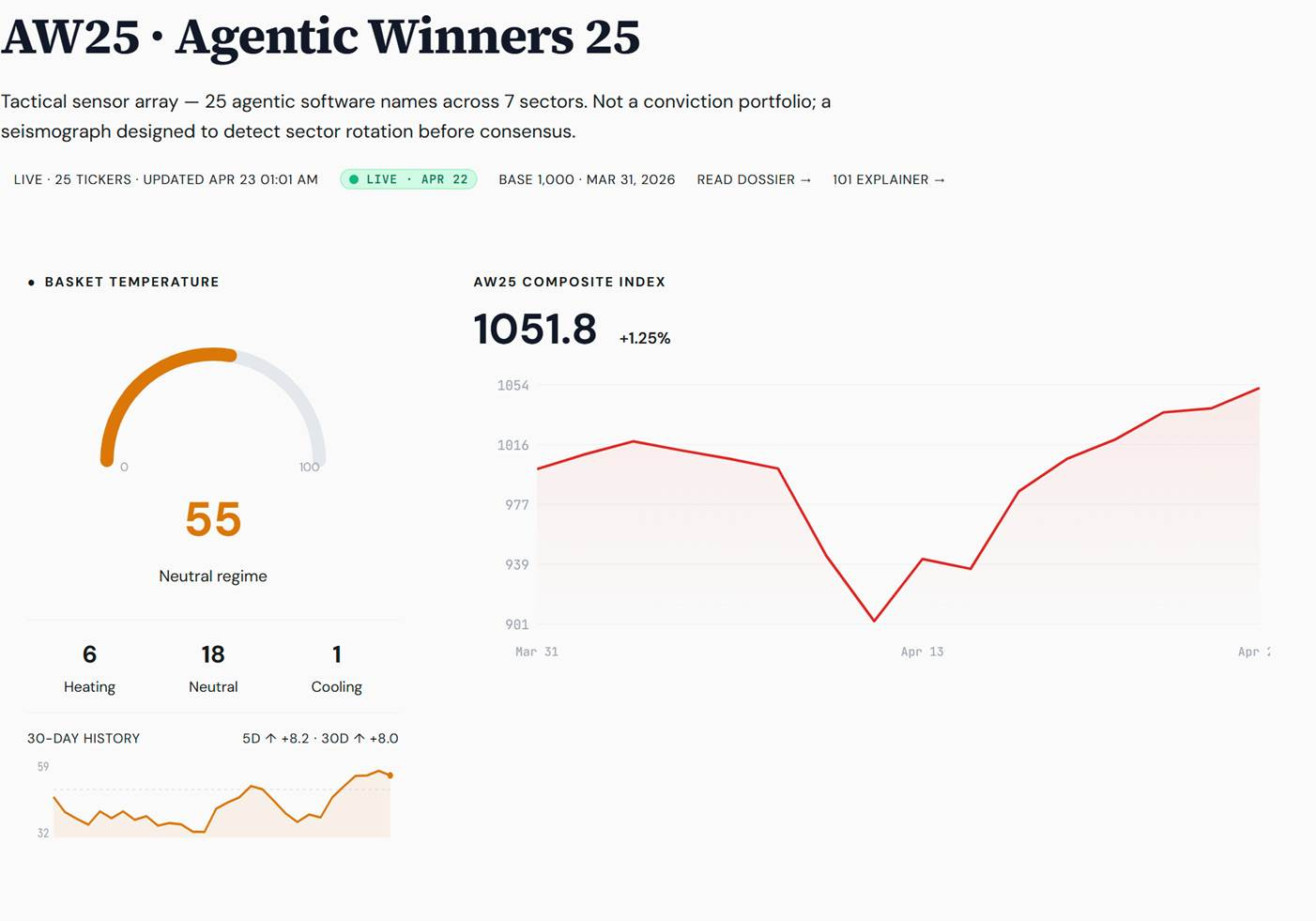
Chart 2 — AW25 Composite Index · 21-Day V-Shape
This Week’s Signals
Two OBV divergences in AW25 basket: OKTA and PTC — both in the coldest quintile (basket temperature 47–48). Divergences in cold names are early-turn candidates, not confirmations. Flagged for watch, not position.
What Happened (as of 21 April 2026)
Two things happened in parallel that we think are the same thing.
Inside the Rubin 100 universe, the sector ranking reordered itself. On a year-to-date basis, High-Speed Interconnects still leads at +124%. On a one-month basis, Interconnects keeps running at +71%, but Power Semiconductors has moved to fourth place at +37%. On a one-week basis, Power Semiconductors is first at +13.53%, and Interconnects has dropped to sixth at +7.95%. Every earlier leader is still positive on every timeframe. A new leader has joined on top. Nothing rotated out. One more layer rotated in.
Inside AW25 — our 25-name agentic software sensor array — the picture is different in shape but identical in meaning. The composite index dropped from 1,005 on March 31 to 905 on April 10, a 10% drawdown in eight trading days. It has now recovered to 1,036, above the starting point. Six of the seven sub-sectors traced the same V-shape. The MAG7 Gateway sub-sector did not participate in the crash at all — it is up 12.65% over the 60-day window without interruption. Zero of the 25 names in the basket are currently classified as “cooling.” Nineteen sit neutral, six are heating.
Both stories have the same signature: the old leadership did not hand over. New leadership joined above and around it. The semis rally is broadening from Early Ramp into Mid-Ramp. The agentic recovery is broadening from hyperscalers outward into the rest of the stack. §3 makes the case that this is the structurally stronger setup, not the weaker one — and §4 names what comes next.
(2) Overview: The Semi Map
Sorted by 1W % descending · All returns in USD · Close of April 17, 2026. This is a thematic edition on the semiconductor supply chain; the standard Hypergrowth portfolio map returns next week.
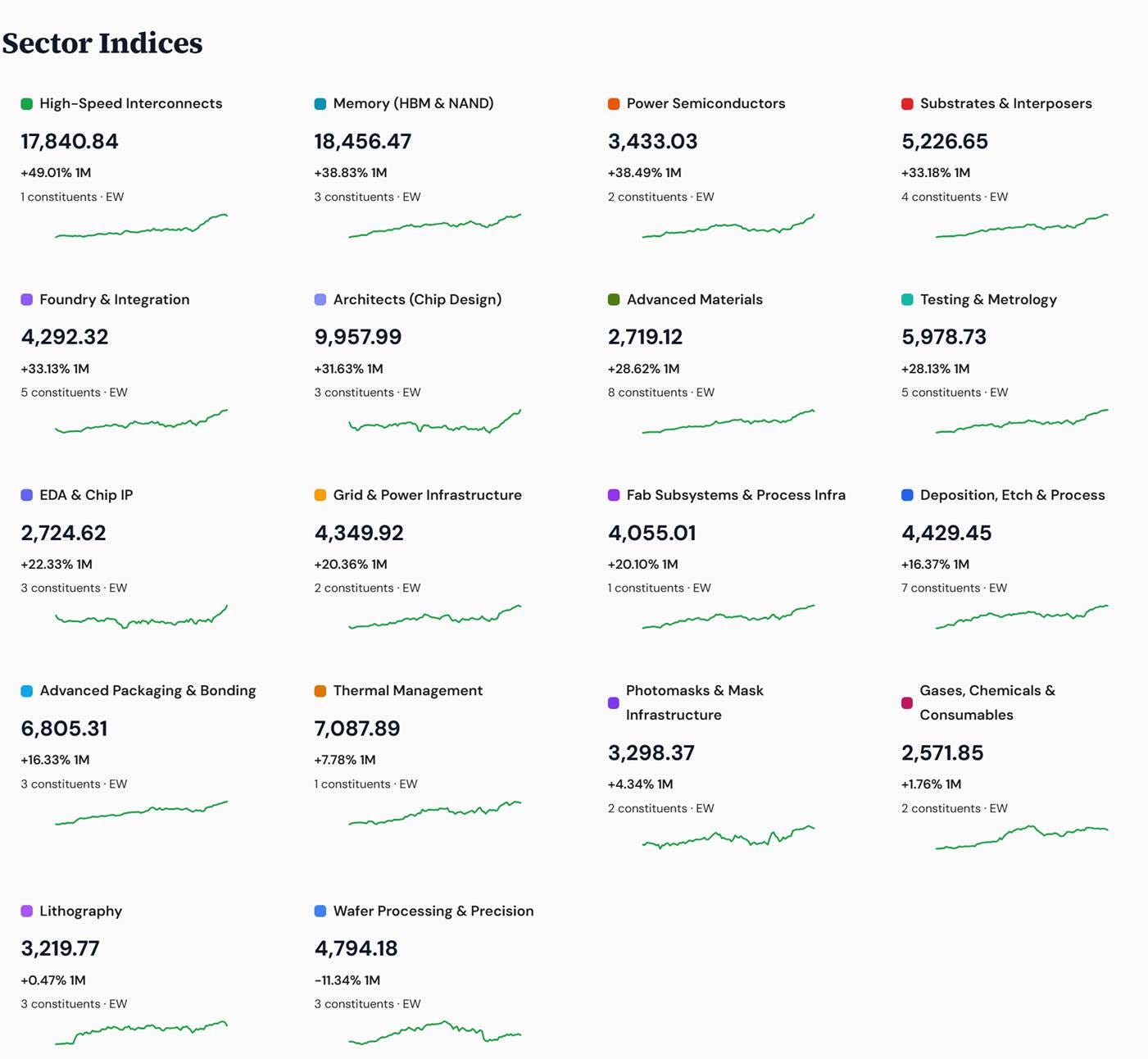
Rubin 100 sector indices — three-timeframe view (YTD · 1M · 1W)
Rubin 100 Sector Indices (as of 22 April 2026)
The broadening is only visible when you put the three timeframes side by side. YTD shows the history. 1M shows the acceleration. 1W shows who is leading right now. Read them as a sequence.
Power Semiconductors went from Rank 7 YTD to Rank 3 on the month to Rank 1 on the week. That progression is the acceleration. And the old leaders did not fall off the board — High-Speed Interconnects is still #1 on the monthly timeframe. This is broadening.
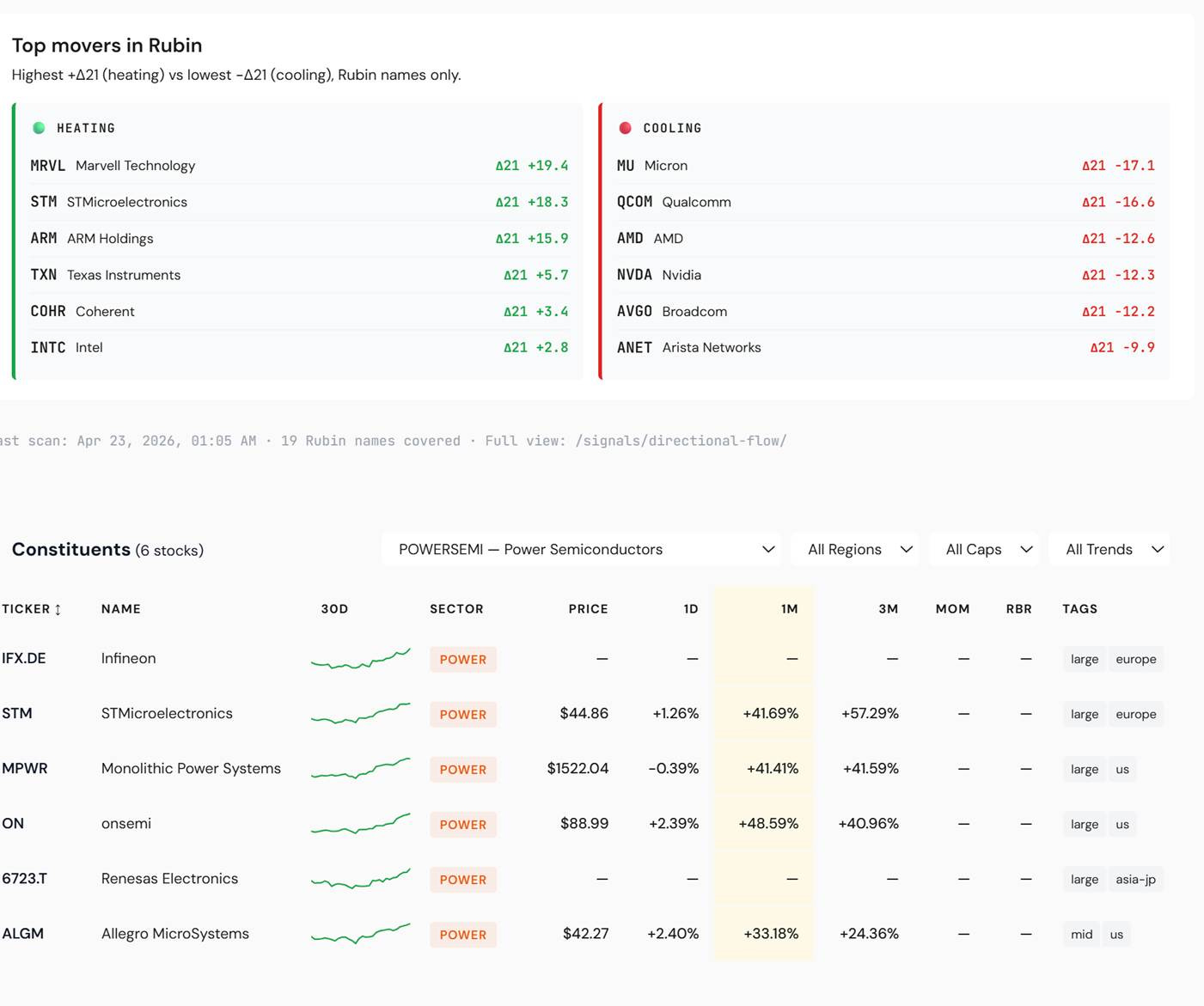
Power Semiconductors — six constituents driving the cohort
Power Semiconductors — The Six Constituents
Why Power is running now: The GB200 and Rubin rack architectures pull 120–140 kW per rack, a step-change from Hopper’s 35–40 kW. That is not a GPU story — it is a full power-delivery redesign. SiC and GaN components, high-voltage DC distribution, on-board converters per accelerator. Jensen Huang called power the next bottleneck on the GTC stage. ON, STM and MPWR sit directly in that bill of materials. The 1W move is the market pricing that bill in real time.
Thermal Management — Lagging, But for Structural Reasons
Thermal Management sits lowly on the 1W list (+2.22%) and on the 1M list (+20.32%). That looks like a contradiction of the broadening thesis. It is not.
Thermal Management had its leg. Vertiv — the dominant name in the cohort — ran 2023–2026 and is now digesting that move at a high base (despite another earnings beat yesterday). No new leader has emerged in the sector to replace it. Compare this with Power Semi, where ON, STM and MPWR are all posting 30%+ months simultaneously. Thermal is not the next joining layer. Power is.
The ordering of the broadening matters. Thermal first (2023–2025), now consolidating. Power second (now). The next layer is not Thermal re-accelerating — it is something further down the dependency chain.
Thermal management — consolidation at a high base
(3) The State — Broadening, Not Rotation
This is the core read of this edition. Everything else in the newsletter supports this one thesis.
The Thesis
The rally is broadening in two domains simultaneously. Inside Rubin, Early Ramp leaders keep compounding while Mid-Ramp layers — Power Semiconductors first — take the one-week lead. Inside AW25, six of seven agentic sub-sectors completed a synchronized V-shape recovery in twenty-one days, while MAG7 Gateway never participated in the crash. Nothing handed over. Everything added. That is the signature of a rally getting wider, not thinner — and two sub-sectors (Platform −1.03%, Vertical −2.88% over 60 days) tell us it still has runway.
1. Inside the semis, the broadening is sequential. Our Rubin 100 index moved through its first phase cleanly. Memory, Packaging, Substrates, Interconnects led from January through March. Power Semiconductors is the new one-week leader. That does not mean Memory stopped — Memory is still up on the week and on the month. It means capital kept buying Memory and also started buying Power. The three screenshots of the same sector map at YTD, 1M and 1W show the same fourteen names in the top half of the table. Only the ordering changes.
b) The Mid-Ramp layer has started, but Thermal did not go with it. Power Semiconductors is running. Thermal Management is not. Vertiv — the dominant thermal name — had its run in 2023–2025 and is consolidating at a high base. No new leader has emerged in the cohort. That is the disciplined read: broadening is not indiscriminate. Power joined because the GB200/Rubin rack architecture redefined its bill of materials. Thermal did not join because no analogous catalyst has landed.
c) The AW25 V-shape is the cleanest regime chart we have seen in 2026. The composite index went from 1,005 on March 31 to 905 on April 10 to 1,036 on April 20. Eight trading days down, eight trading days up. Every sub-sector traced the same shape with two exceptions: MAG7 Gateway (which never dropped, +12.65% on 60 days) and Vertical (which has recovered but still sits −2.88% on 60 days). The basket temperature reads 55 — neutral regime with warming bias. Six names heating, nineteen neutral, zero cooling. Zero. That is the number that tells you this is not a bounce, it is a regime shift.
d) Hyperscalers never participated in the agentic crash. MAG7 Gateway in AW25 is up 12.65% over the same 60-day window that saw the rest of the basket crash and recover. GOOGL is the hottest name in that sub-sector at 62. The hyperscaler cohort was a quiet safe haven inside agentic — the opposite of how most commentators framed the drawdown as “tech crashing.” Tech did not crash. Everything in AW25 except hyperscalers crashed, and then recovered. Hyperscalers kept compounding through it.
e) The first agentic winners turning are names that were left for dead. The hottest constituents in AW25 right now are DigitalOcean at a basket score of 75, Twilio at 68, Fastly at 68. These are not the obvious growth names. DigitalOcean is a neocloud pure-play that got written off when hyperscalers captured the infrastructure narrative in 2024. Twilio is the developer-API bellwether that has been in a three-year drawdown. Fastly is edge compute, which most analysts consider structurally challenged. All three sit in sub-sectors — Neocloud/Edge (+0.42% 60D) and Commerce+Orch (+6.75% 60D) — that have just completed their V-shape. These are signals of where capital is moving, not position recommendations. We do not hold them.
f) Two sub-sectors still lag. That is the runway. Platform (S2) sits at −1.03% over 60 days. Vertical (S6) sits at −2.88%. Both have traced the V-shape; neither has closed above the starting line. The coldest AW25 constituents — INTU at 46, WDAY at 47, PTC at 47, ESTC at 47 — concentrate in exactly these two sub-sectors. If the broadening thesis holds, these are the names that turn next. If the thesis breaks, these are where it breaks first. The watchlist in §4 makes this operational.
Regime Verdict — 🟢 Broadening Bull
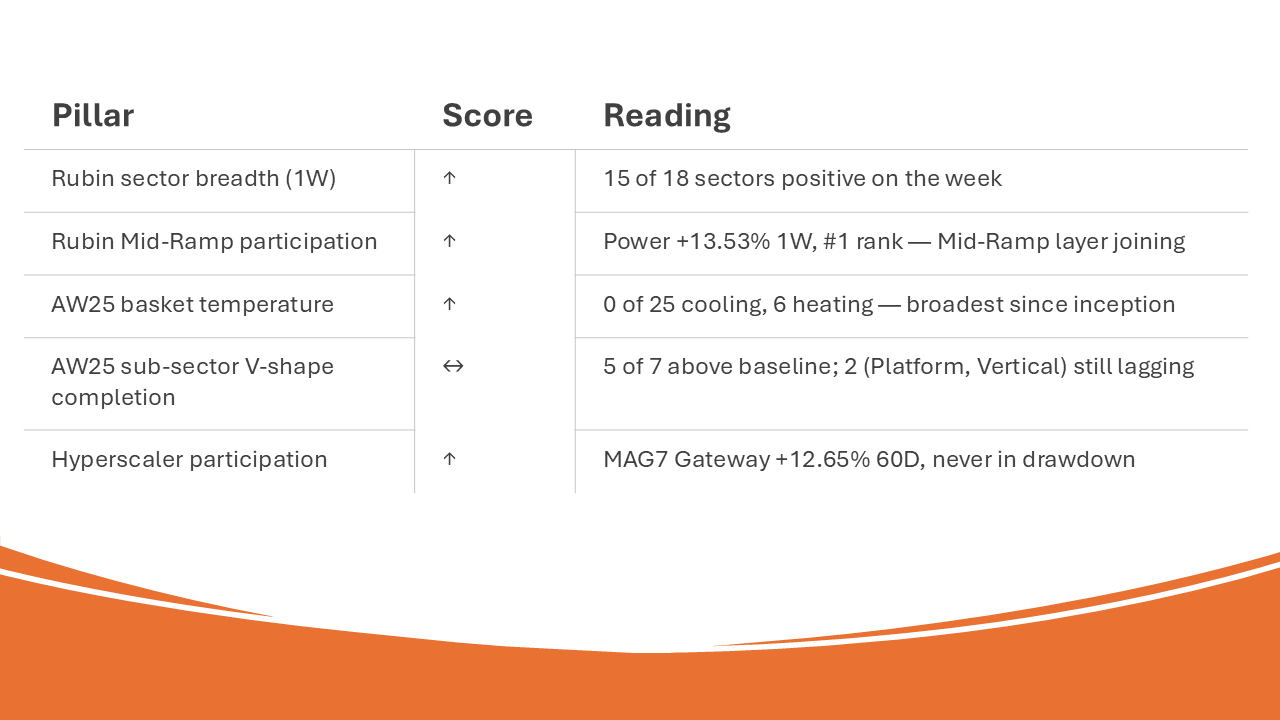
Score 4 of 5 is a strong signal. The one neutral pillar is the structural tell: Platform and Vertical sub-sectors still below baseline means the broadening has not completed. That is bullish, not bearish — it says the rally has names left to rotate into before the signature exhausts.
The Dispersion Behind the Composite
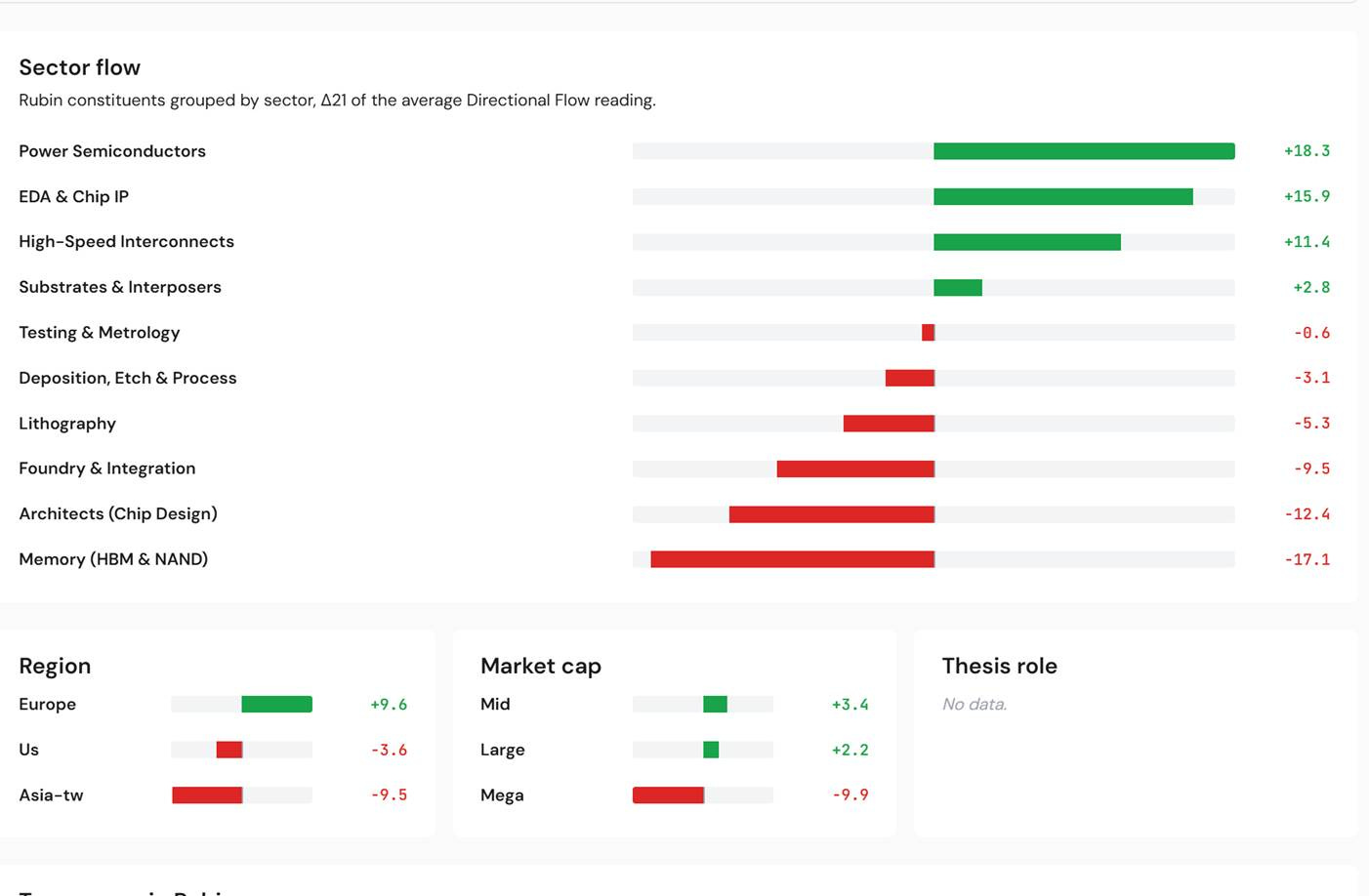
The composite number hides the dispersion. Here is the 21-day cohort spread that actually matters:
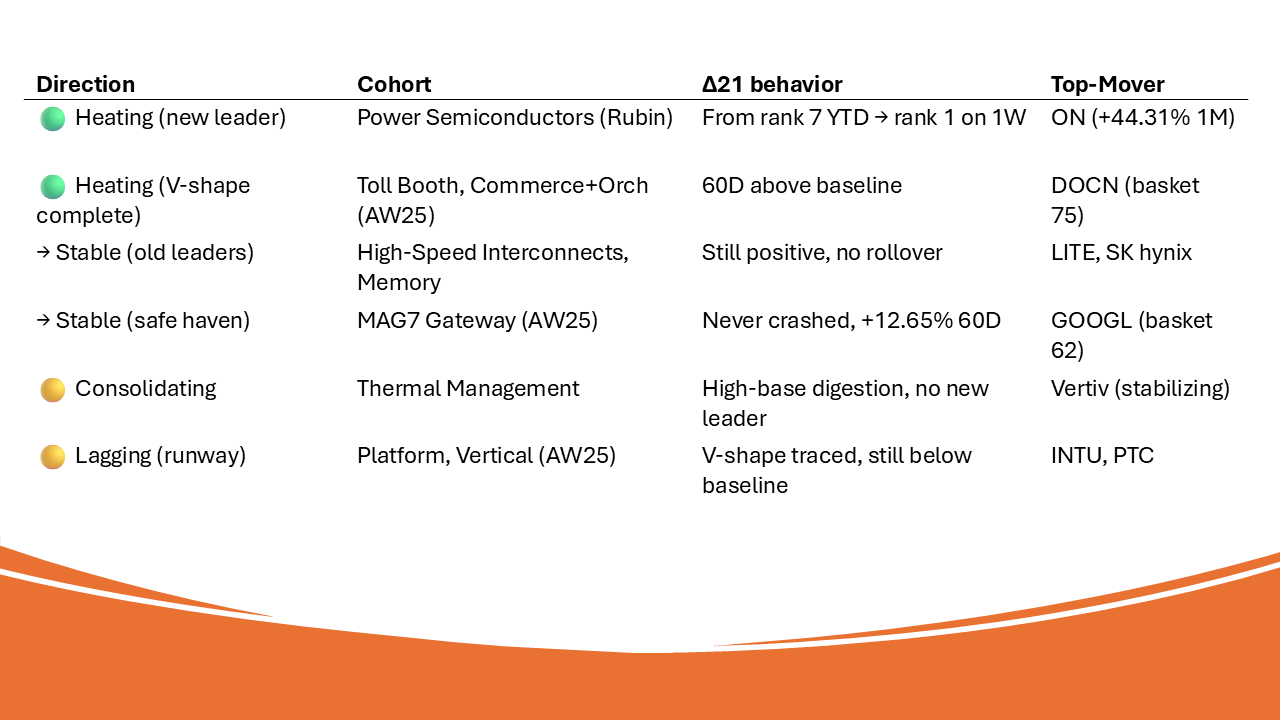
Spread between hottest and coolest cohort in the Rubin/AW25 combined universe: +46 points. Wide spread means active rotation; broad participation means nothing cooling. Both at once is the broadening signature.
(4) The Outlook — Where the Wave Runs Next
§3 describes the state. §4 names what comes next — and what would invalidate the read.
Forward Reads — Three Waves to Watch
Wave 1 — Power Semi acceleration continues. ON, STM and MPWR all posted 30%+ monthly gains. The catalyst is structural — power-delivery redesign for GB200/Rubin racks — and the buying is only one week old as the new #1. Infineon just entered. Renesas is a pending-data name but structurally belongs to the cohort. Watch for the cohort to hold the 1W lead for a second consecutive week. If it does, Power Semi transitions from “joining” to “established Mid-Ramp leader.” If it fades, the one-week print was a spike, not a trend.
Wave 2 — AW25 Platform and Vertical sub-sectors close the gap. These are the two sub-sectors still below the March 31 baseline. The basket’s coldest names — INTU, WDAY, PTC, ESTC — concentrate here. A single week where Platform and Vertical both close above the baseline would complete the V-shape across all seven sub-sectors. That is the operational definition of “broadening completed” inside agentic.
Wave 3 — OBV divergences fire on OKTA and PTC. Both names sit in the coldest quintile with active technical divergences in the AW25 scanner. OBV divergences in cold names are early-turn candidates. If either name prints above its 20-day moving average on volume, it signals the coldest quintile is starting to turn — which historically leads the full-basket recovery by two to three weeks.
Watchlist — What Would Flip the Read
· Power Semiconductors drops out of the top three 1W sectors next Friday: Mid-Ramp joining thesis weakens. Semi broadening reduces to “Early Ramp continuation only.”
· AW25 basket temperature prints any “Cooling” name: 0 of 25 cooling is the broadest signal we have. A single cooling transition is not a reversal, but it is the first datapoint that would matter.
· Platform + Vertical fail to close above baseline for two more weeks: V-shape completion stalls at 5 of 7 sub-sectors. Broadening thesis holds but has a visible ceiling.
· MAG7 Gateway sub-sector rolls over: The safe-haven-through-the-crash story was the structural anchor. A rollover there would flip the entire read from broadening to narrowing.
(5) What May Lie Ahead: Macro Setup
Macro is the tide. Broadening-bull regimes need liquidity to persist.
Money Temperature
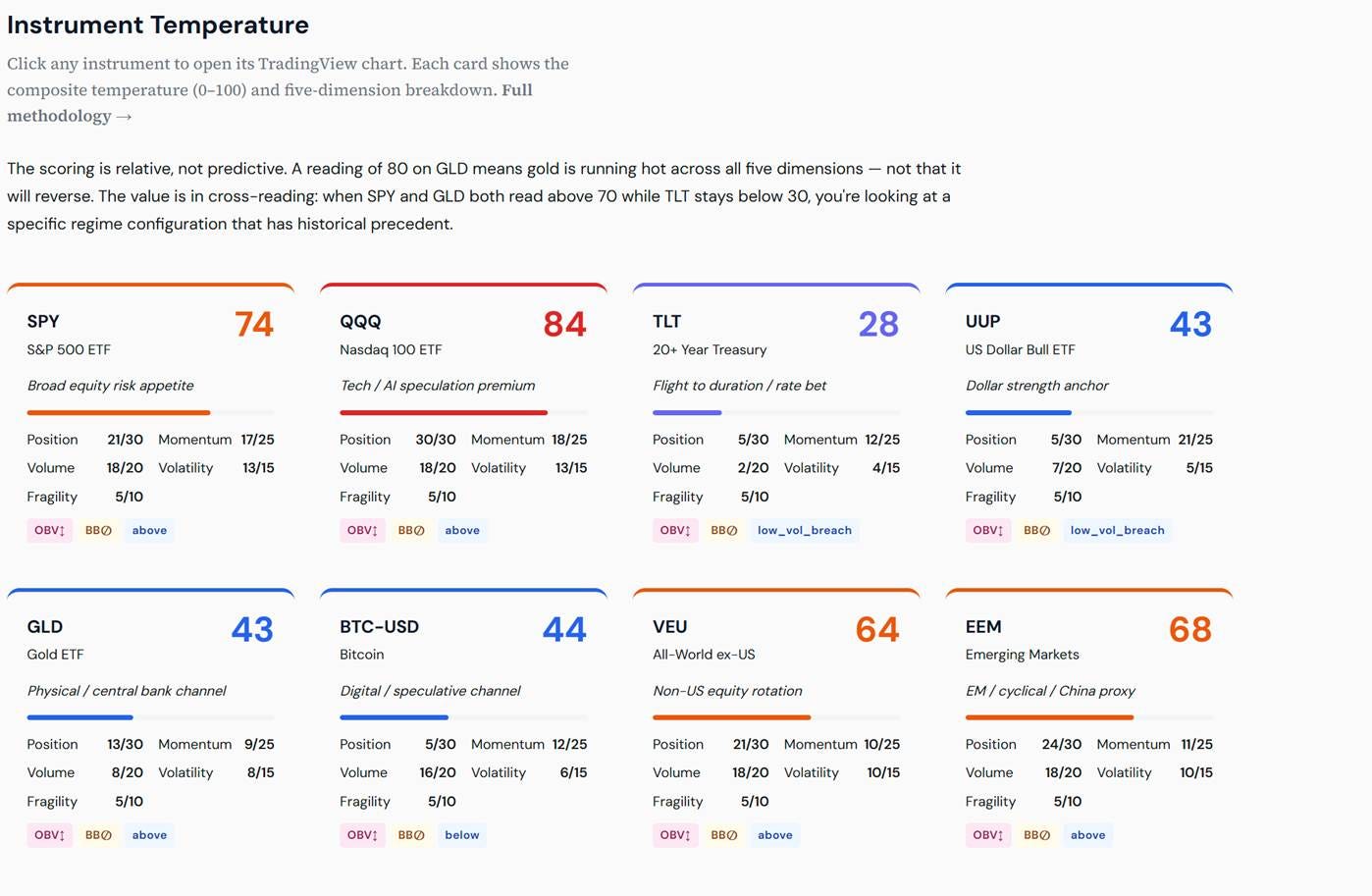
Money Temperature dashboard — 8-instrument macro regime scoring
Full dashboard: closelook.net/lab/temperature/
Central Bank Pulse
Fed: Hold at 4.25–4.50% keeps the long-duration discount rate steady — which is why AI-native software names could recover on multiple expansion alone. One cut priced by September, second at ~70% by December. For broadening specifically, the Fed is neutral: the regime does not need cuts to continue, but cuts would accelerate the Platform and Vertical catch-up.
ECB: At 2.25% and still cutting. The April move was executed; June at 25bp is priced near 80%. European Power Semi names (STM, Infineon) benefit from the ECB path twice — once through domestic liquidity, once through the general global risk-on backdrop that broadening regimes thrive in.
BoJ: Holding at 0.50% against services inflation above 3.0% is the unresolved policy error. A faster-than-expected hike re-prices yen carry and hits long-duration growth first. That means the coldest AW25 names — INTU, WDAY, PTC — are the most yen-sensitive in the basket, which is the second reason they are lagging.
PBoC: Managed easing. RRR at 9.5%, LPR at 3.10%. Broadening-regime relevance: Chinese liquidity is mostly a second-order signal for US hypergrowth, but any surprise acceleration would land hardest on picks-and-shovels semis — ANET, AVGO, MRVL. Watch the mid-May RRR decision.
Macro Commentary (Ed Yardeni, April 2026)
· “As far as the stock market is concerned, the war is over until further notice,” Yardeni said, suggesting that the market has factored in a resolution to the Iran conflict.
· “I think the market is right that Trump intends to end it sooner rather than later, and that the world economy, which has been remarkably resilient over the past few years, will remain so,” Yardeni stated regarding the ongoing geopolitical situation.
· “I don’t think the market will retest the low point reached on March 30th. There is too much money on the sidelines ready to come in during a pullback,” he noted regarding market volatility.
(6) What May Lie Ahead: Technical Setup
Seasonally, we have entered the best 4-months stretch of a calendar year (April to July).
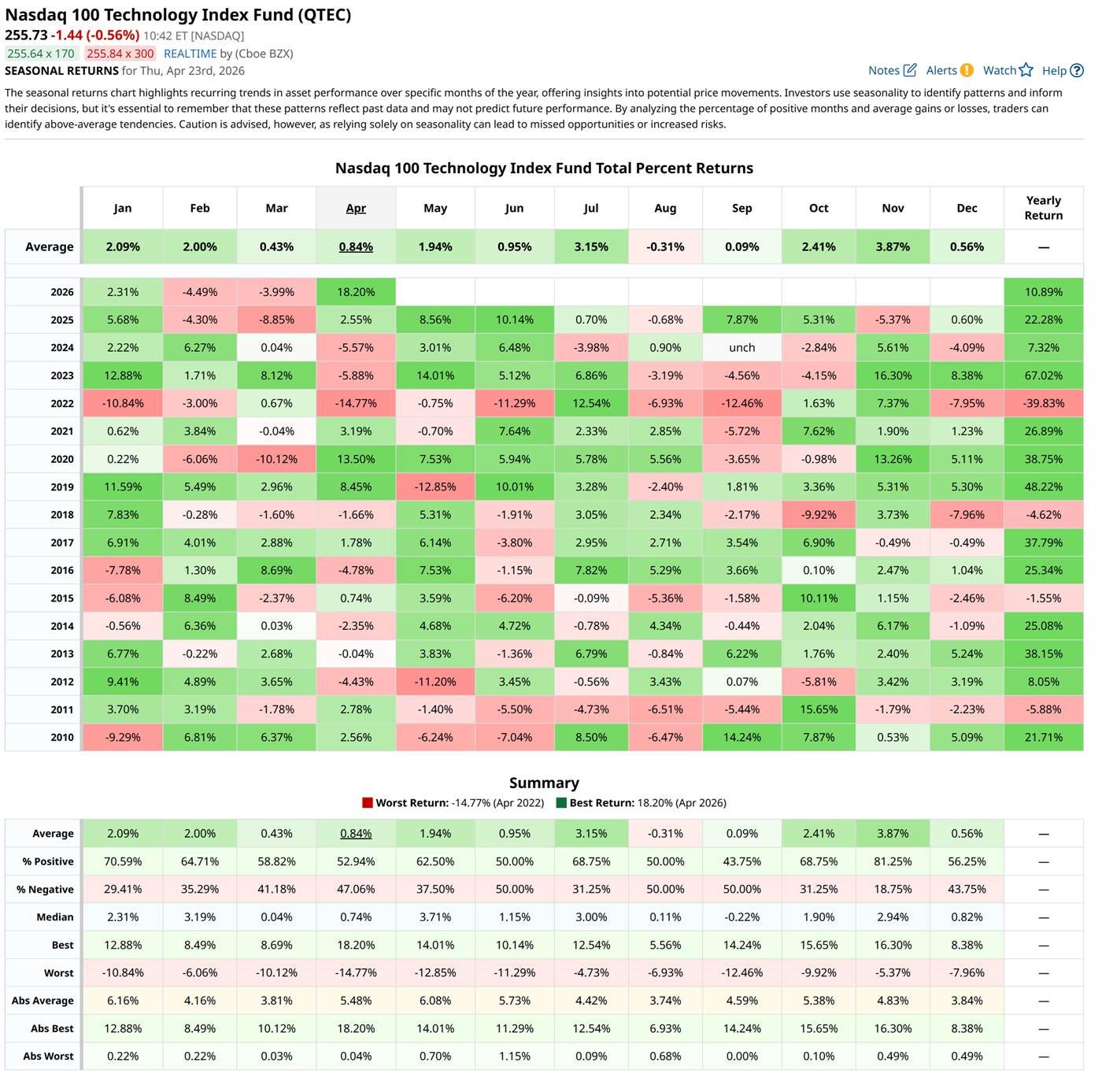
Seasonal pattern — April through July is historically the strongest 4-month stretch
Earnings prints to date have been considerably better than predicted.
While the Saas sell off may have come to a temporary end, the bull in semis seems to have legs and more to run.
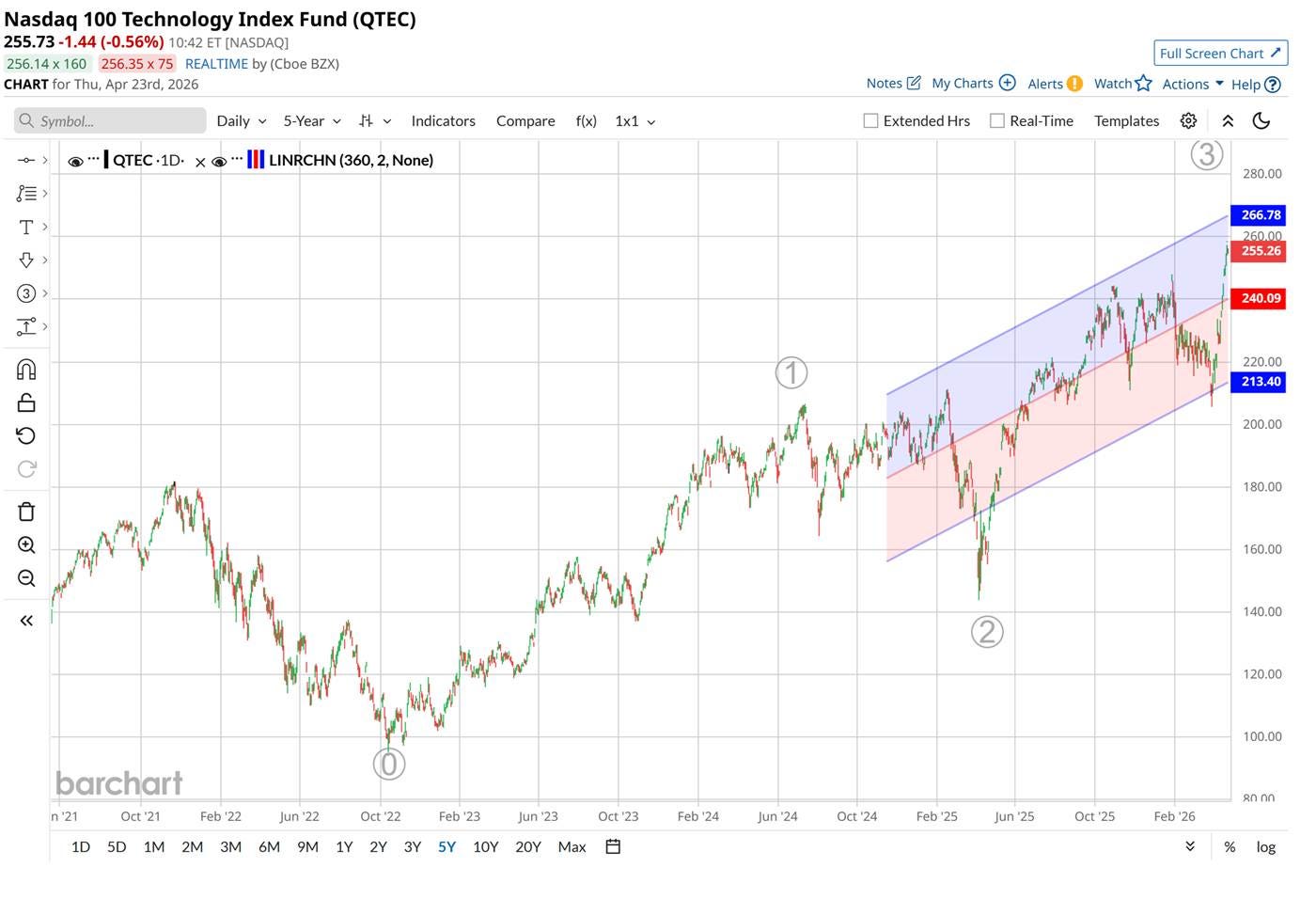
SaaS vs. Semis — the bull in semis has more to run
(7) The Hypergrowth Portfolio: What We Did
Coming Soon — Live Transaction Feed
The new closelook-portfolio-engine is in build. Once it ships, this section becomes a live read from the transaction ledger — every buy, sell, and covered-call write appears here with the reason attached.
C+ subscribers get real-time push notifications on every move before it reaches this section. Waitlist: closelook.net/c-plus.
(8) The Hypergrowth Portfolio: What We Plan To Do
Forward Plan — Candidates With Triggers
The new closelook-portfolio-engine is in build. Once it ships, this section becomes a live read from the transaction ledger — every planned buy, sell, and covered-call write appears here with the reason attached.
C+ subscribers see the candidate list before execution.
(9) Knowledge Corner: Broadening vs. Rotation
Why these two words mean different things — and why the difference is the edition’s whole point.
Rotation and broadening look similar on a one-week tape. Both show new names in the leadership table. Both show capital moving. The difference is what happens to the old leaders.
In a rotation, the old leaders hand over. Capital leaves Name A and enters Name B. The leadership changes hands, not size. The index can hold steady while internal composition churns. Rotation is zero-sum at the cohort level — what Name B gains, Name A gives up.
In a broadening, the old leaders keep compounding and new leaders join above them. Capital does not leave Name A; it arrives in addition at Name B. The index gains altitude, the leadership widens, and the spread between best and worst sector stays high even as the bottom of the distribution also lifts. Broadening is additive.
Three diagnostic questions separate the two:
Question 1: Are the old leaders still positive on every timeframe? In our Rubin 100 data this week, High-Speed Interconnects moved from #1 YTD to #6 on the 1W tape. If Interconnects had gone negative, that would be rotation. It is up 7.95% on the week. That is broadening.
Question 2: Is the dispersion staying high, or compressing? The Rubin sector spread on YTD is 120 percentage points. On the 1M view, the top-to-bottom spread is also wide (+71% to −20% for Wafer Processing). On 1W, the spread is +13.53% to −0.56%, still wide. Dispersion staying high means active rotation inside a rising tide — the broadening signature. Dispersion compressing toward zero means everything moving together without leadership — the late-cycle signature that precedes exhaustion.
Question 3: Are the laggards starting to turn, or giving up further? In AW25 this week, Platform and Vertical sub-sectors are still below baseline but have traced the same V-shape as the recovered sub-sectors. The coldest names — INTU, PTC, WDAY — have OBV divergences firing. Laggards turning is the confirmation of broadening. Laggards accelerating downward is the early sign of rotation-into-defense.
Why the distinction matters operationally. In a rotation, you trim the old leaders and add to the new. In a broadening, you hold the old leaders and scale into the new. The portfolio action is opposite.
A historical caveat. The broadening regimes of 1999 and 2020 both exhausted via a narrowing event — a single week where dispersion collapsed into the prior leaders as participation died. That pattern is the failure mode we watch for in §4 watchlist items three and four. Broadening is bullish. It is not permanent.
The full framework — dispersion math, sub-sector velocity scoring, and the three historical case studies — is at closelook.net/101/broadening-vs-rotation.
(10) Upcoming Transactions: Be Informed
Two ways to stay close to Closelook’s portfolio moves — one free, one premium.
Free Access
· LinkedIn Newsletter (Closelook@Hypergrowth)
· closelook.net — free tier with full index and lab access
Subscribe → closelook.net/subscribe
Coming Soon · Paid
· Real-time push notifications on every portfolio move (live via closelook-push)
· C+ Premium Substack section
· Options overlay: covered calls + cash-secured puts on all 16 Hypergrowth positions
· AW25 basket-temperature alerts for cooling transitions
Join waitlist → closelook.net/c-plus
(11) What May Go Wrong: Risk & Change Triggers
The falsification test: what would invalidate the broadening thesis — and how we’d know.
Framework Shift Triggers — Broadening Specific
· Any AW25 constituent transitions to “Cooling”: 0 of 25 is the broadest signal we have. First cooling name is the first crack.
· Rubin sector spread compresses to below 60 percentage points on YTD: Indicates leadership consolidating, not broadening.
· MAG7 Gateway sub-sector drops below baseline: The structural anchor of the agentic recovery. A break there reframes the entire AW25 read.
· Power Semi falls out of the top five 1W sectors for two consecutive weeks: Mid-Ramp joining was a spike, not a trend.
The thesis holds until one of these triggers fires. When they do, the next edition updates the read.
(12) Final Words
Broadening is the kind of regime that rewards patience and punishes impatience equally.
“The obvious trade is already priced. The disciplined trade is to watch the map and wait for the layers to name themselves. Power Semi named itself this week. Platform and Vertical have not named themselves yet. The watchlist is the patience.”
— Closelook, this week
Thank you for reading. See you next week.
Annex — Further Reading at Closelook
Suggested navigation across Closelook’s own work. Not external — everything below lives at closelook.net.
Indices & Frameworks — Data Behind This Edition
· Rubin Build-Out 100 — 100 stocks, 18 sectors, the map in §2 (closelook.net/indices/rubin)
· Agentic Winners 25 — 25-name sensor array, the basket in §3 (closelook.net/indices/aw25)
· HALO Growth 100 — AI-neutral breadth check (closelook.net/indices/halo)
· Generation Rotation Framework — Why we were watching Power Semi to name itself (closelook.net/101/generation-rotation)
· Broadening vs. Rotation — This edition’s Knowledge Corner, full framework (closelook.net/101/broadening-vs-rotation)
· ABR Framework — Agent Beneficiary Ratio scorecard (closelook.net/research/abr-framework)
· Money Temperature — 8-instrument macro regime scoring (closelook.net/lab/temperature)
Portfolios
· Hypergrowth — 16 AI-native names + covered-calls layer ← this newsletter
· AI Build-Out — Rubin-aligned single-stock portfolio
· Global Tech 50 — Non-US tech, long-horizon
· Global ETFs — Allocation portfolio tracked in @US newsletter
· Derivatives — Covered calls, cash-secured puts overlay
Editorial
· Closelook@US Stock Markets — Sunday longform (closelook.net/us)
· Closelook@Global Stock Markets — Saturday longform (closelook.net/global)
· Weekly Signal — 9-dimensional market regime scorecard (closelook.net/weekly)
· Closelook 101 — Concepts and frameworks (closelook.net/101)
Publishing Schedule