


The Federal Reserve hiked on Wednesday and the belly of the curve sold, the 10-year closed above 5% for the first time in the cycle, and the equity lines were lost at the bell. The Bank of Japan hiked on Friday morning, a quarter point to 1.25%, the highest policy rate in Japan since the mid-1990s and exactly what the wires expected — and the yen fell.

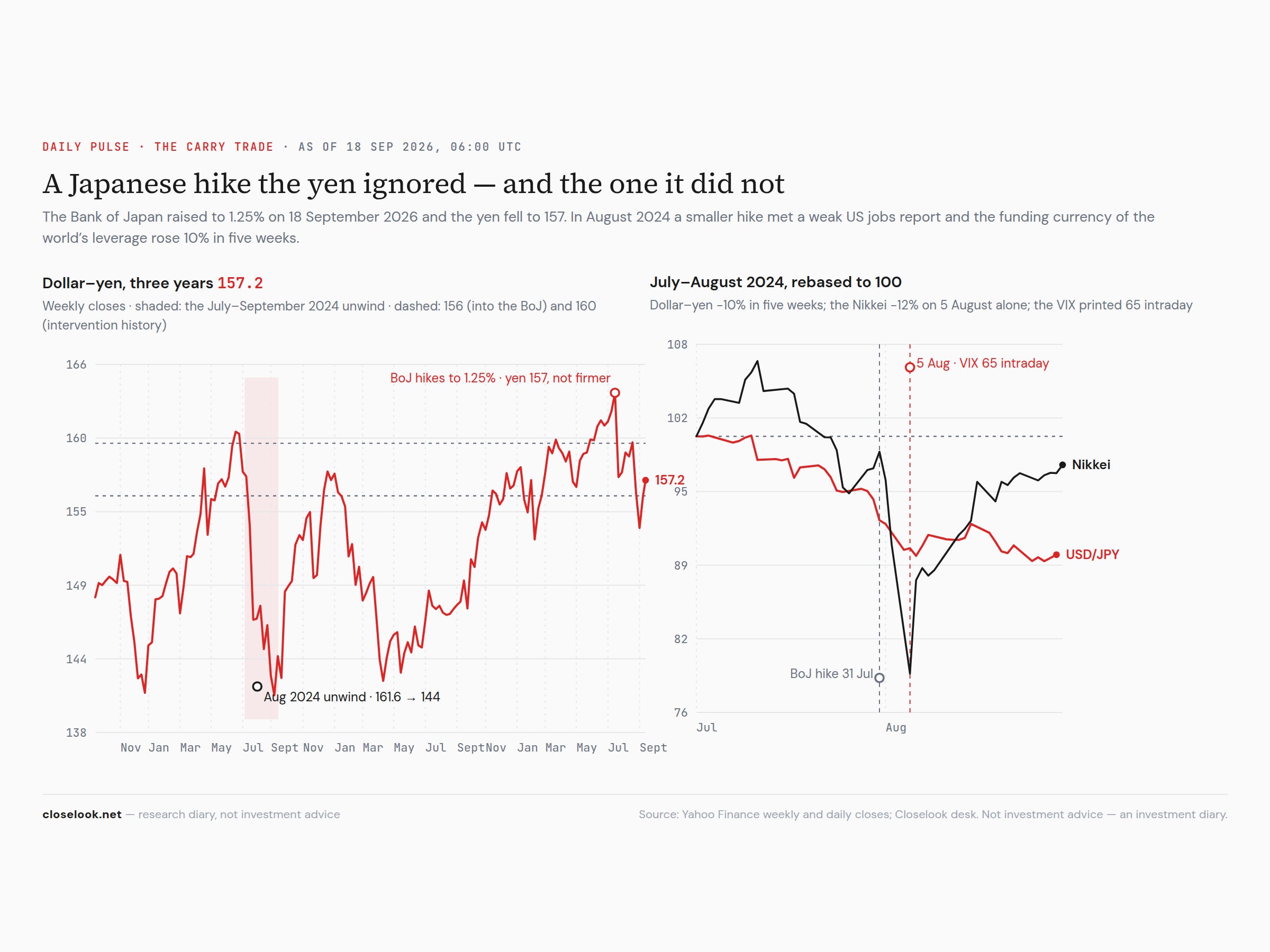
It was 156.0 into the decision and 157.2 at 06:00 UTC, 0.8% weaker on the day; Reuters’ headline was ‘Yen slumps after BOJ hikes rates as expected’. The dollar index did not move, 100.3, so the yen’s move is the yen’s. Tokyo bought the decision, the Nikkei +1.6% at 65,159 with Tokyo Electron +4.2%; Seoul bought harder, the Kospi +2.8% with SK Hynix +6.0%.
Yesterday’s Pulse was about the fraction: cash flows over a discount rate, and why the direction of the expected rate path matters more than the level. Today is about the variable that sits outside the fraction and can break it from the side. The currency in which the world’s leverage is funded. And a thought from the desk’s diary that we want to write down while the tape is still behaving as if it were true.
Closelooknet on Google
Get our reads first in Top Stories and AI answers. One tap, no account needed here.
A hike the currency market declined to price
A central bank hikes and its currency weakens when the market has looked at the rate differential and decided the hike did not change it. The 5-year Treasury closed Thursday at 4.80%. The Japanese policy rate is now 1.25%. That is a spread of three and a half percentage points, and a quarter point in Tokyo, flagged for weeks and delivered on schedule, did not close it. The carry trade — borrow the low-rate currency, own the high-rate assets, pocket the difference — is paid on that spread. A spread that stays open keeps paying, and people who keep getting paid do not unwind.
That is the whole of Friday morning in one sentence, and it is the opposite of what happened the last time the Bank of Japan hiked into a nervous market. Which is why the desk’s diary entry from this week deserves a full airing.
The diary entry: higher US rates as the bull’s insurance
Moderately but durably rising rates in the United States may have just saved the bull market in US stocks. Not because higher rates are good for equities — they are not, and Wednesday showed what a 10-year above 5% does to the multiple — but because of what they do to the yen. A US rate path that is rising, slowly and for longer than the market assumed a month ago, keeps the differential to Japan wide even as the Bank of Japan hikes. A wide differential keeps the yen weak. A weak yen keeps the carry trade in place. And the carry trade in place is the condition under which a bull market in US risk assets does not get the one thing that has ended two of them from the side: a sudden, large rise in the yen that forces the borrowed money home.
Put differently, the market has spent the week worrying about the denominator — the discount rate — and the denominator is the lesser risk. The greater risk to a levered bull market is the funding currency, and a higher US rate path is, on this reading, what keeps the funding currency quiet. We hold that as a possibility, not a prophecy. But the two cases that make the argument are on the record.
Two cases: August 2024 and 2007–08
The first is August 2024, and the chart above is the record of it. The Bank of Japan raised rates on 31 July 2024. The dollar had been near 161.6 yen in early July; a weak US jobs report landed two days after the hike, and by the first week of August the yen had strengthened to about 144 at the close and near 142 intraday — roughly 10% in five weeks, in the currency that funded a large share of the world’s levered long positions. The Nikkei fell 12.4% on 5 August 2024, its worst day since 1987. The VIX printed 65 intraday, a level otherwise seen in 2008 and March 2020. The S&P 500 lost about eight percent from its July high before the unwind ran out of sellers. Nothing about the earnings of the companies in the S&P 500 changed that fortnight. The fraction did not change. The currency did, and the currency forced the positions.
The second case is larger and we frame it exactly. In our reading, the unwinding of the yen carry trade in 2007 and 2008 — the dollar went from roughly 124 yen in the summer of 2007 to roughly 90 by the end of 2008 as the Fed cut and the differential collapsed — was a major catalyst of the financial crisis and not its reason. The reason was the credit. The catalyst was the funding currency reversing and taking every levered position priced in dollars with it. A catalyst is not a cause, and we do not pretend it is. But a bull market that avoids the catalyst has avoided something real.
Up to a level: the four conditions and the number
The argument only works up to a level, and this week has printed the four conditions that define it. A stronger US economy than the market had assumed: the Fed hiked into it on Wednesday and said it sees more tightening ahead, which is not what a central bank does into weakness. Higher earnings: the numerator is rising, and the Street’s 2027 number on the S&P 500 is $425 in Ed Yardeni’s arithmetic. A stronger dollar: the dollar index is 100.3, firm, and the yen’s move on Friday was the yen’s. And no more structural inflation — the condition that matters most, and the one on which the desk keys a number.
Structural inflation, excluding energy and tariffs, sits on our reading around 2.4% to 2.5%. The August prints by our count: core CPI at 2.4%, the lowest core reading since 2021 as new cars and goods cool; the Atlanta Fed’s sticky-price core — rents, insurance, medical services, the items slow to reprice — at 2.7%; and services excluding energy and shelter, the measure the Fed says it watches most closely, around 3.0%, held there by labour shortages in healthcare and in the technical trades that build the infrastructure we track in Rubin. Month on month the core did firm moderately, 0.29% in August after 0.22% in July — reported as 0.3% after 0.2%, because the rounding threshold sits at 0.05% and July fell under it while August fell over it. We say so plainly rather than round it away: a moderate rise in the monthly core, inside an annual core at its lowest since 2021.
Put the number against the yield and the level a market can absorb becomes arithmetic. A 10-year at 4.95% against a 2.4% core is a real yield of roughly two and a half points. Paid by an economy that is growing, by companies whose earnings are rising and by a currency the world is still buying, that is a discount rate — a higher one than August priced, which is what cost the multiple two turns in Yardeni’s revision from 19.8 to 18.6 — but a rate, not a threat. The same 4.95% against a 4% core would be a policy error, because the central bank would be chasing rather than choosing, and the currency market would read the differential as unstable. Chair Warsh’s line at Wednesday’s press conference, as the desk read it, was that there is a level up to which a market can absorb a stronger-than-perceived economy with moderately rising rates quite well. That level is not a number on the 10-year. It is the gap between the 10-year and the core, and at two and a half points, with the annual core at 2.4%, we are inside it.
What Thursday and Friday printed
The tape this week has behaved as if the argument were true, and we read that as evidence rather than proof. The curve fell six basis points in parallel on Thursday — 10-year 4.947%, 5-year 4.801%, 30-year 5.296% — the shape of a market that decided the level was enough for now, not one that changed its mind about the sequence. Gold was bought back +1.7% on the lower curve with the dollar flat, which is the hedge returning to its job and not a vote against the dollar. Credit did not move, the high-yield ETF +0.4%; what was repriced was duration, both ways, in two days. And every equity line we carry was retaken and held into the close, led by the half of the AI trade that had been sold hardest on the discount rate: the chip ETF +3.4% to $519.10, above $505 and above last Thursday’s $517.43; AMD +6.4%, Arm +8.6%, Micron +5.5%, Intel +7.7%, Nvidia +2.5%. The S&P 500 ETF closed $762.60, its first close above $757.83 since Monday; the Nasdaq-100 fund $716.92, above $708.69. Then Tokyo opened, the Bank of Japan hiked, the yen fell, and the Nikkei rose 1.6%.
The caveats are the same two the Morning 10 carried. Friday is the quarterly options expiry, and a reclaim printed the day before a pin is tested by the expiry rather than made by it — the better version, but not booked until Monday’s close. And the equipment names did not join in New York — Applied Materials +0.5%, Lam flat, KLA +1.0% on a day the chip ETF gained 3.4% — though Tokyo Electron’s +4.2% this morning is the first crack in that. Micron’s print next week is the order-book fact that settles it.
What we do with it
Less than the argument might suggest, on purpose. We do not buy the chip ETF on a 3.4% day into an expiry, and we do not add to software on a day it recovered a quarter of what chips recovered. We hold the equity lines and we add two on the currency: 156, the level the yen carried into Friday’s meeting, and 160, the level at which Japan’s finance ministry has intervened before. A yen that holds 157 with the Nikkei’s gain kept is a hike the currency market declined to price and a carry trade that pays into the weekend. A yen back through 156 on Governor Ueda’s press conference is the market deciding this was the first of several, and the carry question reopens — that is the reversal case, and we would rather name it this morning than meet it on Monday.
The diary’s thesis is a possibility we are holding: moderately, durably higher US rates, into a 2.4% annual core that is firming only moderately month on month, with earnings rising and the dollar firm, may be the thing that keeps the yen from doing to this bull market what it did to the last two. The tape this week has behaved as if that were true. We keep reading it until it does not. Yesterday’s fraction is here; the G7 curves and the yen sit on the sovereign-pressure board; the regime read is on the Market Regime 101.
The signals behind this
Each line links to the tool it comes from
https://closelook.net/pulse/2026-09-18-carry-trade-why-higher-us-rates-may-be-the-bull-markets-insurance/