


Underneath: the season’s most violent single-name sorting, a private-equity bid under the software discount, a 21-billion-dollar stake nobody knew about, and a bond veto that came back from the dead.”
Edition of 2026-08-16 · from the C+ archive
1 · This Week’s Action
The tape, day by day. The week arrived carrying a binary and disposed of it early: CPI cool on Tuesday, PPI cool on Thursday — and the market did almost nothing with either. The S&P added 0.40% across five sessions to 776.34, the Nasdaq 100 1.11% to 731.07, and the VIX fell to 14.32.

Friday was the exception that defined it. Retail sales printed −0.6% against +0.1% expected, Michigan sentiment 51.0 against 54.5, and the index shrugged — the S&P −0.22%, the Nasdaq 100 −0.14%. Two cool inflation prints and a demand miss inside five sessions, and the index moved four tenths of a percent. Everything that happened this week happened underneath it.
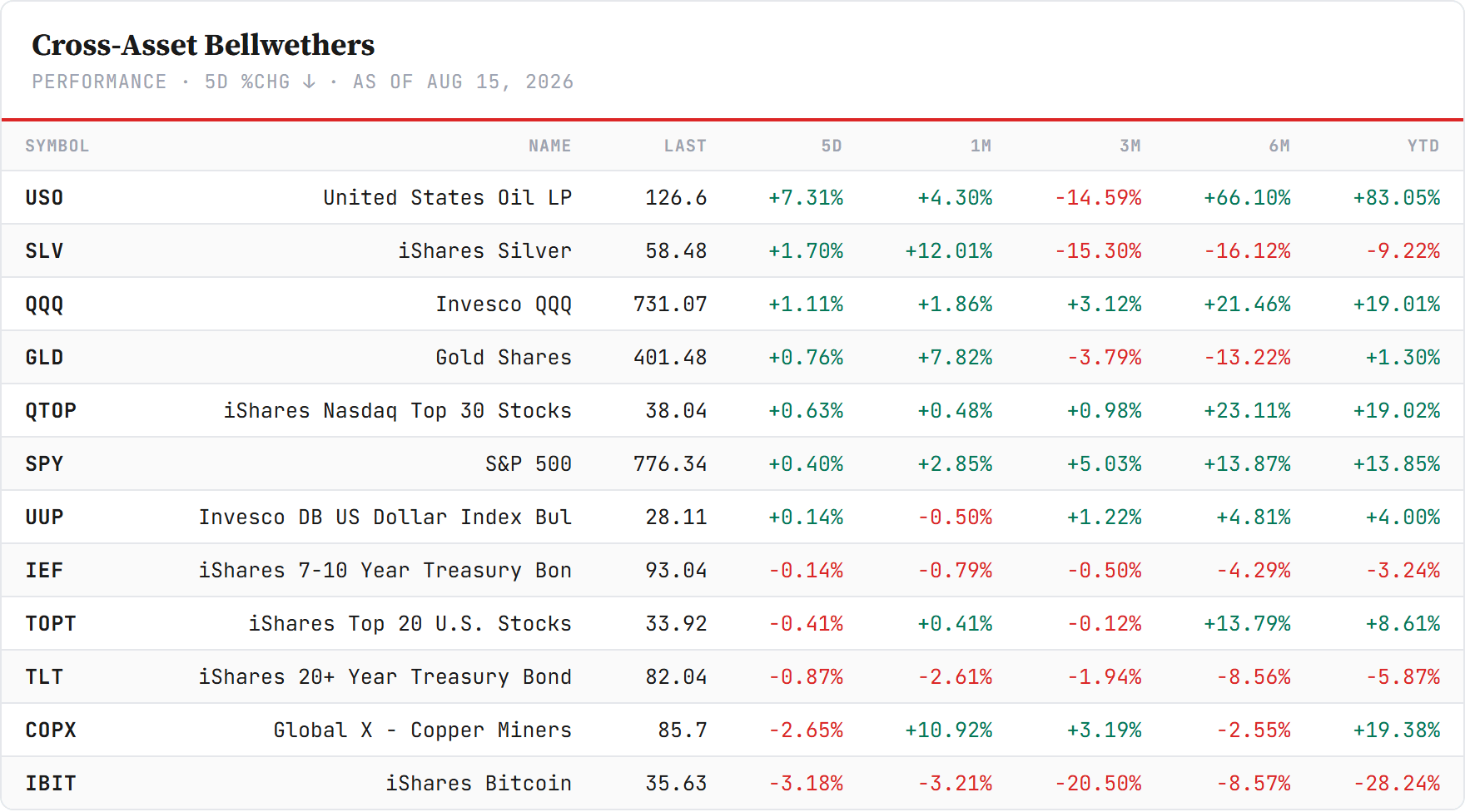
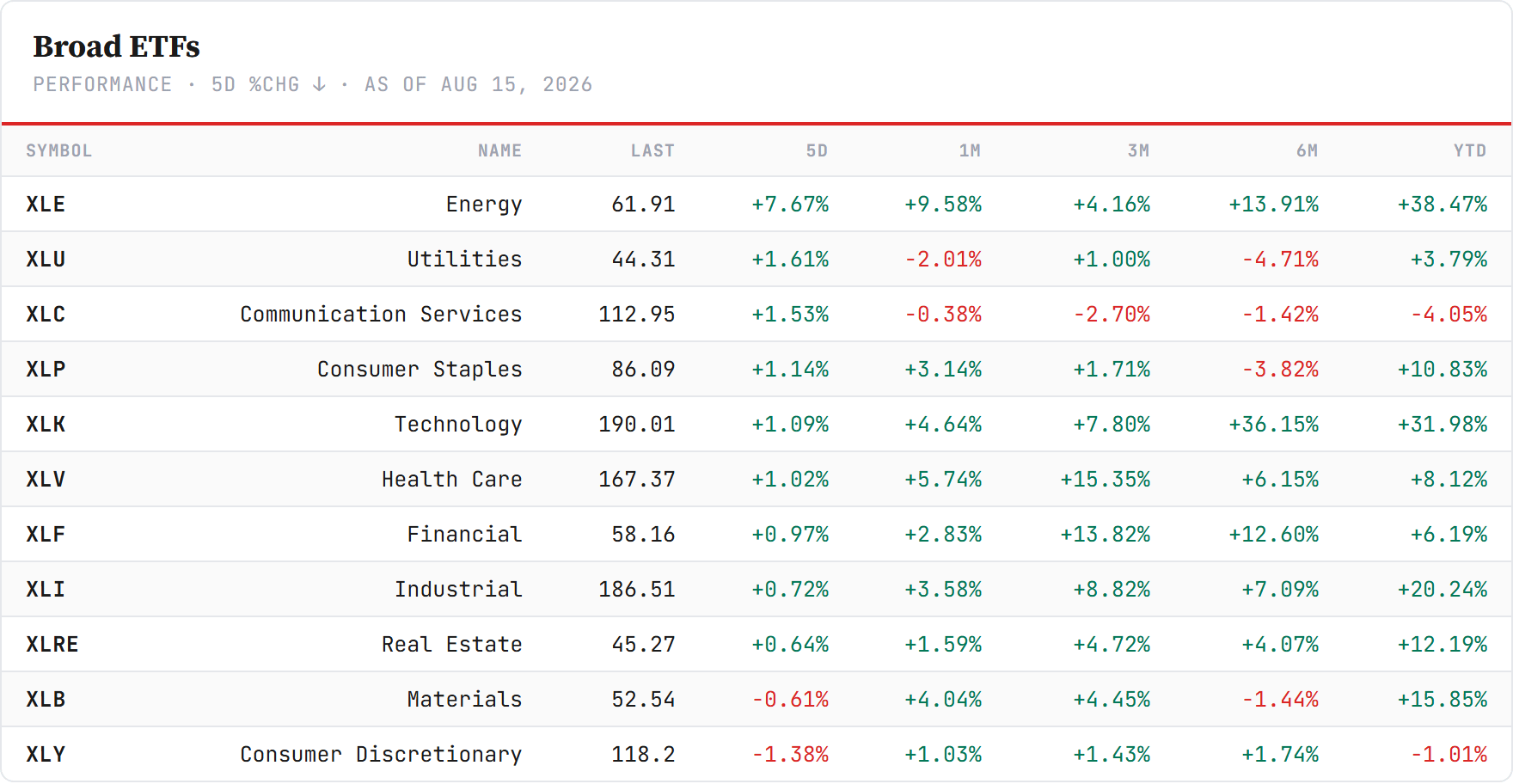
The sector read — nine green, two red, and the red is a sentence. Energy took the week outright at +7.67%, and the honest reason is the barrel rather than a thesis: crude round-tripped +7.31%, taking back nearly all of the prior week’s 8.7% fall on the Iran file. Utilities +1.61% and communications +1.53% followed.
The two red lines are the sentence: materials −0.61% and discretionary −1.38% — the demand-facing ends of the board, in the week the Michigan number said demand was softening. A sector table where energy leads by seven points on a war headline while discretionary is the worst line is not a risk-on sweep. It is a capex board with a geopolitical spike inside it.
The factor read — momentum at the 95th percentile, participation underneath. Our factor-regime gauge reads momentum-leading, risk appetite building: momentum against low volatility at 2.0077, the 94.6th percentile of its own history and above its 50-day trend, with momentum’s twenty-day rate of change at +6.55% against low-vol’s −0.27%.
The pair behind that number is tradable, which is why this letter tracks it rather than an abstract factor series: the S&P Momentum ETF closed at 153.31 against the Low-Volatility ETF’s 76.36, and the ratio between them is the gauge. Over sixty days momentum has compounded +9.02% against low-vol’s +3.99%; over twenty, +6.55% against −0.27%. The spread is not drifting apart — the defensive leg has stopped moving while the aggressive one keeps going.
Two things follow. The ratio sits above its own 50-day trend (159.4 indexed against 158.5), so the regime is confirmed rather than merely elevated. And at the 94.6th percentile, roughly nineteen of every twenty readings in this pair’s history have been less extreme than today’s — which is a statement about crowding, not about direction. Momentum can lead for quarters from here. It has also never mean-reverted gently from this part of its distribution.
Saturday’s Global letter reports the same pair built from international instruments, where momentum leads defensives by 1.9 points on the week and 4.5 on the year. Two continents, two independent constructions, one regime. That makes it a market fact rather than an artefact of American index concentration — and it means a turn, when it comes, will not be contained to one geography.
Underneath the factor read, participation held: the equal-weight cut beat cap-weight roughly three to one — RSP +1.22% against SPY’s +0.40% — while the Magnificent-7 basket closed red at −1.27%. Momentum leading, the average stock outrunning the index, and the largest names sitting it out: three readings that rarely print together, and all three did.

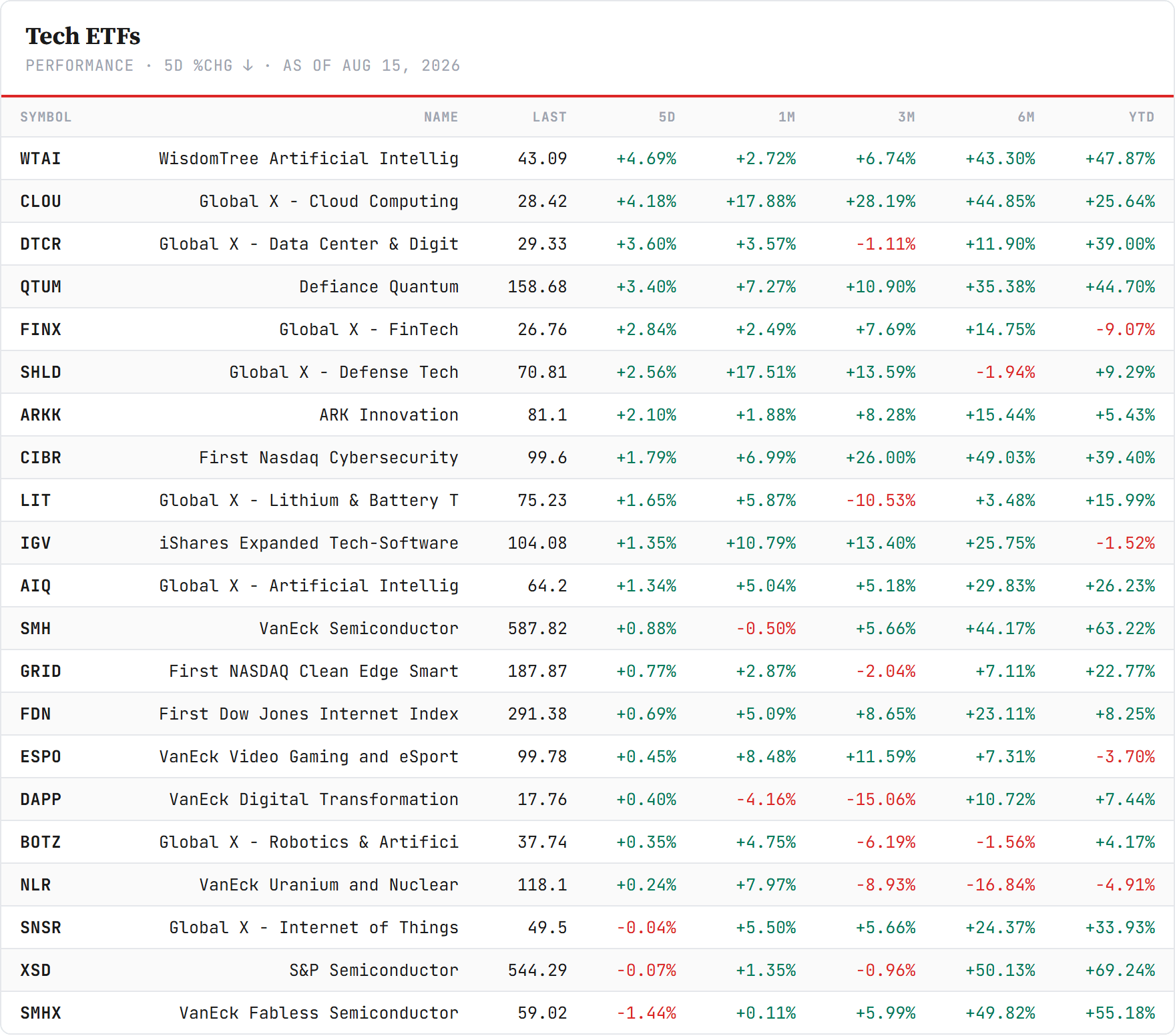
Inside tech — the infrastructure sleeves led, the year’s winners lagged. The AI-infrastructure cut took the week: WTAI +4.69%, cloud +4.18%, data-centre REITs +3.60%, quantum +3.40%, cybersecurity +1.79%. Software managed +1.35% and remains −1.5% on the year — one good fortnight does not repair a de-rating.
And the bottom of the shelf is the tell: fabless semis −1.44%, small-cap semis −0.07% — both red inside a green group, both up more than 55% for 2026. The names that ran hardest into this week did the least in it. That is the sorting rule showing up in ETFs before we reach a single ticker.
2 · The State
The sorting rule, named. Strip the week to its load-bearing facts and one rule explains all of them: the market paid challengers and charged champions.
The challengers were paid, and the payment held. CoreWeave rose 19.3% on its print and Nebius 34.1%. Payment retention is precisely where paid prints have died all season — the verdict lands and the market takes it back inside two sessions. Not this time: both retained through day two at −1.3% and −1.6%, and by Friday Nebius had extended another 8.8% to 277.58. Three sessions on, the payment is larger than the verdict was.
And the champions were charged, on clean beats. Cisco fell 8.4% on its twenty-first consecutive double beat — the deepest single-day charge in the only twenty-for-twenty record on the docket. Coherent fell 8.0% after running 8.2% into its print. Applied Materials beat on both lines and closed Friday −5.1% at 507.18. None of the three missed. All three were charged for being expected to win.
The veto is back — scored at the close, per the contract. Last week this letter scored the bond veto dead: IEF reclaimed its two-year trendline and closed at 93.17, above it, and by this book’s convention the close is the verdict. This week the same convention reverses it. IEF broke 93.17 on Monday, reclaimed it Thursday on the cool PPI print, and then closed the week at 93.04 — below. TLT finished at 82.04, within five cents of its 52-week low.
The rule does not get to be applied only when it flatters the position. The veto was dead on a close; it is live again on a close. What makes it more serious than a level is the company it keeps: the equity tape priced two cool inflation prints, the bond tape priced something else, and volatility got cheaper while they disagreed.
Then a buyer walked in under the discount. Silver Lake is reported in talks to take Workday private. The stock rose 17.8% on Thursday, halted intraday on 3.6 times normal volume — a name that traded near 250 last September and bottomed at 110 in April — then gave back a third of the spike on Friday to 198.68. Read as market structure rather than as a deal: operators are selling the software they think agents will eat, and financial buyers are underwriting what they think survives.
And then the supplier turned out to be a shareholder. Nvidia’s second-quarter filing, disclosed Friday, carries a stake in SpaceX worth about $21 billion — 122.8 million Class A shares as of 30 June, readable at all only because SpaceX listed in June. That makes it Nvidia’s second-largest public equity position, behind roughly $30 billion of Intel.
It did not begin as a SpaceX position. It began as Nvidia’s $10 billion investment in xAI, which SpaceX absorbed. Alongside the disclosure, Musk said SpaceX will build its AI infrastructure and data centres exclusively on Nvidia hardware — Vera Rubin included — and pointed at orbit-based compute satellites running on Nvidia systems.
Read structurally, that is a supplier holding a large equity position in a customer that has just committed to buying exclusively from it, with the commitment itself among the things that marks the position. None of this is new in kind: the buildout has been part-financed by its own vendors for two years and this letter has tracked it as the capex-anchor question throughout. What is new is the scale, and that it is visible in a filing rather than inferred. A $10 billion cheque marked at $21 billion is a good outcome. It is also a reminder that some of the demand underwriting the capex layer sits on the supplier’s own balance sheet.
The macro print was the wrong shape. Retail sales −0.6% against +0.1% expected, ex-autos −0.3% against +0.2%; Michigan 51.0 against 54.5, with one-year inflation expectations rising to 4.3% and the five-year at 3.3%. Weak demand with firming expectations is the first stagflation-shaped print of this run, and it landed after the two cool inflation reads had already been banked — which is why the bond market’s answer carries more weight this week than the equity market’s silence.
3 · The Outlook
The four indices — the operating layer took it. The family printed the week’s sorting in one row: Agentic Ecosystem +7.5% (the opex layer; +69.4% YTD), Rubin Build-Out +4.9% (the capex layer; +107.4%), Agentic Winners +3.3% (the applications; still −7.0% on the year), HALO +1.0% (broad growth, no AI thesis; +7.2%) — with Euro-AI +3.5% across the Atlantic, +39.4% on its own year.
Two things worth holding from that row. The operating layer led while the buildout still owns the year by a distance — the money goes into building, but the fastest-moving claim this week was on running. And HALO, the control group, gained under one percent: this was an AI bid, not a growth bid, and anyone reading the broadening as general risk-on is reading the wrong instrument.
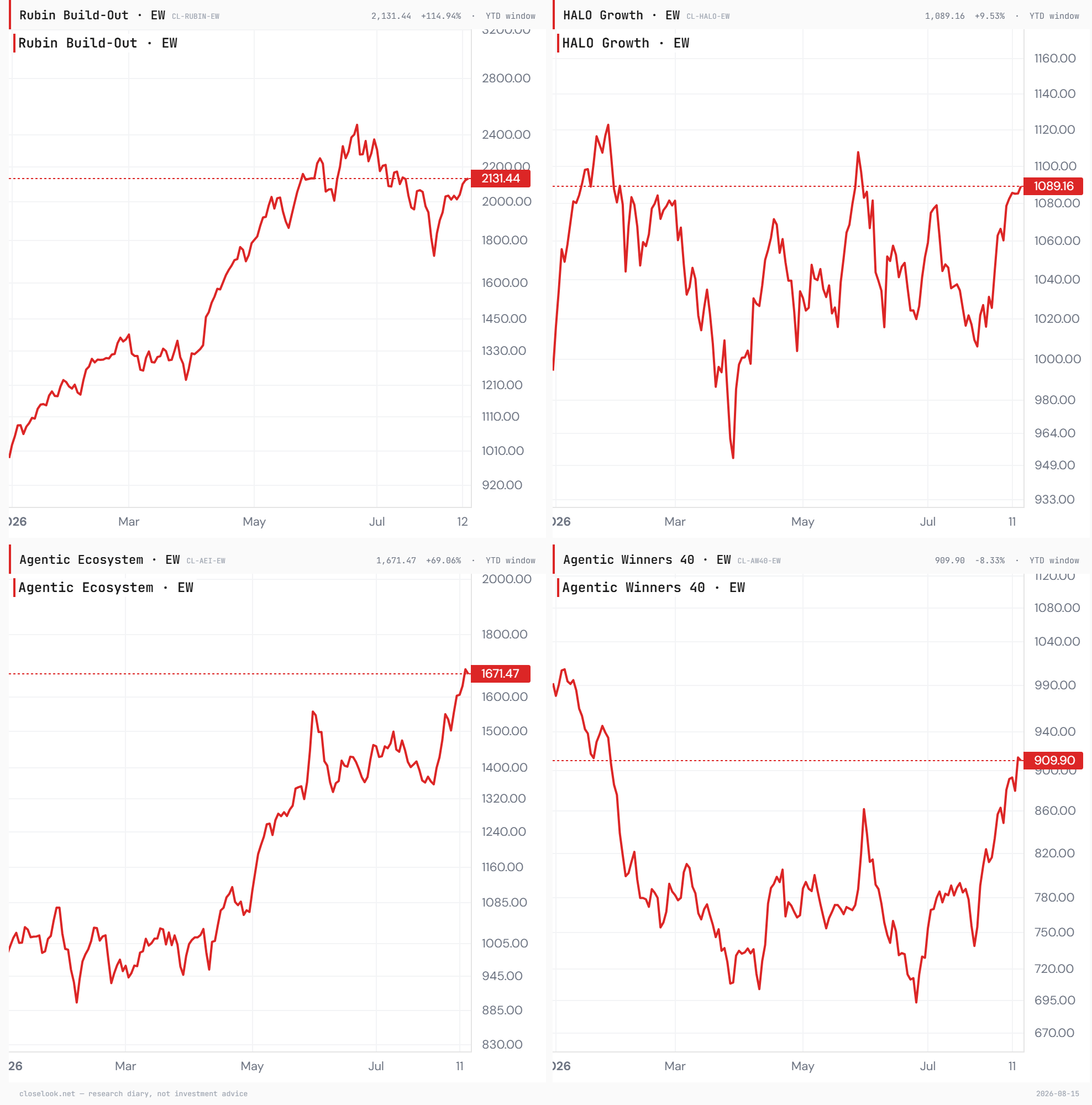
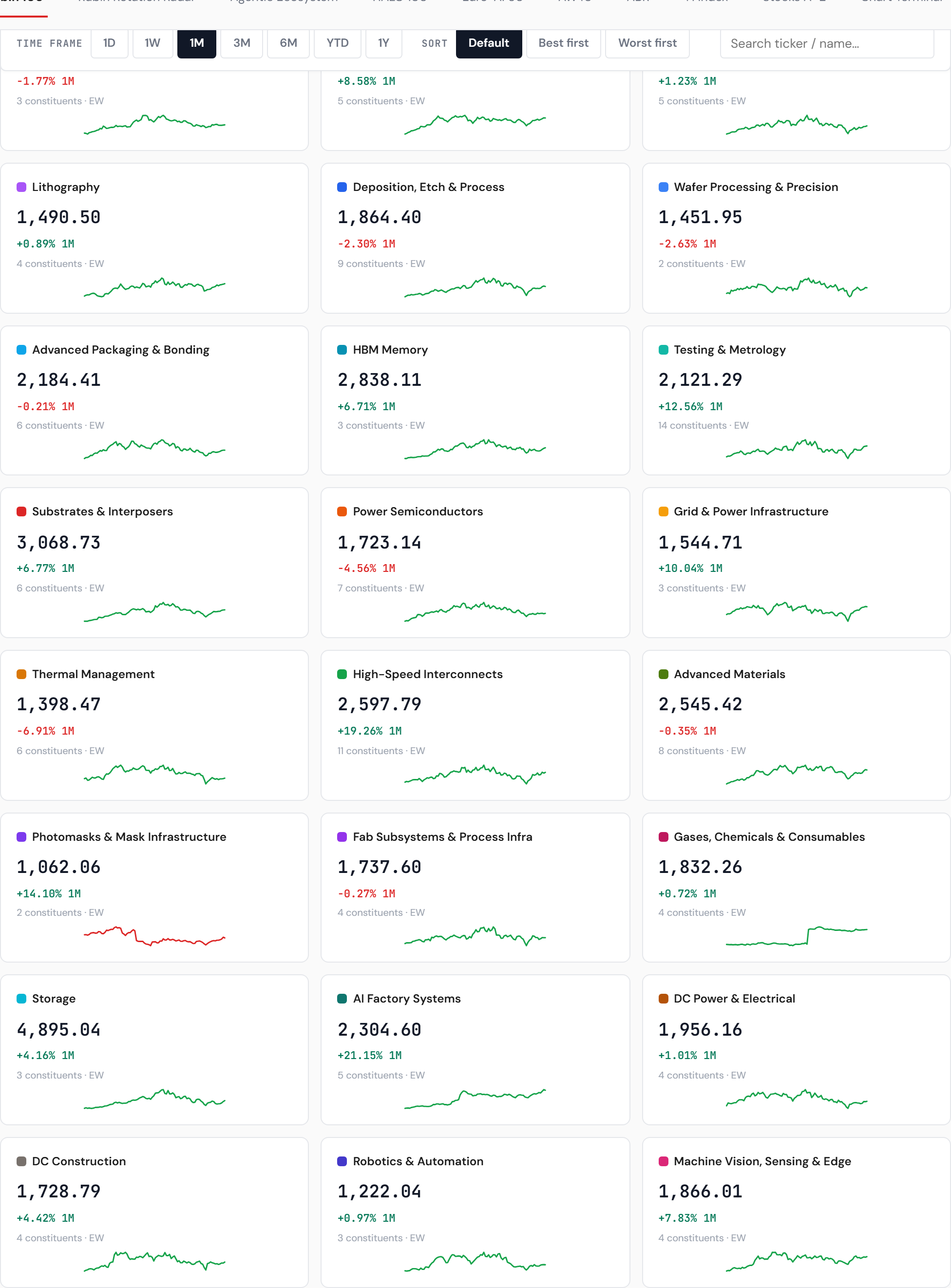
Inside the indices — where the week actually happened. The sub-index tables are the week’s best microscope. Inside Rubin, the top of the board is one thesis three times over: Storage +21.1% — the strongest line in the entire twenty-four-sector table and now +357% on the year — with HBM Memory +15.3% (+168%), AI Factory Systems +10.0% and Testing & Metrology +9.6%. And the bottom of the same board: EDA & Chip IP −1.3%, the weakest line, with Power Semiconductors −0.5% and Fab Subsystems −0.1% the only other red. Physical capacity paid; the design layer that sells into everyone equally was charged.
Inside the Agentic Ecosystem, every sector was green — Edge & Distribution +12.8%, Data & Memory +12.3%, Substrate +11.4%, Compute Operators +11.1% — while its own defining sleeve stood still: Foundation Models +1.9% against +858% on the year. Inside Agentic Winners, the inversion runs the other way: Application Leaders +4.9%, Enterprise +3.6%, Control Plane +3.5%, Consumer +2.7%, every one still negative on 2026 — and the only sector up on the year, Megacap Gateway at +9.7%, was the only one red this week at −1.6%.
Best and worst week, by name — the whole story in ten tickers. Across the family’s 291 constituents with a full week of prints, the five best: Nebius +47.7%, SanDisk +35.4%, Everpure +31.2%, Fastly +30.4%, Aehr Test Systems +30.1% — a paid challenger, the memory complex, a test house. The five worst: Trend Micro −16.0%, On Holding −14.2%, Coherent −14.1%, Lasertec −10.4%, DroneShield −10.1%.
Put the two lists side by side and the sorting rule is legible without a single index number: the paid challenger tops the board and the charged champion sits fourth from the bottom. Coherent beat on both lines and finished the week down fourteen percent. Nebius beat and finished up forty-eight. Same market, same five sessions, opposite verdicts — and the variable is not the quarter, it is what was expected of it.
The AI Handoff Board — the stack rotated one layer up. The handoff ratios moved exactly where the sorting rule pointed: operate-against-build +2.5% to 1.2723, operators-against-suppliers +5.9% to 1.2704, beyond-gateways +5.9% to 1.2158 — the applications pulling away from their distribution chokepoints, which is the Megacap-Gateway-only-red week expressed as a ratio.
Two ratios went the other way and both deserve naming: use-against-operate −3.8% and trust-against-execution −5.4%. Last week this board went quiet because every layer rose together. This week it is loud again — and it is not rotation between winners and losers, it is the stack shifting one rung upward, leaving behind the rung that sells the picks.
The hyperscaler cohort — the leaders sat out again. The Mag Pulse board reads the basket at 68.26, −1.27% on the week and 1.8% below the 69.5 shelf that has capped it since spring — further from that shelf than last week’s 69.14, which was half a percent under it. Underneath: the hyperscalers (Microsoft, Amazon, Alphabet) −2.58%, consumer AI (Meta, Apple) −1.46%, the supplier (Nvidia) +0.54% — barely green in the week its own customers’ capex was the market’s leading question. The torque name, Oracle, added 2.38% and is +21.2% on the month while still −37.9% on the year.
Third consecutive reading in which the default holdings underperform a broadening tape. At some point that stops being rotation and starts being distribution; the December pivot at 62.56, eight percent below, is where that question gets answered.
Compute tightness — the demand side kept printing. The week’s quietest strong signal is the one the price boards buried. The two neocloud prints did not merely get paid, they kept the payment through a macro-miss Friday — CoreWeave at 105.26 and Nebius at 277.58, the latter still extending on day three. Inside the family, the Compute Operators sleeve rose 11.1% and Data & Memory 12.3%.
Against that, storage and memory led the entire capex table on price while their largest names sit at the bottom of our flow ledger — SanDisk and Kioxia both decelerating-up: price rising with less behind it every session. Both readings can be true briefly, because physical shortage is a slow fact and positioning is a fast one. They cannot both be true for long, and next week’s prints are where the argument gets its next data.
Structural inflation — our gauge against the tape’s calm. The house composite in the macro lab is the instrument that tells us in advance which buckets will matter, and this week it earned that: the two cool prints landed as it expected, and the third datapoint — one-year inflation expectations at 4.3% — came in on the bucket the gauge has flagged as its elevated one all month. When the composite’s own named risk is the thing that prints hot, that is not a surprise. It is the instrument doing its job in an uncomfortable direction.

Breadth and temperature — participation good, thermometer neutral. Participation stayed strong on the two readings settled at the close: the equal-weight cut beat cap-weight three to one, and the momentum factor pulled away from low volatility without the largest names contributing at all. That is broad participation with a hole exactly where the defaults sit.
The Money Temperature composite reads 51 — the middle of its range, and cooler than a week carrying two cool prints, a record in the world index and a 94.6th-percentile momentum spread has any right to feel. Read together: participation is good, the tape is not stretched on its own thermometer, and neither reading front-runs anything. It is the state where rotations get funded — and where first mistakes get funded too.
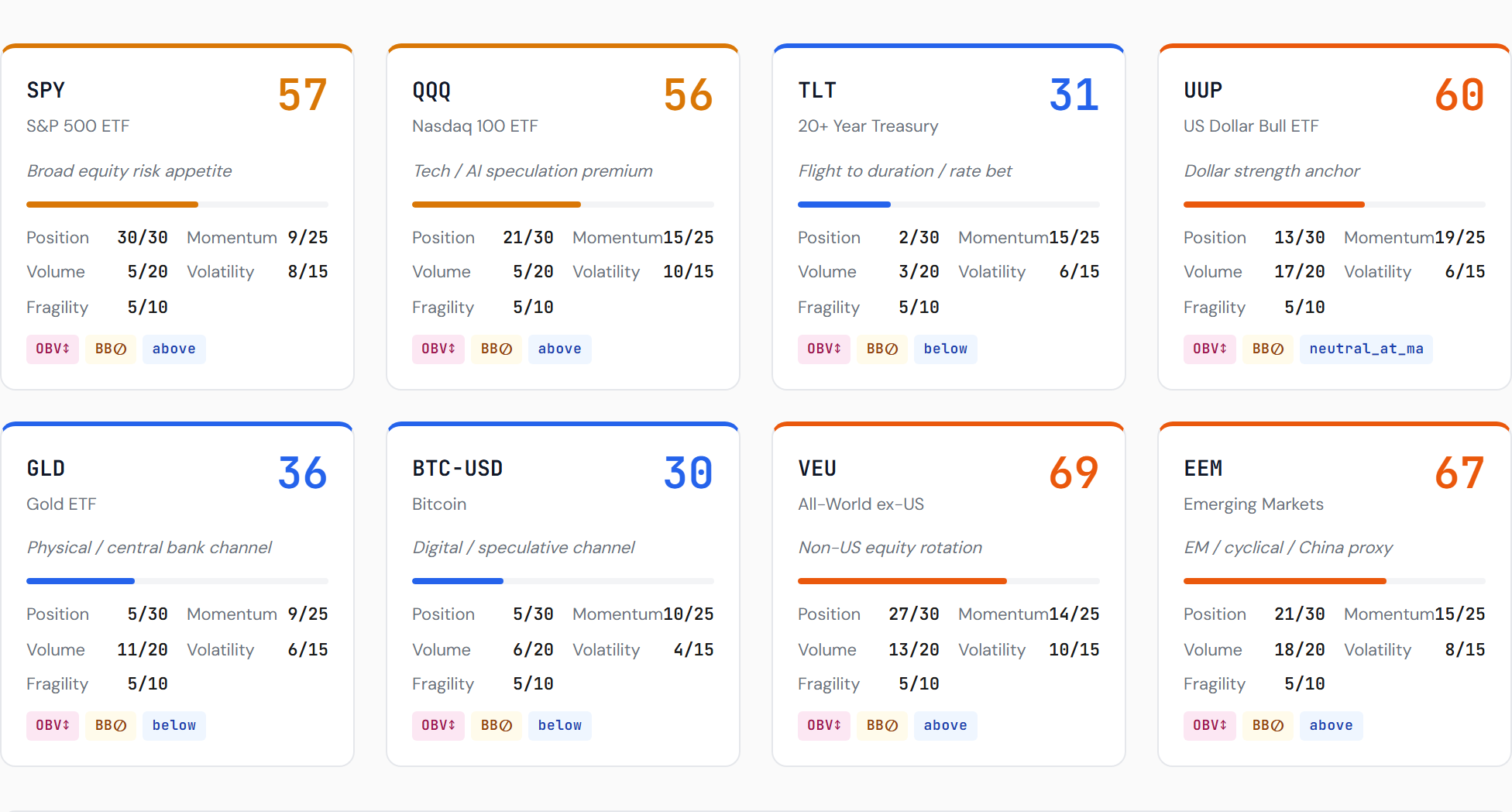
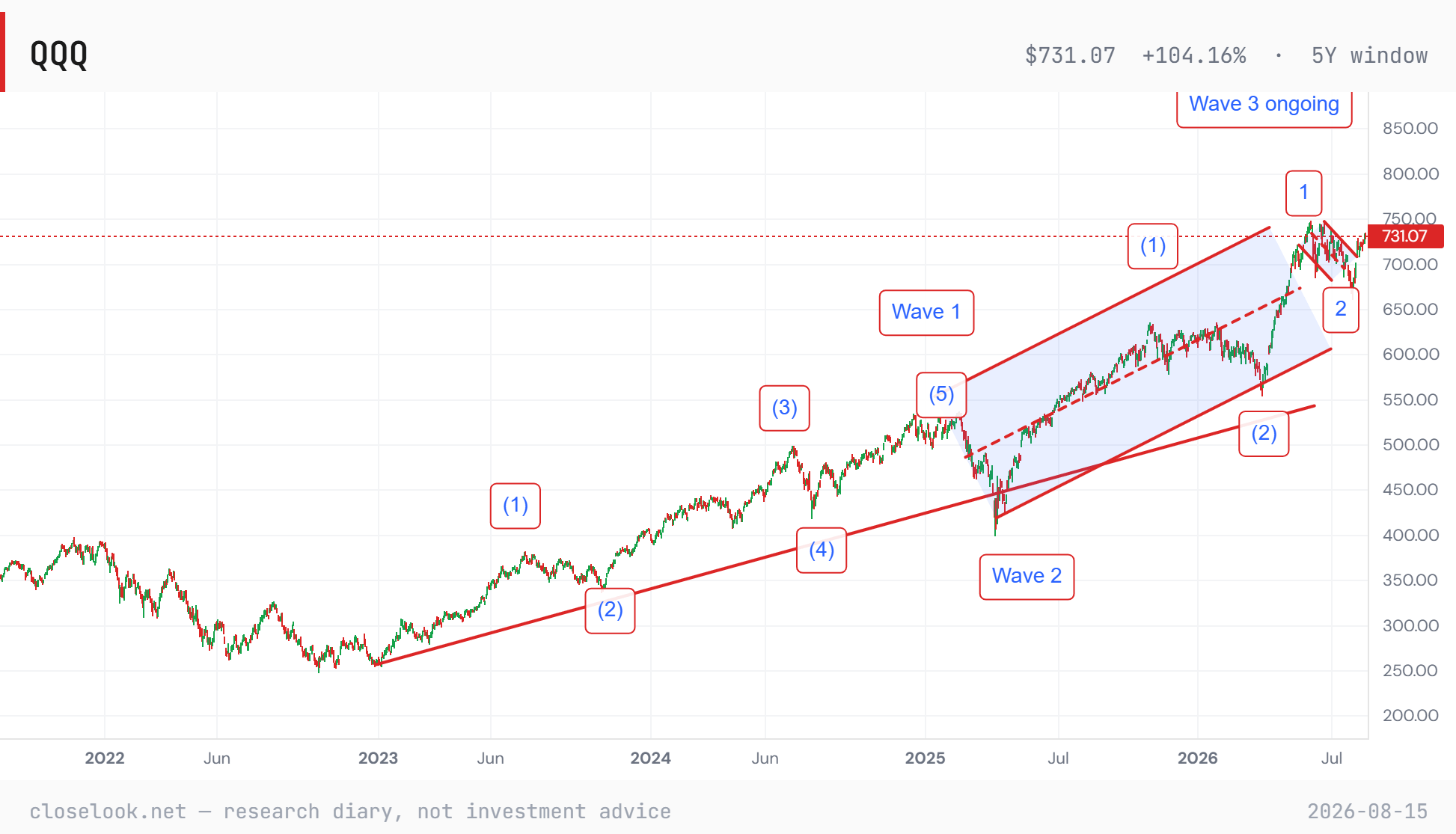
The count — advanced, not confirmed. Two weeks ago this letter filed the contrarian count: the pullback complete, the market inside the third wave of the third of the third. Last week it went live when 694 converted to support. This week it advanced again, quietly: QQQ closed 731.07, through the 723.85 high-water mark that was the map’s upper marker, with Thursday’s 732.07 the week’s best close.
What has not happened is confirmation. 746 remains the line that turns the count from live to confirmed, 2.0% above Friday’s close, and the chip index never challenged its 505 floor. A count that advances a notch in a week the index moves four tenths of a percent is a count carried by internals rather than by price — which is either the healthiest way to advance or the quietest way to stall. The difference prints at 746.
