


0 · Last week, scored
Verdict: the floor held and non-tech growth rose 2.4%; the 10-year broke its line on Monday and gave it back by Thursday.
Last Sunday’s signal was non-tech growth: two years of dead capital, now trading like a bond. The Nasdaq 100 without tech held its 95.56 low, closed back above the 96.2 shelf and finished at 98.15 — still under its 50-day. The 10-year closed at 5.31% on Monday, above the 5.29% line, then fell back to 5.22% on Thursday; the bond funds made one more new low on Monday and ended the week a little higher. In a week the bond market stopped falling, the bond-like half of the Nasdaq rose with it — exactly the link the signal described.
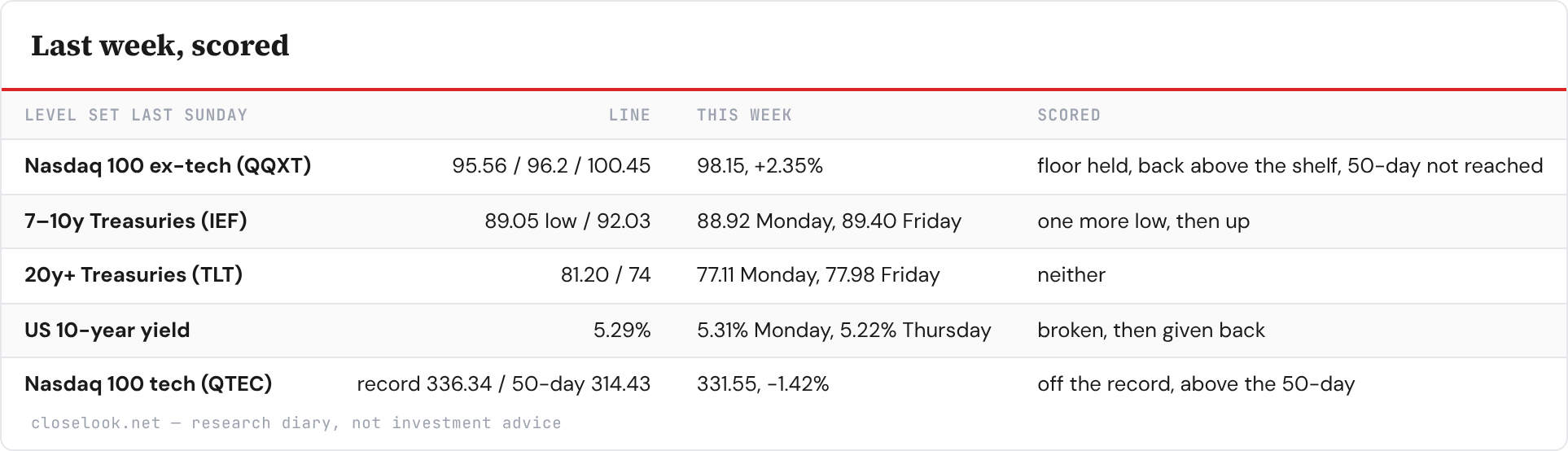
Table as text
1 · The signal — financials: the early warning has turned, for now
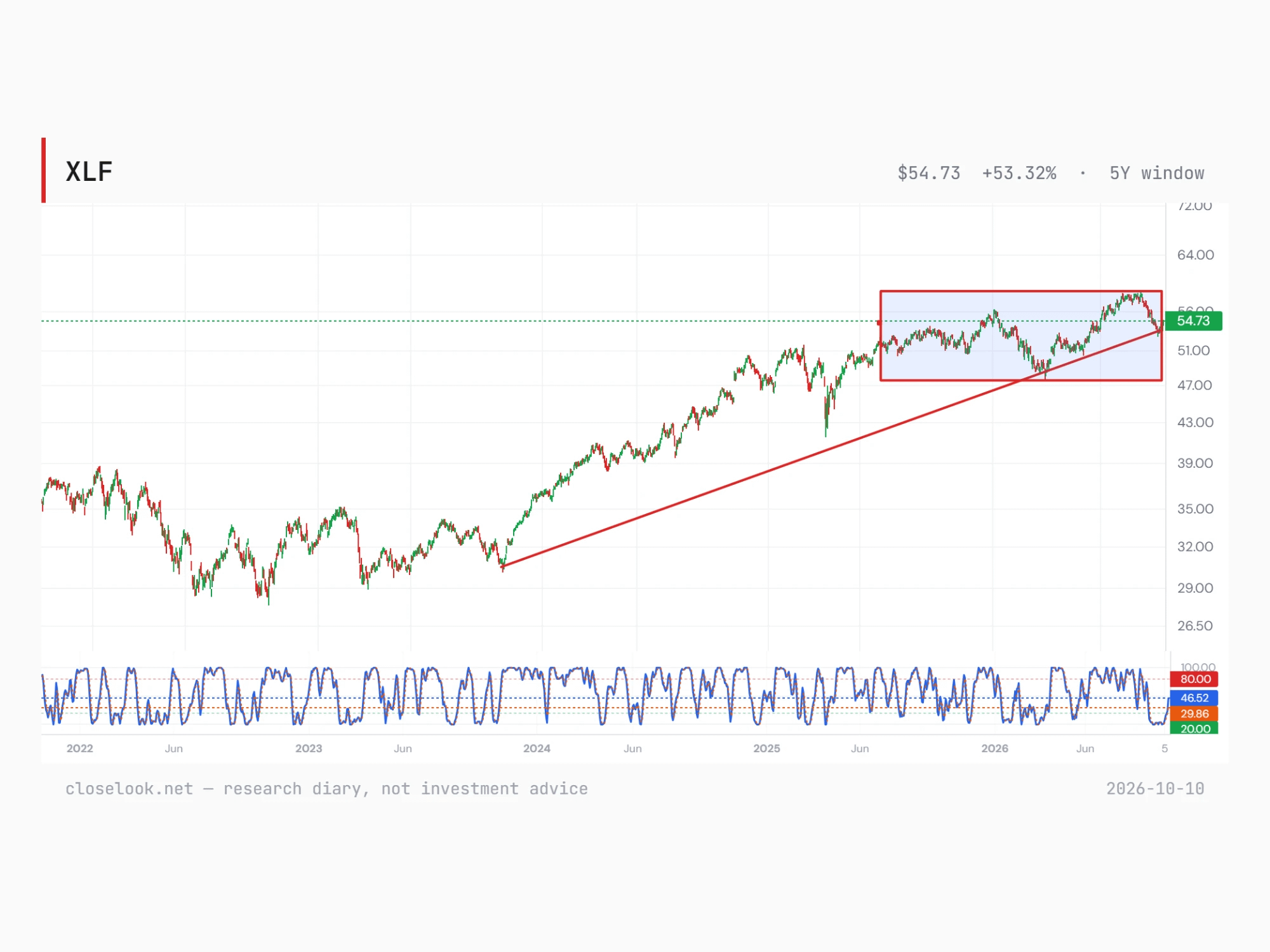
The financial sector fund closed Friday at 54.73. Its lowest close of the autumn came on 30 September, at 53.40; every close since has been higher, and the week ended 2.5% above it. A week ago not one of the 76 financial stocks in the S&P 500 closed above its 20-day average; on Friday 29 did. The fund closed exactly on its 20-day average and back on the rising line the editor draws from the October 2023 low.
That matters for more than the banks. Financials have a habit: they tend to turn before the rest of the market at the top. This autumn they did it again — XLF made its high on 3 September at 58.56, a month before the S&P 500 made its record on 6 October, and fell 8.8% to its low while the index kept rising. That is the pattern an early warning looks like. The bottom on 30 September is the first sign the warning has been withdrawn. It is only a sign: the fund is still 6.5% under its September high and 3.2% under its 50-day.
2 · The numbers: who turns first
We checked the habit against the record: every S&P 500 decline of 15% or more on monthly closes since 1999, plus the shorter corrections of 2011, 2015–16 and 2018, and in each the month the financial sector fund made its high and its low against the month the S&P made its own.
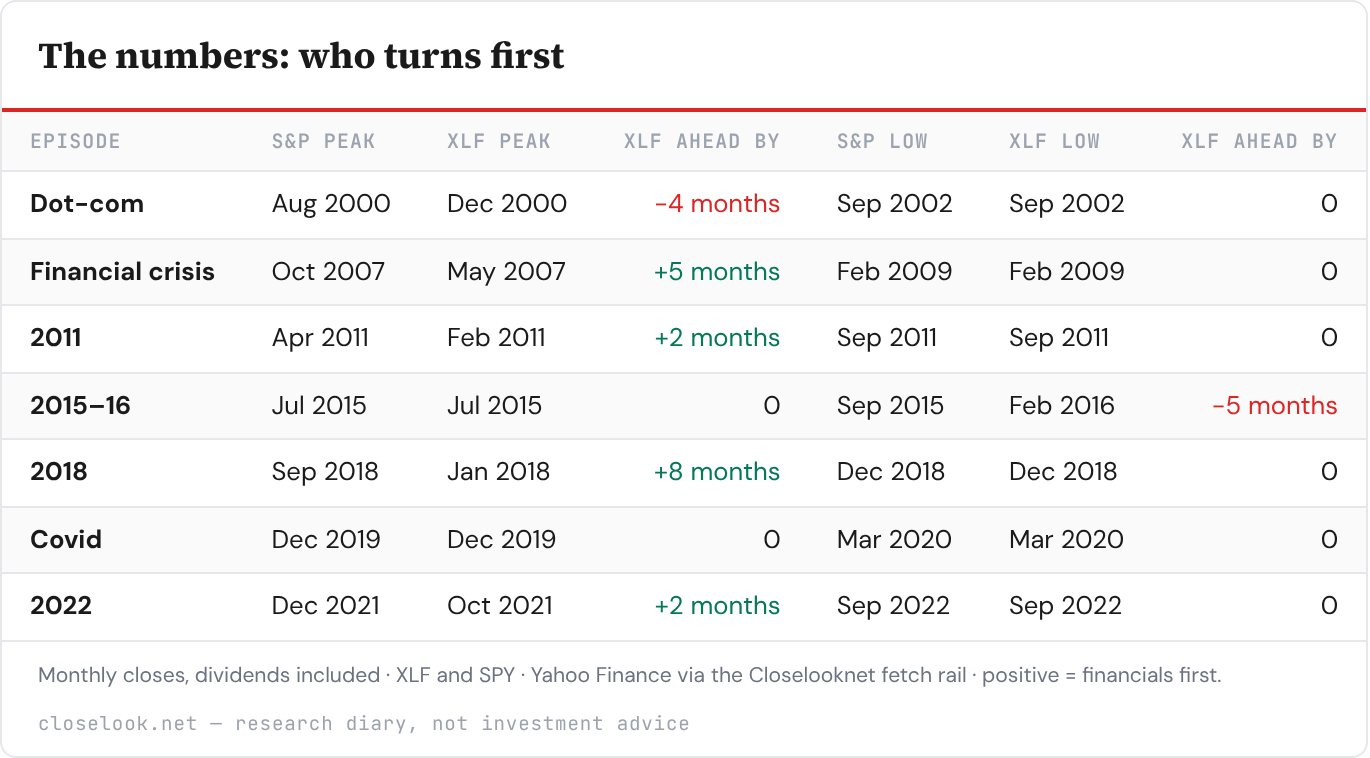
Table as text
Monthly closes, dividends included · XLF and SPY · Yahoo Finance via the Closelooknet fetch rail · positive = financials first.
Read it in two lines. At the top, financials usually go first: in four of seven episodes they peaked two to eight months before the index, in two the same month, and only once later. At the bottom they do not lead: in six of seven they made their low in the same month as the index, and once later. So the record supports half of the idea. An early top in financials has been a real warning; a bottom in financials has been a bottom for everything, not an early one. That is why the September high was the signal worth watching — and why a new low would be the signal worth fearing.
3 · Why: the sector that sees credit first
Banks, insurers and asset managers sit where money is lent and borrowed. They see loan demand slow, defaults rise and deal activity fade before those show up in the rest of the economy’s profits — and their own earnings depend on the shape of the yield curve, which turns before the cycle does. When investors start to worry about credit, they sell the lenders first. When the worry passes, they usually buy everything at once.
This year the worry was the long end: a 10-year yield that rose from under 4% to above 5.3%, with real yields at their highest since 2008. The sector peaked on 3 September and fell for four weeks. This week the long end steadied, the market traded as if the top in rates were in — utilities turned on 28 September, financials on the 30th, staples on 1 October, health care on the 2nd — and the lenders were part of the turn, not ahead of it.
4 · Dead capital since July 2025
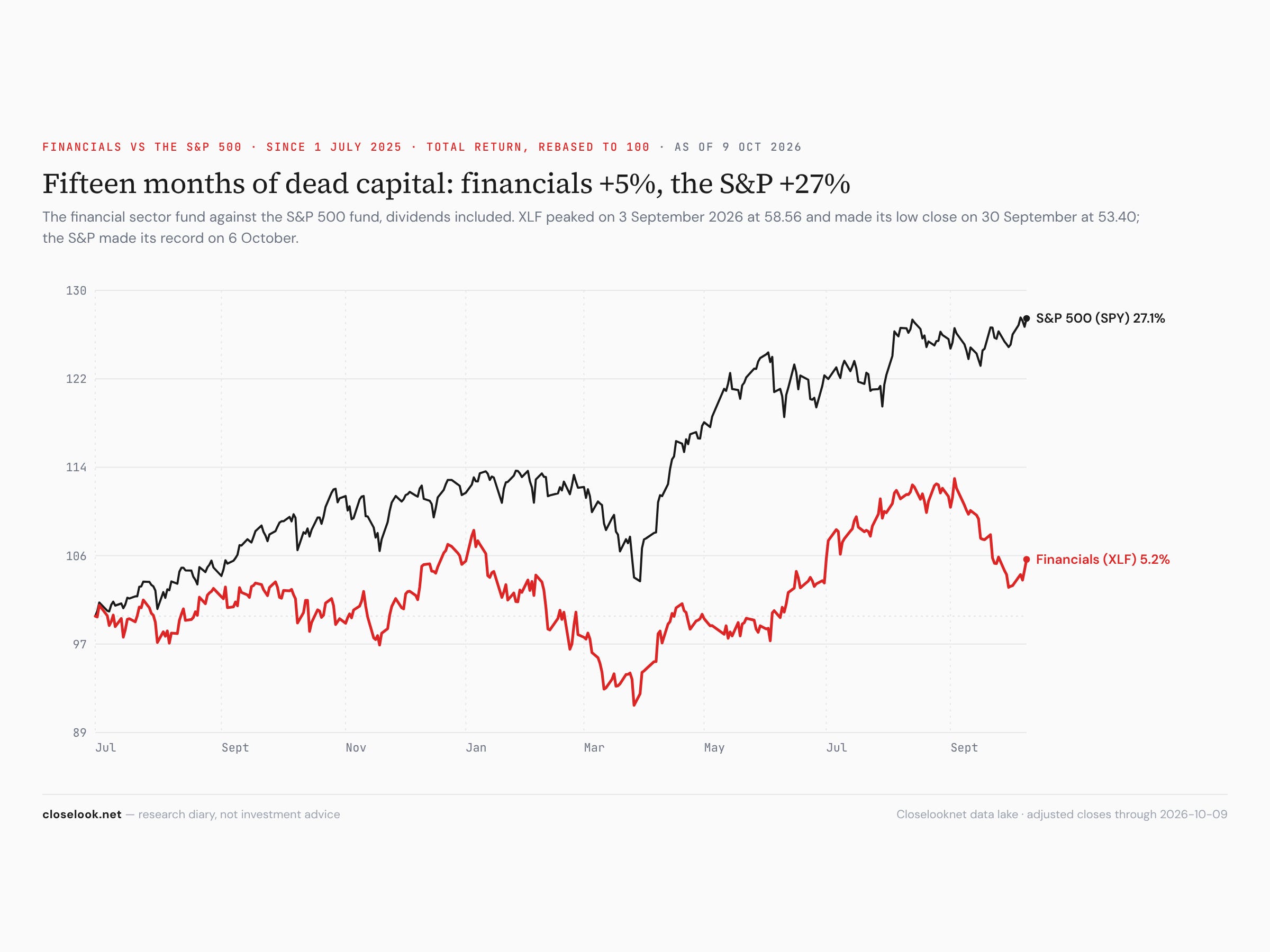
Since 1 July 2025 the financial sector fund has returned 5.2% with dividends; the S&P 500 fund 27.1%. For fifteen months the sector has moved in a box between 47.81 (27 March 2026) and 58.56 (3 September 2026) — the editor’s shaded rectangle. In that time the S&P rose a quarter. Financials were not falling; they were simply not part of the market that was rising.
The four names that decide the sector, and where each stands. They are not one trade:
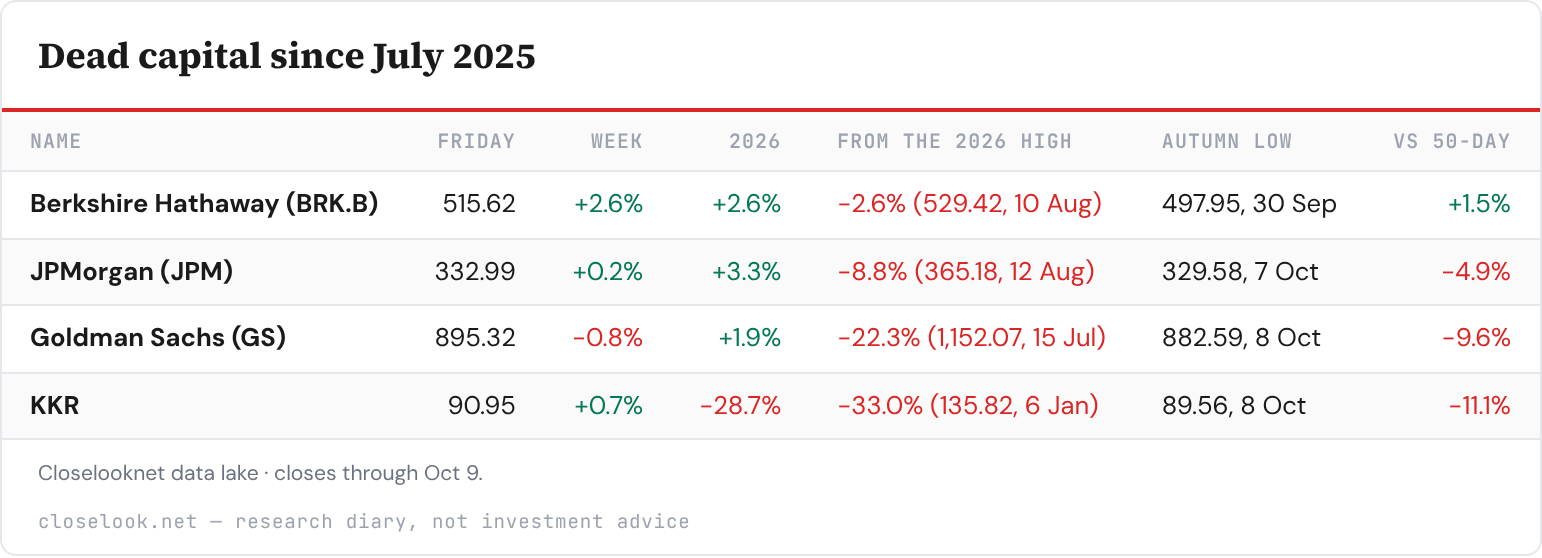
Table as text
Closelooknet data lake · closes through Oct 9.
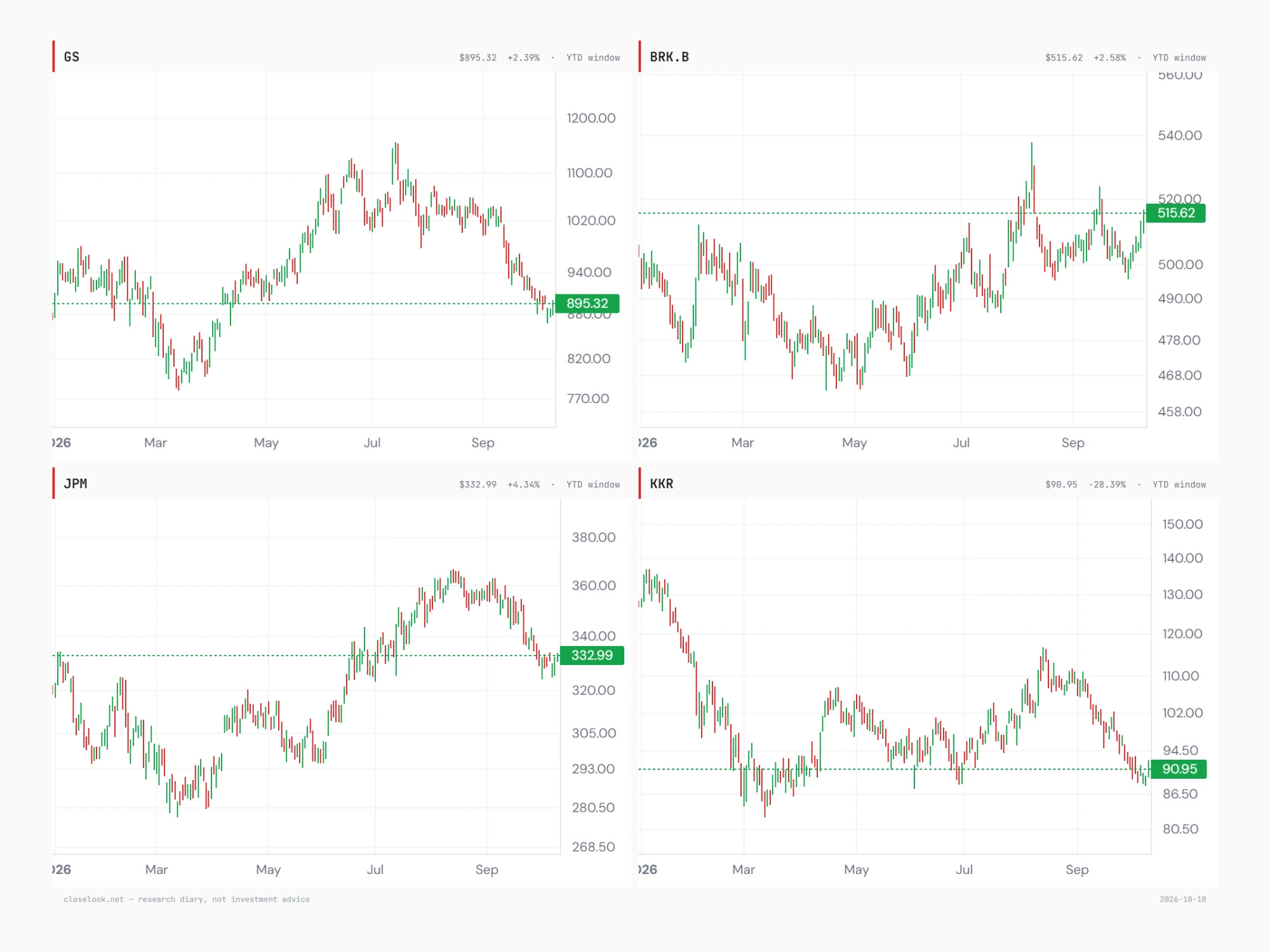
One turned, two sit on their lows, one never stopped falling. Berkshire — insurance, railways, utilities and a cash pile — made its low on 30 September with the sector and is back within 2.6% of its August high. JPMorgan and Goldman made their lows this week, on Wednesday and Thursday, and have barely moved off them; Goldman is 22% under its July high. KKR, the private-capital manager, is down 29% on the year and made its low on Thursday. The turn in the sector is so far a turn in its safest part. The banks and the private-credit firms are where the warning would come back.
5 · The test: the banks report next week
The reporting season opens with the big banks: JPMorgan and Goldman Sachs are scheduled to report on Tuesday, 13 October (calendar listings; not yet confirmed by the banks). Their numbers are the first hard read of the quarter on loan demand, credit losses, deal-making and trading — the things the sector’s price has been worrying about since September. A bank season that shows steady credit and a reopening deal market would turn this week’s bottom into the start of a catch-up; one that shows rising provisions would make the September high the early top the record says it can be.
6 · The levels
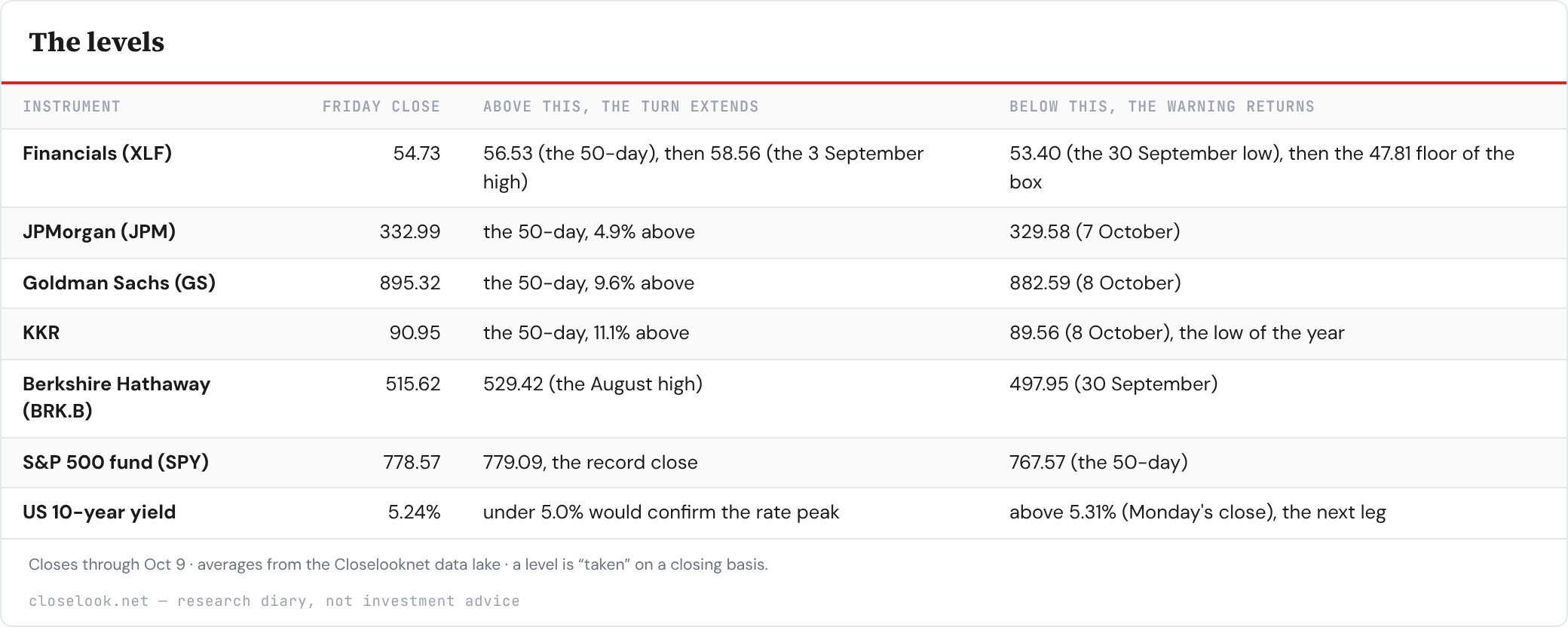
Table as text
Closes through Oct 9 · averages from the Closelooknet data lake · a level is “taken” on a closing basis.
7 · The questions ahead
Does XLF hold 53.40 through the bank reports — the one level that decides whether September was a warning withdrawn or a warning delayed? Do JPMorgan and Goldman lift off the lows they made this week, or does Goldman’s 22% drawdown say the deal market is not coming back yet? Does KKR stop falling — the private-credit firms are where a credit problem would surface first? And does the 10-year stay under Monday’s 5.31%, the condition for the whole rate-peak trade the market began this week?
Our read, stated so it can be scored: the financial sector may have bottomed on 30 September, and the bank reports next week are the test. Held, it removes the early warning that has hung over the market since the sector peaked in September, and it gives the broadening the market began this week its most important member. Any further decline — a weekly close under 53.40 — would be negative: on the record, financials do not bottom early, and a sector that has already topped and then makes a new low is the late-cycle pattern of 2007 and 2018, not the start of a catch-up.
8 · The count
The Nasdaq 100 fund closed the week at 751.27 and held the 746.16 confirmation line on every close; the S&P 500 fund made a record close of 779.09 on Tuesday and ended at 778.57. The equal-weight S&P rose 1.58%, the Nasdaq 0.23%. The bond market gave its first partial countersignature in twelve weeks: the long Treasury fund made a new low on Monday and closed higher four days later. The dollar fund made another high close of the year on Wednesday.
One sentence to close, because a diary should say what it actually thinks. Financials gave the market its early warning in September, the way they did before the tops of 2007, 2011, 2018 and 2022, and this week they turned with the rate-sensitive sectors — so the warning is withdrawn for now, but on the record a bottom in financials is never early, and the bank reports on Tuesday decide whether this one holds. Probability, not prophecy. We monitor, and we score it next Sunday.
Related on Closelooknet: XLF on the terminal · JPMorgan · Goldman Sachs · Financials breadth · Sovereign Pressure · Sunday’s US letter · Daily Pulse