


The 30-year Treasury yield closed at 5.561%, above Friday’s 5.504%, which was already its highest close since 2004. On our chart this is a clear break, not a test of support, and it is not only an American story. Yields are rising in Tokyo and across Europe at the same time. That changes what works in stocks: when the rate used to value future profits keeps climbing, only companies whose earnings grow faster than their valuation shrinks can hold their price.

Three bond funds, one picture
The break is not confined to the longest bonds. The 10-20 year fund TLH and the 7-10 year fund IEF show the same state: below their 20-, 50- and 200-day averages and within half a percent of their 52-week lows.
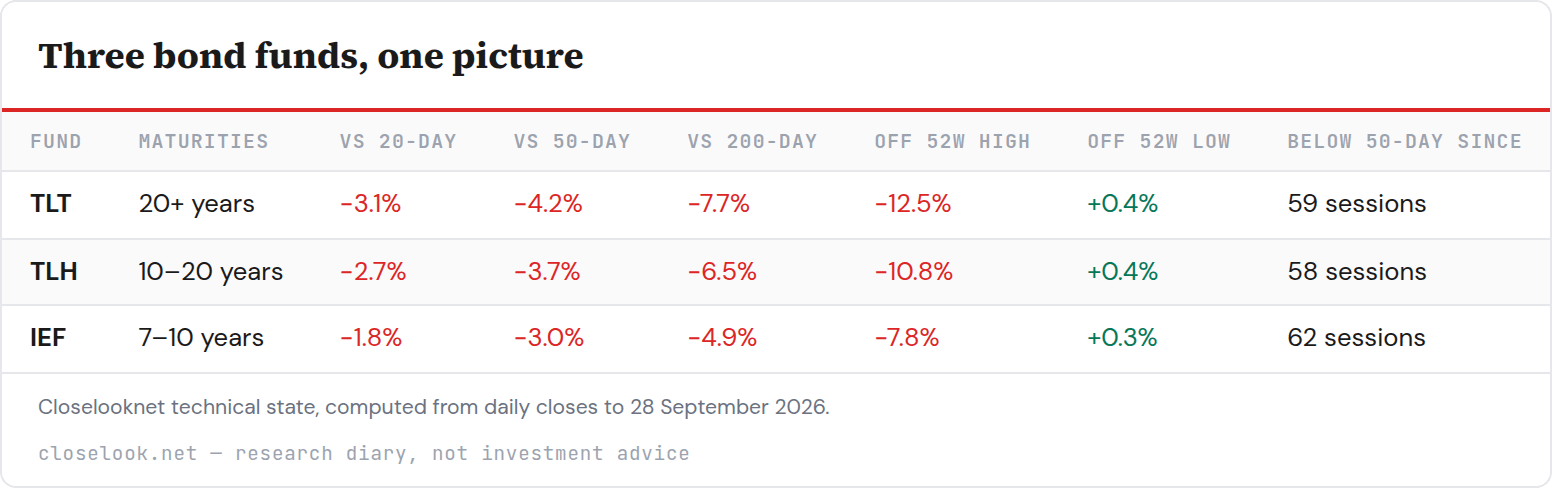
Table as text
Closelooknet technical state, computed from daily closes to 28 September 2026.
All three have been below their 50-day average for about three months. Their stochastic readings - a measure of where the price sits inside its recent range - are at extreme lows (TLT %K 8.7) and have just turned up. In a strong trend that signal is weak evidence: the earlier bull crosses in this downtrend failed. A turn in the indicator is not yet a turn in price.
Closelooknet on Google
Get our reads first in Top Stories and AI answers. One tap, no account needed here.
Why the break is global
Our Sovereign Pressure board tracks the benchmark yields of the G7. At Friday’s close the average 10-year yield across the seven was 4.34%, up 38 basis points in 21 trading days and up from 3.39% a year ago. Two moves stand out beyond the US.
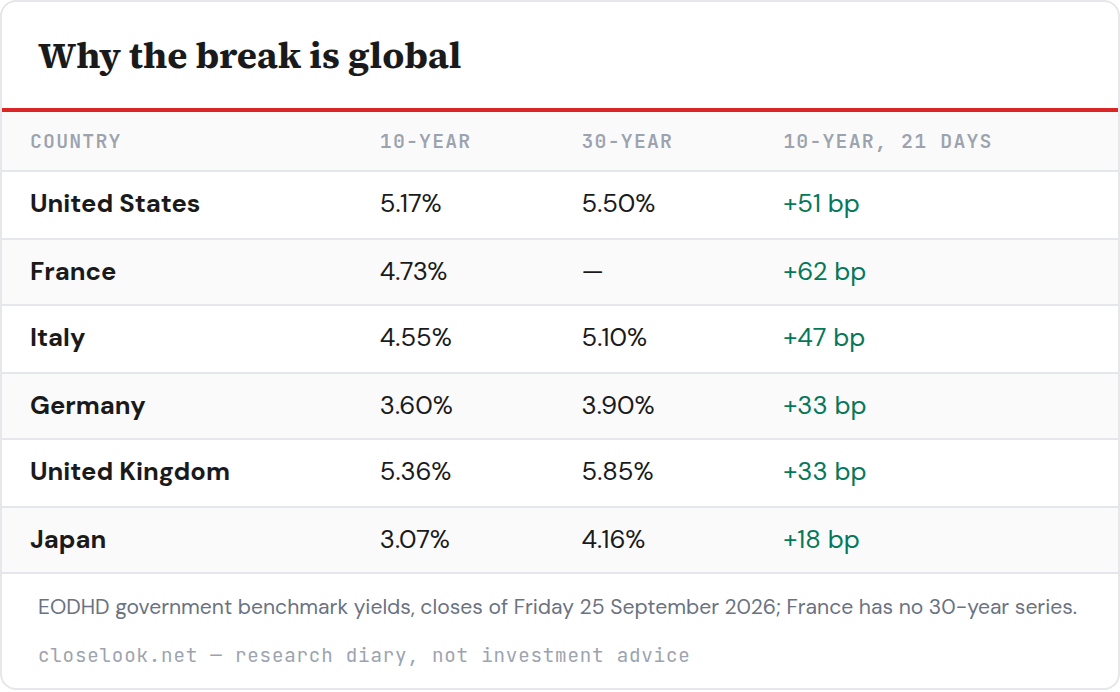
Table as text
EODHD government benchmark yields, closes of Friday 25 September 2026; France has no 30-year series.
Japan is normalizing. After decades near zero, the Japanese 10-year yield is above 3% and the 30-year above 4%. For years Japanese savers were the marginal buyers of foreign bonds, because home paid nothing. With 4% at home, that money has less reason to leave, and some reason to come back.
Europe’s sovereign credit is weakening. France now pays more to borrow for ten years than Italy - 4.73% against 4.55% - and its yield rose 62 basis points in 21 days, the most in the G7. The gap to Germany is more than one percentage point. When a core euro country is priced like the periphery, investors demand more for holding government debt everywhere.
US long bonds are being sold into that.
What it means for stocks
A higher long-term yield raises the rate at which future profits are discounted, so the same stream of earnings is worth less today. Every stock’s valuation multiple comes under pressure. The companies that can hold their price are the ones whose earnings grow fast enough to make up for the lower multiple. In our reading, three groups separate in this setting:
Fast growers - companies whose profits are still rising quickly. A lower multiple on much higher earnings can still mean a higher price. Monday, Nvidia rose 1.68% on a day the S&P 500 fell 0.77%.
Steady growers - companies whose earnings rise slowly and reliably. They have no growth cushion against a lower multiple, and a 5.5% bond now competes directly with their dividend. Last week utilities fell 3.87% and real estate 2.28% while technology rose 3.52%.
Assets without income - gold first. It pays nothing while bonds pay 5.5%. The gold fund GLD fell 3.94% on Monday, a rare one-day drop for the metal, and the miners 5.36%.
This does not say every fast grower wins; Monday also showed Meta losing 4.79% on the cost of a new business, and MongoDB 18.46% on the loss of its chief executive. It says that in a market where the discount rate is rising worldwide, earnings growth is the only thing that offsets it.
What to watch
Wednesday brings core PCE, the Fed’s preferred inflation measure, and Micron’s results. A hot inflation number with TLT below 78 would extend the break toward 74, the next level named in Saturday’s Global letter. A soft number would test whether the stochastic turn finally holds. For the stock side, Micron is the test of the argument: a company whose earnings are growing fast, reporting into the highest long yields since 2004.
This is a research diary, not a recommendation to buy or sell any security.
Into tomorrow
Tonight: Costco and BlackBerry are scored on the print record at the close (Costco paid at 923.37). Wednesday: core PCE and Micron’s results after the close; the functional indices rebalance at the 30 September close. The lines: TLT 78 and its 52-week low; the 30-year at 5.60%; GLD 377.91.
The signals behind thisEach line links to the tool it comes from
LabSovereign Pressure — G7 benchmark yields, 10-year and 30-year, every day→LabRates Lab — the US curve and the long end→Morning 10Bonds — the long end breaks: 30-year at 5.56%, gold -3.9%→Print RecordMicron — reports Wednesday into the highest long yields since 2004