


0 · Last week, scored
Verdict: the coin kept its trend, the coin stocks gave theirs back. Rubin took its 50-day and held it.
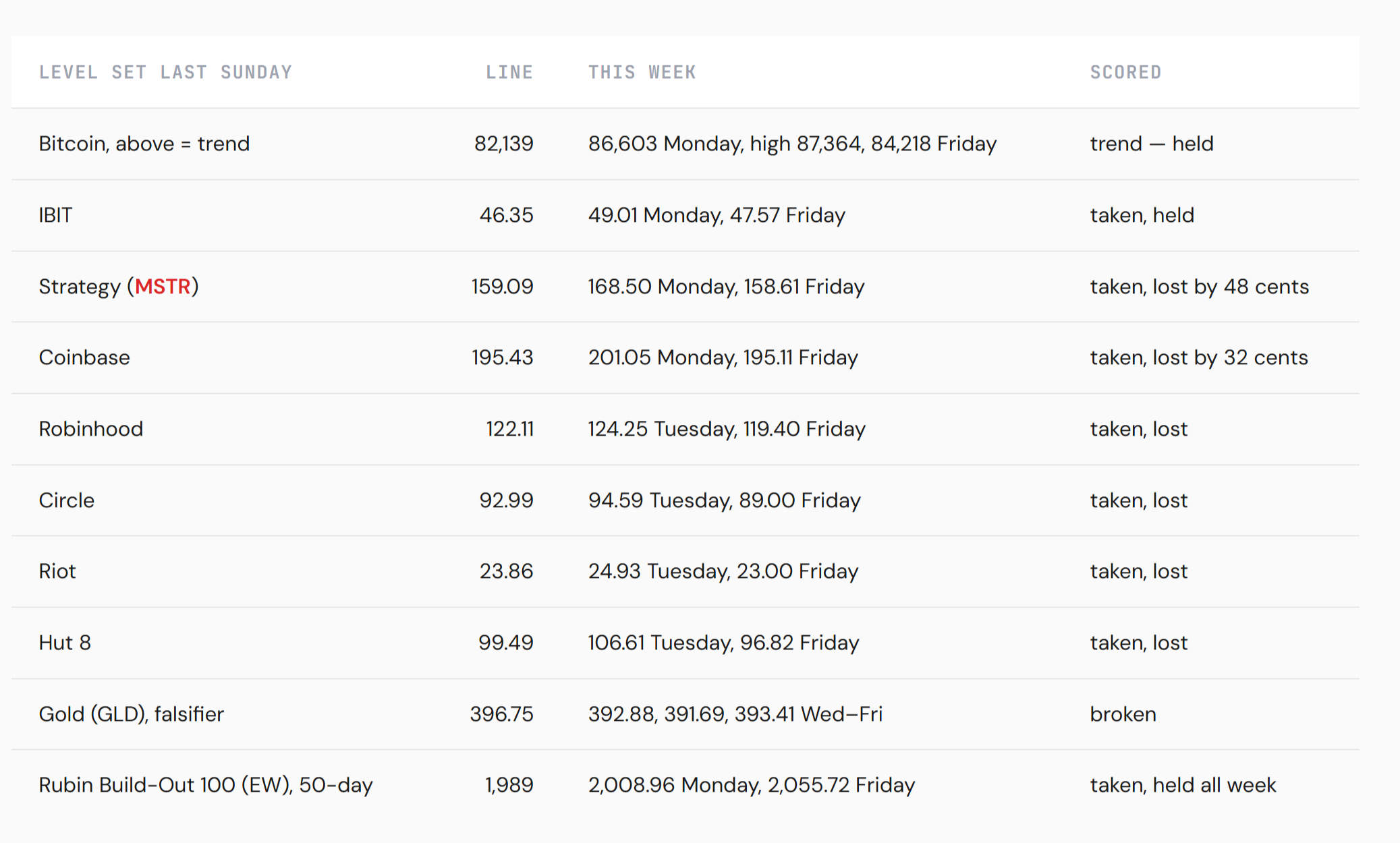
Last Sunday put bitcoin’s recovery on two lines: above 82,139, the May 8 weekly close, the recovery becomes a trend; below 76,838 it was a bounce. Bitcoin closed Monday at 86,603, made 87,364 intraday and finished the week at 84,218, above the line on every close. Scored: a trend, for now, with a pause near 84,000 on Saturday. The bitcoin fund followed through 46.35 and held.
The stocks did something else. Every one of the six coin stocks we set a level for — Strategy, Coinbase, Robinhood, Circle, Riot and Hut 8 — took its line on Monday or Tuesday, and every one closed Friday back under it, two of them by less than fifty cents. That is the week’s most useful coin fact: the coin held its breakout, the equities that carry its leverage did not. Gold closed under its 396.75 falsifier three sessions running. On the equity board, Rubin Build-Out 100 closed above its 1,989 50-day on Monday for the first time since August and stayed there all week, ending at 2,055.72, +5.1%.
1 · The signal — the Magnificent Seven without Tesla are beating the market
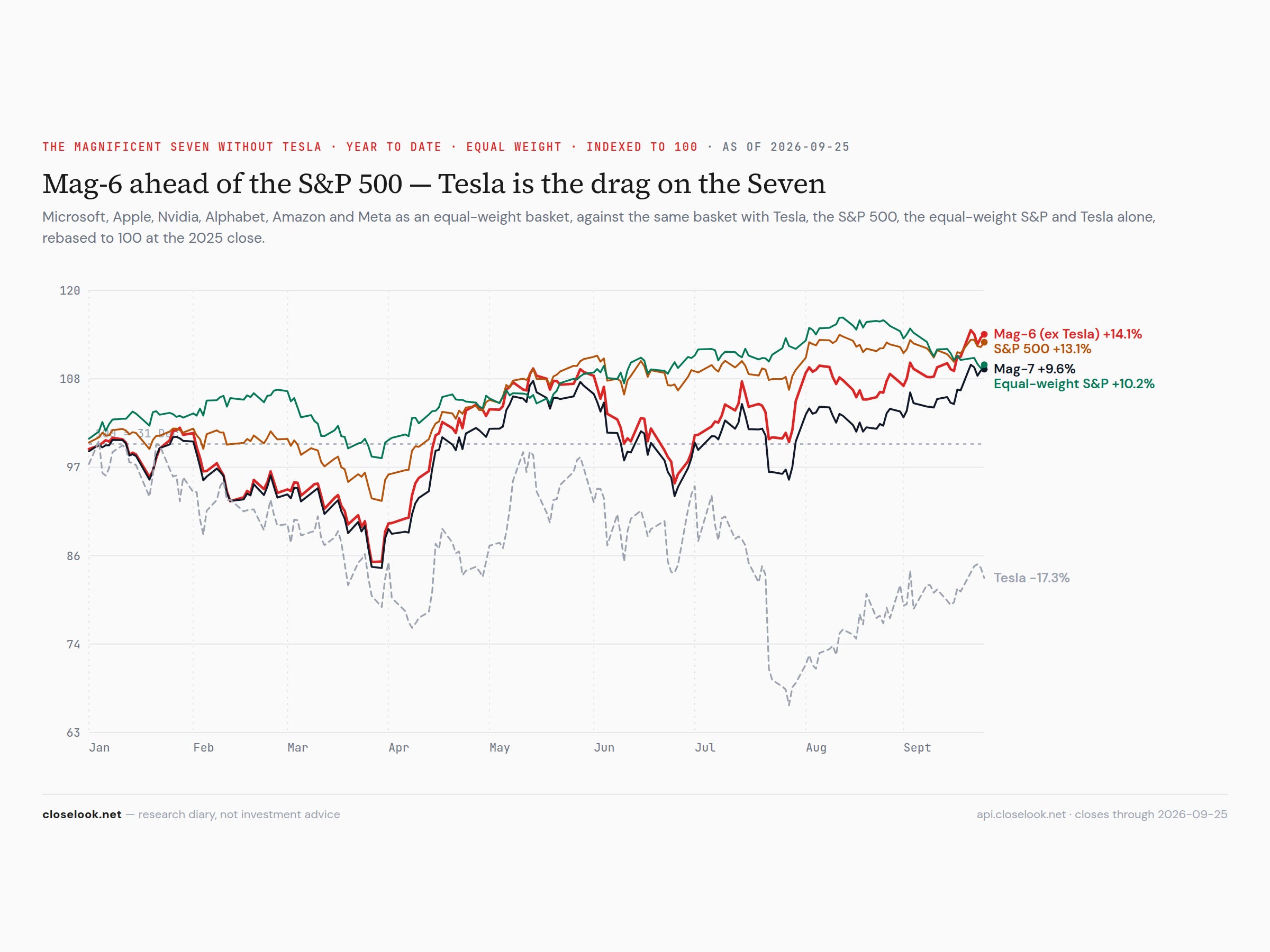
Take Tesla out of the Magnificent Seven and the remaining six — Microsoft, Apple, Nvidia, Alphabet, Amazon and Meta — are ahead of the S&P 500 this year: +14.1% as an equal-weight basket against +13.1% for the index and +10.2% for the average stock. With Tesla the seven are only +9.6%. Tesla is down 17.3% on the year and 24% under its December record; it has cost the group four and a half points.
The lead is recent, and that is the signal. Until the last week of September the six were behind the index all year; they caught up over the summer — +22.3% in three months against +5.0% for the S&P — and went ahead this week, when the Magnificent Seven fund made a record close of 72.97 on Monday and Meta rose 12.9%. The equal-weight S&P fell 0.6% in the same week and is down 4.8% on the month. The market’s gains are being made by fewer, larger companies, and six of them in particular.
2 · Six names, five windows
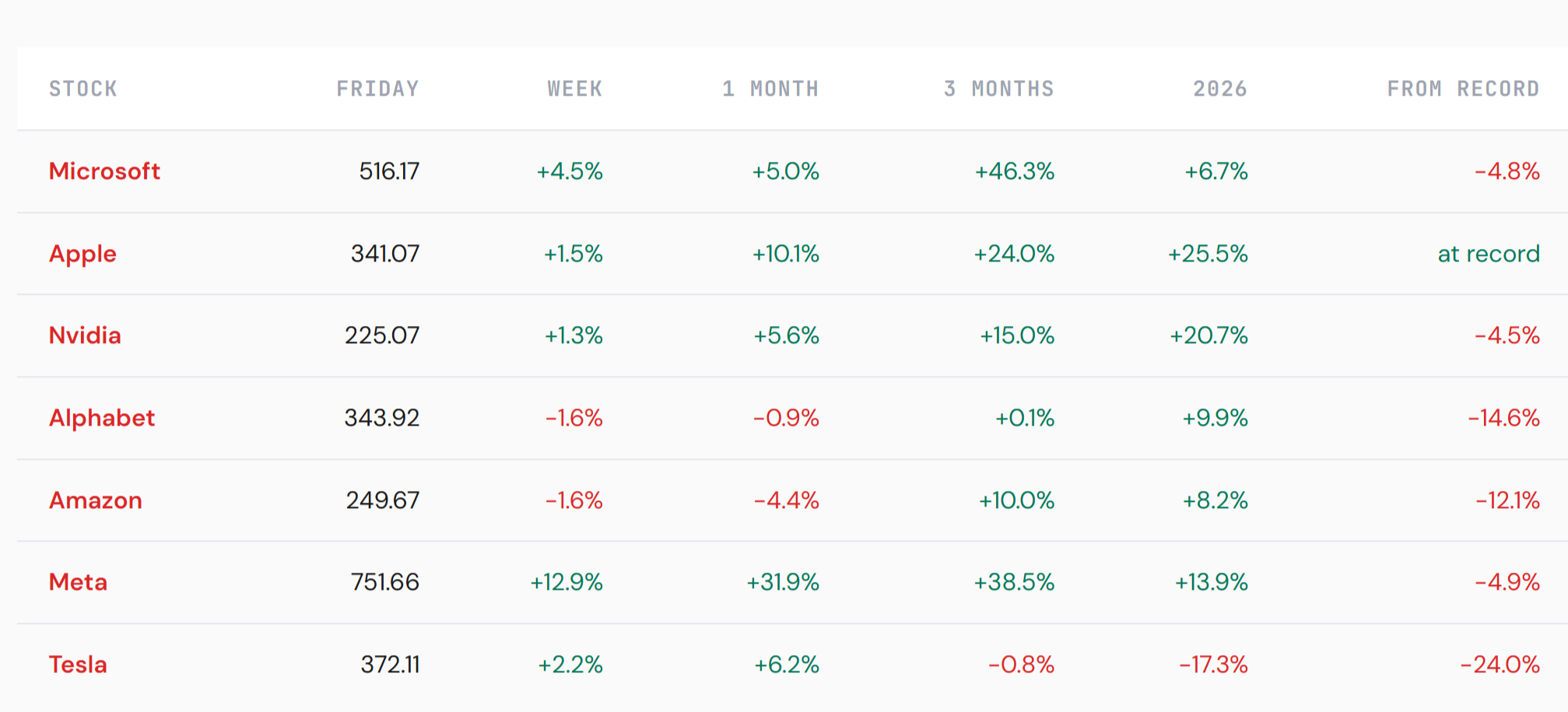
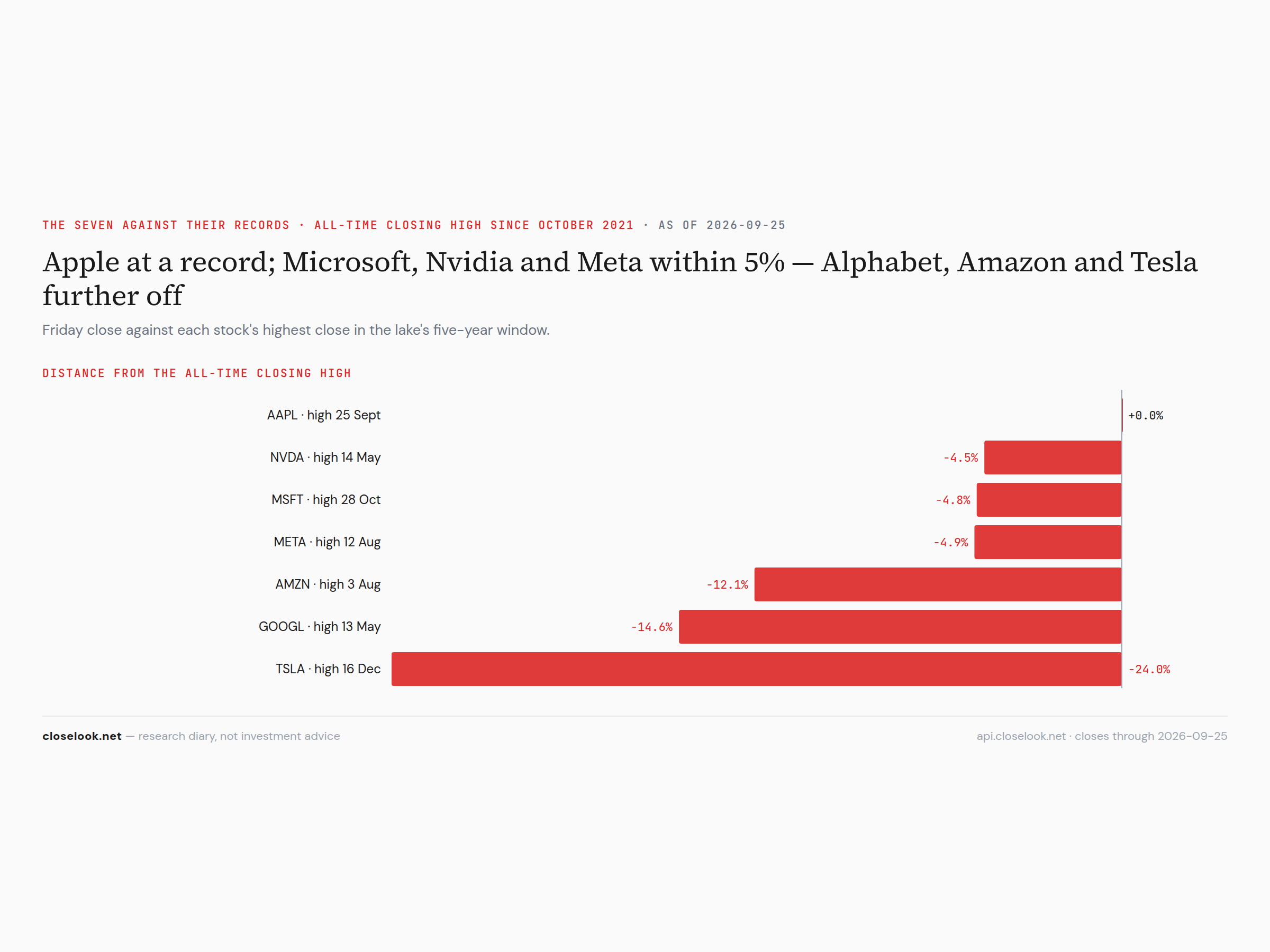
Closes through Sep 25 · record = highest close since October 2021 (Microsoft 28 Oct 2025, Meta 12 Aug 2025, Tesla 16 Dec 2025, the rest 2026) · Closelooknet data lake.
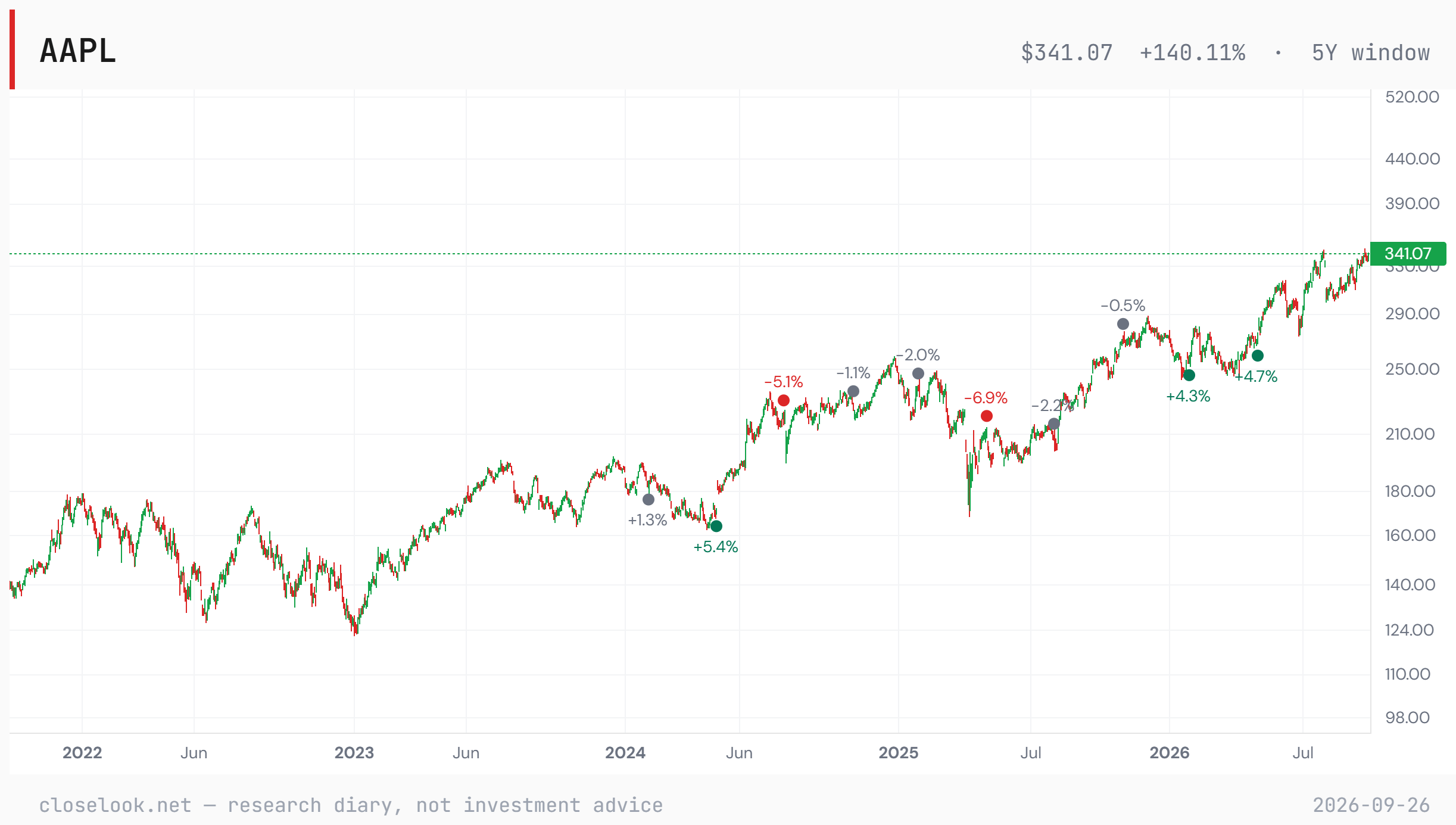
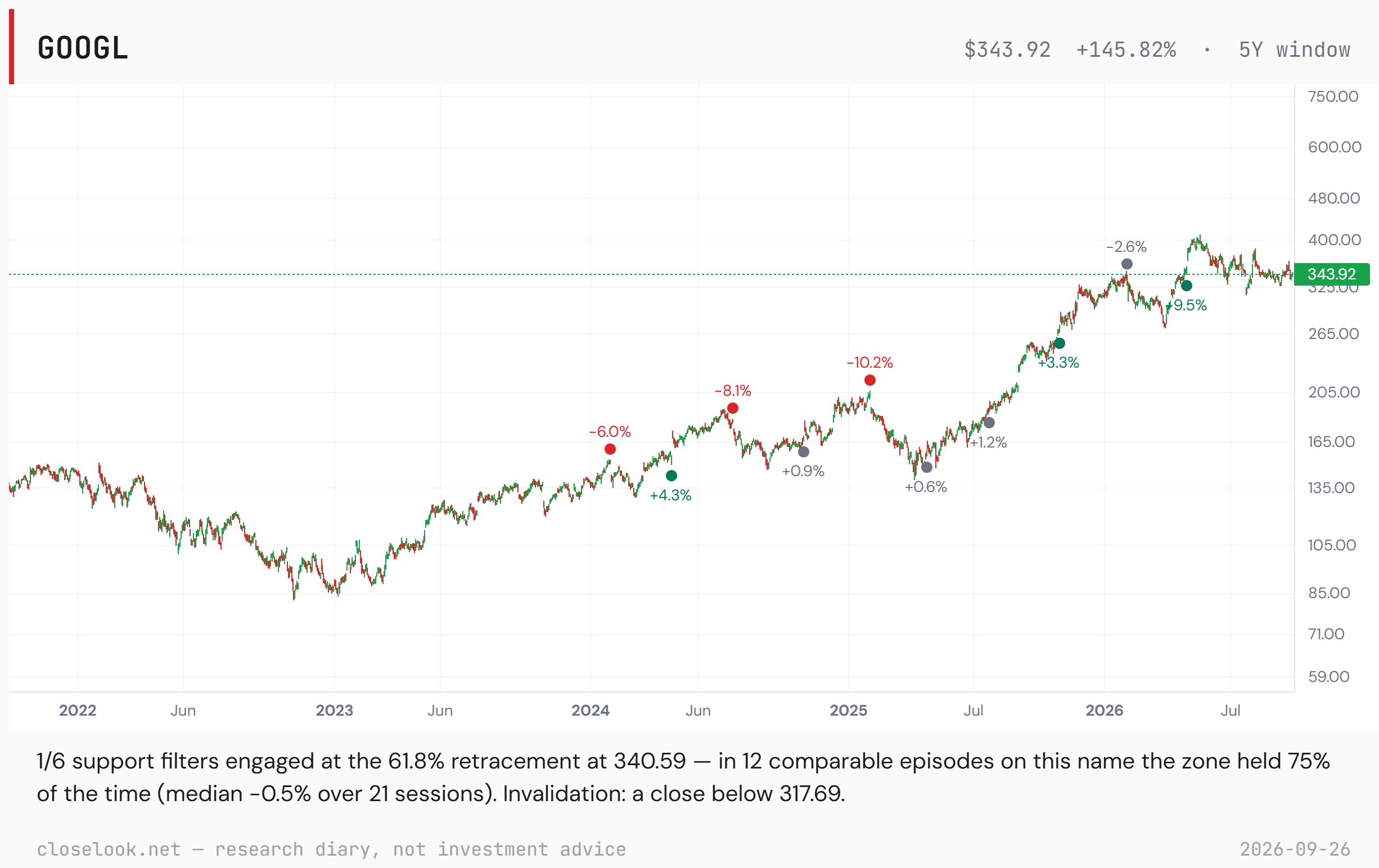
Read the table from the right. Apple closed Friday at a record, 341.07. Nvidia, Microsoft and Meta are within five percent of theirs. Alphabet (−14.6%) and Amazon (−12.1%) are the two the lead does not yet include — both closed the week lower, and Amazon sits under its 50-day average. Microsoft’s three-month +46.3% is the largest move of the six; Meta’s month, +31.9%, the fastest.
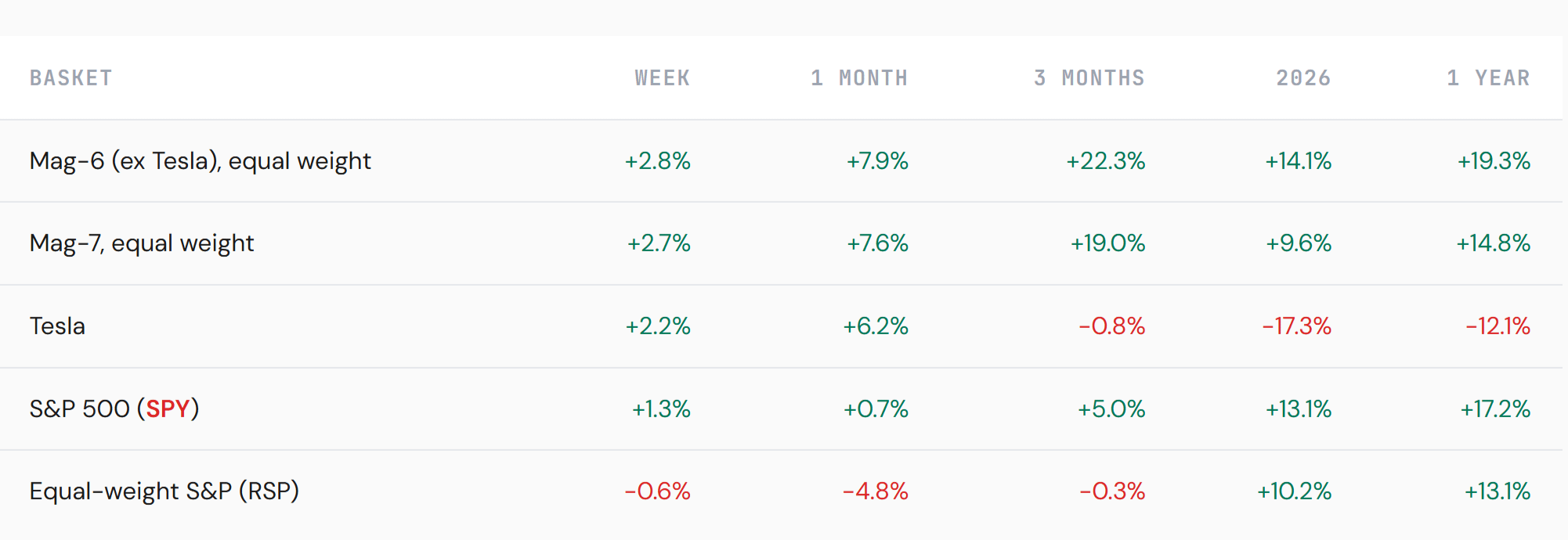
Over every window from one month to one year the six beat both the S&P 500 and the average stock. The gap to the seven — the Tesla effect — is small on the week and the month and wide on the year: three and a half points in three months, four and a half in 2026.
3 · Why the six, and why now
The first reason is AI products people can buy, sold through reach the companies already own. Meta’s Muse agent went to No. 1 on Apple’s US App Store on Monday and named Walmart, Best Buy, Gap, Sephora and Wayfair as shopping partners on Wednesday; the stock rose 11.3% on Monday, its best day in thirteen months. Microsoft rose 3.6% on Friday on reports of a large Copilot expansion — coding tools, autonomous agents and direct access to Word, Excel and Outlook. Neither had to find new customers: Meta puts Muse in front of the billions who already use its apps, and Microsoft puts Copilot inside the Office software companies already pay for. Apple, with the iPhone, and Alphabet, with Search, Android and Chrome, sit on the same kind of installed base, and our read is that they are next in line to sell AI through it. The records of the spring were made on spending plans; this week’s were made on products.
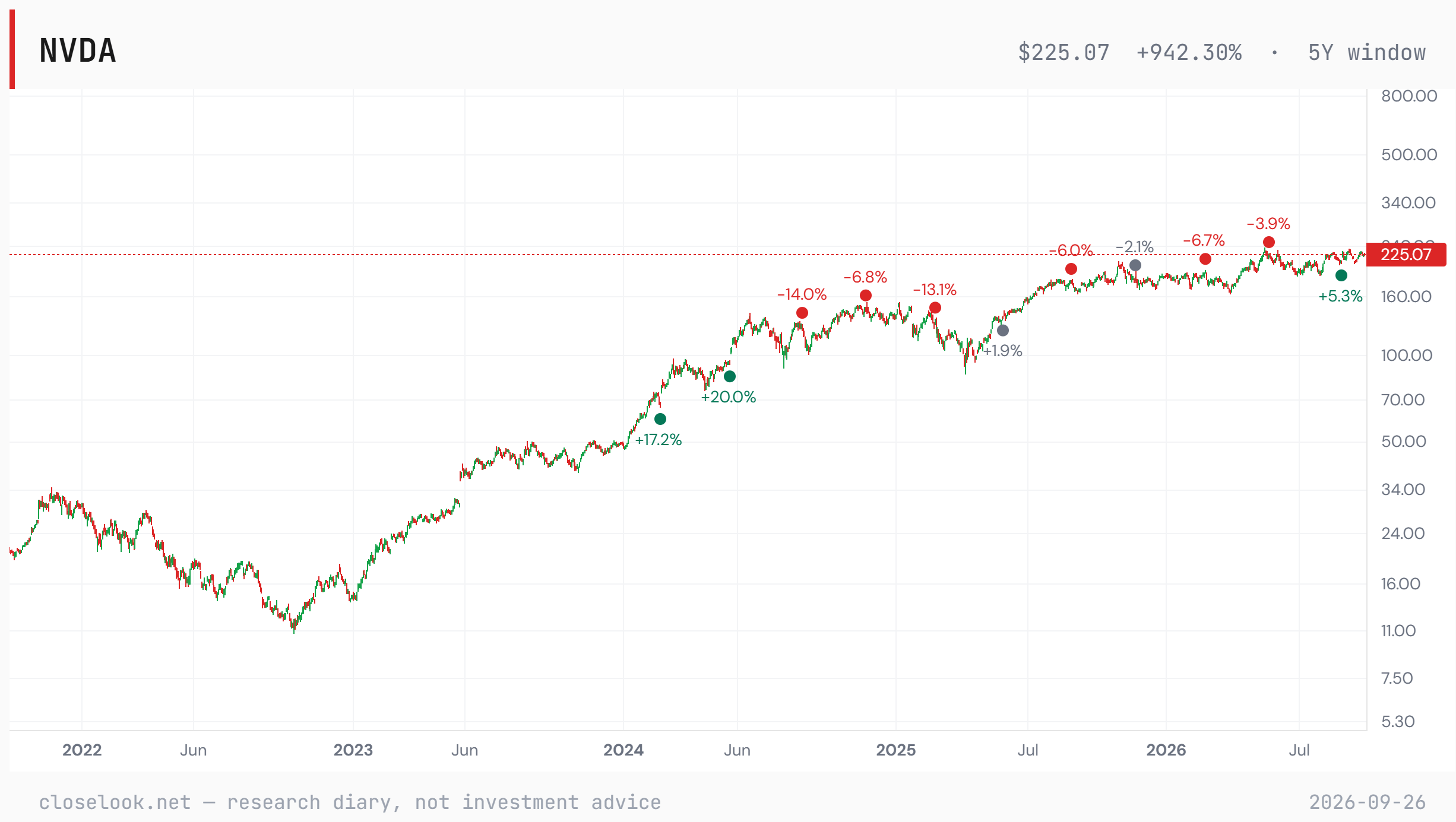
That is why the market sees light at the end of the tunnel. For most of the year the question over AI was who pays for it and whom it replaces. This week the answer to the first question started to outweigh the fear in the second: the prospect of new revenue is outshining the risk of disruption again. Nvidia is the other half of the same story: it is still the dominant maker of the chips all of them build on, its next generation, Rubin, is now shipping, and nothing this week changed that.
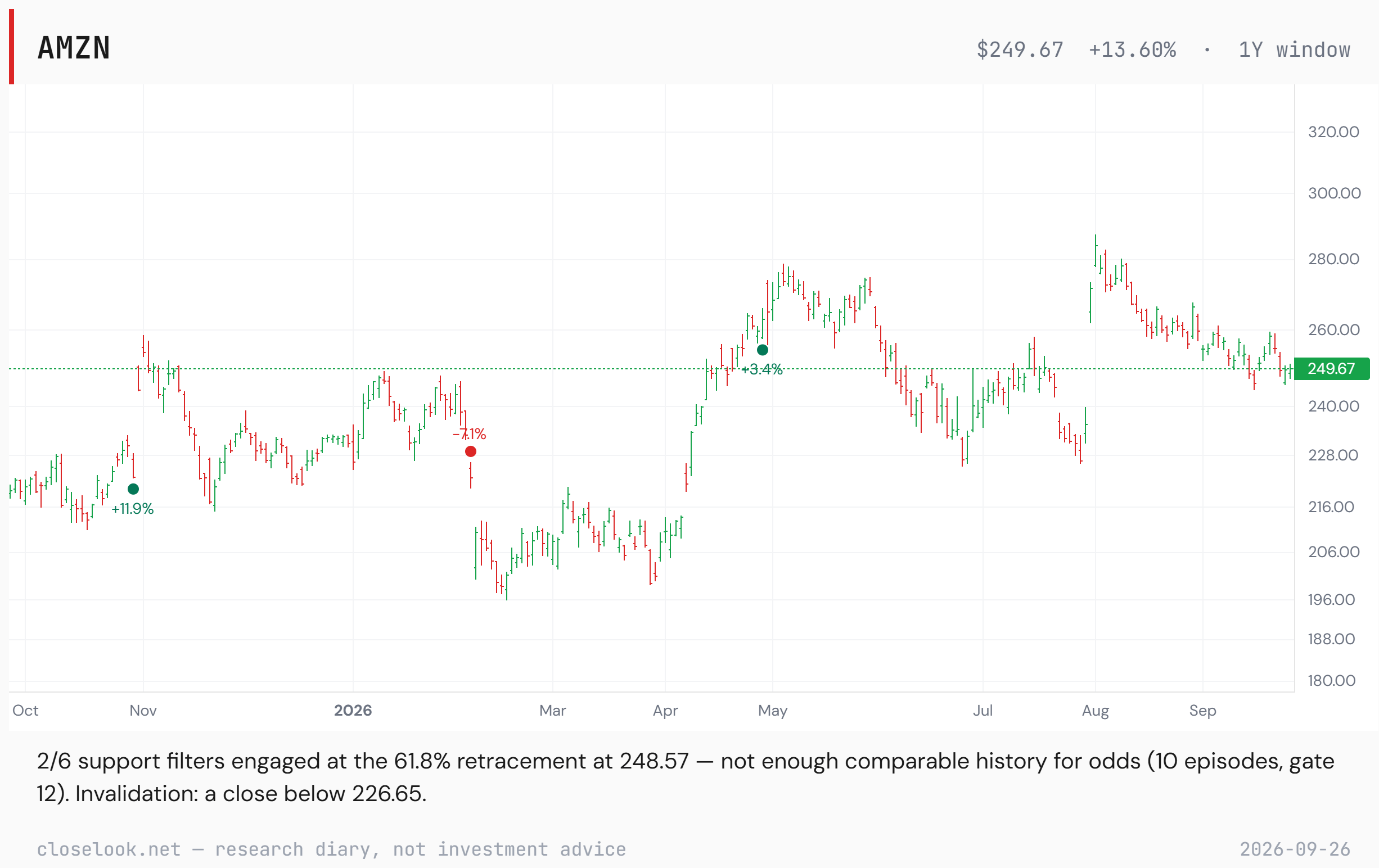
Amazon is the one to watch closely. Its business is broader than the others’ — online shopping, the AWS cloud, advertising — and that spread cushions it. But Muse points at the risk: if shoppers ask an AI agent to buy for them instead of visiting Amazon, Amazon becomes the warehouse and the delivery van behind someone else’s storefront, a middleman with thinner say over price and advertising. It is the only one of the six still 12% below its record.
The idea already has a ticker. The NYSE FANG+ index holds ten equal-weighted names — the six, plus Palantir, Broadcom, Micron and Netflix — and leaves Tesla out. The MicroSectors FANG+ note that tracks it (FNGS) is up 23.1% this year, closed Friday at $83.75 and made its record on Tuesday. It is a note, not a fund: it carries the credit risk of the bank that issues it. We note it as the closest listed version of the theme, not as a recommendation.
The second is cash. As Thursday’s Daily Pulse set out, the seven produce about $396 billion of free cash flow, and five of the seven trade at 22 to 25 times next year’s earnings. The four hyperscalers are spending about $409 billion on capital projects, and that is the catch: the spending is paid for out of the cash, not borrowed. In a week the thirty-year Treasury yield reached its highest since 2004, companies that do not need the bond market were the ones investors paid for.
The third is the absence of the one that did not deliver. Tesla’s year has been a story about what it might become, and in a market paying for what companies sell today, that story fell 17% while the six rose 14%. The difference between the Magnificent Seven and the Mag-6 this year is almost entirely one company.
4 · What the lead leaves behind
A market led by six companies is a narrow market, and this week showed how narrow. The equal-weight S&P fell 0.6%; small caps fell 0.8%; the Nasdaq 100 without its tech stocks fell from its 2026 high to within one percent of its low in five weeks; fewer than one financial stock in twelve closed above its 50-day average. At the same time the thirty largest Nasdaq stocks made a new high and America’s twenty largest companies closed level with theirs. Sunday’s US letter has the full sort.
Narrow markets can run for a long time. They also carry one specific risk: when the few carry the index, a stumble by the few is a stumble by the index. The six are the S&P’s largest weights; their lead is the index’s lead.
5 · The chart, and the flow
The Magnificent Seven fund broke out of a box it had traded in for ten months — roughly 53 to 69 since November 2025 — closing through the 71.4 summer high to a record 72.97 on Monday and 72.64 on Friday. The top of the box, 69, is now the line underneath.
Directional Flow agrees on four of the six: Microsoft, Apple and Nvidia are accelerating up; Meta is reversing up, its flow still slightly negative but +12.4 over the month. Alphabet is losing force and Amazon is flat — the same two names the price table leaves behind. The flow and the price tell one story: four of six are leading, two are not yet.
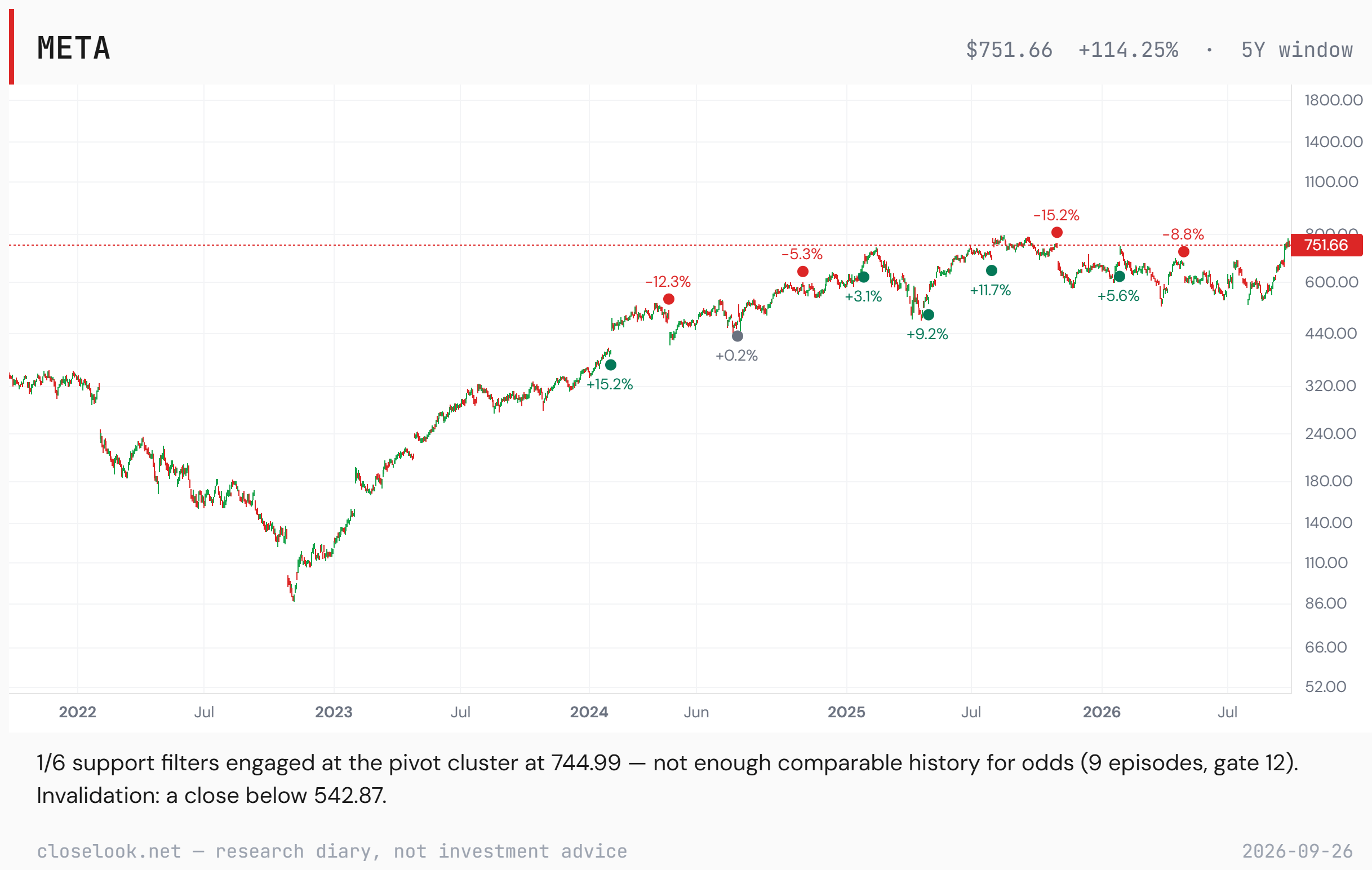
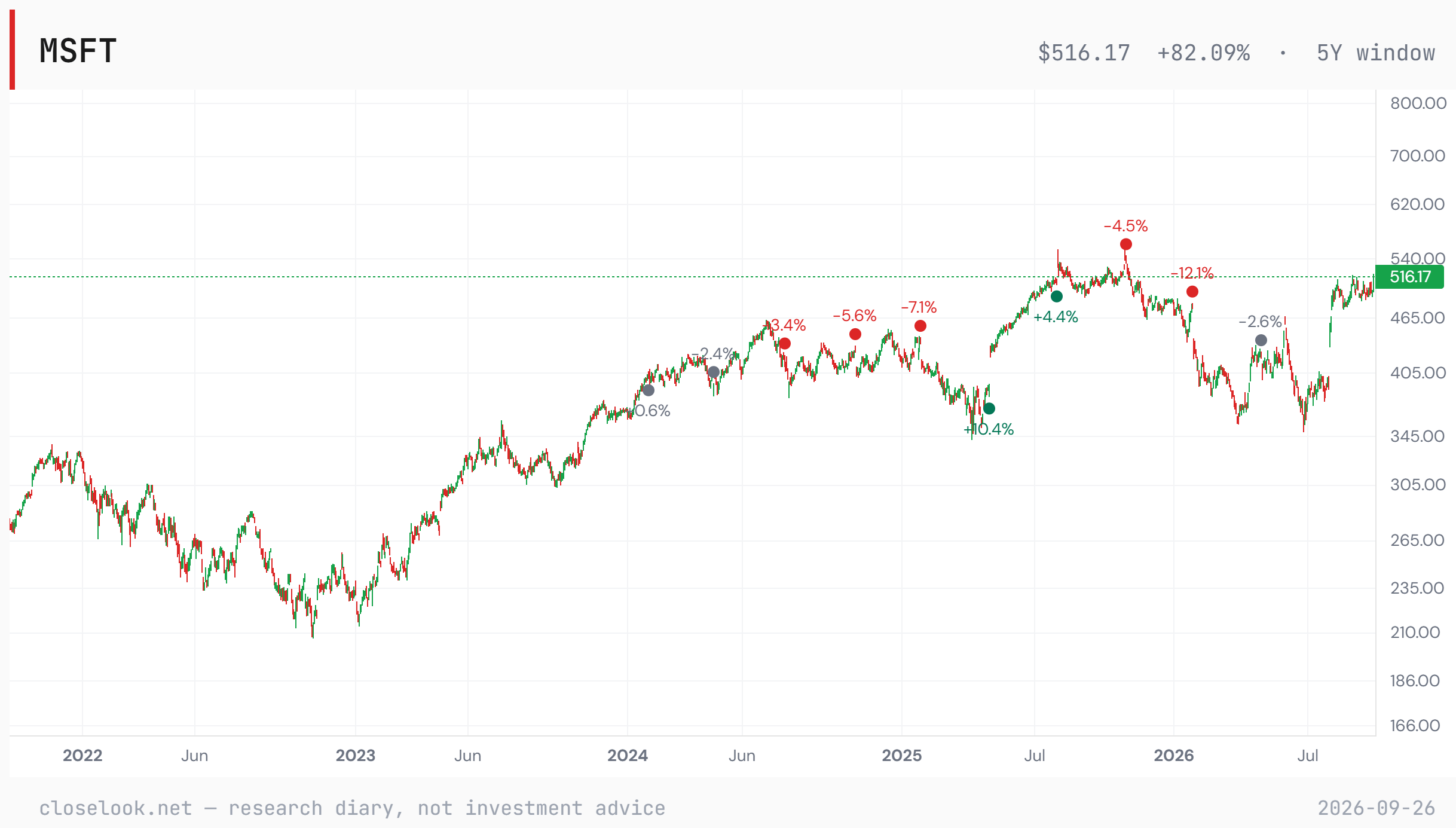
The six, one by one. The dots on each chart mark how the stock moved after each quarterly earnings report — green up, red down, grey roughly flat. The first four are the names selling AI through reach they already own; then Nvidia, which supplies them; then Amazon, the one the agents could route around.
6 · The levels
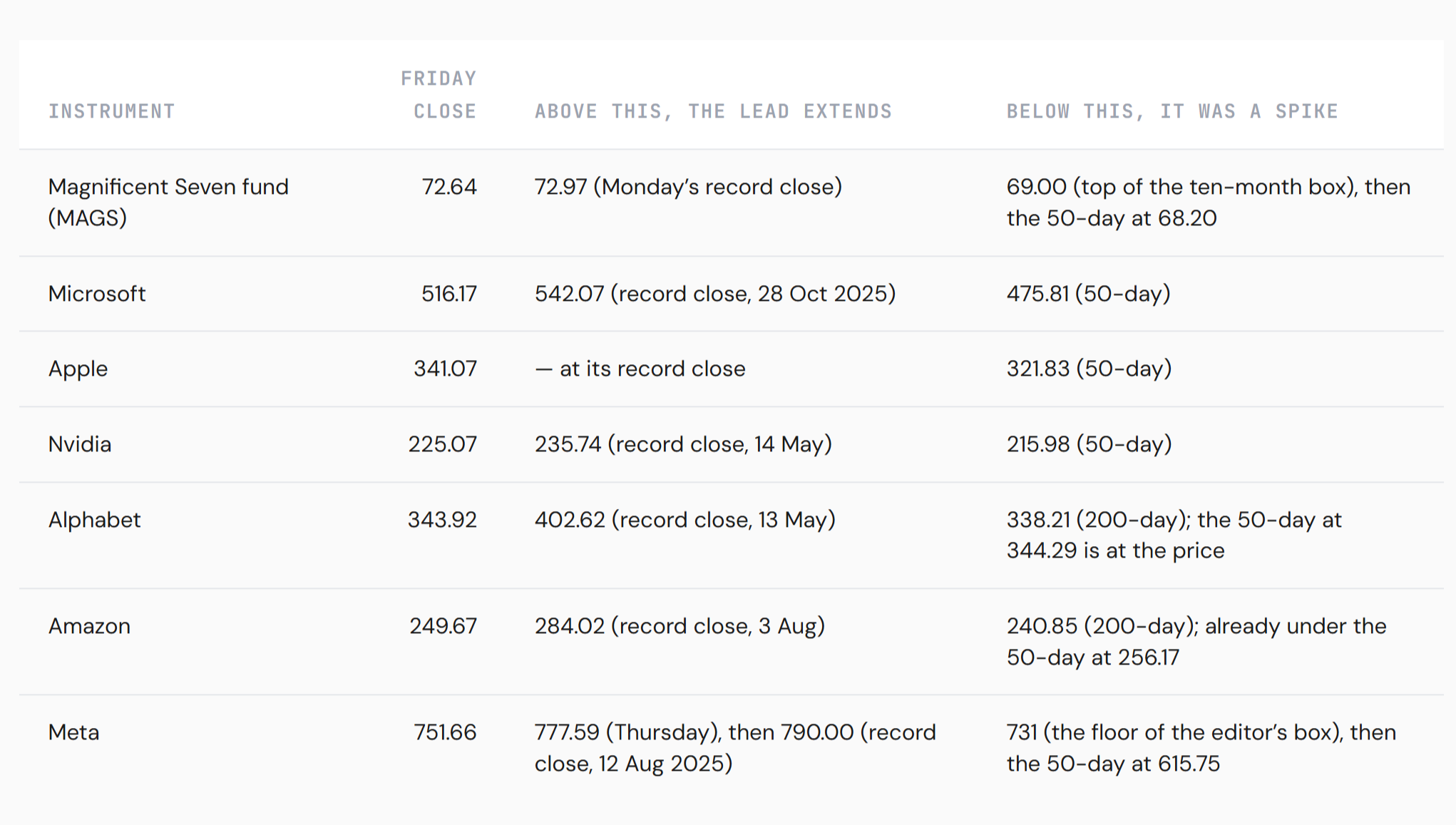
Closes through Sep 25 · averages from the Closelooknet data lake · a level is “taken” on a closing basis.
The fund’s lines are the ones to score. Above 72.97, the breakout extends; a weekly close under 69 puts it back in the box it spent ten months in. For the names: Apple’s record is the level; Microsoft, Nvidia and Meta each need five percent to join it; Alphabet and Amazon need a close back above their 50-day averages before the six are a group of six again.
7 · The board and the questions ahead
The week ahead has one order book and one inflation number, both on Wednesday: Micron’s results and the core inflation reading, on the last day of the quarter. Then October, whose first two weeks are seasonally the challenging ones, inside the uncertain window this diary has set to the midterm elections on November 3.
The questions: does the Magnificent Seven fund hold above 69 through the first week of October; does Apple’s record become a group record — Microsoft, Nvidia or Meta through their highs; do Alphabet and Amazon retake their 50-day averages; and does the average stock — the equal-weight S&P, 5.2% under its August high — join, or does the lead stay six names wide.
8 · The count
The Nasdaq 100 fund closed Tuesday at 747.46, through the 746.16 confirmation line on a close for the first time, and the week at 744.50, 1.66 under it and 4.5% above its 50-day. The S&P 500 fund rose 1.3% to 771.35, 0.8% under its August 13 record. The bond market withheld its countersignature for a tenth week: the long Treasury fund closed at 79.32, a new low, under the 81.20 line; the thirty-year yield closed at 5.50%, its highest since 2004. The dollar fund made its highest close of the past year.
One sentence to close, because a diary should say what it actually thinks. The market is being carried by six companies that sell products people are paying for today and fund themselves from their own cash, which is exactly what a market with a 5.5% long bond should pay for; the seventh is the one it has stopped paying for; and the lead is real but six names wide, which makes the first two weeks of October the test of whether it widens or wobbles. Probability, not prophecy. We monitor, and we score it next Sunday.
Related on Closelooknet: Mag Pulse · MAGS on the terminal · Directional Flow · Daily Pulse · Apple · Meta · Microsoft · Tesla