


The memory makers led: Samsung Electronics fell 4.73% and SK Hynix 4.57%. In Tokyo the flash-memory maker Kioxia lost 4.37%. Micron, the largest US memory maker, reports on Wednesday. Every sell-off in these names now raises the same question: has memory put in its top, the way it always did before? We think that question is asked with the wrong picture in mind. Memory in 2026 carries the same name as memory in 2022, but it is a different product with a different use. It is still a cycle. It is not the old one.

Same name, different product
In 2022 memory was a consumer part. Most DRAM and flash went into phones and PCs, prices followed device sales, and a weak holiday season meant a glut: factories kept producing, buyers stopped buying, and prices collapsed within a few quarters. That is the cycle investors learned, and it is the cycle they still fear.
In 2026 the growth sits somewhere else. High-bandwidth memory (HBM) is stacked next to AI chips inside data-center servers, and a second layer of demand comes from the working memory an AI model needs to hold a long conversation. That working memory grows with the context window. According to Artificial Analysis, cited by the I/O Fund, OpenAI’s GPT-3.5 Turbo handled 4,000 tokens in 2023; GPT-5.5 handles 922,000 - 230 times more in three years. The HBM market grew from roughly $4 billion in 2023 to $34.6 billion in 2025, and Micron expects $100 billion in 2027. Same word, “memory”. Different buyer, different contract, different reason to buy. Our memory supercycle entry explains the shift from commodity to AI constraint.
The closest picture outside chips is a drug that finds a second use. Semaglutide was approved to treat diabetes and sold as Ozempic. Then it turned out to work for weight loss and was sold again as Wegovy. The molecule did not change; the number of people who wanted it did, and for years the makers could not produce enough. Anyone who valued it on the old diabetes market was looking at the wrong patient list. Memory is in the same place: the chip is still called DRAM, but the buyer is now an AI data center, not a phone maker.
Closelooknet on Google
Get our reads first in Top Stories and AI answers. One tap, no account needed here.
Still a cycle - a different one
That does not make memory a steady business, and it would be a mistake to swap one simple story for another. Memory is still cyclical. It may be cyclical in a different way, or less cyclical than before, and it keeps properties of the old cycle: prices still swing far more than volumes, new factories still take years to build, and every supplier still adds capacity when prices are high. What has changed is the trigger. The old cycle turned on consumer demand. The new one turns on two things: whether the largest AI buyers keep spending, and when the new factories arrive.
On the second point the suppliers are unusually clear. Micron’s chief executive Sanjay Mehrotra said in May that meaningful new industry supply does not start ramping until 2028, and in its last report Micron said it has no line of sight on when supply can catch up with demand. SK Hynix’s chief executive Kwak Noh-jung went further: he expects customer demand to stay above his company’s capacity even beyond 2030. Kioxia plans to double its 2024 flash capacity - by 2029. So the one mistake to avoid this week is to read a Seoul sell-off through the old cycle. A drop can be profit-taking, a worry about contracts, or a fear that prices peak later this year. It is not, by itself, the start of the old glut, because the old glut needed falling consumer demand and runaway new supply, and neither is in sight.
The new part: contracts, and who caps what
Beth Kindig of the I/O Fund argued on 18 September that the real difference in this cycle is that supply is being built against signed contracts rather than on speculation. The details matter for the stocks. Micron has moved from one-year agreements to five-year strategic customer agreements with a price floor and a price ceiling, the ceiling tied to April-June market levels. Newer products - the next generations of HBM, DDR6 and LPDDR6 - sit outside the ceiling and will be priced separately. SK Hynix has reportedly gone the other way and removed price caps from its long-term deals, so a shortage passes straight into its contract prices.
The consequence, in Kindig’s reading, is a tight market with slower reported growth. With roughly 40% of Micron’s revenue under capped contracts, the 343% year-on-year growth it just reported is likely behind it; consensus, as she quotes it, expects about 88% revenue growth in the fiscal year to August 2027, then 13% and 10%. Price forecasts disagree too: TrendForce put second-quarter DRAM contract prices up 58% to 63% on the quarter; for the third quarter Jefferies reportedly expects another 40% to 50%, UBS about 23%. A market can be short of memory for years while the reported growth rate falls. Investors usually price the second fact first.
The market already tested the old-cycle fear
The stocks have been living this debate since June. Almost every memory and storage name peaked between 18 and 25 June and then fell hard into August - the old-cycle fear playing out on the screen. Today’s closes (Asia) and Friday’s (US) show how far each is from that peak, and how far they still are above where they were a year ago.
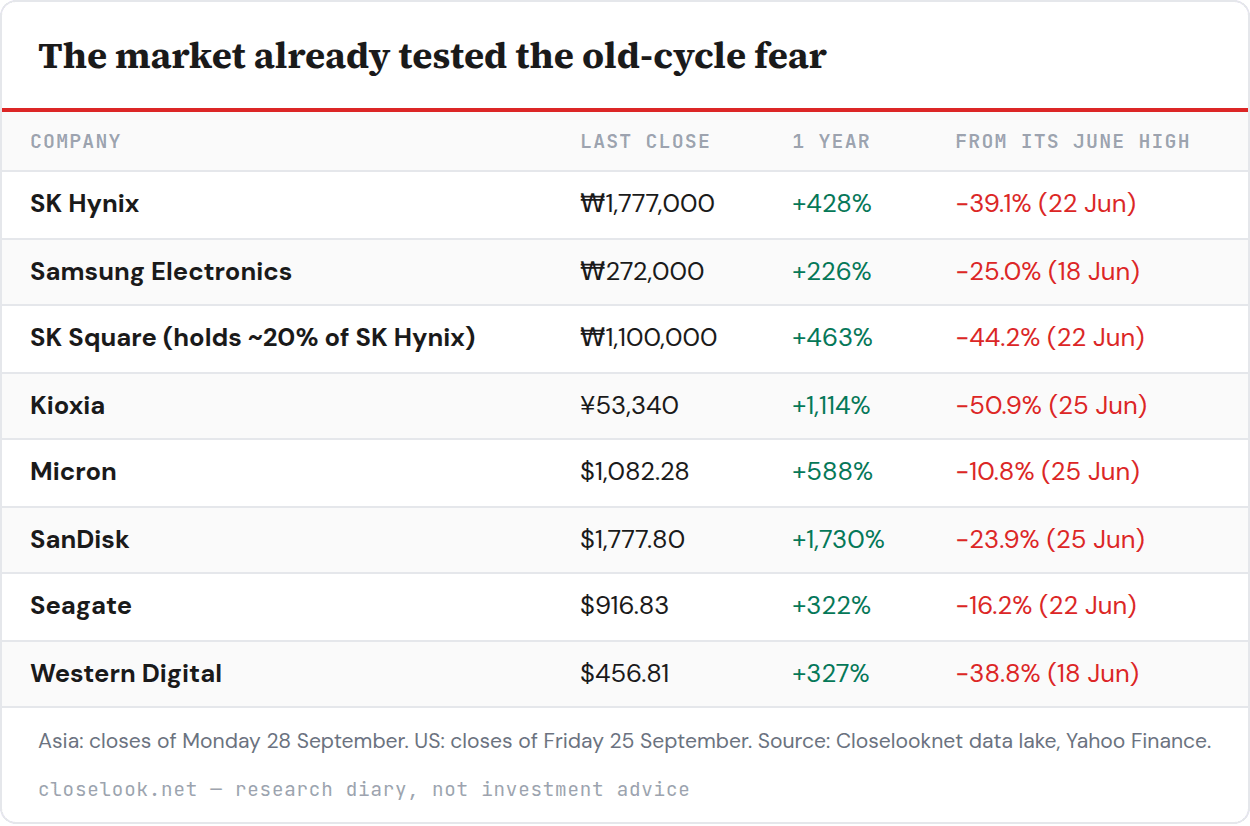
Table as text
Asia: closes of Monday 28 September. US: closes of Friday 25 September. Source: Closelooknet data lake, Yahoo Finance.
Two things stand out. First, the fall from June was large everywhere - 51% for Kioxia, 39% for SK Hynix - yet every name is still up more than threefold on the year. Second, Micron, the supplier with capped contracts, is only 10.8% below its high, while SK Hynix, the supplier without caps, is 39.1% below. That fits the contract story: the uncapped supplier carries the most upside in a shortage and the least protection when the market doubts the price.
Memory is not isolated
Monday’s session showed how far a memory question travels. SK Square, the holding company that owns about a fifth of SK Hynix, fell 7.56%. Hanmi Semiconductor, whose machines bond the layers of HBM stacks, lost 3.70%. In flash storage, Kioxia fell 4.37% and Taiwan’s SSD-controller maker Phison 4.06%; Taiwan’s DRAM maker Nanya lost 2.33%, and the chip-substrate maker Ibiden 4.43%. Everything paid on the memory price was sold.
The tool makers were not. Disco, which grinds and cuts the wafers, closed +0.33%; Tokyo Electron -0.35%; Advantest, which tests the chips, -0.79%. They are paid for new capacity whatever the chip price does. The US storage names meet this at today’s open: on Friday Western Digital rose 1.44%, Seagate 1.20% and SanDisk 1.38%, and last week the chip-equipment makers Lam Research (+9.41%) and Applied Materials (+9.09%) led the chip rally that lifted our Rubin build-out index. If New York repeats Asia, the storage names fall and the equipment makers hold - sell the price, keep the capacity. Our Memory & HBM Pulse tracks the chain every day.
Our favourites, for the record
The desk’s own favourites in memory are SK Hynix and Samsung, not Micron. That makes the contract question sharper for us. SK Hynix, without caps, carries the full upside of a shortage and the full downside of a price turn. Samsung sits in between: the largest memory maker, with a broader business around it. Monday’s 4.6% and 4.7% falls, and SK Square’s 7.6%, show the market reaching for the purest exposure first when it doubts the price. This is how we read the week, not a trade instruction.
What would change the read
Micron on Wednesday evening. Not whether memory is short - every supplier says it is into 2028 - but how much of the price rise Micron’s capped contracts let it keep, and how much new-generation product sits outside the ceiling. Our Print Record card on Micron is live: ten reports, never a flat reaction. Contract prices. A clear slowdown in the quarterly rise of contract prices would bring the old-cycle fear back. AI spending. A cut in data-center capital spending by one of the largest buyers is the new trigger for a down-cycle. New factories. Any supplier pulling its 2028 capacity forward shortens the runway. See our memory wall entry for why AI chips wait on memory. This is an investment diary, not advice.
C · members block
Into tomorrow
Seoul: Kospi 6,913.17 (−2.37%); SK Hynix ₩1,777,000, Samsung ₩272,000. New York open: do Western Digital, Seagate and SanDisk follow Asia while Lam and Applied Materials hold? Wednesday: Micron’s results after the close and core PCE; the functional indices rebalance to equal weight at the 30 September close. The line: SK Hynix’s June high is ₩2,919,000, Micron’s $1,213.56.
The signals behind thisEach line links to the tool it comes from
LabMemory & HBM Pulse — the memory chain every day, from DRAM makers to HBM equipment→101The memory supercycle — how HBM turned memory from a commodity into an AI constraint→GlossaryHBM — high-bandwidth memory, stacked next to the AI chip→Print RecordMicron — ten reports, never a flat reaction; prints Wednesday 30 September→Morning 10Samsung and SK Hynix drop 4% as Seoul reopens, storage follows