


The tracker’s twelve best names this week are seven operators and two builders — security, identity, the sovereign cloud, Lenovo and the Taiwanese design house — and its twelve worst are the energy-transition names, the fibre name that led a fortnight ago, and the neocloud.
Inside — the strongest and weakest sleeves of each AI index on the week and on the year, the flow tables that were finally paid on the building side, the Taiwan August revenues, and what the Hypergrowth book did with Nebius and four covered calls on Monday.

1 · This Week’s Action
Where this letter sits, in one line. Sunday’s US edition reads the market at index and sector degree; this one reads it at name altitude — which companies the money went into, which it left, and what the flow behind each is doing. The backdrop, one line more: the Fed hiked on Wednesday and the Bank of Japan on Friday, the S&P made its low on the decision and bought it for two sessions, the chips lost five percent on Monday’s pacing letter and took their average back on Friday’s expiry, the yen fell on Tokyo’s own hike so the carry trade stayed in place — and the US letter reads all of that as the bull holding its test. This letter says which names held it.
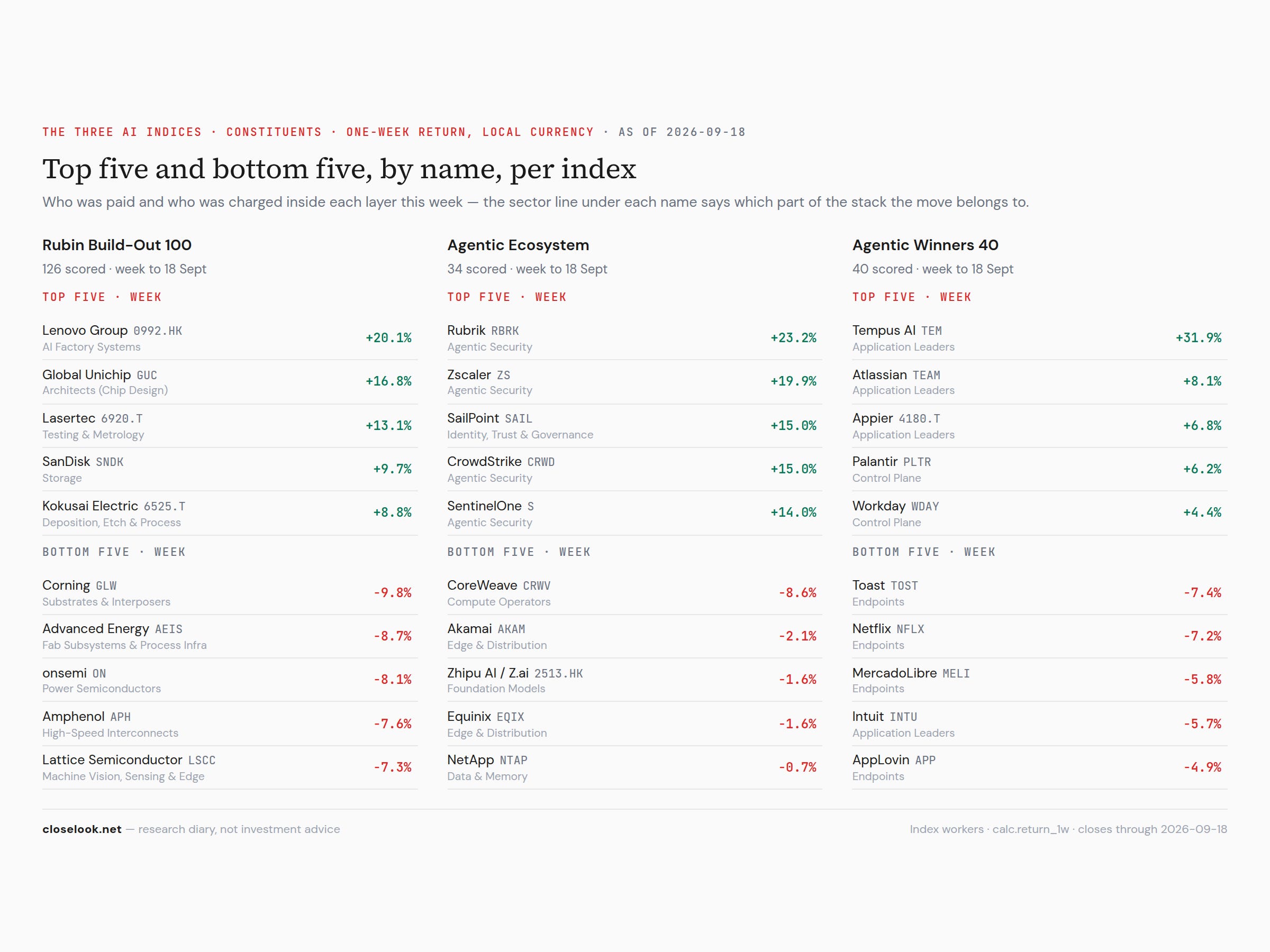
The selection, first — what the tracker paid and what it charged. Across the three AI indices’ constituents, the twelve best lines of the tracker’s week are seven operators, two builders, two names from the control group and one application: Tempus AI +31.9%, Rubrik +23.2%, Lenovo +20.1%, Zscaler +19.9%, Global Unichip +16.8%, Illumina +16.1%, SailPoint +15.0%, CrowdStrike +15.0%, SentinelOne +14.0%, OVHcloud +13.3%, Lasertec +13.1%, Natera +12.3%. Security, identity, backup, the sovereign cloud, the assembler, the Taiwanese design house, the Japanese mask inspector, and two diagnostics names: the layer the weekend’s pacing letter wrote a demand case for, plus the parts of the physical layer that are not the tools. The twelve worst: Fluence Energy −26.3%, Red Cat −15.2%, Array Technologies −12.1%, Corning −9.8%, Viking Therapeutics −9.3%, Dutch Bros −8.8%, Advanced Energy −8.7%, CoreWeave −8.6%, onsemi −8.1%, Chipotle −7.7%, Amphenol −7.6%, CAVA −7.6% — the energy-transition names sold with the utilities on the five-percent ten-year, the fibre name that was the family’s third-best a fortnight ago, the neocloud, the power semiconductor, and the consumer restaurants. The medians say the sort in one row, and for the first time in six weeks the order is not the distance from the silicon: opex +5.89% with 27 of 34 green; capex −0.18% with 58 of 126; applications −0.83% with 15 of 40; the control group −1.25% with 34 of 99. Section 2 has the same cut per index and per sleeve, on the week and on the year; section 6 has what the book did about it on Monday.
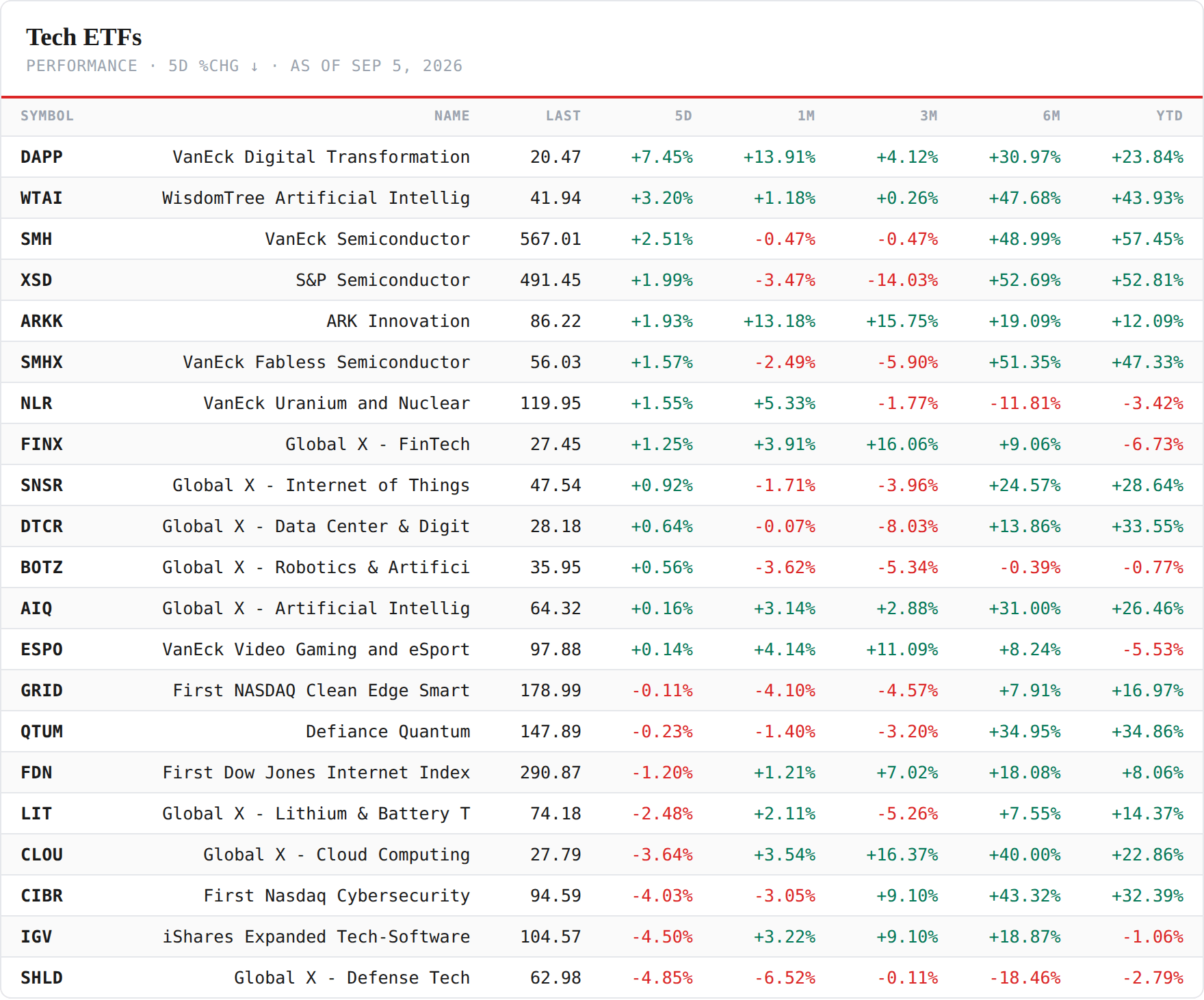
The tech shelf — the code on Monday, the silicon on Friday, and the week’s total hides the order. Twelve green lines of twenty-one, and the top is the layer above the chip: cybersecurity +5.79%, ARK +5.56%, the digital-asset fund +4.97%, software +2.79% — after three consecutive weeks as one of the board’s worst lines — cloud +2.54%, defense tech +1.51%. Then the chips: SOXX +1.14%, SMH +0.79%, the AI basket +0.78%, the fabless vehicle +0.63%, the equal-weight semis +0.22%. Nine red: uranium −4.88% — sold with the utilities — fintech −1.47%, the grid fund −1.40%, lithium −1.38%, data centers −0.78%. Inside the week the order was the reverse of the total: Monday, software +5.04% to 106.64 (its best day of the year) and SMH −4.75%; Friday, SMH +2.21% and software −1.35%. Software made its week in one session and gave a piece back on each of the next four; the chips lost their week in one session and made it back in two. The software-to-semis ratio rose 1.99% on the week to 39.5% above its June 22 low, from 37% — a third of what it gave back in the two prior weeks, returned in one.
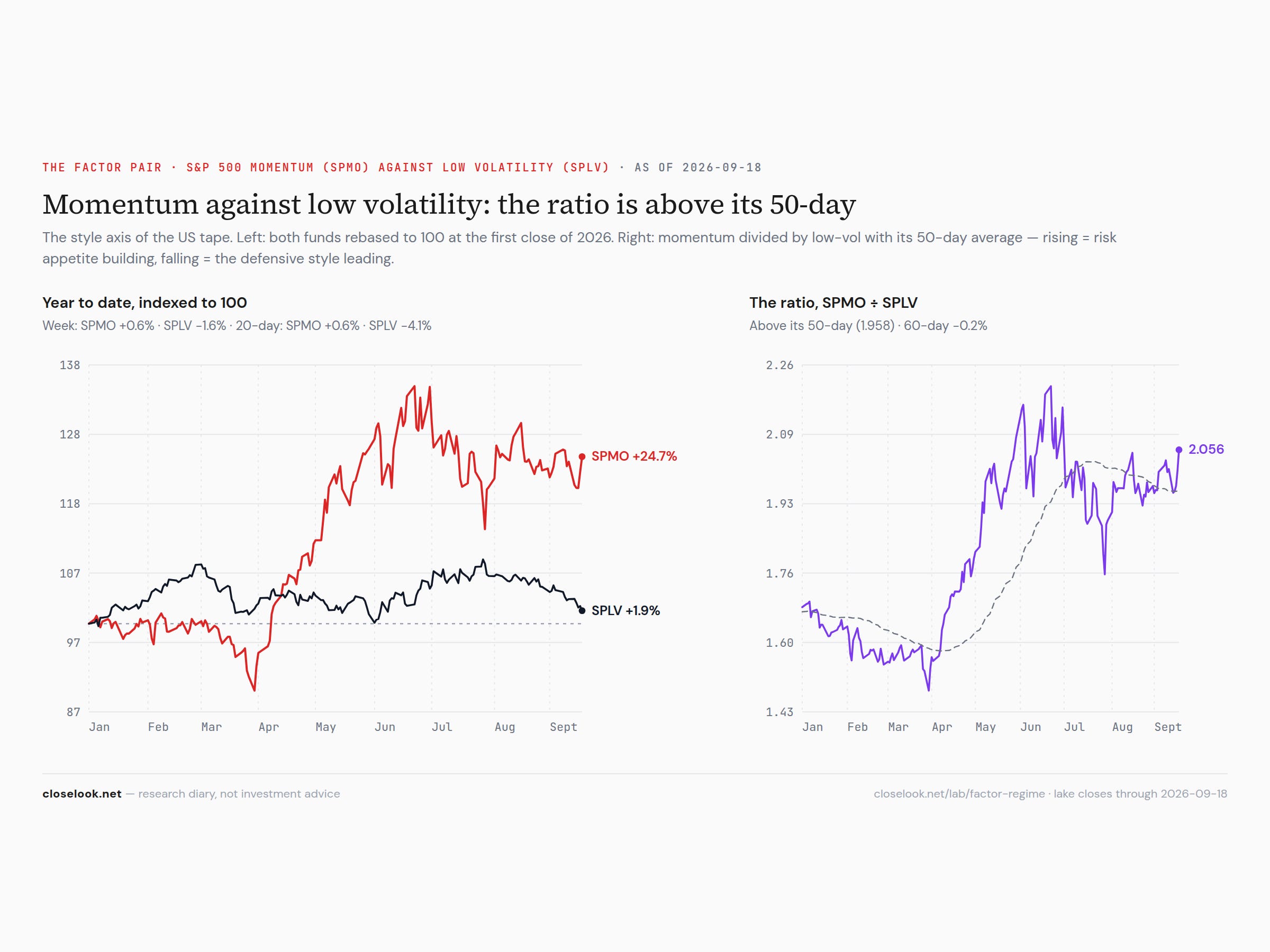
The factor view — the legs sorted this time. The factor-regime gauge reads “momentum leading, risk appetite building” at the 97.1st percentile — indexed 163.25 against a 50-day at 155.48 — and this week the two legs went opposite ways: SPMO +0.61% against SPLV −1.64%. For this cohort the read is sharper than last week’s: when the tape sold on the hike it sold the bond proxies, and when it bought the decision it bought the momentum names — the chips, the security names, the consumer-AI megacaps. The money that left the utilities on Wednesday did not go to low-volatility. It went to a security-software company on Monday and to a memory maker on Friday.
Our own board — the Rotation Ledger, on Friday’s closes, and the receipts. The scanner ran on its own Friday night for the first time in four weeks — the cron fix of Thursday — so the tables carry Friday’s closes; and the universe is now 1,172 stocks, from 647, because the score tranche added the rule-based names this week, so the confirmed tables carry names from outside the AI stack for the first time (declared, and read around). The shares on the wider universe: building flow (accelerating-up plus reversing-up) 32.7%; decelerating-up 36.6% — still the largest bucket outright, the long warning; accelerating-down 13.7%; flat 17.0%. Not comparable to last week’s 36.5 / 36.2 / 9.1 on the narrow universe, except in shape: the draining end is heavier again. The receipts, both ways, because that is the contract: the fastest-risers table published here last Sunday — Atlassian, freee, Appier, e.l.f., Duolingo, Elastic, Veeva, Workday, Salesforce, ServiceNow, UiPath, Snowflake — was paid on price this week for the first time in three: Atlassian +6.86%, Workday +4.40%, Elastic +4.28%, ServiceNow +2.22%, Snowflake +1.05%; Veeva −0.83% and Salesforce −3.96% the exceptions. Three weeks of building flow while the price was sold, and in the fourth the price came to the flow. And the draining table — SanDisk, Kioxia, KLA, Applied Optoelectronics — was wrong on its biggest name and right on the rest: SanDisk +9.7% with an 11% Friday, Applied Opto −0.2%, KLA −2.0%. Four weeks in: the building side has now been charged twice and paid once, the draining side paid twice and split once. The instrument reads a 252-day trend of flow; this week the market read it the same way for the software names, and read the memory names by their order book instead.
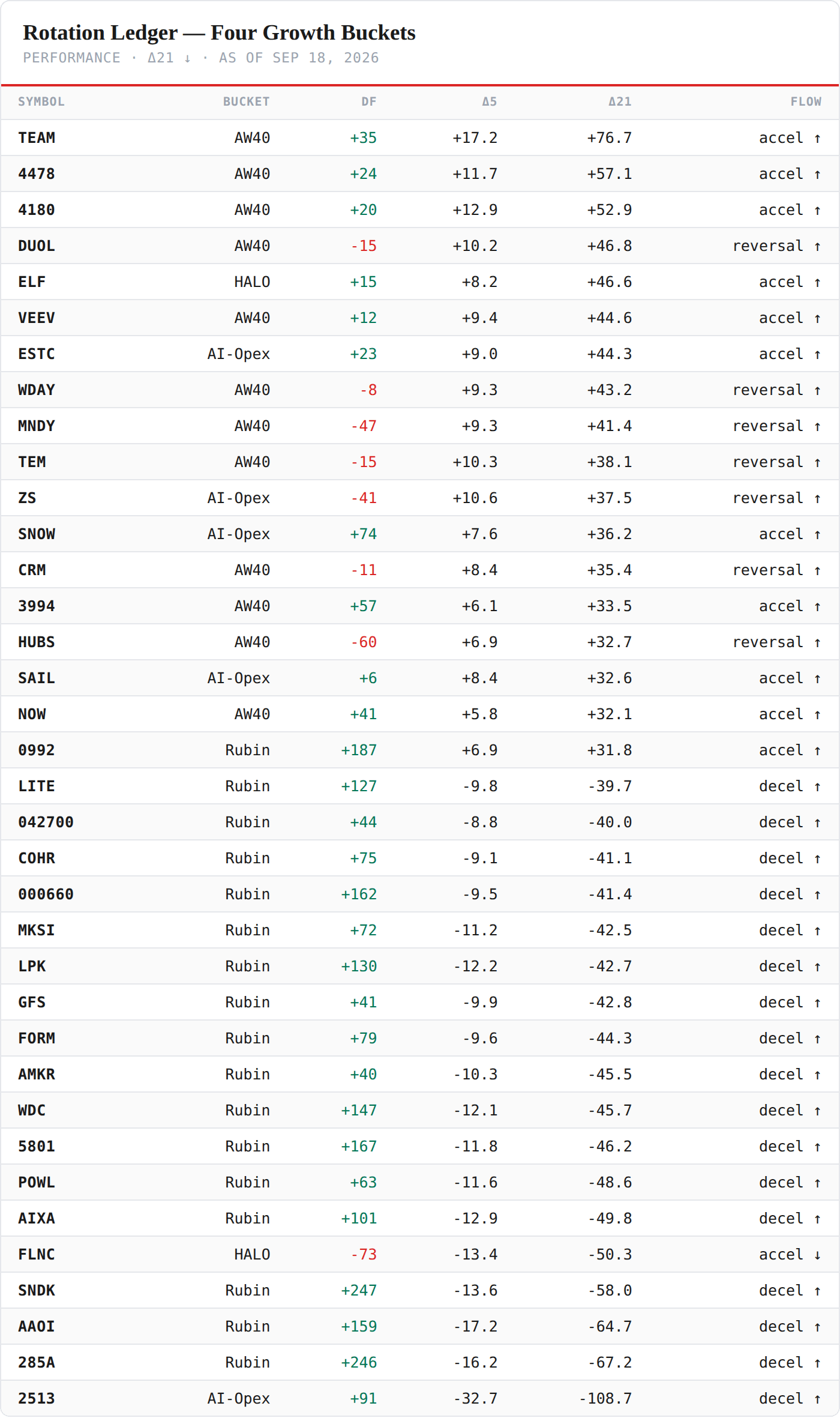
The four stock tables — this letter’s own board, as of Friday 18 September.
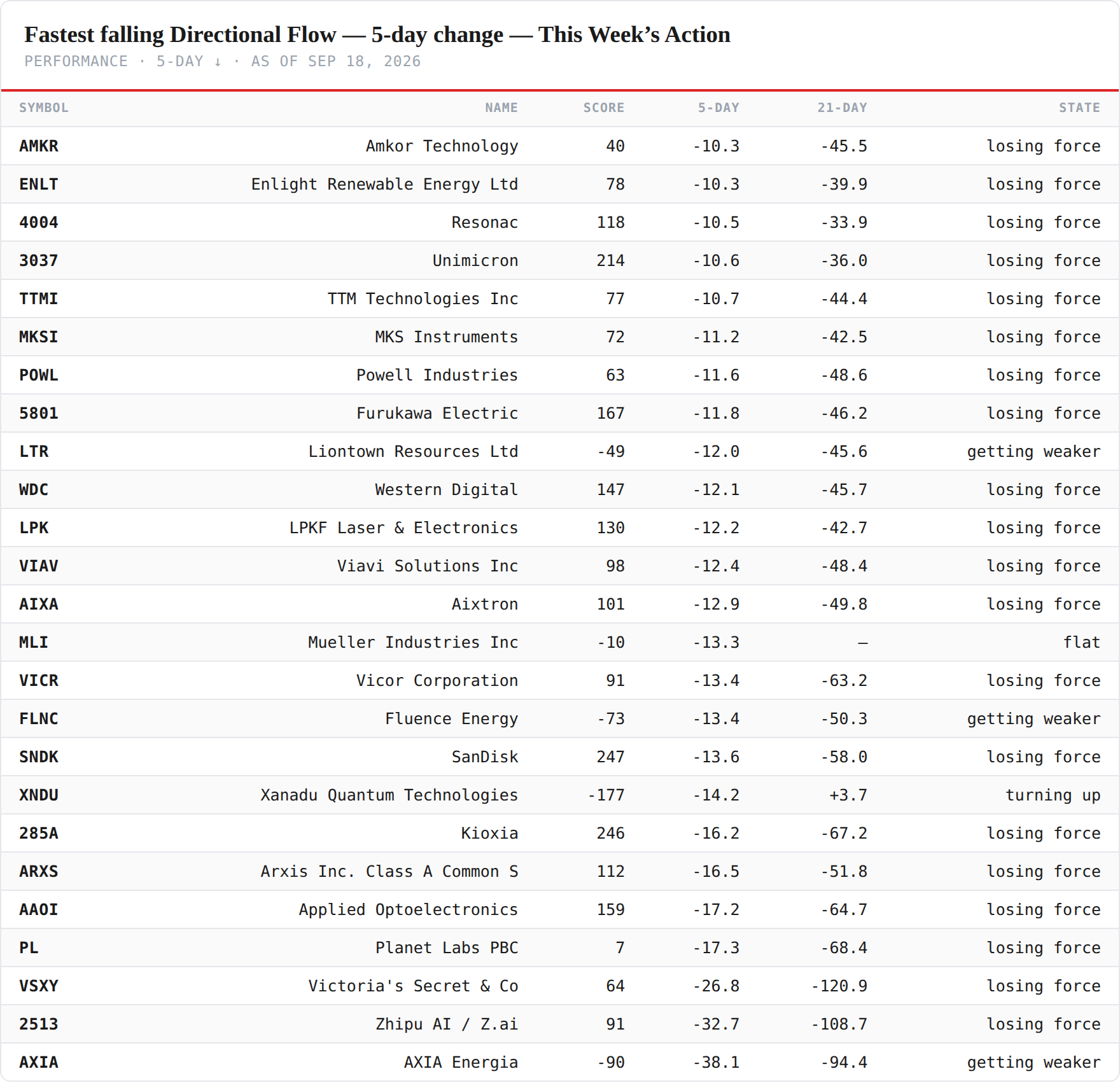
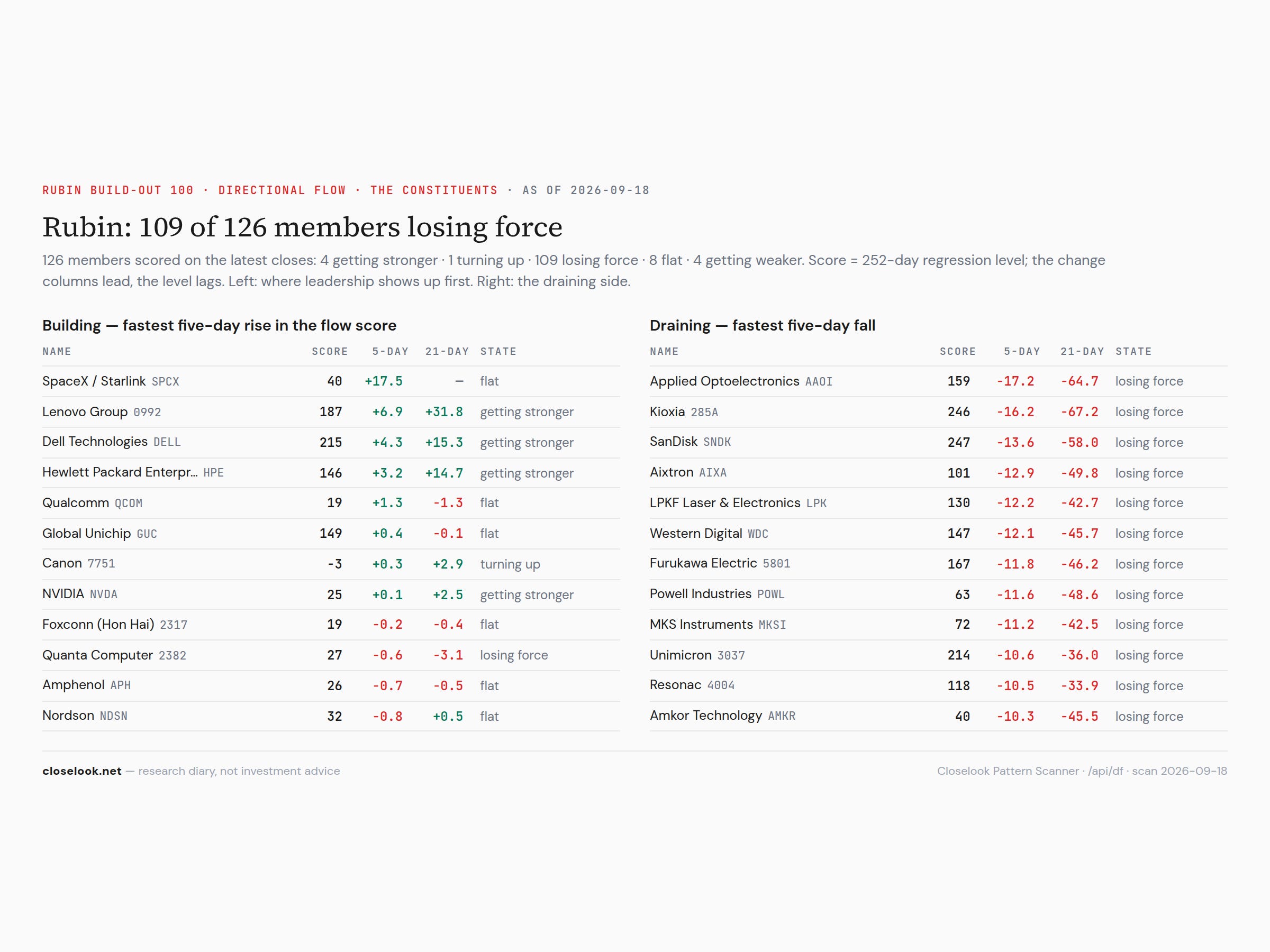
The strongest trends, confirmed on the medium term. Dell at 215 (+15.3 on the month), Lenovo 187 (+31.8 — the fastest-building high score on the AI board, and the tracker’s third-best name on price), HPE 146 (+14.7), Fortinet 118, Palo Alto 116 (+18.1) — the assemblers and the firewall pair, a fourth week running, and this week the assembler in the book’s sibling was paid twenty percent. The rest of the confirmed board is the new universe speaking: SWI Capital 169, MiniMed 149, Corcept 129, Oscar Health 124, Hinge Health 119, Travere 116, PBF 115 — health-care and energy names the rule tranche brought in, none of them this letter’s. The exhibit of level-versus-change, unchanged and larger for a fourth week: SanDisk 247 and Kioxia 246 with the deepest monthly drains on the AI board (−58.0, −67.2) — and this week the price disagreed with the drain for the first time: SanDisk +9.7%.
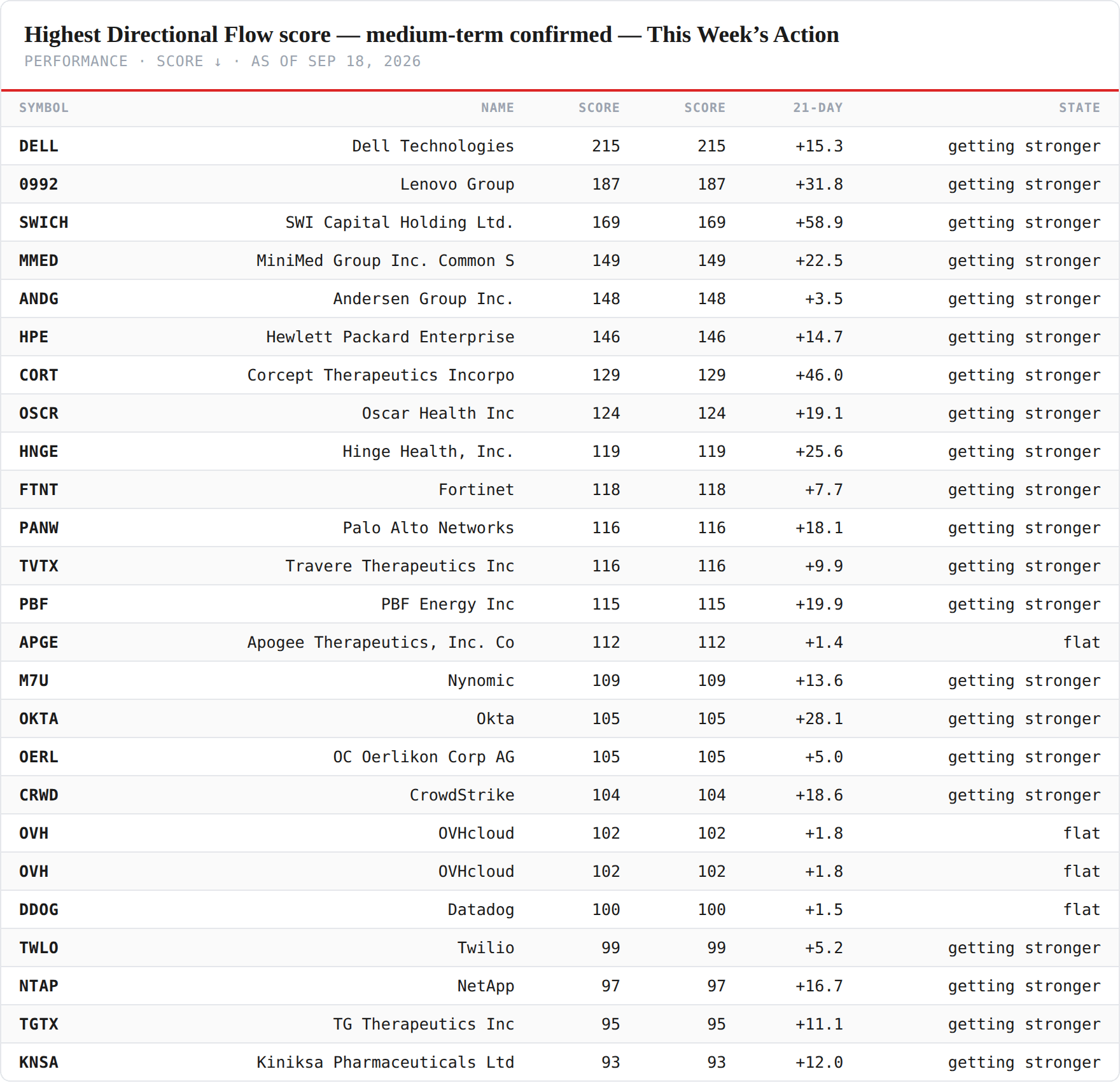
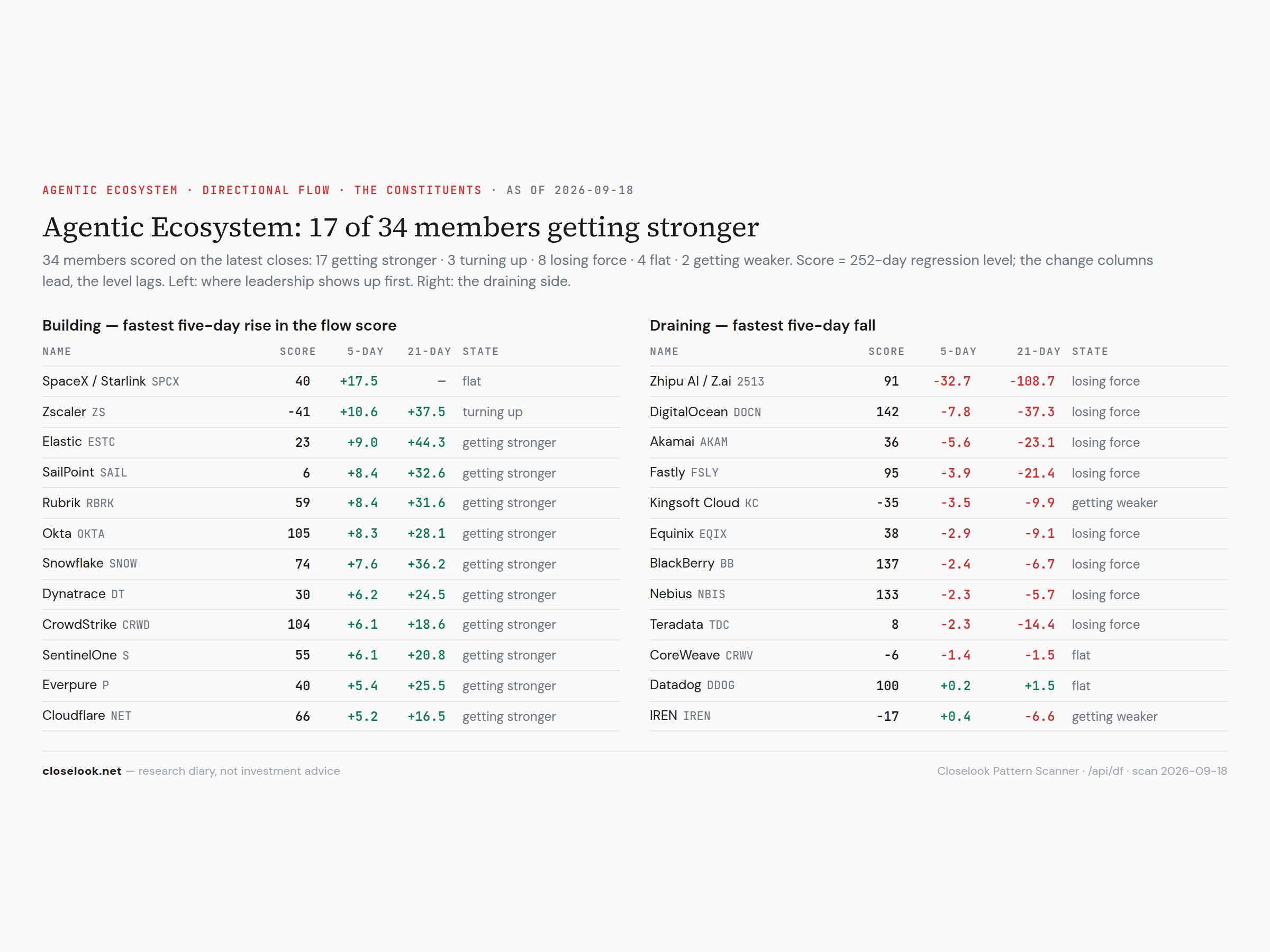
The same list, confirmed on the short term. Dell (+4.3 on five days), Lenovo (+6.9), HPE (+3.2), Fortinet (+2.2), Palo Alto (+4.3), Global Unichip 149 — flat on the month, +0.4 on the week, and the tracker’s second-best name on price at +16.8%. Still the incumbent software layer and the hardware assemblers on the AI side of the board; still no memory name on it. What the confirmed board does not contain is the week’s best price list — Rubrik, Zscaler, SailPoint, CrowdStrike, SentinelOne — which sit on the building side with low or negative scores: Zscaler at −41 building +37 on the month, SailPoint at 6 building +33, Rubrik at 59 building +32. The governors were paid from a build, not from a confirmed trend — which is the opposite of how the test bench was paid a fortnight ago.
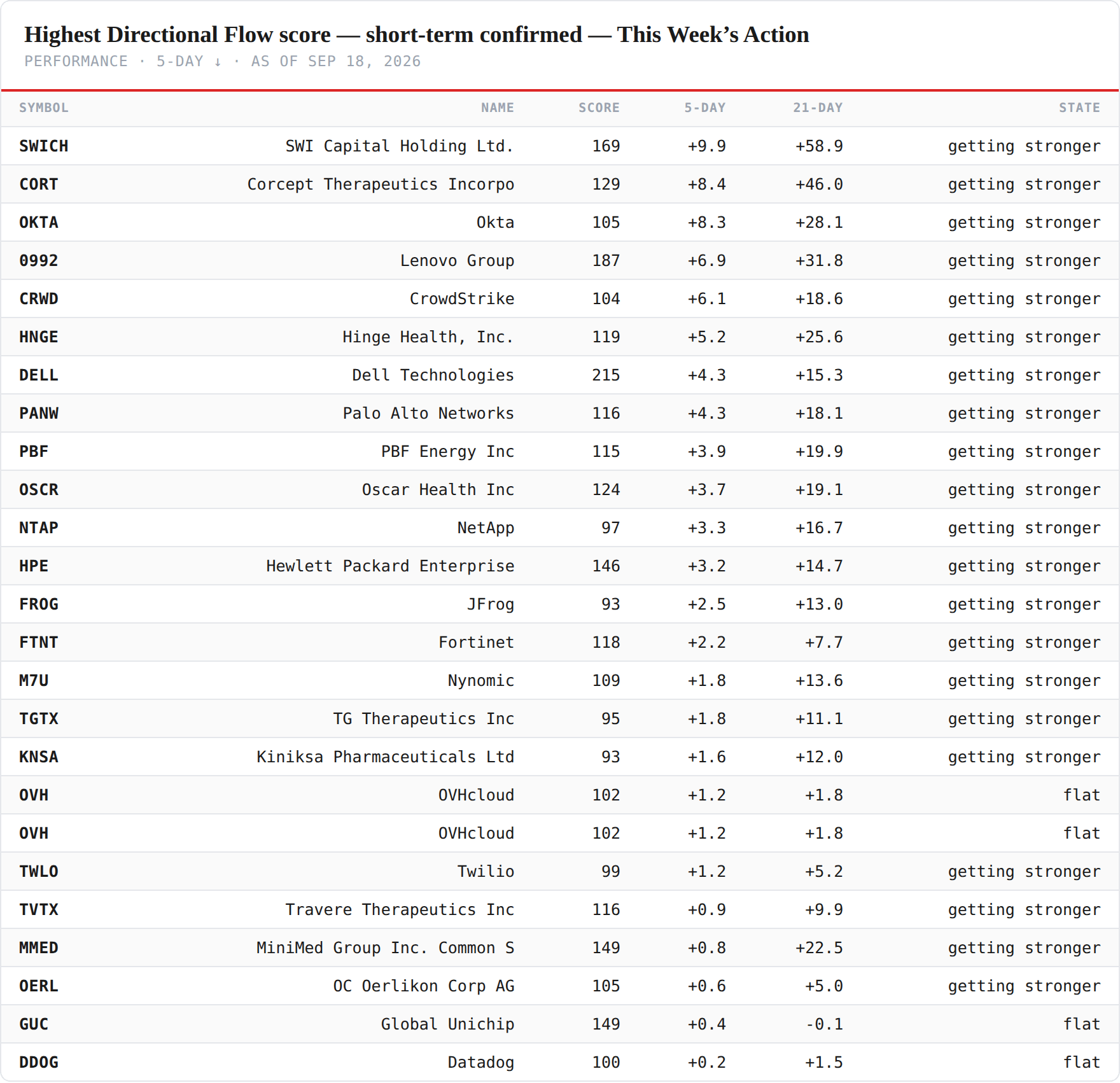
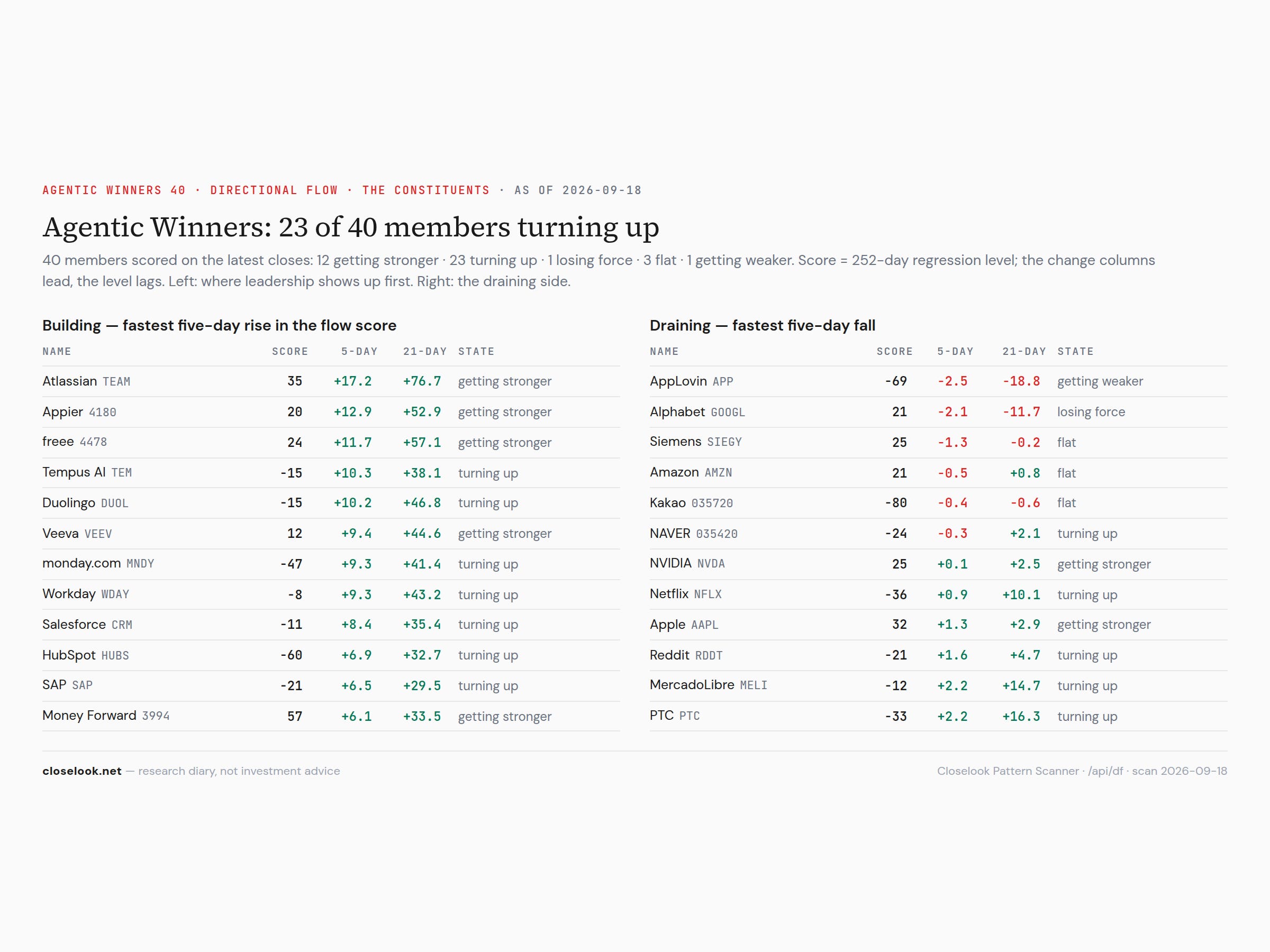
Where new leadership shows up first — the fastest risers. SpaceX +17.5 on five days from a 40 score — the book’s newest line, still without a monthly column — then Atlassian +17.2 (+76.7 on the month), Curaleaf +16.5, PayPay +16.1, Appier +12.9, Caris +12.6, freee +11.7, Zscaler +10.6 (+37.5 on the month), Tempus +10.3, Duolingo +10.2, Veeva +9.4. Software plus consumer, a fourth week, plus the security name the sort bought and the diagnostics name that led the whole family. The question this table had to answer last week — is flow that builds for three weeks while the price is sold a leading indicator or a lagging one — got its answer on Monday: leading, by one week, on a governance headline. The next question is whether a table that was right once on the far side of the Fed is right on the far side of an expiry.
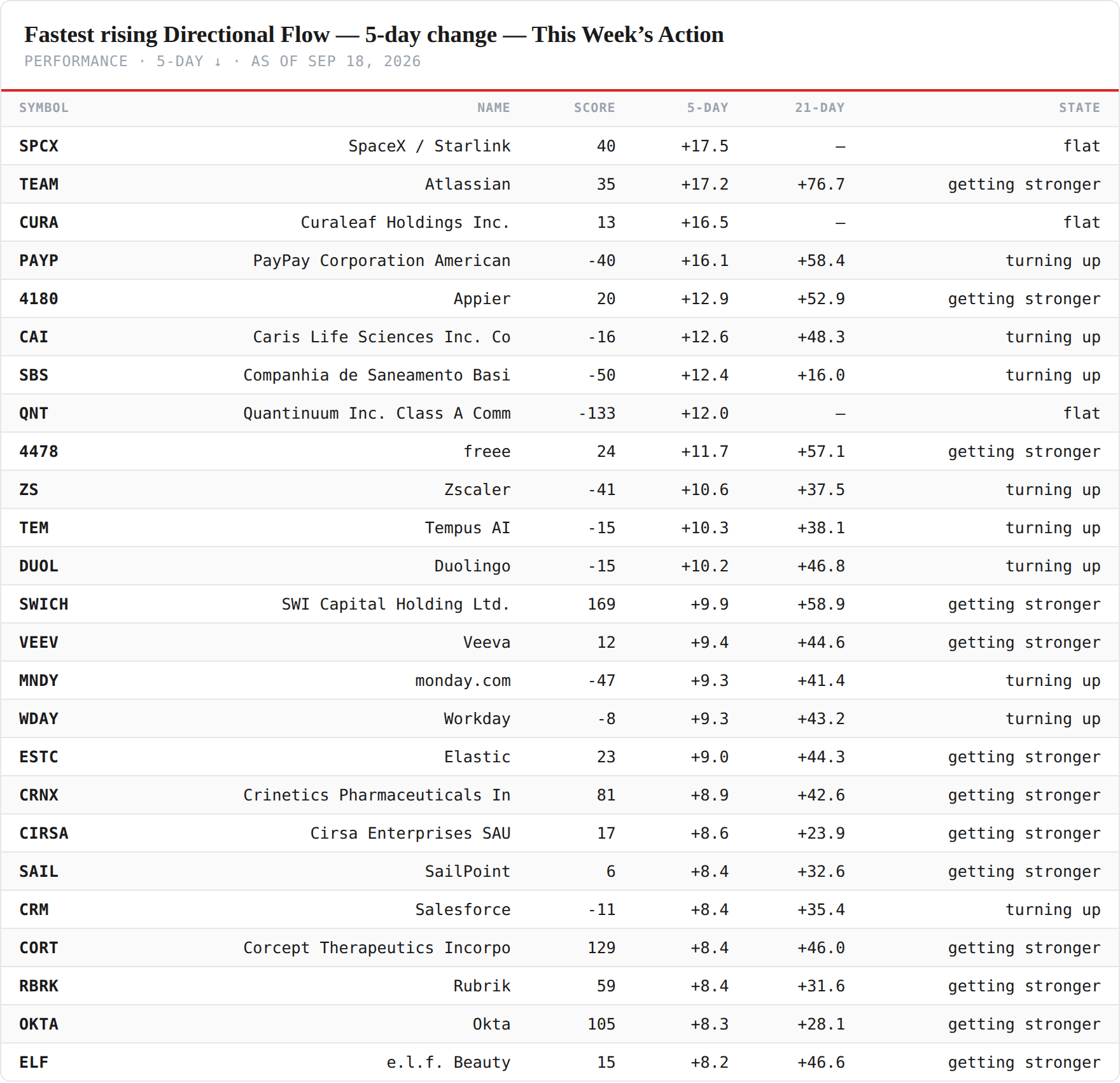
And the draining side. AXIA Energia −38.1 on five days, Zhipu −32.7 from a 91 score (−108.7 on the month, still the deepest in the universe), Victoria’s Secret −26.8, Planet Labs −17.3, Applied Optoelectronics −17.2 from 159, Arxis −16.5, Kioxia −16.2 from 246, SanDisk −13.6 from 247, Vicor −13.4, Fluence −13.4, Aixtron −12.9, Viavi −12.4. The memory-and-optics complex, six weeks running on the draining side — and this week the drain was not paid: SanDisk rose ten percent, Kioxia was bought back in Tokyo on Friday, the memory vehicle took its line back. Read against the price, the table did the opposite of what it did a fortnight ago: it named the names that led the bounce. A drain that the price ignores for a week is a drain that has to be re-scored on Monday’s close — the flow ledger keeps that score in public, as it kept the other one.
2 · The State
The four buckets, briefly. New readers: we cut the growth trade into functional indices rather than sectors — capex (Rubin Build-Out, what gets built), opex (Agentic Ecosystem, what it costs to run), applications (Agentic Winners, what gets sold on top), and HALO as the control group carrying no AI thesis.
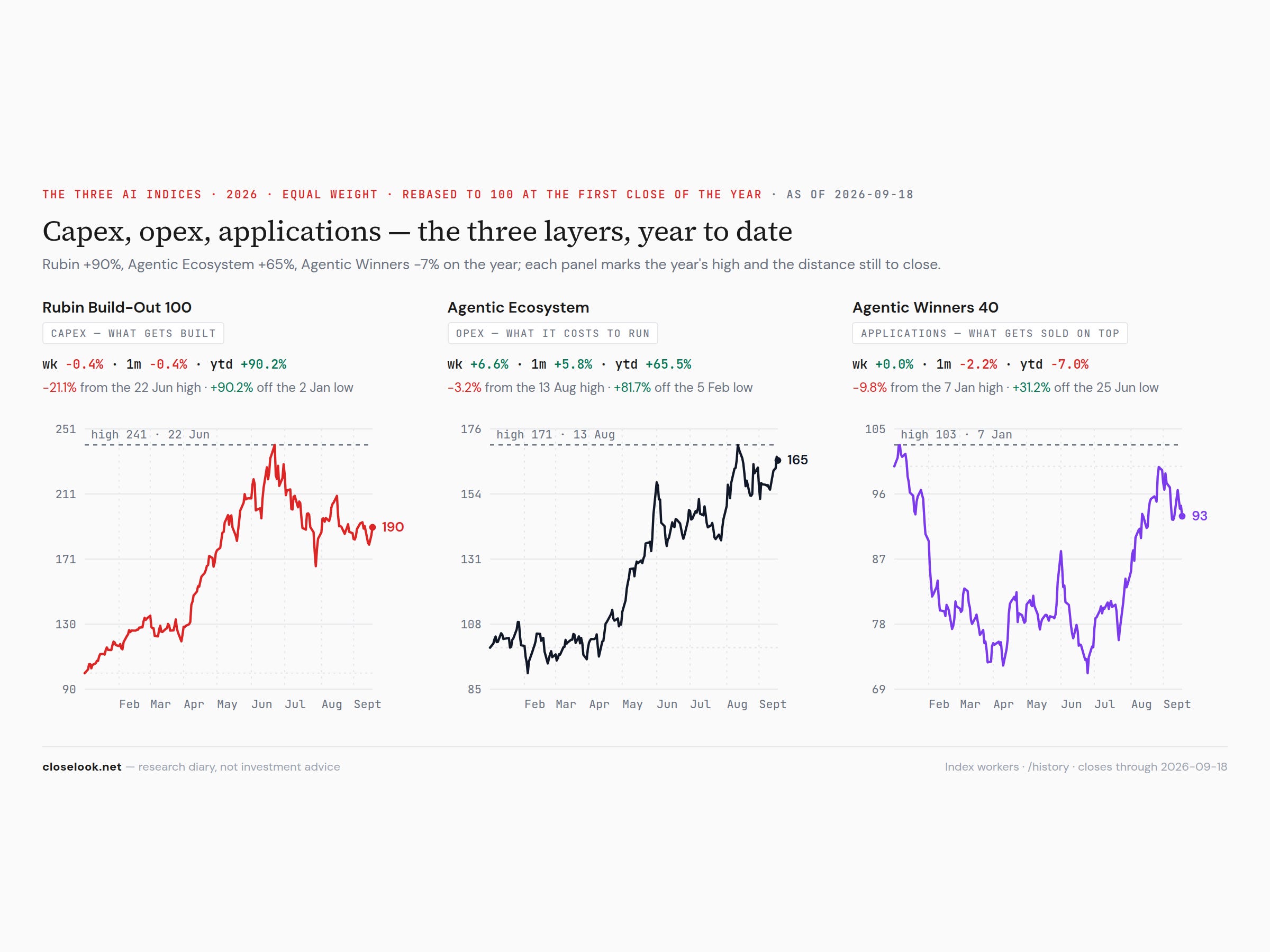
The week’s ladder: opex +6.57%, applications +0.01%, capex −0.40%; the control group −1.46%. On the year: capex +90.2%, opex +65.5%, applications −7.0% — unchanged to the decimal; the control group −1.1%, red now, from +0.3%. Euro-AI −0.23%. The order inverted for the first time in five weeks, and the week inside says how: the build-out fell 5.3% on Monday with every layer red and recovered all but four tenths of it in four sessions; the opex layer rose 4.2% on the same Monday — the other side of the same sort — and kept going; the applications rose four percent on Monday and gave all of it back to finish a cent up. The no-AI control group fell modestly while the AI stack’s middle layer was bought hard, which makes this a sort week rather than a duration week: the curve did the same thing it did last week and one layer was bought through it. That is all this letter says about HALO this week.
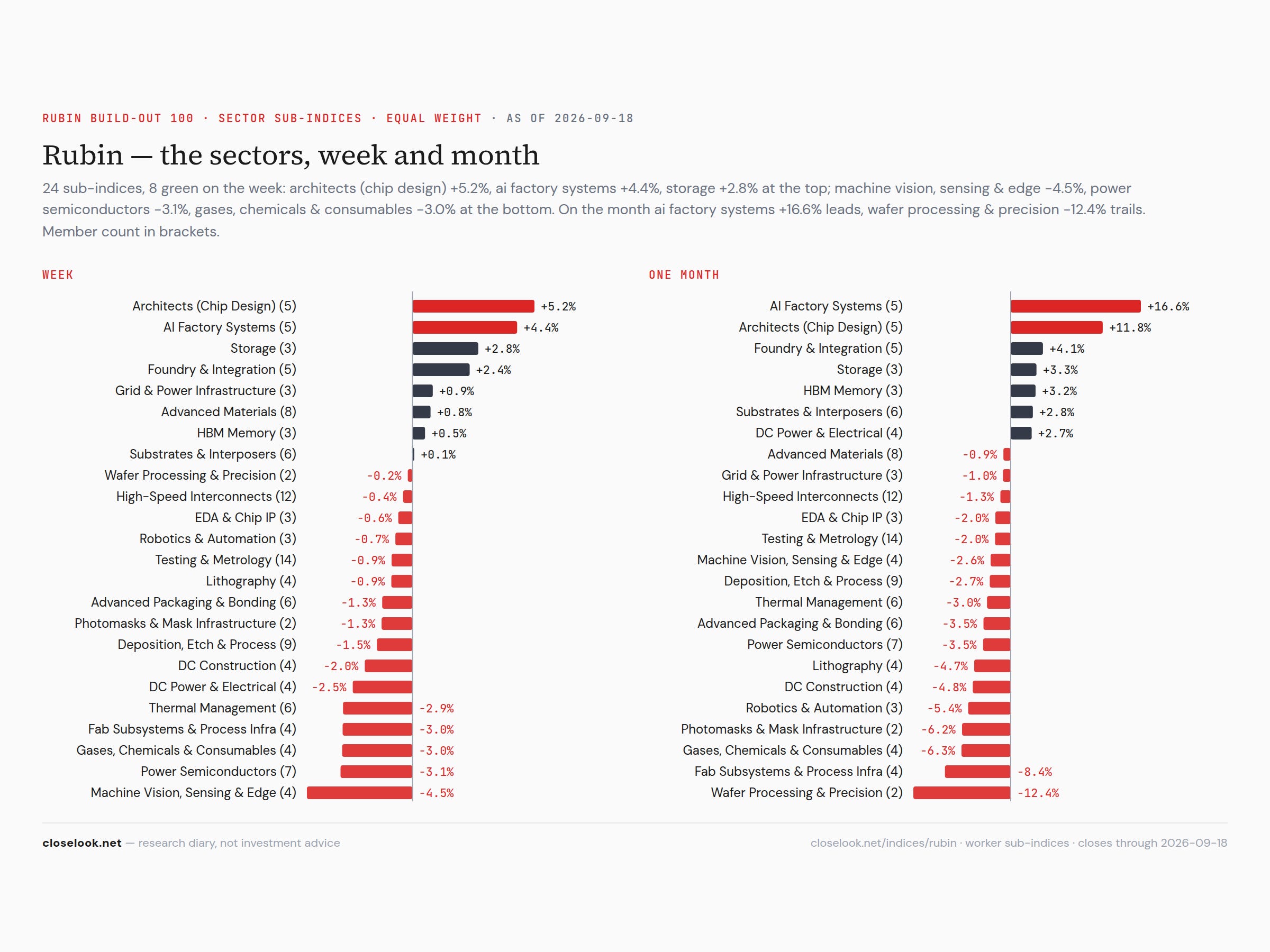
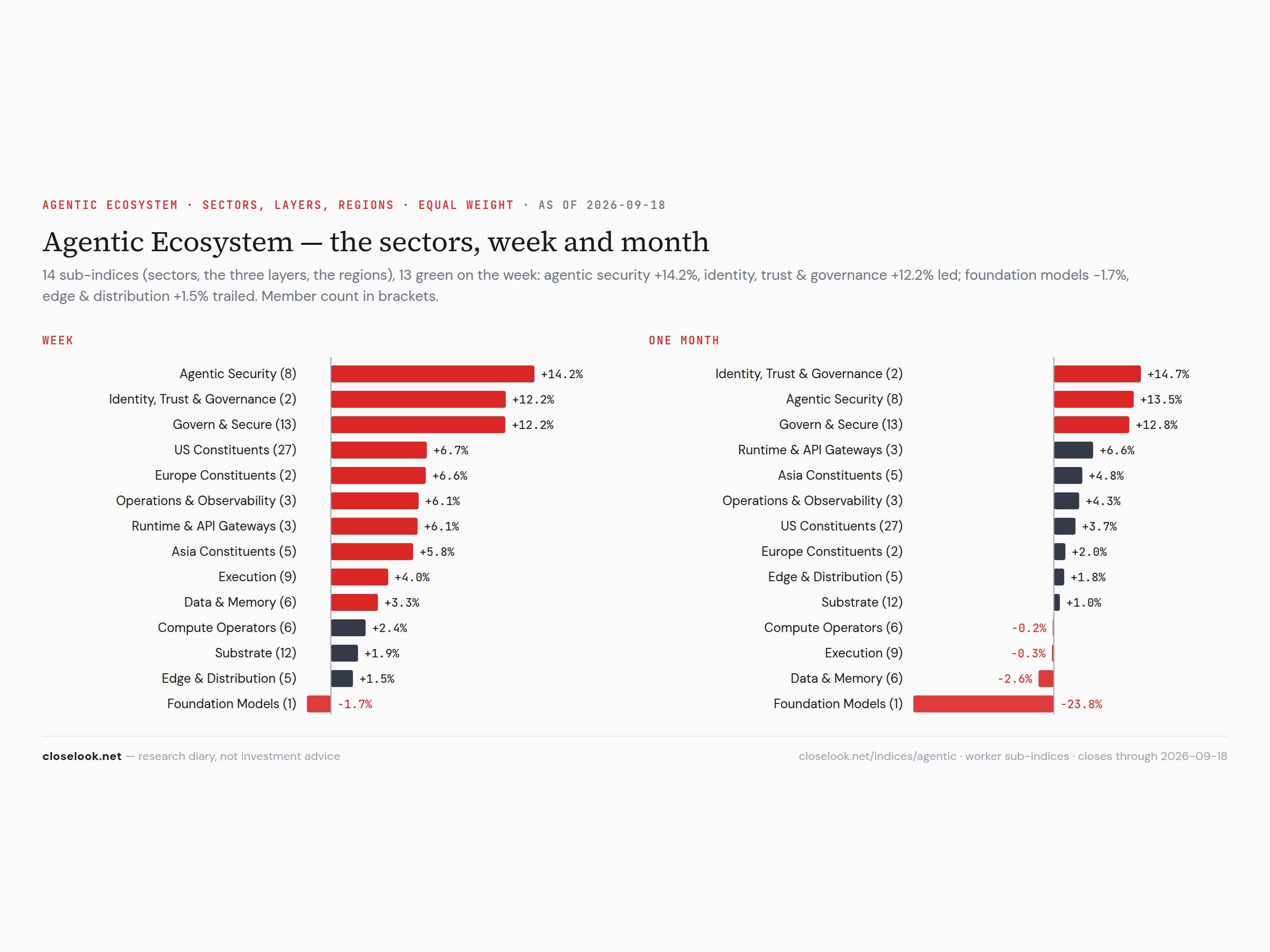
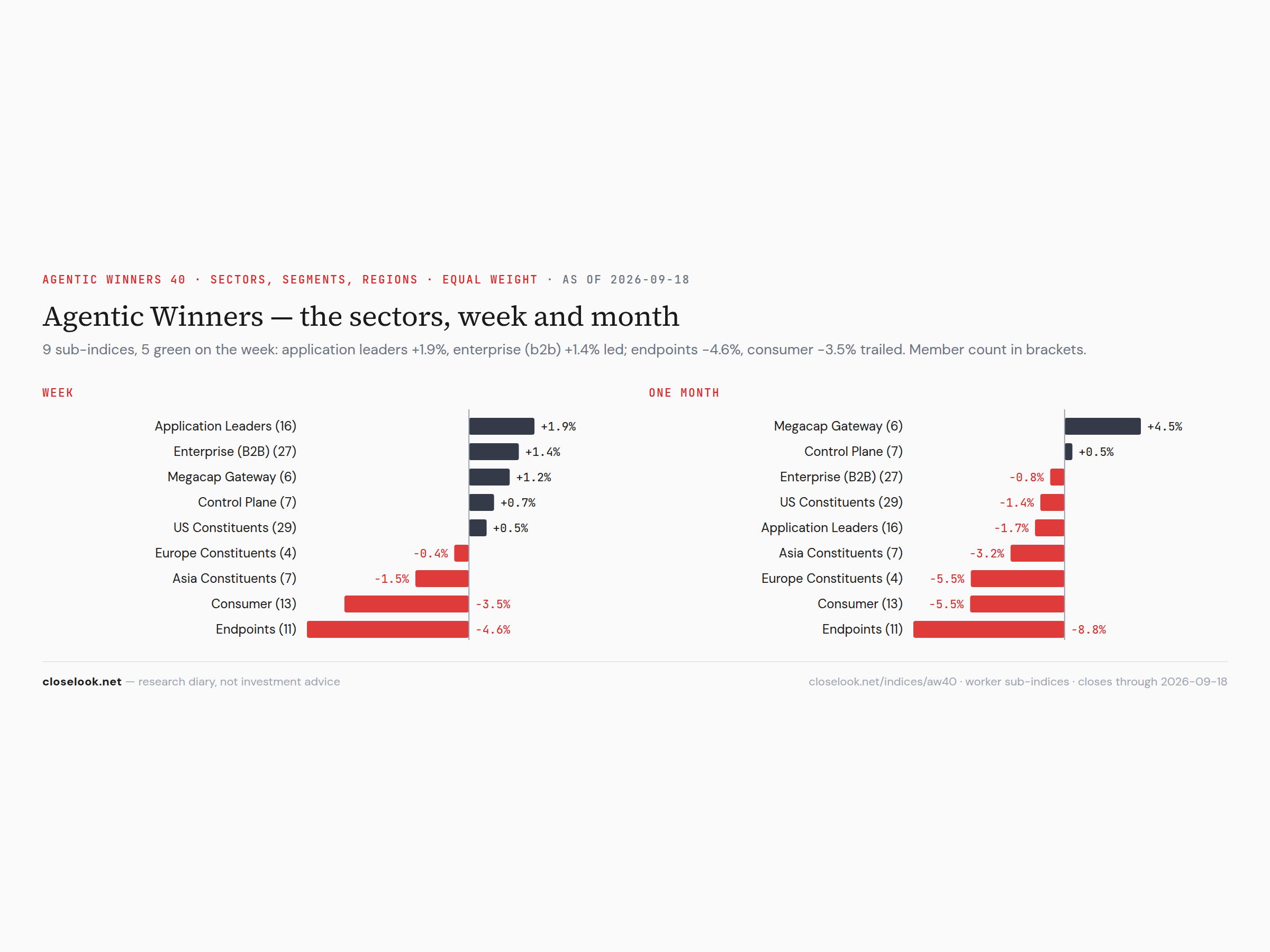
The scorecards — strongest and weakest sleeves, per index, on the week and on the year. Rubin Build-Out, the week (13 of 36 green): strongest Asia-Pacific ex-Japan +5.2%, the chip architects +5.2%, AI factory systems +4.4%, the design layer +3.3%, storage +2.8%; weakest machine vision & sensing −4.5%, power semiconductors −3.1%, physical AI −3.0%, gases & consumables −3.0%, fab subsystems −3.0%. Rubin, the year: strongest storage +353%, substrates & interposers +195%, HBM memory +181%, AI factory systems +143%, Asia-Pacific ex-Japan +140%; weakest photomasks −6%, wafer processing +8%, robotics & automation +10%, thermal management +23%, gases & consumables +25%. Rubin, the month: AI factory systems +16.6% and the chip architects +11.8% lead by a distance; wafer processing −12.4%, fab subsystems −8.4%, manufacturing support −7.0% the bottom — the build-out is being bought at the top of its stack and sold at the bottom, where the tools are made. Agentic Ecosystem, the week (13 of 14 green): strongest agentic security +14.2%, identity & governance +12.2%, the govern-and-secure layer +12.2%, the US constituents +6.7%, the European constituents +6.6%; weakest foundation models −1.7% (one name, Zhipu), edge & distribution +1.5%, the substrate sleeve +1.9%, compute operators +2.4%, data & memory +3.3% — the “weakest” four all green. Ecosystem, the year: strongest foundation models +489%, the European constituents +153%, the substrate sleeve +77%, the US constituents +73%, edge & distribution +69%; weakest data & memory +35%, agentic security +58%, identity & governance +57%, the govern-and-secure layer +59%, compute operators +60% — the two sleeves that led the week are still the two that trail the year. Agentic Winners, the week (5 of 9 green): strongest the application leaders +1.9%, the enterprise layer +1.4%, the megacap gateway +1.2%, the control plane +0.7%, the US constituents +0.5%; weakest endpoints −4.6%, consumer −3.5%, the Asian constituents −1.5%, the European constituents −0.4%. Winners, the year: the megacap gateway +12.8% is the only green sleeve; enterprise −3.3%, application leaders −6.1%, control plane −8.4%, consumer −16.1%, endpoints −20.9% the worst. Read the three top to bottom: on the week, the strongest sleeve in every index is the one the pacing letter named — the governors, the corridor’s memory makers on the rebound, the application leaders — and the weakest is the consumer’s endpoint and the tool makers’ suppliers; on the year, the strongest are still memory, substrates and the model layer, the weakest are the consumer applications and the tools that were the spring’s leaders. The week rotated the leaders; it did not touch the year.
The best and worst stocks, per index — from the best sleeves and from the whole list. Inside Rubin: the best five are Lenovo +20.1% — the assembler, from the AI factory systems sleeve — Global Unichip +16.8% from the architects, Lasertec +13.1% from photomasks, SanDisk +9.7% from storage, Kokusai Electric +8.8%; then AMD +8.5%, Credo +7.9%, Delta Electronics +7.1%. The worst five are American components and tool suppliers: Corning −9.8%, Advanced Energy −8.7%, onsemi −8.1%, Amphenol −7.6%, Lattice −7.3%, then PDF Solutions, Aixtron, Onto Innovation. The build-out’s week was the corridor’s assemblers and designers up, the American fibre, connector and power-semiconductor names down — and Corning, the fibre name that was third-best on this list a fortnight ago on eighty million miles of Verizon fibre, is the worst name on it now. Inside the Ecosystem: best Rubrik +23.2%, Zscaler +19.9%, SailPoint +15.0%, CrowdStrike +15.0%, SentinelOne +14.0% — the govern-and-secure sleeve, five for five — then OVHcloud +13.3%, Sangfor +11.8%, Trend Micro +10.4%; worst CoreWeave −8.6%, Akamai −2.1%, Zhipu −1.6%, Equinix −1.6%, NetApp −0.7%, then Nebius −0.4%, Kingsoft Cloud −0.4% — the neocloud the only name in the layer down more than three percent. Inside the Winners: best Tempus AI +31.9%, Atlassian +8.1%, Appier +6.8%, Palantir +6.2%, Workday +4.4% — the diagnostics name, then the enterprise layer and the application leaders — then PTC +3.9%, Alphabet +3.3%, Samsara +3.0%; worst Toast −7.4%, Netflix −7.2%, MercadoLibre −5.8%, Intuit −5.7%, AppLovin −4.9%, then CoStar, Reddit, NAVER — the consumer endpoints, five for five. Three indices, one signature, and it is the reverse of last week’s: the names that govern, secure and diagnose were paid; the names that sell to the consumer, the neocloud that rents compute and the American suppliers of glass and power were charged. And the flow ledger’s detail, because this letter publishes both: the Ecosystem’s best five on price — Rubrik, Zscaler, SailPoint, CrowdStrike — are on the building side of the flow tables this week, with monthly builds of +32, +37 and +33; a fortnight ago the layer’s best names were on the draining side and its worst on the building side. The opex layer’s flow and its price have swapped back.
The floors, scored — the incumbent floor was paid, the challenger floor split by name. The incumbent floor: the names whose takeout-value argument this letter has carried — Workday +4.40%, ServiceNow +2.22%, Atlassian +6.86%, Salesforce −3.96% on the tape’s week — were bought on Monday’s letter, three of four, with the flow still building under every one of them (Atlassian +76.7 on the month, Workday +43.2). Adobe’s window paid +3.9%, the card’s second payment in eleven prints; Oracle’s sold −8.3%, a clean double beat repriced as a seller of compute. The floor’s argument held for the software that uses compute and failed for the software that sells it — which is the pacing letter’s sort, applied to two cards. The challenger floor: Nebius −0.45%, IREN +6.50%, CoreWeave −8.57% on the tape, the compute-operators sub-index +2.43%, operators-against-suppliers +2.84% after −2.23%. The operators’ ratio turned back up in the week their index was green — and inside the sleeve the sovereign cloud and the miner-turned-host made the week while the two names the house watches went nowhere and down. The floor held as a layer and split as a list; the book’s own answer is in section 6.
The buckets against their highs. Applications closed 9.8% below the January record — from 9.7%, unchanged, still +31.2% off the June 25 low. Opex sits 3.2% below its August 13 high — from 9.1% a week ago; it recovered six points of the gap in five sessions — and +8.9% off the post-high low it set on September 2. The build-out is 21.1% below June, from 20.8%, +14.5% off its July 29 low — the first week in three its distance to the peak grew. The spring pattern — the index that bottoms first leads — has now failed for three weeks in the layer that bottomed first; the layer whose low was newest led the week and is the house index closest to its high.
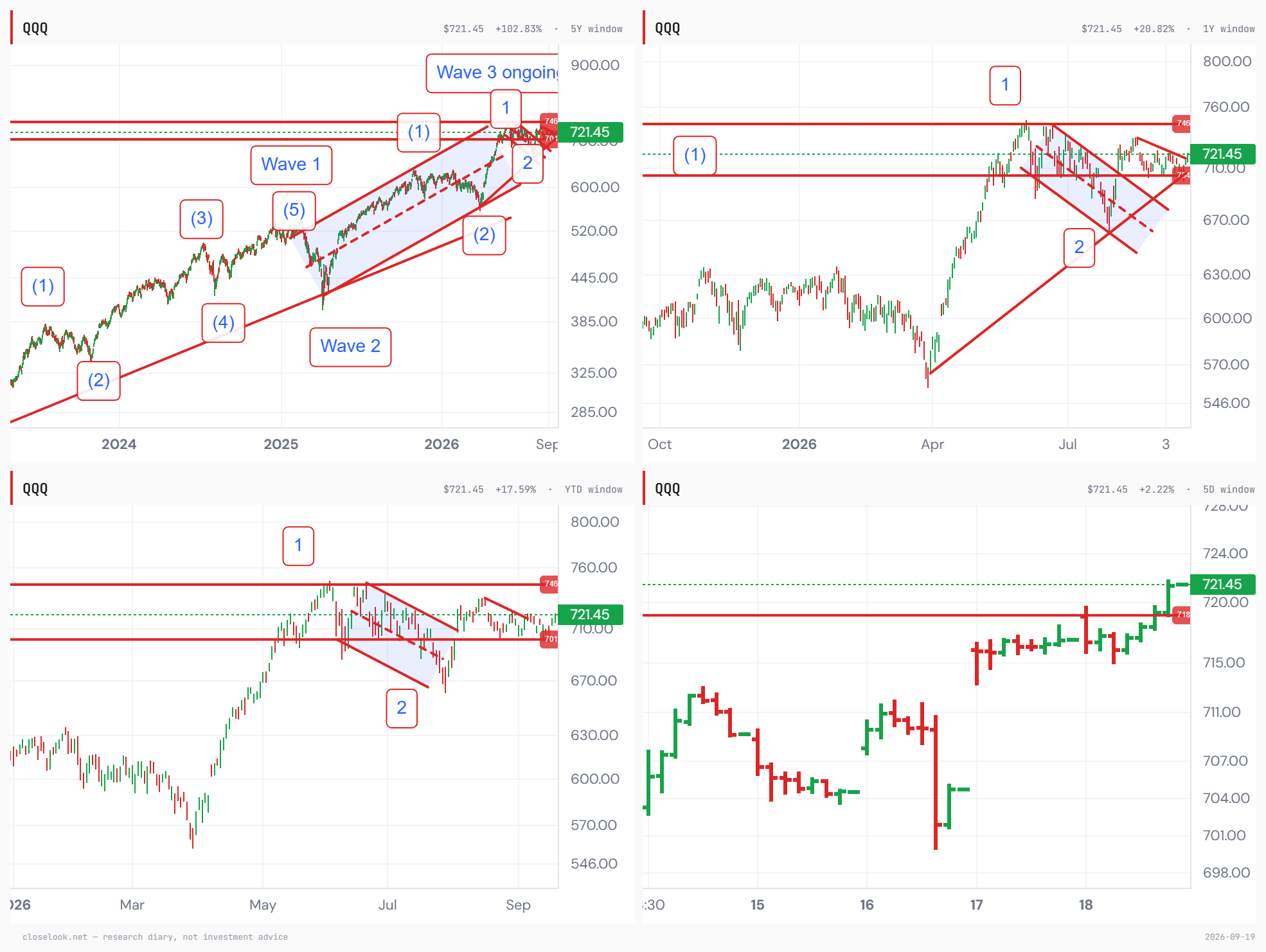
The structural read — the count, from the US letter, as the gate. QQQ closed 721.45, 1.6% above the 50-day, after two closes on the 704 shelf to the cent; 746.16 confirms, 694 voids, neither traded; Friday’s close took the descending line from the mid-August high that had capped every session for a month. The count is unchanged — 1-2 off the April low, wave 3 ongoing — and the editor’s four-window grid below carries it at every focal length: the five-year count, the one-year with the wave-2 channel, the year-to-date, and the five-day tape with Friday’s close above the 718 line. The house read, in Thomas’s words: the recovery on Thursday and Friday despite the hike is positive, and there was no unwind of the yen carry — the bull held its test. For this cohort the corollary matters more than it did a week ago: if the range resolves up, the first candidate to lead is the leader of the spring — the chips, back above their average on Friday — and inside the chips, this week for the first time, the memory names joined; the second candidate is the layer the pacing letter wrote a demand case for, which was bought on Monday and not sold on Friday.
3 · The AI Board — the stack, instrument by instrument
Why this section exists. The Hypergrowth letter carries the site’s AI instruments on one board — the three indices, their sectors and names, the flow behind them, the physical gauges of the build-out, demand, order flow and credit. Every panel is a house instrument, read from its own data, one paragraph each.
The three indices, year to date. Capex +90%, opex +66%, applications −7% — and the distances to the highs: the build-out 21.1% under June and, for the first time in three weeks, widening the gap; the opex layer 3.2% under August after closing six points of it in a week; the applications 9.8% under January, unchanged.
Rubin — the sectors. Thirteen of thirty-six green: the Asia-Pacific constituents +5.2%, the chip architects +5.2%, AI factory systems +4.4%, the design layer +3.3%, storage +2.8% at the top; machine vision −4.5%, power semiconductors −3.1%, physical AI −3.0%, gases and fab subsystems −3.0% at the bottom. On the month AI factory systems +16.6% and the architects +11.8% lead; wafer processing −12.4% trails everything. The build-out is bought at the top of its stack and sold where the tools are made.
Agentic Ecosystem — the sectors. Thirteen green of fourteen — agentic security +14.2%, identity & governance +12.2%, the govern-and-secure layer +12.2%, the US constituents +6.7%, Europe +6.6% — and the one red line is the single foundation-model name at −1.7%. The opex layer bought its trust layer by fourteen percent in five sessions, the exact sleeve it sold for two weeks before the pacing letter told the market why it might be needed.
Agentic Winners — the sectors. Five green of nine: the application leaders +1.9%, the enterprise layer +1.4%, the megacap gateway +1.2% (still the only sleeve green on the year, +12.8%), the control plane +0.7%, the US constituents +0.5%; endpoints −4.6% (now −20.9% on the year) and consumer −3.5% the bottom. The control plane that lost ten percent a fortnight ago gained back less than one; the applications index finished the week where it started, to the cent.
Top five winners and losers, by name, per index. The capex list is the corridor’s assemblers and designers (Lenovo, Global Unichip, Lasertec, SanDisk, Kokusai) against American glass, power and connectors (Corning, Advanced Energy, onsemi, Amphenol, Lattice); the opex list is the governors (Rubrik, Zscaler, SailPoint, CrowdStrike, SentinelOne) against the neocloud and the edge (CoreWeave, Akamai, Zhipu, Equinix, NetApp); the applications list is the diagnostics name and the enterprise layer (Tempus, Atlassian, Appier, Palantir, Workday) against the consumer endpoints (Toast, Netflix, MercadoLibre, Intuit, AppLovin). Three indices, one signature, reversed from last week: the governors and the assemblers were paid, the consumer and the tool suppliers were charged.
Directional Flow — Rubin. 109 of 126 members are losing force — the largest decelerating-up cohort of any index for a third week — with only four getting stronger and one turning up; the storage and optics names still lead the draining side (Kioxia −67, Applied Optoelectronics −65, SanDisk −58 on the month) in the week their prices went the other way. Lenovo (+32 on the month), Dell and HPE lead the building side, the assemblers, a fourth week — and Lenovo was the tracker’s third-best name on price.
Directional Flow — Agentic Ecosystem. 17 of 34 members are getting stronger and three more are turning up — twenty of thirty-four building, the broadest cohort on the board by share for a second week — and this week the names building are the names paid: Elastic (+44 on the month), Zscaler (+37), Snowflake (+36), SailPoint (+33), Rubrik (+32), Okta (+28). The draining side is the single model name (Zhipu −109), DigitalOcean (−37), Akamai and Fastly — the edge names that were paid a fortnight ago. The layer’s flow and its price agree again, in both directions.
Directional Flow — Agentic Winners. 35 of 40 members are building — 23 turning up, 12 getting stronger — with Atlassian (+77 on the month, +17 on the week), freee, Appier, Duolingo, Veeva and Workday the fastest, all from low or negative scores, and this week paid on price for the first time in three. The draining side is two names: AppLovin (−19) and Alphabet (−12) — and Alphabet was the megacap basket’s best line on the week, which is the one disagreement left on the board.
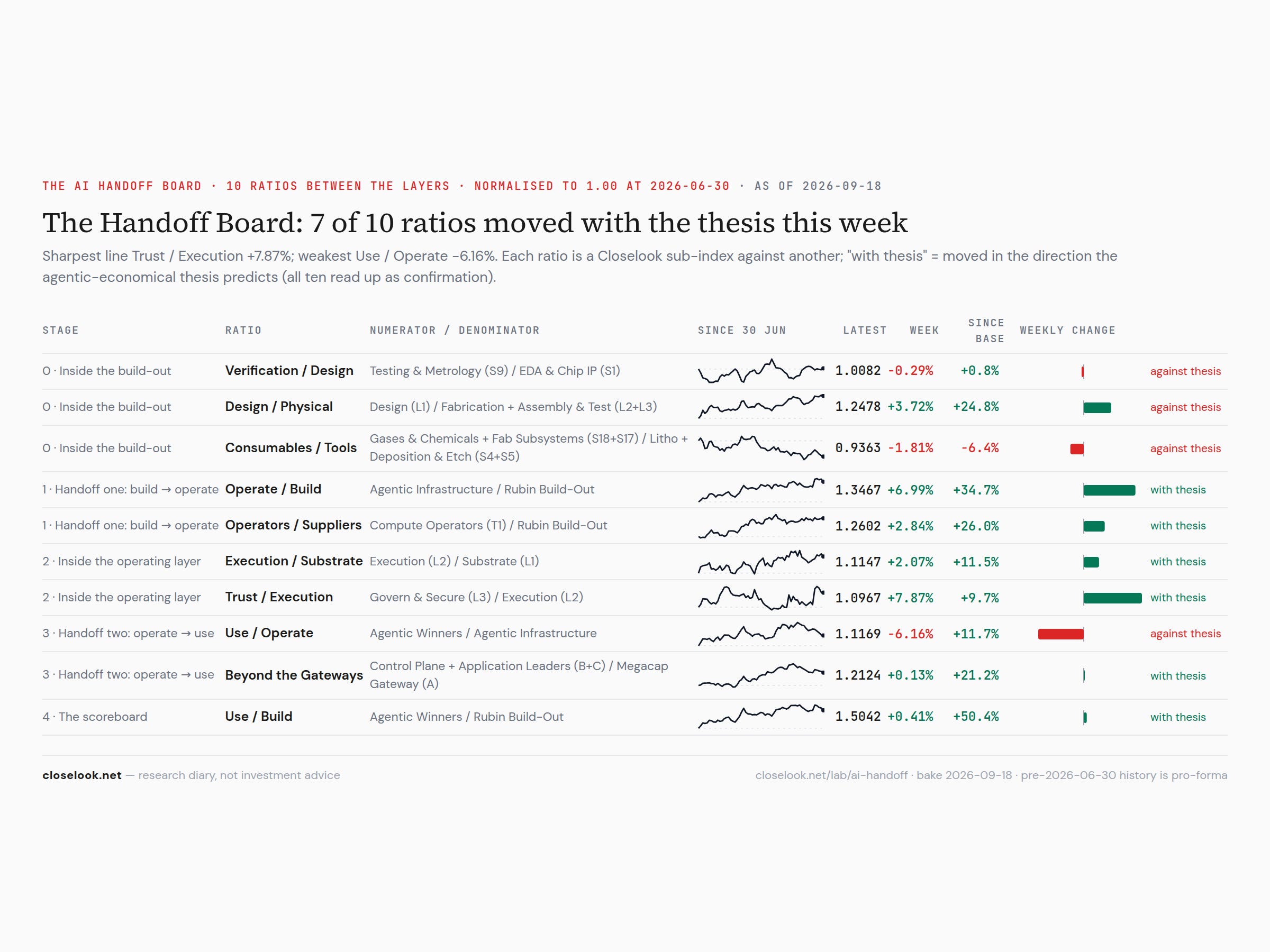
The Handoff Board. Ten ratios between the layers: the operate-and-trust ratios re-rated against everything — operate-against-build +6.99% to 1.3467, trust-against-execution +7.87% to 1.0967 (the week’s widest handoff), operators-against-suppliers +2.84% after −2.23%, design-against-physical +3.72%, execution-against-substrate +2.07% — while the applications were flat against the builders (use-against-build +0.41%) and lost against the operators (use-against-operate −6.16%). The ratios that fell are the ones that rose last week: consumables-against-tools −1.81%, verification-against-design −0.29%. The build-to-operate handoff the house has been waiting for printed a week of it.
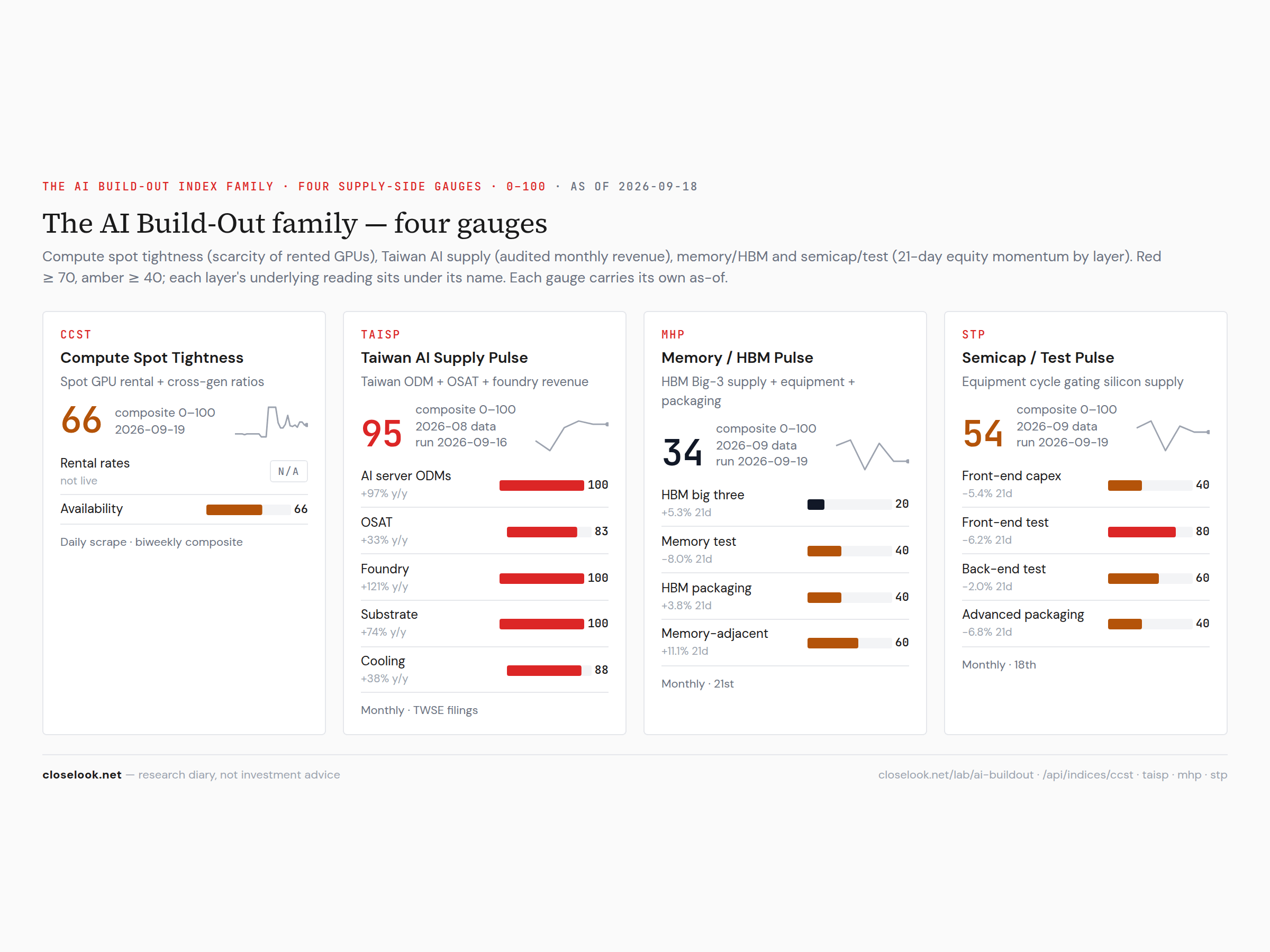
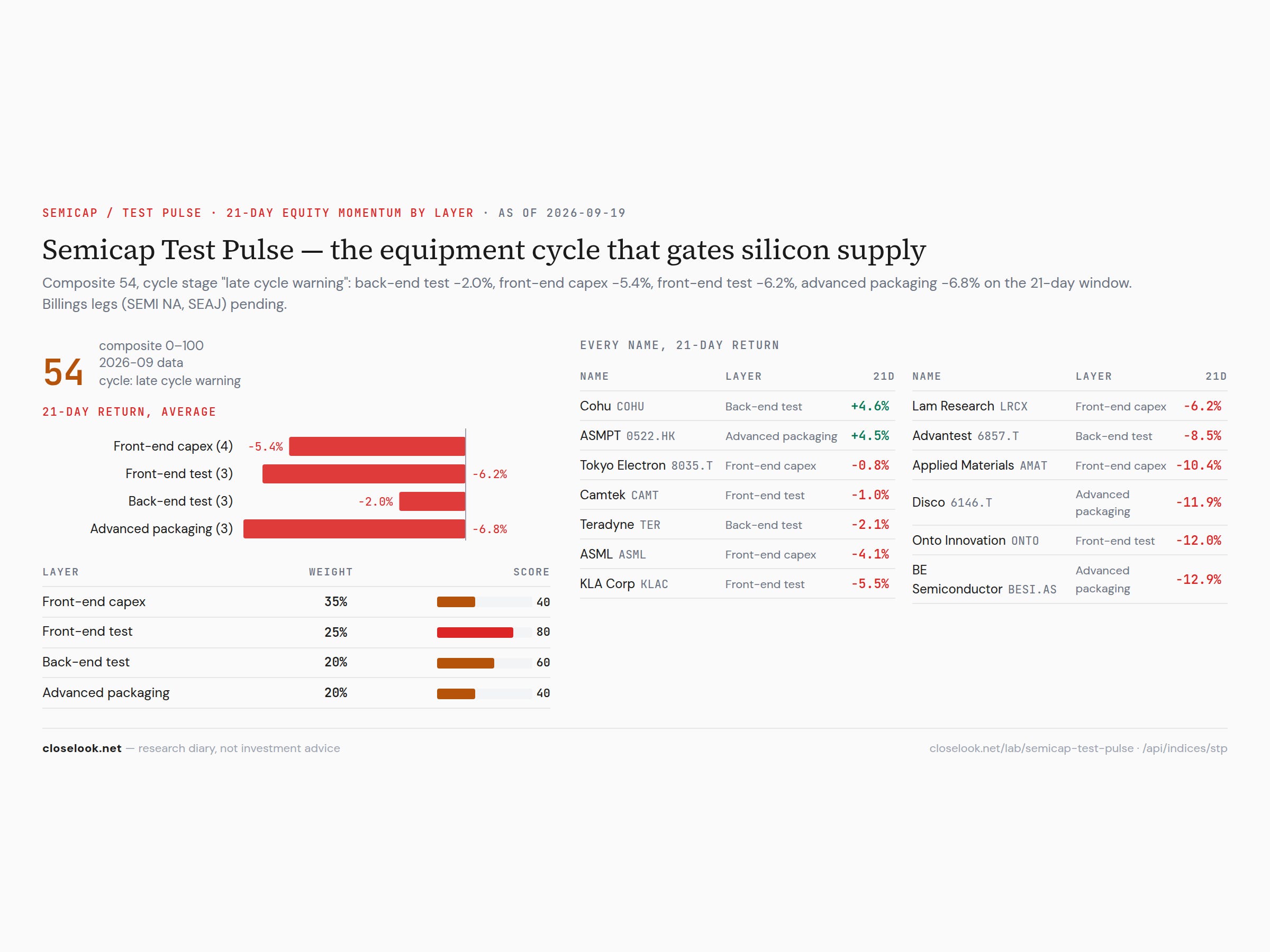
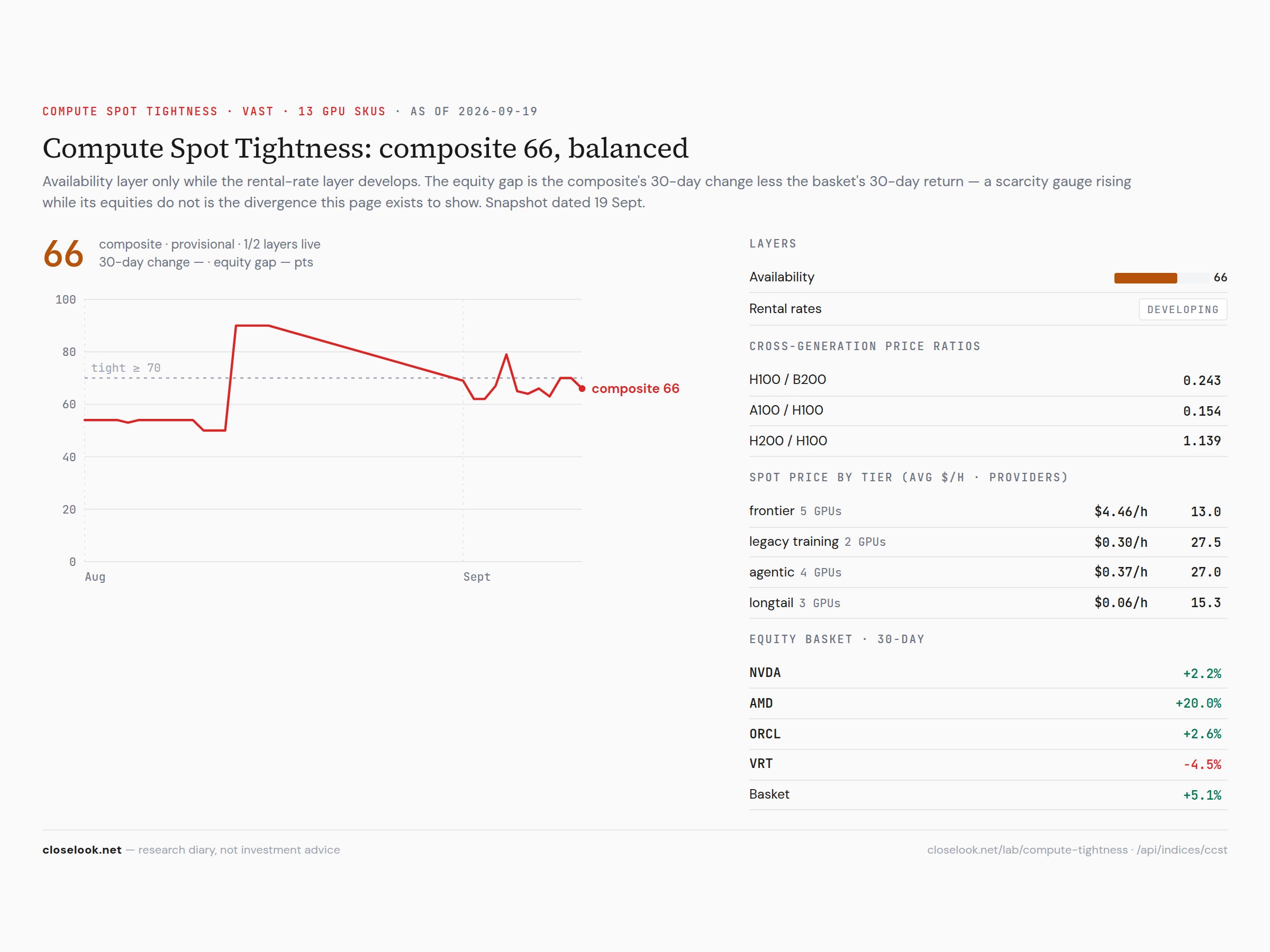
The AI Build-Out family — four gauges. Compute spot tightness 66, from 79 — the availability layer only, thirteen GPUs, the rental layer still developing; Taiwan AI supply 95 on the August revenues, which landed this week — foundry +121% and ODM +97% year over year, substrate +74%, cooling +38%, OSAT +33%; memory/HBM 34, from 28 — the big three +5% on the 21-day window with SK hynix +11% carrying it, memory test −8%, packaging +4%, the adjacent pair (Nvidia, AMD) +11%; semicap test 54, from 29 — front-end test −6%, packaging −7%, front-end capex −5%, back-end test −2%: every layer still negative on the window and every layer less negative than a fortnight ago, which is the tools’ Friday arriving in a month-wide gauge.
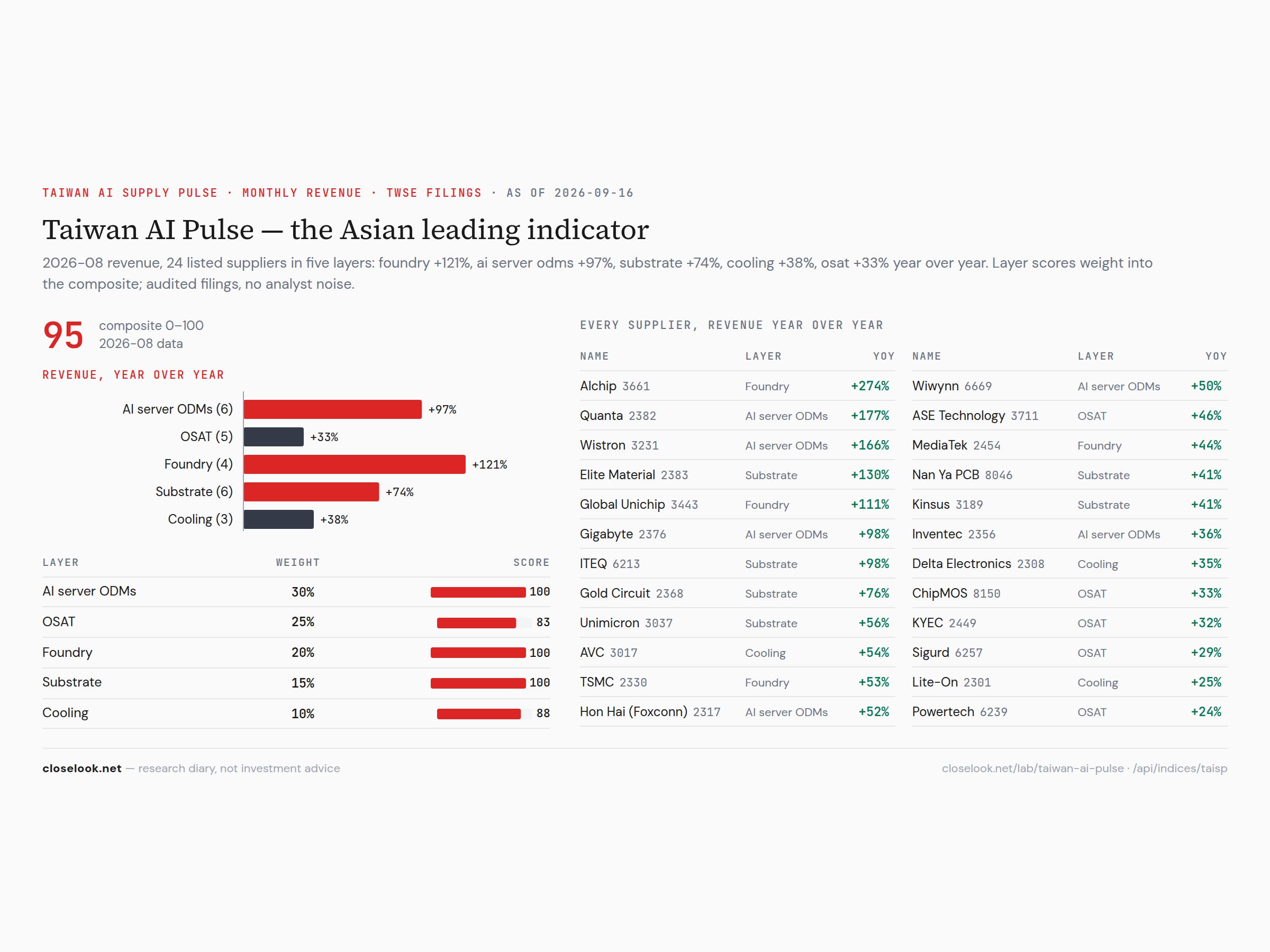
Taiwan AI Pulse — the Asian leading indicator, and the August print is in. The monthly revenues for August landed on the fifteenth: foundry +121% year over year (+15% month on month), ODM +97% (+14%), substrate +74%, cooling +38%, OSAT +33% — every layer accelerating or holding against July’s, the composite at 95 from 96, the foundry and ODM layers at 100 on the gauge. This is the earliest hard number on the build-out anywhere, and it says the physical layer that New York sold on Monday’s pacing letter shipped fifteen percent more in August than in July.
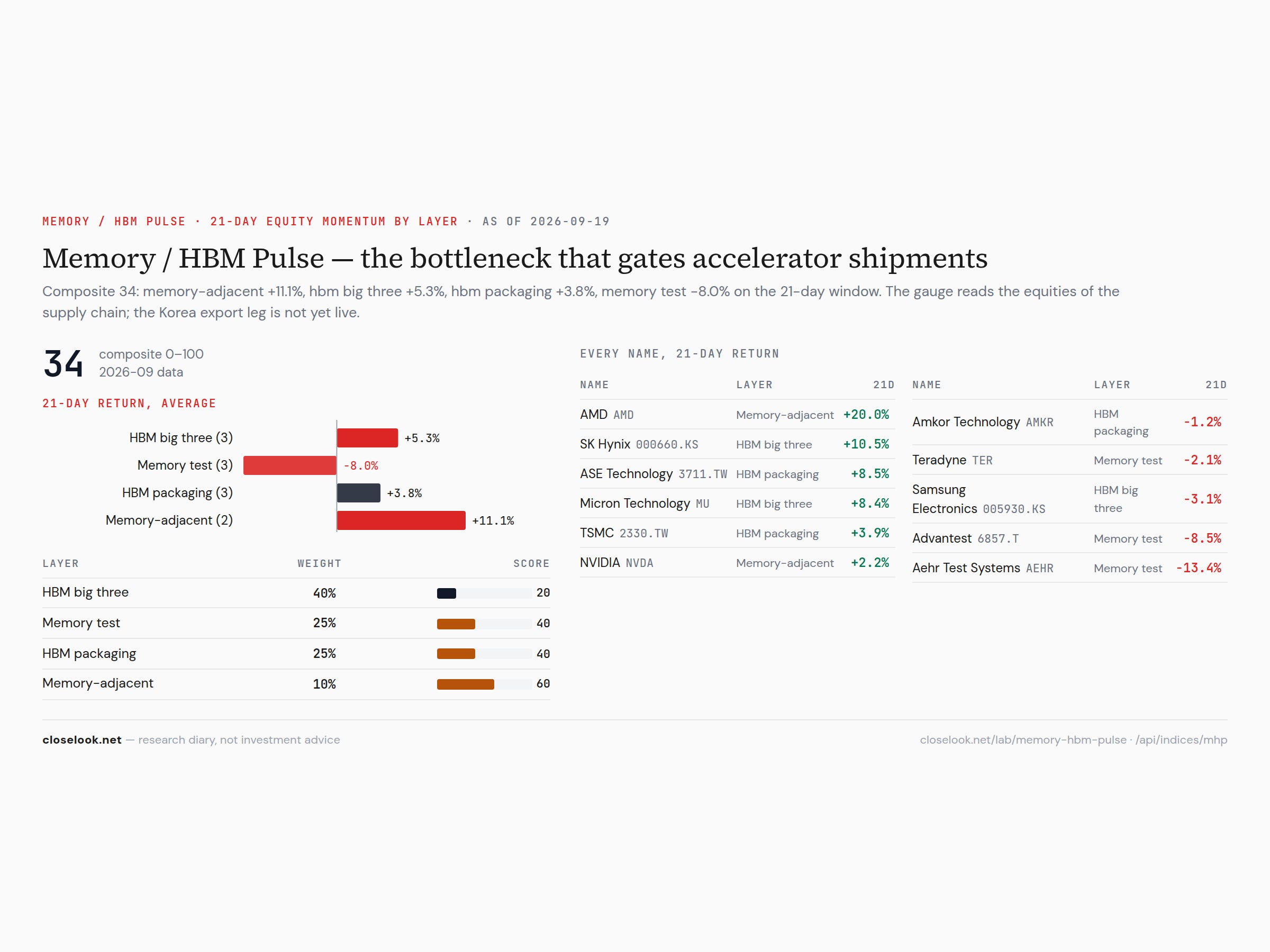
Memory / HBM Pulse. The big three +5% on 21 days — SK hynix +11% the carrier, Samsung and Micron behind — while memory test (Advantest, Teradyne, Aehr) reads −8% on the window and HBM packaging +4%; the composite 34 from 28. The gauge is a month wide; inside the week the American memory names rose four to ten percent on Friday and the Korean one fell in New York and rose in Seoul. The pulse and the price agree on the direction this week, and disagree on the geography — the reverse of a fortnight ago.
Semicap Test Pulse. Front-end test −6% (KLA, Onto, Camtek), advanced packaging −7% (BESI, ASMPT, Disco), front-end capex −5% (ASML, Applied, Lam, Tokyo Electron), back-end test −2% (Advantest, Teradyne, Cohu) — all four layers red on the window and all four narrower than a fortnight ago, the composite 54 from 29. The sibling books’ three September-4 fills (Advantest, BESI, Tokyo Electron) sit in the three coldest layers still; Friday’s +4.6% to +7.0% in the American equipment names is the first session the gauge will carry into next week.
Compute Spot Tightness. Composite 66 from 79, availability only — an H100 rents at 24% of a B200’s hourly price, the legacy-training tier at 30 cents an hour, the agentic tier at 37 cents, the frontier tier at $4.46 with thirteen providers and a B300 at $8.69. Signpost two lives on this page; the rental layer is not yet live, so the gauge says how available compute is — and it says more available than a fortnight ago, which is the neocloud’s charge in one number.
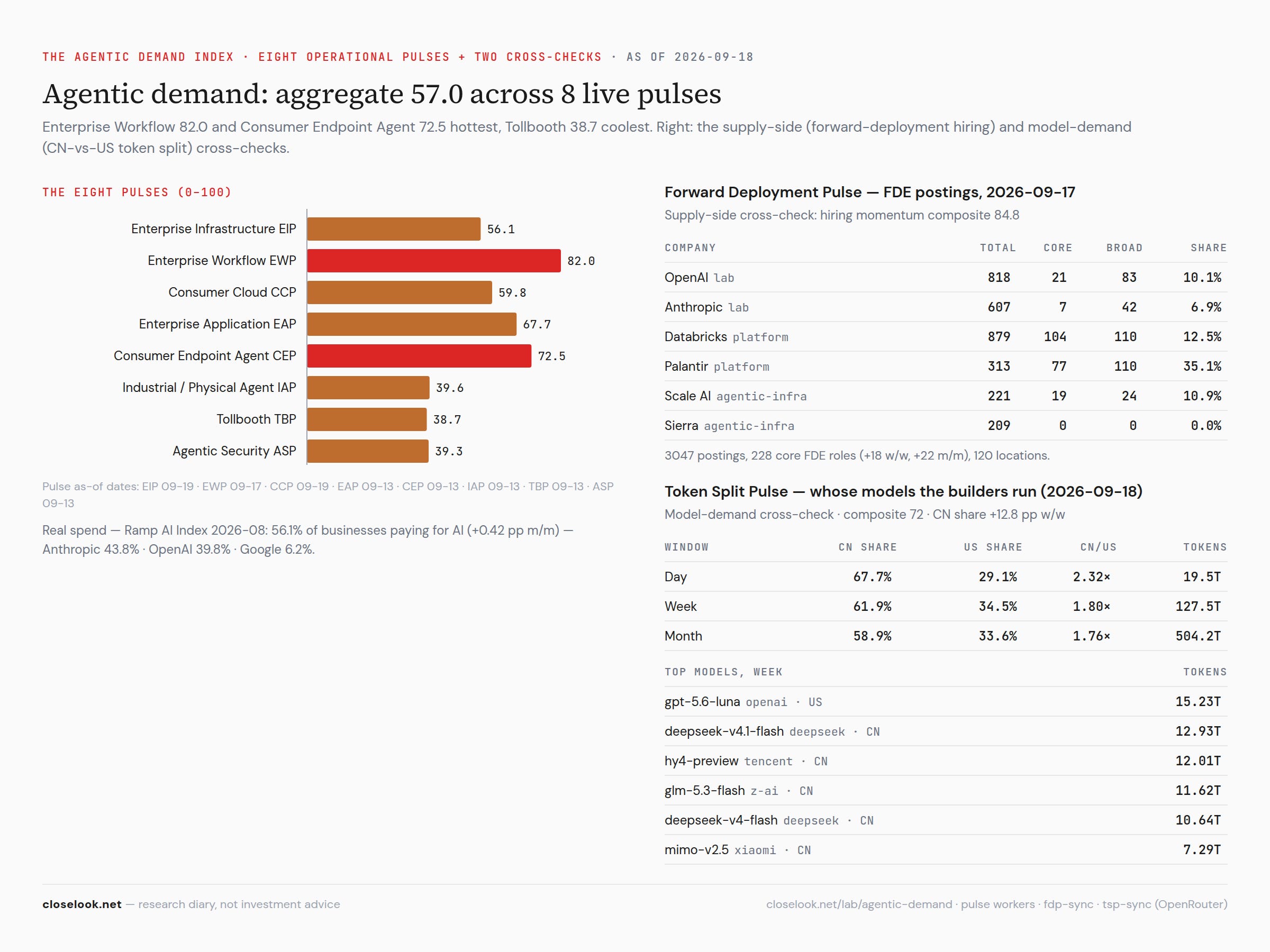
The Agentic Demand Index. Eight pulses: enterprise workflow 82 the hottest, consumer endpoints 73, enterprise applications 68, compute 60, enterprise infrastructure 56, and the three coolest — security 39, toll-booth 39, industrial 40 — are the three the market bought hardest this week, which is the gauge lagging the sort. The token split for the week: 127.5 trillion tokens, China’s open models 62% of them, US models 35% — from 122.6 trillion and 62/35 a week ago; on Friday alone the Chinese share was 68%. The forward-deployed hiring board: Databricks 879 postings with 104 core, OpenAI 818 with 21, Anthropic 607 with 7, Palantir 313 with 77 — the platform that sells the deployment engineer is hiring more of them than the labs that sell the model.
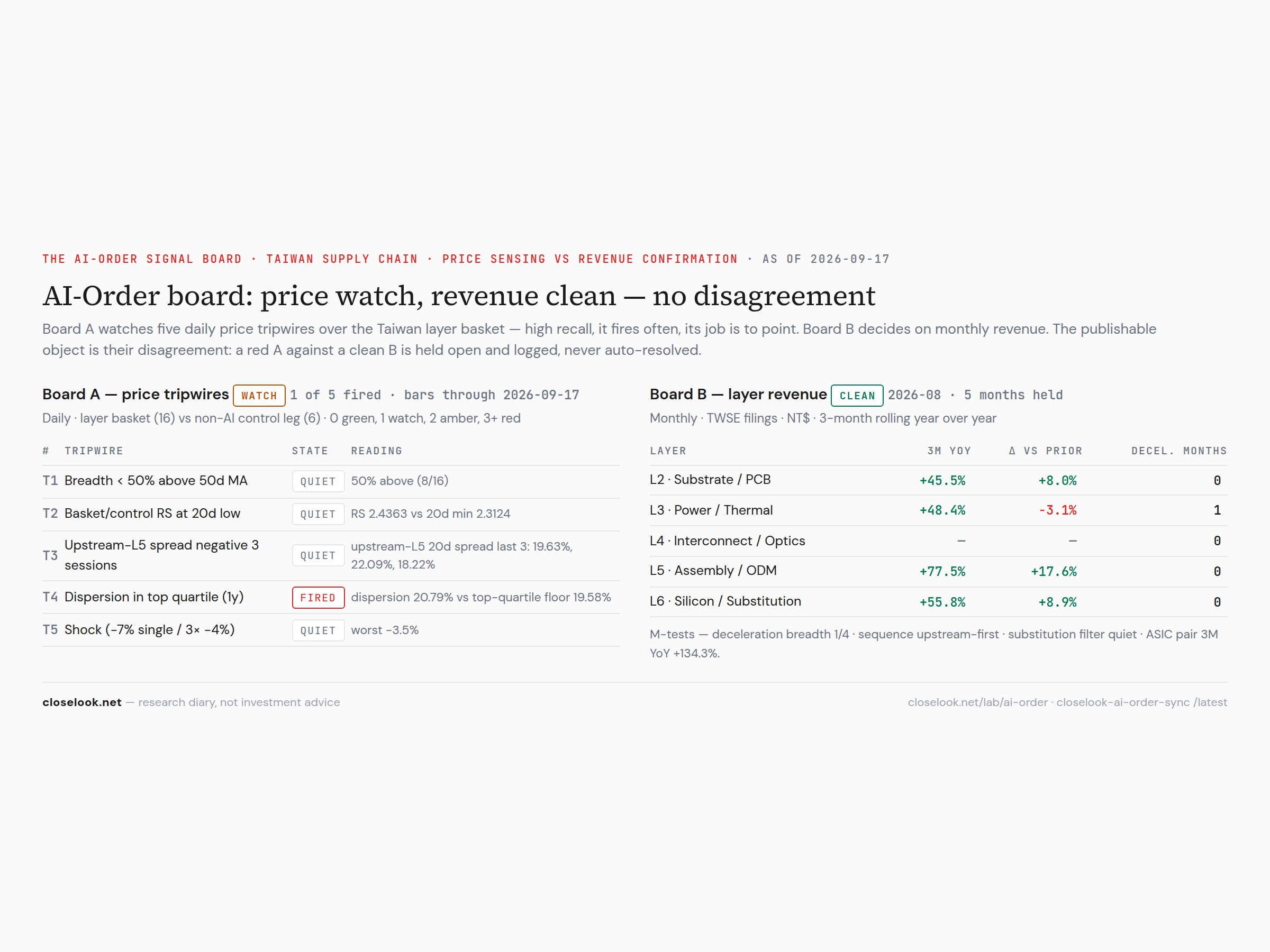
The AI-Order Signal Board. WATCH, score one of five, a third week: only the dispersion tripwire fired (20.79% against a 19.58% top-quartile floor); breadth 50% above the 50-day, the basket’s relative strength above its 20-day low, the upstream spread positive by eighteen to twenty-two points, and the single-name shock missed (worst −3.5%). Board B on the August revenues reads CLEAN — the foundry layer +45% on the three-month window and accelerating, the OSAT layer +48% with its first month of deceleration, the ODM layer +77% and accelerating by eighteen points. Price is sensing; revenue is not blinking. The house holds the pair in WATCH.
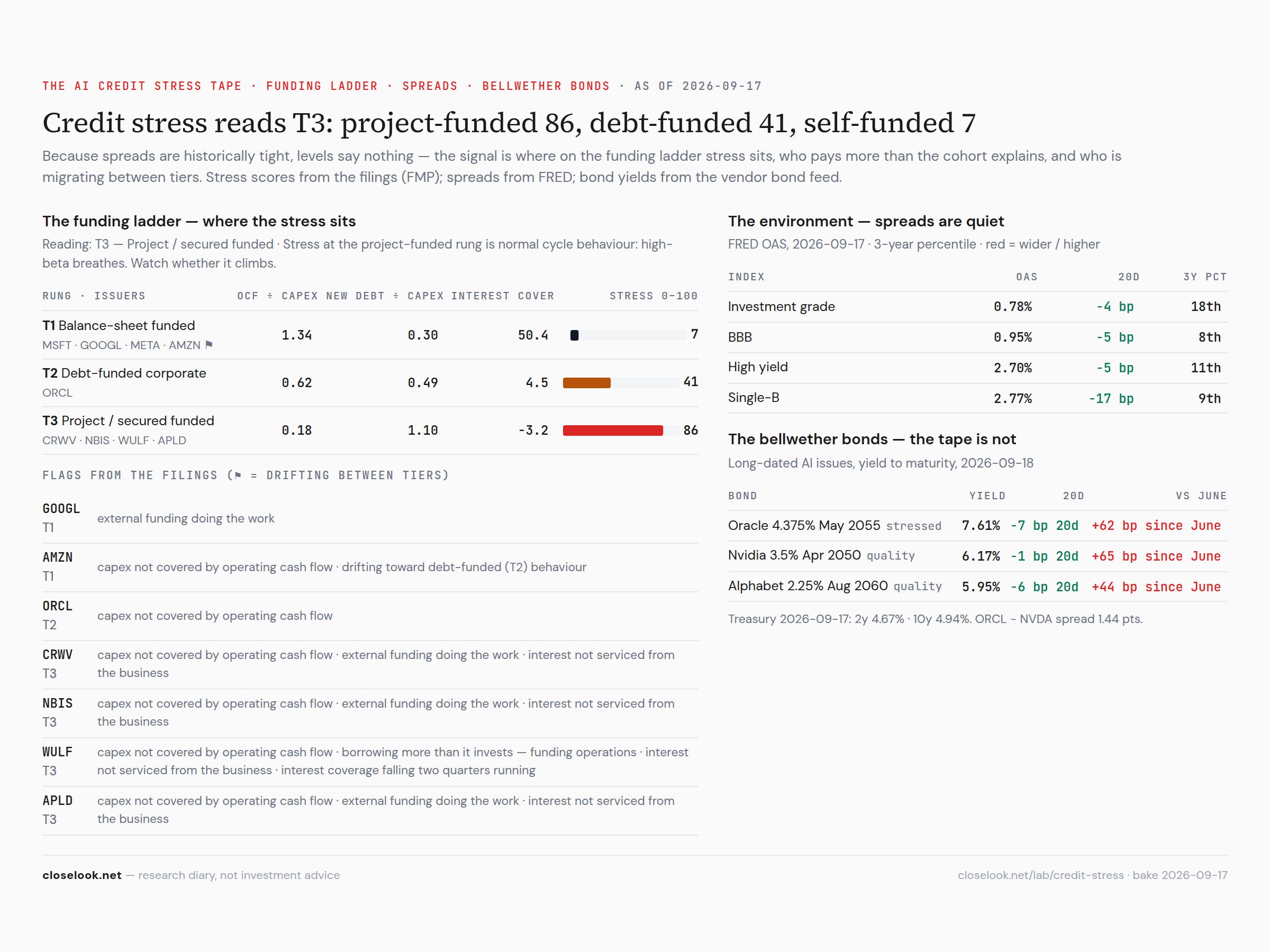
AI Credit Stress — the tape. Spreads are quiet and got quieter — high yield 2.70% at the 11th percentile of three years, investment grade 0.78% at the 18th, single-B 2.77% at the 9th, twenty-day changes all negative — and Treasuries are not: the ten-year at 4.94% and the two-year at 4.67% on the snapshot date, the two-year up thirty basis points in a fortnight. The ladder: the self-funded hyperscalers still T1 with interest cover of fifty and eighty; the debt-funded and project-funded rungs unchanged. The equity of the capacity traders was charged this week (CoreWeave −8.6%); their cost of capital rose with the front of the curve.
4 · The Outlook
The tells from last edition — scored. The book’s two drains — “SK hynix at 171 draining −43 and Lumentum at 137 draining −39, the same shape as SanDisk and Kioxia three weeks ago” — resolved neither way: SK hynix −1.35% in New York and +6.0% in Seoul on Friday, Lumentum +0.42% with a +4.2% Friday; both fills within half a percent of their price, both drains still on the ledger, both names bought on the last day. Scored as unresolved, leaning the book’s way. The flow-tables tell — “wrong on the building side for two weeks” — reversed: the building side was paid on Monday, Atlassian +6.86%, Workday +4.40%, Elastic +4.28%; scored as a hit for the instrument, one week late. The chip-leadership tell — “two weeks of not falling, and Thursday’s re-coupling as the reminder” — went through the reminder and out the other side: −5.6% on Monday, +7.2% from there to Friday, the average taken. Three tells: one unresolved, one hit, one resolved up. The diary keeps the score it earns.
The regime gauges, one paragraph. The Handoff Board: operate-against-build +6.99%, trust-against-execution +7.87%, use-against-operate −6.16% — the middle of the stack re-rated against both ends. The Money Temperature composite: 50 to 46 on the sort, 44 on the rates day, 45 on the hike, 55 on the reclaim, 50 on Friday — “mixed / transitional” at low confidence all week, flat on the week for the first time in a month. The house inflation composite: 49, contained, direction flat, character “leans transitory” — with the long-run-expectations bucket the one hot reading at 64, and the Fed’s statement naming a “timelier drop in inflation” as the reason it hiked into it.

Three signposts for when the thesis comes back — the week printed on two of three.
One — the model-release delta, as the scaling-law gauge. No release this week; the opposite of one — three labs on one page arguing the frontier should be paced. The first thing the world’s markets did with that was sort by layer again, the other way from the GPT-6 week: Seoul sold the physical layer (the Kospi −3.3%, SK hynix −6.7%, Samsung −4.0%) and New York bought the governance layer (+13% to +17% in the security names) and the buyers of compute (Microsoft, Alphabet, Meta +2% to +3%). A release is a demand statement for memory and a fear leg for seats; a pacing letter is a demand statement for governance and a question mark for the physical layer — and the market priced the question mark for one session and the demand for five. The token board says deployment did not pause: 127.5 trillion tokens on the week, from 122.6 trillion.
Two — old-GPU rental prices, as the pent-up-demand gauge. Still no print of the previous generation’s rental rate; the tightness gauge fell again, to 66 from 79, on availability alone — an H100 at 24% of a B200’s hourly price, from 30%, the legacy tier at 30 cents. What the week supplied instead was the equity side of the signpost going both ways at once: the operators’ index +2.4% and the operators-against-suppliers ratio back up +2.8%, and the neocloud the house watches most closely −8.6%. The signpost fires when the old-GPU rate holds while new capacity ships. Not yet — and the gauge says the old GPUs got cheaper again.
Three — incremental margins, not operating margins, as the monetization gauge. Two exhibits, opposite grades, and the grades were the sort’s: Adobe: an eleventh straight double beat, paid +3.9% — the card’s second payment in eleven prints and the first since June 2024. Oracle: EPS $1.92 against $1.74, cloud infrastructure +121%, remaining performance obligations $664 billion — sold −8.3%, three sessions of repricing for a seller of compute. The number accelerated on both cards; the market paid the software house that uses compute and declined the one that sells it, in the week a letter told it which layer’s demand had a question mark. That is the third signpost printing on the pacing letter rather than on the numbers — and the subject of this week’s Knowledge Corner is what the book did with the same asymmetry inside its own lines, with covered calls.
The week ahead — the referee’s calendar, name by name. Monday: the expiry release — Friday’s reclaim put the memory vehicle through 58, the chip index through its average and the Nasdaq 100 through its August line on a quadruple-witching session; Monday’s close says which were held and which were the expiry, and the Kospi opens with Friday’s 2.7% not yet in SK hynix’s New York price. Micron — the vendor calendar says September 30 after the close, estimate $31.27 on roughly $50.59 billion; the house card carried the 22nd; the date is confirmed before this letter or the US letter mints a print-record window. The card’s last four prints: four double beats, two paid (+22.6%, +9.2%), two sold (−5.5%, −12.4%) — and the book sold its Micron at 976 a week before the stock closed above 1,000. No central bank, no scheduled print this letter scores before Micron, and October opens after eight more sessions. The house frame from the US letter governs: the bull held its test, the resolution is still coming, and the first honest witness for the chips is Monday’s close.
5 · Growth With No Tech Inside — the second pillar, test week four
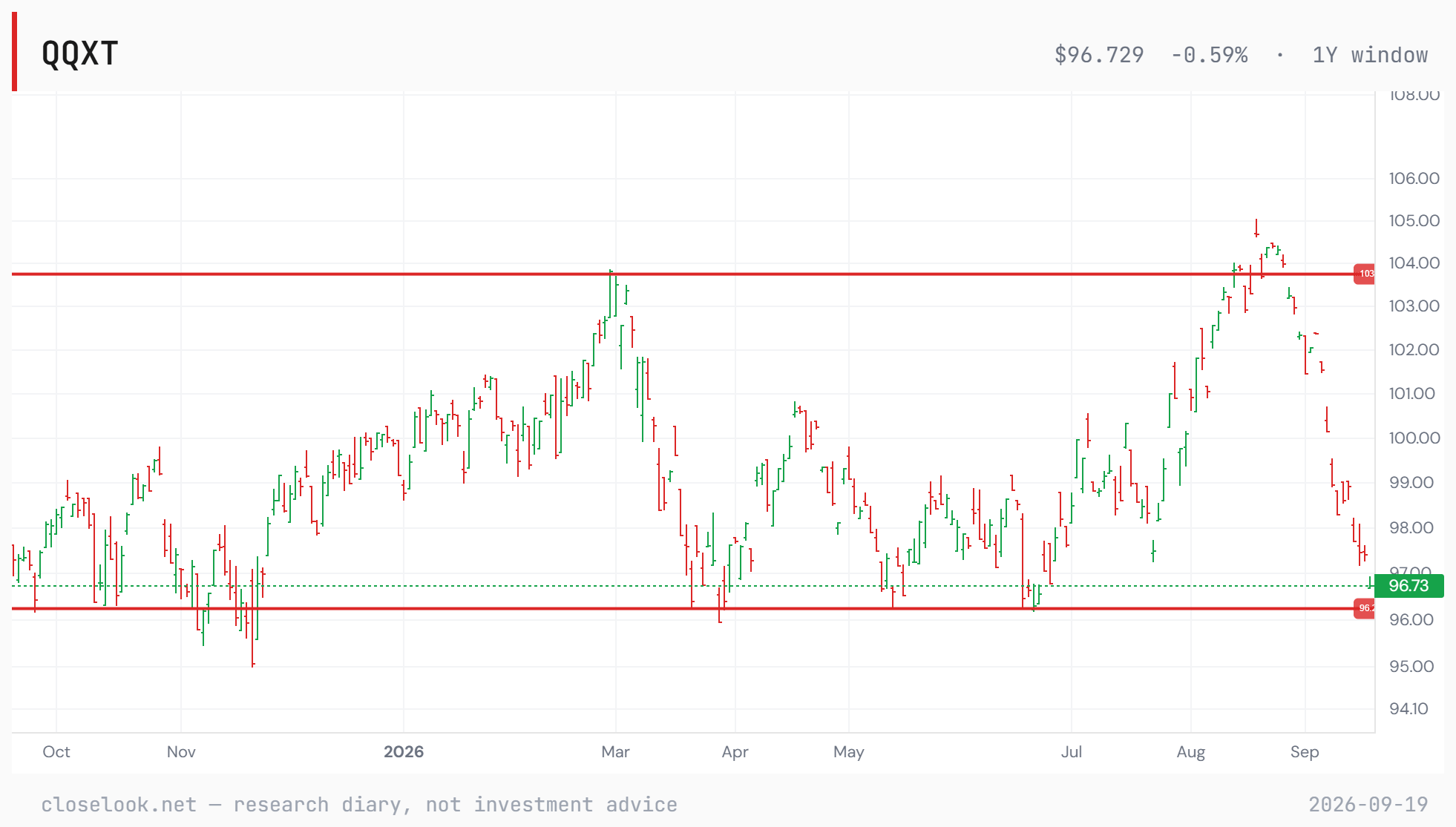
The count reached four, and the claim retires — in public, as promised. Adopted four Sundays ago as the letter’s standing second pillar: the axis had turned to tech-versus-everything-else, the year still tech’s, the month and quarter going to growth with no AI exposure. Four weeks later: the Nasdaq 100 ex-technology −1.90% against the Nasdaq 100’s +0.92%; the S&P ex-tech −0.82% against the S&P’s −0.34% — the ex-tech cuts trailing their parents a fourth straight week, the widest single-week gap of the four, and the ex-tech Nasdaq at 96.73, −2.66% on 2026, at the floor of the year-long range on the editor’s chart — 96.2 the line, half a dollar under Friday’s close, 103.7 the ceiling it touched in August. The letter’s stated standard was four consecutive weeks. Four. This section retires the tactical claim here and keeps the structural names: Tempus +31.9%, Natera +12.3% and Illumina +16.1% were three of the family’s twelve best lines this week — diagnostics, not AI — and Palantir, Eli Lilly and Nubank remain in the book. The everything-else trade as a tactical call is over by its own rule; the names the pillar found are staying for their own reasons, which is what a pillar is for.
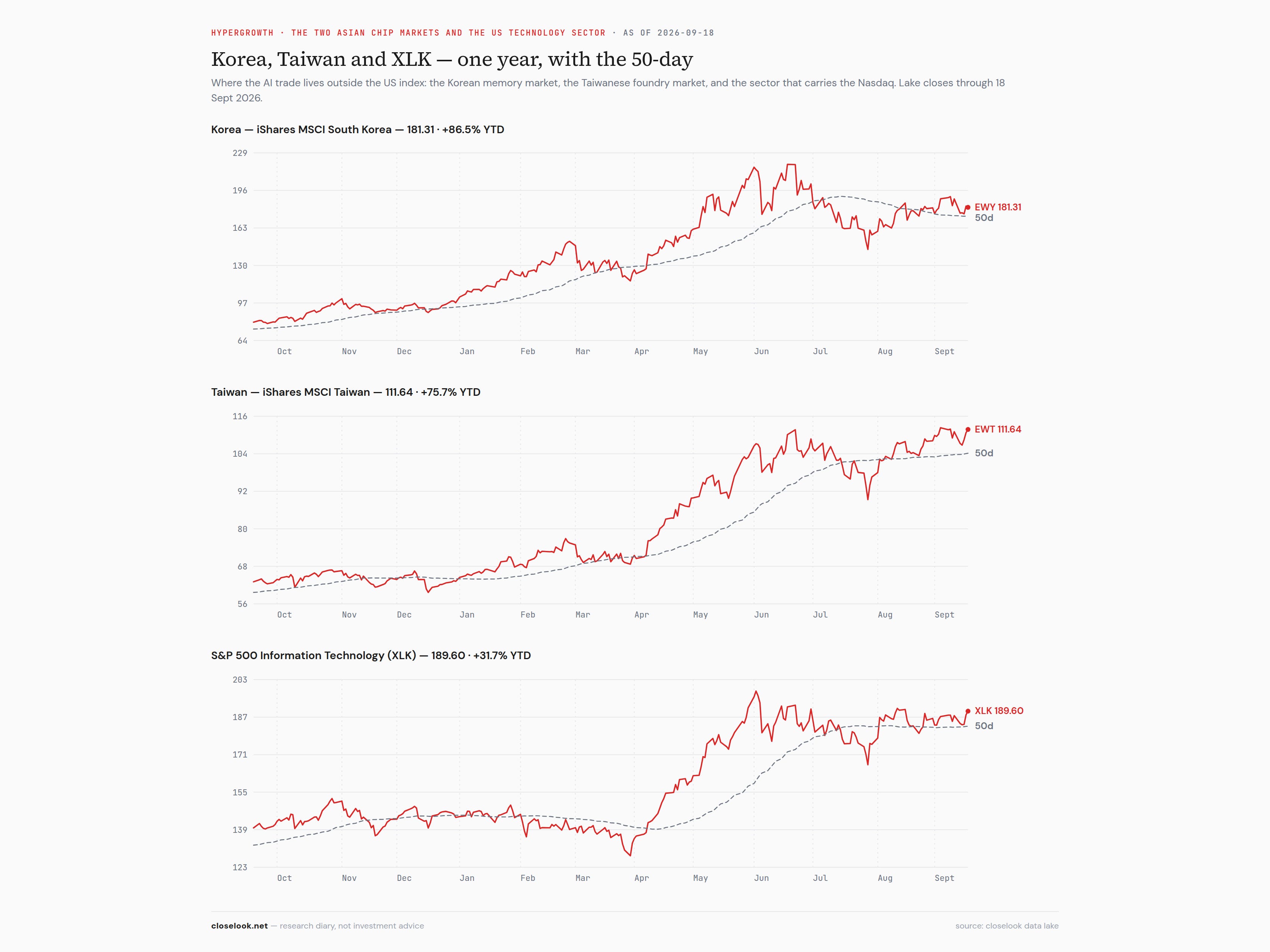
Where the AI trade lives outside the US index — Korea, Taiwan and the sector that carries the Nasdaq. Three charts, one year, with the 50-day. Korea’s fund at 181.31, −3.93% on the week, +86% on the year — it lost the 183.46 hold on the weekly close for the first time since the confirmation, closed under 180 three days running (176.22, 176.49, 175.54) and back above it on Thursday and Friday, in a week the Kospi fell 0.2% in won: the dollar wrapper paid for Monday’s Seoul sell-off on the day and has not yet been paid for Friday’s 2.7% Seoul recovery. Taiwan’s fund at 111.64, +0.66%, +76% on the year — the only country green on the Global board, half a percent under its September 4 record, above its 50-day throughout: the foundry market read the pacing letter as a demand question and answered it with August’s revenue print on the fifteenth. XLK at 189.60, +1.03%, about +31% on the year — on the rising line from the April low, the only one of the four US charts in the US letter’s ex-tech grid making a higher weekly close. For this cohort the read is the second pillar’s mirror, one week after the pillar retired: inside the AI trade the geography still pays — the two Asian chip markets are up 76% and 86% on the year against 31% for the US sector — and this week the geography split, memory against logic, for the first time in three weeks. The book’s Korean memory line was charged four percent for it and its Taiwanese assembler line was paid five.
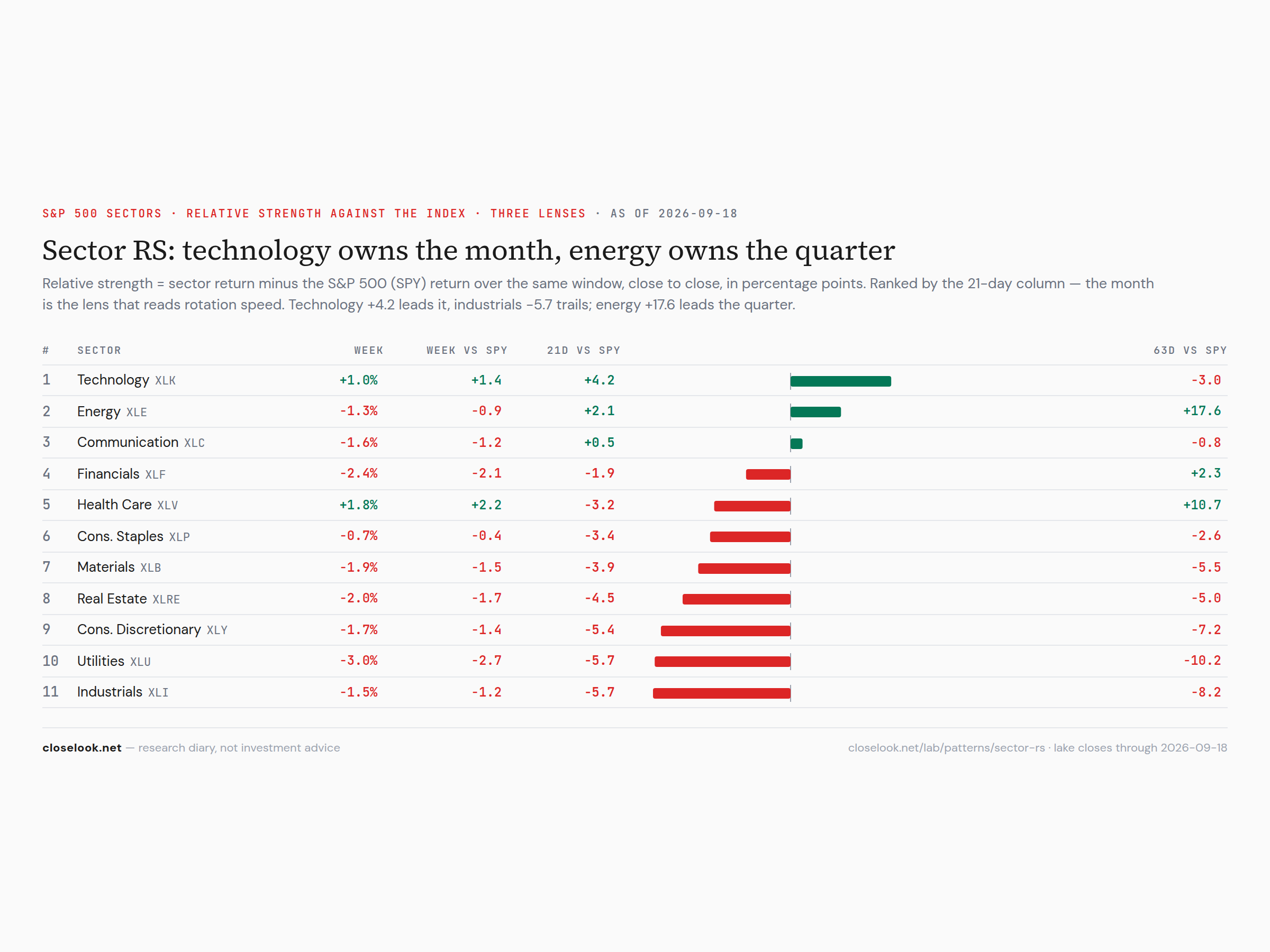
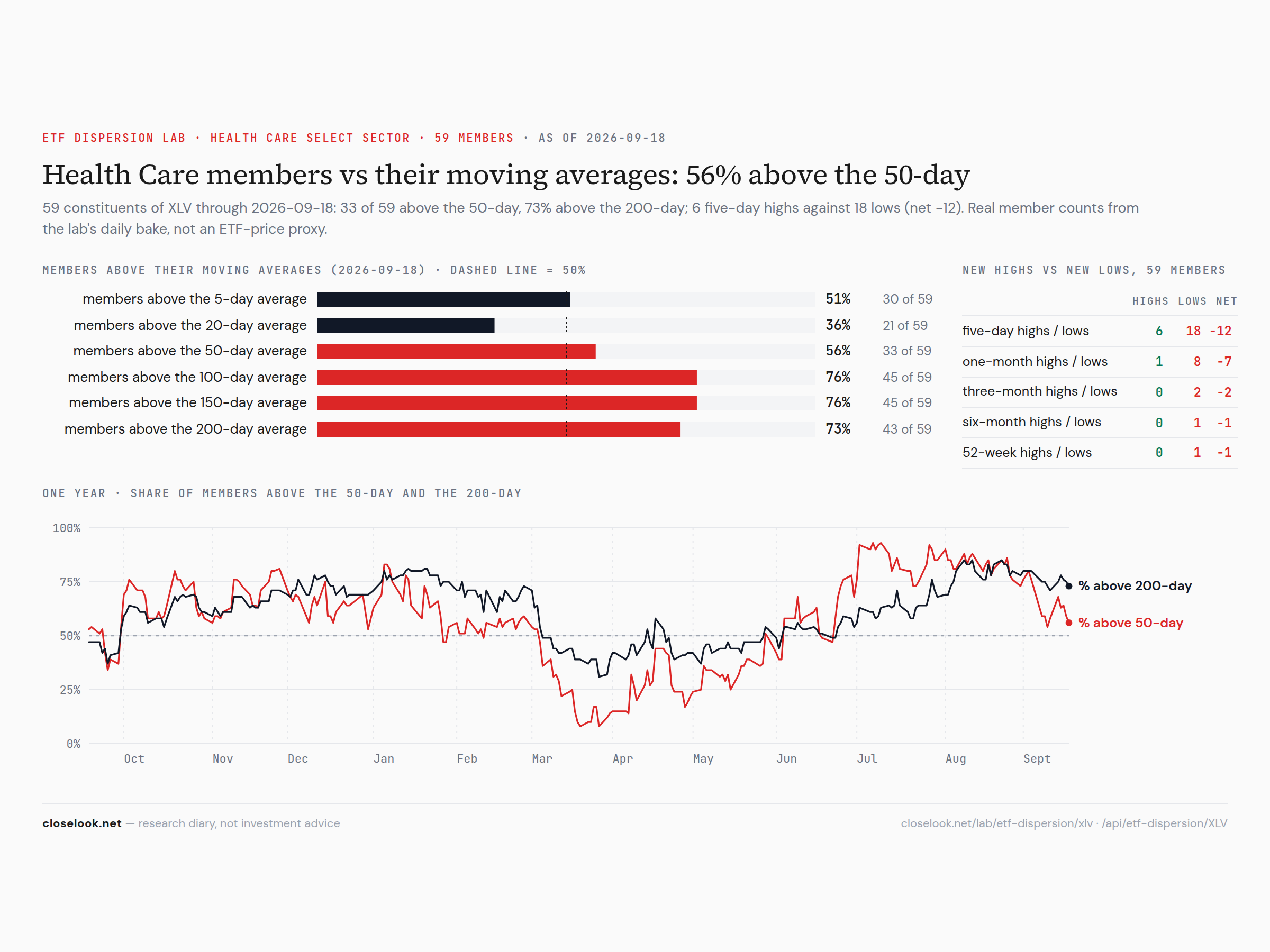
The sectors, underneath. Energy kept the quarter on the RS board (+17.6 against the index over 63 days) and lost its month to technology (+4.2 on the month, from flat); health care went from the worst US sector to the best on the surface (+1.83%) and is still the fastest-fading line on the month lens (−3.2); its breadth firmed on the medium term — 76% of members above the 100-day, from 73% — while 6 five-day highs against 18 lows says the surface week was a bounce and not a base. Financials the weakest internal reading on the board at 17% above the 50-day; industrials at 11%. The pillar’s sector expression rests a fourth week; the letter keeps the table.
6 · The Hypergrowth Portfolio
▤ Portfolio table as published — the live book is at /portfolios/hypergrowth/.
The book, marked — and traded on Monday, five lines and a buy-back. On the lines it held all week the book gained about $2,635, +0.79%, in a week the S&P lost a third of a percent and the applications index was flat; the equity lines stand at roughly $336,400 by the engine mark, with cash at about $1,500 after Monday. Monday’s lines, from Saturday’s Daily Pulse and the trade log: Nebius — the 50 shares sold at 225.56 on Friday bought back at 212.19 on Monday, $13.37 a share cheaper, the position back at 200 shares with the two January-2028 250 calls still over it; Corning — one January-2028 165 call sold at 38.25, $3,824 of premium, the strike ten percent above Friday’s 150.13 after the stock fell 13.7% on Monday; Nubank — ten December-2027 17 calls sold at 2.22, $2,219, the strike 25% above Friday’s 13.65; Rocket Lab — two January-2028 80 calls sold at 17.50, $3,498, the strike 24% above Friday’s 64.57; ASE — one of the six short January-2027 40 calls bought back at 4.10 against a sale at 5.69, a realised gain of $159, five calls left over the 500 shares, all in the money at Friday’s 41.63. Net: $9,541 of premium collected, $10,610 spent on the Nebius shares, $411 on the ASE buy-back — the calls paid for the shares, and the book that ended last Friday overdrawn ended this one with cash. Where last Friday’s fills stood at this Friday’s close: SK hynix 187.50, −0.4% on the 188.30 fill, after −7.6% on Monday and +2.5% on Friday; Lumentum 930.91, −0.5% on 935.70, after a +4.2% Friday; SpaceX 152.71, +3.1% on 148.18. And the two exits, scored: Micron, sold in full at 976.00, closed at 1,015.80 — +4.1%, its first close above 1,000, on a Friday the memory complex led the market: the book sold the American memory maker a week early. Qualcomm, sold at 183.74, closed at 177.72 — −3.3% after a −5.8% Friday: that sale was right on the week. One exit each way, said plainly.
What paid and what charged. The payers, on the tape’s week: Cloudflare +5.6% (+$1,707, the largest payment again — through 320, with the short December 250 call now 74 dollars in the money against it), ASE +5.5% (+$1,080, through its 40 strike), Palantir +6.2% (+$1,041), Datadog +3.9% (+$871), Eli Lilly +3.3% (+$560), Nvidia +1.8% (+$399), Rocket Lab +2.6% (+$324), BlackBerry +4.2%, SpaceX +1.0%, the fabless fund +0.6%, Lumentum +0.4%, TSMC +0.3%. The charges: Corning −9.8% (−$1,629, the largest charge — the fibre name that paid the book +7.8% a fortnight ago, and the line the book wrote a call over on Monday, at the day’s low), Nu −6.6% (−$970), Infineon −4.3% (−$433), BESI −2.1% (−$231), Advantest −2.1% (−$219), SK hynix −1.4% (−$206), Nebius −0.5% (−$202). Twelve lines paid, seven charged, and the split is the family’s: the governance-adjacent lines (Cloudflare, Palantir, Datadog) and the Taiwanese assembler paid; the American glass, the European tools and the Korean memory maker charged. A hypergrowth book gaining eight tenths in a week two central banks hiked is the silicon core plus the code lines doing what they are held for — and the charge on Corning is the same charge the family took: the fibre name went from the best list to the worst list in a fortnight, and the book’s answer was a covered call at the bottom, not a sale.
What the book did, read as one sentence — and what the flow says about it. It bought back the shares it had trimmed into strength, thirteen dollars lower, and wrote calls over four names it already owned at strikes ten to twenty-five percent above the market. That is a book saying it expects to be paid for holding growth names through a range rather than through a run — and the strikes say so: the stock has to do a good year before the call costs the book anything but the upside beyond it. Now the ledger’s view of the same lines, because this letter publishes both: Nebius sits at a 44 score, flat on the month; Corning is not on the AI board’s ledger; Rocket Lab and Nubank are HALO lines, both draining; SpaceX at 40 with the fastest five-day build on the board (+17.5) for a second week; SK hynix at 162 still draining −41; Lumentum at 127 draining −40. The book’s two drains from last week are still drains, and their prices sat still; the book’s newest line is the flow’s fastest riser, and its price rose three percent. The diary said it would score the drains; the score this week is “not yet”.
What we plan to do — nothing on Monday, and the calls are the standing thought. No central bank, no print this letter scores before Micron, the expiry’s positions released on Monday. The book does not act ahead of Monday’s close and it does not act ahead of its own scoring convention. The standing thought is the one Monday’s four fills wrote: the book is now short calls on Nebius (250, 27 dollars out of the money), Corning (165, ten percent out), Nubank (17, twenty-five percent out), Rocket Lab (80, twenty-four percent out) and ASE (40, in the money by $1.63) — five names, thirteen to sixteen months of runway, and Cloudflare’s December 250s seventy-four dollars in the money against the book’s best line. A short call deep in the money is upside already given away; the next resolution, if it is up and led by the chips and the code, is exactly the kind of move those calls cap. The Knowledge Corner explains what a covered call written at the bottom of a thirteen-percent day buys and what it costs; the book will decide Cloudflare’s calls on the close that takes a line, not before.
The four tradable books, open for inspection. Alongside the reference portfolios on this site, the four Closelook-companion wikifolios publish their own ledgers on the wikifolio platform, every transaction visible trade by trade, via Trade the Look. Same diary, harder currency. A research diary made investable for its author; not a recommendation.
7 · What May Go Wrong
One: the book wrote a call over the fibre name at the bottom of its worst day, and the fibre name was the family’s best line a fortnight ago. Corning fell 13.7% on Monday and the book sold a January-2028 165 call against it at 38.25 the same session. If the fibre trade — eighty million miles of Verizon fibre, the AI data-center interconnect — was sold on the pacing letter’s question mark and comes back on August’s Taiwan revenues, the book has capped its recovery at 165 plus the premium, from 150. A covered call written into a thirteen-percent drop collects the fattest premium of the year and gives away the fattest bounce.
Two: the flow tables were right on the building side for one week — after being wrong for two. Atlassian, Workday, Elastic, Snowflake: three weeks of building flow, two weeks of falling prices, one week of rising ones, made on a Monday and given back a piece per session after. If the pacing letter’s bid for the governance and enterprise layer was one session’s positioning rather than a re-rating, the fastest-risers table is back to being a list of what the market sells into strength — and the table’s newest riser, the book’s SpaceX, has no monthly column to say either way.
Three: the chips’ reclaim was an expiry’s, and the memory names led it. SanDisk +11% on Friday, Micron through 1,000 on Friday, the memory vehicle through 58 on Friday — all three on a quadruple-witching session, all three against the deepest drains on the flow board. If Monday gives the memory vehicle’s 58 back, the memory complex’s bounce was the sort’s expiry and the ledger’s drain was right for a seventh week; the book’s Korean memory line, already charged four percent, is the one with the most to give. If Monday holds it, the ledger is wrong for the first time in seven weeks on the names it has been most certain about.
Four: the second pillar retired this week, and the names it found are now held on a different argument. Four of four. The tactical claim is gone by its own rule; Tempus, Natera, Illumina, Palantir, Lilly and Nubank stay as structural growth with no AI thesis. A structural argument is harder to score than a tactical one, and a letter that keeps names after their rule expires has to say each week why — this section will, or the names go.
Five: the short calls cap the book exactly where the thesis pays, and there are five of them now. Cloudflare 74 dollars through its strike, ASE $1.63 through, Nebius 27 out, Corning, Nubank and Rocket Lab ten to twenty-five out, thirteen to sixteen months of runway. If October delivers the upswing version of its reputation — the US letter’s bull holding its test, the chips and the code leading — a book with calls over its five best-known lines collects the premium and gives away the move above the strikes. Monday’s four fills were the book saying it expects a range; the count in the US letter says the range ends.
Each of these has a falsifier that prints within a fortnight — most within one, and one of them on Monday. The book acts on prints, not on the fear of them.
8 · Knowledge Corner
Writing a covered call into a crash day — what the book bought on Monday, and what it paid. A covered call is a promise to sell shares you own at a strike price on or before a date; the premium is what you are paid for the promise. The premium has two parts: intrinsic value (how far the stock is already above the strike — zero for a strike above the market) and time value (what the market pays for the chance the stock gets there before expiry). Time value rises with three things: the time to expiry, the distance the stock has to travel, and — the one that matters on a Monday like this — the volatility the market expects. Corning fell 13.7% on Monday; on a day like that the options market marks up the expected swings in both directions, so a call ten percent above the market with sixteen months to run — the January-2028 165s — was priced at $38.25 a share, $3,824 for one contract on a $15,000 line: a quarter of the position’s value, for a promise that only costs the book something if the stock is above 165 in January 2028. That is the trade’s logic: sell the promise when the market is paying the most for it, which is when the stock has just been hurt. The cost is the shape of the payoff afterwards. If Corning recovers to 165, the book keeps the shares, the premium and fifteen dollars of recovery; if it recovers to 200, the book keeps the premium and gives away the last thirty-five; if it keeps falling, the premium is the only cushion. The same logic priced Nubank’s and Rocket Lab’s calls on the same afternoon at strikes a quarter above the market, and it is why the four fills together paid for the Nebius buy-back: the book converted one bad day’s volatility into $9,541 of cash and a cap on four names. The rule of thumb for reading such a fill in any ledger: the premium as a share of the position’s value tells you how much the market feared the stock that day; the distance to the strike tells you how much upside the writer was willing to sell. Ten percent for a quarter of the value is a writer who expects a range. The house publishes every call on the portfolio page — and the roll-up-and-out mechanics from last week’s Corner apply the day any of them goes deep in the money.
9 · Final Words
The selection came first this week because the week sorted by letter, not by layer: it paid the governors, the diagnostics names and the assemblers, and it charged the fibre, the tool suppliers and the neocloud — in the tracker’s names, in the sleeves, and in the book’s own lines. The flow tables were paid on the building side for the first time in three weeks and ignored on the draining side for the first time in six, and the diary records both.
The Fed hiked into a range that had narrowed for three months and the range survived it with its floor tested and its ceiling’s diagonal taken; the Bank of Japan hiked and the yen fell, so the carry trade that has ended two bull markets from the side stayed in place. The US letter reads that as the bull holding its test, and this letter reads the names the same way: the layer the pacing letter wrote a demand case for was bought on Monday and kept on Friday; the physical layer was sold on Monday and bought back by Friday, memory included; the tools’ suppliers were the only layer sold on both. If the resolution is up, the leader of the spring is the first candidate again — and inside the chips, this time, the memory names are on the paid list. We will see.
Price is the only truth. This week it paid what governs, secures and diagnoses, charged what makes the glass and the power supplies, put the memory names through their lines on an expiry, and paid the book $9,541 for promising to sell four names it owns at prices it would be glad to get. Monday’s close, Micron’s order book on the 30th and the next Friday-night scan — which ran on its own this week, at last — decide whether the book’s two drains and its five short calls were the right trades.
The Closelook letters — where this one sits. The house thesis, compressed: the stock market is a growing system at the aggregate level in which most constituents slowly fade while a small group massively outperforms — and that group changes dynamically; it never stays static. Own the aggregate, know the current winner group, watch for the rotation. Right now the winner group is the AI stack, and the live question is which of its layers — building, operating, using — earns the next leg; this week the market answered “operating, on a letter, and building again by Friday”. Three letters read that question at three altitudes: Closelook@Global Stock Markets (Saturdays) follows the geography of the money — regions, cross-asset, the core thesis owned through ETFs. Closelook@US Stock Markets (Sundays) reads the tape — the four-layer AI thesis at sector and index degree, the levels, the print records. Closelook@Hypergrowth (Sundays) reads the names — four growth buckets, the flow ledger, the tactical sleeve. Same market, top down. This is the name altitude.