The tracker's ten best names this week are eleven-twelfths build-out — test equipment, power, photonics, fibre and the CPU makers — and its ten worst are enterprise software, from UiPath to Adobe.
Inside — the strongest and weakest sleeves of each AI index on the week and on the year, the flow behind the names that were paid, the two Asian chip markets against the US technology sector, and what the Hypergrowth book did with Micron, Qualcomm, SK hynix, Lumentum and SpaceX on Friday.

1 · This Week’s Action
Where this letter sits, in one line. Sunday’s US edition reads the market at index and sector degree; this one reads it at name altitude — which companies the money went into, which it left, and what the flow behind each is doing. The backdrop, one line more: the S&P sold four sessions into a hot inflation print and bought the print, the chips beat the market a second week from under their average, the Nasdaq 100 without its technology stocks turned negative on the year, and the Fed decides on Wednesday with a hike four-fifths priced.
The selection, first — what the tracker paid and what it charged. Across the three AI indices’ constituents, the twelve best lines of the tracker’s week are eleven build-out names and one operator: Aehr Test +24.2%, Cohu +24.1%, FormFactor +18.8%, Bloom Energy +17.1%, Coherent +15.5%, HPE +14.1%, Corning +14.0%, Nokia +13.9%, AMD +13.1%, Marvell +13.1%, DigitalOcean +12.4%, Intel +12.3%. Test equipment, power, photonics, fibre, the CPU makers — the physical layer, and inside it the parts that are not memory.
The twelve worst: Zhipu −26.2%, UiPath −24.5%, Amgen −15.0%, Kingdee −14.9%, Elastic −13.3%, PTC −12.9%, HubSpot −12.4%, Adobe −11.7%, Shopify −11.7%, Money Forward −11.5%, Delta Electronics −11.2%, SailPoint −11.1% — enterprise software in three time zones, one health-care name, one Taiwanese power-supply maker. (The tracker’s week is a five-session window; across Labor Day it reaches back to Thursday 3 September, so its name-level moves are wider than the Friday-to-Friday tape the US letter reads.)
The medians say the same thing in one row: capex +2.25% with 85 of 126 green; opex −0.30% with 14 of 34; applications −6.13% with 4 of 40. Section 2 has the same cut per index and per sleeve, on the week and on the year; section 6 has what the book did about it on Friday.
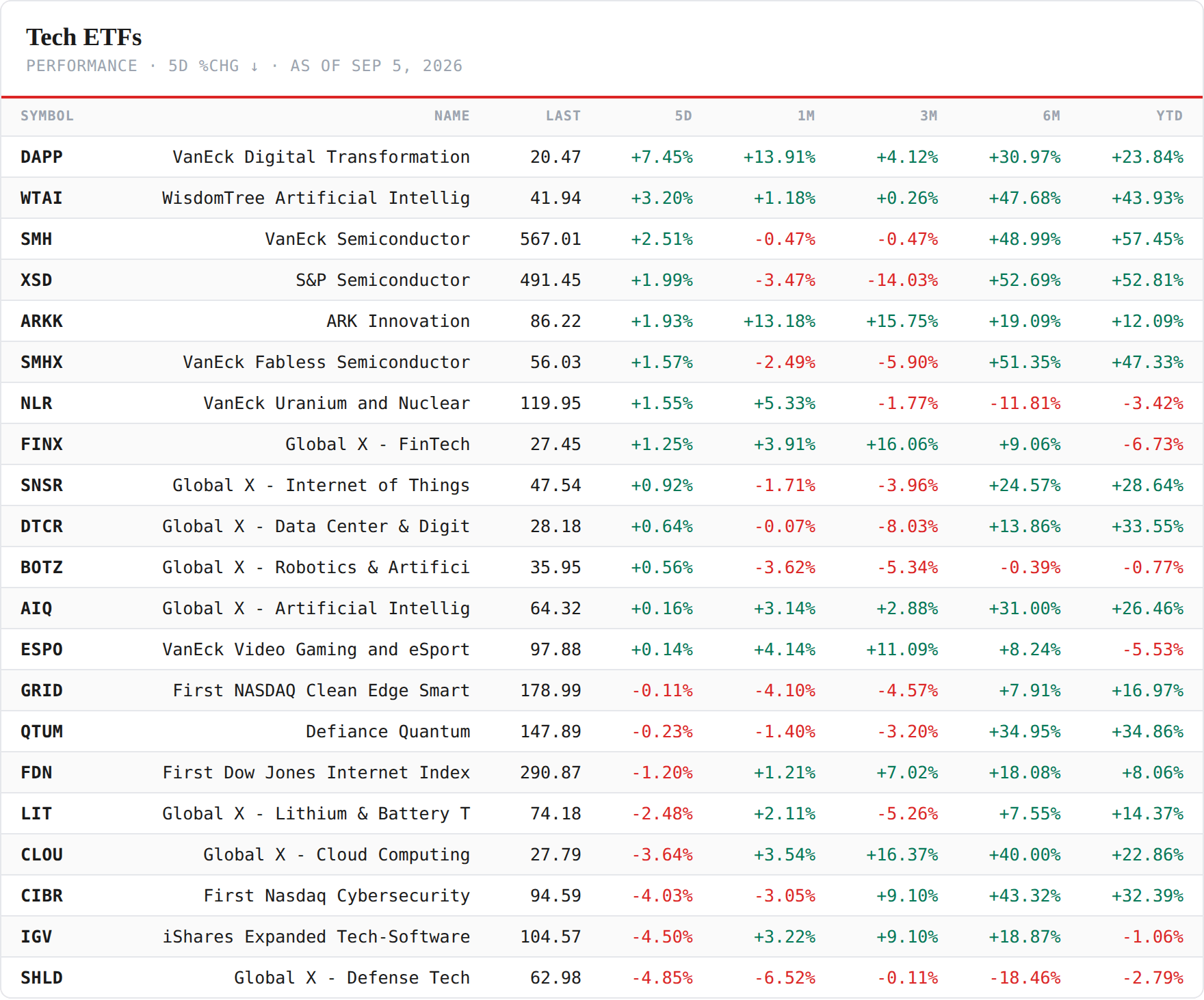
The tech shelf — silicon green, everything else red. Six green lines of twenty-one, five of them chips or the things chips plug into: XSD +2.87%, SMHX +1.18%, the grid fund +1.00%, the internet-of-things fund +0.56%, data centres +0.28%, SMH +0.27%. Fifteen red, led by nuclear −5.61%, fintech −4.74%, lithium −3.63%, ARK −3.06%, software −2.92%, the digital-asset fund −2.69%, cloud −2.37%. Second consecutive week of the inversion, and it narrowed: the semis did not rise much; they did not fall while the index did. The software-to-semis ratio fell 3.18% on the week to 37% above its June 22 low, from 41% — ten percent of the ratio’s rise surrendered in two weeks.
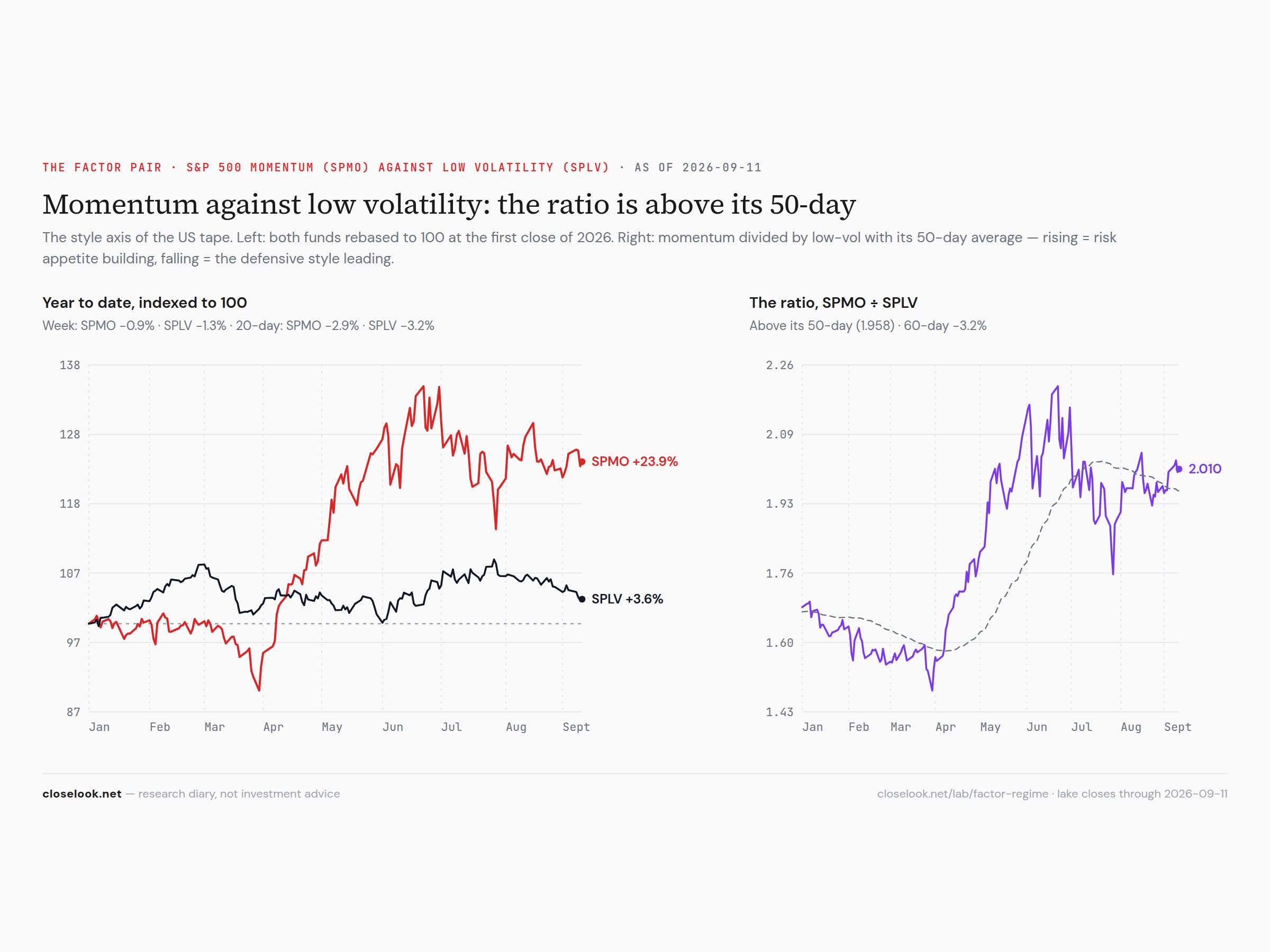
The factor view — both legs down, the label held. The factor-regime gauge kept “momentum leading, risk appetite building” — indexed 159.61 against a 50-day at 155.45, 94.4th percentile — on a week in which SPMO −0.94% and SPLV −1.27% both fell. For this cohort the read is the same as a week ago and matters more into a Fed decision: when the tape sold, it sold the defensive factor harder than the momentum factor. The money that left the software names did not go to low-volatility. It went to a test-equipment maker.
Our own board — the Rotation Ledger, on Friday’s closes, and the receipts. The scanner missed its Friday-night run a third week and this desk triggered it Saturday afternoon, so the tables carry Friday’s closes across 647 stocks. The shares: building flow (accelerating-up plus reversing-up) 36.5% of the universe, from 38.5%; decelerating-up 36.2%, from 34.5% — now the largest bucket outright, and still the long warning; accelerating-down 9.1%, from 8.4%; flat 18.2%.
Softer at the building end, heavier at the draining end, a second week. The receipts, both ways, because that is the contract: the fastest-risers table published here last Sunday — Atlassian, freee, Appier, e.l.f., Duolingo, Elastic, Veeva, Workday, Salesforce, ServiceNow, UiPath, Snowflake — was charged again on price: Atlassian −6.27%, ServiceNow −6.18%, Workday −5.15%, Salesforce −4.44%, Elastic −9.17%, Snowflake −2.43% after its paid window, UiPath the second-worst name in the family.
And the draining table — SanDisk, Kioxia, KLA, Applied Optoelectronics — was right this week: SanDisk −6.13%, Kioxia sold in Tokyo on Thursday, KLA −2.67%, and every one of them sat out Friday’s chip rally. Three weeks in: one lead, one lag, and one split — right on the draining side, wrong on the building side. The instrument reads a 252-day trend of flow; the software names it says are building have now been sold for two weeks by a market pricing a hike. The letter keeps the score it earns.
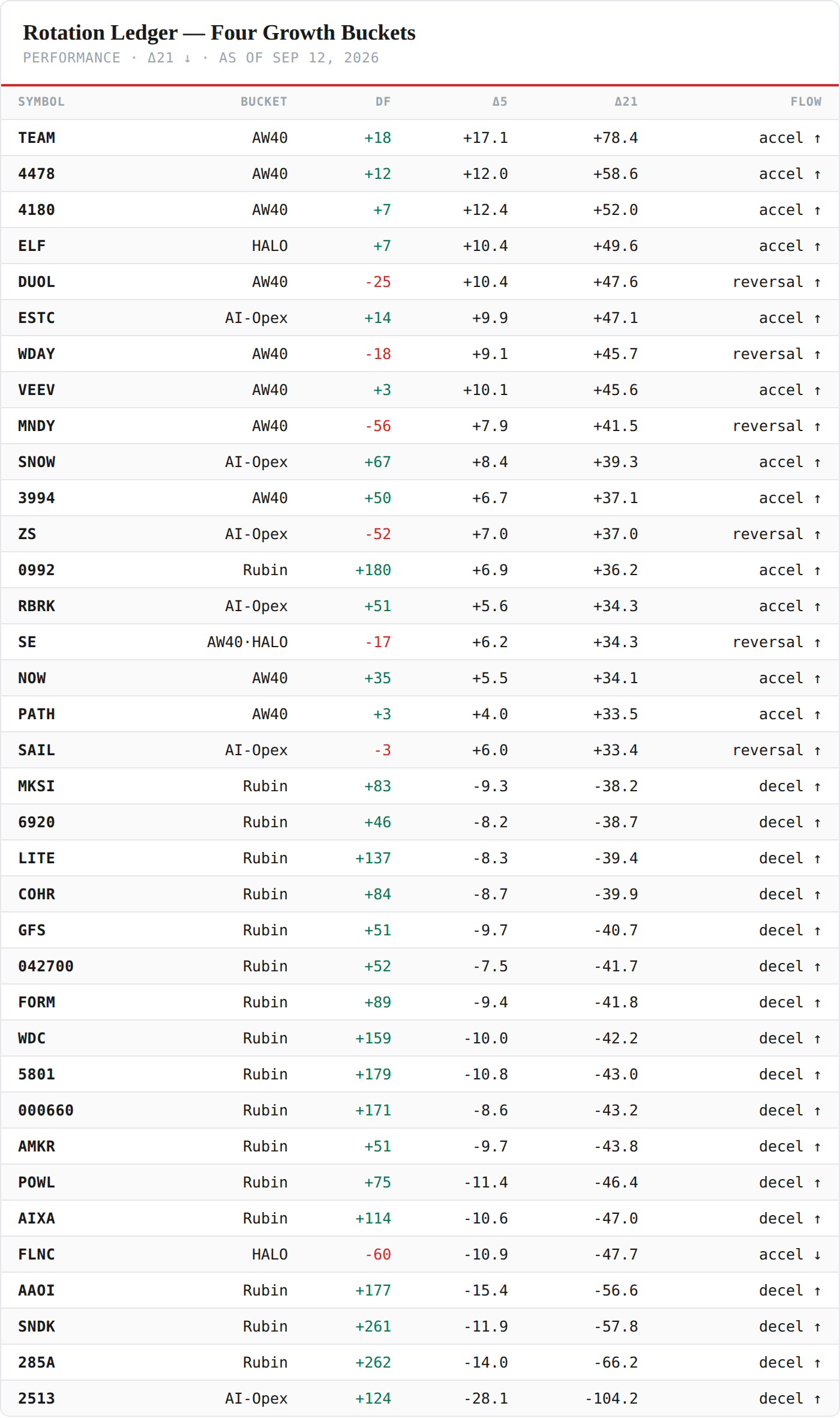
The four stock tables — this letter’s own board, as of Friday 11 September.
The strongest trends, confirmed on the medium term. Dell at 211 (+16.9 on the month), Lenovo 180 (+36.2 — the fastest-building high score on the board), HPE 143 (+18.4, the week after its paid window), Nebius 135 (flat on the month), Astera Labs 129, ams-OSRAM 125, Fortinet 116, Palo Alto 112 (+21.8), Nynomic 107, Datadog 100.
The confirmed board is the assemblers and the firewall pair, a third week running — and this week the assemblers were paid on price too: HPE +19.4% on the tape’s week, Dell +8.2%, Lenovo the book’s line in the sibling book. The exhibit of level-versus-change is unchanged and larger: Kioxia 262 and SanDisk 261 with the deepest monthly drains on the board (−66.2, −57.8), and this week the price agreed with the drain.
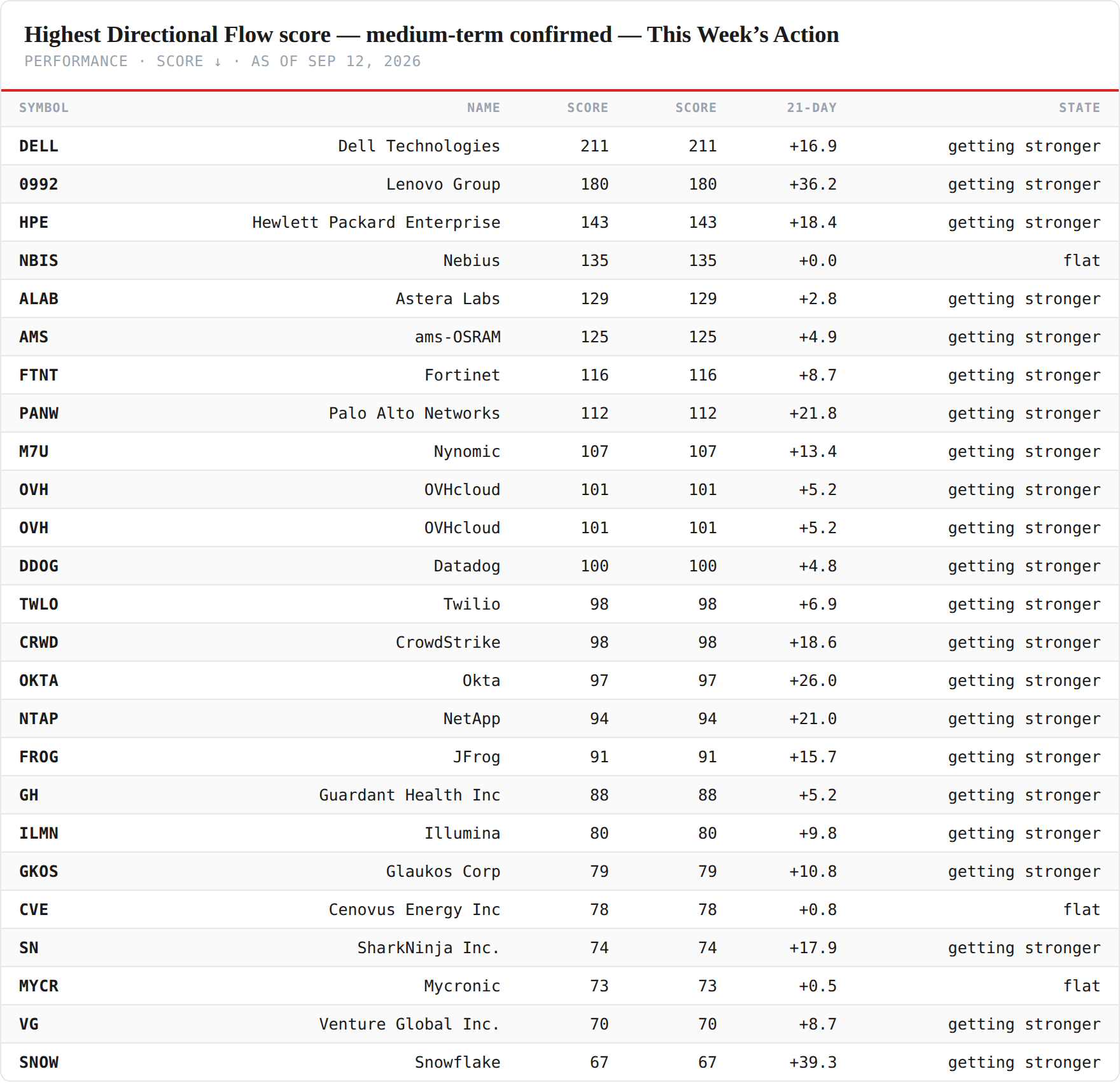
The same list, confirmed on the short term. Dell, Lenovo (+6.9 on five days), HPE, Fortinet, Palo Alto (+2.6), CrowdStrike 98 (+3.6, +18.6 on the month), Okta 97 (+7.0, +26.0), NetApp 94 (+3.5, +21.0 — the storage name the flow does confirm), Twilio 98.
Still the incumbent software layer and the hardware assemblers; still no chip designer and no memory name on it. What the confirmed board does not contain is the week’s best price list — Aehr, Cohu, FormFactor, Coherent — which sit on the draining side at 205, 89 and 84 with monthly changes of −14.8, −41.8 and −39.9. The test bench was paid from a drain, the same way storage was a fortnight ago.
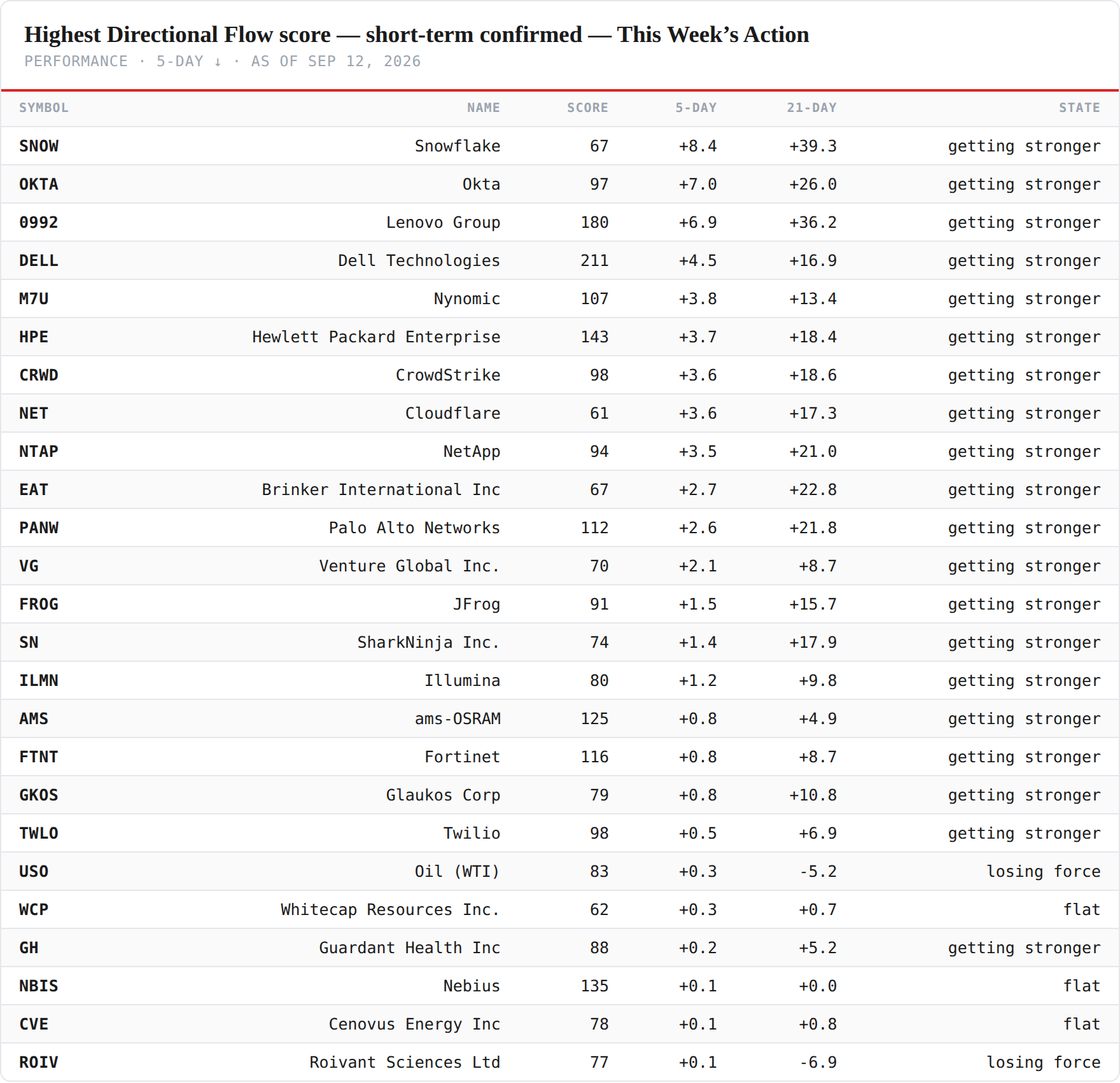
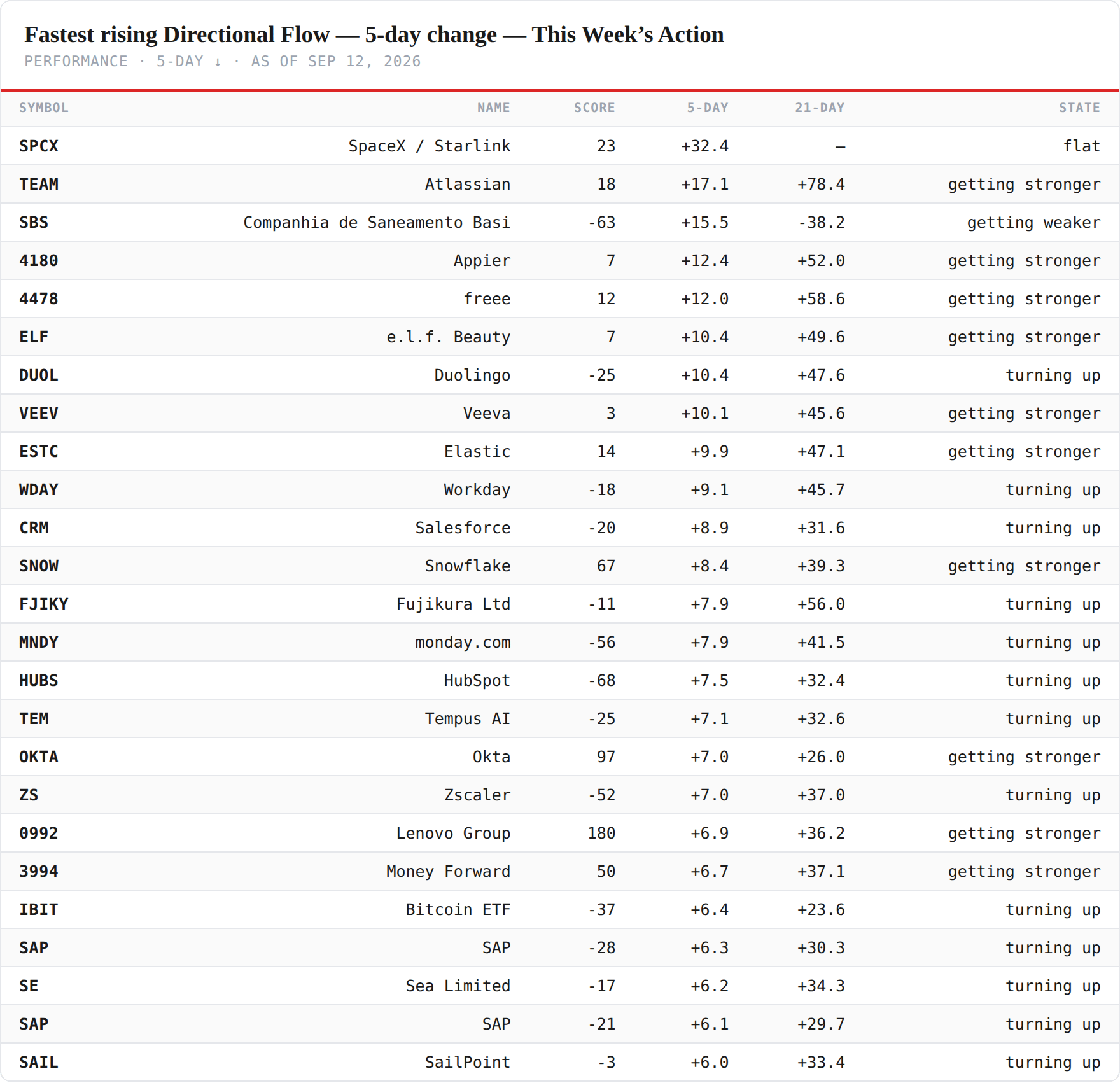
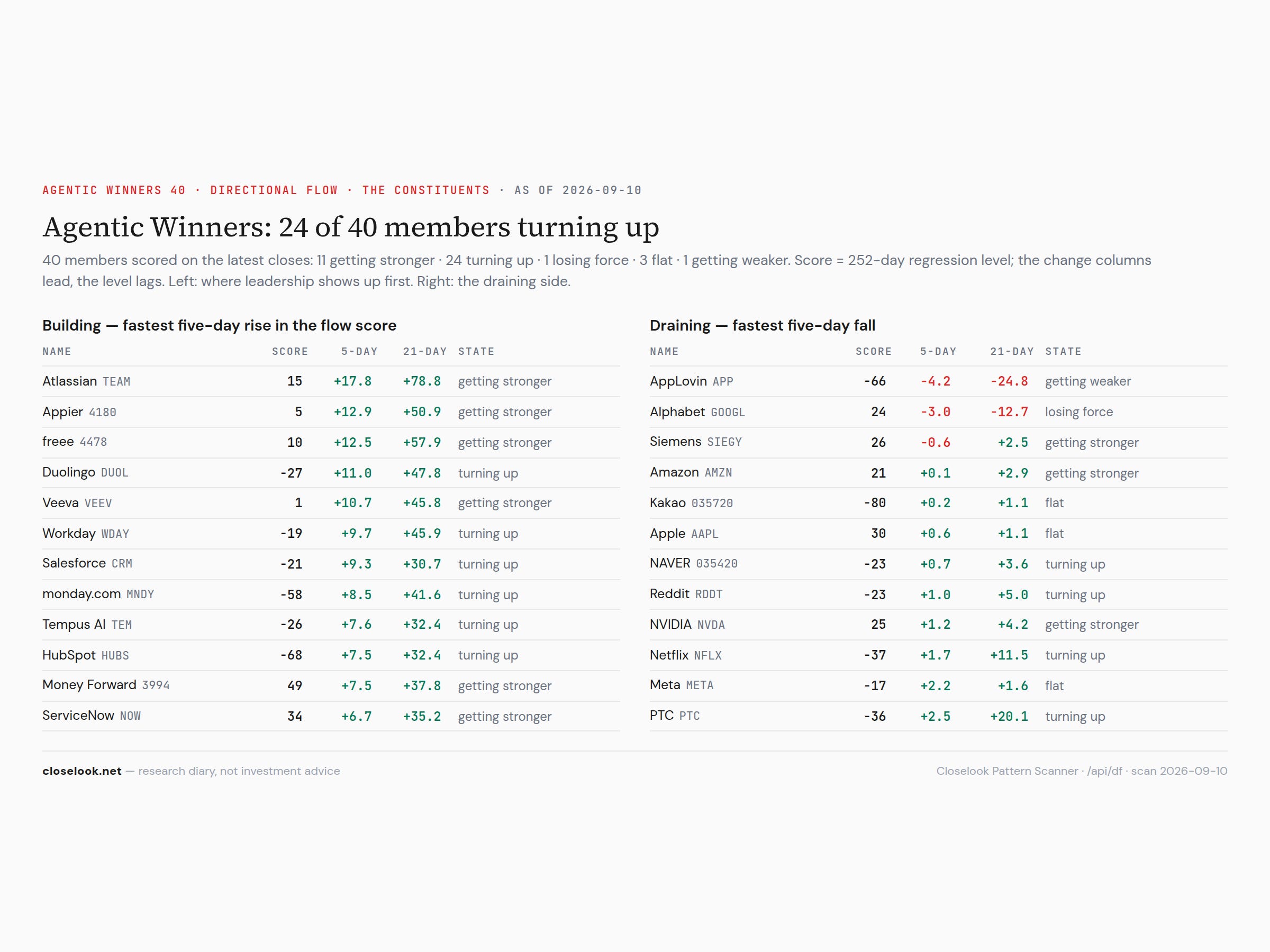
Where new leadership shows up first — the fastest risers. SpaceX +32.4 on five days from a 23 score — a listing too new for a monthly column, and the book’s newest line — then Atlassian +17.1 (+78.4 on the month), Appier +12.4, freee +12.0, e.l.f. +10.4, Duolingo +10.4, Veeva +10.1, Elastic +9.9, Workday +9.1, Salesforce +8.9, Snowflake +8.4 (score 67), Fujikura +7.9.
Software plus consumer, a third week, one rung further along, and one rocket company. The question this table now has to answer is not whether the flow is building — it is — but whether flow that builds for three weeks while the price is sold for two is a leading indicator or a lagging one. The next scan on the far side of the Fed will say.
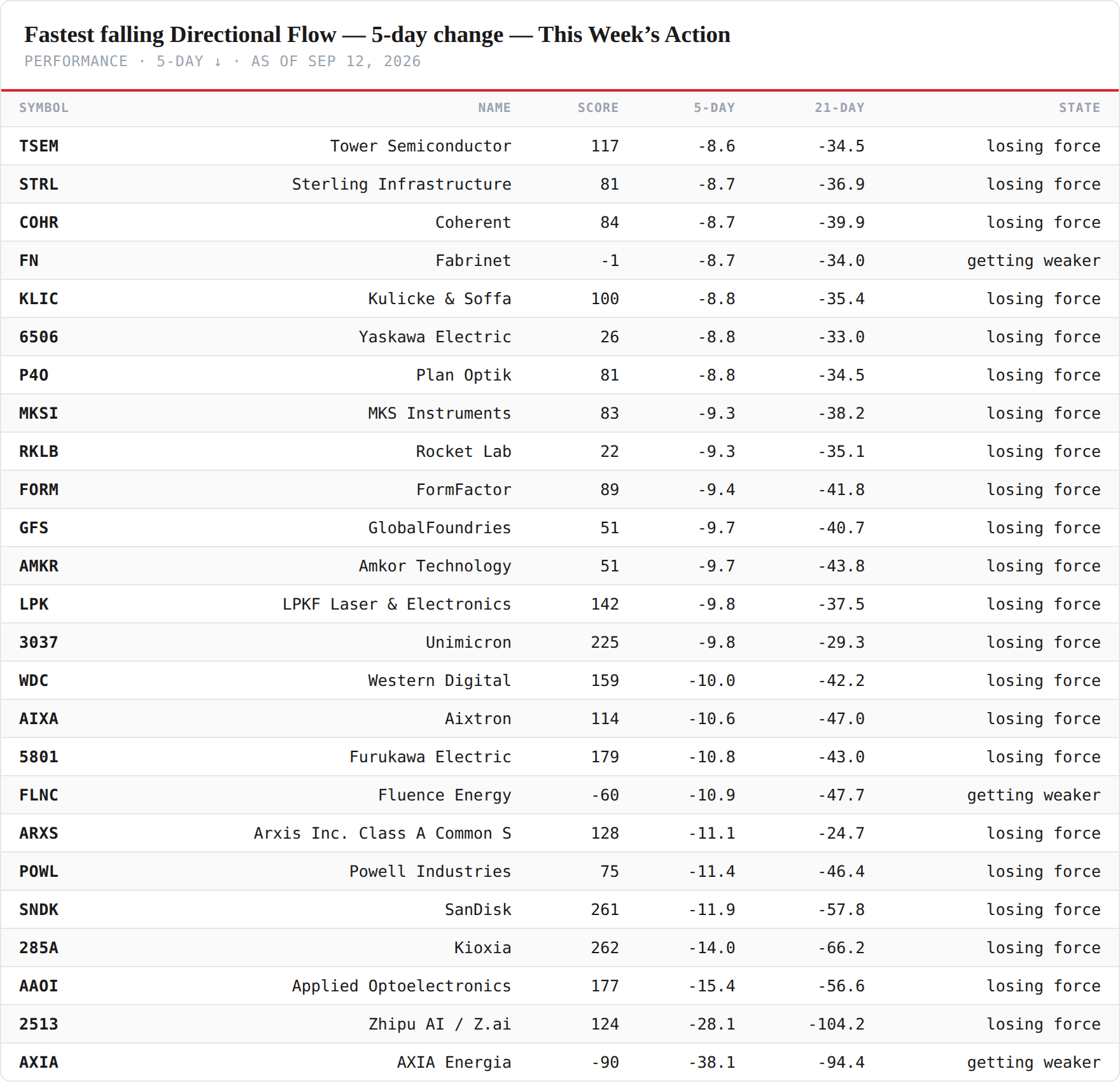
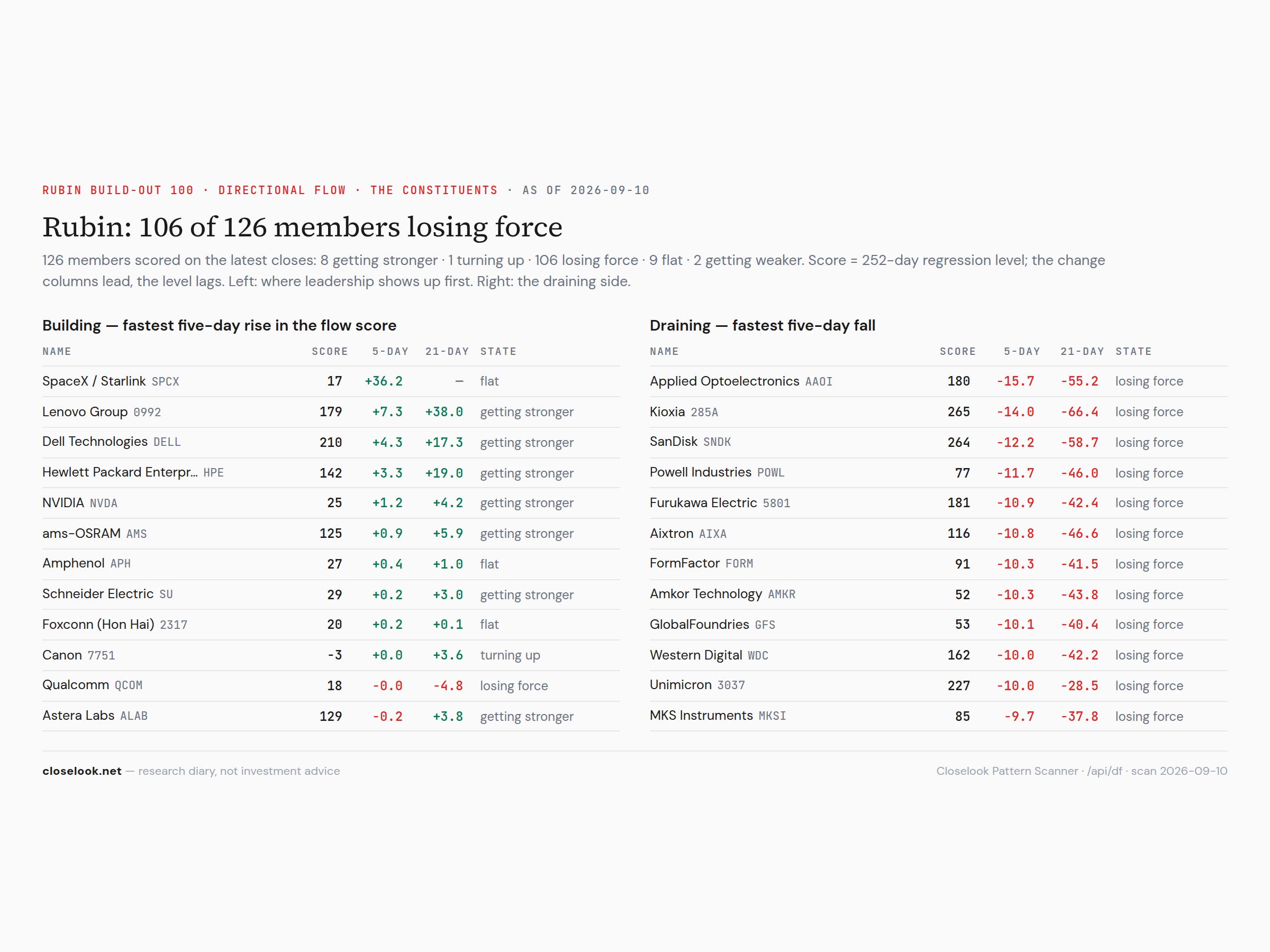
And the draining side. Zhipu −28.1 on five days from a 124 score (−104.2 on the month, the deepest in the universe by a distance), Applied Optoelectronics −15.4 from 177, Kioxia −14.0 from 262, SanDisk −11.9 from 261, Powell Industries −11.4, Furukawa Electric −10.8 from 179, Aixtron −10.6, Western Digital −10.0 from 159, Unimicron −9.8 from 225, GlobalFoundries −9.7.
The memory-and-optics complex, five weeks running, and this week the drain was paid in full: SanDisk the worst chip on Friday, Western Digital −4.3% on the week, the Japanese optics and materials names the worst lines in the build-out. Read against the price, the table did what it is built to do: it named the names that did not participate in the bounce.
2 · The State
The four buckets, briefly. New readers: we cut the growth trade into functional indices rather than sectors — capex (Rubin Build-Out, what gets built), opex (Agentic Ecosystem, what it costs to run), applications (Agentic Winners, what gets sold on top), and HALO as the control group carrying no AI thesis.
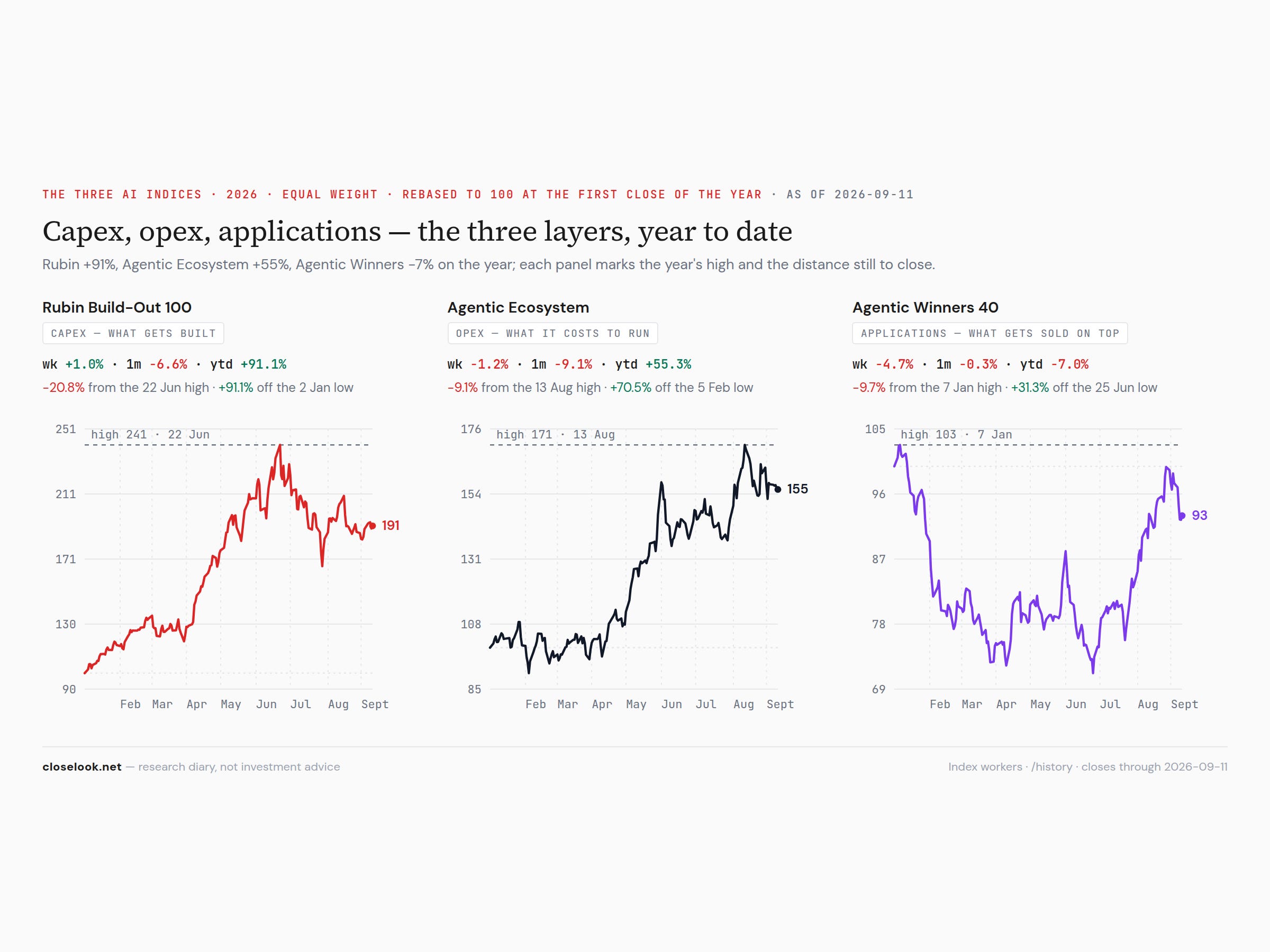
The week’s ladder: capex +1.04%, opex −1.17%, applications −4.71%; the control group −3.54%. On the year: capex +91.1%, opex +55.3%, applications −7.0% — from −2.4% a week ago; the control group +0.3%, one ordinary session from red. Euro-AI −2.79%. The physical layer is the only green line for a second week, and the margin widened from forty basis points to five points. The no-AI control group fell with the applications, which makes this a duration week rather than an AI week — everything priced on 2027 earnings was marked down by a five-year yield that rose 24 basis points in four sessions; the one layer priced on this year’s shipments rose. That is all this letter says about HALO this week.
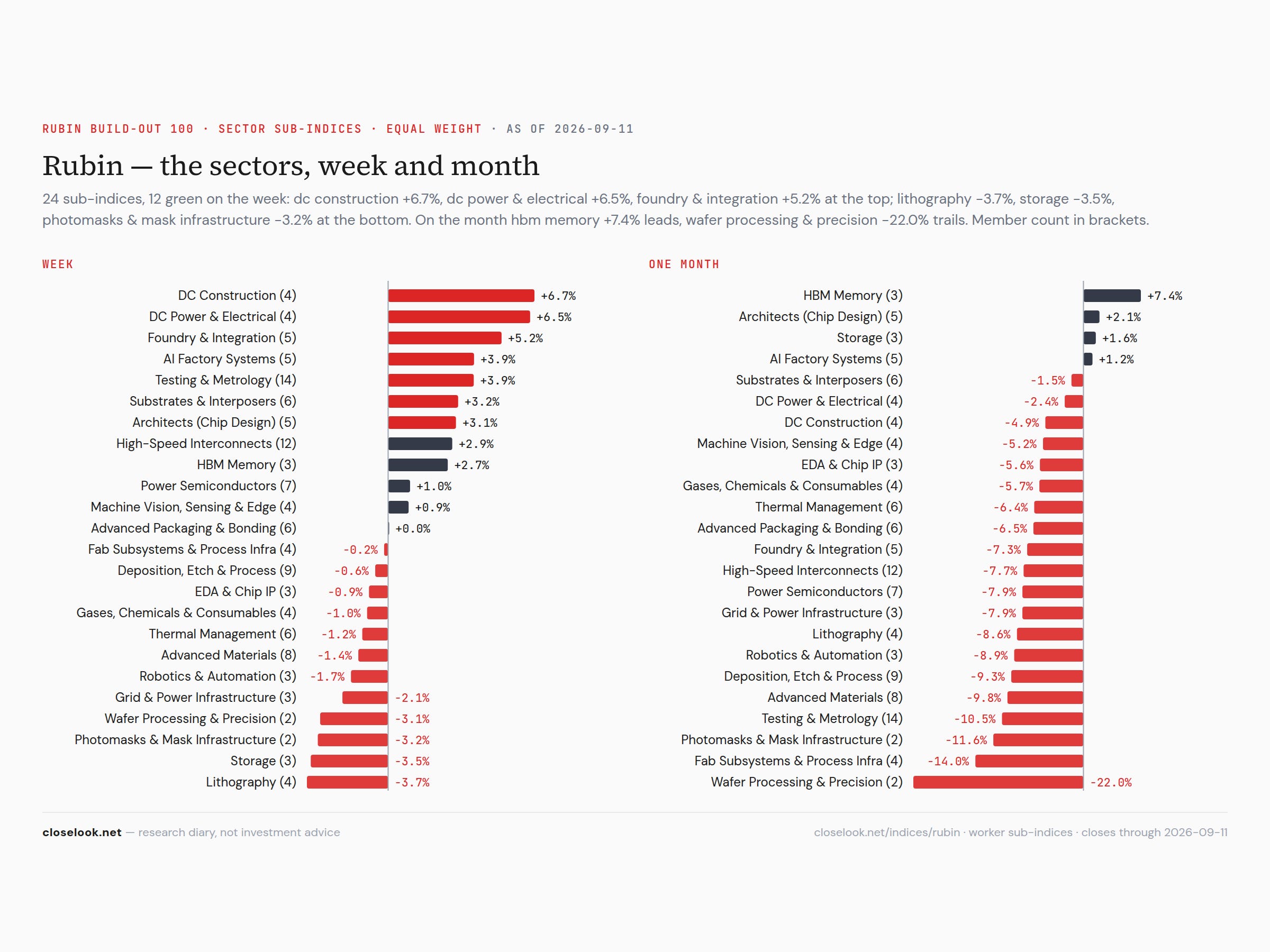
The scorecards — strongest and weakest sleeves, per index, on the week and on the year. Rubin Build-Out, the week (20 of 36 green): strongest DC construction +6.7%, DC power & electrical +6.5%, foundry & integration +5.2%, AI factory systems +3.9%, testing & metrology +3.9%; weakest lithography −3.7%, storage −3.5%, photomasks −3.2%, wafer processing −3.1%, grid & power infrastructure −2.1%. Rubin, the year: strongest storage +341%, substrates & interposers +196%, HBM memory +181%, AI factory systems +132%, advanced materials +128%; weakest photomasks −4.0%, wafer processing +8.4%, robotics & automation +10.9%, thermal management +26.6%, gases & consumables +29.3%.
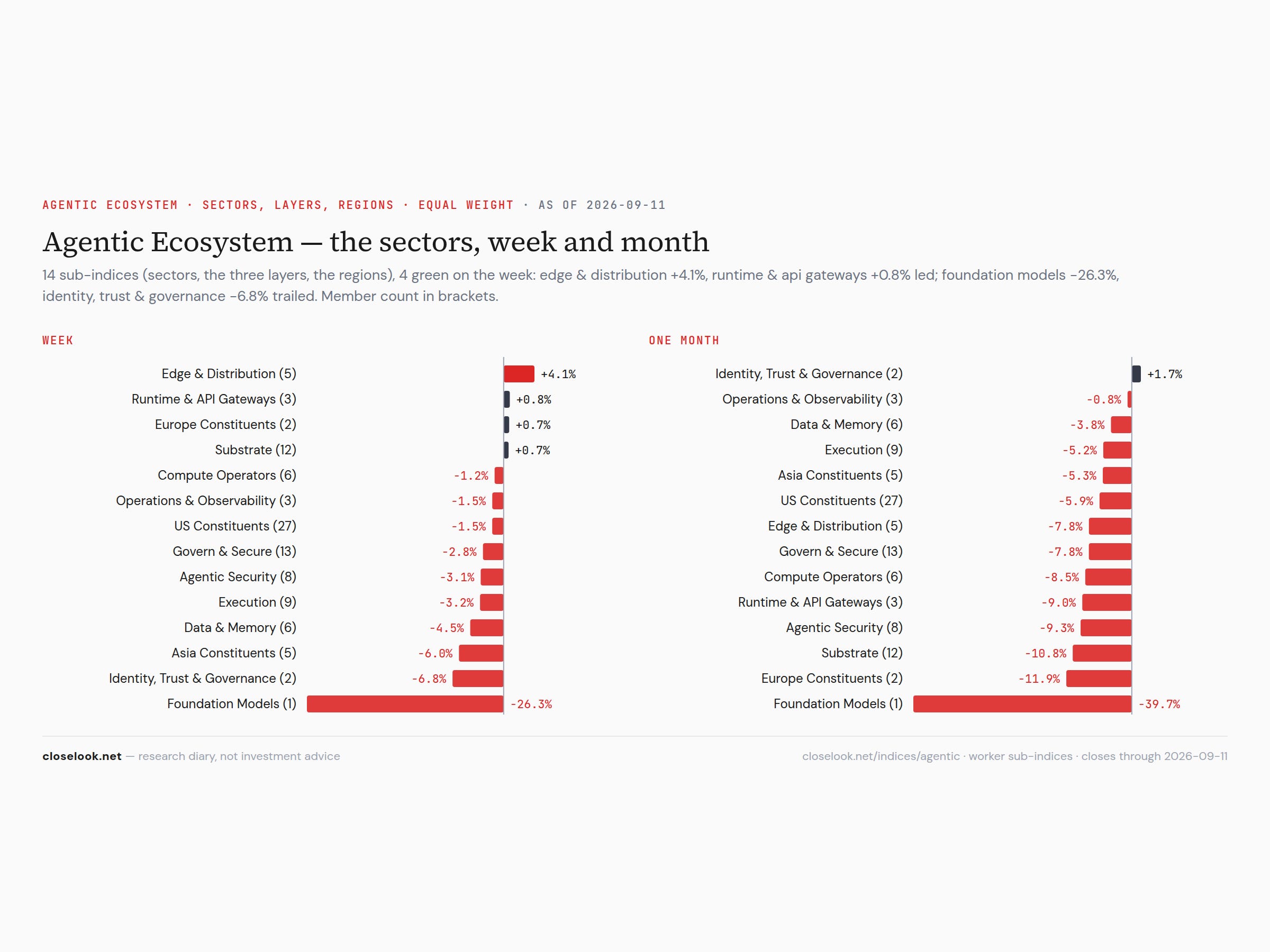
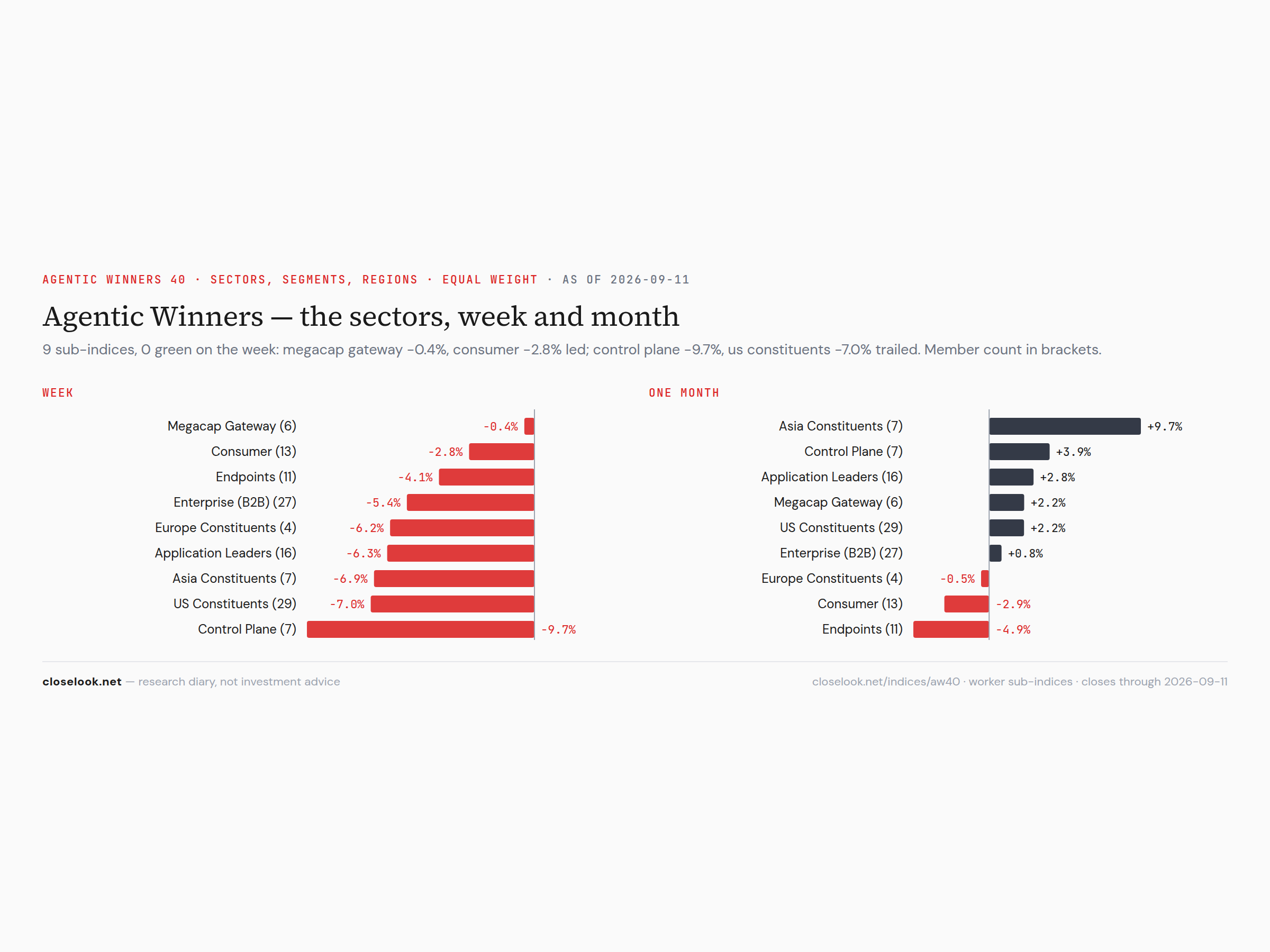
Rubin, the month: HBM memory +7.4% the only sleeve up more than three percent; wafer processing −22.0%, fab subsystems −14.0%, photomasks −11.6% the bottom — the build-out is green on the week because its power and construction names were bid, and red on the month almost everywhere. Agentic Ecosystem, the week (4 of 14 green): strongest edge & distribution +4.1%, runtime & API gateways +0.8%, the European constituents +0.7%, the substrate sleeve +0.7%; weakest foundation models −26.3% (one name, Zhipu), identity & governance −6.8%, the Asian constituents −6.0%, data & memory −4.5%, execution −3.2%. Ecosystem, the year: strongest foundation models +499%, the European constituents +137%, runtime & API gateways +136%, execution +71%, edge & distribution +67%; weakest data & memory +30.7%, the Asian constituents +32.3%, agentic security +38.1%, identity & governance +40.0%, govern & secure +42.0%. Agentic Winners, the week (0 of 9 green): strongest — none green — megacap gateway −0.4%, consumer −2.8%, endpoints −4.1%; weakest control plane −9.7%, the US constituents −7.0%, the Asian constituents −6.9%, application leaders −6.3%, the European constituents −6.2%.
Winners, the year: the megacap gateway +11.6% is the only green sleeve; enterprise −4.6%, application leaders −7.7%, control plane −9.0%, consumer −13.0%, endpoints −17.0% the worst. Read the three top to bottom: on the week, the strongest sleeve in every index is the one nearest the physical stack or nearest the consumer’s phone, the weakest is enterprise software; on the year, the strongest are memory, substrates and the model layer, the weakest are the consumer applications and the tools that were the spring’s leaders.
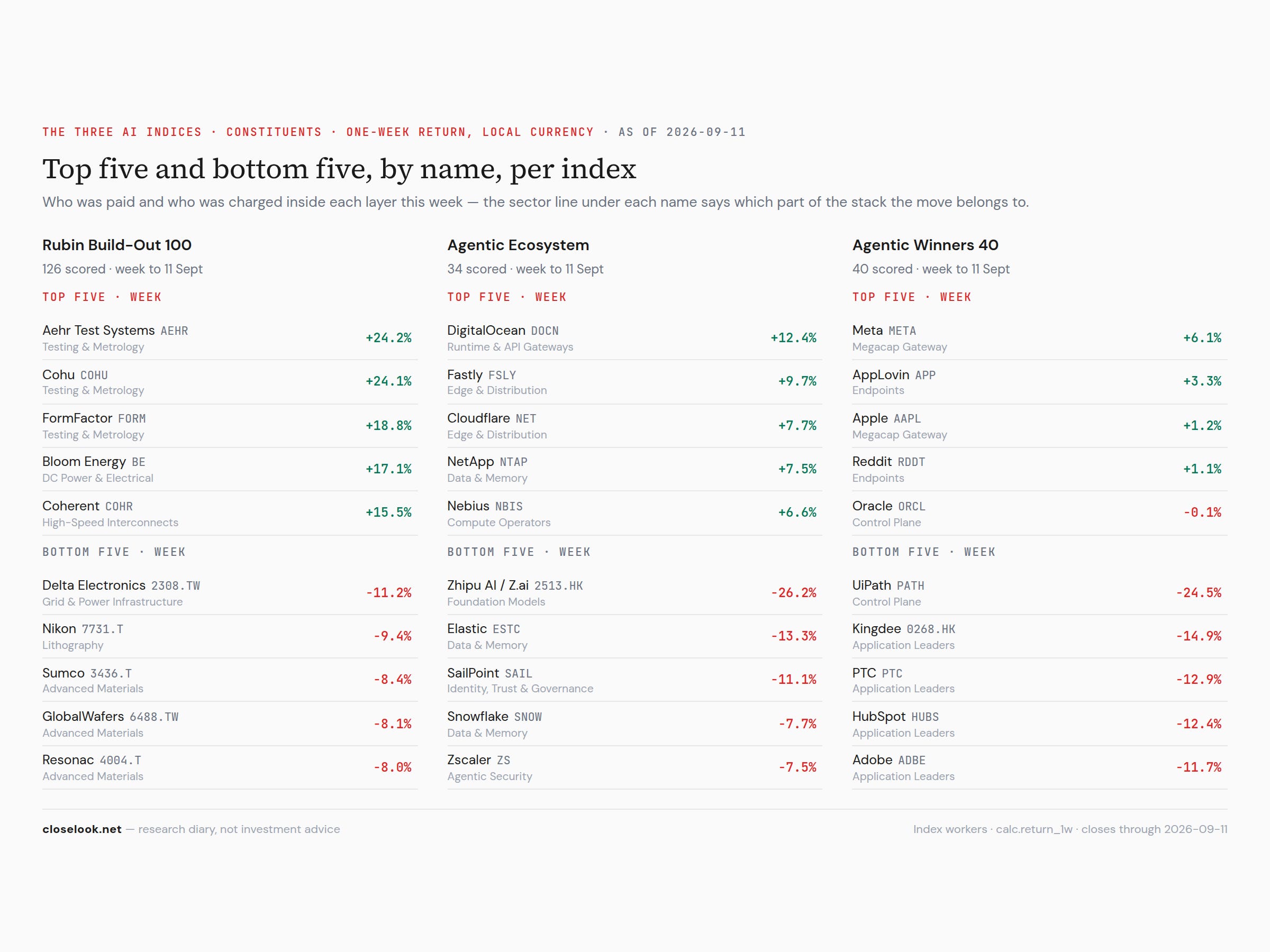
The best and worst stocks, per index — from the best sleeves and from the whole list. Inside Rubin: the best five are Aehr Test +24.2%, Cohu +24.1%, FormFactor +18.8% — three test-equipment names from the testing & metrology sleeve — Bloom Energy +17.1% from DC power, Coherent +15.5% from interconnects; then HPE, Corning, Nokia, AMD, Marvell, Intel, Teradyne. The worst five are Japanese and Taiwanese equipment and materials: Delta Electronics −11.2%, Nikon −9.4%, Sumco −8.4%, GlobalWafers −8.1%, Resonac −8.0%, then Toppan, Yaskawa, Canon, Cadence, Horiba, Hamamatsu, Disco. The build-out’s week was American test and power up, Japanese lithography and wafers down. Inside the Ecosystem: best DigitalOcean +12.4%, Fastly +9.7%, Cloudflare +7.7%, NetApp +7.5%, Nebius +6.6% — the edge sleeve and the operators on the tracker’s window — then IREN, CoreWeave, Datadog; worst Zhipu −26.2%, Elastic −13.3%, SailPoint −11.1%, Snowflake −7.7%, Zscaler −7.5%, then Rubrik, MongoDB, Twilio, Kingsoft Cloud, CrowdStrike. Inside the Winners: best Meta +6.1%, AppLovin +3.3%, Apple +1.2%, Reddit +1.1%, Oracle −0.1% — the gateway and the consumer sleeve, and only two of forty names up more than two percent; worst UiPath −24.5%, Kingdee −14.9%, PTC −12.9%, HubSpot −12.4%, Adobe −11.7%, then Shopify, Money Forward, Dassault, Workday, Duolingo, ServiceNow.
Three indices, one signature for a second week: the names that sell a physical thing or run a physical network were paid; the names that sell a seat were charged. And one detail for the flow ledger: the Ecosystem’s best five on price — DigitalOcean, Fastly, Cloudflare — are on the draining side of the flow tables, while its worst five — Elastic, SailPoint, Snowflake, Zscaler — are on the building side. The opex layer’s flow and its price have swapped places.
The floors, scored — the incumbent floor was sold, the challenger floor sat still. The incumbent floor: the names whose takeout-value argument this letter has carried — Workday −5.15%, ServiceNow −6.18%, Salesforce −4.44%, Atlassian −6.27% on the tape’s week — were sold together, with the flow still building under every one of them (Workday +45.7 on the month, Atlassian +78.4). Oracle beat every line, rose 4.3% after hours and gave it all back by Friday; Adobe beat and guided a shade under; both score Tuesday inside their bands. The floor’s argument has not changed; the market’s willingness to pay for it has, for two weeks. The challenger floor: Nebius −0.81%, CoreWeave −0.41%, IREN −1.90% on the tape, the compute-operators sub-index −1.21%, operators-against-suppliers −2.23% after +3.26%. Last week’s first green week in four did not get a second — but the operators were not sold either, in the week the five-year did what it did. Flat, in a duration week, for the most rate-sensitive sleeve of the stack, is its own kind of information.
The buckets against their highs. Applications closed 9.7% below the January record — from 5.3% a week ago; the gap doubled in four sessions — still +31% off the June 25 low. Opex sits 9.1% below its August 13 high, from 8.1%, 2.2% off its September 2 low. The build-out is 20.8% below June, from 22.0%, +15.0% off its July 29 low — and for a second week it is the only layer whose distance to its high shrank. The spring pattern — the index that bottoms first leads — has now failed for two weeks in the layer that bottomed first, and the layer that bottomed last led both.
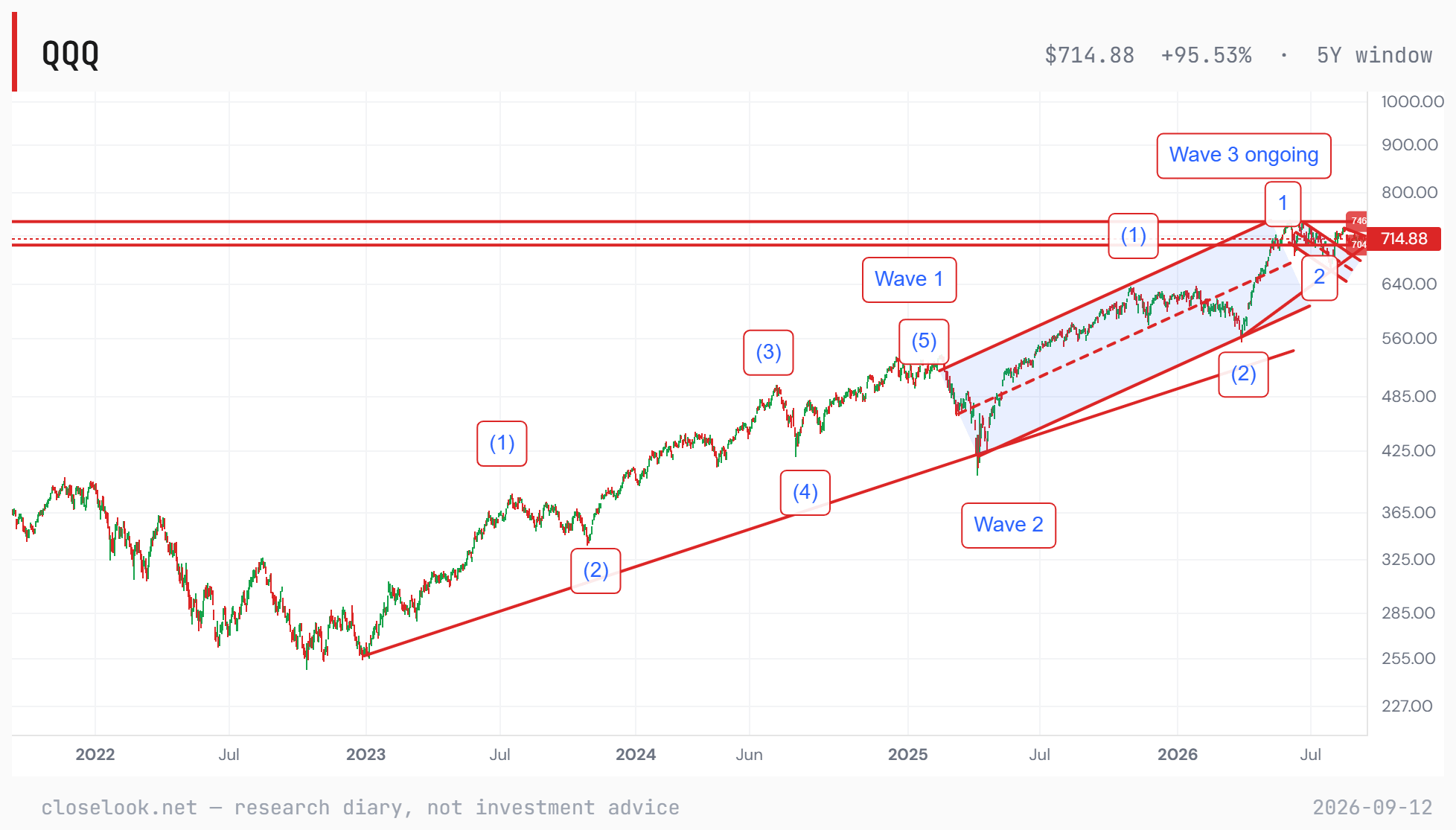
The structural read — the count, from the US letter, as the gate. QQQ closed 714.88, 0.6% above the 50-day after one close under it on Thursday; 746.16 confirms, 694 voids, neither traded; Thursday’s 708.69 was the closest approach to the 704 shelf since the average was reclaimed. The count is unchanged — 1-2 off the April low, wave 3 ongoing — and the range is narrowing under the descending line from the mid-August high into a dated catalyst.
The house read, in Thomas’s words: the sideways movement will soon resolve into a bigger move, up or down; the catalyst may be Wednesday; October is the month that usually settles a late-summer consolidation one way or the other. For this cohort the corollary matters: if it resolves up, the first candidate to lead is the leader of the spring — the chips, already four points ahead of the market from under their average — and inside the chips, the names on this letter’s paid list, not its memory names.
3 · The AI Board — the stack, instrument by instrument
Why this section exists. The Hypergrowth letter carries the site’s AI instruments on one board — the three indices, their sectors and names, the flow behind them, the physical gauges of the build-out, demand, order flow and credit. Every panel is a house instrument, read from its own data, one paragraph each.
The three indices, year to date. Capex +91%, opex +55%, applications −7% — and the distances to the highs: the build-out 20.8% under June and closing the gap, the opex layer 9.1% under August and widening it, the applications 9.7% under January and widening it fastest.
Rubin — the sectors. Twenty of thirty-six green: DC construction +6.7%, DC power +6.5%, foundry +5.2%, AI factory systems and testing & metrology +3.9% at the top; lithography −3.7%, storage −3.5%, photomasks −3.2%, wafer processing −3.1% at the bottom. On the month HBM memory +7.4% is the only sleeve up more than three percent; wafer processing −22.0% trails everything.
Agentic Ecosystem — the sectors. Four green of fourteen — edge & distribution +4.1% the best line, runtime gateways, Europe and the substrate sleeve under a percent — and the bottom is governance and Asia: identity −6.8%, the Asian constituents −6.0%, data & memory −4.5%, with the single foundation-model name −26.3%. The opex layer bought its network edge and sold its trust layer.
Agentic Winners — the sectors. Nothing green: the megacap gateway −0.4% the best, consumer −2.8%, endpoints −4.1%, enterprise −5.4%, the application leaders −6.3%, the US constituents −7.0%, and the control plane −9.7% — the worst multi-name sleeve in the four-family system for the second week the governance thesis has been sold.
Top five winners and losers, by name, per index. The capex list is test and power (Aehr, Cohu, FormFactor, Bloom, Coherent) against Japanese equipment and wafers (Delta Electronics, Nikon, Sumco, GlobalWafers, Resonac); the opex list is the edge (DigitalOcean, Fastly, Cloudflare, NetApp, Nebius) against enterprise data and security (Zhipu, Elastic, SailPoint, Snowflake, Zscaler); the applications list is the gateway and the consumer (Meta, AppLovin, Apple, Reddit, Oracle) against the seat-sellers (UiPath, Kingdee, PTC, HubSpot, Adobe). Three indices, one signature: the physical names and the gateways were paid, the seat-based software was charged.
Directional Flow — Rubin. 106 of 126 members are losing force — the largest decelerating-up cohort of any index for a second week — and the storage and optics names lead the draining side (Kioxia −66, SanDisk −58, Applied Optoelectronics −57 on the month) in the week their prices finally followed the flow down. Lenovo, HPE and Dell lead the building side: the assemblers, and this week they were paid.
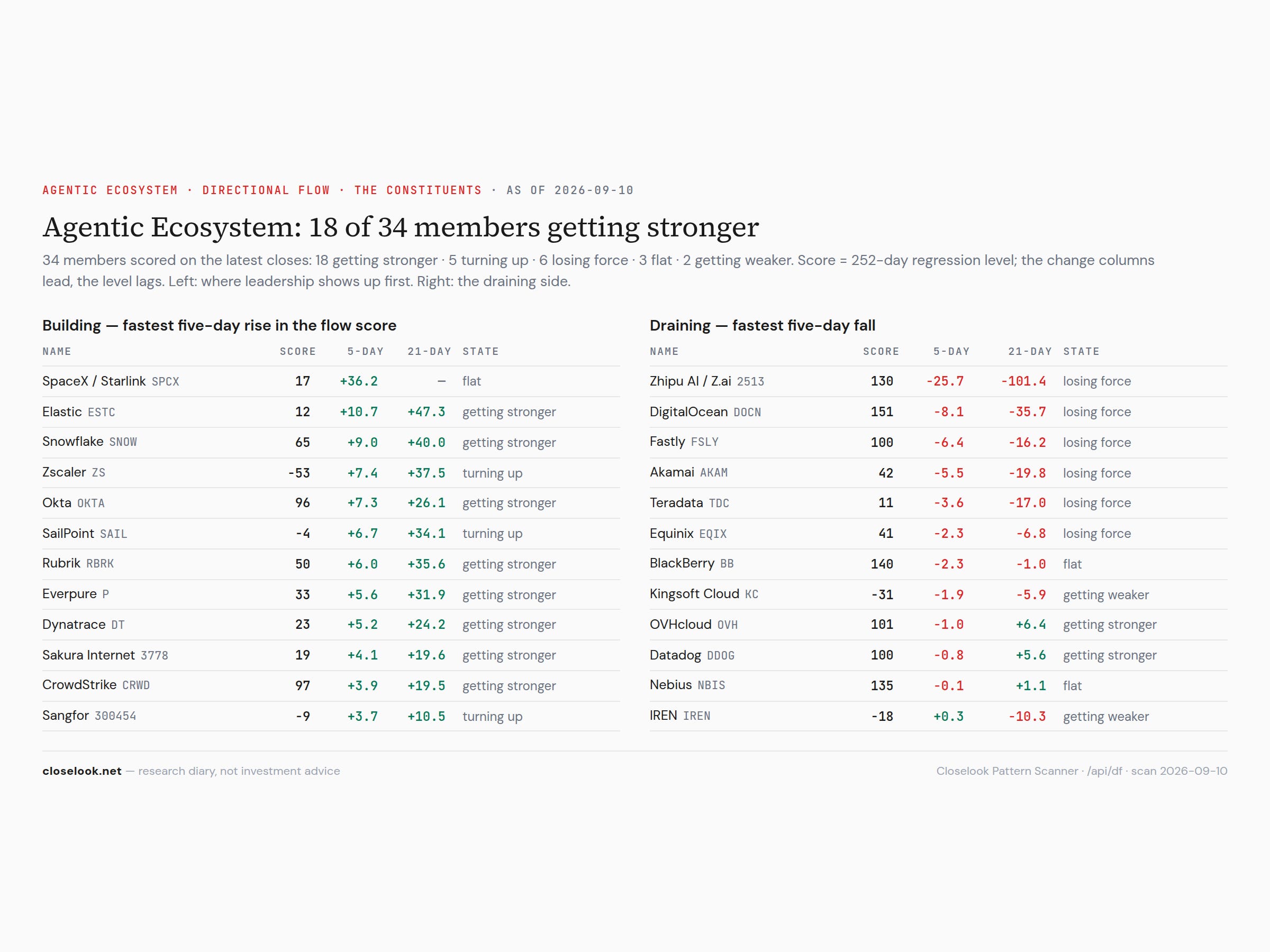
Directional Flow — Agentic Ecosystem. 18 of 34 members are getting stronger and five more are turning up — the broadest building cohort on the board by share — and the names building are the names charged this week: Elastic (+47 on the month), Snowflake, Zscaler, Rubrik, SailPoint. The names paid this week — DigitalOcean, Fastly — are draining. The layer’s flow and its price disagree in both directions.
Directional Flow — Agentic Winners. 36 of 40 members are building — 24 turning up, 12 getting stronger — with Atlassian (+78 on the month), freee, Appier, Duolingo and Workday the fastest, all from low or negative scores, and all sold on price for a second week. The draining side is two names: AppLovin and Alphabet.
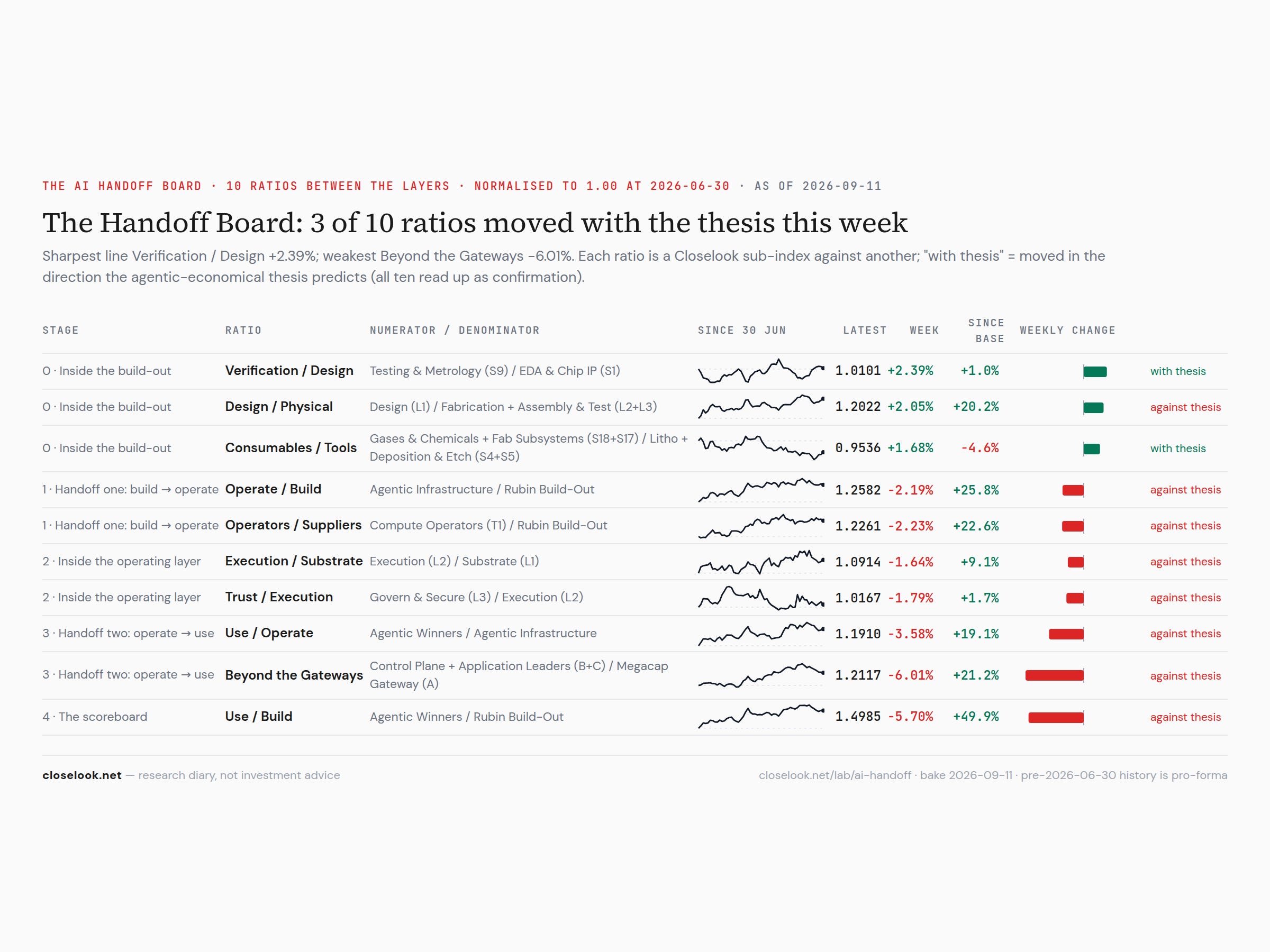
The Handoff Board. Ten ratios between the layers: the applications gave back against everything — use-against-build −5.7%, beyond-gateways −6.0%, use-against-operate −3.6% — the operators turned back against their suppliers (−2.2% after +3.3%), and the three ratios that rose are all inside the build-out: verification against design +2.4%, design against physical +2.1%, consumables against tools +1.7%. The parts of the stack that sell into this quarter’s volume re-rated against the parts that sell into next year’s capacity.
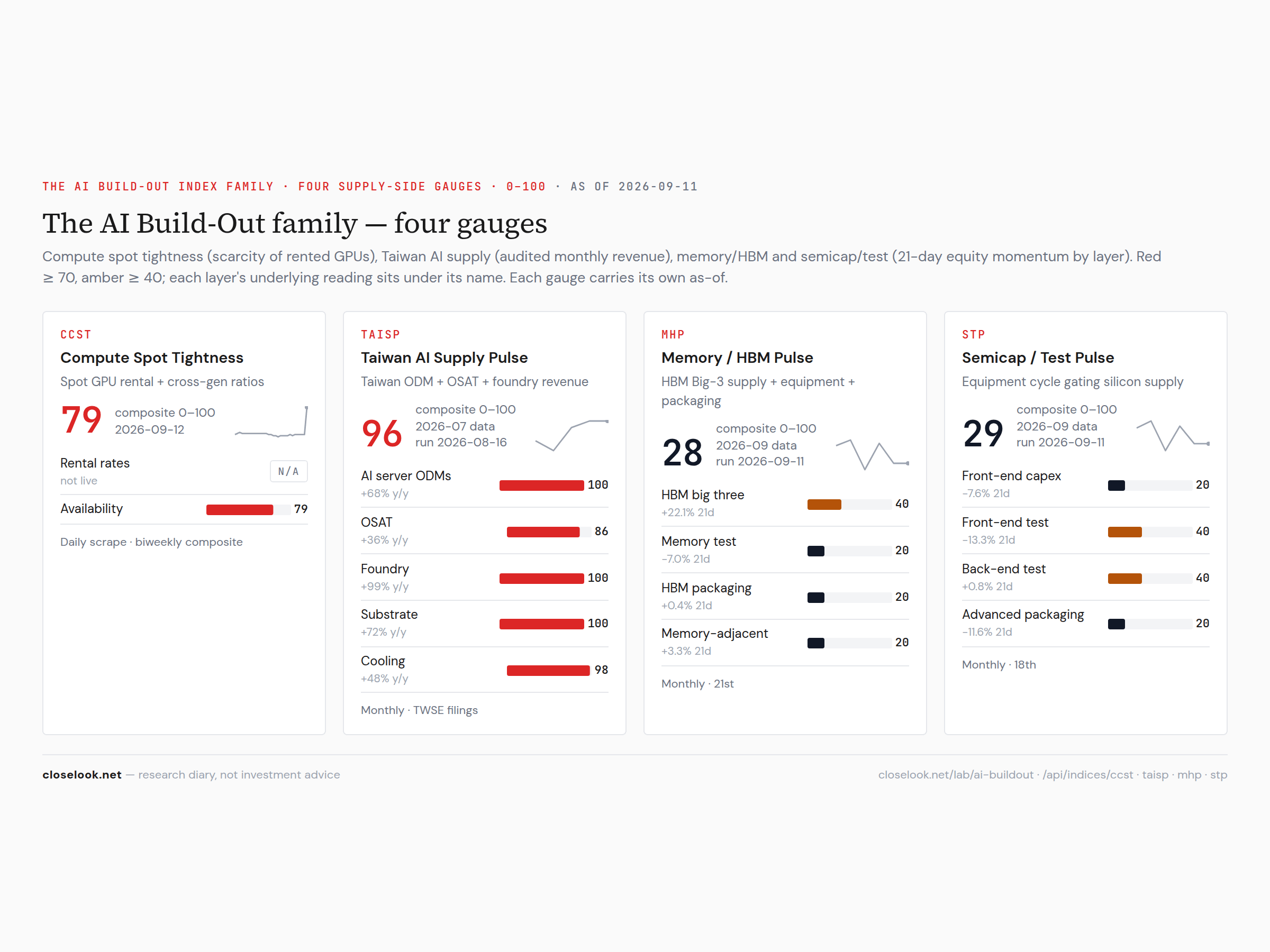
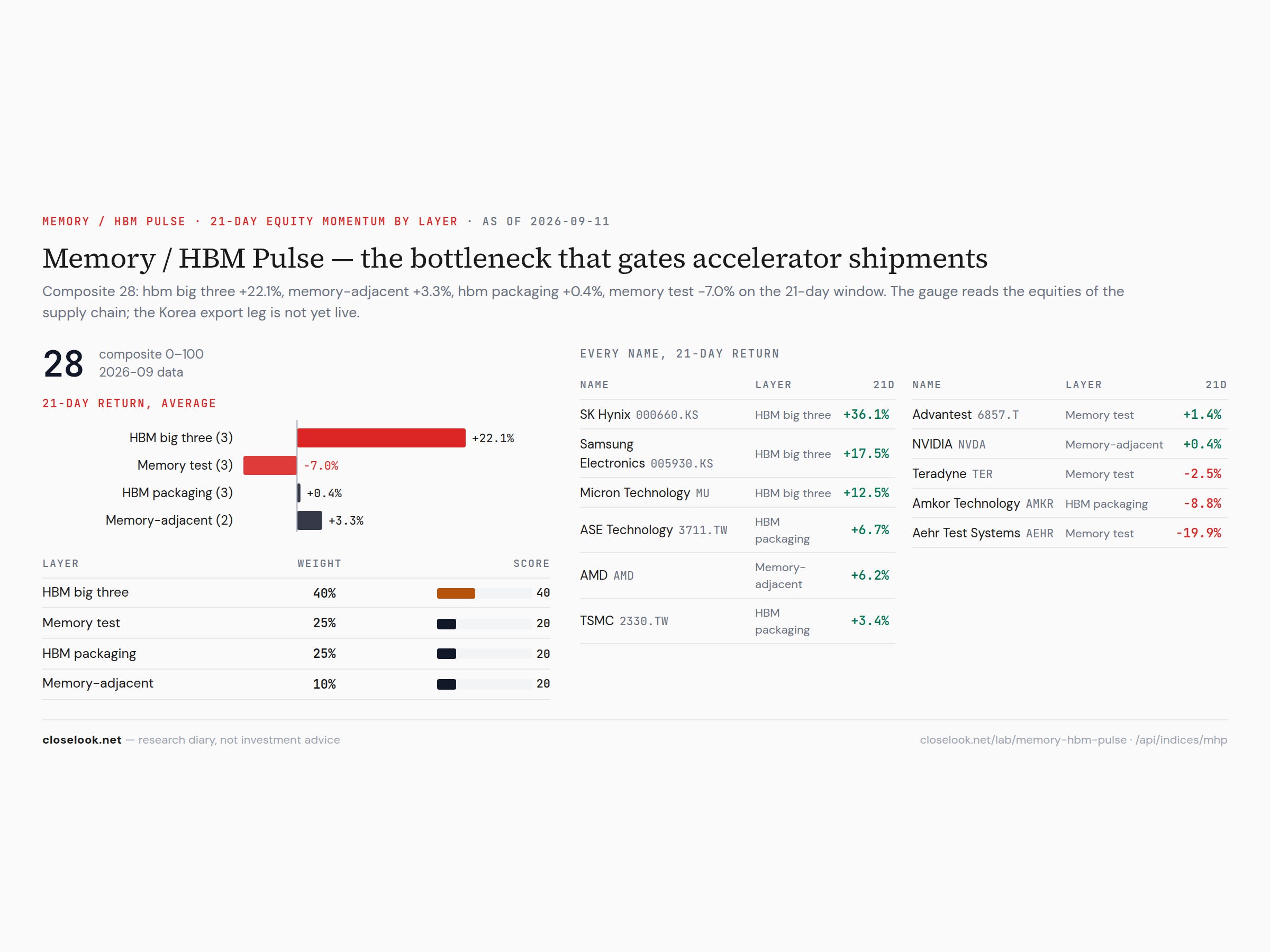
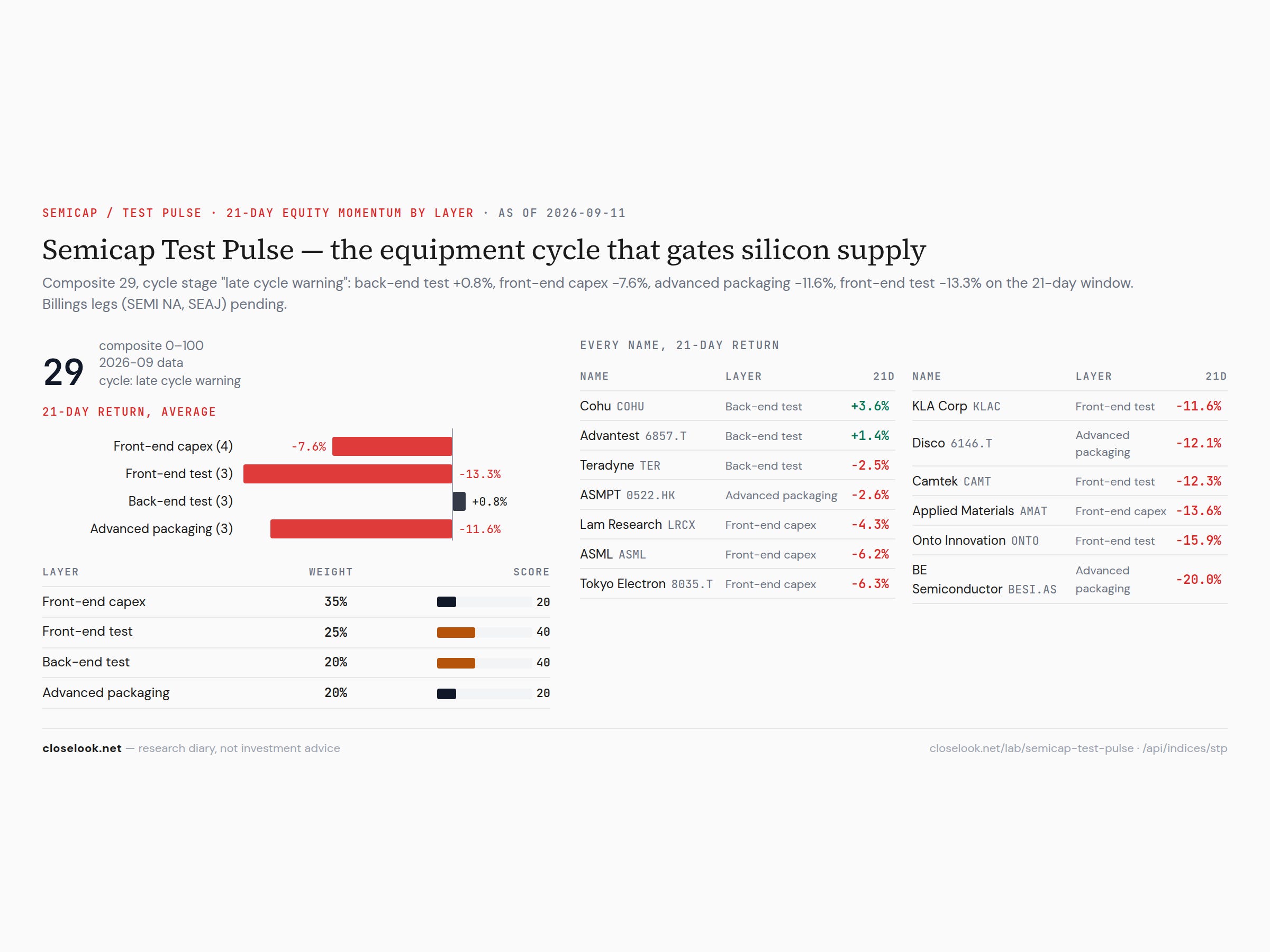
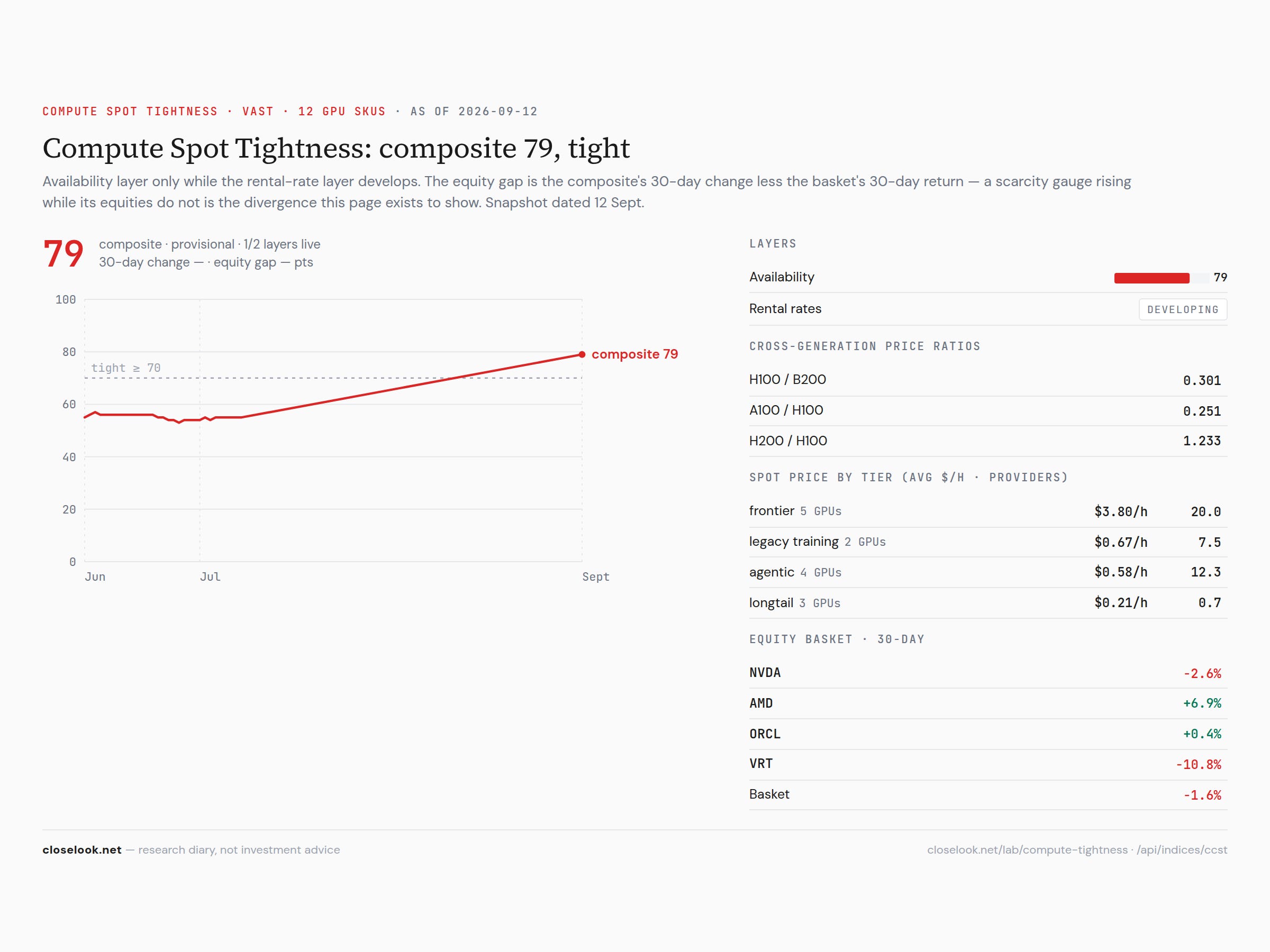
The AI Build-Out family — four gauges. Compute spot tightness 79, from 90 — the availability layer only, twelve GPUs, the rental layer still developing; Taiwan AI supply 96 on July’s revenue (foundry +99% and ODM +68% year over year, the August print due mid-month); memory/HBM 28 — the big three +22% on the 21-day window with SK hynix +36% carrying it, memory test −7%, packaging flat; semicap test 29 — front-end test −13%, packaging −12%, front-end capex −8%, and back-end test +1% the one green layer, which is the layer the model books bought a week ago.
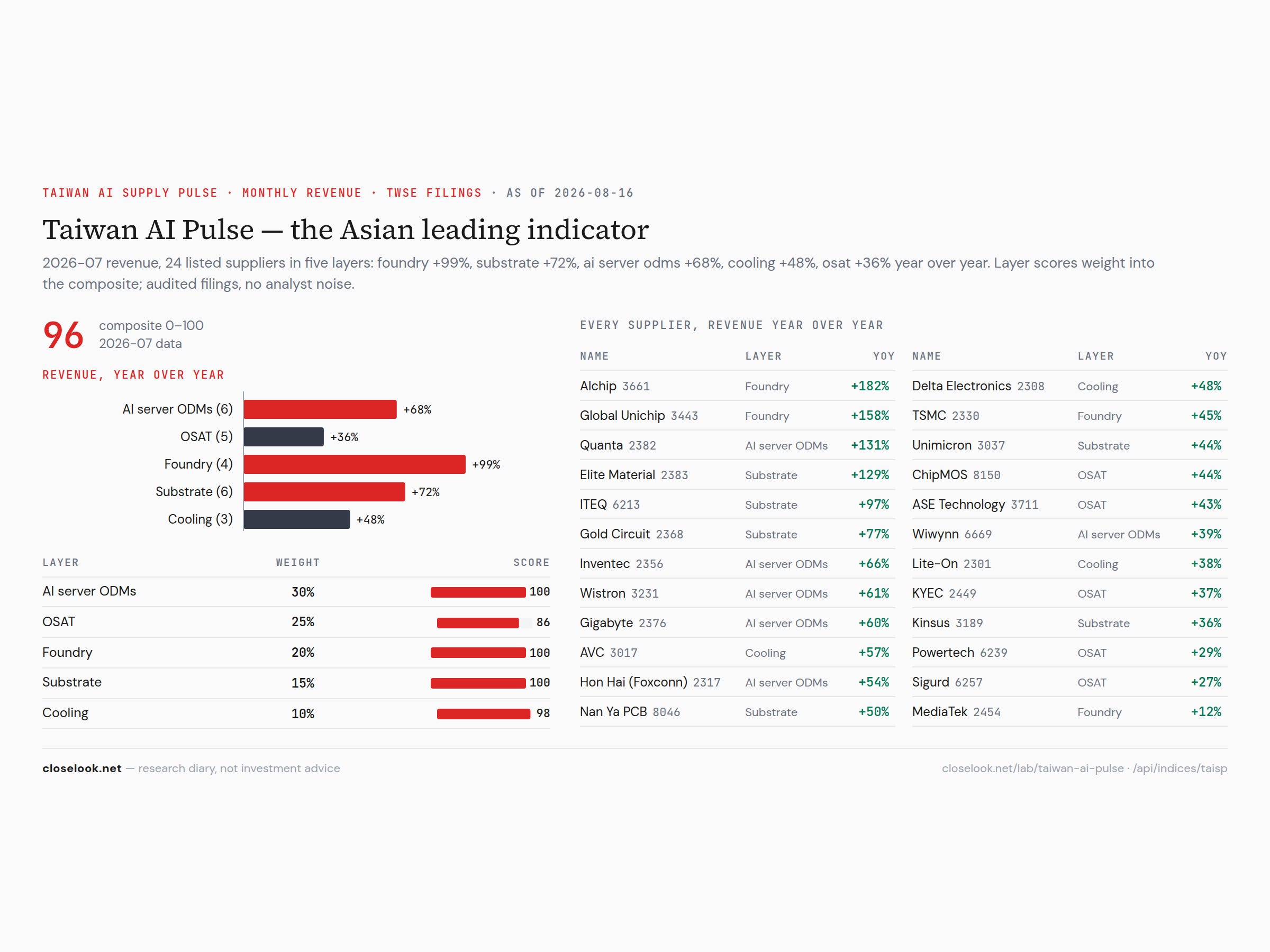
Taiwan AI Pulse — the Asian leading indicator. Unchanged since the July print: foundry +99%, substrate +72%, ODM +68%, cooling +48%, OSAT +36% year over year, every layer at 86 or higher. The August monthly revenues arrive around the fifteenth; this is the earliest hard number on the build-out anywhere, and it lands in the Fed week.
Memory / HBM Pulse. The big three +22% on 21 days — SK hynix +36% the carrier, Samsung and Micron behind — while memory test (Advantest, Teradyne, Aehr) reads −7% on the window and HBM packaging flat. The gauge is a month wide; inside the week the American memory names fell four to six percent and the Korean one rose seven. The pulse and the price agree on the geography, not on the direction.
Semicap Test Pulse. Front-end test −13% (KLA, Onto, Camtek), advanced packaging −12% (BESI, ASMPT, Disco), front-end capex −8% (ASML, Applied, Lam, Tokyo Electron) — and back-end test +1%, the only green layer. The sibling books bought Advantest, BESI and Tokyo Electron a week ago; two of the three sit in the layers that read coldest.
Compute Spot Tightness. Composite 79 from 90, availability only — an H100 rents at 30% of a B200’s hourly price, the legacy-training tier at 67 cents an hour, the frontier tier at $3.80 with twenty providers. Signpost two lives on this page; the rental layer is not yet live, so the gauge says how available compute is, not what the previous generation earns.
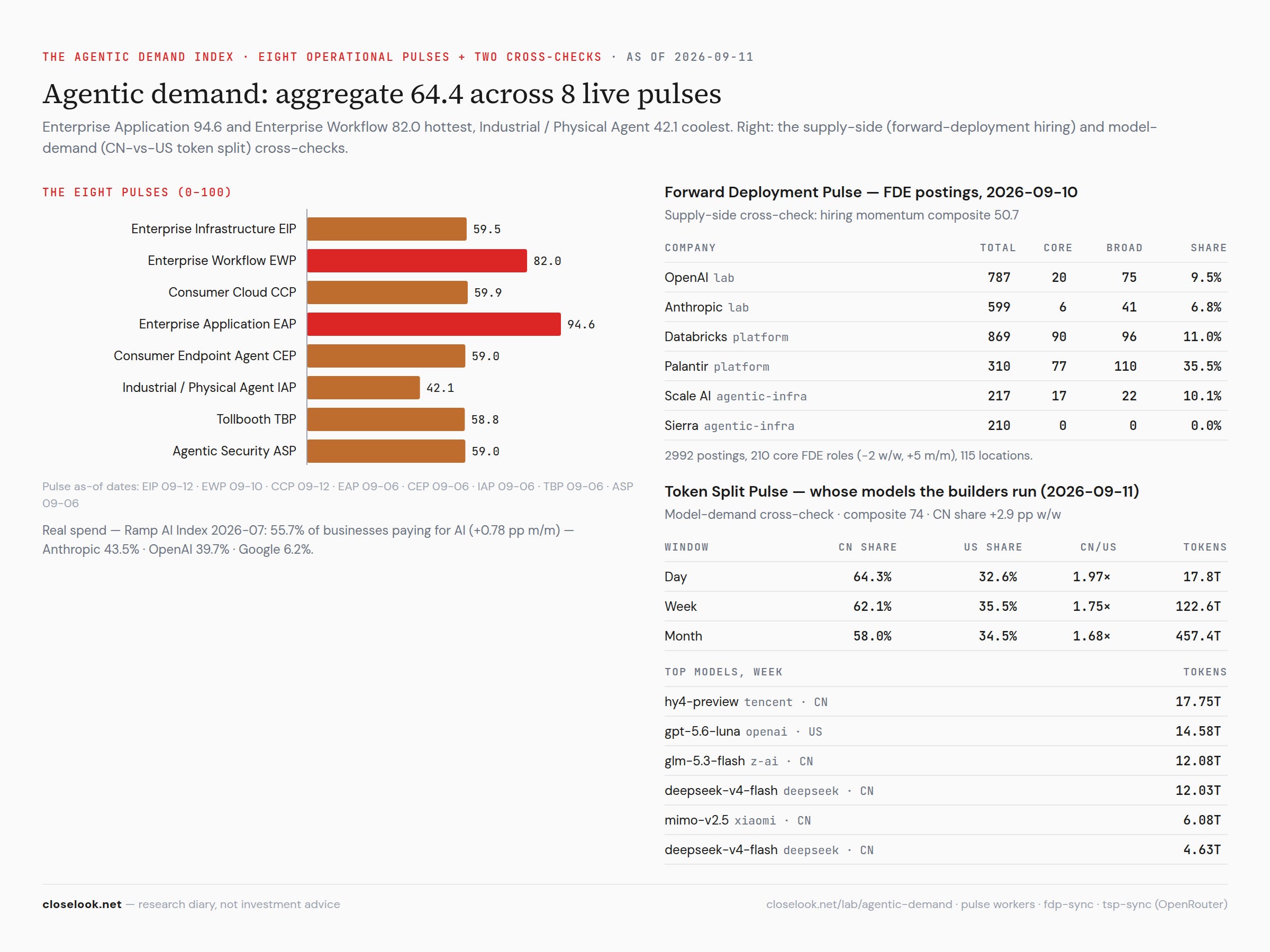
The Agentic Demand Index. Eight pulses: enterprise application 94.6 the hottest, one pulse at 82, five clustered between 59 and 60, the coolest at 42. The token split for the week: 122.6 trillion tokens, China’s open models 62% of them, US models 35% — the builders of the world still run Chinese weights for nearly two of every three tokens, in the week GPT-6 shipped.
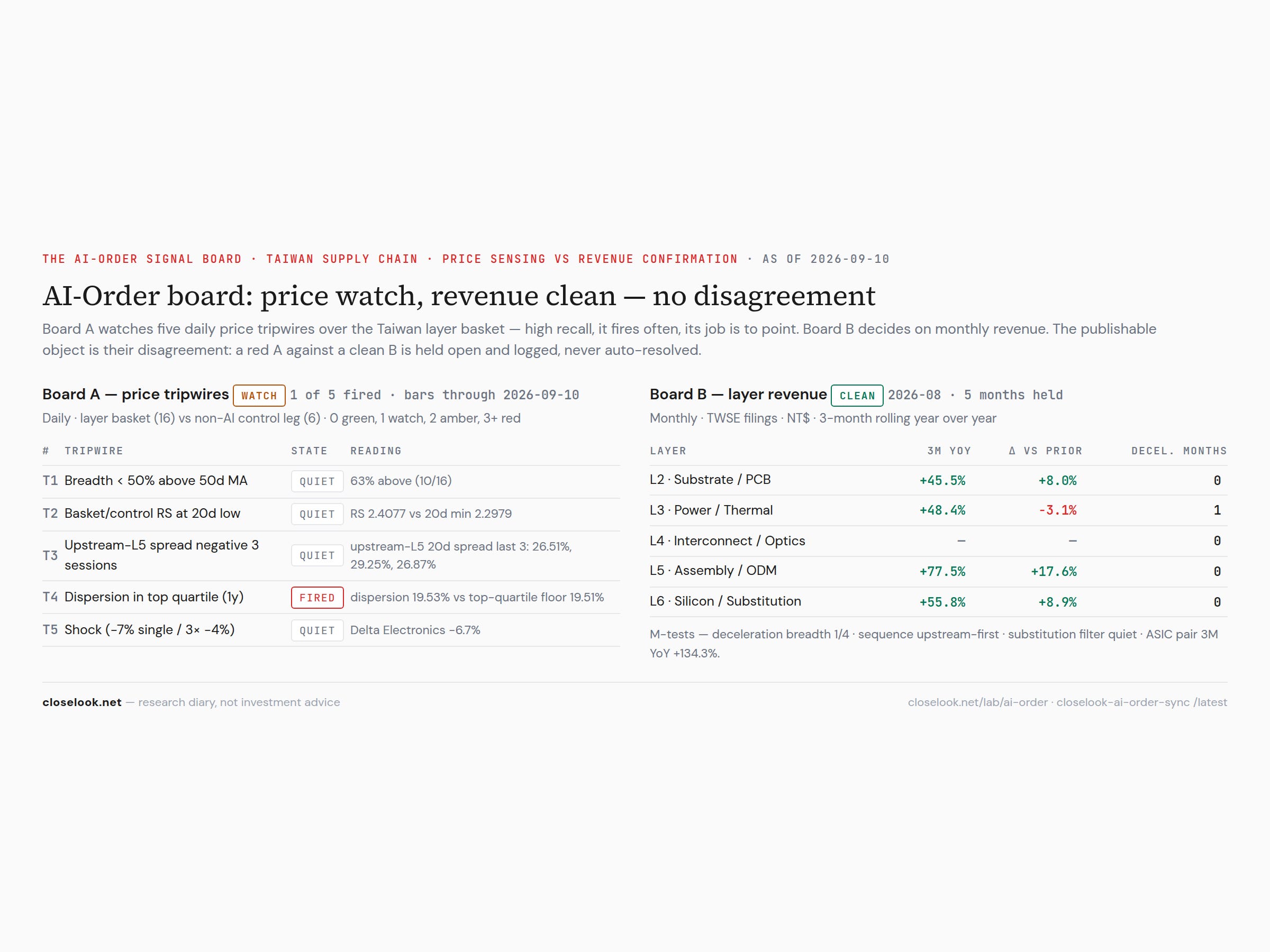
The AI-Order Signal Board. WATCH, score one of five: only the dispersion tripwire fired (19.53% against a 19.51% top-quartile floor); breadth 63% above the 50-day, the basket’s relative strength off its 20-day low, the upstream spread positive, and the single-name shock missed by three-tenths (Delta Electronics −6.7%). Price is sensing; revenue — Taiwan’s July layers all accelerating — has not blinked. The house holds the pair in WATCH.
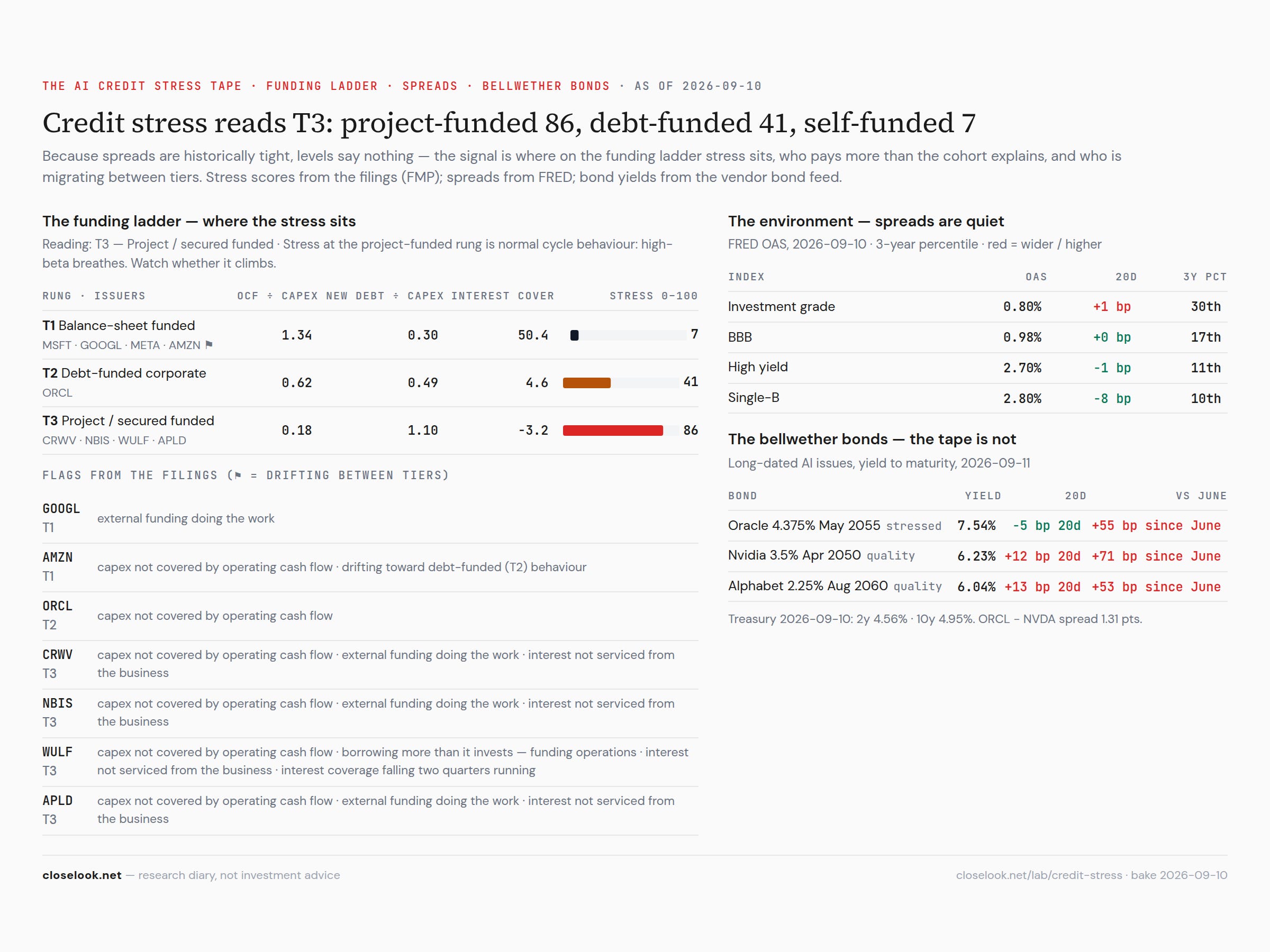
AI Credit Stress — the tape. Spreads are quiet — high yield 2.7% at the 11th percentile of three years, investment grade 0.8% at the 30th — and Treasuries are not: the ten-year at 4.95% and the two-year at 4.56% on the snapshot date, with Thursday’s 30-year auction weak. The ladder: the self-funded hyperscalers still T1 with interest cover in the fifties and eighties; the debt-funded and project-funded rungs unchanged. The equity of the capacity traders sat still this week; their cost of capital rose with the curve.