The builder rose 5.9% and is up 111% on the year, but 110 of its 126 members lost momentum while it rose; the runner made a record; the applications index fell again, and 33 of its 40 members turned stronger. The money went to the companies that test, package and connect the chips. Five winners and five losers of the week, with the catalyst behind each — and TSMC’s September sales next week as the first number of the fourth quarter.

1 · This Week’s Action
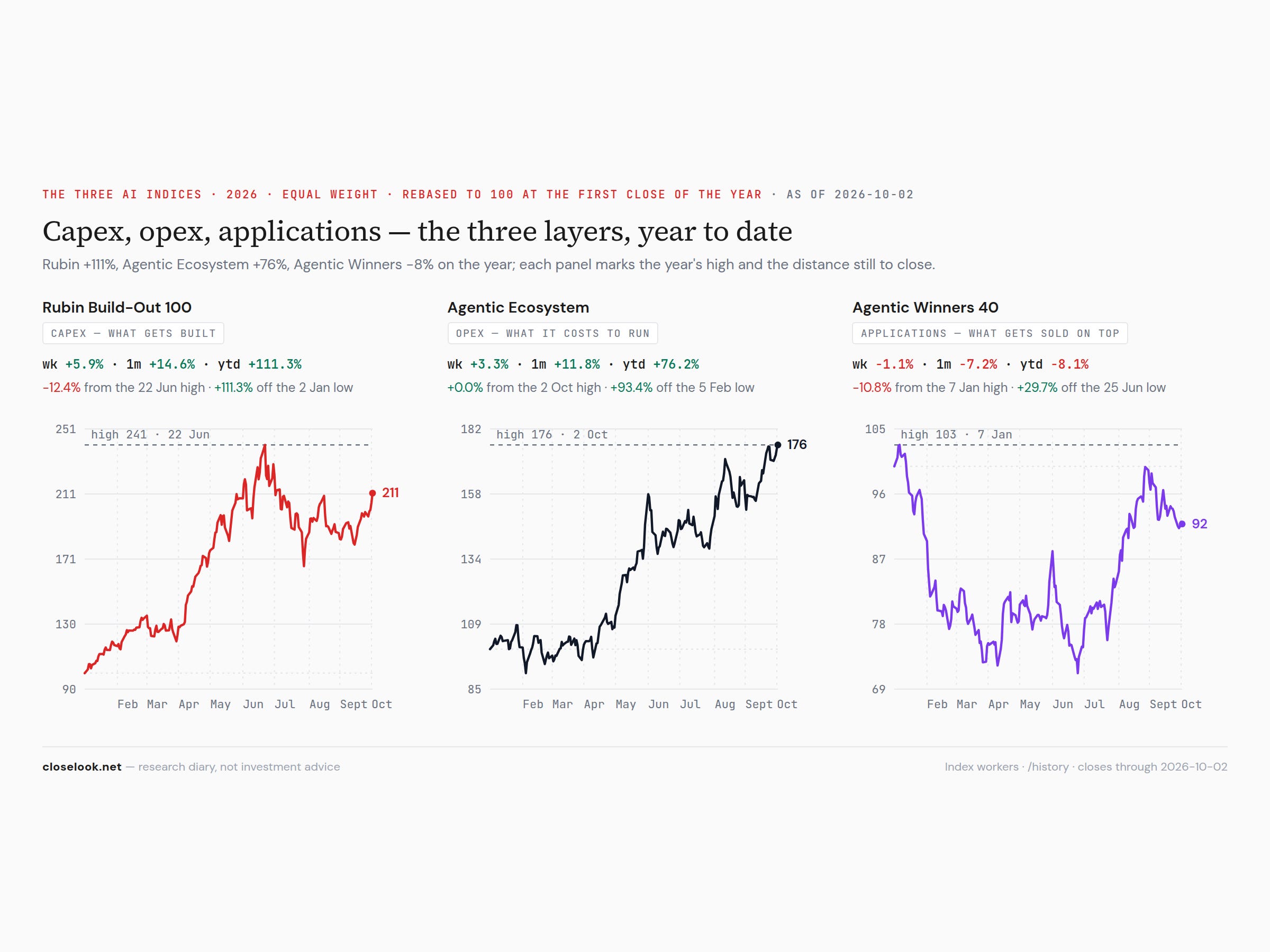
The week in one line: the price said build, the flow said tired. Capex (Rubin Build-Out) +5.87% to 2,172.09, +111.3% on the year; opex (Agentic Ecosystem) +3.25% to a record 1,738.49, +76.2%; applications (Agentic Winners 40) −1.06%, −8.1%. That is the price. The flow — the house Directional Flow score, which measures whether each stock’s trend is gaining or losing force — says something else: in the builder, 110 of 126 members are losing strength and only 9 are gaining; in the applications index, 33 of 40 are getting stronger. The builder rose on tiring legs; the applications index fell on legs that are turning.
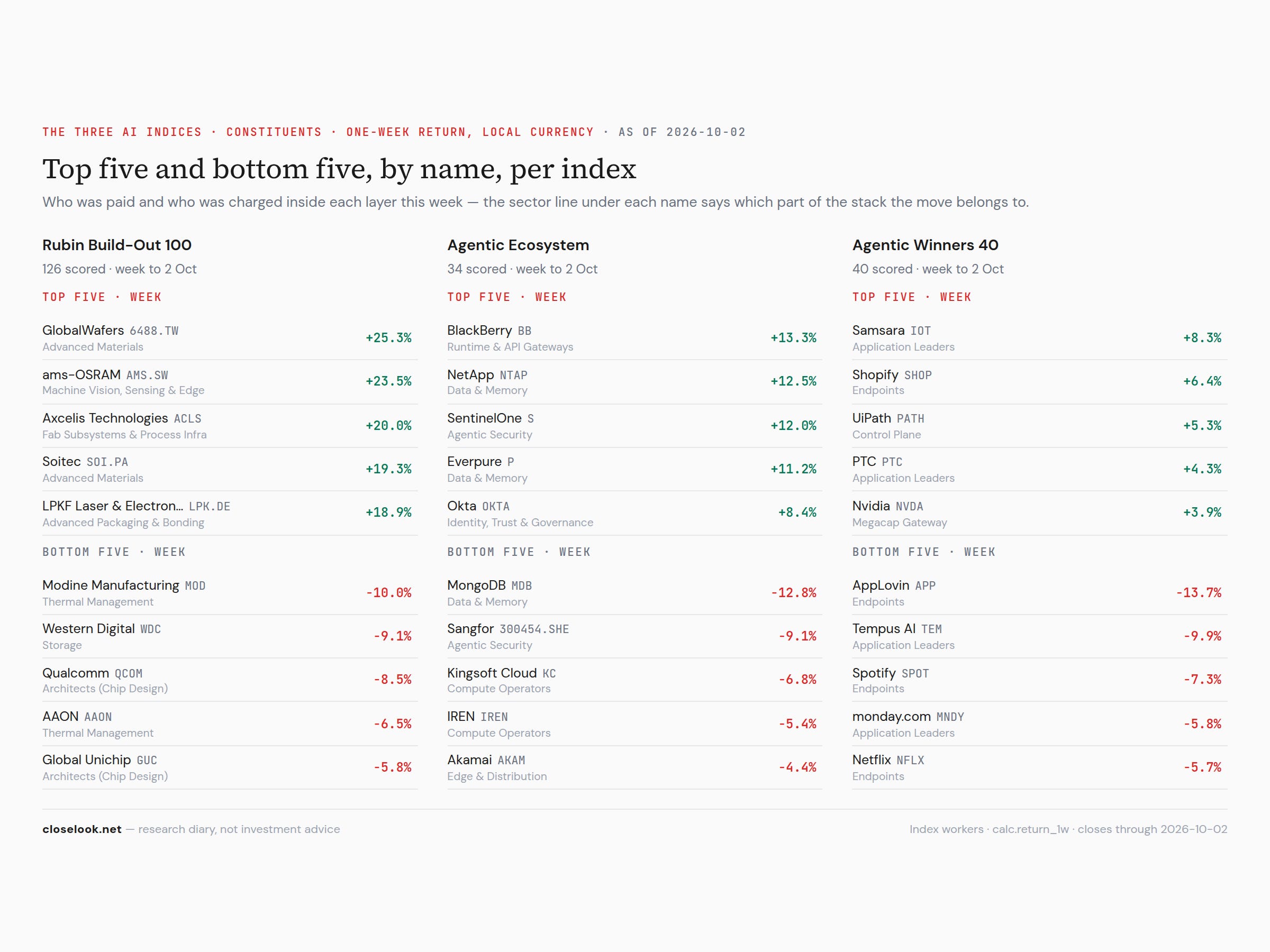
The ten best of the week, across all three indices — the testers, the materials and the optics. GlobalWafers +25.3%, ams-OSRAM +23.5%, Axcelis +20.0%, Soitec +19.3%, LPKF Laser +18.9%, Furukawa Electric +15.8%, Resonac +15.5%, Lumentum +15.3%, SUMCO +15.1%, Synopsys +15.1%. Three wafer and materials makers (GlobalWafers, Soitec, SUMCO, with Resonac’s chemicals), an ion-implant maker (Axcelis), a laser tool maker (LPKF), two optics companies (ams-OSRAM, Lumentum) and a fibre maker (Furukawa), and the design-software leader (Synopsys). Not one of the ten is a chip designer or a cloud operator. The catalyst was the same for most of them: Micron’s record quarter on Wednesday night — a memory maker that sells more needs more wafers, more implant, more test — and Tokyo’s 3.3% Thursday, led by the equipment names.
The ten worst — the software that sells seats, and the storage that met a rival. AppLovin −13.7%, MongoDB −12.8%, Modine −10.0%, Tempus AI −9.9%, Western Digital −9.1%, Sangfor −9.1%, Qualcomm −8.5%, Spotify −7.3%, Kingsoft Cloud −6.8%, AAON −6.5%. MongoDB fell 18% on Monday after Meta hired its chief executive to run a new unit selling Meta’s AI stack to companies; Western Digital fell 10% on Friday on a report that Toshiba will double its hard-drive output for AI data centers; Modine and AAON, two cooling suppliers, fell as the thermal layer rested.
2 · The Three Functional Indices — index, sectors, stocks
We read the three together because they are three stages of one spend: capex (what gets built), opex (what it costs to run), applications (what gets sold on top). HALO, the growth index with no AI thesis, is the control.
Rubin Build-Out — capex
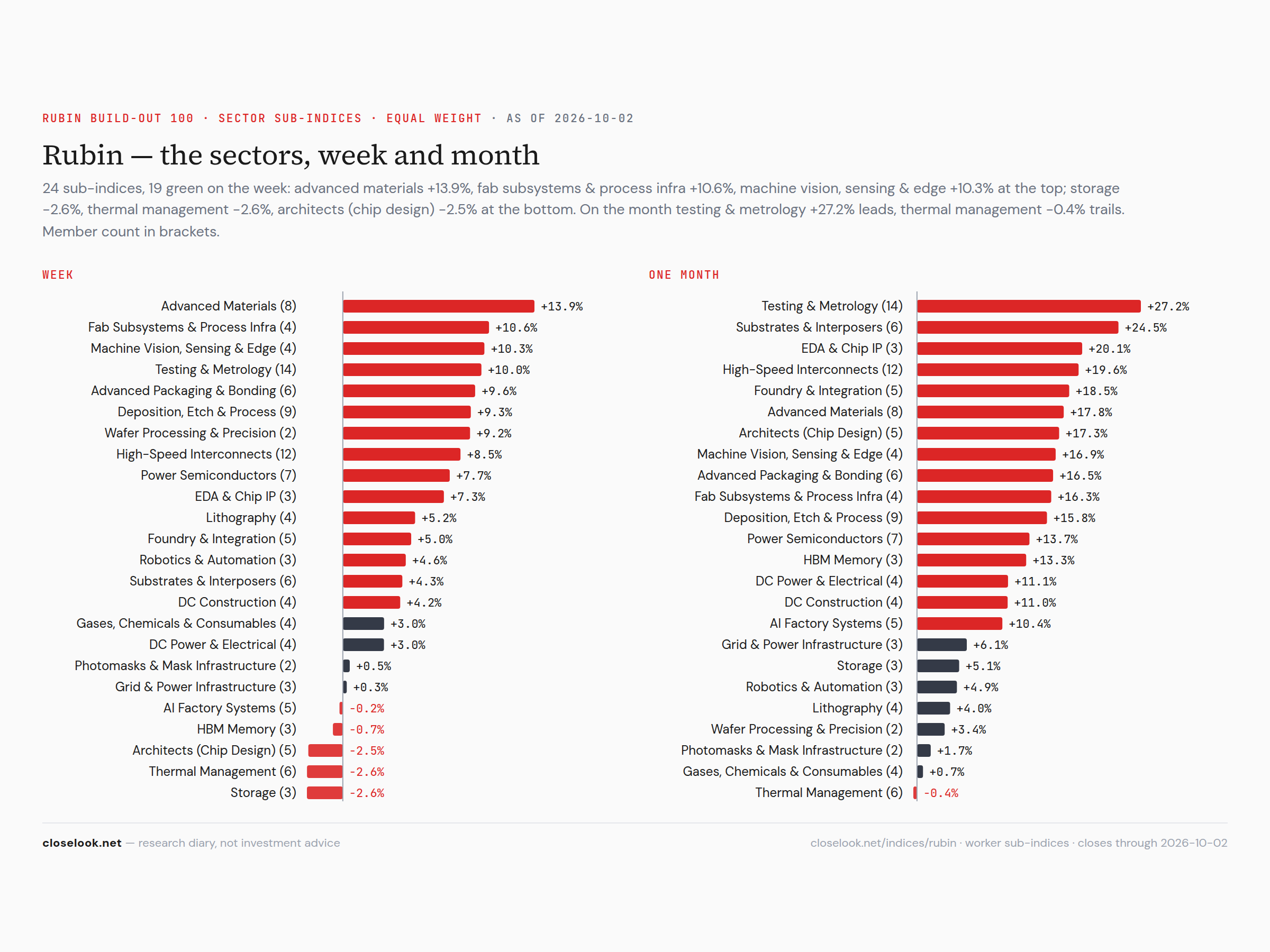
+5.87% to 2,172.09, every day of the week higher — 2,024.39, 2,055.57, 2,066.04, 2,112.51, 2,172.09 — through the quarterly reset of its weights on Wednesday. 103 of 126 members rose, the median member +5.45%. 12.4% under the June 22 high, 27.2% above the July 29 low, +111.3% on the year. Thirty-one of thirty-six sub-indices green. The best: advanced materials +13.9%, connectivity and materials +10.8%, fab subsystems +10.6%, machine vision +10.3%, testing and metrology +10.0%. The slowest: storage −2.6%, thermal −2.6%, the chip architects −2.5%, HBM memory −0.7%, AI factory systems −0.2%. Over the month the leaders are the same family: testing and metrology +27.2%, substrates and interposers +24.5%, EDA and chip IP +20.1%, assembly and test +19.7%, high-speed interconnects +19.6%.
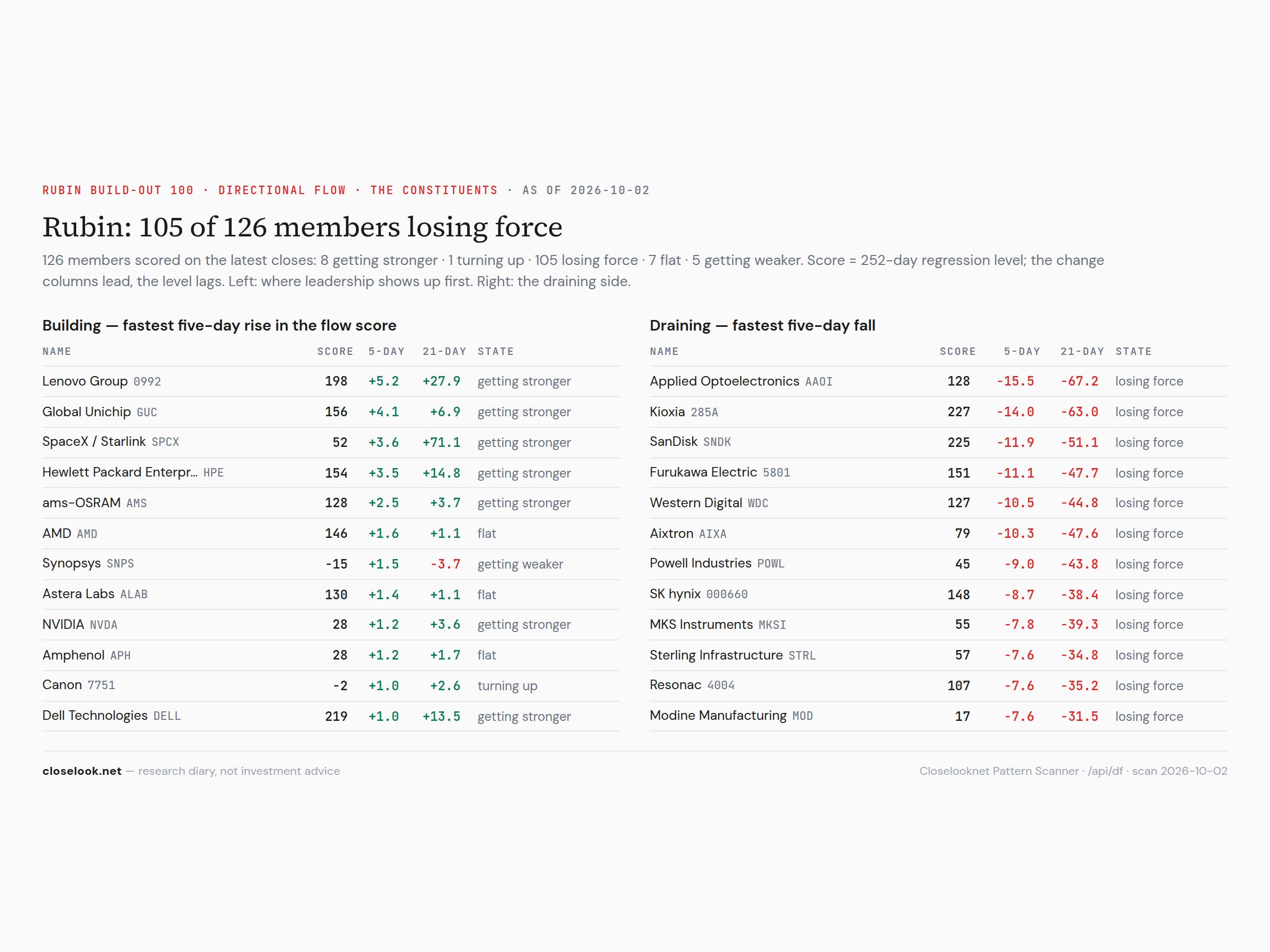
And the flow under it — 9 stronger, 110 weaker. The builder’s average flow score is 71.1, down 3.5 points in five sessions and 19.2 in twenty-one; the trend reads falling. A flow score that falls while the price rises is not a sell signal on its own. It is what a trend looks like when it is still going up but each day’s move adds less force than the day before — a stage the builder has passed through after every leg since the spring. The one name that turned up: SpaceX.
Agentic Ecosystem — opex
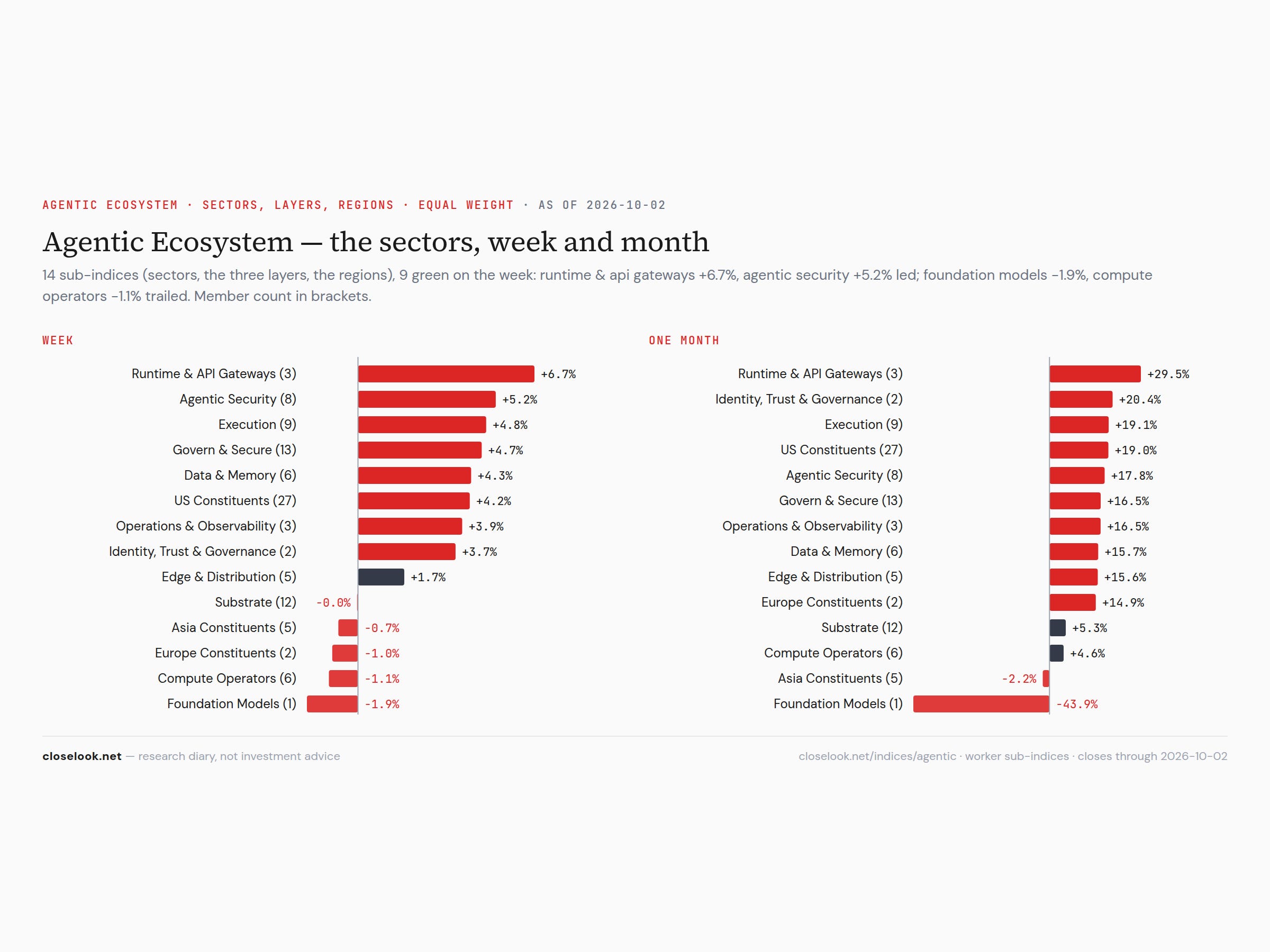
+3.25% to a record 1,738.49, +76.2% on the year, 26 of 34 members up, the median +3.41%. Nine of fourteen sub-indices green: runtime and API gateways +6.7%, agentic security +5.2%, execution +4.8%, govern and secure +4.7%, data and memory +4.3%. The red five: foundation models −1.9%, compute operators −1.1%, Europe’s constituents −1.0%, Asia’s −0.7%, substrate flat. The security layer had its week — CrowdStrike +7.1%, Palo Alto +7.6%, Okta +8.4% — and the operators who rent out compute rested.
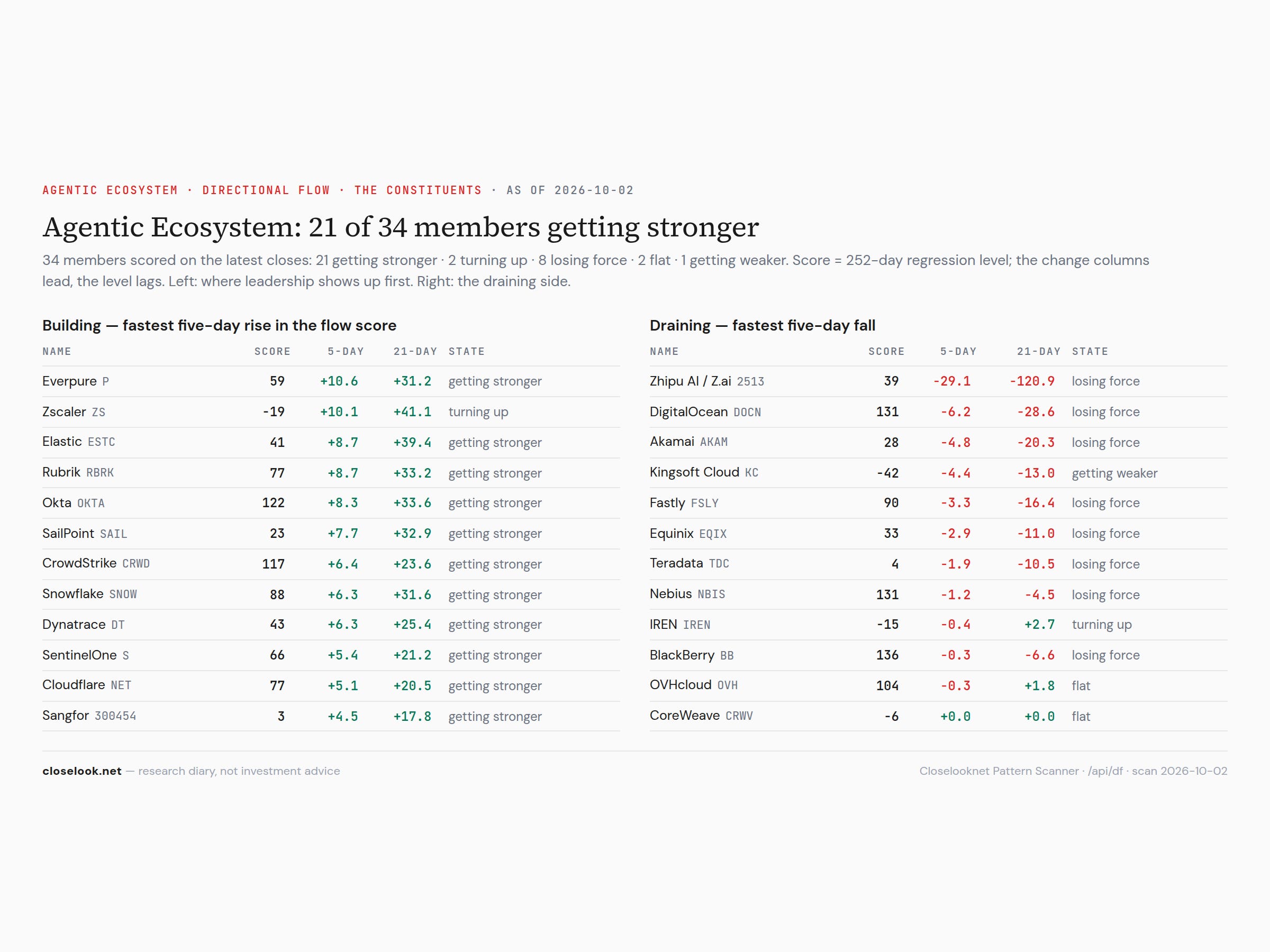
The flow — 23 stronger, 9 weaker. Average 61.5, up 1.9 in five sessions and 8.7 in twenty-one, trend rising. The runner is the one index where price and flow agree.
Agentic Winners 40 — applications
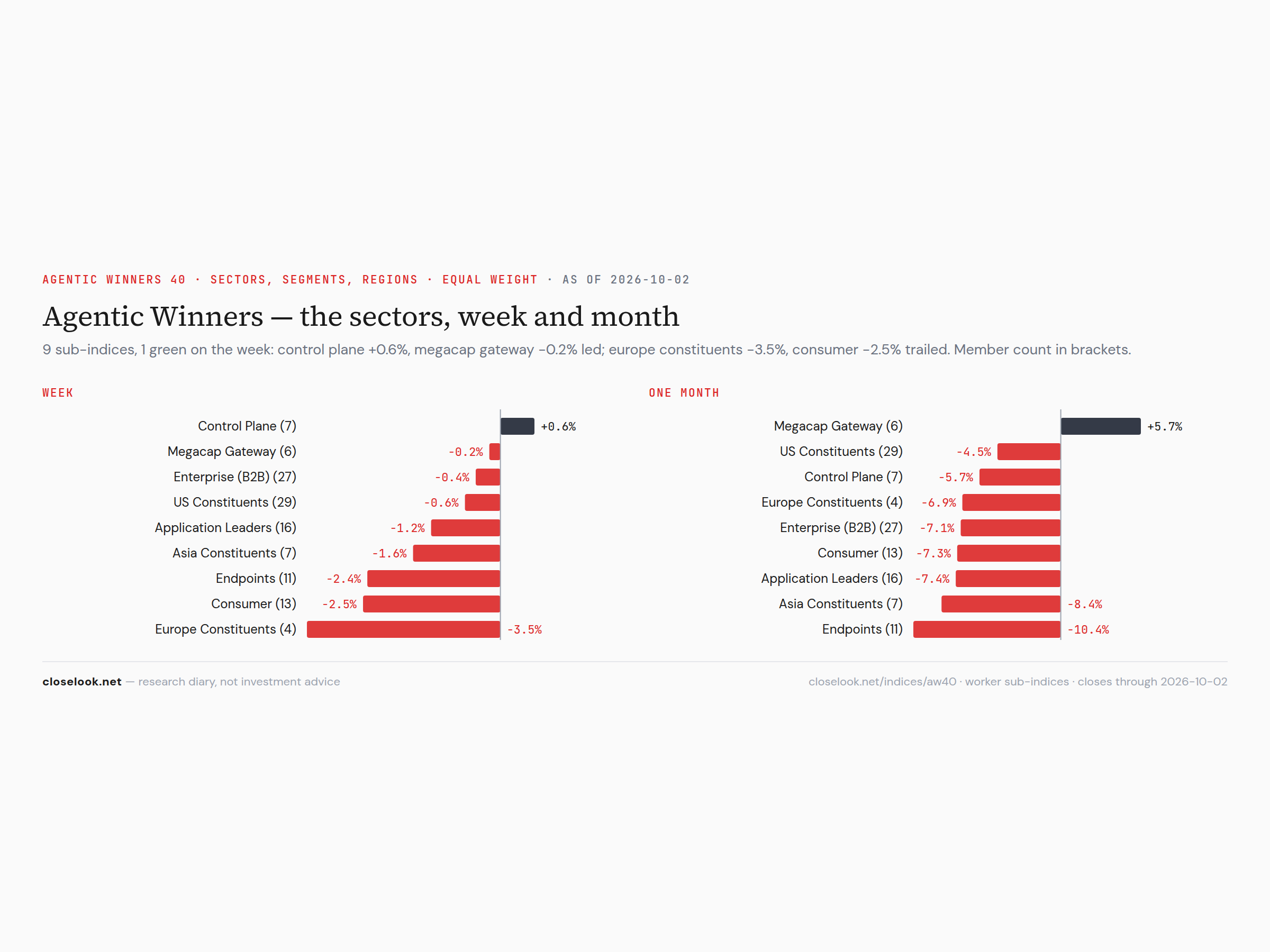
−1.06% to 899.20, −8.1% on the year, 10.8% under its January high, 14 of 40 members up, the median −1.00%. One of nine sub-indices green: the control plane +0.6%. The red eight include the megacap gateway −0.2%, enterprise −0.4%, application leaders −1.2%, endpoints −2.4%, consumer −2.5%, Europe’s constituents −3.5%. AppLovin, Tempus and Spotify were the week’s drags; Meta’s −3.1% after its agent rally held the gateway down.
The flow — 33 stronger, 3 weaker. Average −5.8, up 3.4 in five sessions and 18.2 in twenty-one, trend rising. The score is still below zero — the trends are still pointing down — but they are pointing down less steeply every week. That is the shape of a group that has stopped being sold before it has started being bought.
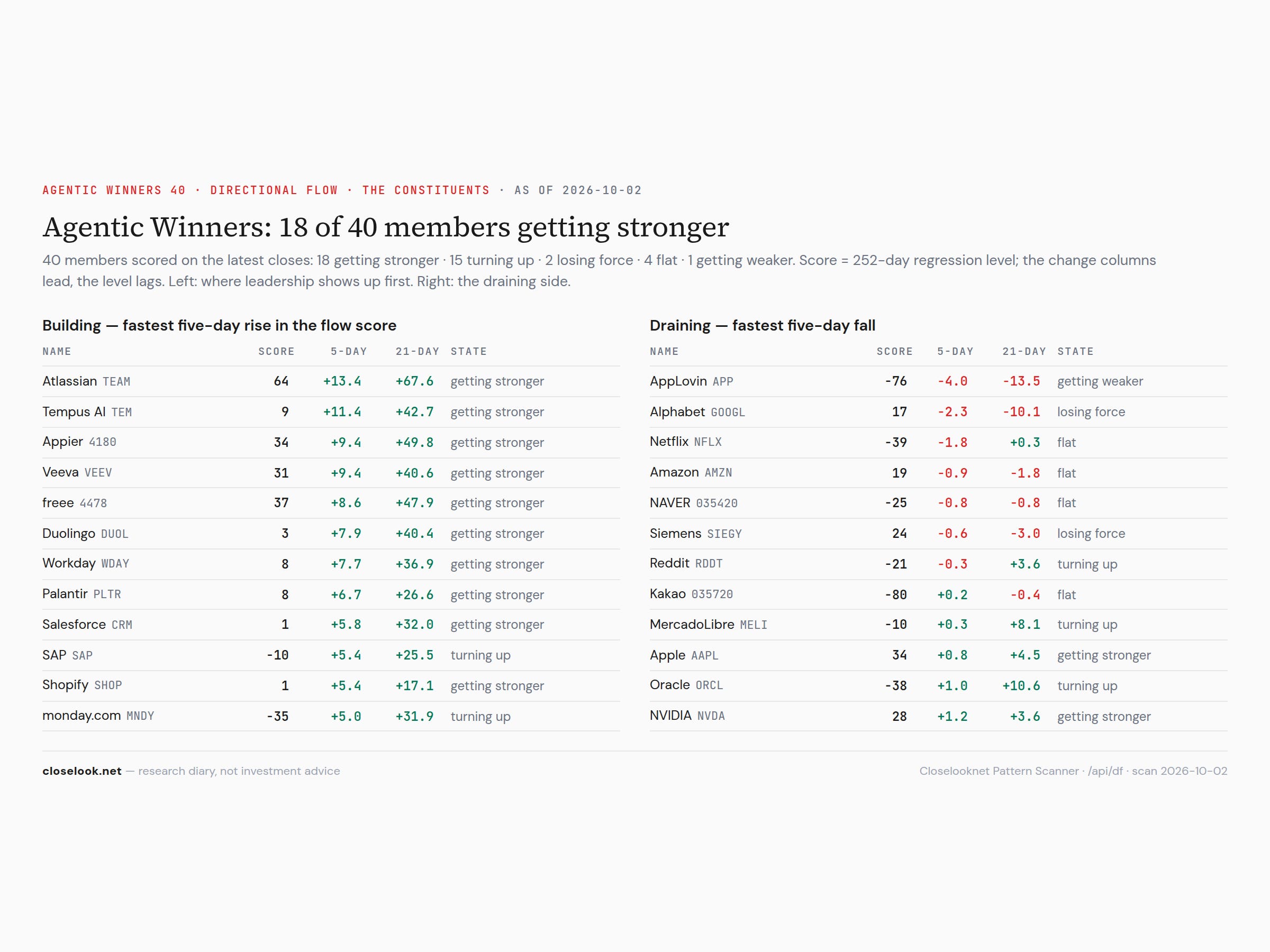
The control group. HALO fell 1.13%, 32 of 97 members up, −2.1% on the year. §5 has the detail.
3 · The AI Board — the stack, instrument by instrument
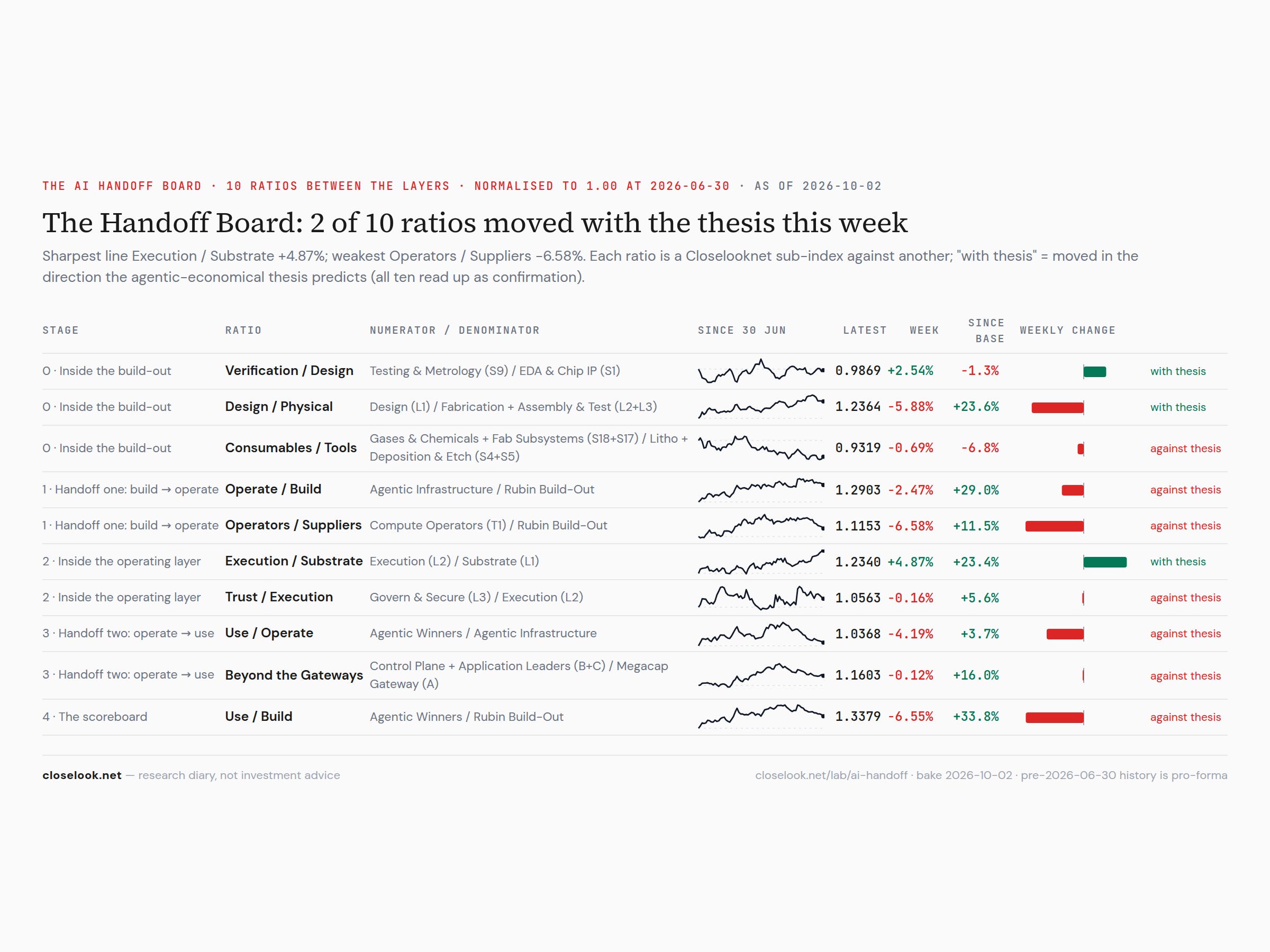
The Handoff Board — two of ten ratios with the thesis. The house AI Handoff Board tracks the money moving from one layer of the stack to the next. This week execution over substrate rose 4.87% and verification over design 2.54% — the testers over the designers, the week’s winners in one ratio. Against the thesis: operators over suppliers −6.58%, use over build −6.55%, design over physical −5.88%, use over operate −4.19%. The handoff from building to using paused again: the money went back down the stack, to the people who make and test the physical chips.
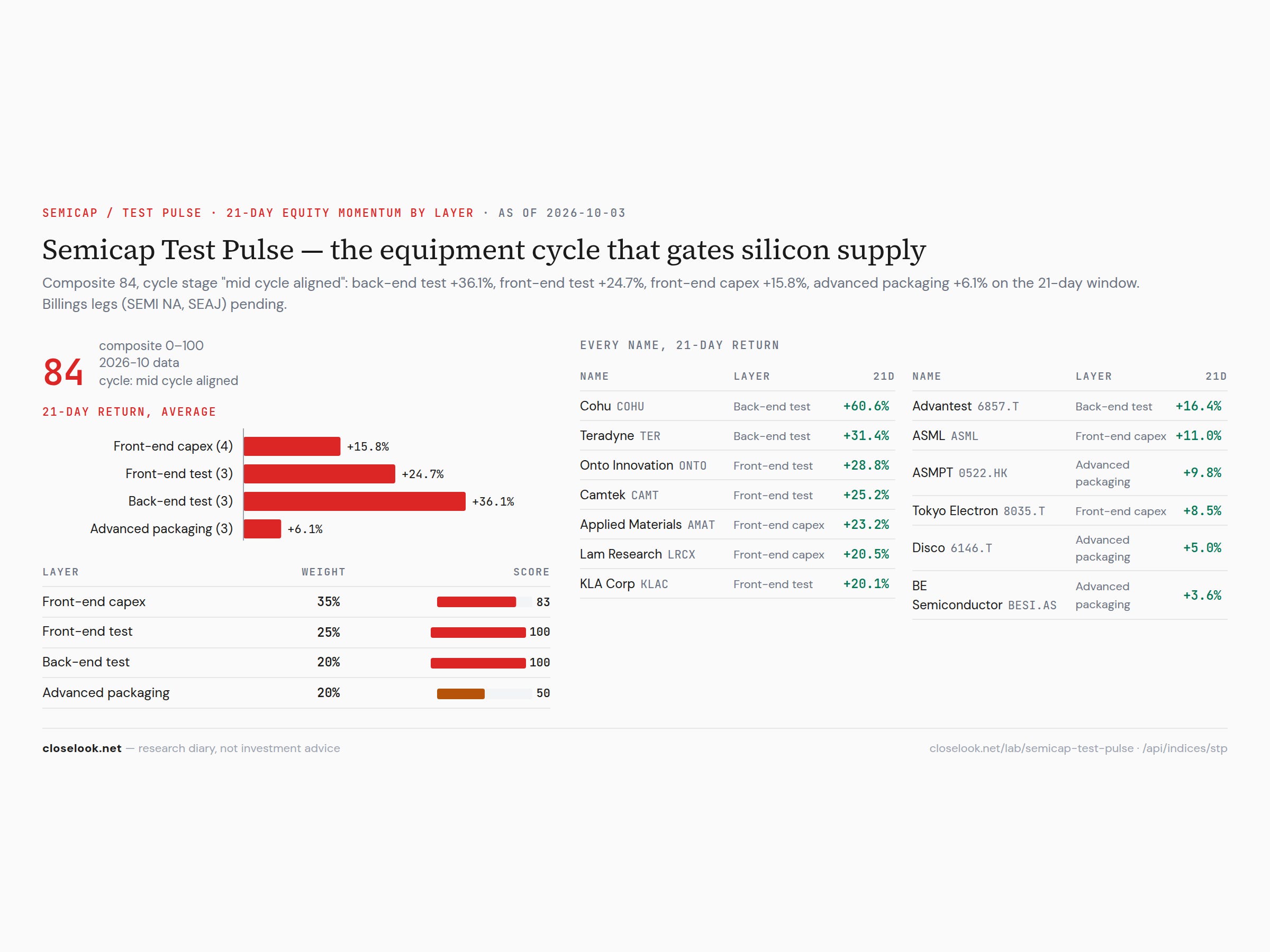
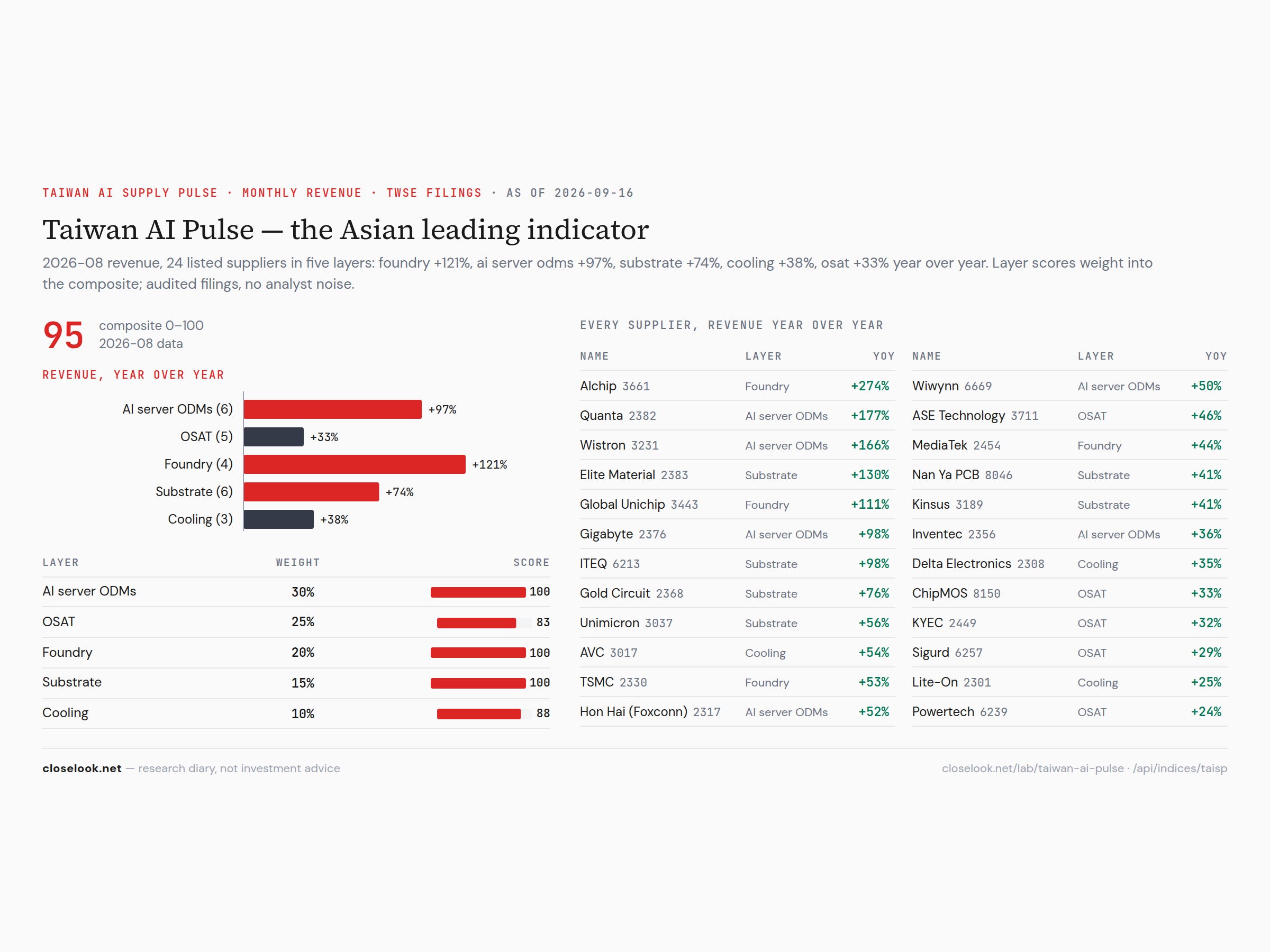
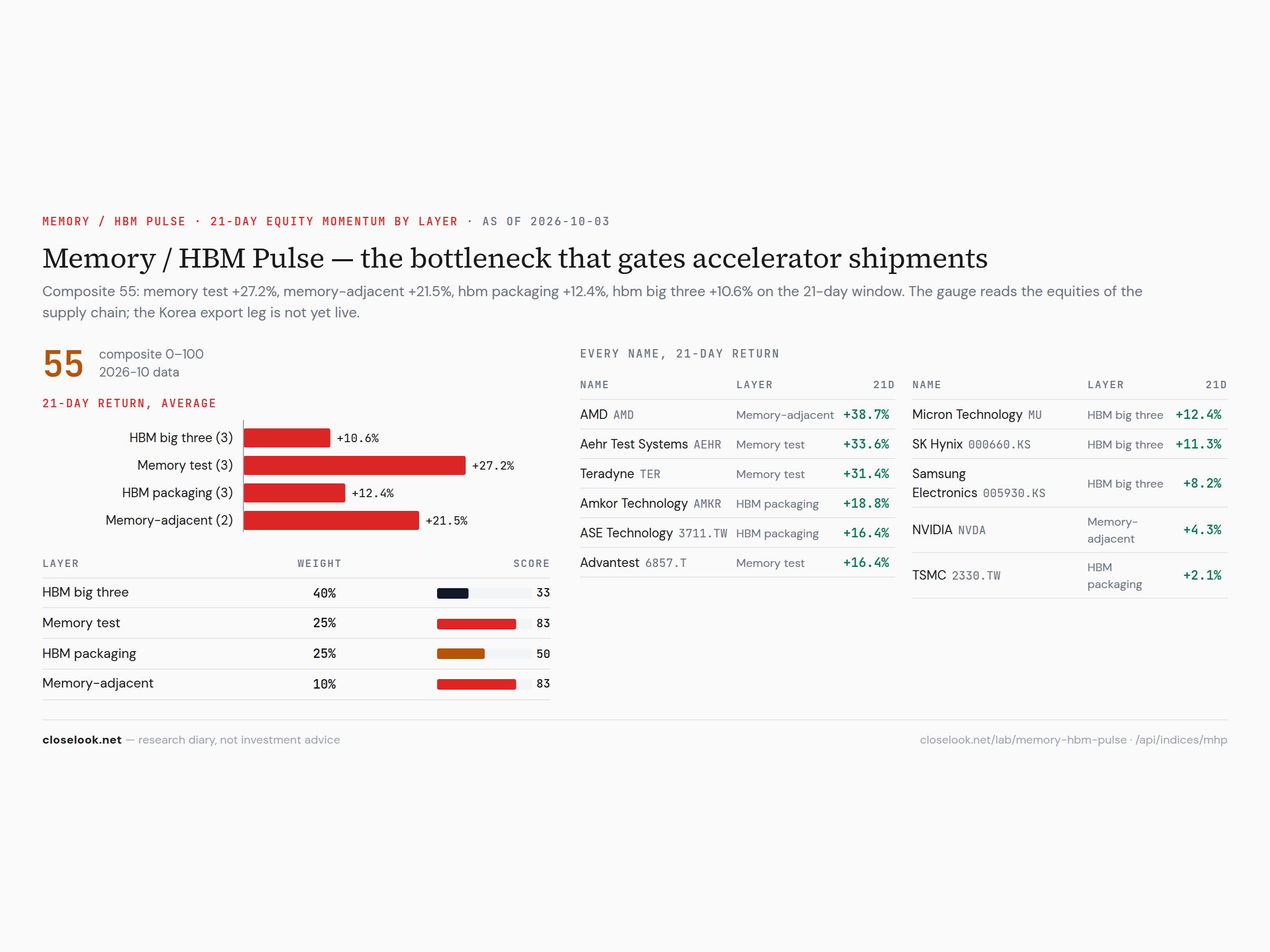
The supply gauges — the equipment cycle at full speed. The four supply-side gauges of the AI Build-Out family: the Semicap / Test Pulse at 84, “mid cycle aligned” — back-end test +36.1% and front-end test +24.7% over twenty-one days, front-end capex +15.8%, advanced packaging +6.1%. The names behind it: Cohu +60.6%, Teradyne +31.4%, Onto +28.8%, Camtek +25.2%, Applied Materials +23.2%, Lam +20.5%, KLA +20.1% over the month. The Taiwan AI Supply Pulse at 95 on August’s audited revenue — foundry +121% year on year, AI server makers +97%, substrates +74%. The Memory / HBM Pulse at 55, the HBM big three +10.6% over the month. Compute spot tightness at 57. Three of four gauges hot; the one that is not is the rented-GPU market.
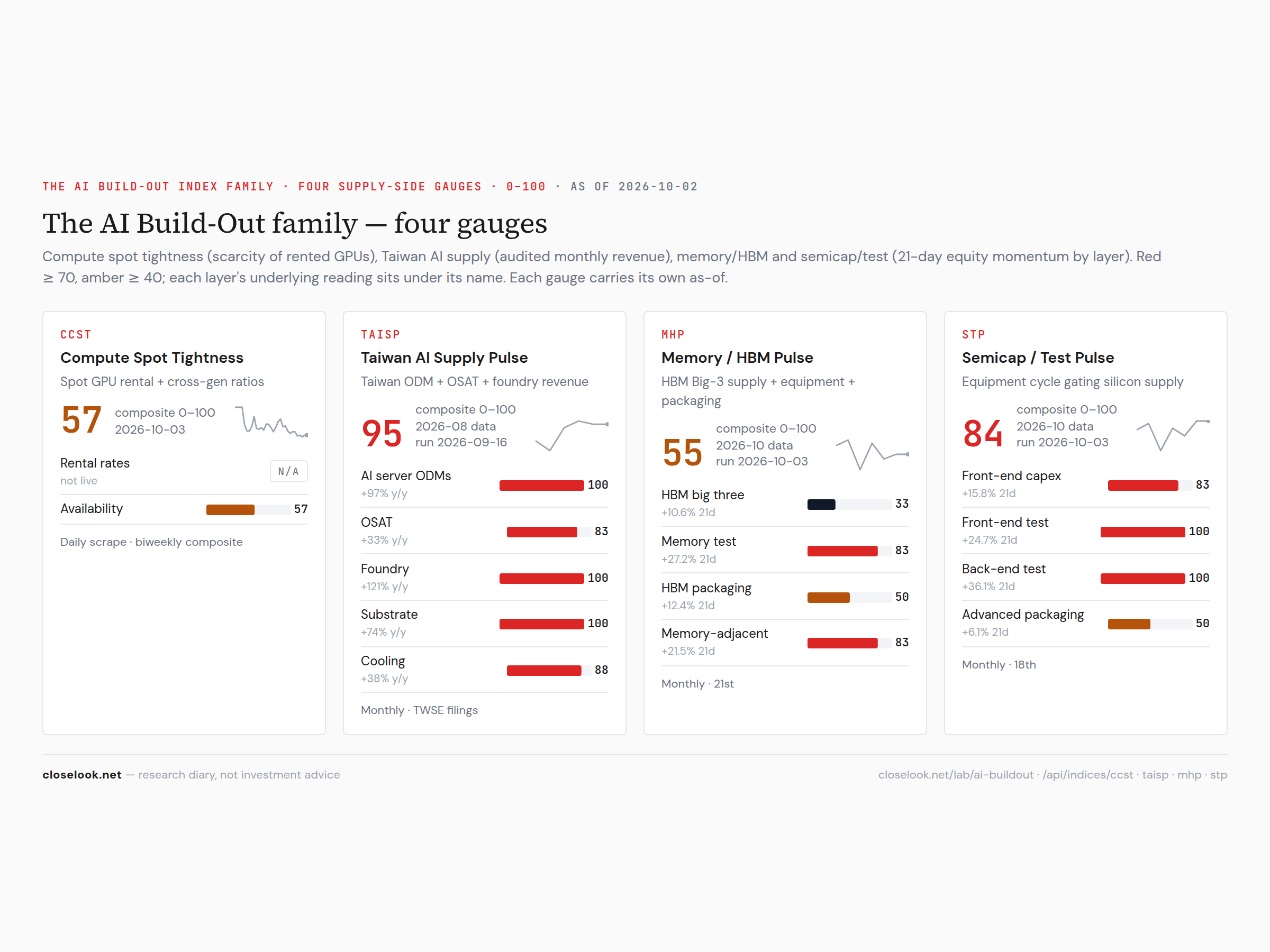
Taiwan — the number that comes next. The Taiwan pulse runs on monthly filings: Alchip +274%, Quanta +177%, Wistron +166%, Elite Material +130%, Global Unichip +111% year on year in August; TSMC +53%. September’s filings arrive next week, TSMC’s first. They are the earliest hard data on the fourth quarter’s AI spend anywhere in the world.
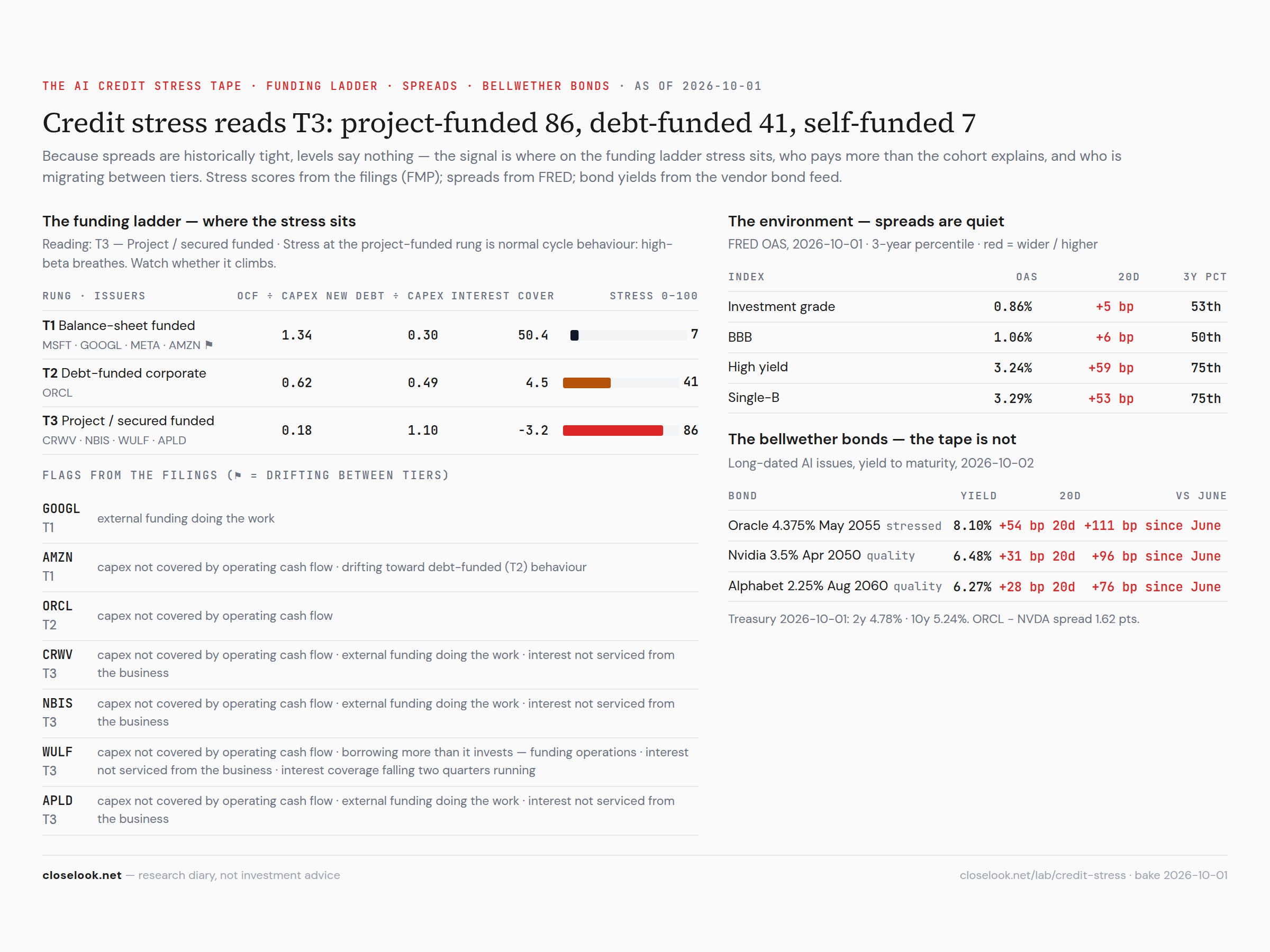
The credit tape. The house AI Credit Stress tape reads the funding behind the build-out. Oracle rose 3.8% on the week after its force-majeure notice of the week before; the tape is the place to watch if the long bond’s new lows start to reach the borrowers that finance the data centers.
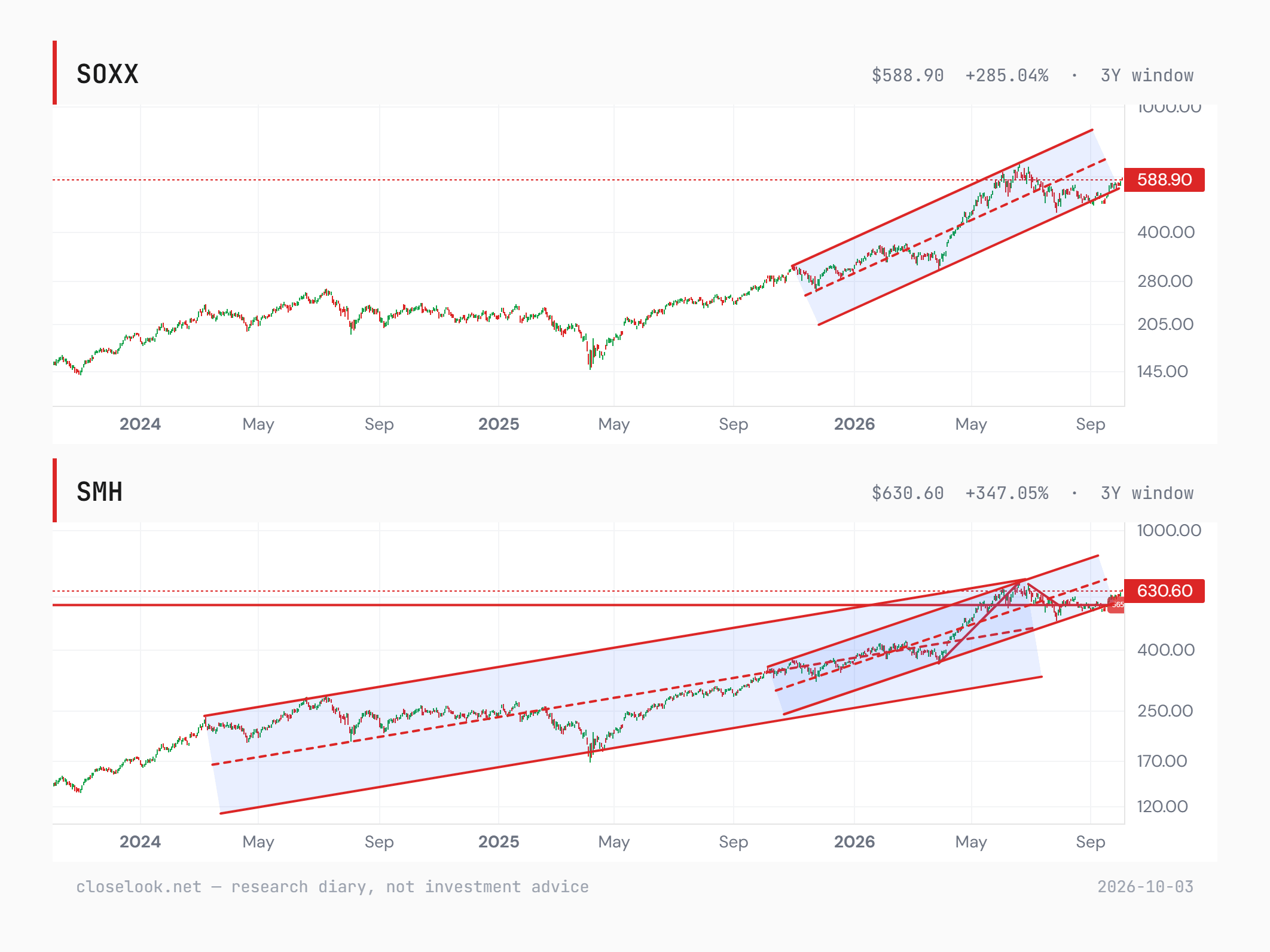
The chips on the editor’s lines — the bull intact. The editor’s three-year charts on the chip index and the chip majors: both inside their rising channels, the chip majors back above the 565 line they lost in the summer. Sunday’s US letter has the levels.