


0 · Last week, scored
Verdict: the floor held — financials rose 1.4% through the bank reports and never closed near 53.40; inside the sector, Berkshire made a new high while Goldman and KKR made new lows.

Last Sunday’s signal was financials: the early warning of September withdrawn, for now, with the bank reports as the test. The financial sector fund’s lowest close of the week was 54.52, well above the 53.40 line, and it finished at 55.52 — still under its 50-day average of 56.28. The split we described widened. Berkshire Hathaway rose 3.2% and closed above its August high. JPMorgan held its line on every close and ended the week up 2.0%. Goldman Sachs closed under its 8 October low on Wednesday, and KKR fell 5.2% to the lowest close since March. The safe part of the sector kept turning; the deal-makers and the private-credit firm did not.
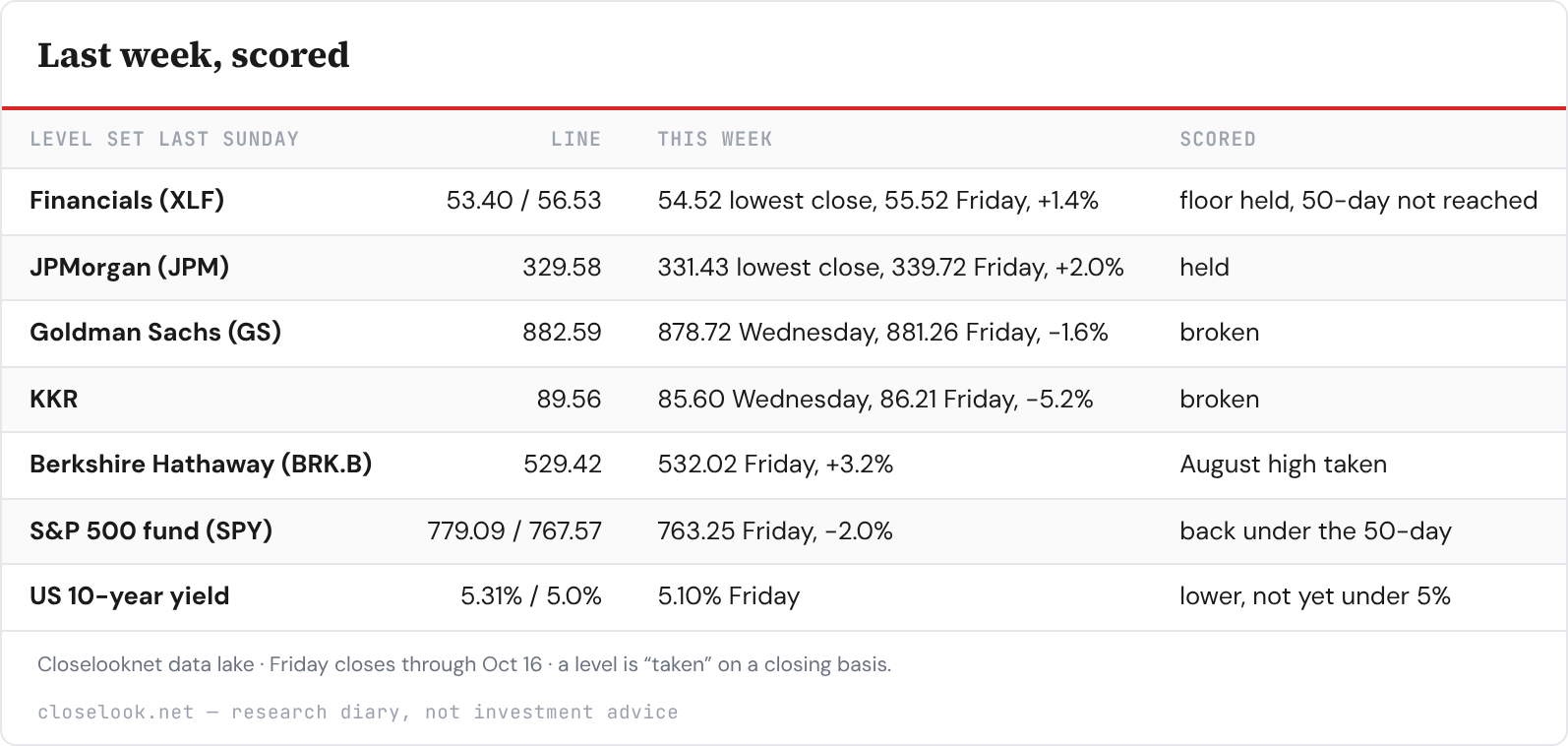
Table as text
Closelooknet data lake · Friday closes through Oct 16 · a level is “taken” on a closing basis.
1 · The signal — second-tier chips: back at the July low
The equal-weight chip fund XSD closed Friday at 462.03, down 12.5% on the week and 17.3% in eight trading days from its 6 October close of 558.42. Its July low was 449.41, on 29 July; the fund is 2.8% above it. Friday was also the first close under its 200-day average (465.05) since a single day at the end of March, on 463,814 shares — about four times its 50-day average and the third-busiest day in our data, which starts in June 2024. 38 of its 43 holdings fell on the week; the median stock lost 12.7%.
XSD holds the same 43 or so chip companies in roughly equal amounts, so a small analog or connectivity maker counts as much as Nvidia. That makes it the fund for the second tier of the chip industry — the companies that live on the build-out rather than lead it. The editor’s note from Saturday morning, in his words: “The second-tier chip stocks fund is already down to the July level. While this level may bounce, I expect the second downleg to stop much more slowly. I see this second leg down as a major buying opportunity and will monitor the XSD fund price action.”
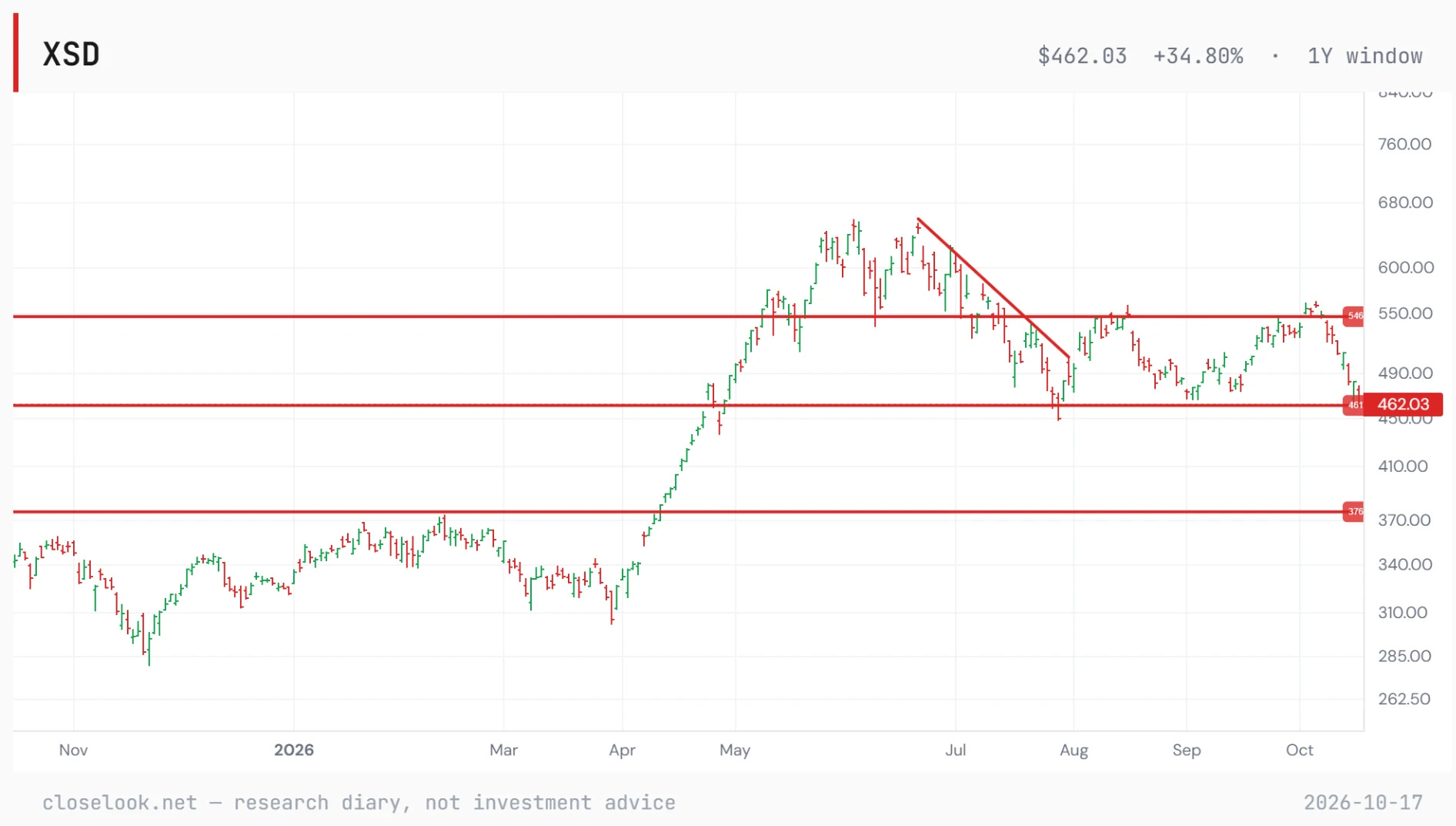
Two legs, then. The first ran from the record close of 649.73 on 3 June to 449.41 on 29 July, a fall of 30.8% in eight weeks. The bounce took the fund back up 24.3% to 558.42 on 6 October, just above the 546 line where it had stalled in August and September. The second leg began the next day.
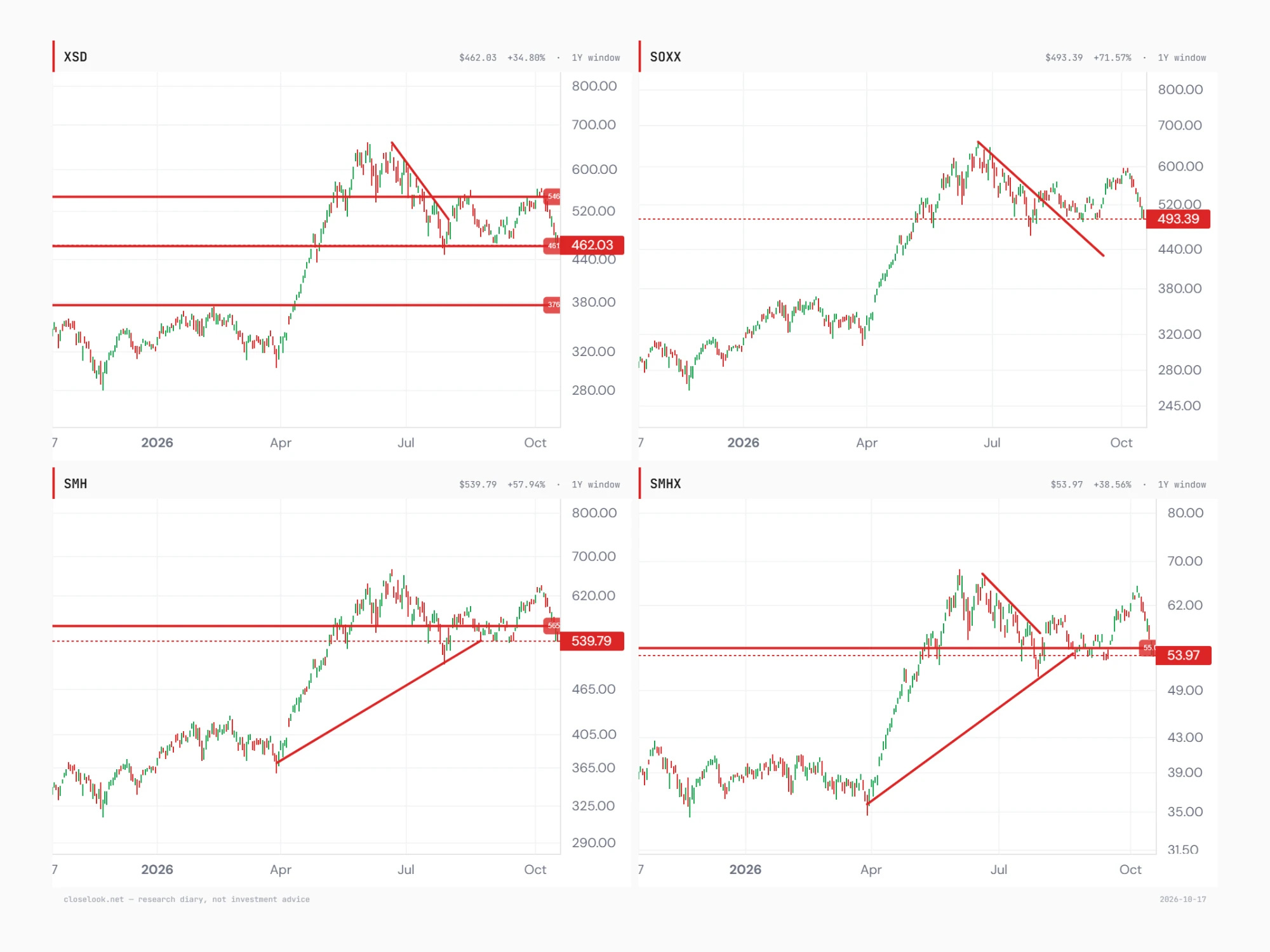
It was not one fund. The editor’s point for the week: the selling hit the whole chip shelf, all four funds at once. The equal-weight XSD fell 12.5%, the fabless-designer fund SMHX 12.1%, the broad chip fund SOXX 11.8% and the big-name fund SMH 10.5%. All four made their top in June, bounced into the first week of October and gave back 15–17% from there in eight sessions. The order of the damage is the story: the smaller the companies, the deeper the cut. XSD is 2.8% above its July low, SMHX 5.9%, SOXX 6.1% and SMH 7.1%. On the editor’s charts SMH closed under its 565 line and its rising line from the April low, SMHX under its line near 55 and its own April line, and SOXX closed under its September low of 497.40, its lowest close since July.
2 · The numbers: how second legs have ended
XSD has traded since February 2006. On weekly closes, dividends included, it has fallen 25% or more from a high six times before this year. Twice the fall came in one piece and turned straight up: 2006 and the 2020 Covid crash. Four times it came in two legs — a fall, a bounce of 21–31%, and a second fall. Those four are the record for where XSD stands now.
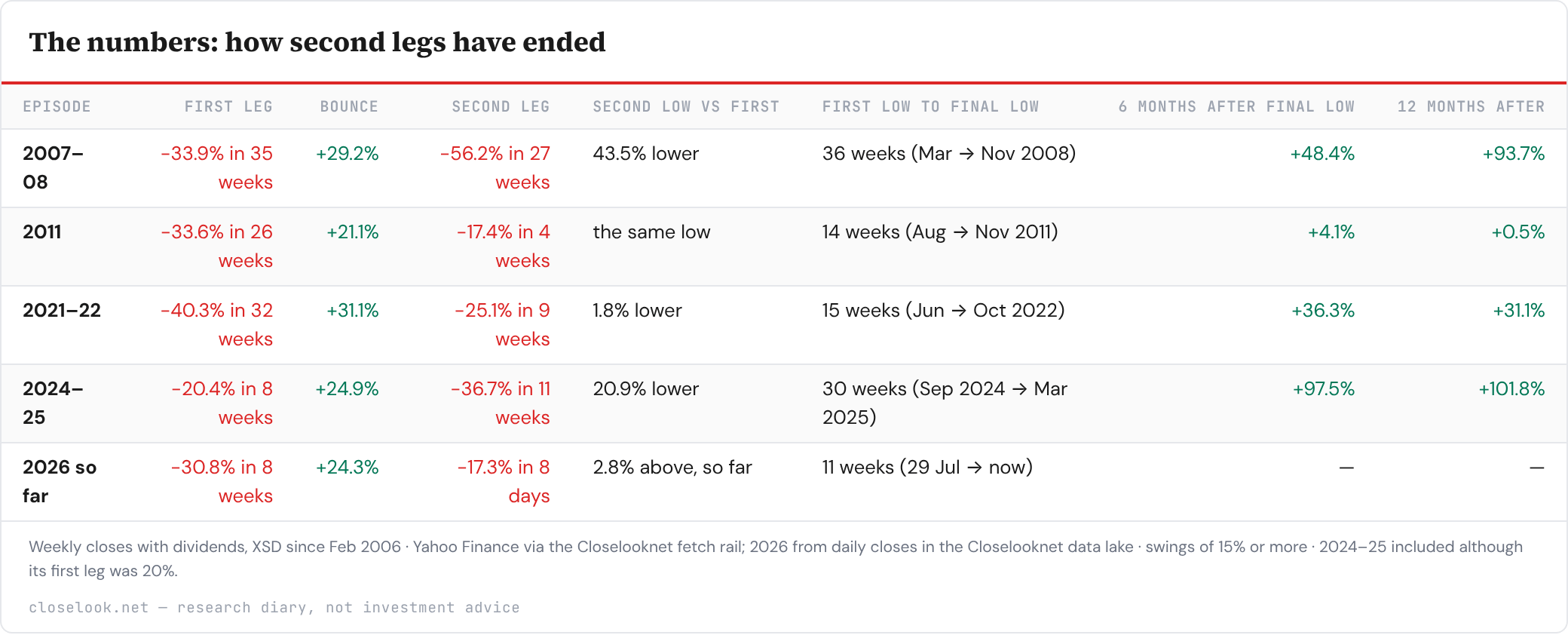
Table as text
Weekly closes with dividends, XSD since Feb 2006 · Yahoo Finance via the Closelooknet fetch rail; 2026 from daily closes in the Closelooknet data lake · swings of 15% or more · 2024–25 included although its first leg was 20%.
Read it in three lines. The final low came 14 to 36 weeks after the first one — a bottom built over months, not a single day. That is the editor’s “stop much more slowly” in numbers: the July low is eleven weeks old. In all four the second leg went at least as low as the first: to the same level in 2011, 1.8% lower in 2022, 21% lower in 2024–25 and 44% lower in 2008. Six and twelve months after the final low, the fund was higher every time — though by only 4% and 0.5% in 2011. Four cases are a small record, and the second leg itself was often quick: four to eleven weeks in three of them. It is the bottom that took time, not the fall.
3 · Why: the AI fringe sold, the old chip makers did not
The whole technology complex was sold this week — the large chip fund SOXX fell 11.8%, software 7.4%, the Nasdaq 100 fund 5.5% — while consumer staples rose 5.0%, health care 3.5% and energy 4.9%. Inside XSD the selling had a clear shape. The names tied to the AI build-out and the small, story-driven companies fell hardest: indie Semiconductor −30%, Semtech −27%, Kopin −26%, MaxLinear −26%, Penguin Solutions −25%, SiTime −23%, Navitas −23% and Credo −22%. The old analog and industrial chip makers barely moved: NXP +0.8%, Texas Instruments −2.6%, Analog Devices −2.7%, Microchip −2.3%, and Skyworks rose 4.4%.
That is the case for the editor’s view and its risk in one table of names. The fund fell because the most speculative third of it was marked down hard, not because the whole industry’s business cracked. If the build-out names find a floor near their July levels, the equal-weight fund carries the cheaper analog half with it. If they keep falling, XSD falls with them — the equal weighting gives the small names the same say as the large ones.
4 · Equal weight against the giants
This year XSD is up 43.7%; SOXX, which holds the 30 largest chip companies weighted by size, is up 63.8%. The two ran together until June. Since then the second tier has fallen further: XSD is 28.9% under its June record close, SOXX 24.7% under its own (655.01 on 22 June). SOXX closed Friday at 493.39, still 6.1% above its July low of 465.00; XSD is already back within 3% of its own.
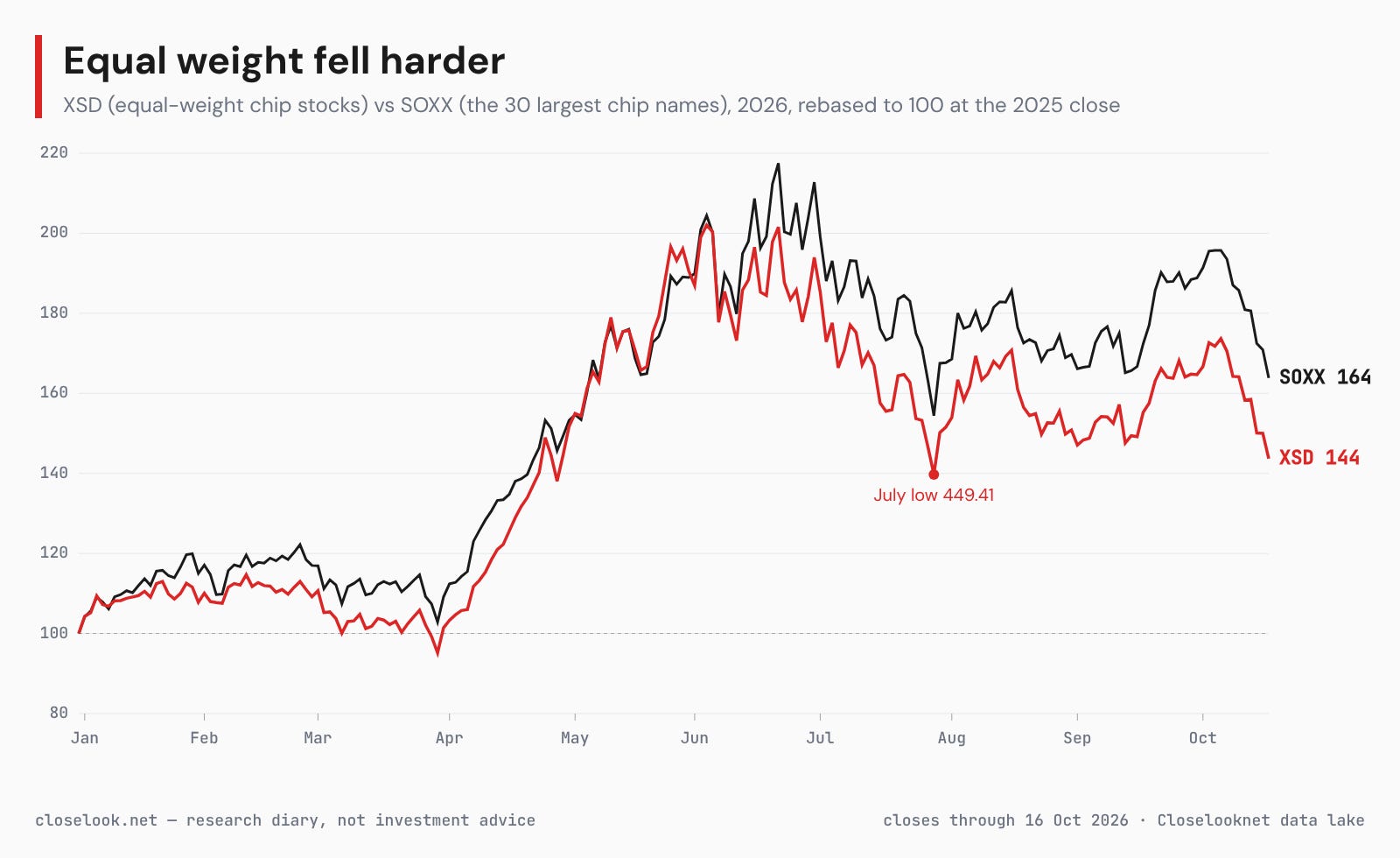
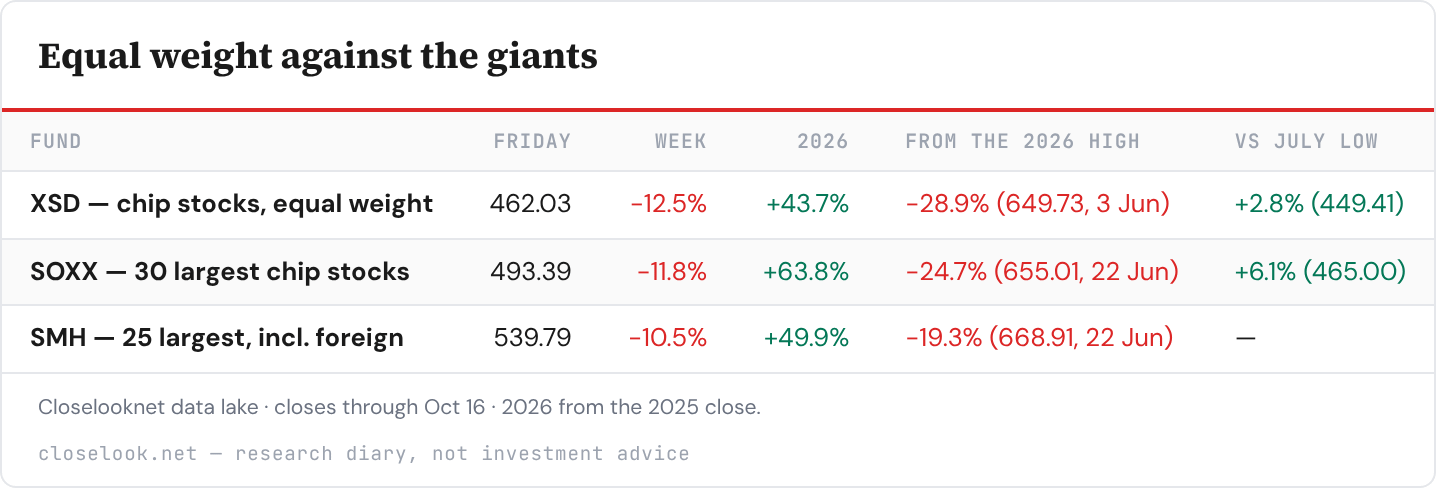
Table as text
Closelooknet data lake · closes through Oct 16 · 2026 from the 2025 close.
The largest chip stocks held up better than the funds — with one exception, Broadcom. Nvidia fell 6.6% on the week to 214.13 and is only 10.5% under its record close of 239.24, set on 6 October; it is the strongest of the big names. TSMC’s ADR fell 9.0% to 412.61, 15.1% under its 5 October record of 485.80. Both lost less than any of the four funds. Broadcom fell 9.1% to 328.75, but it is 31.7% under its June record of 481.57 and lower than a year ago — the one giant that has been weaker than the funds all year. The memory makers fell hardest this week: Micron 14.6% to 878.84 (27.6% under its June record), Samsung Electronics 17.7% in Seoul and SK hynix 24.3%.
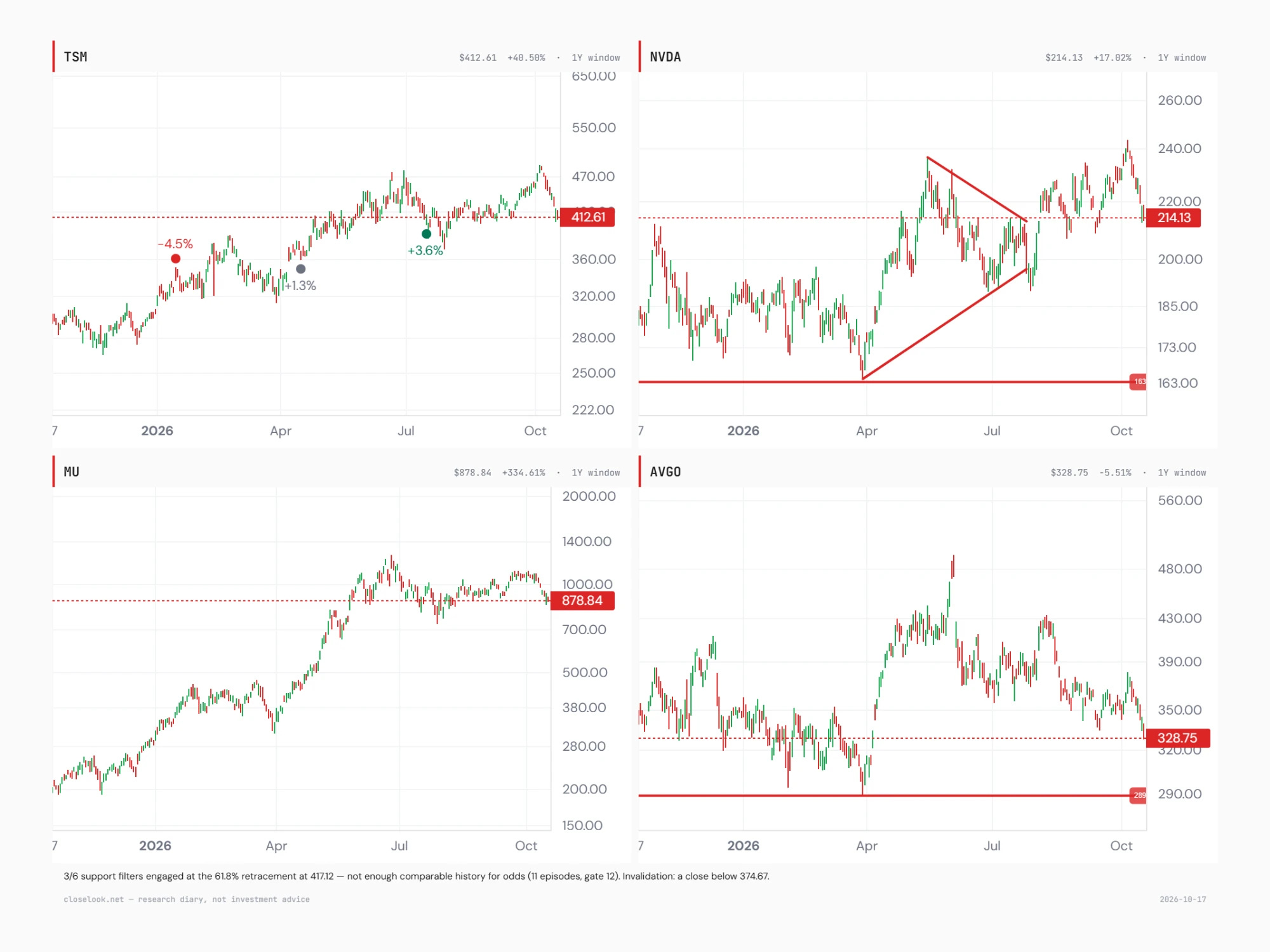
That shapes the editor’s plan. In his words, XSD is the fund to watch as the signal; when the next leg up comes, the money may be better focused on the big chip makers — TSMC and Nvidia, and in memory Samsung, Micron and SK hynix. The equal-weight fund tells you when the second tier has finished falling; the leaders are where the editor expects a new advance to be carried.
5 · The test: Texas Instruments reports next week
The first chip report inside XSD this season is Texas Instruments, listed for Wednesday, 21 October (calendar listings; not yet confirmed by the company). TI is the largest maker of analog chips — the parts that manage power and signals in cars, factories and phones — and its outlook is the best single read on the half of XSD that held up this week. Lam Research, a chip-equipment maker outside XSD, is listed for the same day and speaks to how much the industry plans to spend on new factories. A steady TI outlook would support the view that this is a sell-off in the AI fringe, not in the industry. A weak one would put the analog half of the fund in play too.
6 · The levels
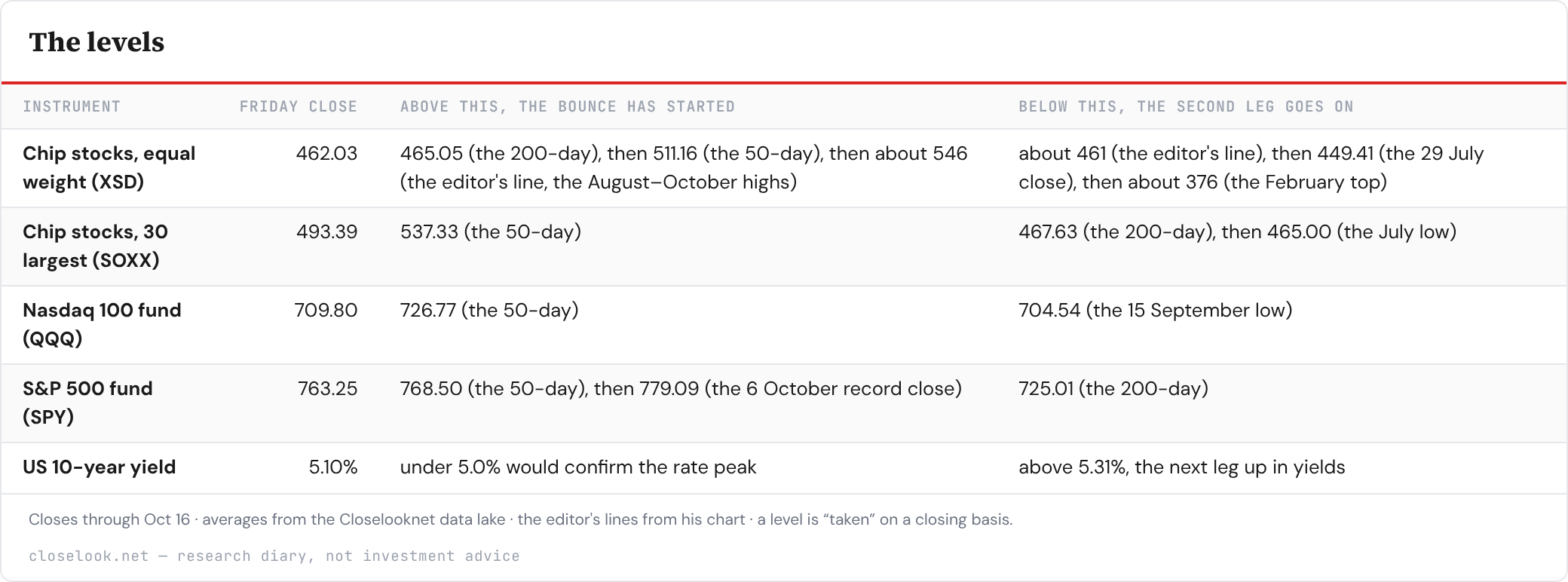
Table as text
Closes through Oct 16 · averages from the Closelooknet data lake · the editor’s lines from his chart · a level is “taken” on a closing basis.
7 · The questions ahead
Does XSD hold the July low of 449.41 on a closing basis — the line the editor expects to give at least a bounce? Does a bounce stop under the 50-day average near 511, the way the August bounce stalled at 546? Does Texas Instruments’ outlook keep the analog half of the fund steady? And do the AI-connectivity names that led the fall — Credo, Semtech, MaxLinear, Astera Labs — stop making new lows?
Our read, stated so it can be scored: the equal-weight chip fund is in the second leg of its decline from June; the July low may give a bounce, but on the record the final low comes weeks to months after the first one, so we expect this leg to end slowly rather than in a single turn. The editor sees this second leg as a major buying opportunity: XSD is his signal to watch, and the next leg up is where he would focus on the big chip makers — TSMC, Nvidia, Samsung, Micron and SK hynix. His view for this diary, not a recommendation. A weekly close under 449.41 would say the second leg has further to run, with the old February top near 376 the next level on his chart. A weekly close back above the 50-day near 511 would say the July low has held a second time.
8 · The count
The Nasdaq 100 fund fell 5.5% to 709.80, under its 50-day and 5 points above the 15 September low; the S&P 500 fund lost 2.0% to 763.25, back under its 50-day, while the equal-weight S&P rose 0.5%. Staples, health care, energy, materials and utilities all rose. The long Treasury fund gained 2.65% and the 10-year yield ended at 5.10%, down from 5.24%; oil rose 9.2% and gold slipped 0.7%. Money moved out of the year’s winners and into what is cheap, steady and paid in dividends.
One sentence to close, because a diary should say what it actually thinks. The second tier of the chip industry has given back almost all of its bounce in eight days and stands at its July low, the AI fringe sold and the old analog makers held, and the record of four past double-dip declines says the bottom tends to be a process of months that, once built, has paid — which is why the editor watches this fund as the signal while the big chip makers, led by Nvidia only 10.5% off its record, are where he would look for the next leg. Probability, not prophecy. We monitor, and we score it next Sunday.
Related on Closelooknet: XSD on the terminal · SOXX · Texas Instruments · Inside XSD · Rubin Build-Out 100 · Sunday’s US letter · Daily Pulse