


Two beats were sold, two beats were paid, two misses were executed — and the semiconductor band cracked one day after our add completed.”
Closelooknet is a reader-supported publication — to receive new posts and support the work, become a free or paid subscriber.

This week’s edition of Closelook@US Stock Markets, dated July 26, 2026.
Last week ended with a question — was Friday’s round trip a spring or the last reclaim? — and this week answered it twice. First the bulls’ way: the semiconductor index rallied six percent off the washout, reclaimed its June zone, and on Tuesday closed within two dollars of the broken 554 line. Then the bears’ way: a rate repricing that took September hike odds from one-in-five to four-in-five, an oil print through $100, and a Friday that closed the chip complex below its capitulation band — on the day Intel reported its fastest revenue growth in fifteen years and was sold eight percent for it. In between, six of the biggest prints of the season landed, and the market applied one consistent rule to all of them: it did not score the earnings. It scored the layer of the stack the company lives in. That rule — who gets sold on a beat, who gets paid on one — is the whole letter.
1 · This Week’s Action
The tape, day by day. Monday drifted; the week was always going to start Wednesday night. Tuesday gave the bulls their evidence: SOXX closed at 552.69, a full reclaim of the June zone that stopped almost exactly at the old 554 floor — tested from below, not regained. Wednesday was verdict night: Alphabet held the beat, raised its capex path again and showed Cloud accelerating; ServiceNow beat on essentially every line; IBM missed with a cut, its mainframe segment down 42% against distributed compute up 37% — the product cycle turning inside one income statement; Tesla missed. Thursday the macro arrived: spot crude traded through $100, September-hike odds spiked toward 80%, the tape fell 2% — Tesla −13.7%, Alphabet −6.5% through its 200-day on a raised guide, gold failing its haven test — while SAP printed positively and rose 6% off its 52-week low and Intel rallied 10% into its own report. Friday sorted the survivors: Intel’s double-beat was sold 7.9%, SOXX fell 4.4% to 527.01 — below the 530–532 band, QQQ broke 694 on its third test — and on the same tape SAP rose another 9.3%, ServiceNow 7.4%, and the S&P closed green with ten of eleven sectors up.
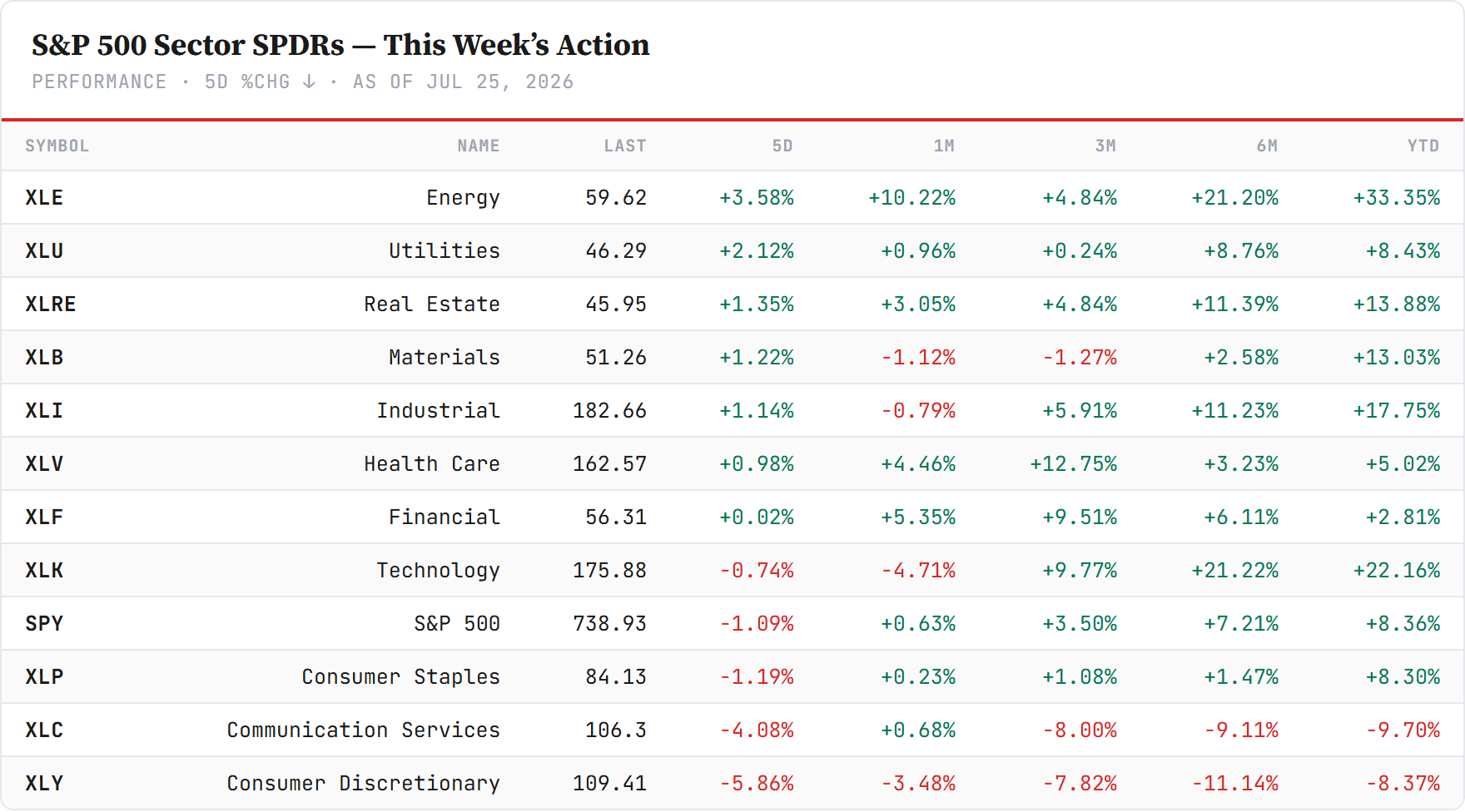
The sector read. Energy led for the third straight week (XLE +3.6%, +33% YTD) with utilities (+2.1%), real estate (+1.4%), materials (+1.2%) and industrials (+1.1%) behind it — the defensive-and-real shelf, again. The bottom two sectors are really two stocks: consumer discretionary −5.9% is Tesla’s −19% week wearing a sector costume, and communications −4.1% is Alphabet’s. Tech itself closed just −0.7% — because inside it, one complex cracked and another rallied, and they nearly cancelled.
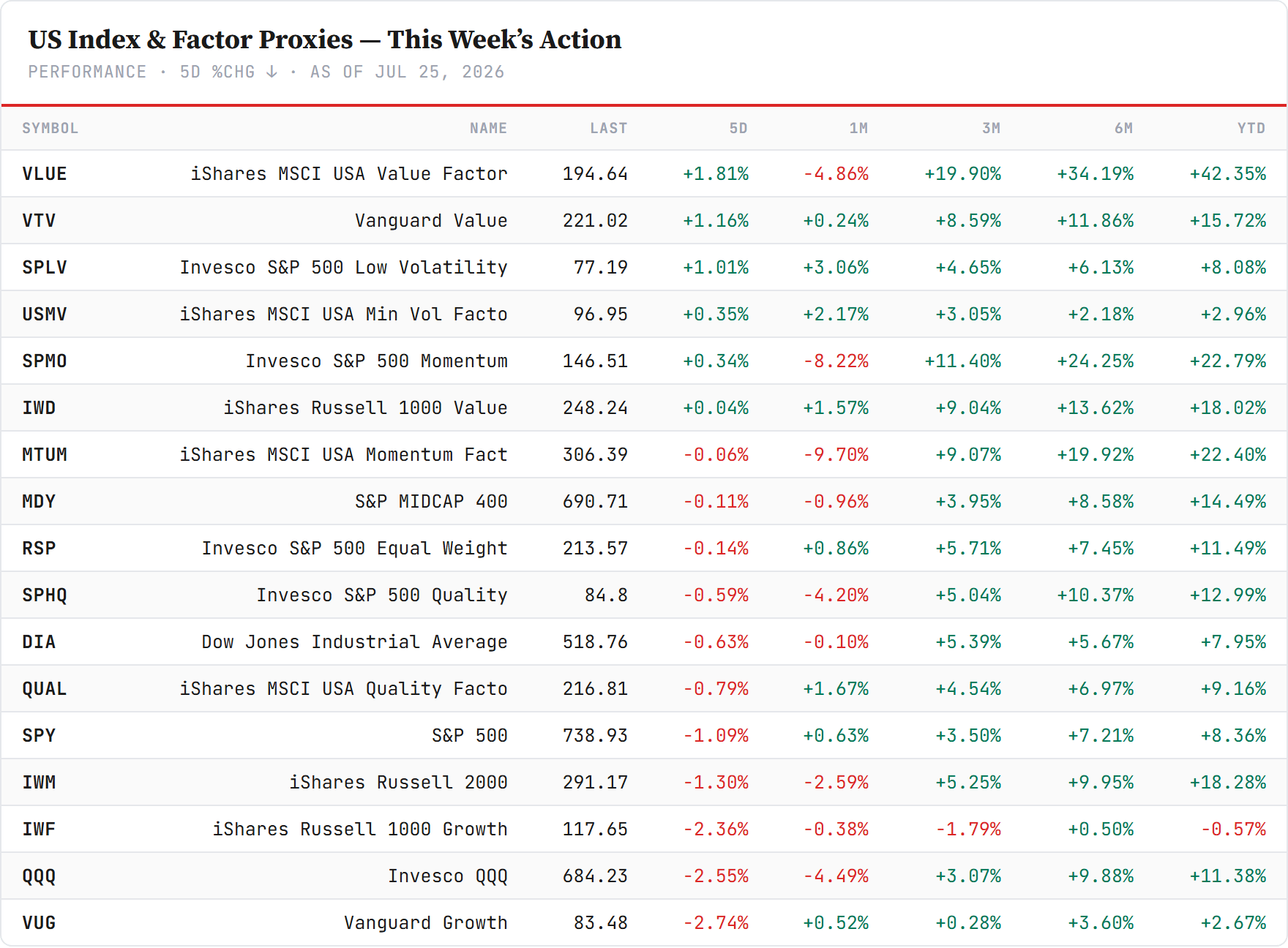
The factor read — the average stock skipped this week. The equal-weight S&P closed at −0.1% against the cap-weighted −1.1% and the Nasdaq’s −2.6%; value gained 1.8% while growth lost 2.7%; low-vol and min-vol were green. For the second stress episode running, this is a concentration event, not a market event — the damage lives where the index weight lives.
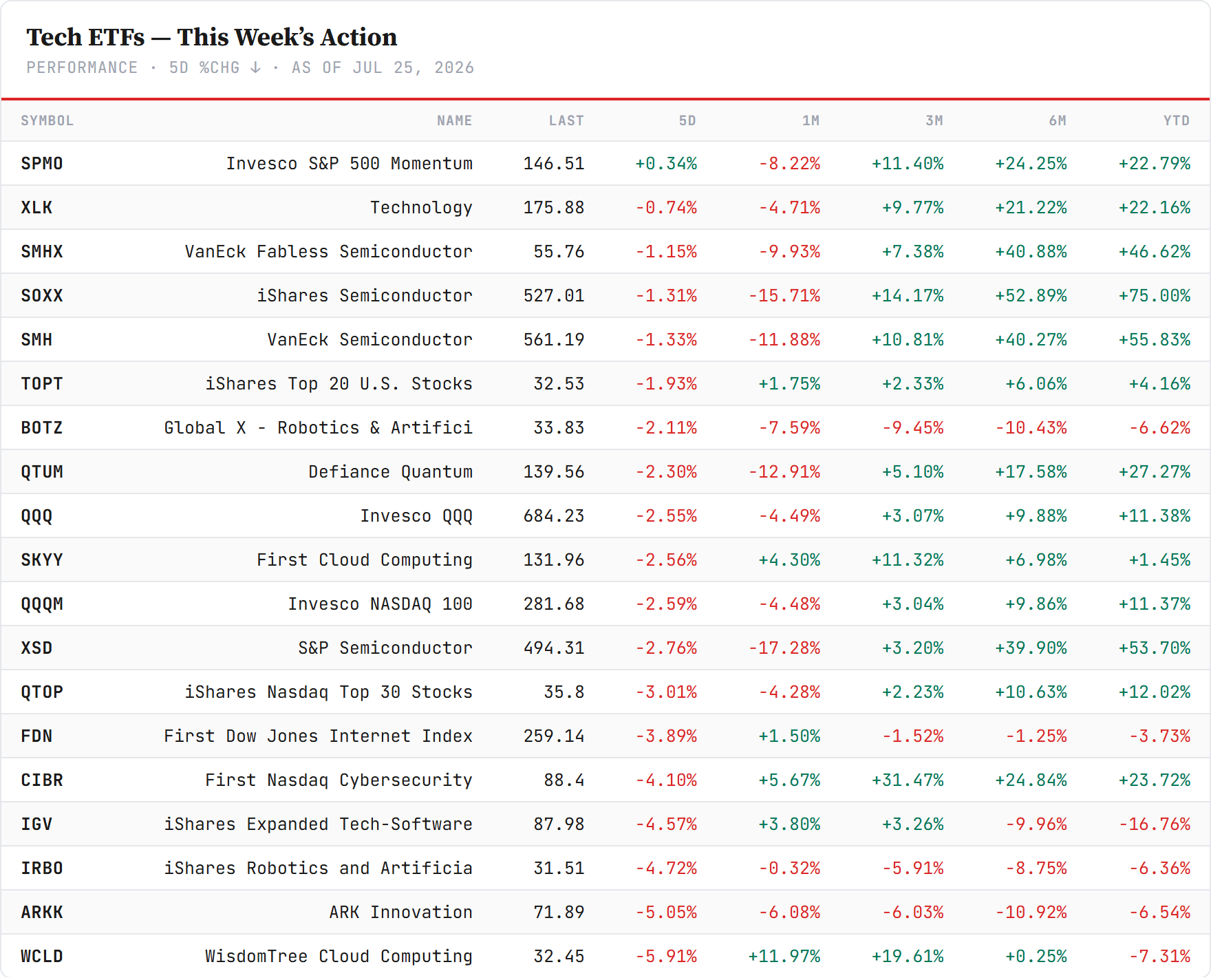
Inside tech. The weekly numbers hide a violent round trip: SOXX’s −1.3% week contains a six-percent reclaim and a six-percent rejection. The month-scale ledger is the honest one — SMH −11.9% over a month against cloud software +9.2% and the broad software basket +3.8%, a twenty-point spread inside “tech.” And July’s semiconductor breadth is three green names out of twenty-two: NVIDIA, AMD, ASML — everything else red, Intel −30% for the month with the season’s best print. The complex is being repriced from its speculative edge inward: on Friday the chip-designer sleeve (XSD) fell hardest, the broad complex least.
2 · The State
The rule the reaction function is running. Line up the week’s six verdicts and the pattern is not subtle. Beats sold: Alphabet — held guide, raised capex, Cloud accelerating — closed the week −8.9%, below its 200-day. Intel — earnings roughly double the estimate, revenue +25%, its best growth since 2011 — jumped double digits after hours and gave back the entire move by Friday’s open, closing −7.9%; the reversal tracked the one number in the release that wasn’t about the quarter: Intel raising its own capex plans. Its record now reads three beats, zero relief rallies, eight declines. Beats paid: SAP +9.3% on Friday alone, ServiceNow +7.4% — the two names that used their calls to claim the same seat: orchestrator of the agentic enterprise. Misses executed: Tesla −18.9% on the week, unrescued; IBM sold on the cut. The market is not grading earnings anymore. It is grading position in the emerging stack — and this week it told us which transition it is pricing. We published the orchestration half this week — the Pulse (Agentic AI: The Orchestration Knock Out) and the long read (The Agent Is Not the Product. The Orchestrator Is.). The other half has a name too.
The handoff, named: capex → opex. Every infrastructure cycle runs the same sequence: first the market rewards building the capacity, then operating it, then using it. The switch between the first two does not happen on a date — it happens when the constraint moves from building AI to operating and monetizing it, and the market’s tell is precise: capex announcements stop producing positive reactions. That tell printed twice this week, on both sides of the same trade, within 24 hours. Wednesday night the demand side: Alphabet’s quarterly capex ($44.9B) exceeded its operating cash flow — quarterly free cash flow printed negative for the first time on record — while the full-year guide rose toward a ~$200B midpoint and disclosed purchase obligations swelled dramatically (a number to handle with care: those commitments span far more than chip orders, so they support the build’s visibility without being a semiconductor backlog). A marginal-return warning, not a financing crisis — trailing-year cash flow remains solidly positive — but the question changed from how much are you building to what does it return. Thursday night the supply side answered with the same sin: Intel, spending well ahead of its own cash generation, raised capex again — and the market sold the season’s best print for it. When both sides of a trade are spending beyond their cash flow, the sustainability of the orders in between becomes the risk. That is what Friday repriced.
The repricing, read at the sector degree. Sort Friday’s tape by dependence on future hyperscaler orders and the market’s new rule is legible in the sleeves before any single name: the chip-designer cut fell hardest, the broad complex less, the diversified complex least — the same speculative-end-first hierarchy the whole July de-rate has followed. The equipment sleeve repriced before the chip sleeve, as it always does — capex changes reach order books before they reach shipments — and behind it the physical layer of the build (the power, cooling and grid-connection complex) took three-to-five-percent hits as a group: fewer data centers under construction means fewer of everything those buildings contain. Meanwhile the software shelf next door was green. One number quantifies the whole boundary: the spread between the complex’s most order-dependent name and its most usage-priced one was seven points in a single session — the market drawing the line between what is priced on orders and what is priced on workloads. The full name-by-name ladder is Sunday’s Hypergrowth material; what belongs here is the architecture it reveals.
The four layers, named — the thesis this letter now runs on. This week forced the AI trade apart into four layers, each with its own index expression and its own verdict:
AI Capex — the build trade (the semiconductor complex, the broad build-out index): repriced. Priced on order flow whose sustainability is now the open question; the band crack is this layer’s chart.
The Rubin constraints — scarcity inside the build (test & verification, metrology, consumables, advanced memory and packaging — the layers that get more scarce, not less, when designs and deployments multiply): held. The Handoff Board’s inside-Rubin ratios — verification-versus-design and consumables-versus-tools — were green through the crack week. When the broad capex trade de-rates, the constraint layers are where the build’s value concentrates.
AI Opex — the operating layer (software’s consumption side, security, observability, orchestration; our Agentic Infrastructure index, +38% YTD): paid. The orchestrator Friday was this layer’s coming-out session.
AI Beneficiaries — the using layer (the Agentic Winners cohort): selective, print by print. No basket treatment yet — this layer must show attributable economics name by name, and mostly hasn’t.
The market stopped trading “AI” this week. It started trading the layers — and every index needed to score that transition is already on the site.
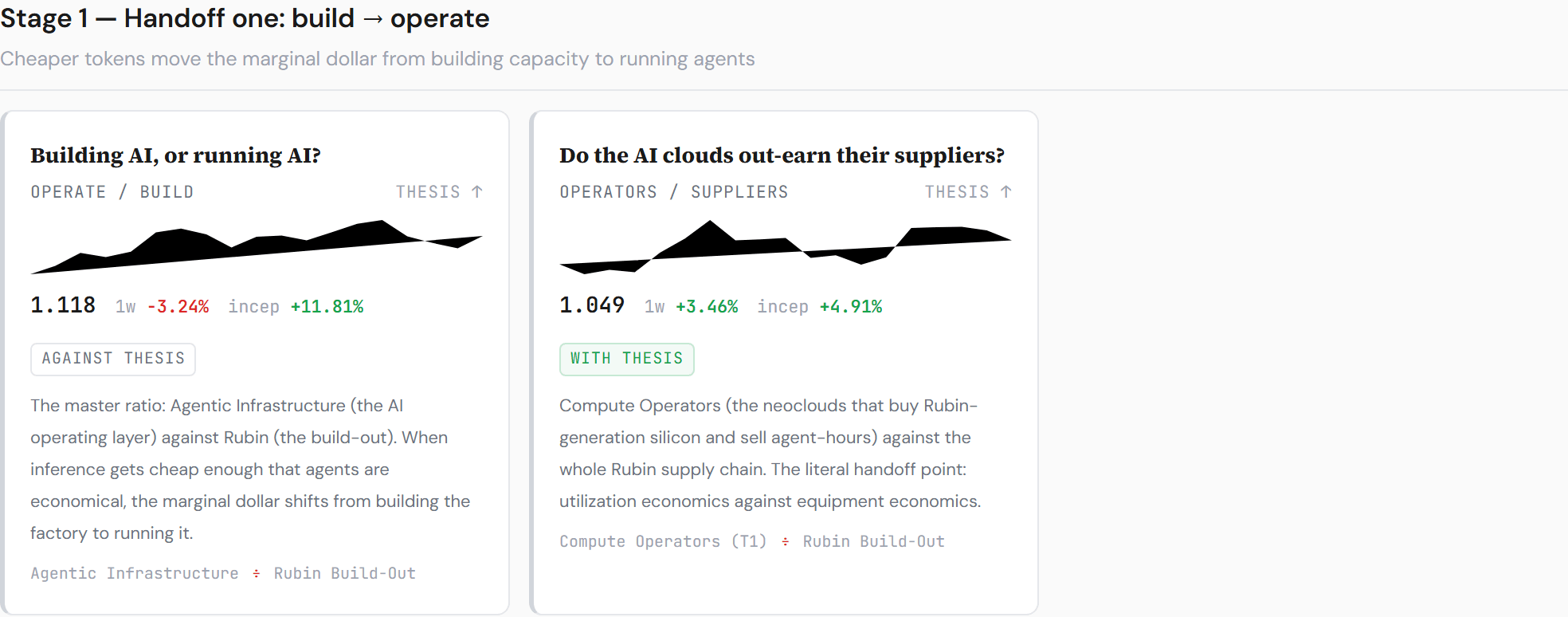
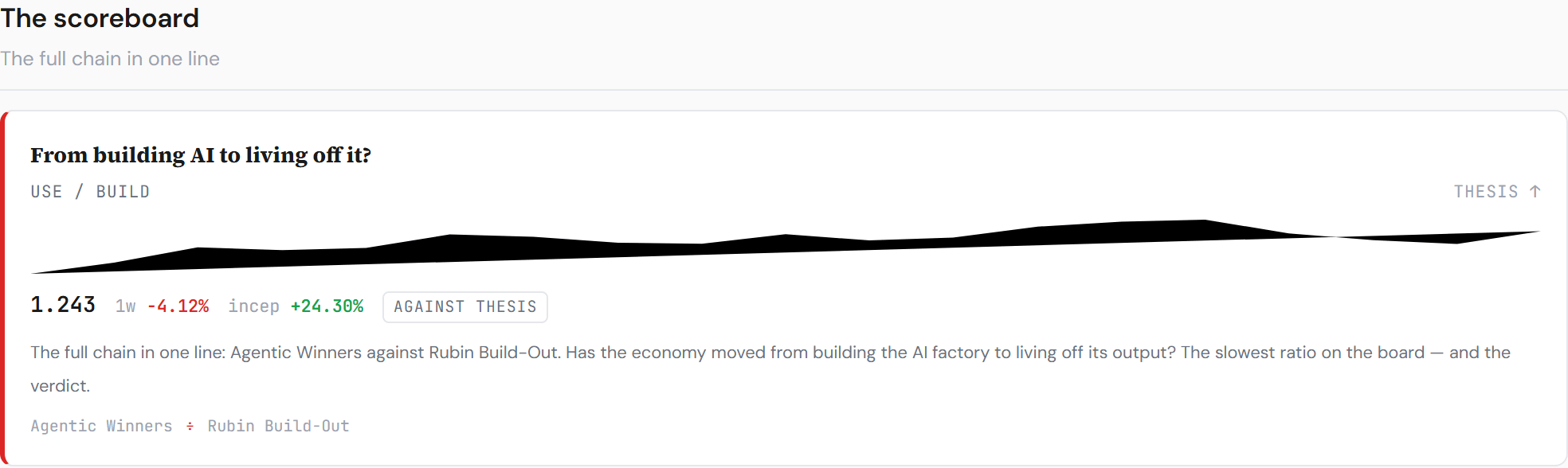
The house instrument already tracks this — and it agrees. We built the AI Handoff Board precisely for this transition: nine ratios measuring value migration across the three-index chain — Rubin builds, Agentic Infrastructure operates, Agentic Winners use — each normalized to 1.00 at June 30. The readings as of Friday: the master ratio (operate ÷ build) stands at 1.12 — the operating layer has re-rated 12% against the building layer in four weeks; the scoreboard (use ÷ build) stands at 1.24. This week both ratios dipped — Rubin stabilizing while the operators gave back — which is exactly what a broadening looks like as opposed to a clean replacement. The board is the standing referee for everything this section claims, updated daily, in public.
The macro engine underneath. None of this happened in a vacuum: Thursday’s flush repriced the September meeting from roughly 20% hike odds to above 80%, real yields pressed toward 3%, and — the week’s signature — Treasuries fell with stocks (IEF −0.8%, TLT −1.3%). A tape where bonds can’t catch the safety bid is a tape repricing its discount rate, and the most extended complex on the board absorbed the hit. Oil is the input behind the odds — spot through $100 this week — but the full term-structure read (and why the December contract near $80 says temporary) is Saturday’s Global letter; for the US tape the transmission is one line: oil → inflation odds → the discount rate → the concentrates.
The levels, and what broke. Tuesday’s 552.69 close is now the defining rejection — the old 554 floor confirmed as ceiling. Friday’s 527.01 close sits below the 530–532 June capitulation band (the first close-basis crack in that band since the spring advance) but above the 522.24 June washout line. One degree up, the escalation line we flagged last week — QQQ closing below the 686.37/686.76 double-washout floor — fired: Friday’s third test of 694 resolved as a break, and the 684.23 close sits two points beneath the floor. And yet the degree above that refused to confirm: the S&P closed green on Friday, the equal-weight was flat on the week, and ten of eleven sectors rose. Last week’s containment question has a split answer — the Nasdaq degree cracked, the market degree did not. Both facts are in ink; neither cancels the other.
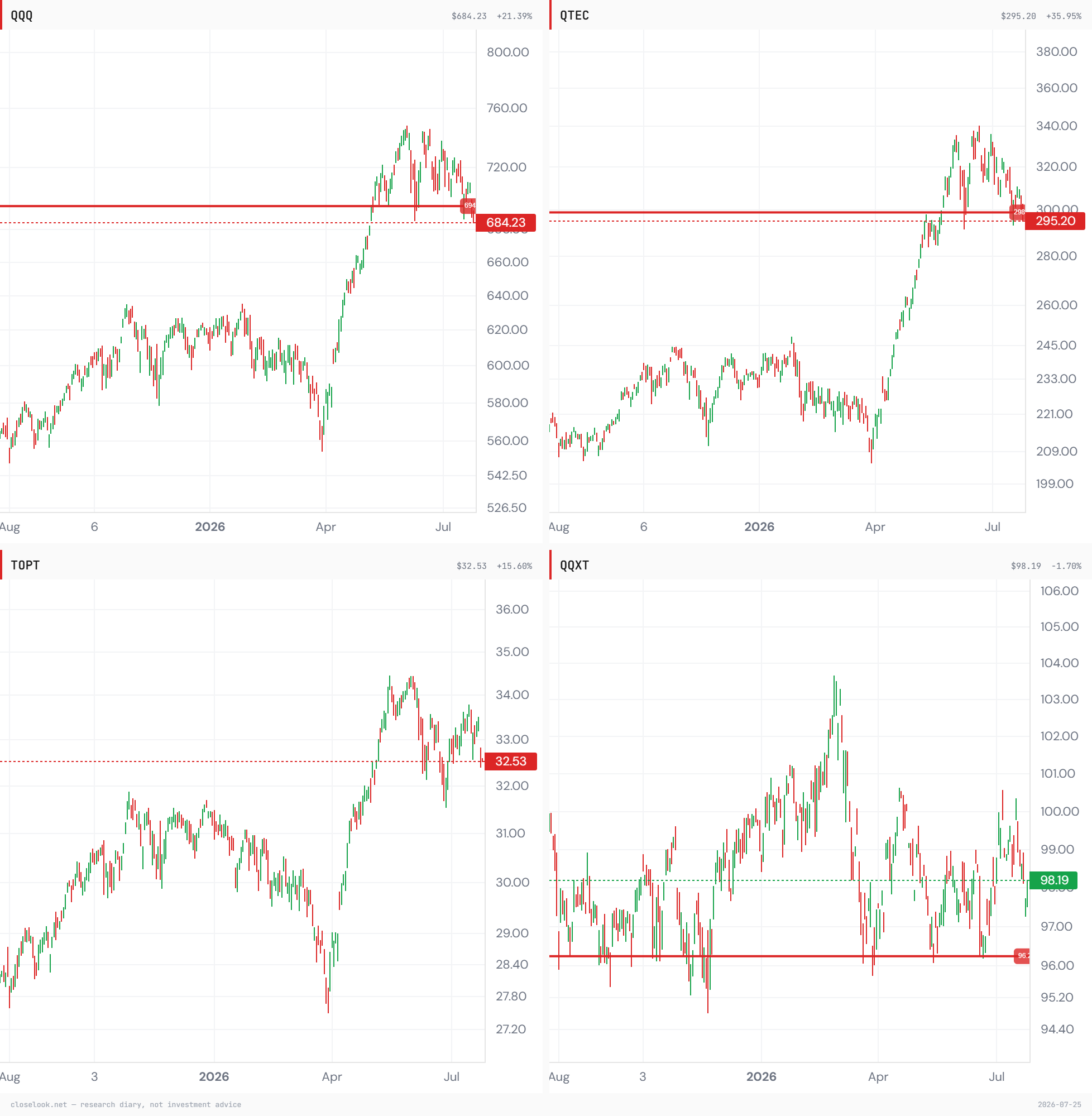
The quiet strength, read correctly. NVIDIA finished the week green (+0.5%, above both moving averages) and was the only major AI-hardware name to sit Friday out — not an accident, per the boundary above: it is the one name in the complex priced on workload execution rather than on the next order. A sector-degree break that its usage-priced leader declines to confirm is not yet a bear market in the AI trade — it is the market splitting the AI trade along the order/usage line. Whether the leader eventually pulls the complex up or the complex pulls the leader down remains the cleanest single tell in the US book.
3 · The Outlook
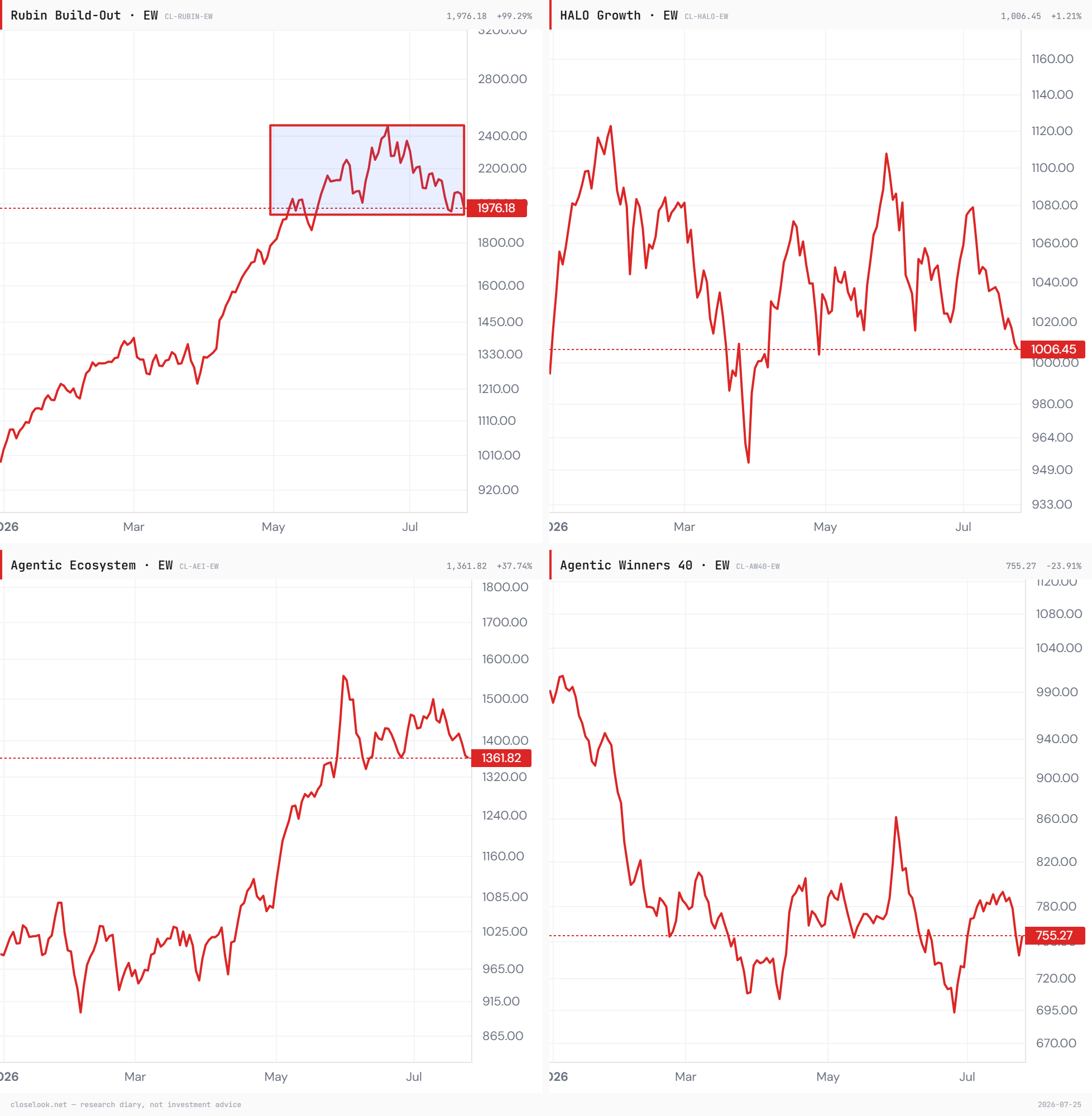
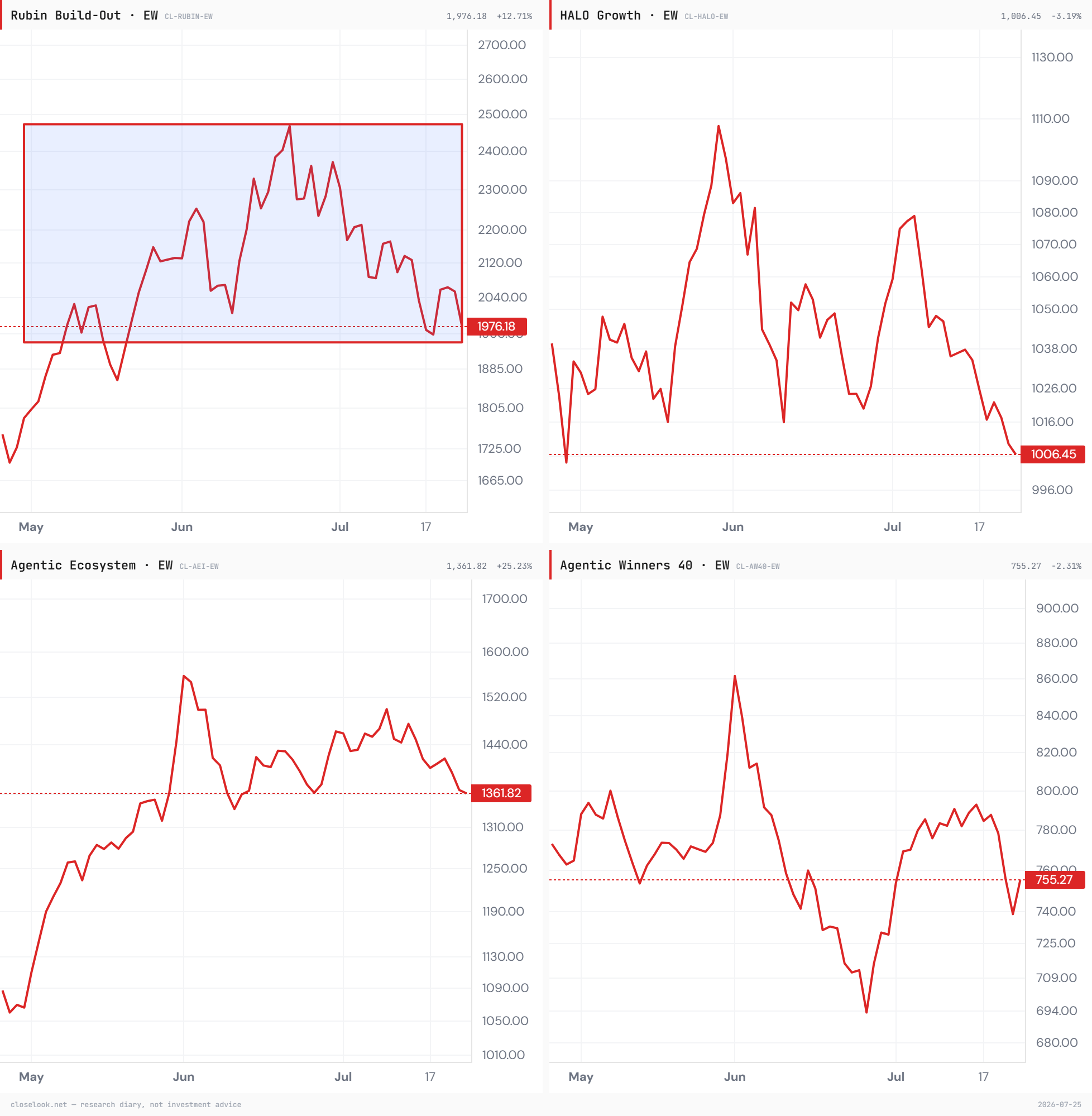
The four indices — the reaction rule, visible in our own instruments. The sold-the-beat/paid-the-plane rule from §2 printed straight through the Closelook index family. On the week: Rubin +0.4% (+92% YTD) — the build-out stabilizing after its washout, even as its ETF proxies cracked. AW40 −3.7% (−23% YTD) — but +2.2% on Friday alone, the orchestrator day, the index’s Control-Plane cohort doing exactly what SAP and ServiceNow’s tape did. The Agentic Ecosystem −2.9% (+38%), HALO −1.9% (−1%). One tape, four different verdicts — the AI trade is no longer one trade, and the full four-bucket flow system behind these numbers is the Hypergrowth letter’s home turf (also out this Sunday). Here the Agentic Winners index earns one sentence: it is where the orchestration thesis gets scored print by print, in an index, in public.
The regime gauge. Money Temperature at 50, up from 44 — back to dead-neutral. The forced-selling phase cooled; nothing euphoric replaced it. At 50 the market funds rotations, not chases — which is precisely what the sector board shows.
What would confirm the handoff — the diary’s checklist. One violent Friday names a transition; it does not confirm one. We will call the capex→opex handoff confirmed when, and only when, several things print together: capex raises keep getting sold across the hyperscalers (Wednesday and Thursday are live tests); analysts stop raising out-year estimates for equipment and memory while orders are still strong; consumption-linked revenue — inference, observability, security, orchestration — visibly accelerates off the installed base; and the opex names show attributable AI revenue, not “AI is a tailwind.” By that standard, July 23–24 was the opening shot, not the verdict: confirmation needs roughly two earnings cycles of relative estimate migration, which points at the second half of 2026 as the transition window. And the both-hands clause, stated plainly: this is a broadening, not a replacement — inference growth itself demands compute, so the usage-priced end of the hardware complex can stay a winner while the order-priced end de-rates. The vulnerable cohort is narrow and specific: marginal, long-duration capacity whose valuation requires hyperscaler capex to accelerate forever.
The week ahead is the season’s center of gravity. Cadence prints Monday — one session after Kimi K3’s promised weights release, making it the one name carrying both the design-shock verification and the sold-beat regime at once. Then the block that funds the entire AI trade: Microsoft and Meta on Wednesday, Amazon and Apple on Thursday — the four largest capex budgets reporting within 24 hours, into a cracked semiconductor band, an 80% hike probability, and month-end flows. Our Microsoft print-record card carries the season’s sharpest stat into Wednesday: twenty beats in twenty quarters — and a stock that has been sold anyway in the recent ones. If the sold-beat rule survives that print block, it is a regime. If it breaks, Friday’s crack loses its sponsor.
4 · What May Lie Ahead
The levels, updated. SOXX: the map now reads 530–532 as overhead (the band, lost on Friday’s close), then 522.24 (the June washout line — Friday closed 527.01, between the two), then the primary rising channel floor near 520 — the line that decides whether the down-channel from the June highs stays corrective — and below it Friday-of-last-week’s 498.54 print. The structural read is unchanged from our chart work: the decline from June still counts as a flag-shaped correction while the channel floor holds. QQQ: 694 and the 686.37/686.76 double-washout floor are both overhead now — Friday closed 684.23, the first close beneath the floor; a fast reclaim of 686–694 would mark Friday as a false break (SPY’s green close argues that branch is live), while acceptance below it points the map toward the June congestion zone. SPY: green Friday, ~745 (the 50-day) overhead, structure intact. Alphabet: closed 319.74 against the 200-day at ~324 — the raise-and-sold print leaves it below the line institutions defend; a reclaim would be the first evidence the collector-selling is exhausting. Intel: the 3-0-8 record needs no level — it needs a reaction regime change.
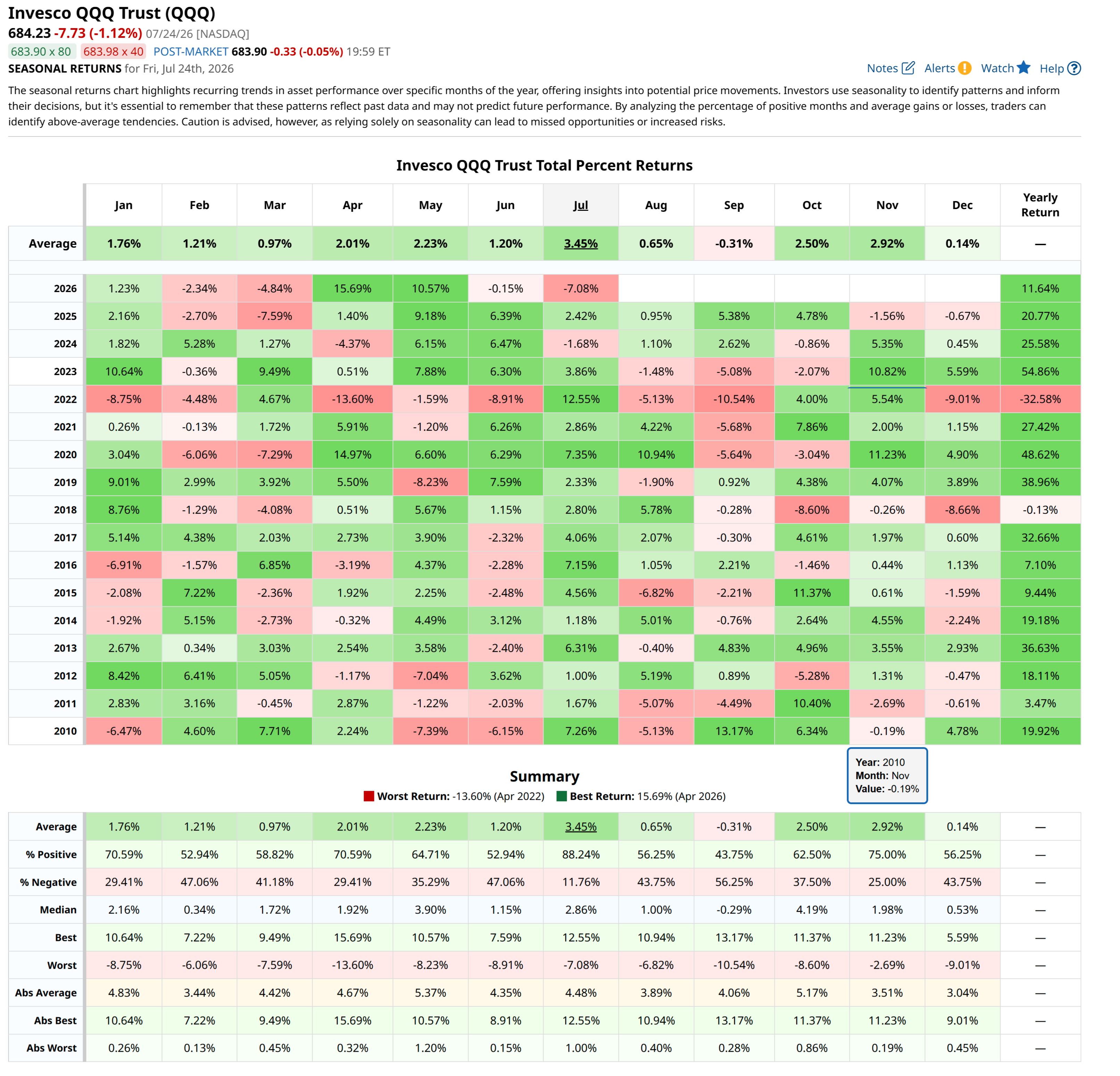
The calendar just testified — against itself. July is, by a wide margin, QQQ’s most reliable month: +3.45% average, positive 88% of the time — 15 of the last 17 years. July 2026 printed −7.08% — not merely the first red July since 2024, but the worst July in the entire 17-year sample, more than four points beyond the previous worst. When the strongest seasonal tailwind of the year produces the worst print in its own history, the message is not seasonal noise — it is that something in the tape currently overpowers the calendar’s most dependable pattern. And the calendar now stops helping: August is mediocre on QQQ’s history (+0.65% average, 56% positive) and September is the only negative-average month of the year (−0.31%, positive less than half the time). The next reliably green columns are October (+2.50%) and November (+2.92%). The band cracked at precisely the moment the seasonal floor was scheduled to leave the building — which cuts both ways: the bears lose their “it’s just seasonality” objection for July, and the bulls lose the calendar as a crutch until October.
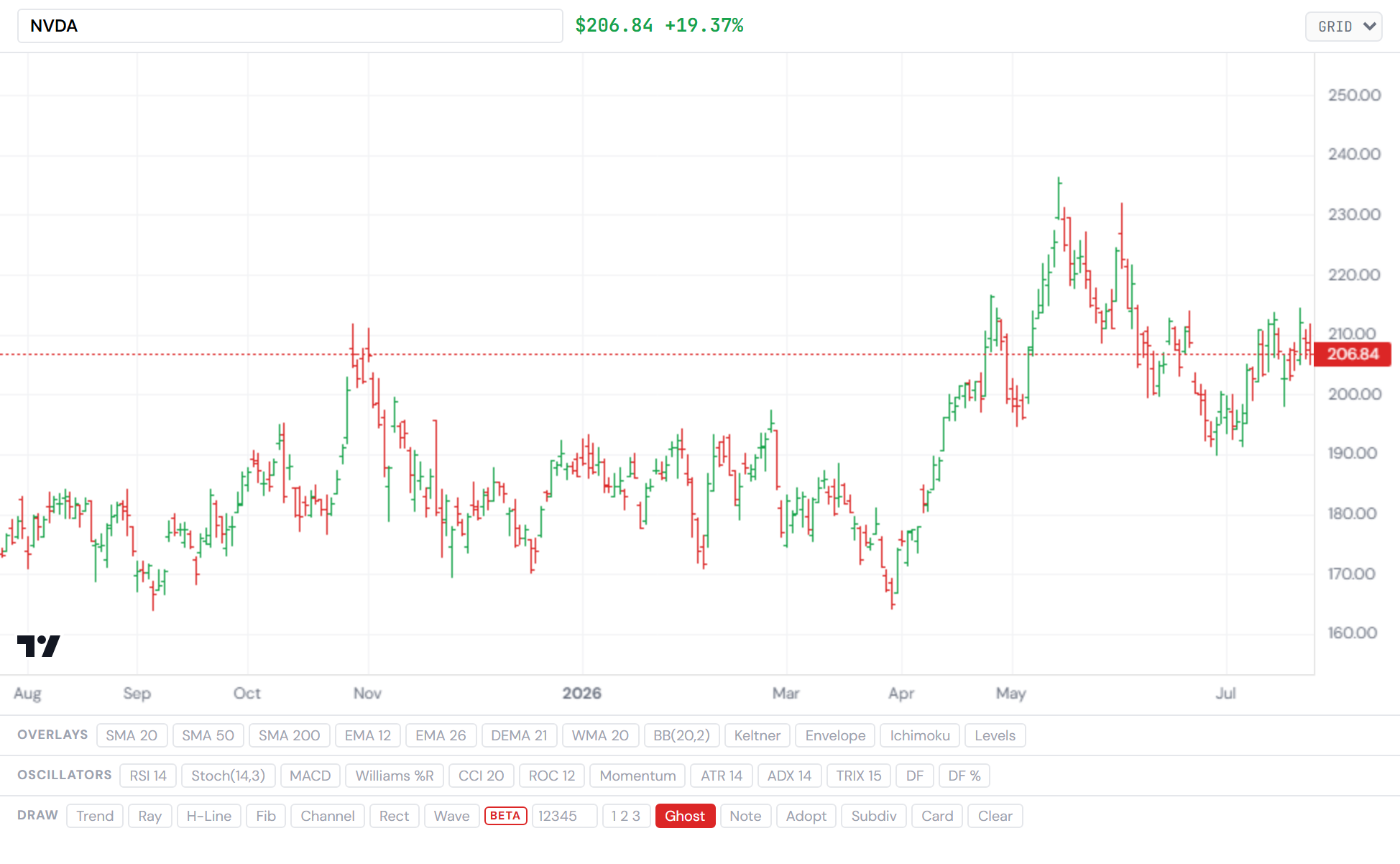
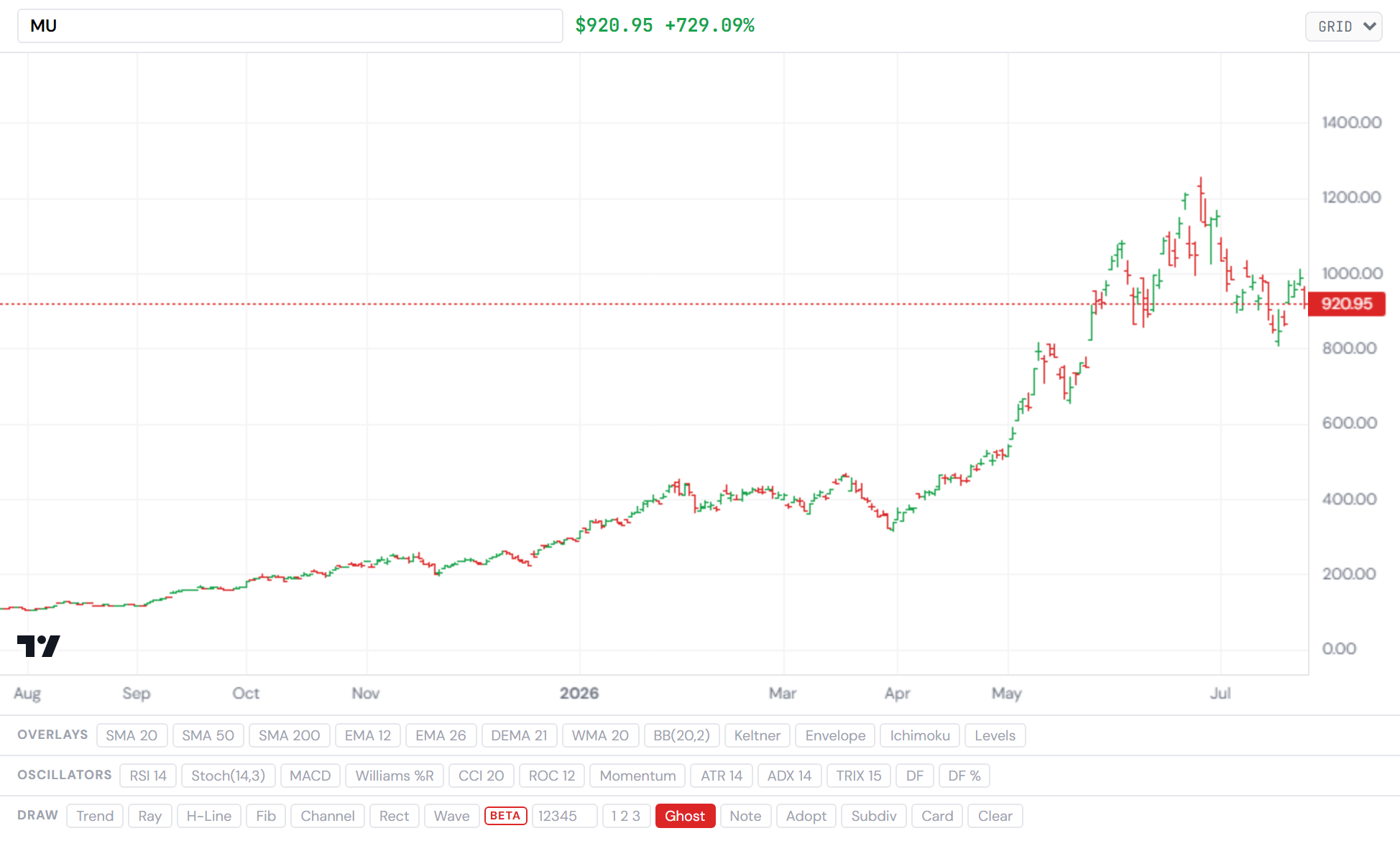
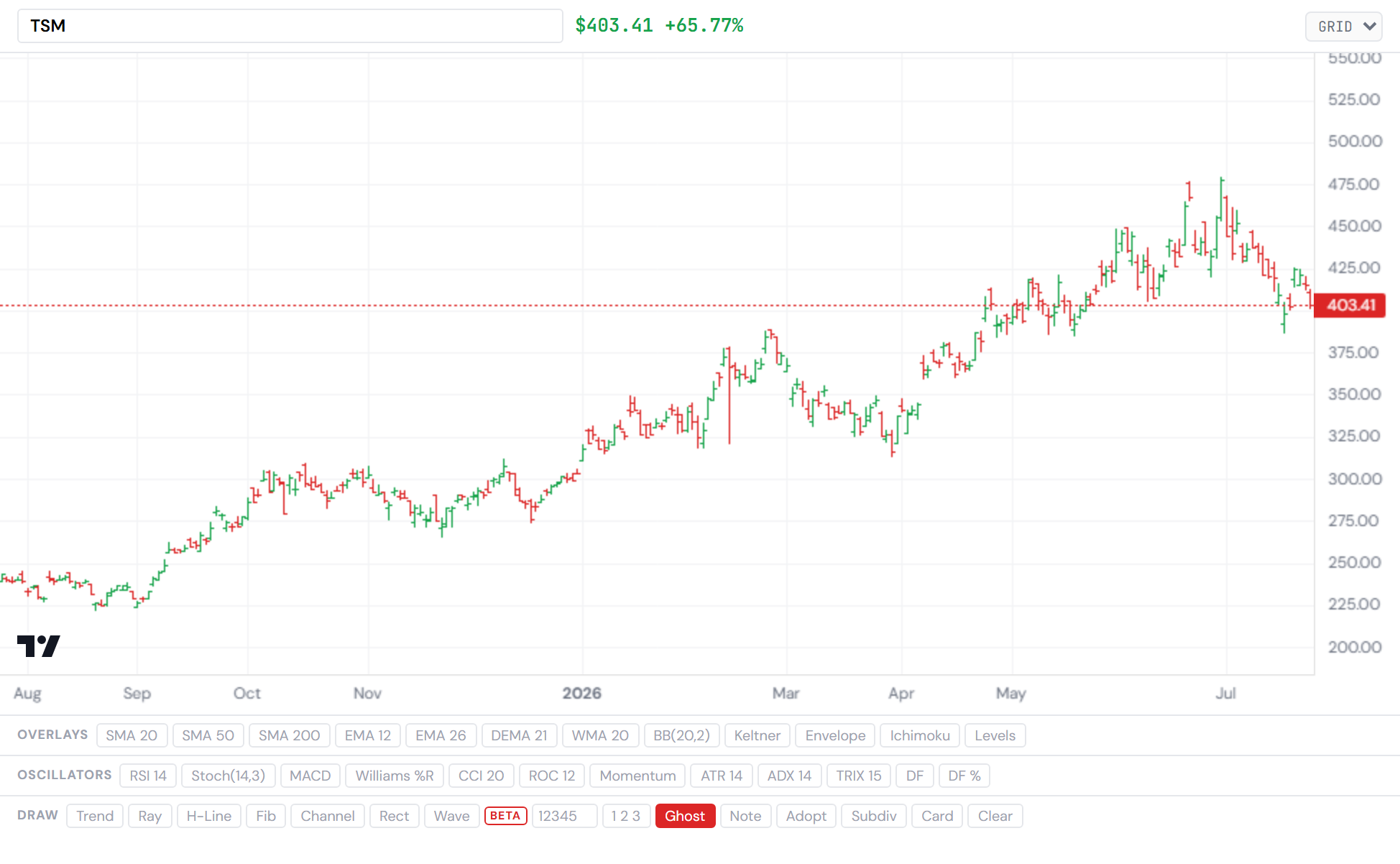
The three bellwethers. The architect diverged from its complex: NVIDIA +0.5% on the week, green, above both averages — the only major AI-hardware name that ignored Friday. Micron +4.0% — the first green week after a −24% month, the memory unwind pausing at scale. TSMC −1.1%, quiet, still below its 50-day (~426) but far above its July low: the paradox holder is consolidating, not breaking. A band crack with all three bellwethers flat-to-green is a very different animal from June 9, when they led the washout. Watch whether that divergence resolves upward (leaders pull the complex) or downward (the complex pulls the leaders) — it is the cleanest single tell in the US book right now.
