

The Angel with Bent Legs
How a boy from Pau Grande became Brazil's most beloved footballer — and died forgotten at 49

Pau Grande is not the kind of place that produces gods.
A factory town wedged into the hills north of Rio de Janeiro, it owes its existence to a British-owned textile mill that employed most of its residents and dictated the rhythms of their days. The houses are small. The streets are narrow. The nearest beach is an hour away. In the 1930s, when Manuel Francisco dos Santos was born there, Pau Grande barely registered on a map of its own state, let alone the world.
The boy arrived on October 28, 1933, with a deformed spine, a right leg that bent inward, and a left leg six centimetres shorter that curved outward. A doctor examined him and used the word “cripple.” His father, Amaro, was a factory worker and a heavy drinker of cachaça — a habit the son would inherit with devastating precision. His older sister Rosa watched the strange, waddling child chase birds through the undergrowth and gave him a nickname that would follow him to glory and to the grave: Garrincha. Little bird.
Nobody in Pau Grande expected Manuel Francisco dos Santos to walk properly, let alone run. The idea that he would become one of the most extraordinary footballers who ever lived was beyond absurdity.
The Botafogo Trial
He played barefoot on the dirt pitches of Pau Grande through his teens, already married and a father, showing no particular interest in a professional career despite possessing skills that left local defenders helpless. Football was a game, not a job. He was happy at the factory.
In 1953, at nineteen, someone arranged a trial at Botafogo, one of Rio’s biggest clubs. The scepticism was immediate. The coaching staff looked at his legs — one bowing out, the other curving in — and saw a medical curiosity, not a footballer. Then the trial began.
Garrincha was paired against Nílton Santos, a Brazilian international defender with sixteen caps and a reputation for reading the game better than anyone in Rio. Within minutes, Garrincha had nutmegged him. Santos, who had spent a career studying attackers, found himself chasing shadows. The ball went through his legs again. And again. Santos did something unusual for a proud professional — he walked to the Botafogo directors and told them to sign this boy immediately, because he never wanted to face him as an opponent.
Garrincha scored a hat-trick in his first match for the club, against Bonsucesso. He would play for Botafogo for 12 years, score 276 goals in 688 appearances, and become so synonymous with the club that, to this day, fans carry homemade banners with his image. At the Maracanã, the home team dressing room is called “Garrincha.” The away dressing room is called “Pelé.”
The Move That Didn’t Exist
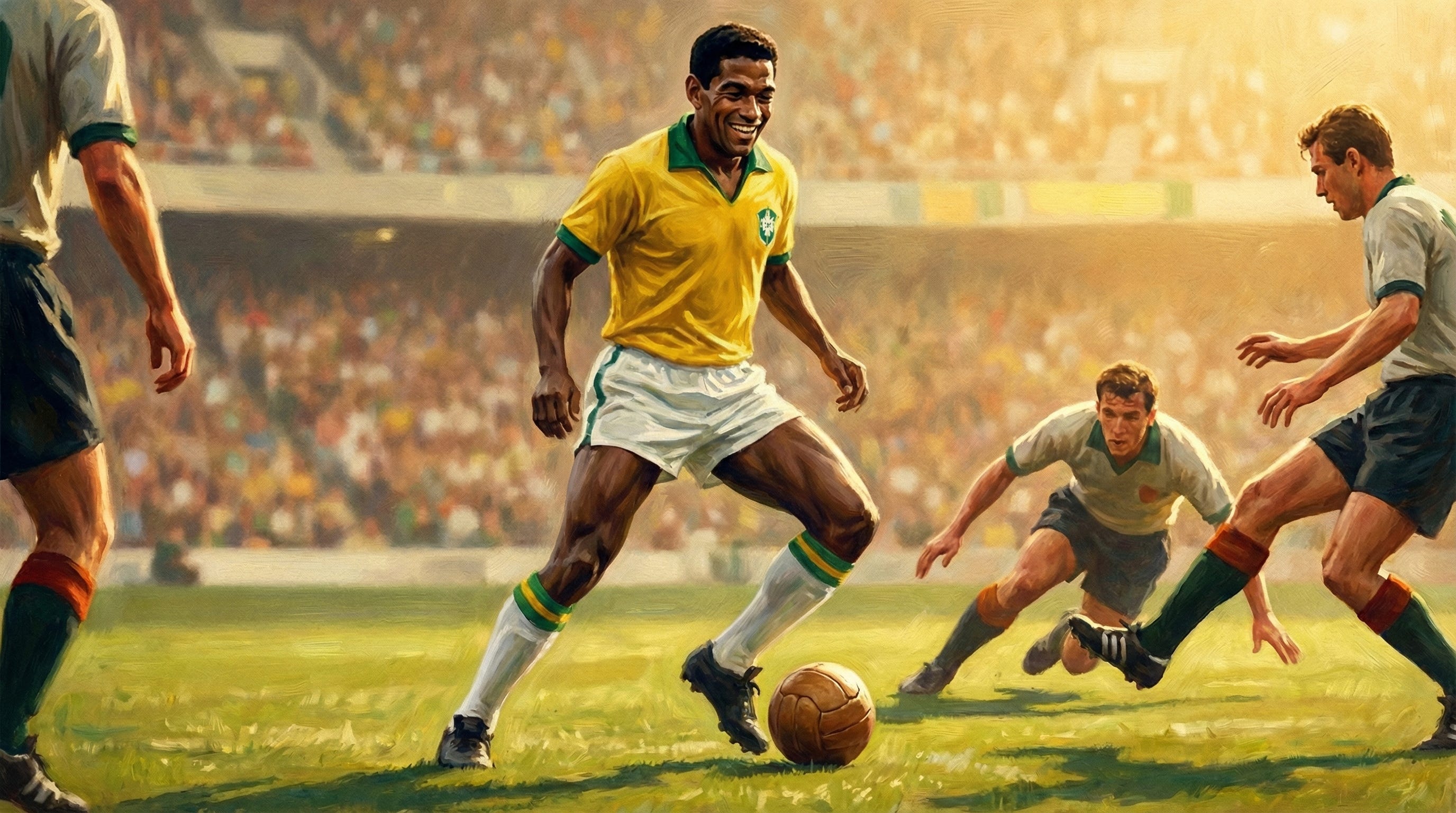
His signature was always the same. He feinted once, twice, swaying his upper body like a man about to lose his balance — which, given the architecture of his legs, seemed permanently likely. He darted back and forth, waited, and then exploded past the defender on the outside. Sometimes, having beaten his man, he would slow down and let the defender catch up. Then he would beat him again.
Nobody had ever seen anything like it. The writer Nelson Rodrigues called him “the Charlie Chaplin of Football” — and in the rare surviving film footage, you can see the resemblance. There is something slapstick about Garrincha, something almost comic in the way defenders flail and stumble while this crooked little man glides past them. But the comedy masked a kind of genius. He invented moves. He improvised feints that other players would spend years trying to replicate. He did it all instinctively, with the naive joy of a child who has just discovered that the ball does whatever he tells it to.
In Brazil, they had a word for players like him: malandro. The crafty trickster. The lovable rogue who bends the rules and charms his way through life. Garrincha was the godfather of all malandros — and also a mulherengo, a notorious womanizer who would eventually father at least fourteen children by five different women.
But in 1957, none of that mattered yet. Garrincha led Botafogo to the Campeonato Carioca and finished as the league’s second-highest scorer. The national team selectors, who had ignored him for the 1954 World Cup in favour of a more disciplined, European-influenced style of play, could no longer pretend he didn’t exist. Garrincha was named to the squad for the 1958 World Cup in Sweden.
He almost didn’t make it onto the pitch.
Three Minutes in Gothenburg
Before the tournament, Brazil played a friendly against Fiorentina in Italy. Garrincha picked up the ball, dribbled past the centre-back, the sweeper, and the goalkeeper. He reached the goal line with an empty net gaping — and stopped. He waited for another defender to sprint back, then back-heeled the ball past him and into the net.
The head of the Brazilian delegation, Carlos Nascimento, watched this and concluded that Garrincha was not ready for a World Cup. He was still kidding around. The team psychologist, Dr. João Carvalhaes, administered tests — drawings, personality questionnaires — and declared both Garrincha and a seventeen-year-old named Pelé psychologically unfit. Garrincha lacked seriousness. Pelé was “immature” and had no “fighting spirit.”
Head coach Vicente Feola ignored them both.
But Garrincha and Pelé were benched for Brazil’s first two group matches anyway — a goalless draw with England and a comfortable win over Austria. It was only for the final group game, against a fearsome Soviet Union side fresh from winning the 1956 Olympic gold, that Feola gave the two unknowns their chance.
What happened next entered football mythology.
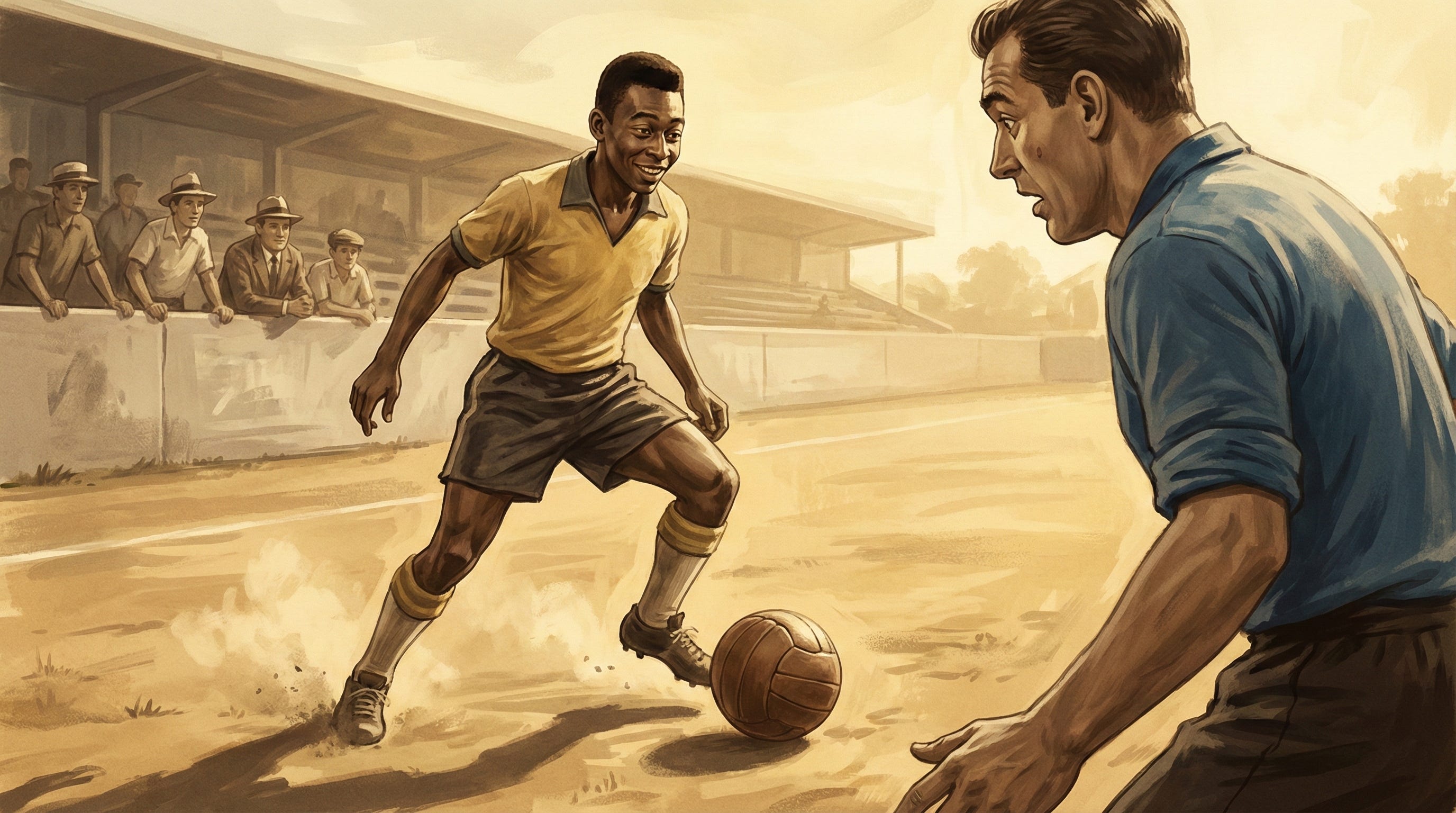
Within three minutes of kickoff in Gothenburg, Garrincha collected the ball on the right wing, beat two Soviet defenders as if they were training cones, and hammered a shot against the post. The stadium gasped. Before the Soviets had recovered, Garrincha was at it again — dancing down the touchline, crossing for Vavá to score. The match was effectively over before it had begun. Brazil won 2-0, and the world had discovered both Pelé and Garrincha in a single afternoon.
From that moment, neither was ever dropped again. Brazil swept through the knockout rounds and crushed Sweden 5-2 in the final. Garrincha set up the first two goals — both finished by Vavá — and was named to the tournament’s All-Star Team. Pelé, the teenager, wept with joy at the final whistle.
For Brazil, the 1958 World Cup was redemption. The trauma of losing the 1950 final on home soil — a wound that had scarred the nation for eight years — was healed. And the man who had healed it, as much as anyone, was a bow-legged factory worker’s son from a town that didn’t appear on most maps.
Chile, 1962: The Greatest Tournament by a Single Player
Four years later, Garrincha returned to the World Cup in Chile as a global star. But the tournament would demand something more from him than star quality. In Brazil’s second group match, Pelé pulled a muscle and was ruled out for the rest of the competition. The world’s best team had lost the world’s best player.
Everything fell on Garrincha.
What followed was arguably the greatest individual performance in World Cup history. Against England in the quarter-final, he scored twice and terrorised the English defence so completely that their strategy dissolved into desperation. Against Chile in the semi-final, he scored twice more, was sent off late in the match — one of only two blemishes in his entire international career — and still walked off the pitch to a standing ovation from the Chilean crowd. The next day, the Santiago newspaper El Mercurio ran a headline that has become part of football folklore: “What planet is Garrincha from?”
Brazil beat Czechoslovakia 3-1 in the final. Garrincha won the Golden Ball as the tournament’s best player and the Golden Boot as its top scorer. He had carried an entire nation on his crooked legs.
When Pelé and Garrincha played together in the Seleção, Brazil never lost a match. Not once.
The Fall
The drinking had started early — perhaps to dull the pain in those misshapen legs, perhaps because his father had done the same, perhaps because Garrincha was a man of simple pleasures who never learned to say no. He was involved in several car accidents. He gained weight between tournaments. He signed blank contracts and ended up one of Botafogo’s lowest-paid players despite being its greatest asset. Money came and went. Mostly it went.
In 1966, his life detonated. He left his wife Nair and their eight daughters to live with Elza Soares, a samba singer he had met during the 1962 World Cup. The relationship scandalised conservative, Catholic Brazil — a mixed-race woman from poverty, already married, taking up with the nation’s idol. Death threats followed. Public abuse. The press turned hostile.
But the people on the streets never abandoned Garrincha. Not yet.
He returned to the World Cup in 1966, in England, and scored a memorable goal against Bulgaria. It wasn’t enough. Brazil lost 3-1 to Hungary in the group stage — Garrincha’s fiftieth and final cap, and the first time he had ever lost in the yellow shirt. The first and only time.
After that, the decline was steep. He left Botafogo, drifted through Corinthians, Portuguesa Carioca, a brief spell in Colombia, a return to Flamengo. His knees were destroyed. His weight ballooned. The alcohol consumed him the way it had consumed his father. A farewell match at the Maracanã in 1973 drew a crowd, but the cheers felt like an elegy.
Then Brazil forgot him.
His pension was negligible. He lived on handouts. By 1980, at forty-six, he appeared at a public tribute in Rio looking bloated, decades older than his actual age. He was hospitalised eight times in his final year alone.
January 20, 1983
Garrincha died in a Rio de Janeiro hospital in an alcoholic coma, from cirrhosis of the liver. He was forty-nine years old. He left behind at least fourteen children and not a single real to his name.
“This is a good example of how our country treats its idols,” said Sócrates, captain of Brazil’s 1982 World Cup squad, when the news broke.
“I only hope the government will not abandon his family,” said Zico, Brazil’s greatest active player, “because Garrincha was one of this country’s most important men.”
The government did abandon them. The family would spend decades fighting for recognition. The house in Pau Grande — given to Garrincha by the local factory as a reward for winning the 1958 World Cup — was later demanded back. His granddaughter Alexsandra eventually opened a small bar in the house called “Garrinchinha,” funded not by the football establishment but by a reality television show. She would later try to sell it for 650,000 reais because she couldn’t afford the upkeep.
But on the day of the funeral, Brazil remembered.
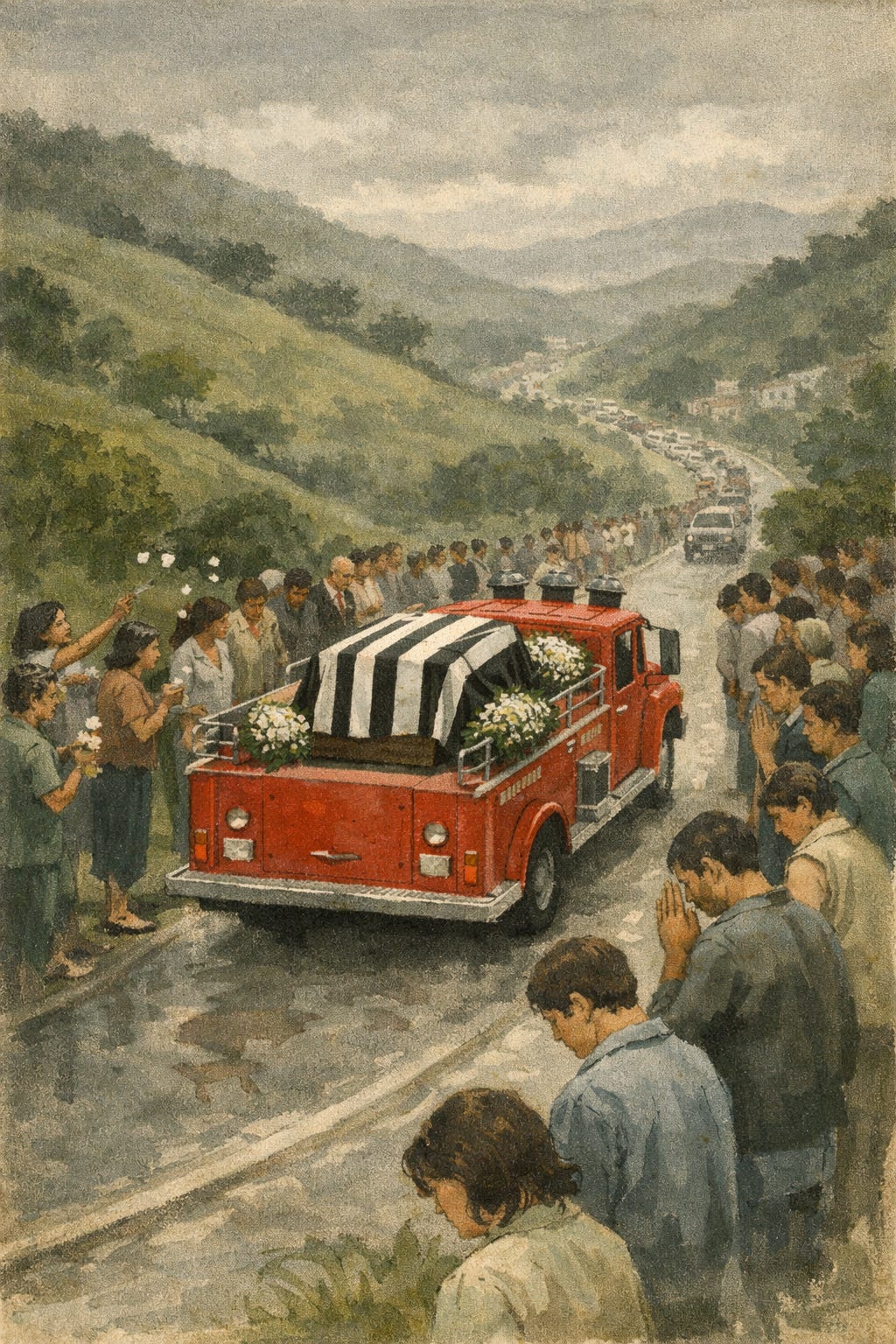
Garrincha’s coffin, draped in the black-and-white flag of Botafogo, was placed on top of a fire brigade truck at the Maracanã. The procession wound forty miles north through the hills to Pau Grande — four hours on the road, stopped again and again by crowds clapping, chanting his name, throwing flowers. Thousands had left Rio by car, bus, and train to be there. Five thousand people stood in the small cemetery at Raiz da Serra and watched the Angel with Bent Legs laid to rest.
His gravestone, barely noticeable among the modest markers around it, carries an inscription in Portuguese:
Aqui descansa em paz o que era a alegria do povo — Mané Garrincha.
Here lies in peace the one who was the joy of the people.
A second memorial, added later, reads:
Ele era uma criança doce, falava com os passarinhos.
He was a sweet child. He spoke with the little birds.
Garrincha’s death, in January 1983, coincided with something larger. A year earlier, at the 1982 World Cup in Spain, Brazil’s magnificent team — Zico, Sócrates, Falcão, Cerezo — had been eliminated by Italy in one of the sport’s great upsets. It was, many Brazilians felt, the last stand of futebol arte, the classical Brazilian style that celebrated beauty and improvisation over efficiency and results.
Garrincha had been the purest expression of that style. When he died, something died with him. The little bird had stopped singing, and Brazilian football would never sound quite the same.
Next in the series: The Murder of an Own Goal Scorer — how Andrés Escobar’s misfortune at the 1994 World Cup ended with twelve bullets outside a bar in Medellín.
Subscribe to Closelook@Worldplay to get the next story in your inbox →
Closelook@Worldplay is a free section of the Closelooknet newsletter. Timeless deep dives into singular events, legendary clubs, and tragic heroes — mostly football.