



This week’s edition of Closelook@Hypergrowth, dated July 07, 2026.
We track the growth trade through four functional buckets — the AI build-out (Rubin), AI operating expenditure (AEI), the agentic winners (AW40) and functional growth beyond AI (HALO). The year so far ran in sequence: HALO led the first months, then the build-out took over — and the agentic winners were wrecked along the way, dragged by their legacy businesses.
This week our own flow data says the sequence is turning again. The absolute flow scores still crown the semiconductors. But the rate of change of those scores — the thing that turns before price does — has already rotated: a broad set of semis has stalled its advance while a broad set of opex and application names has moved forward, and the most-destroyed corner of the tape is producing the largest reversal cluster we track. The read below holds that this is what a healthy hand-off looks like, not a top. The schedule of our other publications is at the end.
1 · This Week’s Action
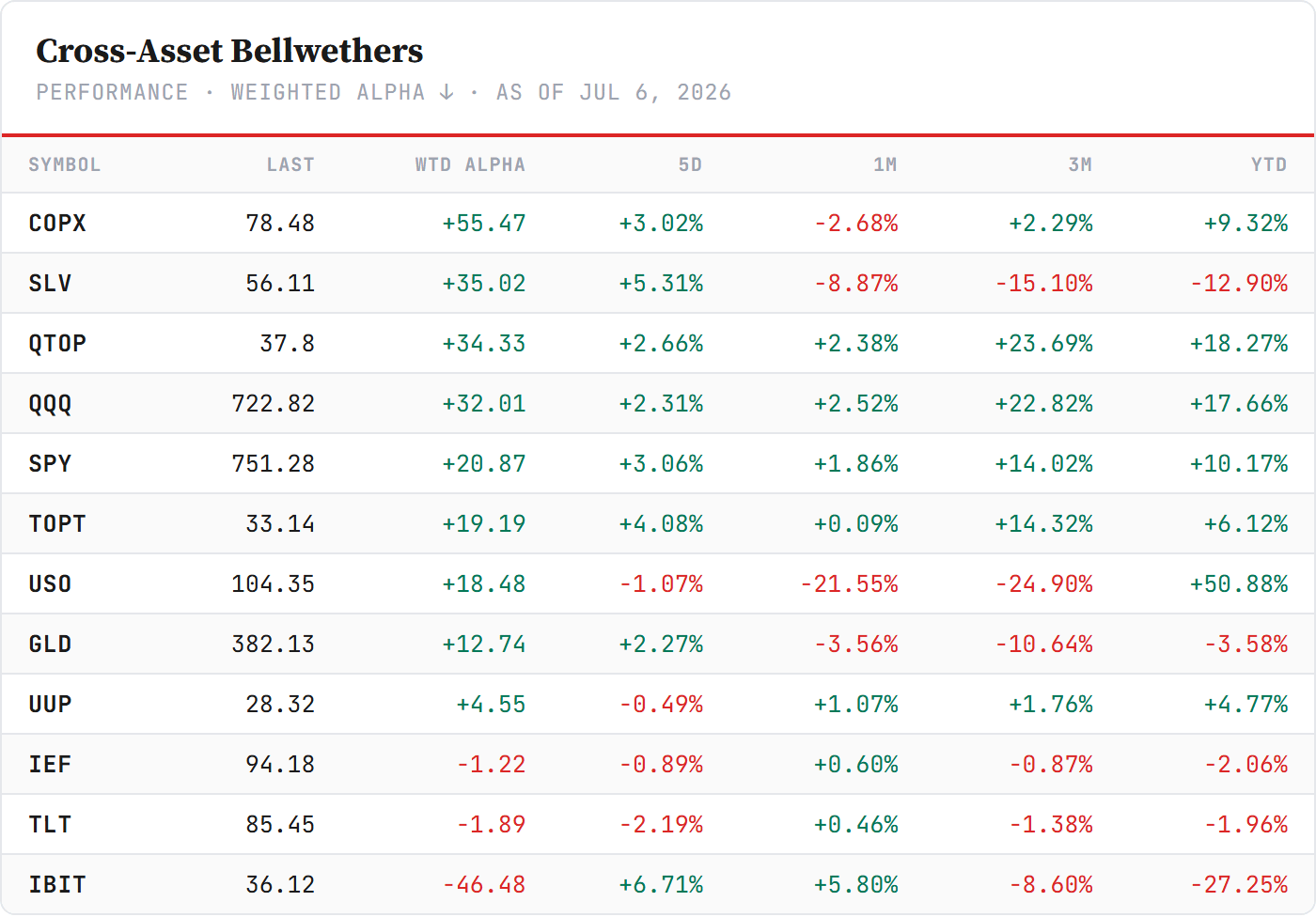
The cross-asset backdrop. Bonds softened as yields firmed, the dollar drifted lower, and the risk-seeking corners — bitcoin, silver, copper — led. No haven bid anywhere: the signature of repositioning, not de-risking.
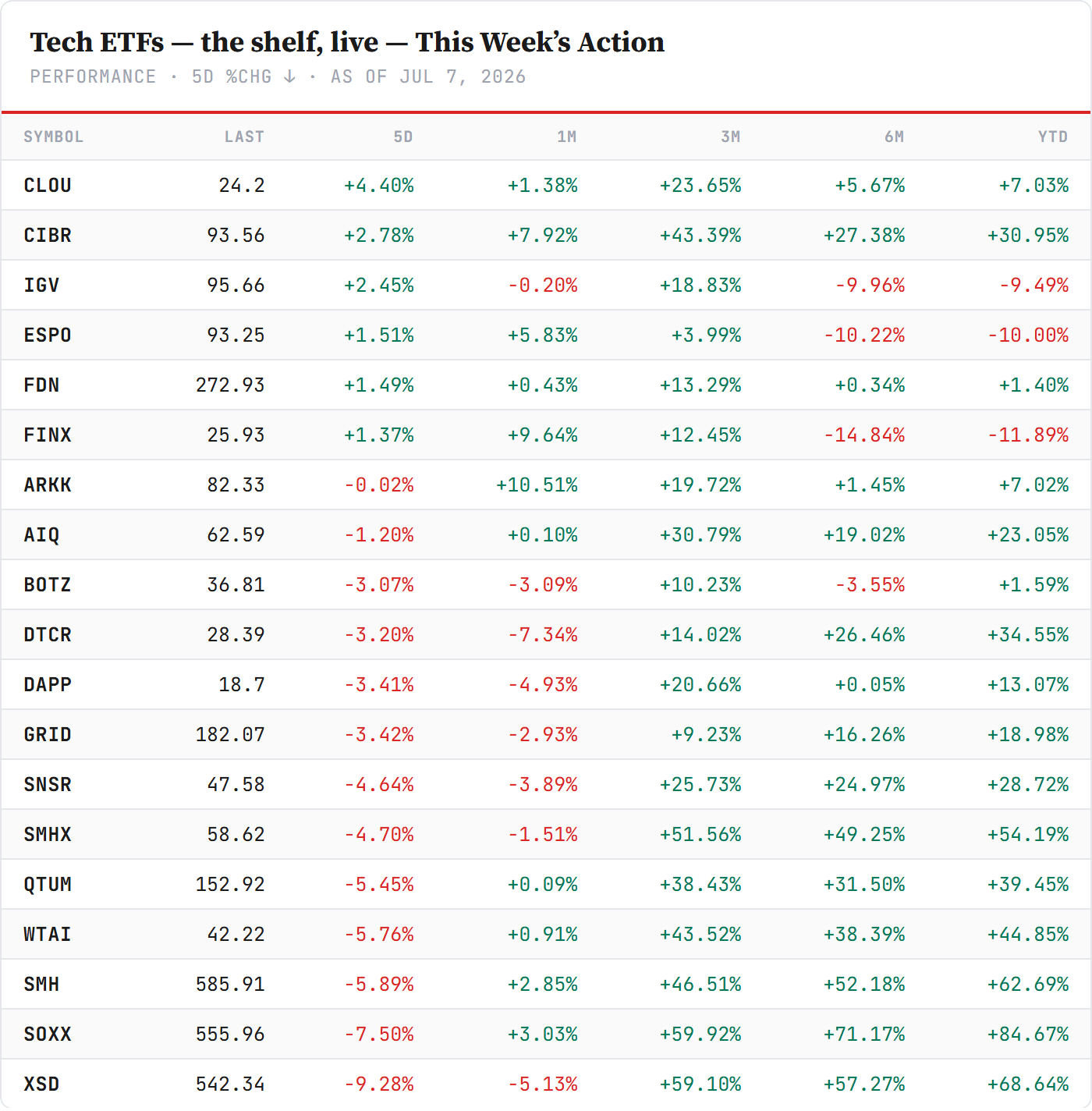
The tech shelf. The split inside technology is the cleanest it has been all year, and the live board states it without commentary: on the week, cloud, cyber and software lead — while the entire semiconductor complex sits at the bottom, down mid-to-high single digits. And note the right-hand columns: the same semi funds that lost 6–9% on the week are still up 60–85% on the year — the crowded winner resting, not a laggard breaking. One number deserves its own sentence: SOXX closed at 555.96 — sitting almost exactly on the 554 line that Tuesday’s Pulse named as the level that decides the week.
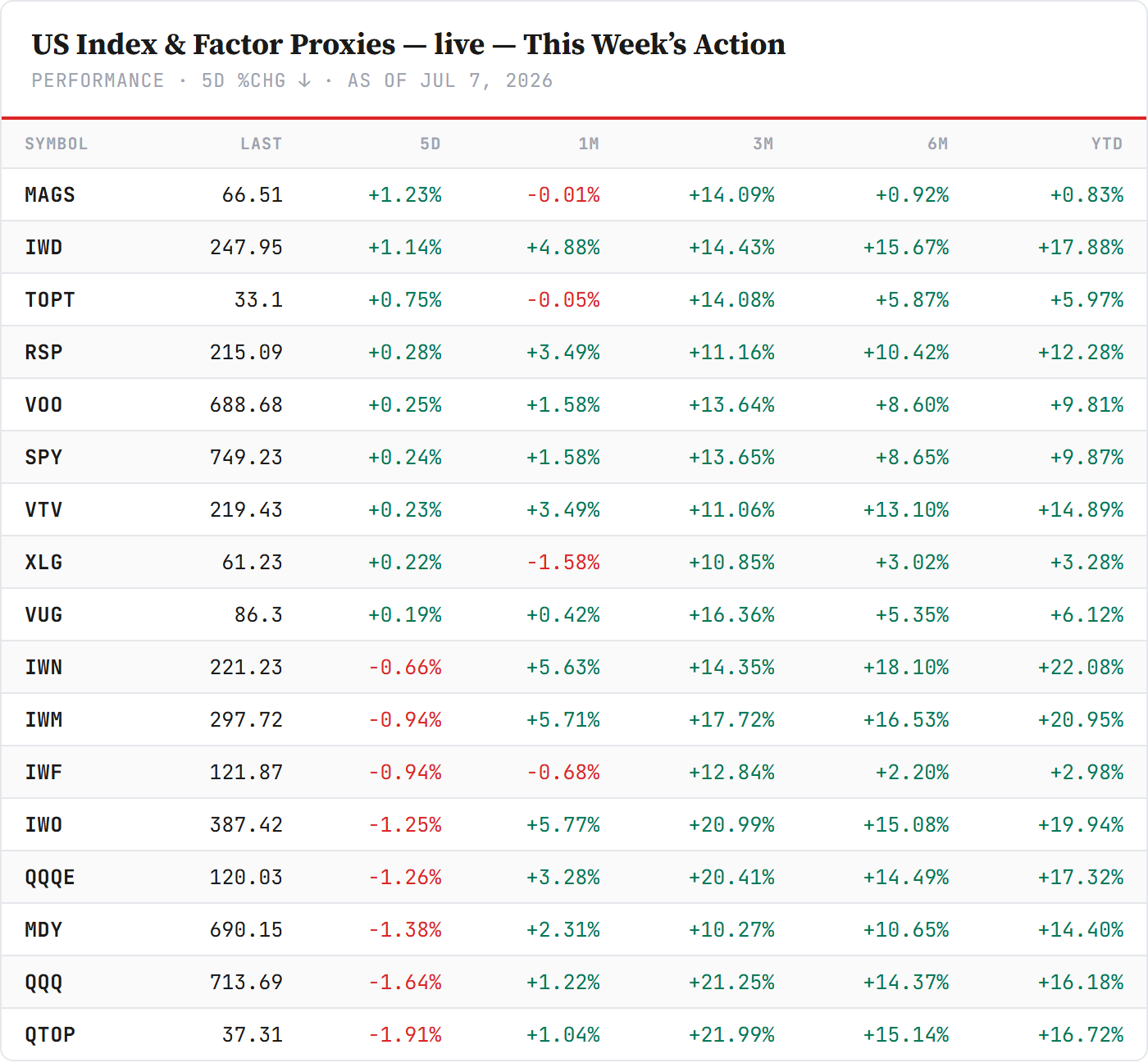
The US index and factor proxies. The factor board tells the same story one level up: on the week, value leads growth and the Nasdaq complex trails the field, while the megacap-7 basket caught a bounce. The year-to-date column is the quiet shock — the value factor has beaten the growth factor by double digits in 2026, and small-cap value leads everything. The growth indices are fine; the growth factor is being carried by an ever-narrower list. That is the concentration story in factor form, and it is the backdrop the rotation below plays against.
The board that matters this week is our own. The Rotation Ledger below is built from the Closelook Directional Flow scan across all four growth buckets — not price performance, but flow, and specifically its rate of change. Sorted by the 21-day flow delta, top and bottom eighteen:
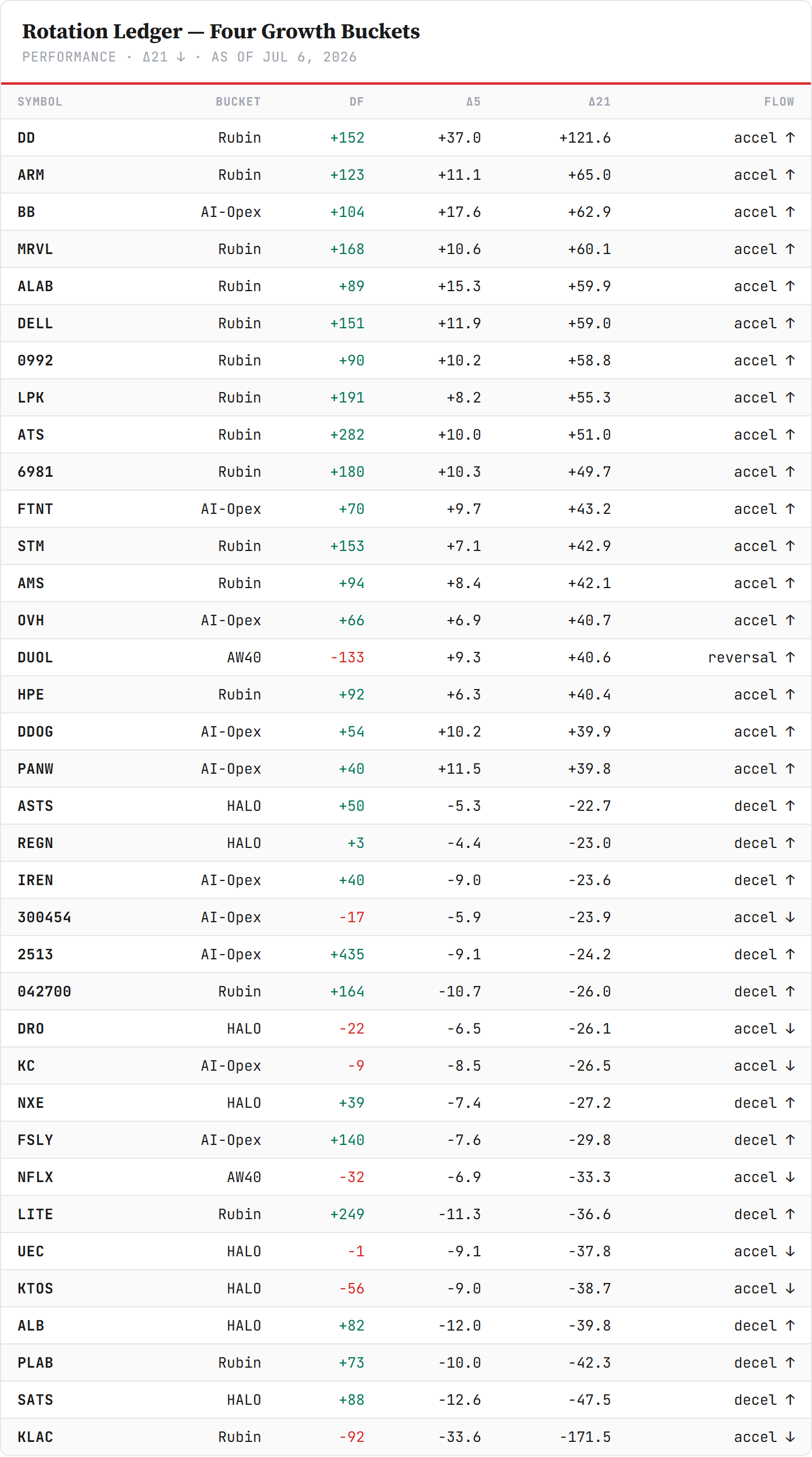
Read the DF column against the delta columns — that is the whole exercise. In the bottom block sit names whose absolute flow is still among the highest on the board — Lumentum at +249, the photonics and equipment complex, KLA with the most negative delta in the scan — but whose advance has stalled. In the top block sit the AI-opex names in a near-unbroken line — BlackBerry, Fortinet, OVH, Datadog, Palo Alto, all accelerating — the Rubin periphery (DuPont, ARM, Marvell, Astera, Dell — connectivity, materials, boxes, not the crowded core), and one row that carries the week’s whole thesis: Duolingo, flow score deeply negative, flagged “reversal ↑” — a destroyed agentic winner turning.
2 · The State
The four buckets, introduced. If you are new to the framework: we cut the growth trade into four functional indices, each with its own page, methodology and sector sub-indices — and the 2026 tape has been a relay between them. Here is each one, with its price action this year and the sectors underneath it.
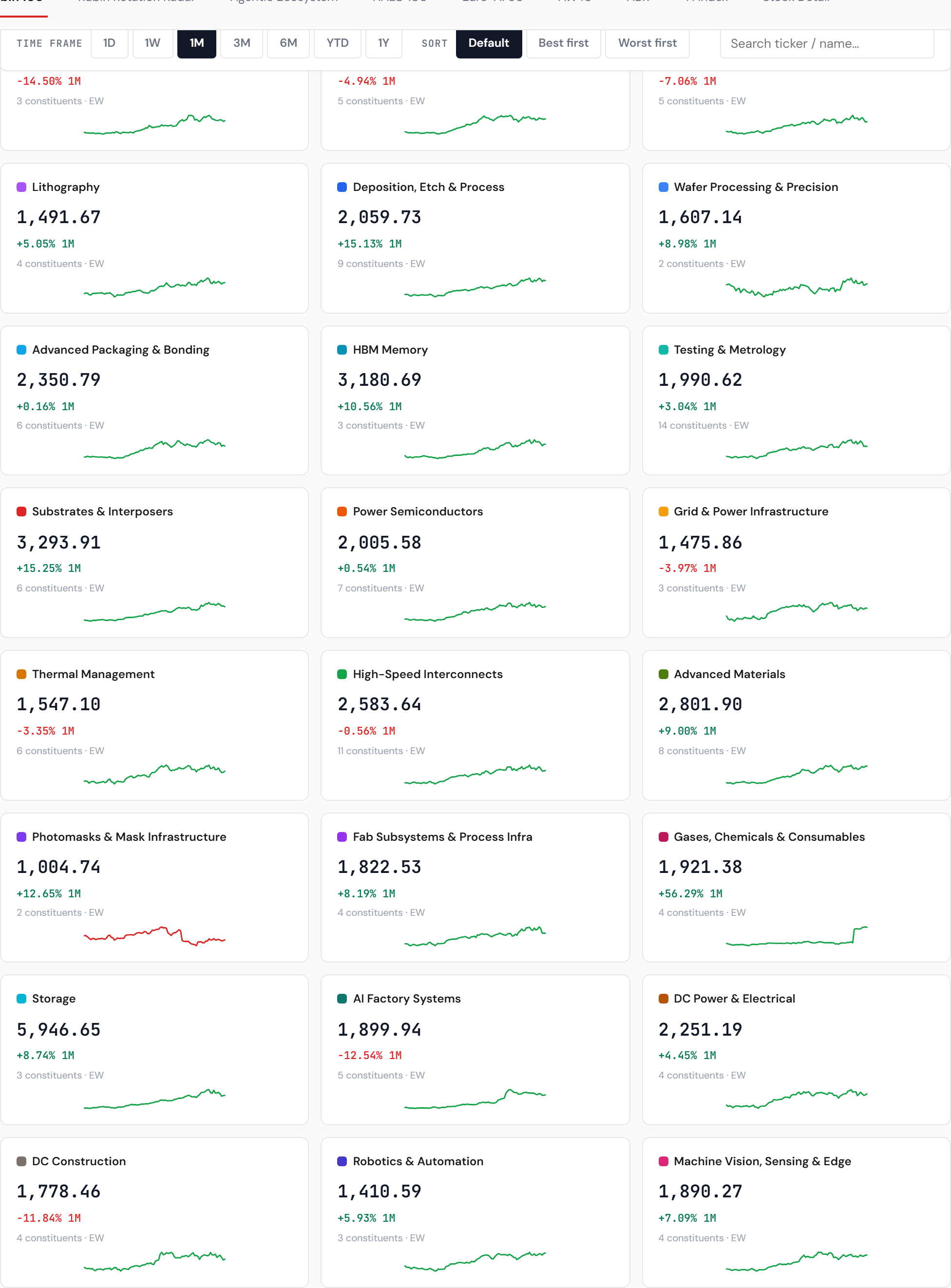
Rubin 100 — the AI build-out. The infrastructure of making intelligence: semiconductors, memory, packaging, equipment, power and materials — ~125 names across the supply chain. The year’s absolute leader since the AI-capex trade crowded in; the composite shows the run, the sector strip shows where inside it the return was made.
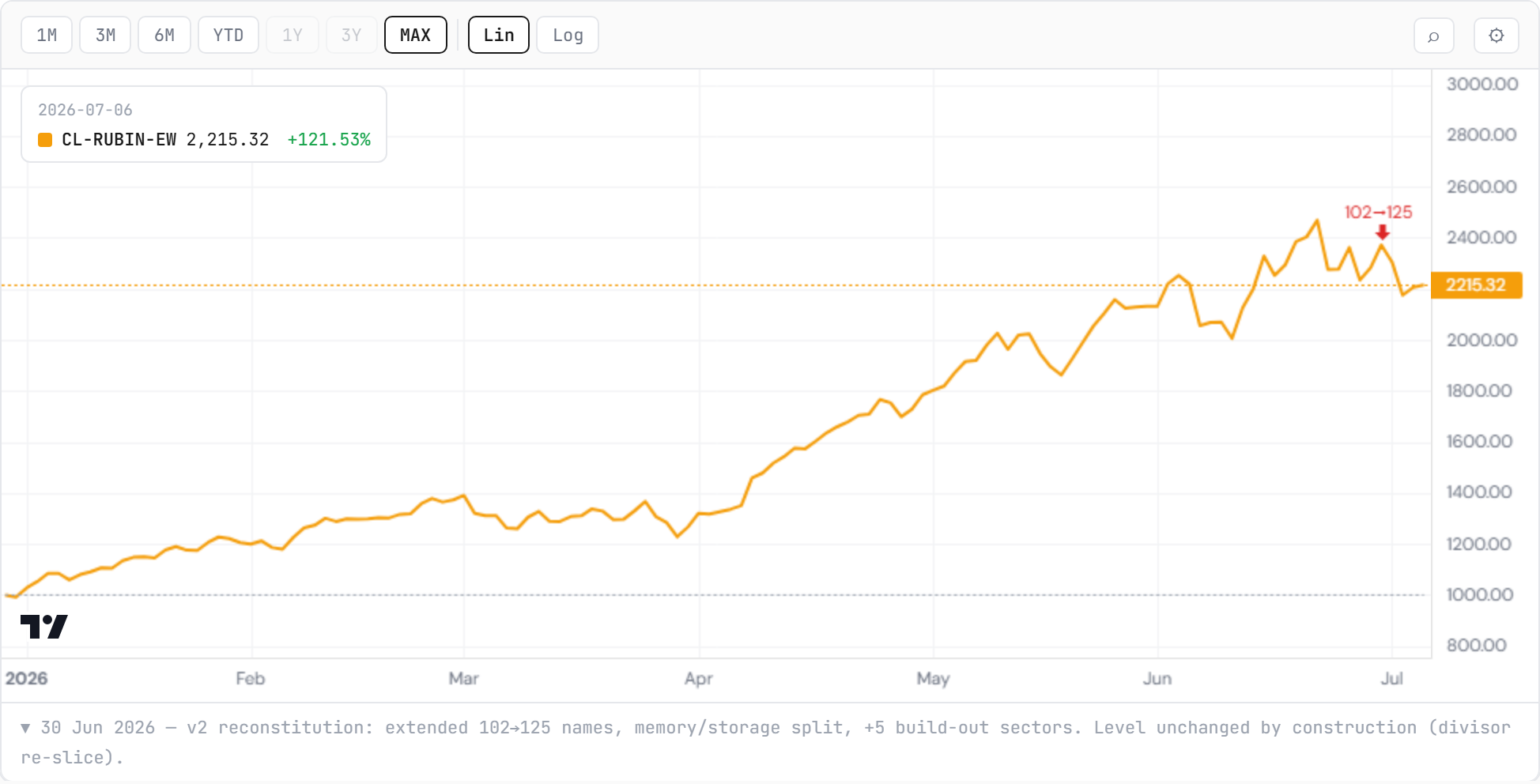
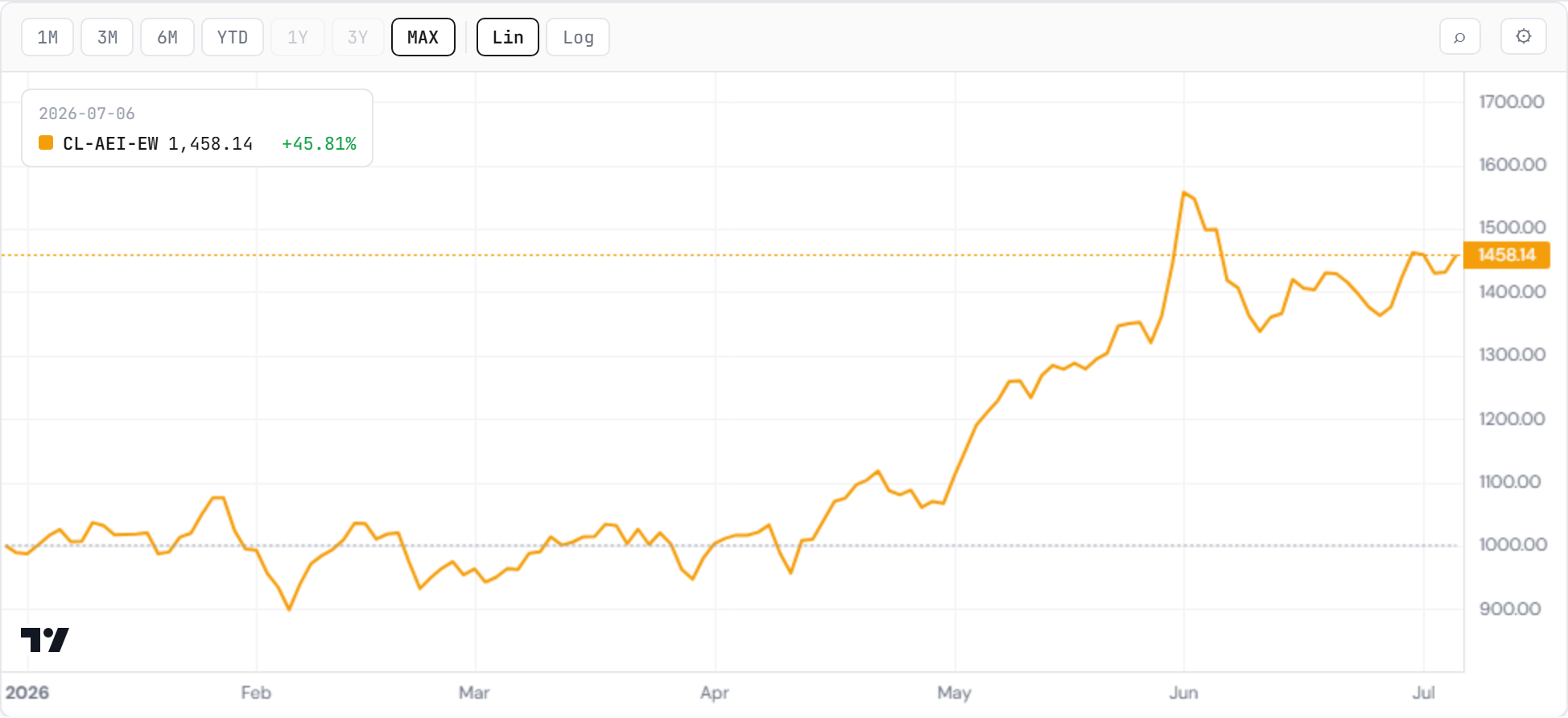
AEI — the AI-opex layer. The companies that sell the running of AI rather than the building of it — security, observability, data and cloud infrastructure, ~33 names. The humbler bet: whoever the application winners turn out to be, all of them pay this toll. It has quietly compounded underneath the build-out all year.
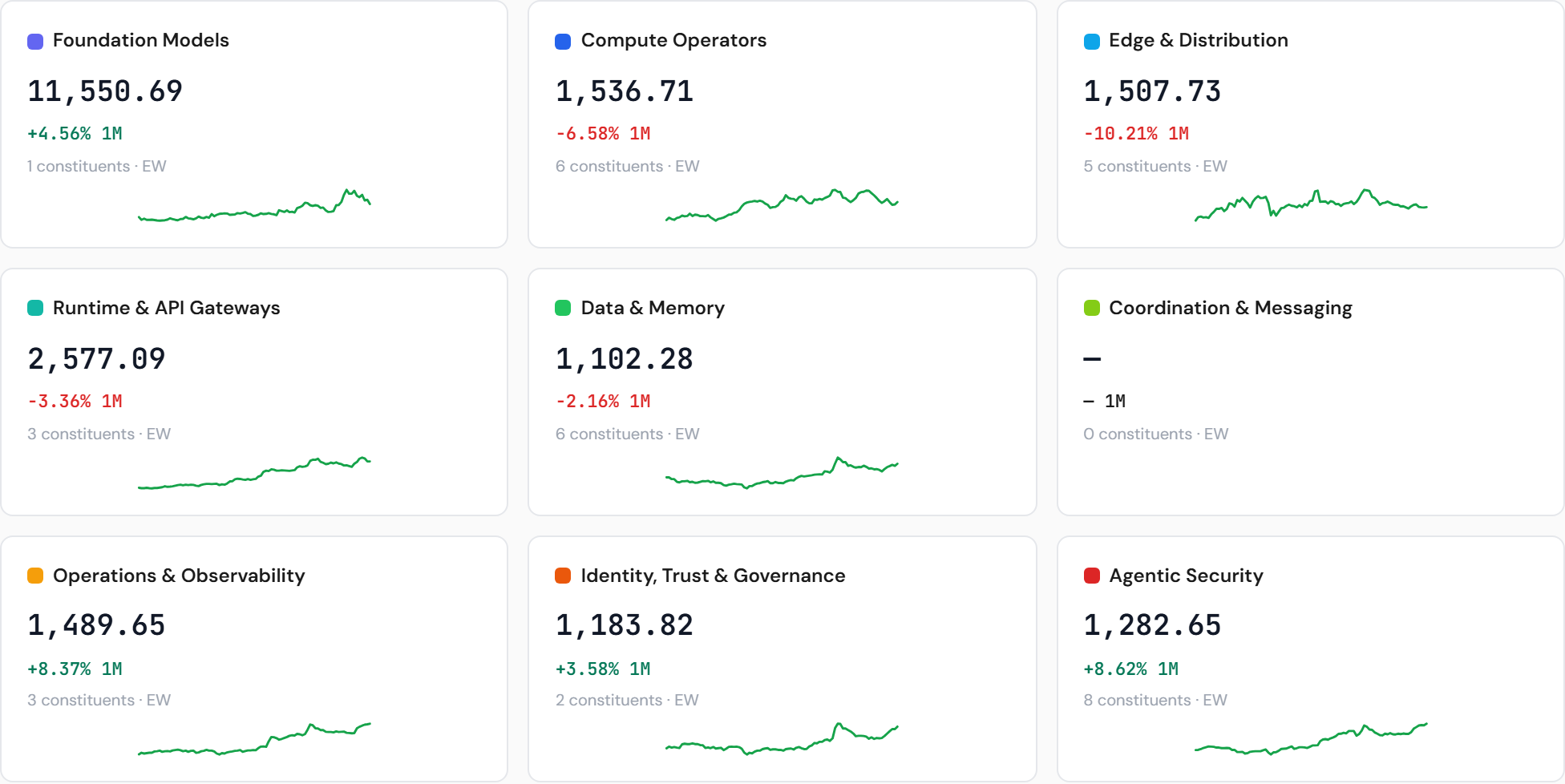
AW40 — the agentic winners. The concentrated list of companies whose applications should win the agentic era — 40 names. This is the cohort 2026 punished hardest: every name whose agentic future is attached to a legacy business was repriced brutally, and the composite wears the damage. It never got to run — which is exactly why its reversal cluster matters now.

HALO 100 — functional growth beyond AI. One hundred growth names selected for what they do — health, aerospace, energy, platforms — the growth tape that is not an AI bet. It carried the first months of the year before the baton passed to the build-out, and its sector strip shows an internal rotation of its own.
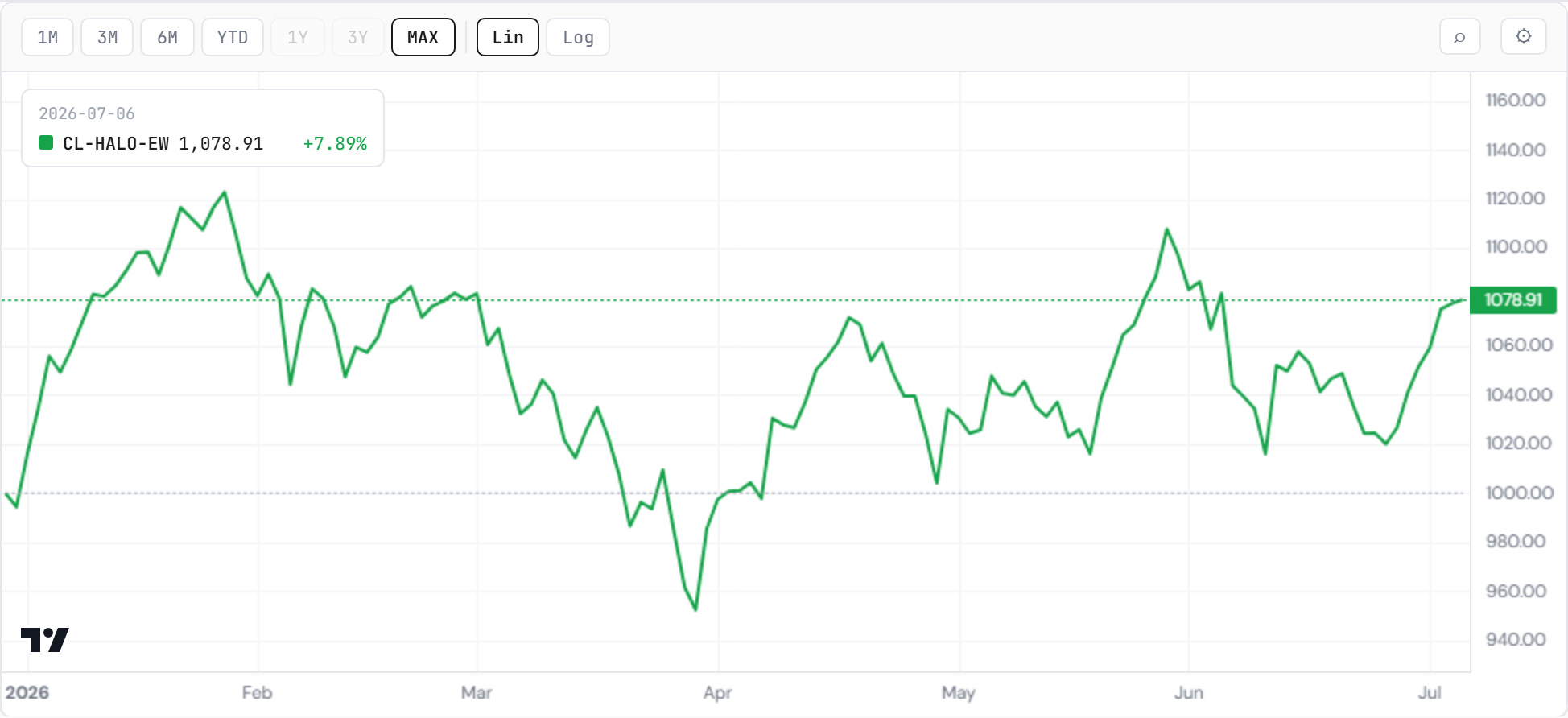
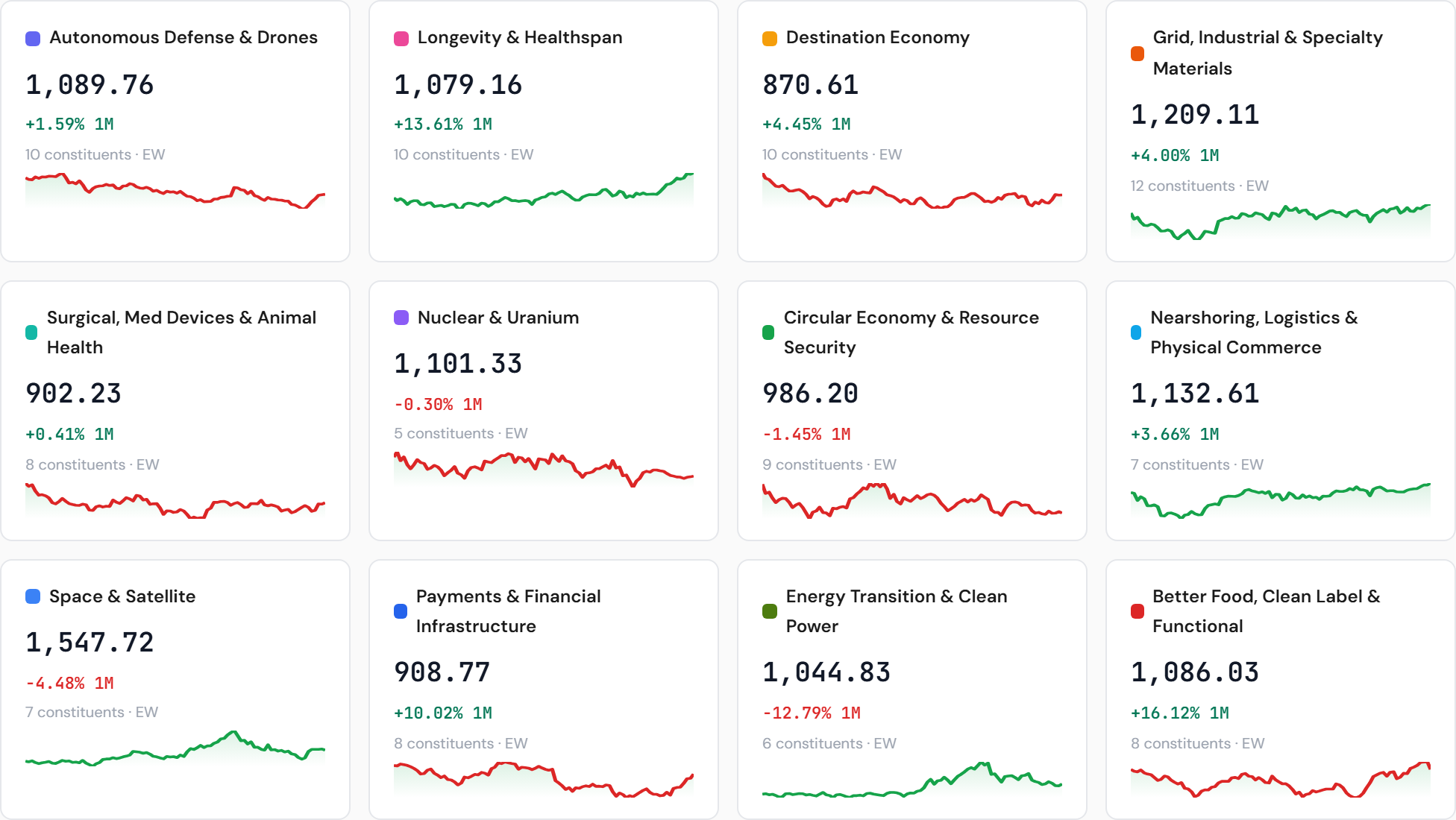
The relay, in one sentence: HALO led the first months → the build-out took over and still holds the year → the agentic winners were wrecked along the way → the opex layer compounded quietly underneath. That is the starting grid for what the flow data says next.
What the flow deltas say now. We ran the rate-of-change cut across all four buckets this week, and the numbers are worth stating plainly:
The build-out (125 names): median flow score 111 — still the highest absolute reading of any bucket — but the median 5-day delta is +1.1, and 44 of 125 names have stalled outright. Inside the semi core it is starker: median 5-day delta +0.6, with 13 of 29 core names stalled — and the stall list is the crowded trade by name: NVIDIA, Broadcom, KLA, Samsung, Advantest, Disco, Lasertec, SanDisk, Western Digital, Teradyne. What still advances inside the complex is the periphery — ARM, Marvell, AMD, Applied Materials, Tokyo Electron — not the core.
AI-opex (33 names): the strongest advancer in the scan — median 21-day delta +16.2, sixteen of thirty-three names accelerating up.
The agentic winners (40 names): median flow score −52 — the wreckage is real — but sixteen of forty names are in “reversing-up,” the single largest reversal cluster we track. Money is quietly returning to the most-destroyed corner of the growth tape.
HALO (100 names): mixed and cooling at the median — the early-year leader resting, with its own internal rotation underway.
The one-line reduction: absolute flow still says “semis lead.” The rate of change says the leadership is already passing — from the build-out core to the opex layer and the application names. Flow deltas turn before price does; that is why we watch them.
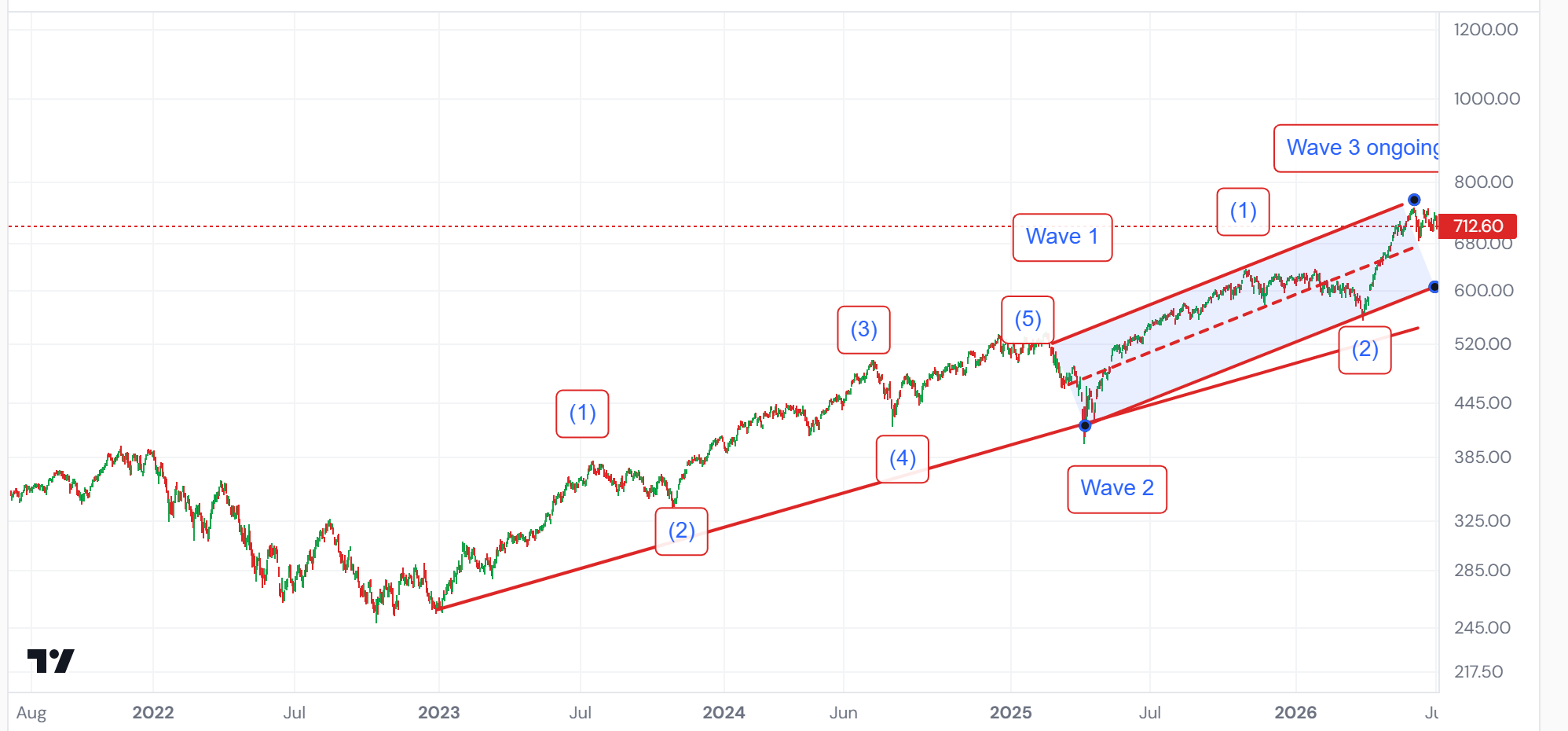
The structural read — the wave count, and what it allows. Our working count on the growth proxy (QQQ): the advance off the late-2022 base ran a complete five-wave sequence — sub-waves (1) through (5) — into the early-2025 high as Wave 1 of a larger degree; the spring-2025 break was Wave 2; and the advance since is an ongoing Wave 3, with its own first sub-waves in place and price riding the upper rail of the ascending channel. If the count is right, the most powerful stretch of the sequence is the one we are in — which argues that pauses get bought and that an internal rotation is more likely than a top. The count is a working hypothesis, not a certainty: a decisive break of the channel and the Wave-2 low is what would invalidate it.
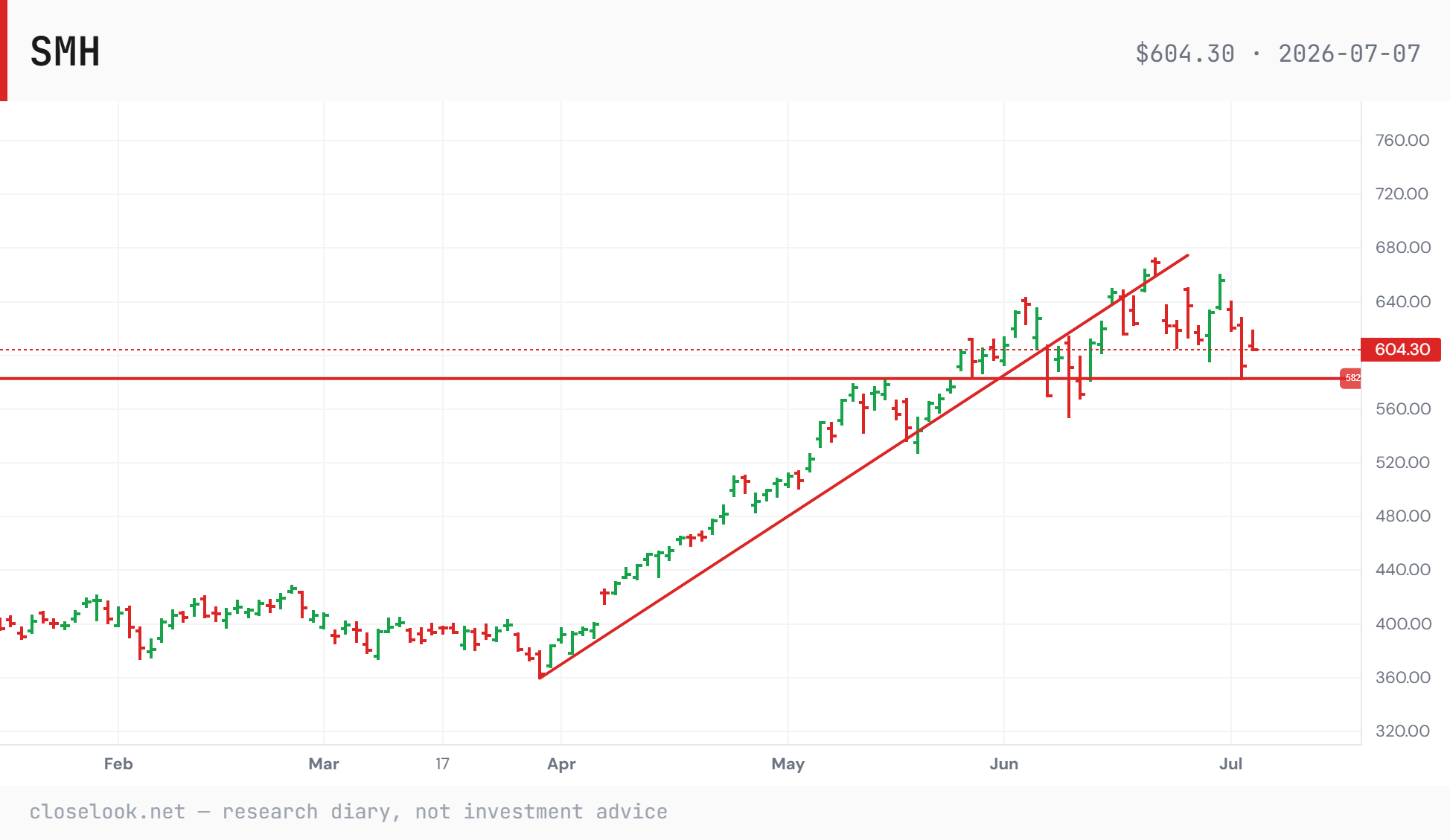
Underneath the index, the two ends of the rotation each carry their own structure. The semi complex broke its steep April uptrend and sits on the horizontal base near SMH 582 — and above that base a diamond may be forming, usually a topping shape. It is not confirmed and could dissolve, but a completed diamond would be the pattern-level version of the hand-off the flow deltas are already showing.
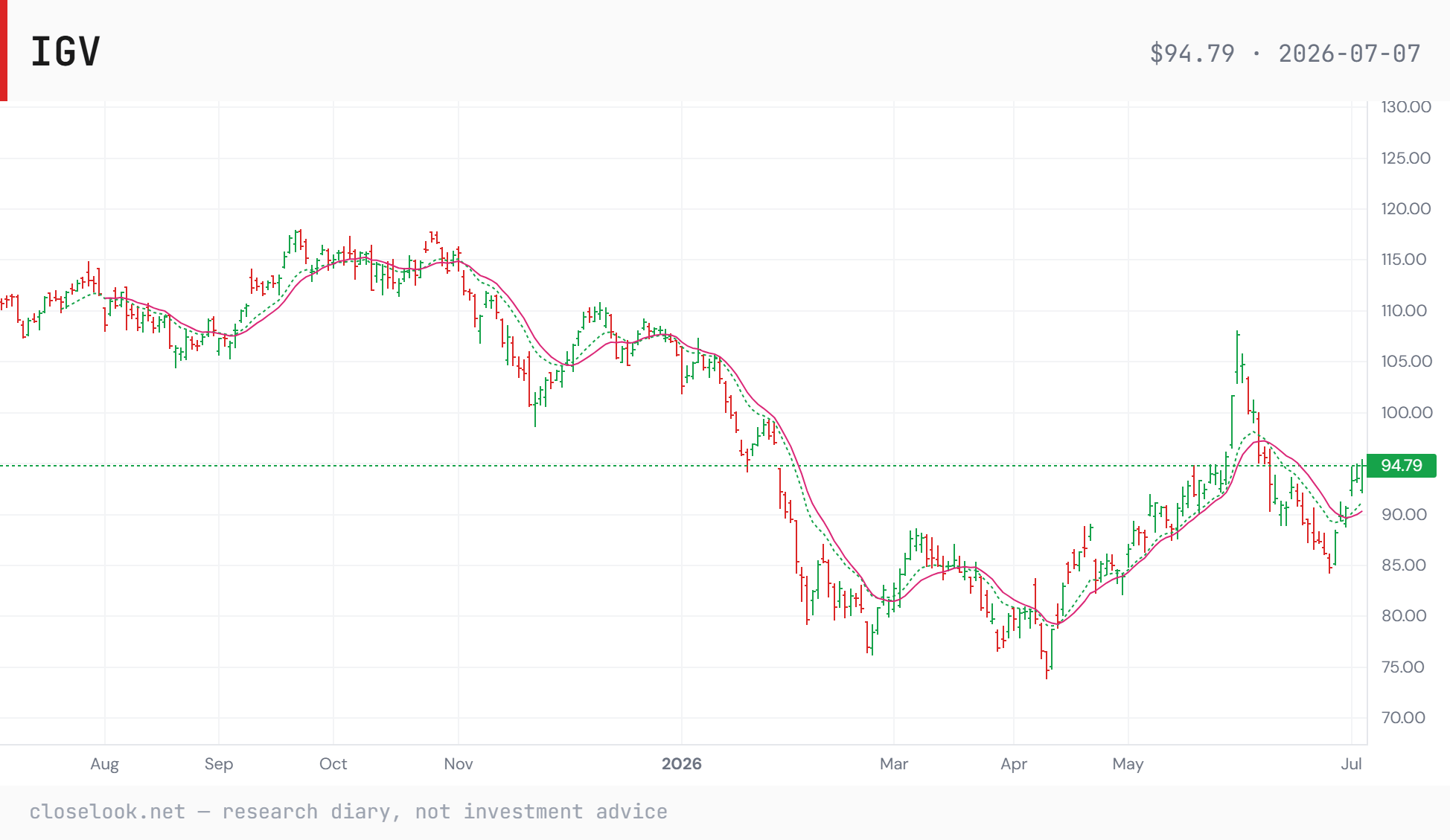
Software — the rotation’s destination — shows the mirror image: the downtrend broke to the upside, the correction came back to retest the old broken line from above and held — a textbook throwback. If that was the extent of the downside, it is stable bullish behaviour and the bottom is likely in.
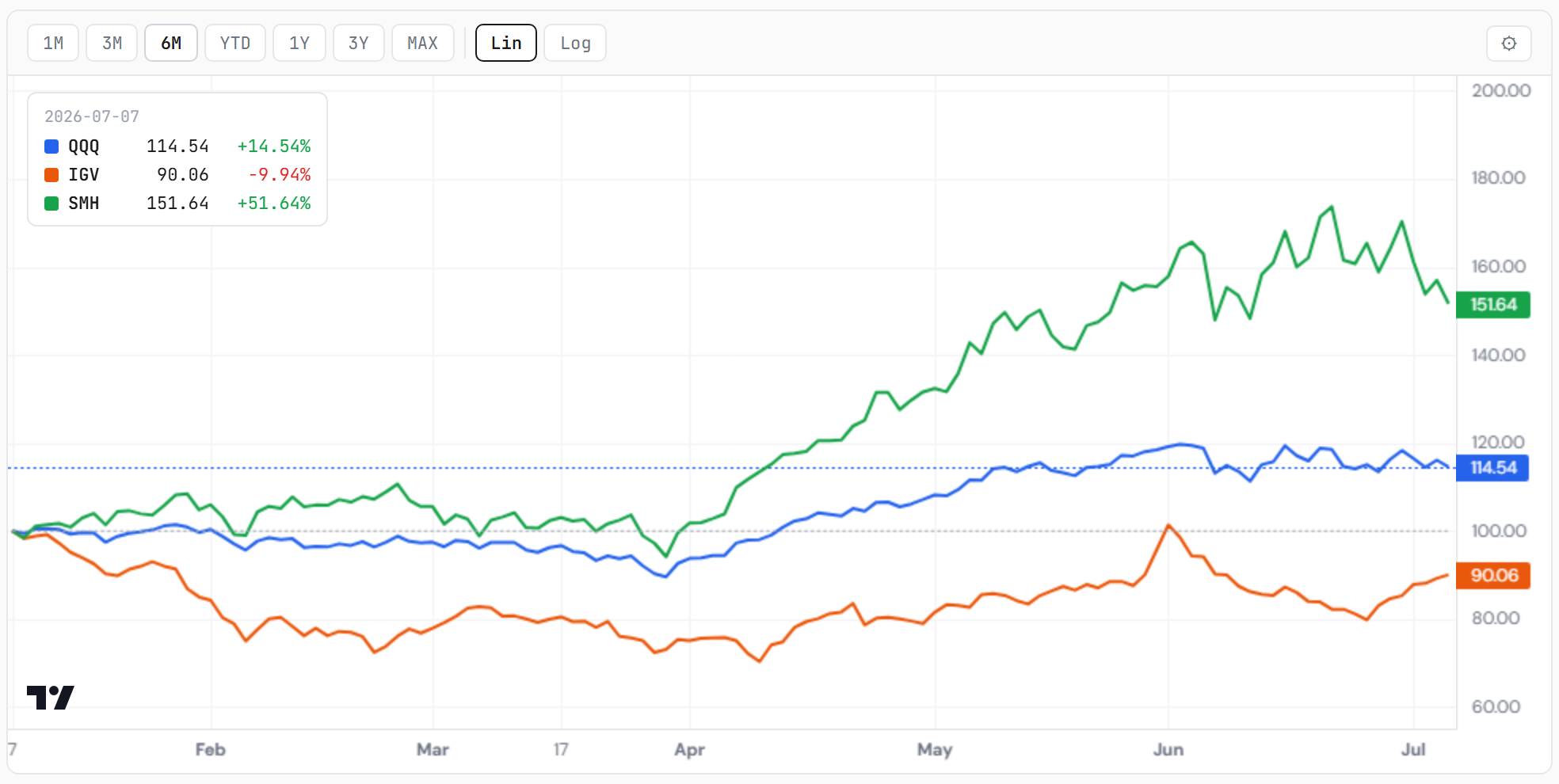
And the three proxies on one rebased window make the hand-off visible in a single frame — the semis’ vertical leg flattening while the index grinds and software climbs off its base:
3 · The Outlook
The forward read we hold lightly and reset each week. This week it is a double rotation — one inside the AI trade, one beyond it — and both would be healthy if they complete.
Rotation one — inside AI, from build-out to opex and applications. If the AI trade matures, this is exactly the hand-off it should produce: capex-led leadership giving way to the layer that runs intelligence. The economics are lining up underneath it — token prices keep falling while the new compute generation ships, and cheaper inference on better silicon is precisely what makes agents economically viable at scale. A market that pays for opex and applications is a market saying AI works — the spend is producing usage, not just capacity. The flow data above says this rotation has already begun.
Rotation two — beyond AI, the laggards catch up. The non-AI growth cohort has underperformed for months, and the earnings bar there is set correspondingly low — good prints should be materially rewarded, the mirror image of the highest-bar-of-the-cycle problem the AI hardware names carry into the same season. HALO’s early-year leadership was the first act of this trade; a second act after the rest would fit the pattern.
And the old winners? The story is not dead. A leadership trade that ran this far needs a rest, and the constructive path is exactly what Tuesday’s Pulse framed: the semi complex holds its base, consolidates through the summer, and comes back later in the year — leaner, and with the earnings season having reset the bar. This applies globally as much as at home: Korea and TSMC are the same crowded trade in regional form, as this week’s Global edition lays out — the ex-US benchmark’s whole year is carried by the chip economies, and their rest is the same rest.
The macro frame sits underneath: whether the inflation impulse crests or entrenches decides how much multiple the growth complex keeps, and firmer yields this week are a small vote for caution on the longest-duration names.

🔒 Be Informed — the rest is for subscribers. Free: the LinkedIn newsletter + closelook.net. C+ (paid): real-time push on every portfolio move → closelook.net/subscribe.
