
The Four Phases of Agentic and SaaS Market Sentiment
Closelooknet - Daily Pulse 2 April
Phase 1 — Pre-AI
Standard Valuation
→ November 2022
SaaS valued on RARR with 10–15 year DCF visibility. Rule-of-40 companies at 10–20x sales. NRR, churn, cohort economics — the model is well understood.
Phase 2 — Euphoria
AI Lifts All Boats
2023 – 2025
Every company with “AI” in the earnings call gets a multiple expansion. No differentiation between cosmetic AI and structural AI architecture.
Phase 3 — Fear
AI Kills All Software
2025 – Q2 2026
Pendulum swings: if agents do the work, why pay for the tool? Blanket multiple compression. Visibility collapses from 10 years to 3. Stocks drop 40% on perfectly good earnings.
Phase 4 — Structured
Decomposition
Q2 2026 →
The market differentiates. Each company becomes two businesses: a disrupted legacy stream and a growing agentic stream. Sum-of-parts replaces blanket valuation.
Between Phase 2 and Phase 3, revenue growth held, guidance held, interest rates held, but the duration of discounting collapsed. Investors stopped projecting RARR over 10 years because AI makes the business model unforecastable beyond 3 years.
In a standard DCF at 15% discount rate, eliminating cashflows after year 3 reduces fair value by 40–60%, even with identical near-term earnings.
The transition into Phase 4 is the trade. The market stops asking “does SaaS survive?” and starts asking “how much of this company’s revenue is legacy, and how much is agentic?” That question requires decomposition, and decomposition creates dispersion.
The Valuation Decomposition
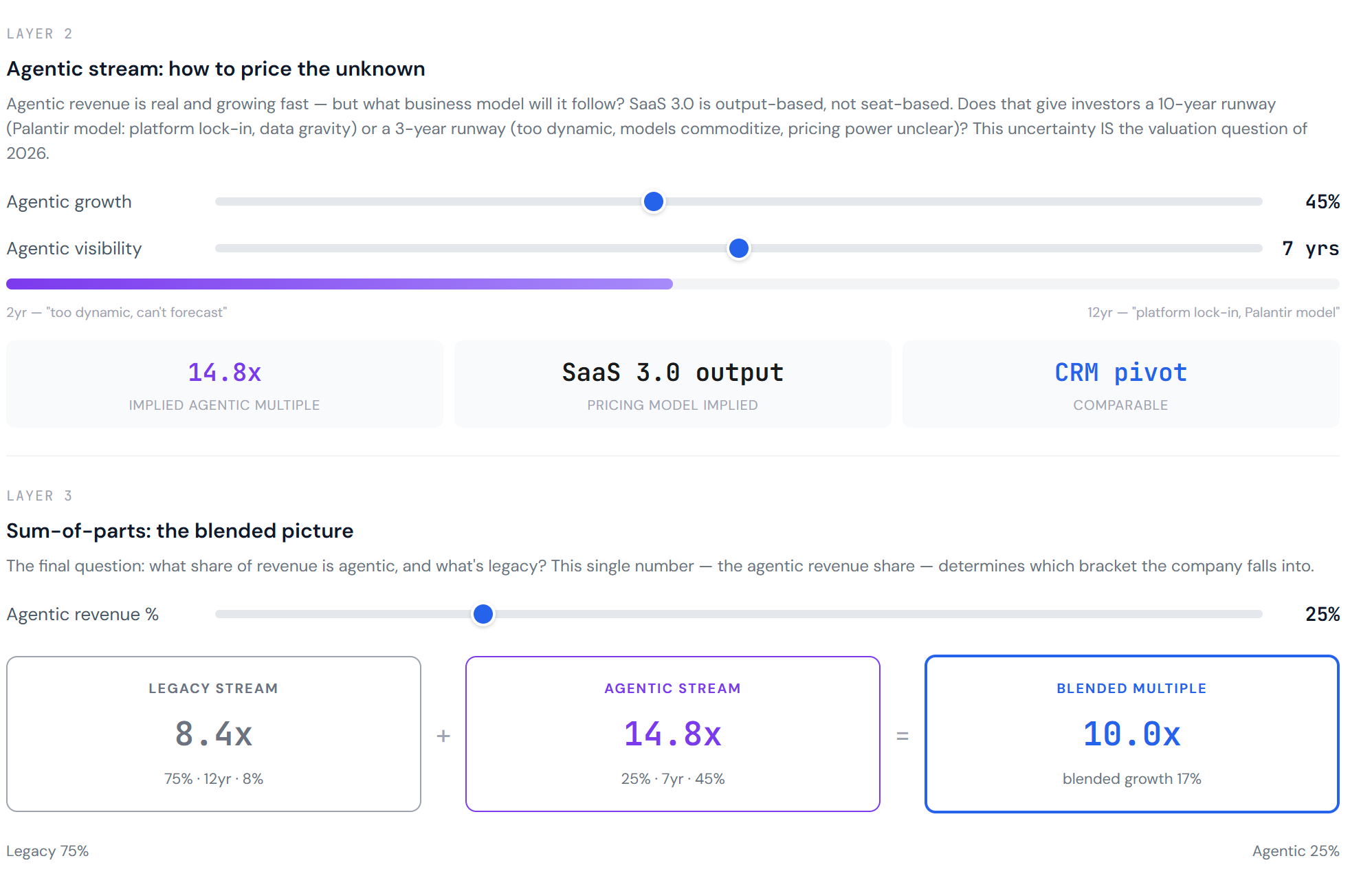
In Phase 4, most enterprise software company becomes two businesses with fundamentally different valuation characteristics. The legacy stream — seat-based licences, workflow tools replicable by agents, point solutions without data gravity — gets a short-duration DCF: 2–5x sales, 3-year visibility, contracting multiples.
The agentic stream — agent operating layer, API infrastructure, data gravity moats, usage-based pricing — gets a long-duration DCF: 12–20x sales, 8–10 year visibility, expanding multiples. The blended multiple is a sum-of-parts, and it shifts every quarter as the revenue mix evolves.
The three-layer valuation model
Standard analysis covers numerator (earnings) and denominator (rates). The third layer — DCF visibility horizon — explains why stocks collapse on good numbers. The fourth question — how to price agentic revenue — is what Phase 4 adds.
Layer 1
Legacy stream: the duration collapse
Earnings are fine. Rates are fine. But if the market can no longer project RARR beyond 3 years fair value drops 40–60%.
Layer 2
Agentic stream: how to price the unknown
Agentic revenue is real and growing fast — but what business model will it follow? SaaS 3.0 is output-based, not seat-based. Does that give investors a 10-year runway or a 3-year runway? This uncertainty IS the valuation question of 2026.
Continued at https://lnkd.in/d7DjzPbU


