


Closelooknet is a reader-supported publication — to receive new posts and support the work, become a free or paid subscriber.

This week’s edition of Closelook@Hypergrowth, dated July 26, 2026.
First, the housekeeping, stated plainly: this letter moves to the weekend. Closelook@Hypergrowth now publishes Sundays, joining Global (Saturday) and US (Sunday) — the mid-week slot is retired, and this edition covers the stretch since July 15. It was a stretch worth two letters. The flow scan’s least favorable pre-print configuration — Netflix, flagged here in black and white — resolved as a growth print sold to a 52-week low within 48 hours. The single warning row on our ledger — KLA — did not stay single: the roll spread through the equipment sleeve, and by Friday the semiconductor complex had broken every base the last edition celebrated defending. The opex flows held their regime through all of it. And the market added a new sort this letter now has to score: on Friday, SAP and ServiceNow were paid nine and seven percent on the same tape that sold Intel eight percent for the season’s best print. The ledger called the last round of shots. Below, we score it — including where it was wrong — and load the next round.
1 · This Week’s Action
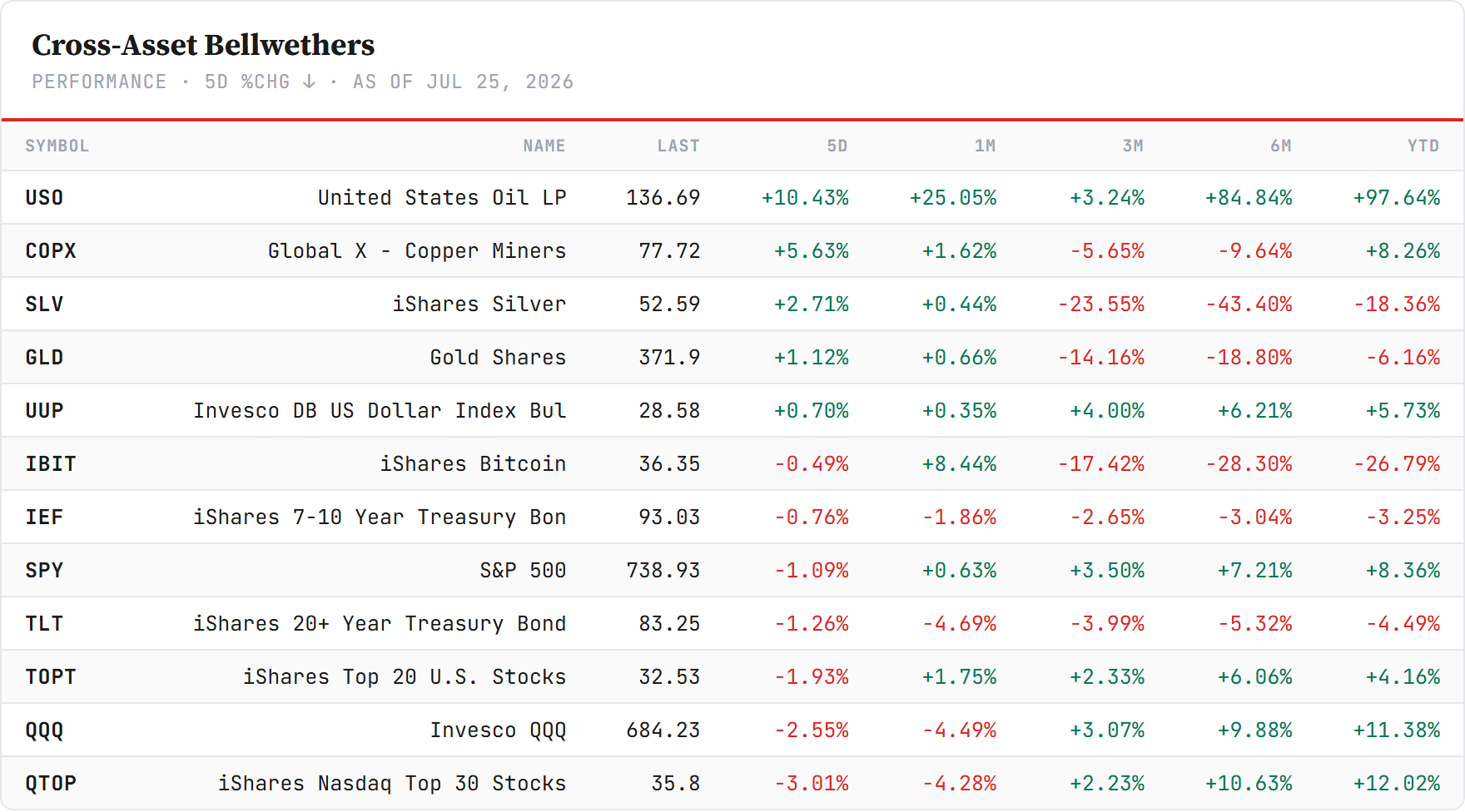
The cross-asset backdrop — the floor changed. The last edition wrote “the friendliest possible macro floor under a rotation.” That floor is gone: September hike odds went from one-in-five to four-in-five, oil traded through $100, and Treasuries fell with equities — a discount-rate shock, whose full cross-asset map belongs to Saturday’s Global letter. This letter needs exactly one conclusion from it: a rotation that was running on a friendly discount rate now runs against a hostile one — and it kept running anyway. That is the fortnight’s most important fact about the flows.
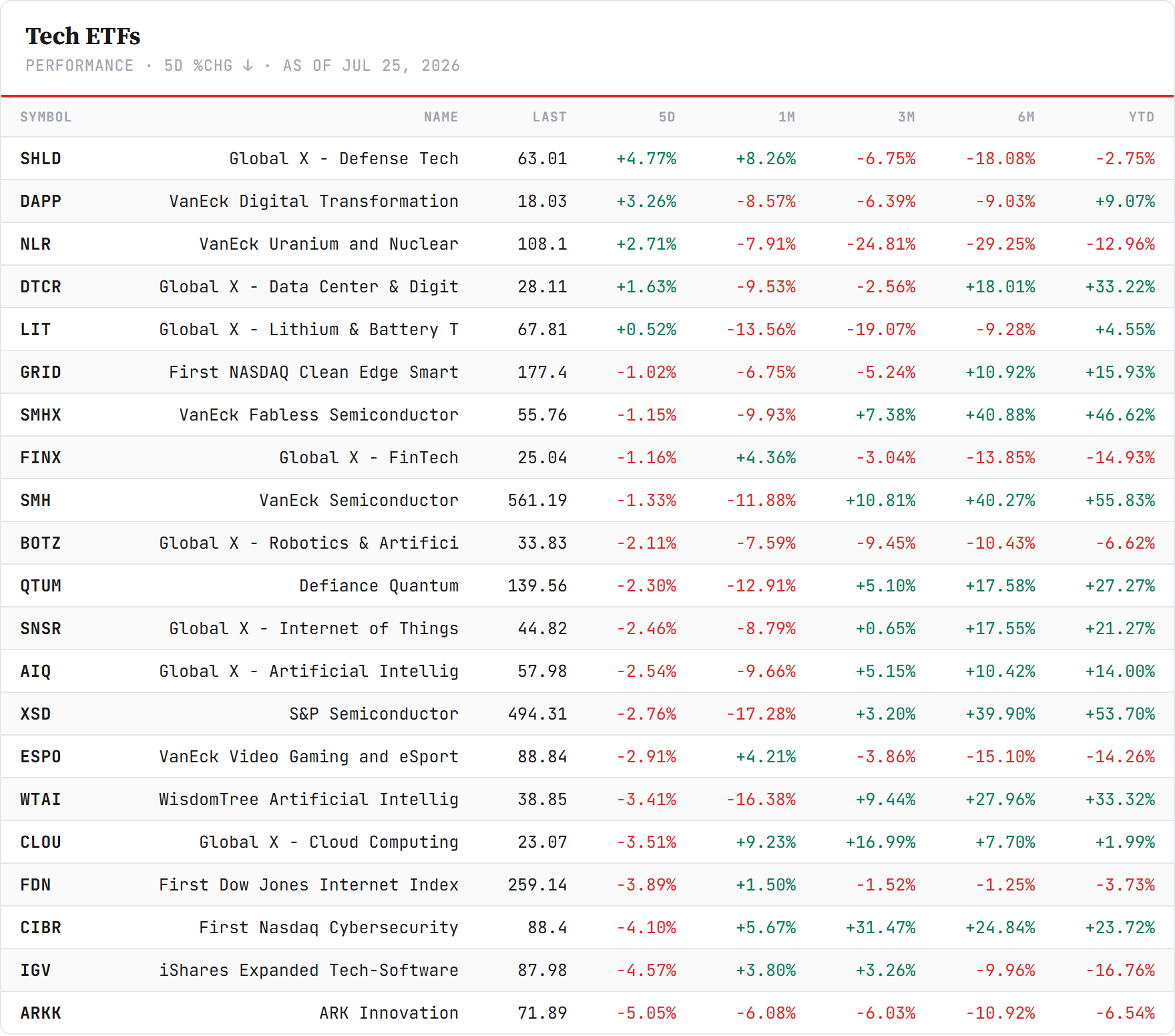
The tech shelf — the bases broke, and we said they’d hold. Full honesty against the last edition, which celebrated the semiconductor bases surviving their hardest test: within the fortnight every one of them went — the old floor was rejected on a retest from below, and the complex ended Friday with its first close-basis crack in the June capitulation structure since spring (the level-by-level map, and what the reference book’s contract does about it, is the US letter’s job). This letter’s job is the regime statement underneath, and it is the cleanest one we have ever printed: SMH −11.9% over one month with three green names out of twenty-two — against cloud software +9.2% and broad software +3.8%. A twenty-point monthly spread between the AI trade’s hardware and its software. The rotation is no longer a flow rumor. It is the tape.
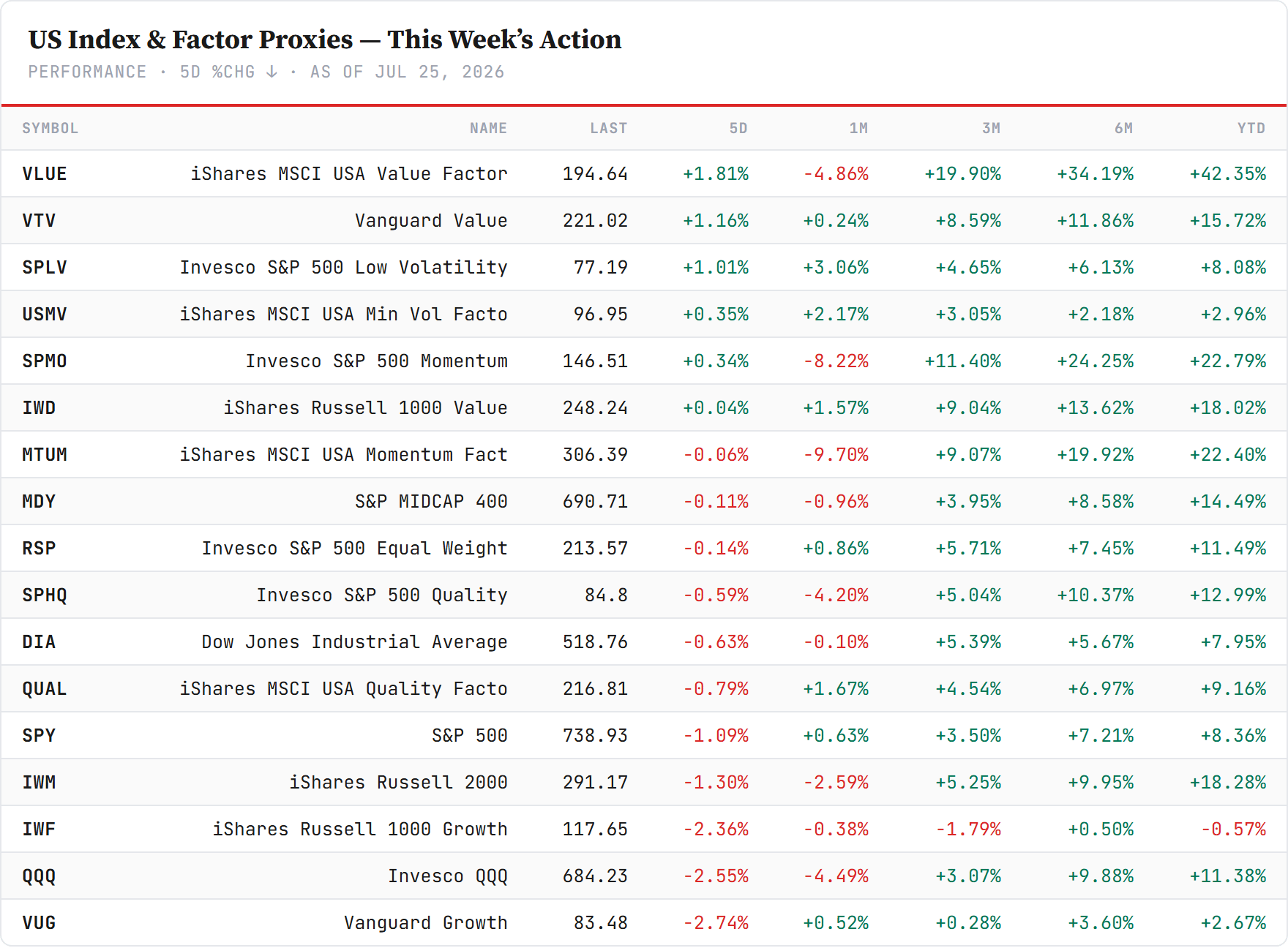
The factor view. The equal-weight S&P closed the week at −0.1% against the Nasdaq’s −2.6%; value +1.8%, growth −2.7%; low-vol green. The stress lives precisely where the index weight lives — a concentration event, second episode running, with the average stock declining to participate.
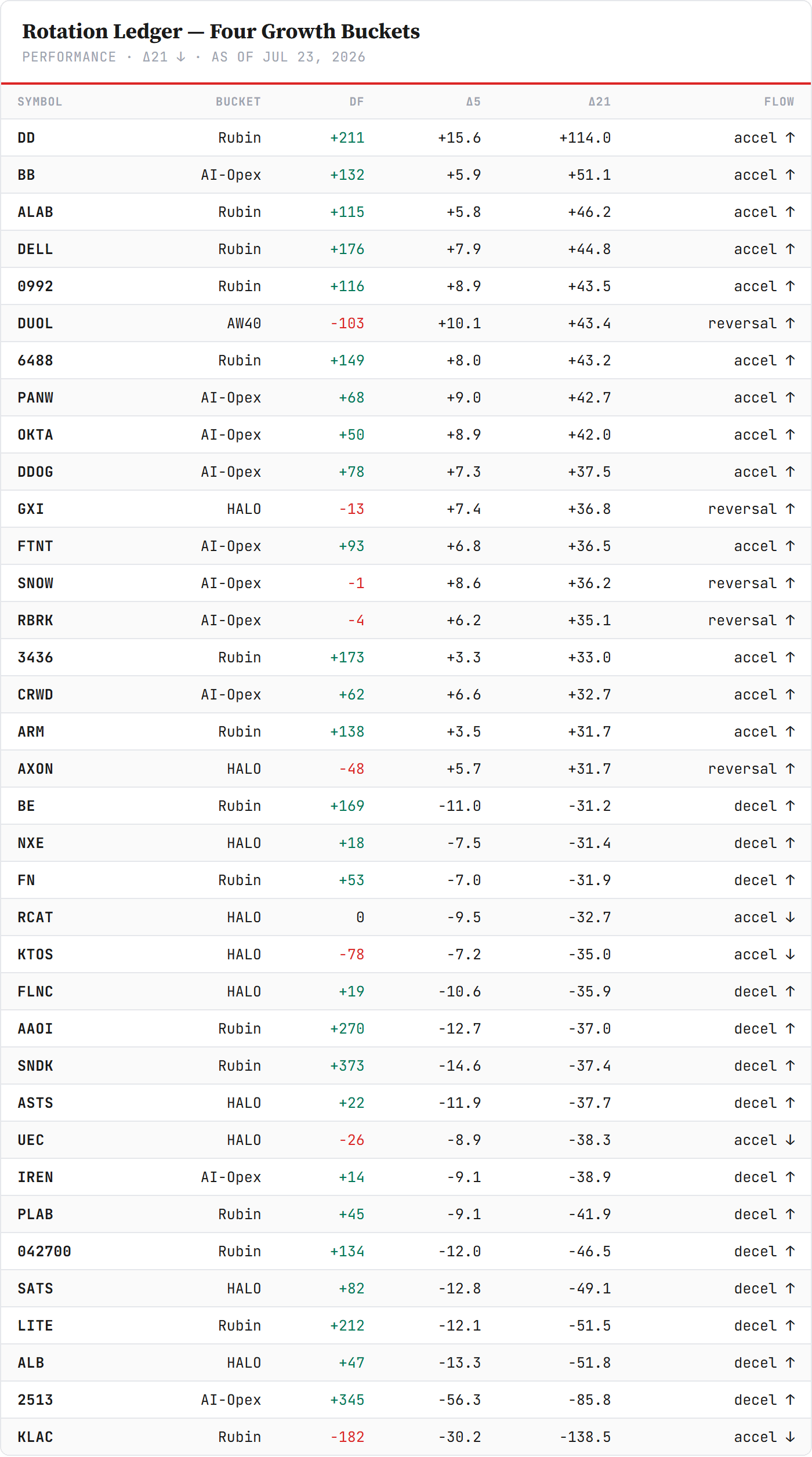
Our own board — the fresh scan. The Rotation Ledger below is the Closelook Directional Flow scan across all four growth buckets, sorted by the 21-day flow delta, scanned July 23. Read it against the last edition’s version:
2 · The State
The four buckets, briefly. New readers: we cut the growth trade into four functional indices — Rubin is the AI build-out, AEI the AI-opex layer, AW40 the agentic winners (the application cohort 2026 punished hardest), and HALO functional growth beyond AI.
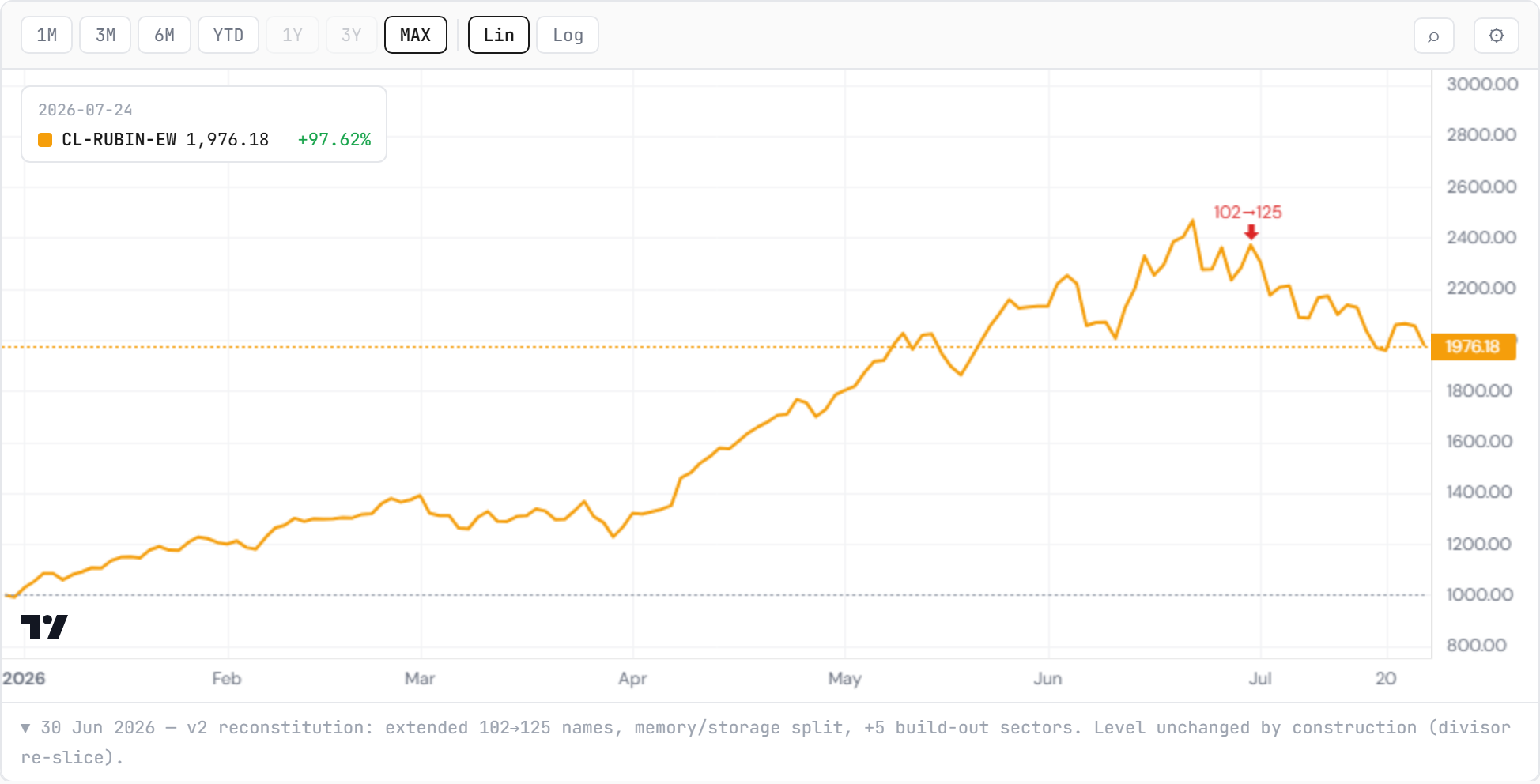
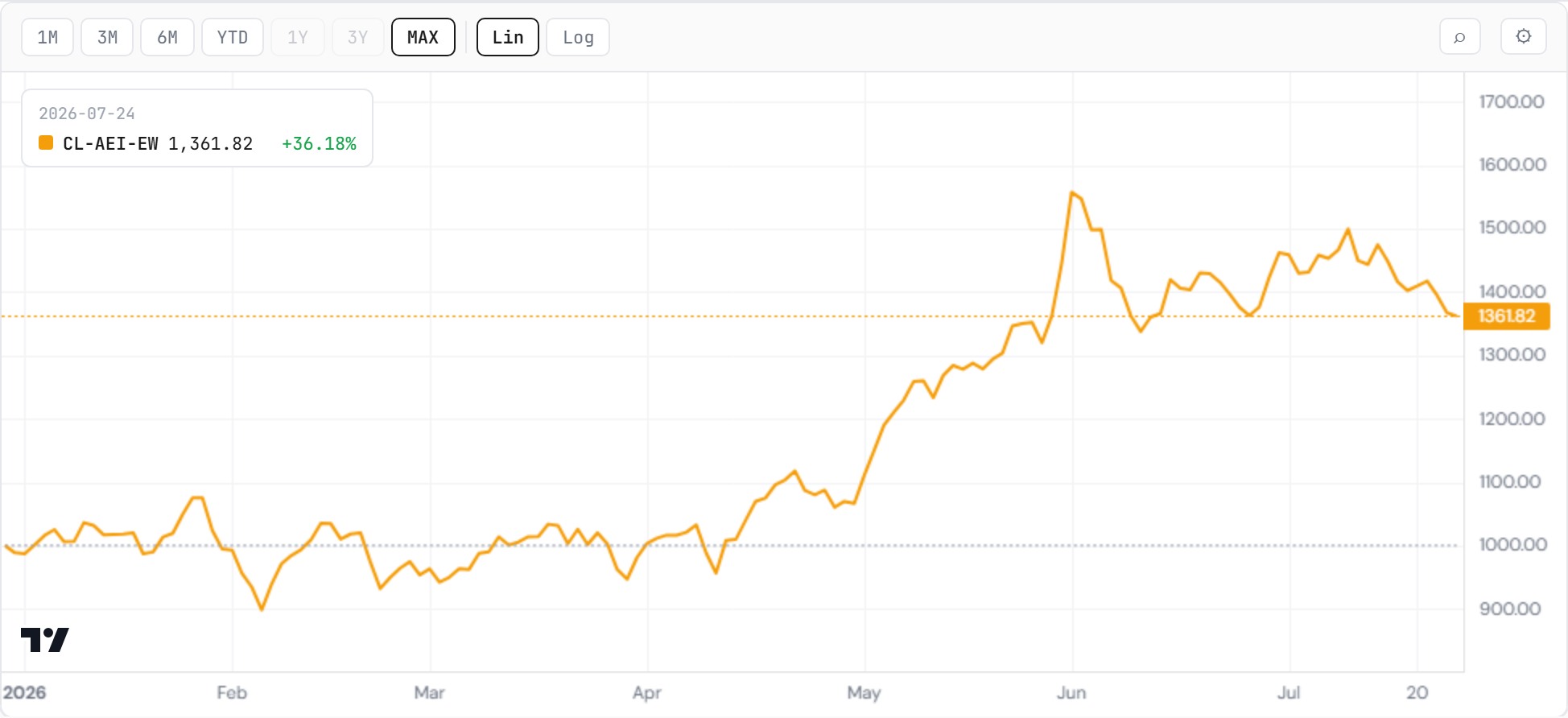

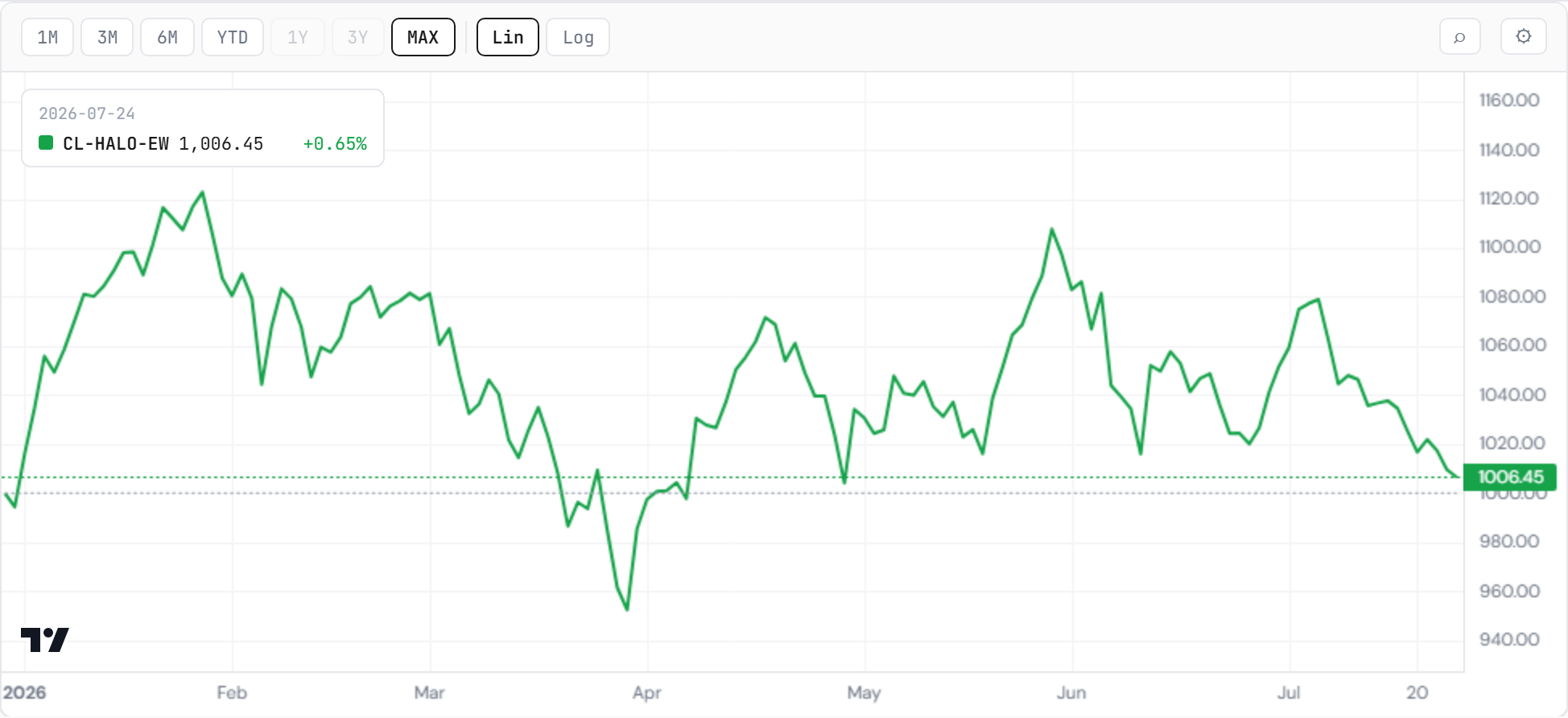
The week the ladder flipped twice. The verdict week sorted the buckets in a new order: Rubin +0.4% — the build-out stabilizing after its washout (+92% YTD) — while AW40 gave back 3.7% (−23% YTD), AEI −2.9% (+38%), HALO −1.9% (−1%). Then Friday re-sorted it again: AW40 +2.2% on the day SAP and ServiceNow were paid for claiming the orchestration seat, while Rubin fell 3.8% with the cracking band. Two flips in five sessions is not indecision — it is the market pricing the AI trade as layers rather than as one theme, which is the founding premise of the four-bucket framework. The scoring just moved onto our home field.
The receipts, in names — what the ledger had already said. Two of the fortnight’s verdicts were this letter’s own calls, so they get scored first. Netflix: the last edition printed, in advance, that it carried “the scan’s least favorable pre-print configuration.” It grew, beat, and was sold to a 52-week low within two sessions — the flow state knew what the estimates didn’t. IBM: missed with a cut, mainframe revenue −42% against distributed +37% — the legacy decay this letter has tracked since the 25%-day, now visible inside a single income statement. The rest of the print week (Intel’s sold double-beat, the SAP and ServiceNow orchestrator bid — the full print-by-print record is the US letter’s) matters here as a sort: the market has started pricing enterprise software by which layer of the agentic stack a name occupies — the framework in this week’s long read, The Agent Is Not the Product. The Orchestrator Is., six claimants, at most three seats. For this letter the consequence is concrete: the AW40 cohort’s fate now depends on layer, not on growth rate — and the ledger’s job is to catch the market’s layer-sorting in the flows before the prints announce it.
The boundary, name by name — Friday’s dependence ladder. Friday’s session sorted the AI-hardware complex by a single variable: how much of each name’s value depends on the next hyperscaler order. Our numbers, Friday close, in that order: ARM −8.1% (royalties per chip deployed — the purest order-dependence in the complex, on its richest premium) · Micron −7.0% (HBM is ordered, not consumed) · Applied Materials −4.7% and KLA −3.8% (equipment order books feel capex changes first) · Vertiv −4.5%, Quanta −4.3%, Eaton −2.7% (the data-center power layer) · AMD −3.3%, Broadcom −2.7% (custom accelerators in between) · and at the far end NVIDIA −0.9%, the one name priced on workload execution rather than on anyone’s order book. Now cross-check the ladder against our own ledger, in public: KLA is the scan’s biggest vindication — flow rolled to accelerating-down two scans before Friday priced the reason. And ARM is the scan’s open contradiction: the ledger has it accelerating-up (+31.7) while Friday hit it hardest of all. One of the two is wrong — either the flows are catching accumulation into weakness, or the delta hasn’t caught the repricing yet. That row is now the most interesting single test on the board, and we will score it here either way.
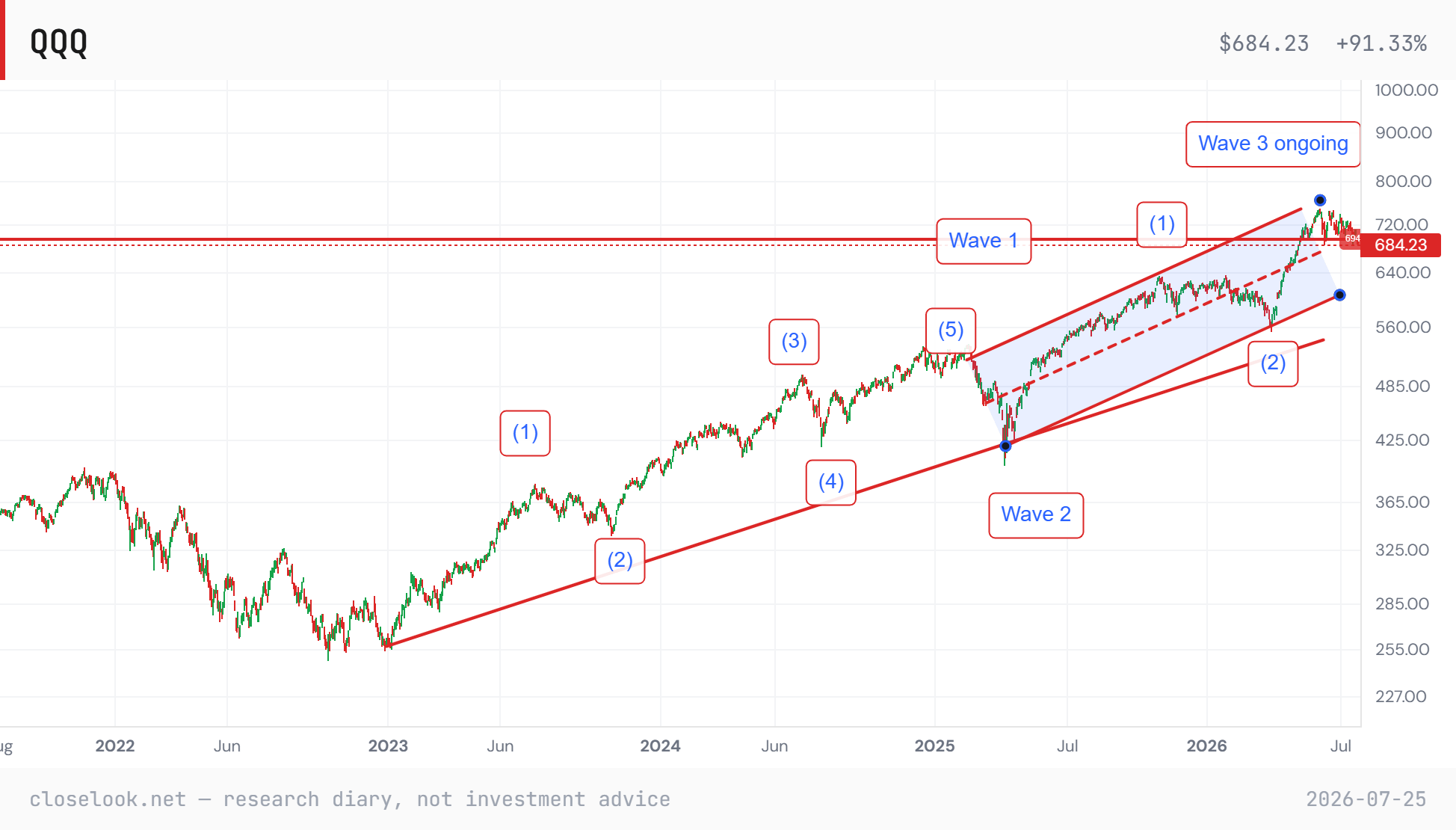
The structural read — scored honestly. Our working QQQ count (Wave 1 into early 2025, Wave 2 the spring break, ongoing Wave 3) took its first real hit: Friday’s close at 684.23 sits below the 686.37/686.76 double-washout floor — the exact escalation line the US letter flagged — while the S&P closed green the same day. A two-point break of the floor with the broader market refusing to confirm is not a completed answer; it is the question, posed at the count’s expense. The honest statement: a fast reclaim of 686–694 keeps the Wave-3 read intact with a deeper internal correction; acceptance below it forces the count’s alternative — that the correction is a degree larger than we have been treating it. We hold the read, at reduced conviction, and let next week grade it.
3 · The Outlook
The tells from the last edition — all three, scored.
Opex persistence, week three: confirmed — in flow. The scan shows the cluster unbroken and broader: Palo Alto (+42.7), Okta (+42.0), Datadog (+37.5), Fortinet (+36.5), CrowdStrike (+32.7) — all accelerating-up, week three-plus. The doctrine said three weeks is a regime; the flow regime is in ink. The price test arrived simultaneously: the rate shock taxed the whole layer mid-week (CrowdStrike −9.8% on the week, Palo Alto −8.7%) before Friday’s orchestrator bid. Flows lead, price got stress-tested, the regime held. Watch the same cluster through the season’s software prints.
The conversion rate: pending, closer. Duolingo did not convert — it remains “reversing-up” — but it climbed to #6 on the entire ledger (Δ21 +43.4 against flow still at −103), and the reversal cluster recruited: Snowflake, Rubrik and Axon joined it this scan. Accumulation is broadening; conversion is still the trigger the tactical sleeve waits for.
KLA — the contagion question: answered, against us. The last edition asked whether KLA’s roll would stay idiosyncratic. It did not. KLA deepened to −138.5 with flow now negative outright, and the roll spread exactly along the sleeve we named: Photronics, Lumentum, AAOI, Sandisk. This was the “stall is the top” scenario’s first domino, and the sector-degree price action — 554 rejected from below, the 582 base gone, the band cracked — confirms the equipment layer’s rest became a de-rating. We wrote we would refuse to pretend otherwise; we are not. The build-out’s core leaders tell the other half, below.
The leaders’ dissent. In the same week the band cracked, NVIDIA closed green (+0.5%, above both moving averages), AMD green, Micron +4% after its −24% month, Dell +9.3% on the ledger’s accelerating flow, DuPont leading the entire scan on the materials side. A complex whose index breaks while its leadership and periphery refuse to confirm is exactly what the last edition called “value migrating from the crowded core to the supplying periphery” — the barbell inside the build-out. The equipment sleeve is repricing; the architecture and materials layers are not. The bucket is not one trade either.
The bucket system now has its own gauge — and it was built for exactly this week. The AI Handoff Board is the four-bucket thesis turned into an instrument: nine ratios measuring whether value is migrating along the chain this letter is organized around — Rubin builds → AEI operates → AW40 uses — each normalized to 1.00 at June 30. The readings, Friday close: operate-versus-build at 1.12 (+12% in four weeks — the opex bucket re-rating against the build bucket), use-versus-operate at 1.11, and the full-chain scoreboard use-versus-build at 1.24. This week all three cross-ratios dipped — which is not a contradiction: Rubin stabilized while the operators gave back, the same double flip the bucket table above shows. The macro event that lit the fuse — the capex-sustainability double-print and the four-layer architecture it forced apart — is the US letter’s story, told at the sector-and-index degree; what belongs here is the system statement (the migration the deltas flagged in early July is now visible in level terms across the whole chain) and, below, the names. Confirmation, in bucket language: two earnings cycles in which AEI-bucket names earn relative estimate upgrades while Rubin-bucket equipment and memory estimates flatten. Wednesday’s referee block is cycle one. (And the opex layer is not an American monopoly — Walldorf proved that this week; the non-US expressions of the layer are next Saturday’s Global material.)

The regime gauge. Money Temperature at 50, up from 44 — dead-neutral. The pairing the doctrine likes (composite steady, rotation internal) survived the fortnight; the composite turning down while rotation runs remains the exit signal, and it has not printed.
The week ahead — the referee block. For the four-bucket framework, next week is not an earnings calendar — it is the referee. The Wednesday/Thursday mega-prints (the budgets that fund the build-out bucket’s entire demand thesis) either re-confirm the capex path at full size, or hand the rotation its biggest receipt yet; the print-record angles and levels live in the US letter. Cadence on Monday matters here for one bucket-specific reason: it prints one session after Kimi K3’s promised open-weights release, and a verified design shock reprices seat-based software economics across two of our four buckets at once. Whatever the verdicts, the ledger scans them before the narratives do — that is the point of it.

