


This week the market paid exactly that list, up to twenty-three percent, while the memory names still draining from 290-point scores kept falling. The incumbent floor got results under it, the challenger floor kept giving way — and the second pillar’s first test week went against it, which the letter records rather than hides. Plus three signposts for when the thesis comes back.

1 · This Week’s Action
Where this letter sits. Sunday’s US edition reads this market at index and sector degree — the tape, the levels, the count. This one reads it at name altitude: which companies the money actually went into, which it left, and what the flow behind each is doing. Same market, one rung lower. And this week the order of those two altitudes matters, because the name-level instrument moved first: what this page’s tables said seven days ago is what the index pages reported five days later.
The backdrop, one line. The index spent the week inside a one-percent band and everything underneath it rotated: software broke its June resistance and went green on the year, the Magnificent-7 basket beat the average stock for the first time in five weeks, Nvidia’s eleventh double beat was paid and half refunded, Thursday’s hardware beat-and-raises were sold in Friday daylight on Warsh’s first keynote — and the VIX fell 4.6% to 14.43.
The tech shelf — the split is now the whole board. The five green lines on the tech board are all the layer above the chip: software +5.93% (the board’s best, through its June resistance), cybersecurity +3.91%, cloud +2.82%, internet +2.69%, AI applications +1.25%. The sixteen red are led down by the silicon again: XSD −3.29% the worst line a second straight week, SMH −1.30%. Two weeks ago the software-up-semis-down split was a tell; last week it was demoted to “a line inside one sector”; this week it promoted itself back — as the axis the whole market paid by. The pair board dates it: the software-to-semis ratio bottomed June 22 and is 52% off that low.
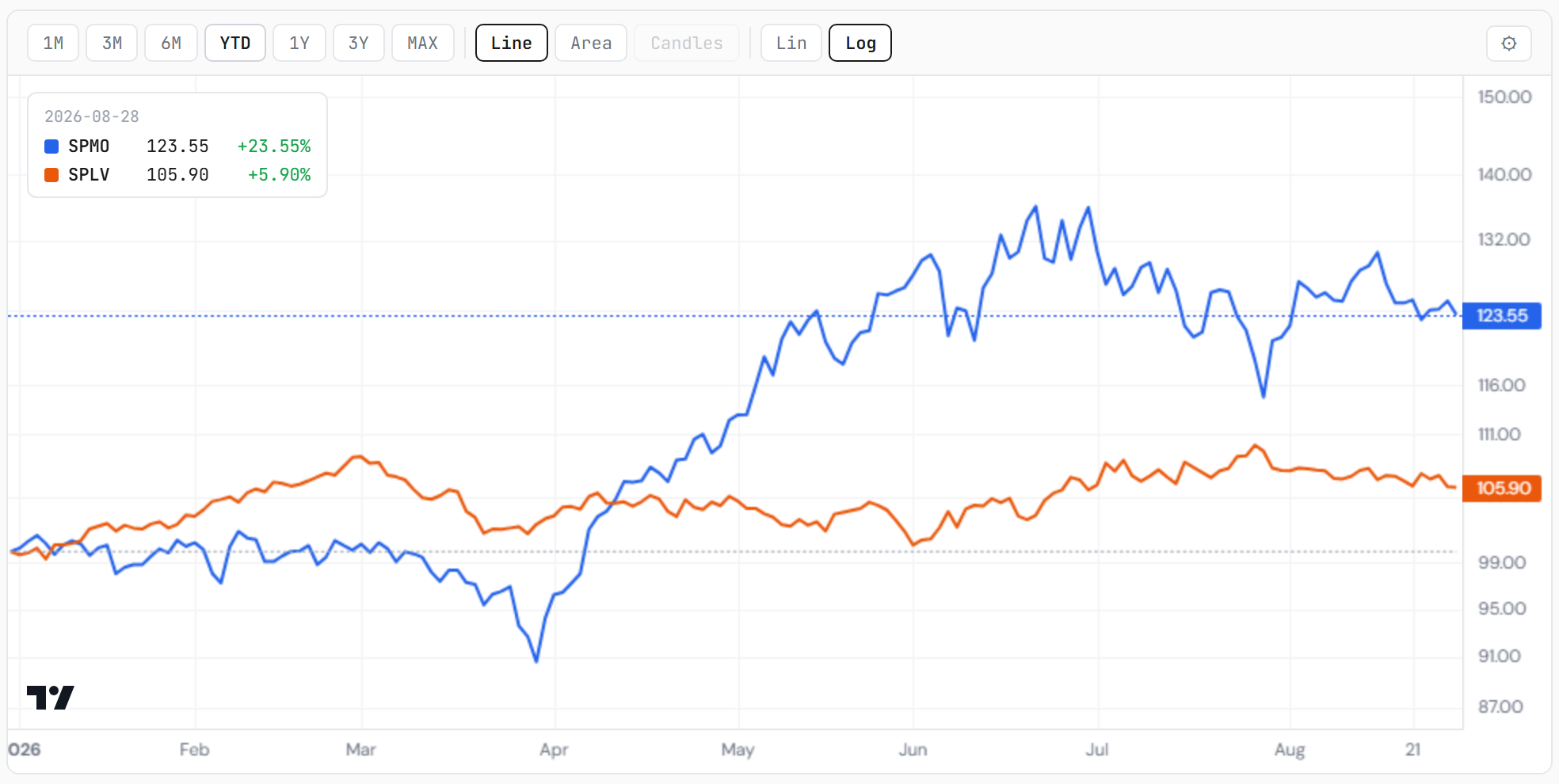
The factor view — the style axis went quiet while the layer axis roared. The factor-regime gauge still reads momentum repair attempt below trend — indexed 155.25 against a 50-day at 157.22, the percentile bleeding a second week, 89.7th from 92.3rd. The pair behind it barely moved: SPMO −1.31% against SPLV −0.31%. For this cohort that quiet is information: the violent rotation ran through what companies do — layer by layer — not through how their charts behave. A hypergrowth book gets sold in factor unwinds; it gets re-sorted in layer rotations, and this week was the second kind.
A note before the ledger. The week’s best names in the whole family — Okta +23.0%, Salesforce +22.4%, freee +17.3%, Elastic +16.3%, CrowdStrike +13.8% — are nine-tenths software and applications, with not one chip, cloud operator or HALO name among them. The exact inversion of last week’s list (a copper miner, a genomics company, an energy-drink maker). Third consecutive week in which the prior week’s hero list leads the casualty list — the one-week-lease market at name altitude. The ledger below is read with that in mind.
Our own board — the Rotation Ledger, on Friday’s closes. The Directional Flow scan read this week is fresh: the scanner missed its Friday-night run and this desk triggered it Saturday morning, so the tables below carry Friday’s closes — no as-of asterisk this week. The buckets across 429 instruments: 93 accelerating-up (from 83), 80 reversing-up (from 77), 159 decelerating-up (unchanged — still the largest bucket and still the long warning), 65 flat, 32 accelerating-down. Slightly firmer at the building end than a week ago; the decelerating-up overhang intact. One instrument in 2.4 is building flow; one in thirteen is losing it outright.
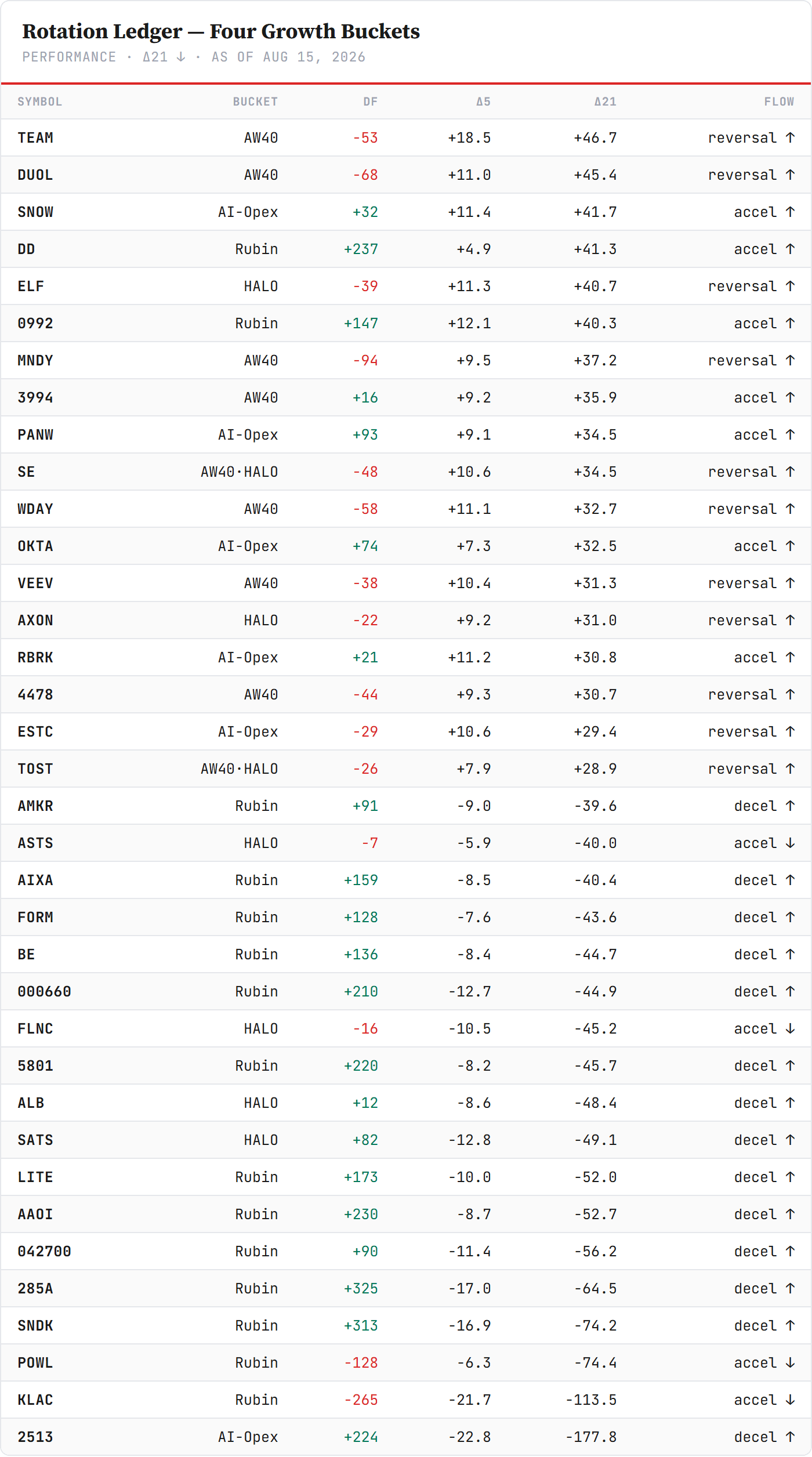
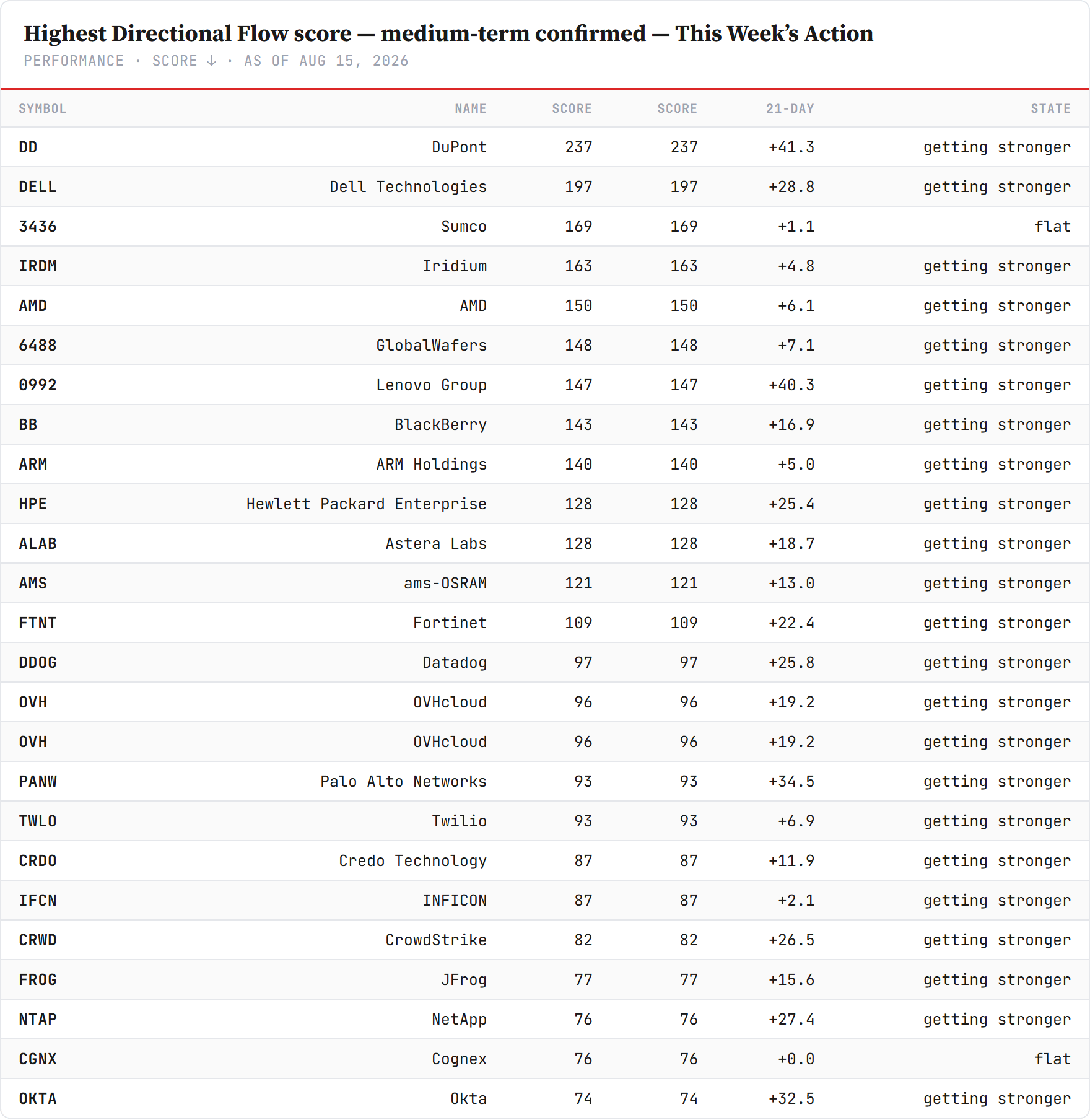
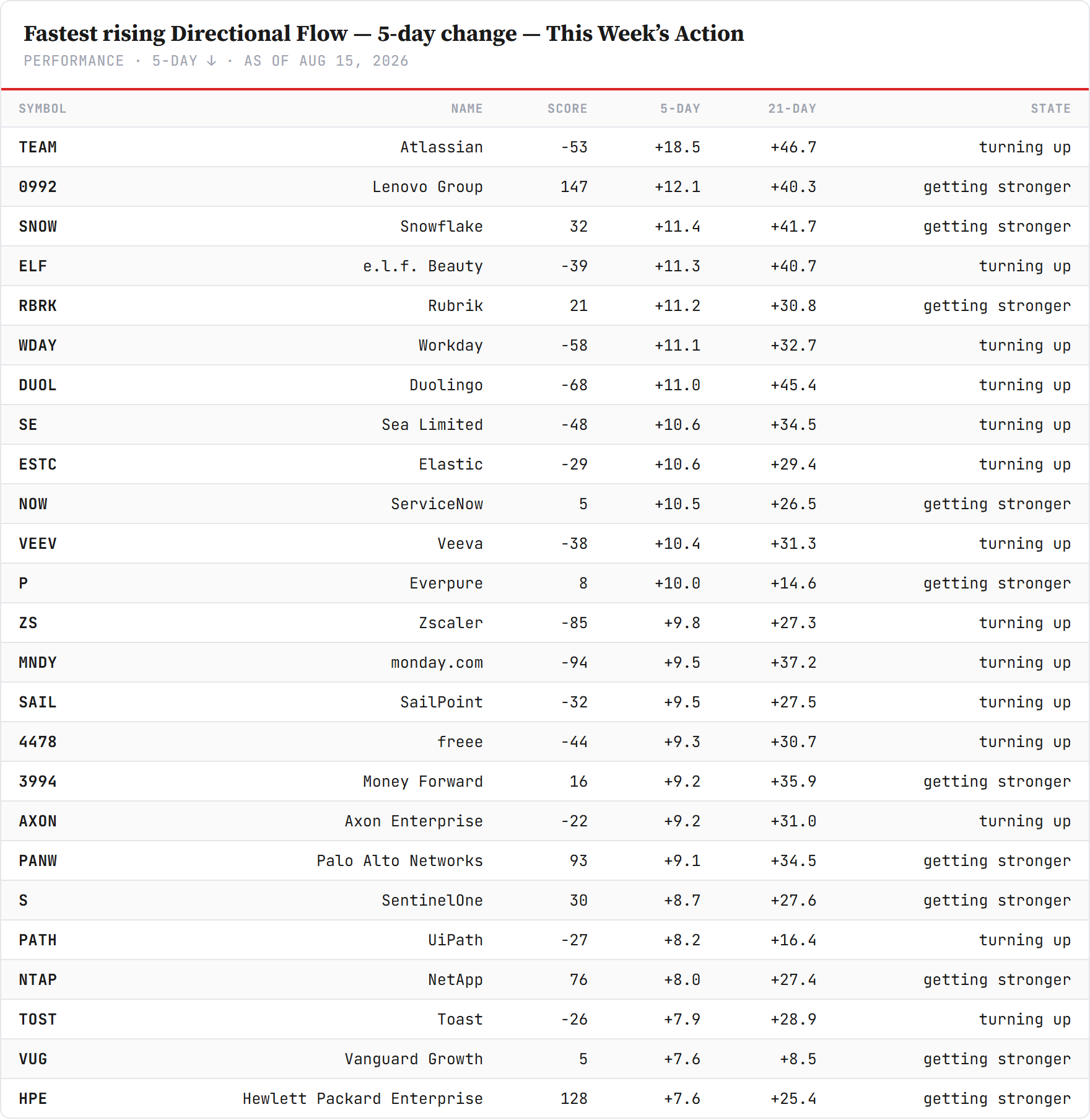
The receipts — last week’s table, this week’s tape. This is the paragraph this edition exists for. Last Sunday the fastest-risers table — the engine’s address for leadership before the price board shows it — read: Atlassian +19.0 on five-day flow from a −38 score, freee +13.2, Appier +12.0, Elastic +11.7, Workday +11.6, e.l.f. +11.3, Duolingo +11.1 — “software names and consumer names building flow from negative scores”, published while the tape was still selling everything. This week the market paid that list, nearly line for line: Atlassian +11.7% on the week, Elastic +16.3% with a print paid nineteen percent in daylight, Workday +5.8% on its own beat-and-raise, Veeva +11.6%, Salesforce +22.4%, Okta +23.0%. The flow ledger led the tape by one week. The diary records it the way it records its misses: an instrument that fired correctly once is a data point, and this page will keep publishing the table before the week rather than after it — that is the only honest test.
The four stock tables — this letter’s own board. Every row from our own Directional Flow scan across 413 stocks, not from a vendor screen. This week’s tables read as of Friday, 28 August.
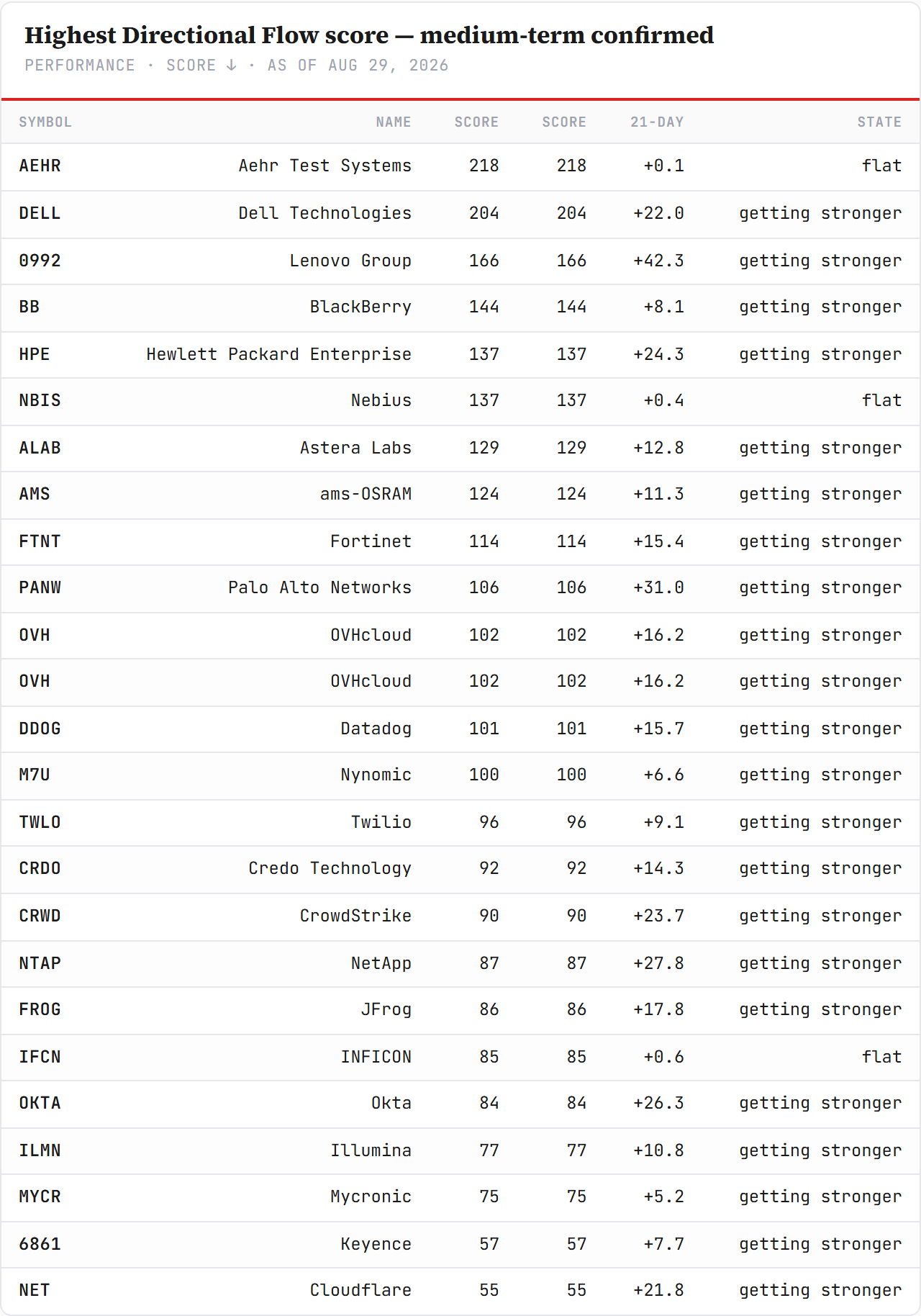
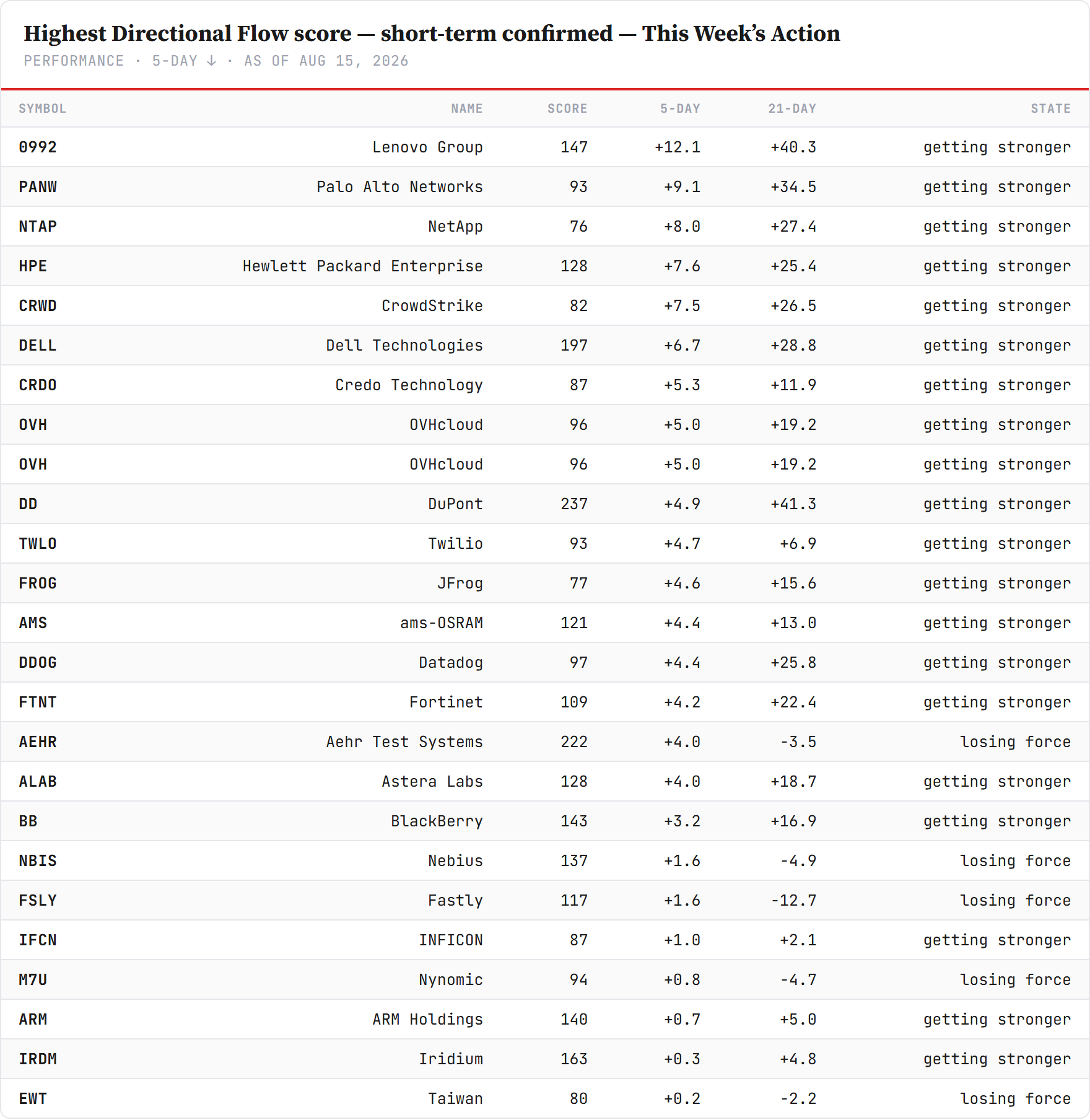
The strongest trends, confirmed on the medium term. DELL at 204 (+22.0 on the month) — and DELL prints Tuesday after the close, arriving with the top score on the confirmed board; Lenovo 166 (+42.3), BlackBerry 144, HPE 137 (+24.3), Astera Labs 129, ams-OSRAM 124. One row to keep reading carefully: Aehr Test Systems at 218, flat on five days, after a further −20.6% price week — the 252-day regression still has not digested the crash, the standing exhibit of why the change columns lead and the level lags.
The same list, confirmed on the short term. DELL 204, Lenovo 166, HPE 137, Astera Labs 129 — and two names this cohort should notice arriving together: Fortinet 114 (+15.4 on the month) and Palo Alto 106 (+31.0). The firewall pair joining the confirmed board in the week the security sub-index led the entire four-family system is the flow and the price agreeing in real time.
Where new leadership shows up first — the fastest risers. The list that got paid, updated: Atlassian +19.0 on five days (21-day build now +70.4), freee +15.6, e.l.f. +13.0, Appier +11.9, Duolingo +11.3, Workday +11.1 (+44.4 on the month), Veeva +11.0. Still software plus consumer, still no chip or tool on it — the same shape one rung further along, with the prices now attached.
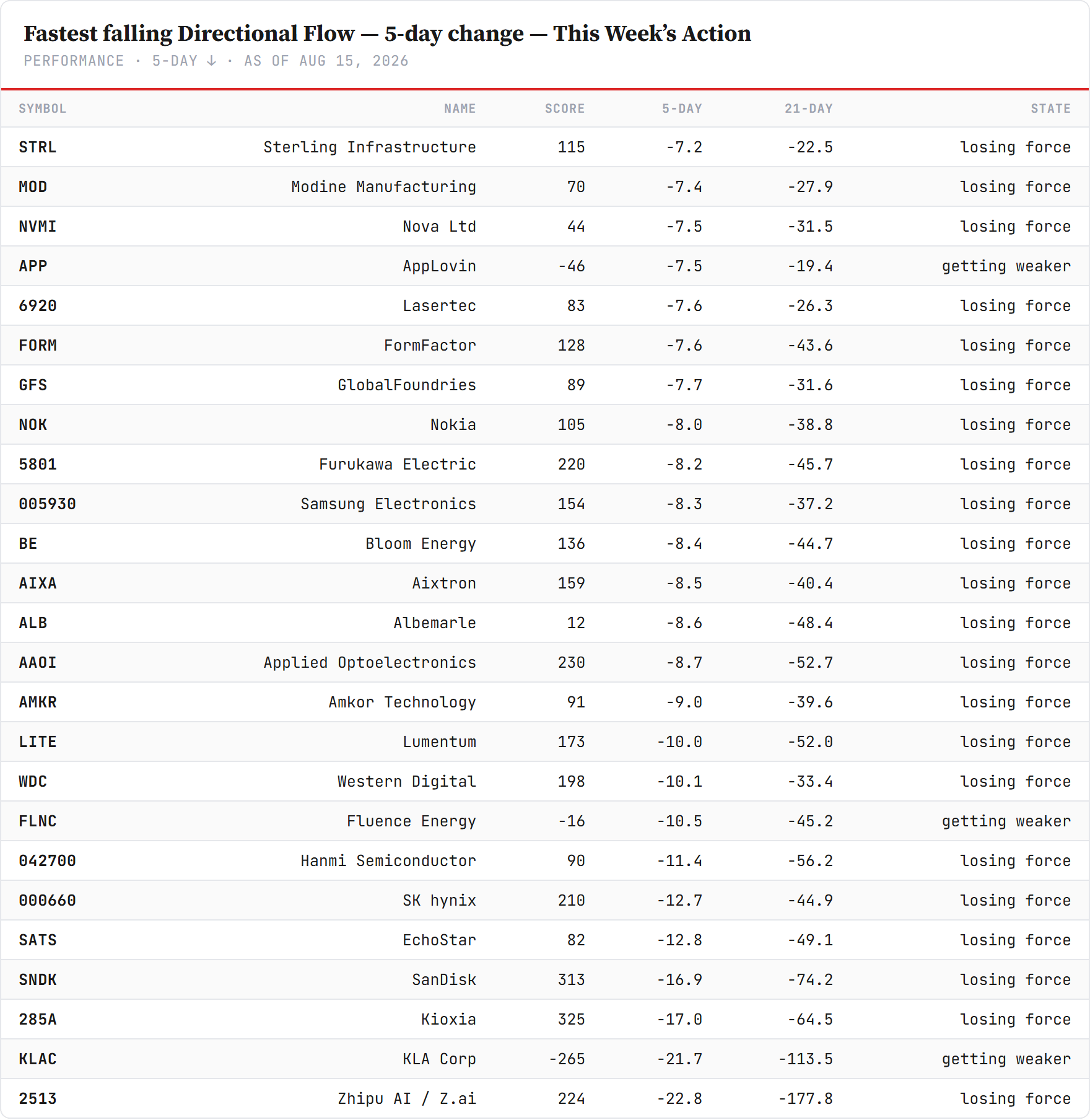
And the draining side. Z.ai −25.0 (score 170), KLA −18.5 at a score of −304 — the deepest acceleration-down in the universe — Kioxia −17.3 from a 293 score, SanDisk −15.5 from 284, Applied Optoelectronics −14.6, EchoStar, Fluence, Aixtron. The memory complex has now spent three weeks draining from among the highest scores on the board, and the price keeps following the drain: SanDisk −6.96% this week, Micron −3.51%, the DRAM vehicle under its 58 line all five sessions. Last edition wrote “the flow was early” about storage; this week the flow stayed early, in the same direction.
2 · The State
The four buckets, briefly. New readers: we cut the growth trade into functional indices rather than sectors — capex (Rubin Build-Out, what gets built), opex (Agentic Ecosystem, what it costs to run), applications (Agentic Winners, what gets sold on top), and HALO as the control group carrying no AI thesis at all.
The week’s ladder: applications +4.7%, opex +1.6%, capex −1.8%, HALO −2.3%. On the year: capex +87.1%, opex +60.9%, applications −0.1%, HALO +6.0%; Euro-AI +0.4% on the week, +32.9% on its year. The lightest layer led for a third week — all nine of its sub-sleeves green, and the layer now one ordinary week from a green year for the first time since January — while the control group fell.
The control group flipped, and this cohort should read it twice. Last week HALO held flat while the AI layers bled: an AI unwind, not a growth unwind. This week HALO fell 2.25% while the applications rose 4.68%: an AI bid inside a growth sell — the exact mirror, on the same one-week cadence as everything else. For a hypergrowth reader the two weeks together say something neither says alone: the market is not deciding between AI and growth. It is oscillating between them weekly, and the only thing bought in both weeks was the application layer. Inside HALO the casualties were last week’s heroes — longevity −3.2% after leading, speculative −7.4%, space −7.3% — with only Asia-Pacific and payments green.
The floors, scored — the asymmetry reversed a second time. Last edition: the results floor (the neocloud payments) deflated while the cheque floor (Workday’s reported takeout interest) held. This week both halves moved again. The challenger floor kept giving way: Nebius −4.5% to 209.18 — a third consecutive red week — CoreWeave −4.1%, IREN −15.4%, with the operators-against-suppliers handoff ratio down 4.8%: the capacity traders repriced against the very supplier who just capped his own year at 70% for lack of supply. And the incumbent floor got results under it: Workday printed a beat-and-raise, was paid 5.8% in Friday daylight, closed the week +2.35% at 204.72 — the floor built on a cheque now has a quarter’s numbers standing beside it, and an +11.1 five-day flow build behind those. The scoring window closes Tuesday; the mechanical verdict follows the letter’s rule, not its enthusiasm.
Inside the buckets — the sub-sleeves put names on the week. Inside the applications: Control Plane +7.87%, Enterprise +5.84%, Application Leaders +5.51%, and Megacap Gateway +3.38% — green again after two red weeks, still the only sleeve positive on the year. No internal rotation; the whole layer was bought. Inside the operating layer, the security stack got paid outright: Identity, Trust & Governance +13.66% — the best sub-index in the entire four-family system — operations & observability +5.84%, govern & secure +5.74%; at the bottom, compute operators −4.02% and foundation models −3.40% against their +723% year. Inside the buildout the best line was EDA & chip IP +5.98% — the buildout’s own software — while HBM Memory, last week’s only green sub-index, fell 4.01% into the bottom five. The layer axis runs through every bucket at every altitude.
The buckets against their highs. Applications closed 3.05% below the January record — from 7.4% below a week ago; it recovered half its remaining gap in five sessions — and +32.3% off the July 23 low, extending. Opex sits 5.8% below its August 13 high, +17.0% off its low. The buildout remains 22.4% below June, the only layer whose peak recedes. The spring pattern — the index that bottoms first leads — has now held for four consecutive weeks, in the layer that bottomed first.
The structural read — the count, from the US letter, as the gate. QQQ closed back above the 50-day it sat on to the cent (716.43 over 712.06); 746.16 confirms, 694 voids, neither traded; the five-day chart resolved an ascending triangle upward through 713. No invalidation; the referees print daily next week.
3 · The Outlook
The tells from last edition — scored. The storage call stayed right: flow led, price followed again (storage sleeve −6.2% inside the buildout, SanDisk and Kioxia still draining from 280–290 scores). The cybersecurity watch resolved as the week’s biggest hit: named two editions ago as the opex sleeve that structurally avoids the biggest-customer-becomes-competitor problem, held last week as “logic held, price did not” — this week the price arrived everywhere at once: Identity +13.66% the system’s best sub-index, the trust-against-execution handoff ratio +4.48%, Okta and CrowdStrike the family’s two best names, the firewall pair joining the confirmed flow board. The neocloud retention call stayed right in the other direction: the payments that died stayed dead, a third week.
The regime gauges, one paragraph. The Handoff Board: use-against-build +3.85% to 1.6007, use-against-operate +3.04%, beyond-gateways +3.19% — a third consecutive week of the stack handing value up — with trust-against-execution +4.48% the sharpest line and operators-against-suppliers −4.79% the sourest. The Money Temperature composite: 57, up four, second consecutive warming week, transition band — the gauge reading the rotation itself as appetite. The house inflation composite: 49, contained, direction flat, while the 30-year rallied to 5.207% into the buyback window.

Three signposts for when the thesis comes back. The hypergrowth thesis is not being refuted this month; it is being repriced and re-sorted — and a repriced thesis returns on evidence, not on mood. These are the three signposts this letter is now watching for the return leg, stated so they can be scored:
One — the model-release delta, as the scaling-law gauge. The capability gap between each frontier model generation and the last is the whole trade’s first principle: if the deltas keep coming, the compute demand curve stays convex and the buildout’s 70% supply-capped year is a floor, not a peak. If the deltas compress, every layer below the applications reprices. The gauge is public — release cadence, benchmark jumps, and whether each new model moves deployment (agents shipped, seats expanded) rather than demos.
Two — old-GPU rental prices, as the pent-up-demand gauge. Scarcity pricing at the frontier is contractual and opaque; the previous generation’s spot rental price is the honest meter. If demand genuinely exceeds supply by the margin the supplier claims, last-generation capacity holds its rate — overflow demand has nowhere else to go. If old-GPU rates roll over while new capacity ships, the “much greater than 70%” demand claim was thinner than the call made it sound. This signpost is also the residual-value question underneath the August 10 financing platforms — the one Nvidia is now reportedly underwriting up to a quarter of project values against, and the subject of the special analysis the US letter announced. One number, three constituencies: the operators’ equity, the platforms’ credit, and the thesis itself.
Three — incremental margins, not operating margins, as the monetization gauge. Operating margins tell you what a business has been; the incremental margin — how many cents of each new revenue dollar reach profit — tells you what it is becoming, and it is the number that separates scarcity sellers from everyone else in this stack. The pricing power of the scarcity sellers is eye-watering precisely there: when supply is the cap, each marginal unit ships at terms the buyer cannot negotiate. Watch the incremental margins of the constrained layers against the unconstrained ones as supply catches up through 2027 — the layer whose incremental margin holds while volume doubles is the layer the thesis returns through. The print record will carry the arithmetic per name as the season’s numbers land.
The week ahead — the referee’s calendar, name by name. Monday: five scoring windows close — Nvidia, Synopsys, and this cohort’s two paid software prints, CrowdStrike and Salesforce, graded at the close. Tuesday: six more — Workday’s results floor gets its mechanical verdict, Rubrik’s zero-flats card measures a beat-and-raise that was sold thirteen percent — plus Dell prints after the close carrying the top score on the confirmed flow board, and the MongoDB card publishes. Wednesday: Broadcom, the silicon’s referee, plus Snowflake and GitLab. Friday: the first Warsh-era payrolls. The September frame from Saturday’s letter governs the month: worst seasonal, a hike more probable, about minus five percent the base case — anything better constructive.
