


The semis were rejected at the line, and the applications layer rose a second week while the buildout and the operating layer bled.
Underneath it, the best names on the board had no AI in them — so this letter opens a standing section for that growth, with a fourth book to follow it.
Edition of 2026-08-23 · from the C+ archive

1 · This Week’s Action
Where this letter sits. Sunday’s US edition reads this market at index and sector degree — the tape, the levels, the count. This one reads it at name altitude: which individual companies the money actually went into, which ones it left, and what the flow behind each is doing. Same market, one rung lower — and from this week on, with a second pillar beside the AI complex: the growth that has no tech inside it, which is where the names went this week. It gets its own section below.
The backdrop, one line. The semis were rejected at their overhead line on Tuesday, the Treasury doubled its long-end buybacks on Wednesday as the minutes leaned hawkish and Seoul had its sidecar night, Walmart’s double beat was sold nine percent on Thursday, the chart pick was paid thirteen on Friday — and the Nasdaq 100 closed the week 2.4% lower, on its 50-day average to the cent, with the VIX up six percent to 15.13.
The tech shelf — the year’s winners did the most, downward. The sleeves this cohort lives in sorted the other way round from last week. The five green lines are what is not the AI stack: crypto equities +9.68% (with the coin), ARKK +6.30%, fintech +2.95%, lithium +1.83%, uranium +1.56%. The four that led seven days ago reversed — WTAI +4.69% became −4.43%, cloud +4.18% became −1.30%, data-centre REITs +3.60% became −3.44%, quantum +3.40% became −5.17% — and the semis were the worst of the board: XSD −8.46%, fabless −6.15%, SMH −4.66%, all still between +45% and +55% for 2026. Software, −0.68%, held — still −2.2% on the year, still the subject of this letter, and this week the half of tech that did not fall.
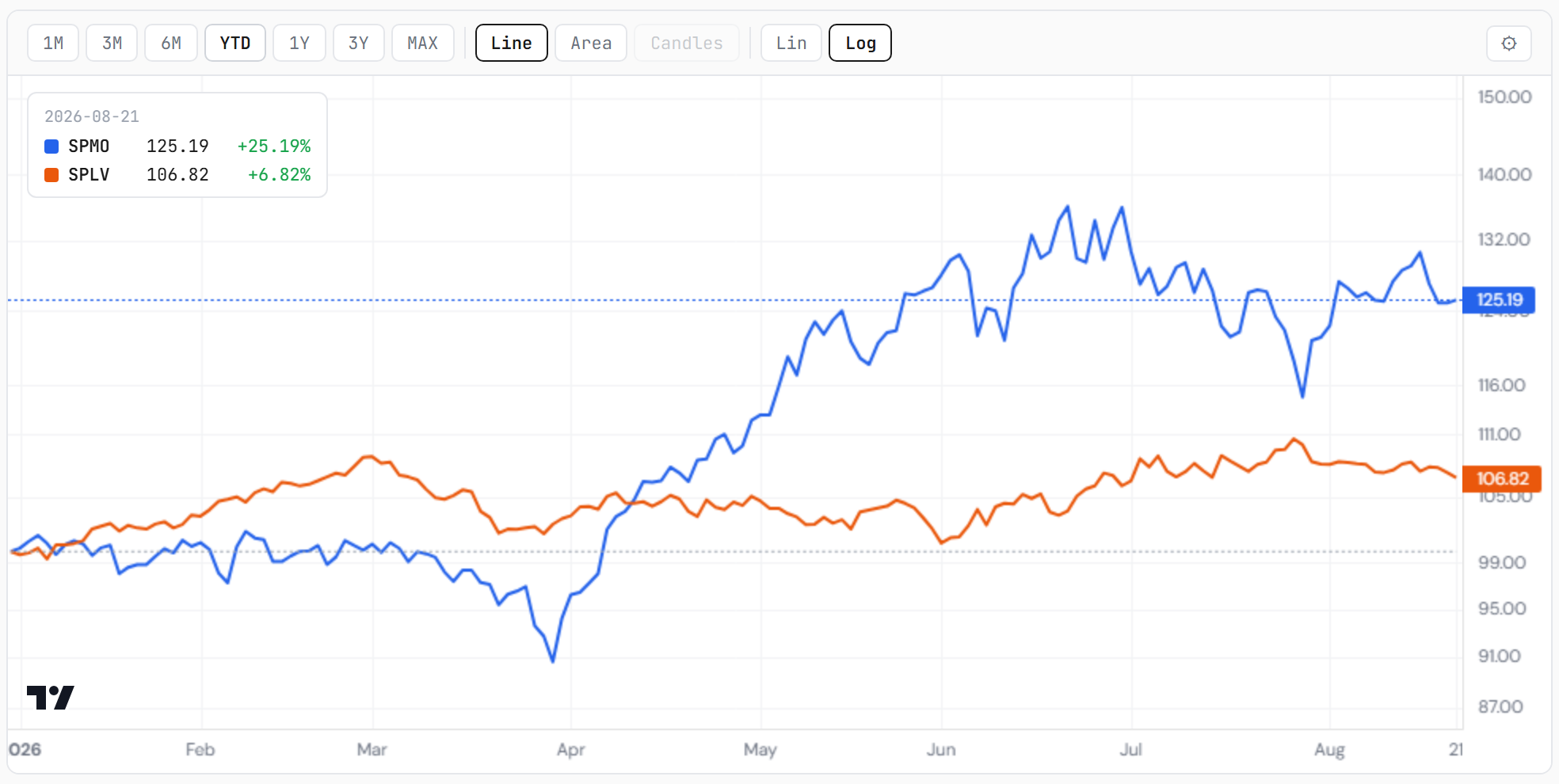
The factor view — the unwind the 95th percentile described. Last week this letter called momentum-over-low-volatility at the 94.6th percentile “both the tailwind and the risk” for this cohort, because hypergrowth is the highest-beta expression of that spread and gets sold to fund the reversal when it turns. It turned. The factor-regime gauge reads 92.3rd percentile, below its 50-day trend — indexed 156.83 against 158.27 — regime label momentum repair attempt below trend. The pair: the S&P Momentum ETF −2.99% on the week against the Low-Volatility ETF’s −1.38%; over sixty days momentum is now −0.58% against low-vol’s +2.35%. And the cohort was sold to fund it: four green names in ninety inside the capex index, three in thirty-one inside the operating layer. The equal-weight S&P lost only 0.49% against the index’s 1.37% — the average stock held; the crowded corner did not.
A note before the ledger. The week’s best names — the ten at the top of the family board — carry no AI thesis: a copper miner, a genomics company, an energy-drink maker, a uranium producer, a cosmetics brand, a restaurant, a language app. That is the subject of the new §4, after The Outlook. The ledger below is read with that in mind.
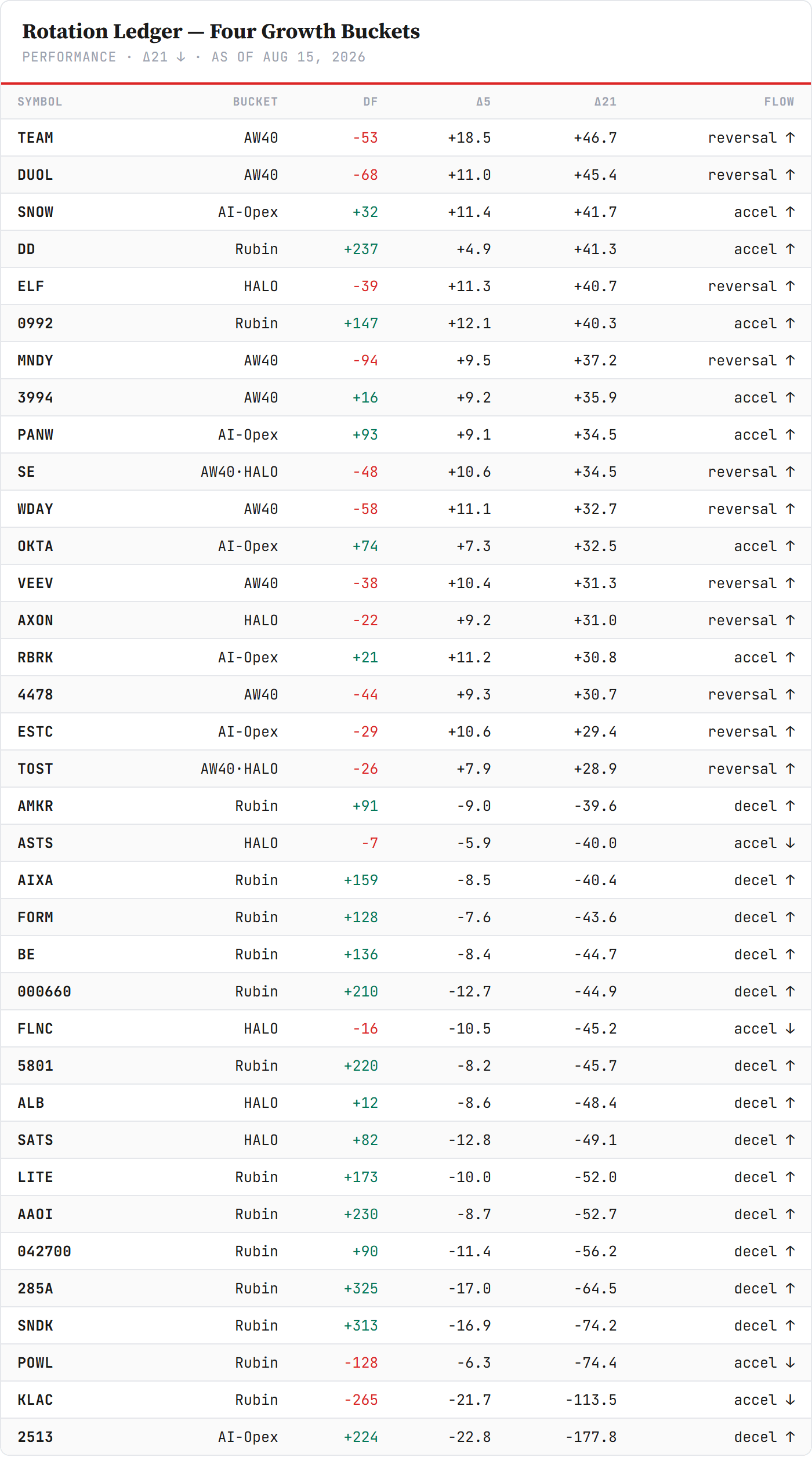
Our own board — the Rotation Ledger. The Directional Flow scan, read as of Thursday 20 August (Friday’s scan had not reached the API at build time), counts 83 accelerating-up, 77 reversing-up, 159 decelerating-up, 77 flat and 33 accelerating-down across 429 instruments. Still broad by our own instrument — one in three building flow, one in thirteen losing it outright — but the decelerating-up bucket, the long warning, is the largest, and it grew.
But read the windows separately, because they say different things. The 21-day builds are still the residue of prints already scored — Atlassian +56.5, Duolingo +46.1, e.l.f. Beauty +43.5, Snowflake +42.8, Lenovo +42.1, Workday +38.1 — gaps that have already happened, carried forward. The five-day cut is the honest read of this week, and it says something this cohort should hear: Atlassian +19.0, freee +13.2, Appier +12.0, Elastic +11.7, Workday +11.6, e.l.f. +11.3, Lenovo +11.3, Duolingo +11.1 — software names and consumer names building flow from negative scores, in the week the semis were sold. The software-vs-semis yin and yang has not gone away inside the ledger; it has been demoted from the line that decides the index to a line inside one sector.
And the five-day bottom is unchanged in kind and worse in degree: Z.ai −28.2, KLA −20.3, Kioxia −15.1, SanDisk −13.2, EchoStar −12.8, Fluence −11.2, SK hynix −11.2 — the memory and equipment complex still draining, this week with its prices finally following. SK hynix announced the largest buyback in Korean history on Wednesday night and still sits in the bottom seven on five-day flow.
How Directional Flow works — for new readers
Level (trend strength). A weighted linear regression on log prices over the last 252 trading days, with recent days carrying heavier weight. The output is the annualised slope in percent: how strong and how persistent the trend is right now. Most stocks score below 100; only exceptional trends run far above it, and the score can be negative.
Flow (our leading layer). We compute that level not only today but also as it stood 5, 21 and 63 days ago. The difference is the leading indicator: positive means the trend is accelerating, negative means it is losing strength. Price usually reacts later.
Why the 21-day change matters. Price is the slowest signal. Trend strength is coincident. The change in trend strength is what leads. A stock making new highs while its 21-day change declines is decelerating — the move is getting tired. A stock still in a downtrend whose 21-day change is turning up is an early-chance setup.
Four flow states. 🟢🟢 Accelerating-Up · 🟢🟡 Decelerating-Up (long warning) · 🟡🟢 Reversing-Up (early chance) · 🔴🔴 Accelerating-Down. The middle two are the valuable ones — they arrive before the price move does.
Universe and cadence. Over 400 instruments — US headline indices, the 11 sector funds, Nasdaq sub-indices, country ETFs, tech thematics, the Closelook indices and all of their constituents. The scan runs on US trading days at 23:05 UTC, after the close. The full ranking is public at closelook.net/stocks/rankings/directional-flow/.
The four stock tables — this letter’s own board. These are the tables the other two letters do not carry, because this is the only one that reads at name altitude. Every row comes from our own Directional Flow scan across more than 400 stocks, not from a vendor screen. This week’s tables read as of the 20 August scan.
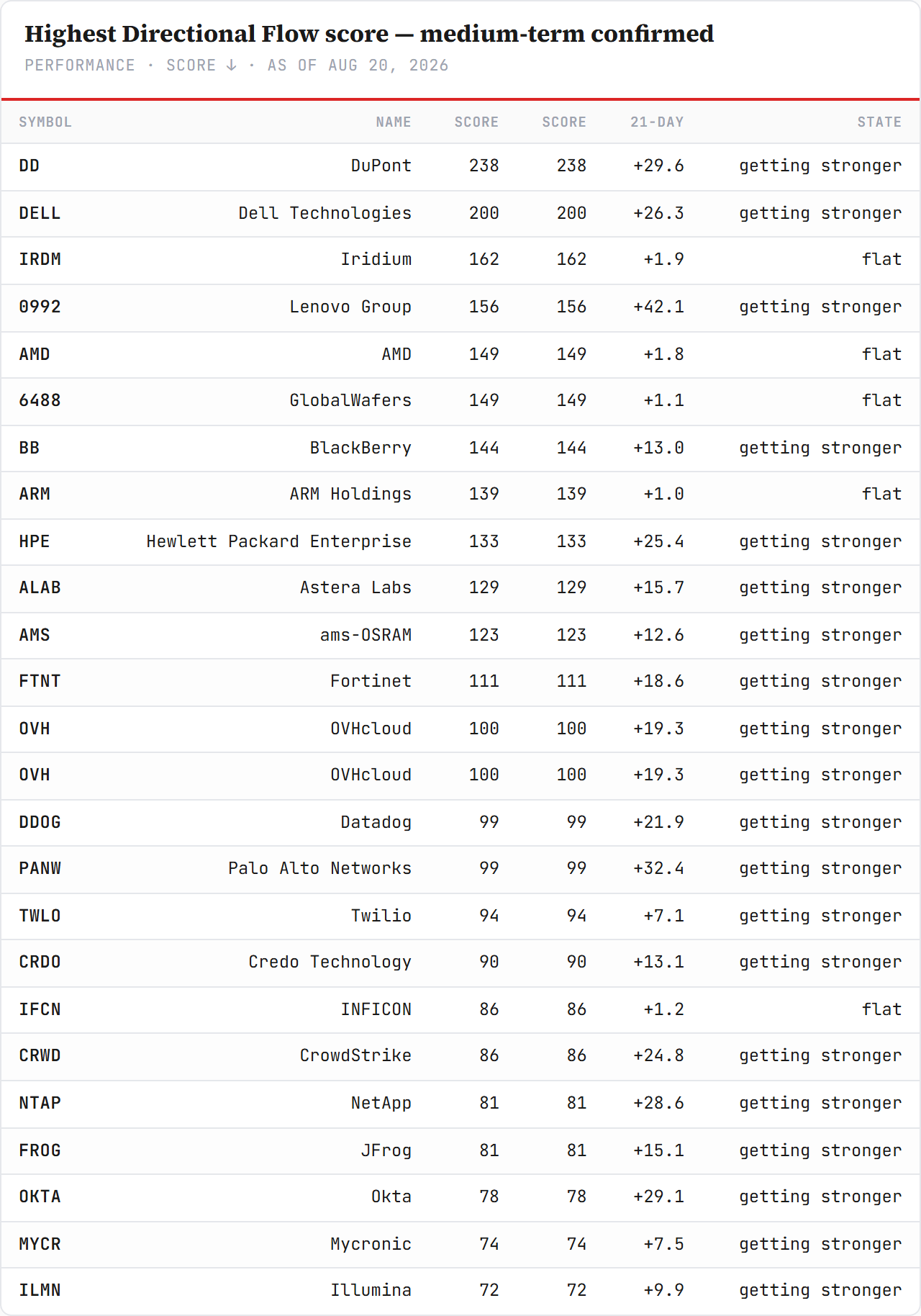
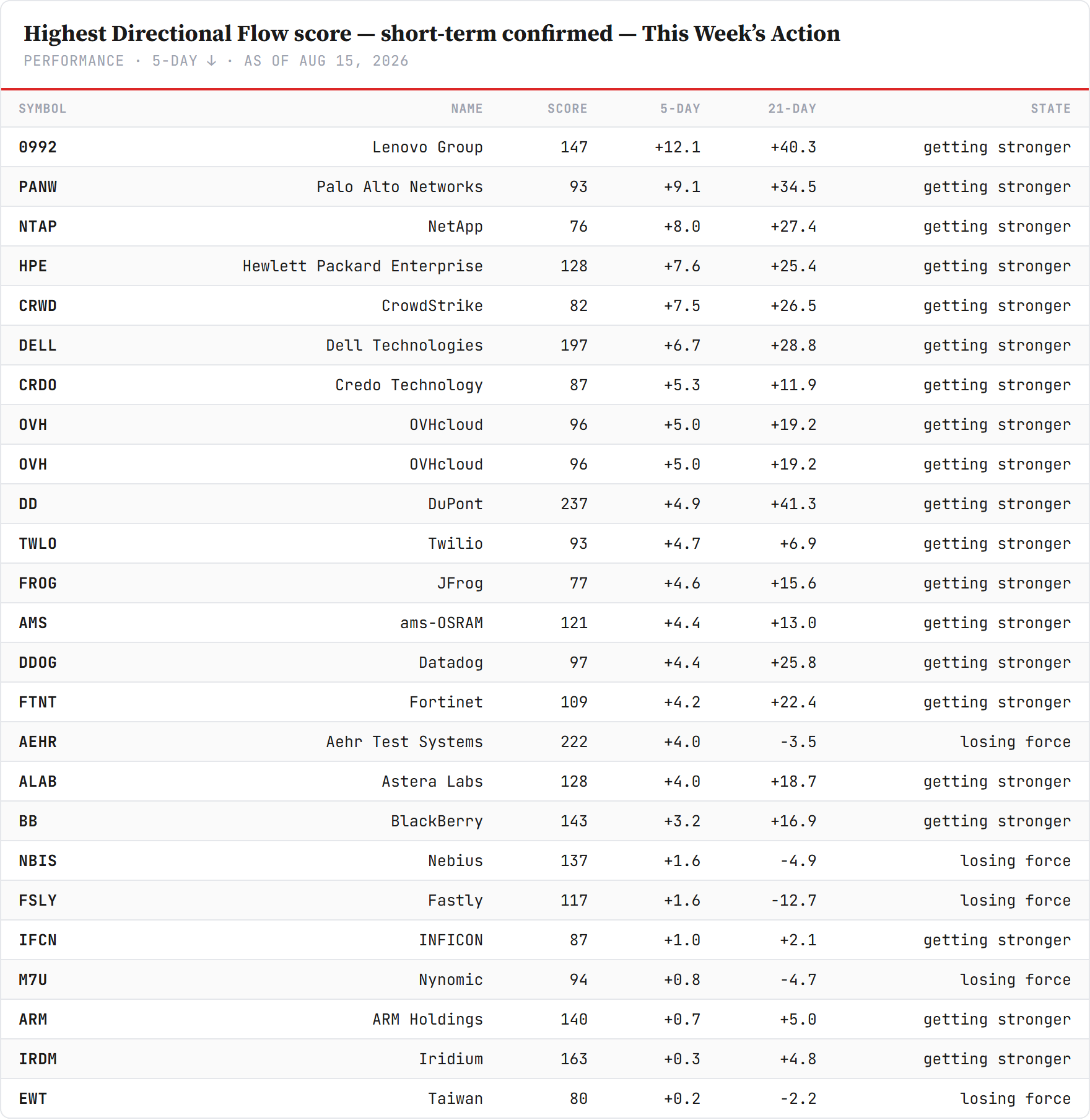
The strongest trends, confirmed on the medium term. Highest absolute score among names whose 21-day change is positive — established trends still improving. DuPont at 238 (+29.6 on the month — the materials name at the top of our whole board), Dell 200 (+26.3), Iridium 162, Lenovo 156 (+42.1), AMD 149. A high score means a steady, persistent trend rather than a fast one; most stocks sit below 100.
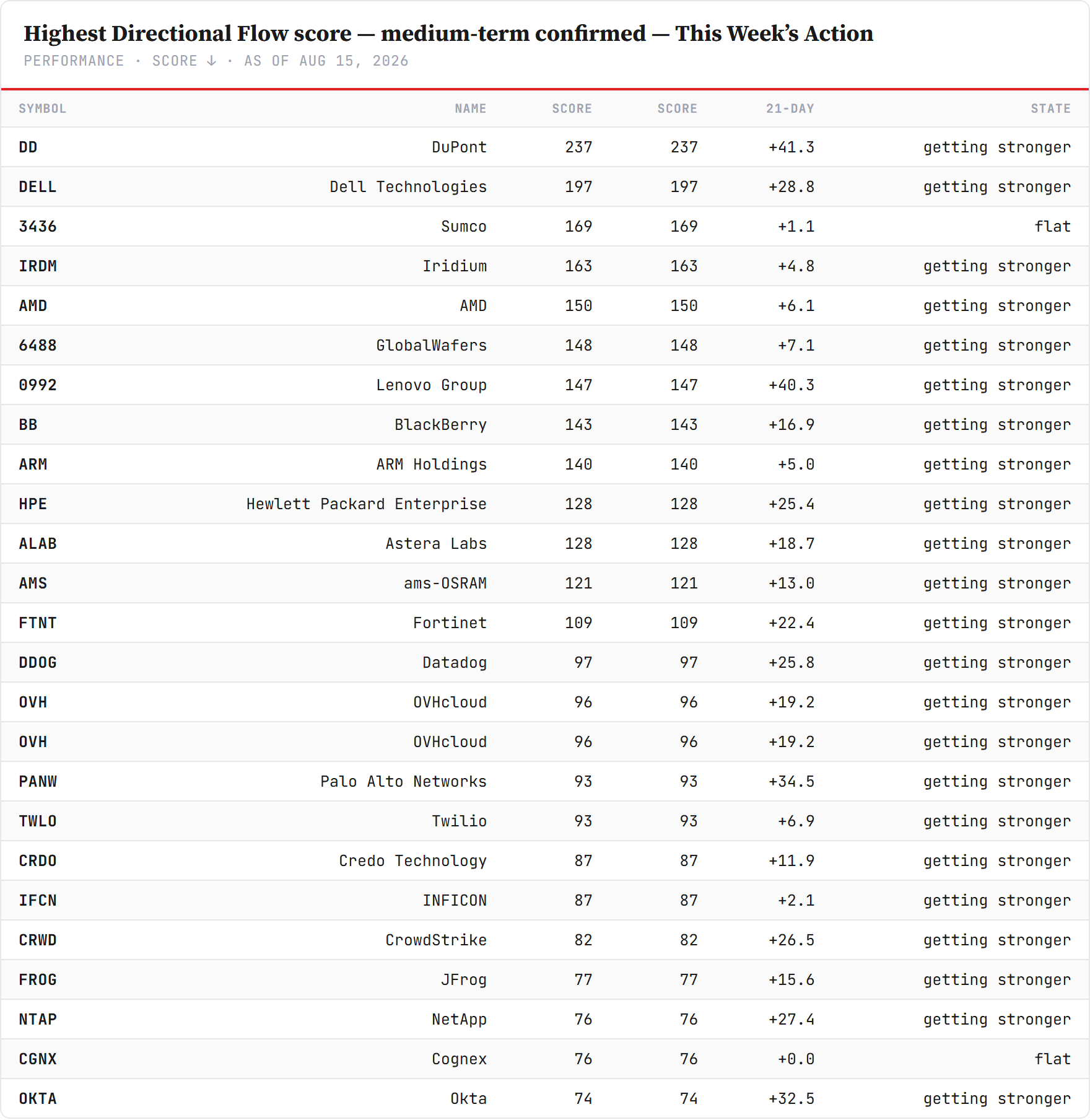
The same list, confirmed on the short term. Where a name appears on this table and not the one above, the strength is fresh rather than established; where it appears on both, the trend is being added to at every horizon we measure. One row to read carefully: Aehr Test Systems at 223, flat on five days — while its price fell 24% this week, the family’s worst name. A 252-day regression does not see a one-week crash immediately; the score lags the price on the way down, which is exactly why the change columns, not the level, are the leading layer.
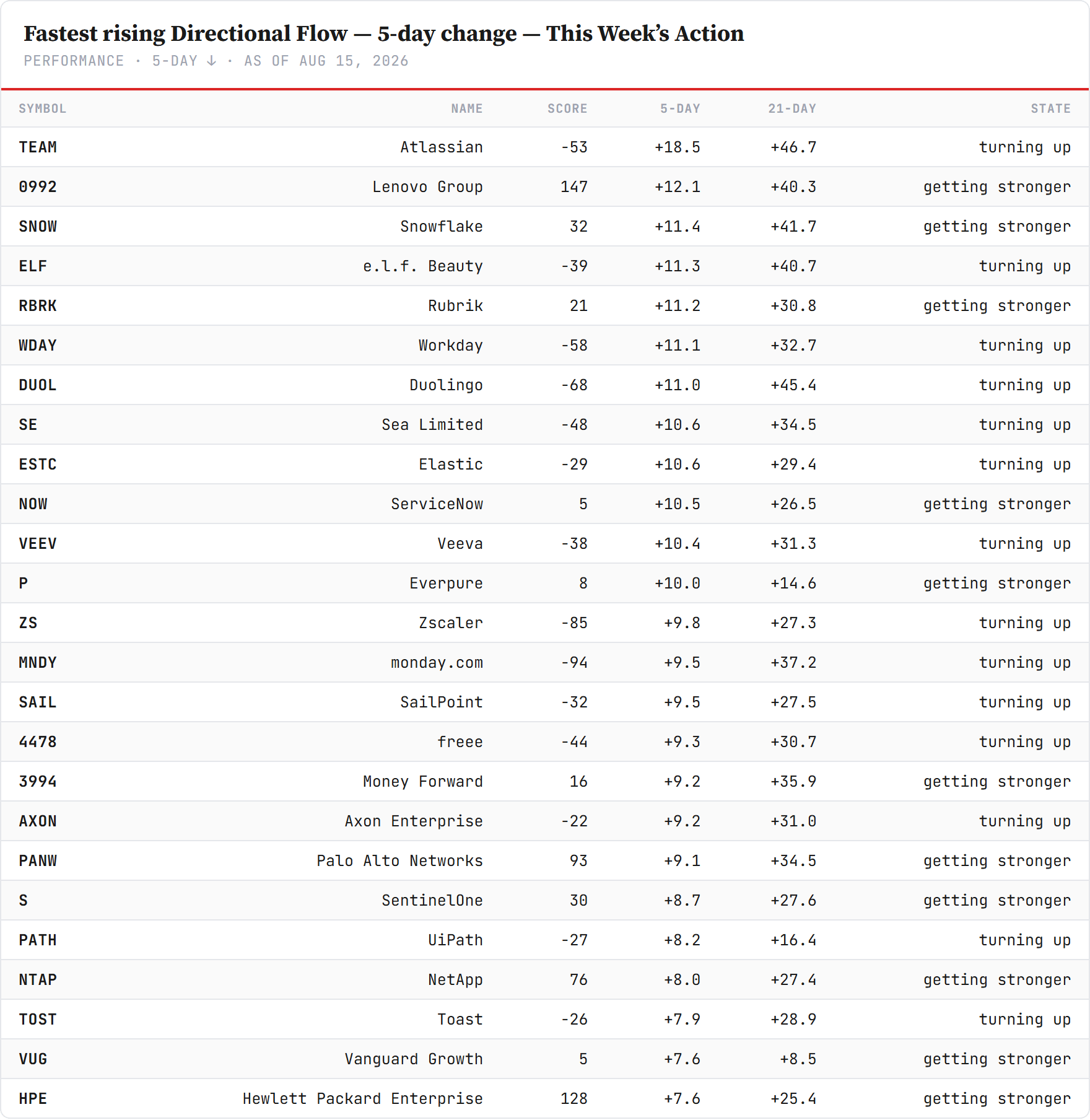
Where new leadership shows up first — the fastest risers. Ranked by five-day change in the score rather than by the score itself: Atlassian +19.0 (score −38), freee +13.2, Appier +12.0, Elastic +11.7, Workday +11.6 (−49), e.l.f. +11.3 (−29), Duolingo +11.1 (−59). Weak trends improving fast — the engine’s historical address for leadership before the price board shows it — and this week the list is software plus consumer, without a chip or a tool on it.
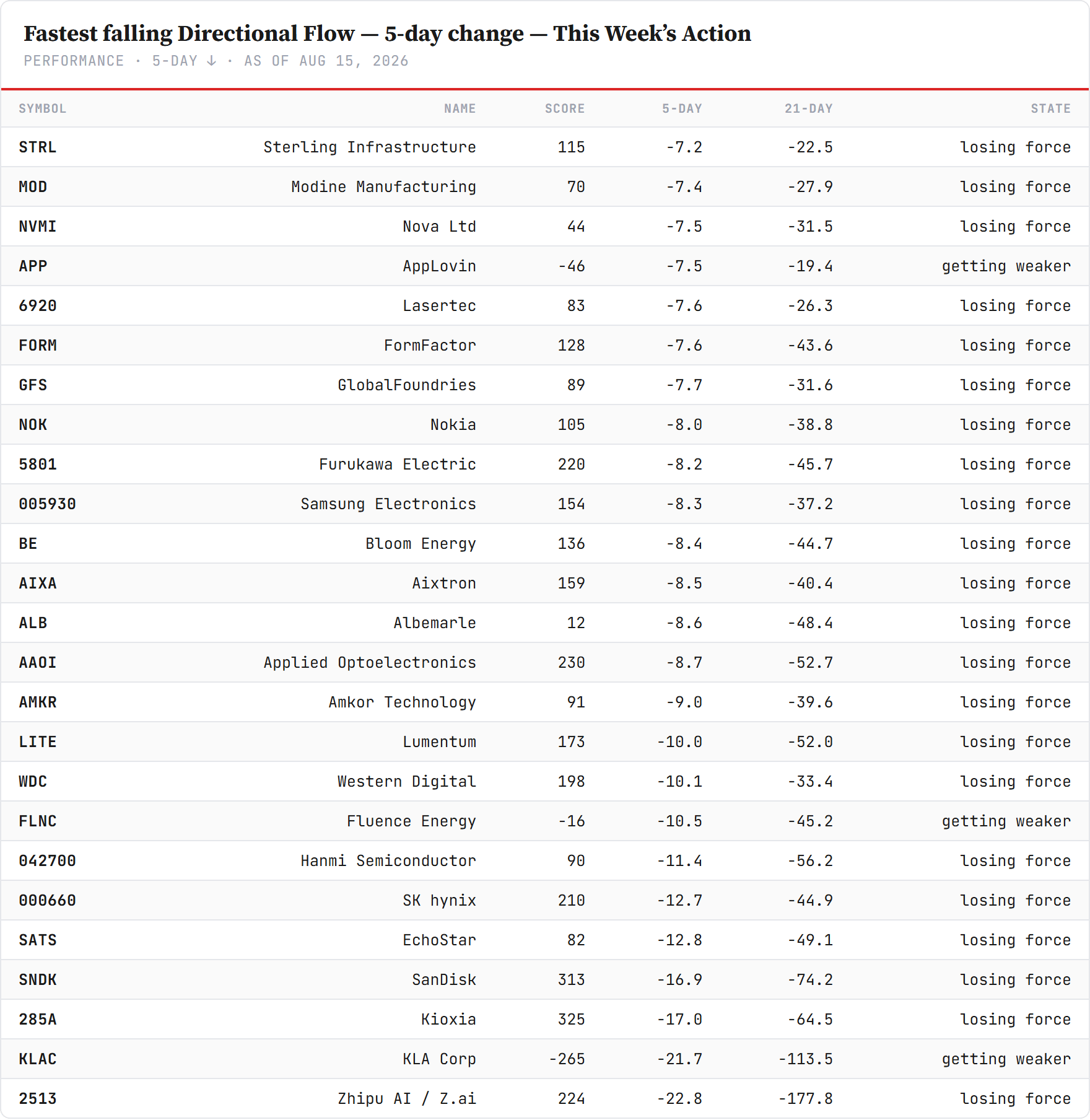
And the draining side. The same measure inverted: Z.ai −28.2, KLA −20.3, Kioxia −15.1, SanDisk −13.2, EchoStar −12.8, Fluence −11.2, SK hynix −11.2, Hanmi −10.4. Kioxia and SanDisk still carry scores above 300 — among the highest in the universe — while losing force faster than almost anything else. Last week this was “a strong trend being drained, price not yet following”. This week the price followed: SanDisk −2.7%, Western Digital −9.7%, storage −4.2% after the prior week’s +21%. KLA is the one in outright acceleration-down, at −282.
2 · The State
The four buckets, briefly. New readers: we cut the growth trade into functional indices rather than sectors — capex (Rubin Build-Out, what gets built), opex (Agentic Ecosystem, what it costs to run), applications (Agentic Winners, what gets sold on top), and HALO as the control group carrying no AI thesis at all.
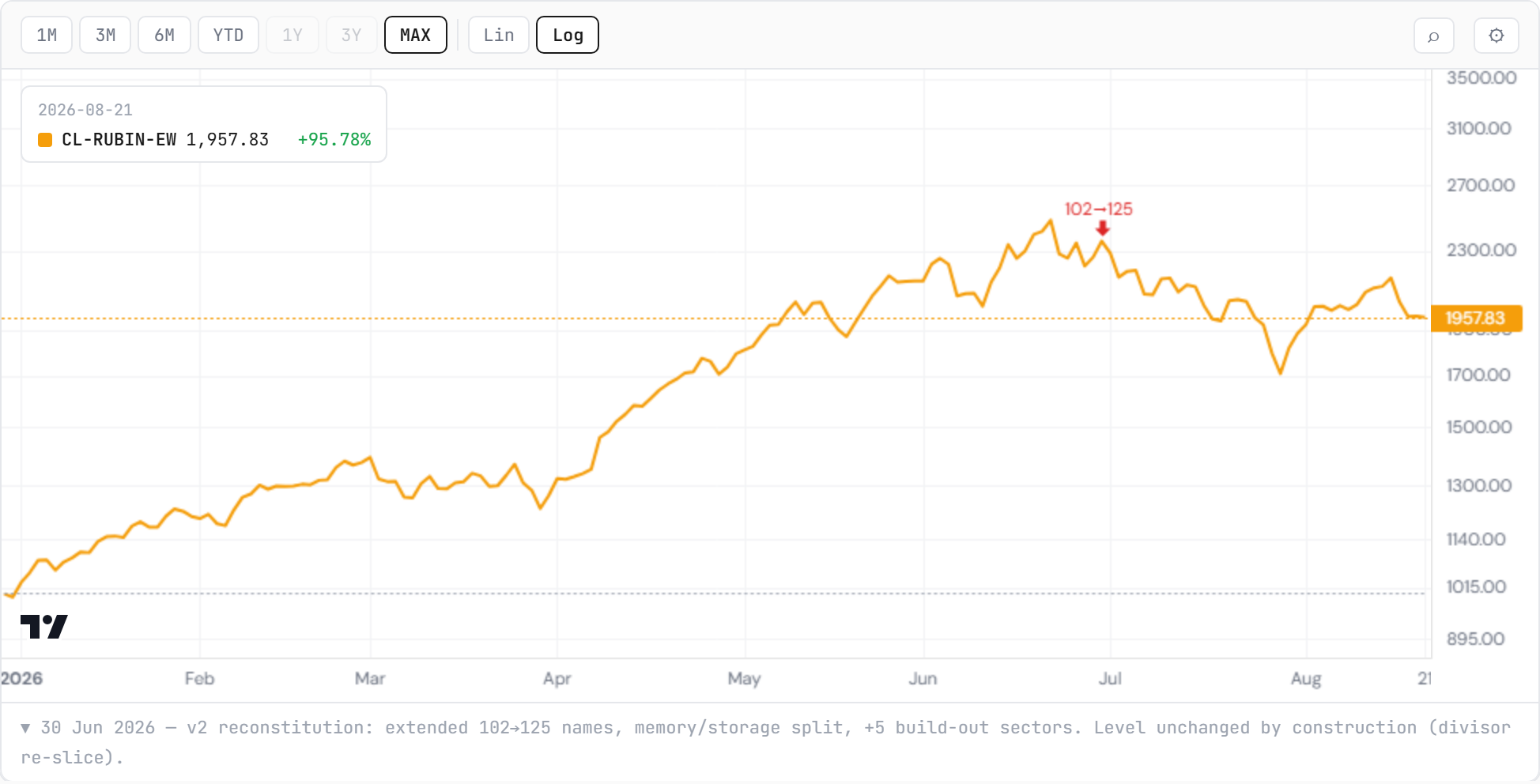
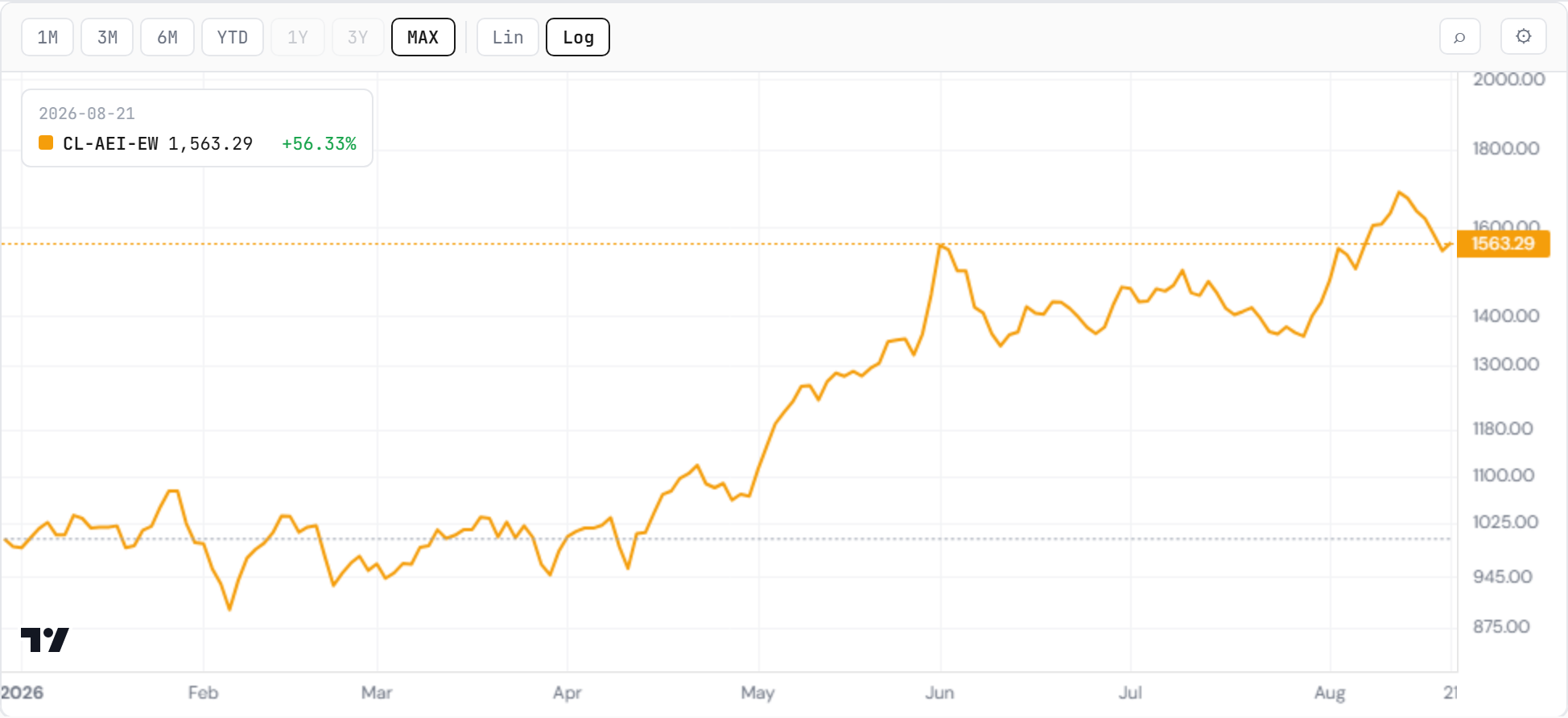

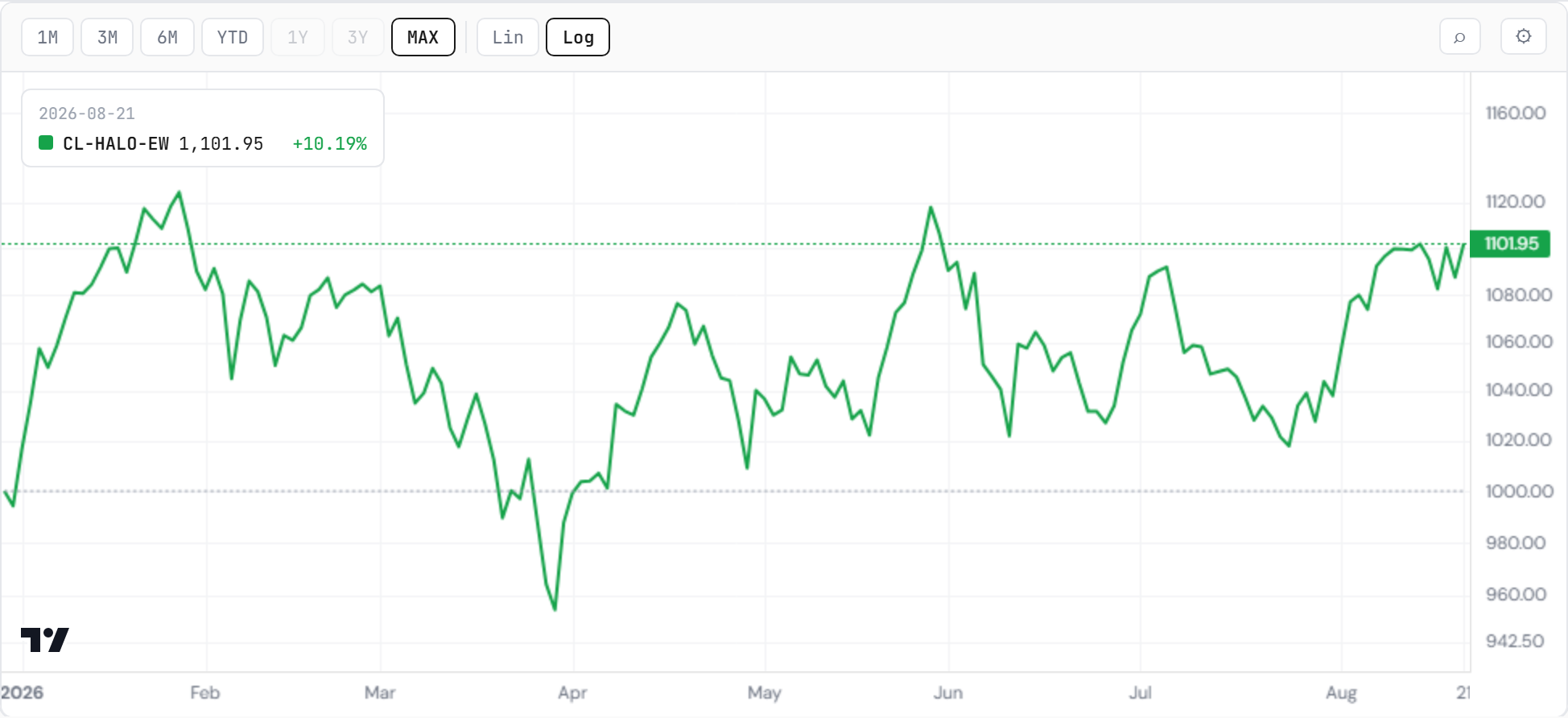
The week’s ladder: applications +2.7%, HALO 0.0%, opex −6.5%, capex −7.3%. On the year: capex +90.5%, opex +58.4%, applications −4.6%, HALO +8.4%; Euro-AI −3.5% on the week, +31.7% on its year. The lightest layer led for a second week; the two heavy layers gave back more than a third of their recovery off the July lows; the buildout still owns the year by a distance.
The control group settles what kind of week it was. HALO closed flat against opex −6.5% and capex −7.3%. Growth was not sold this week — AI was. That is the mirror of last week’s “growth was not bid, AI was”, and for this cohort it is the more important of the two readings: the thing that gets bought by mistake in broad risk-on weeks is also the thing that gets sold first in an AI de-risking, and HALO, the index with no AI thesis, was the only one left standing.
Two floors were re-tested, and this time the results floor was the one that broke.
The challenger floor gave way. Last week the neocloud payments held through day three and Nebius added 8.8% on top; this letter asked whether retention would survive a third week and called the falsifier mechanical — “payments that survive a week and die in the third”. It died in the second. Nebius −21.1% to 219.13, below every close since its print; CoreWeave −16.5% to 87.85; Fastly, last week’s fourth-best name at +30.4%, −16.6%. The payment is gone, and with it the season’s one exhibit of a paid print that was kept.
The incumbent floor held. Workday, the takeout floor built on a reported conversation, traded down to 190.64 on Tuesday and closed the week at 200.01, +0.7% — above where it gave back a third of the spike a week ago. Silver Lake’s talks are still talks, at a reported valuation near $43 billion, nothing signed and no comment from either side. So the asymmetry this letter described reversed: the floor built on results deflated, the floor built on a cheque held. Both remain evidence the disruption discount overshot. This week only the cheque could be scored, and it scored.
Inside the buckets — the sub-sleeves put names on the week. Inside applications: Application Leaders +6.05%, Enterprise +4.11%, Control Plane +2.81% — the three most negative sleeves on the year led the week — while Endpoints −0.55%, Consumer −0.88% and Megacap Gateway −2.47%, the only sleeve positive for 2026, red for a second week. The layer bought again what it sold all year and sold again the one thing it owned.
Inside opex the names that made 2026 led the way down: Foundation Models −11.02% against +753% on the year, Substrate −9.29%, Edge −9.22%, Compute Operators −9.19%, Runtime −8.25%; the best sleeve was operations and observability at −3.70%. Inside capex one sleeve was green of twenty-four — HBM Memory +3.78%, the week SK hynix announced its buyback — and the fab floor was the bottom: wafer processing −11.25%, testing and metrology −10.66%, foundry −10.35%.
And read the buckets against their highs — the focus change, revised. Last week: opex 7.3% above its June record, applications 5.6% through theirs, the buildout 13.7% below June. This week: the Agentic Ecosystem set a new high last Thursday, the 13th, and is now 7.3% below it; the Agentic Winners are still above their summer high and 7.4% below January’s; the Rubin Build-Out is 21.0% below June. The two lighter layers’ distance from their records is now measured in the other direction for one of them. The focus change is intact — the lightest layer is still the one nearest its high and the only one that rose — but the operating layer spent the week closer to the buildout than to the applications.
The opex verdict at name altitude — software built flow while the tape sold AI. The flow ledger puts the operating and application layer’s software names at the top of the board again: Snowflake +42.8 on 21-day flow, accelerating-up, and +1.2% on the week in a tape that fell; Atlassian +56.5 and +19.0 on five days, Workday +38.1 and +11.6, Elastic reversing up — while the semis and the memory complex drained. Cybersecurity, the sleeve this letter keeps naming as the opex category where the biggest-customer-becomes-competitor threat structurally does not apply, fell 4.77% with the rest of the layer: the logic held, the price did not, and it stays a watch rather than a buy until the layer stops bleeding.
The referee this week was the retention window, and it failed. Last edition named the neocloud prints the referee for the cohort and scored the first week a pass. The second week was the fail: both payments gone inside five sessions, the cluster sold on every day but one. The season’s rule — paid prints die — reasserted itself on the two names that had seemed to escape it.
The structural read — the count retreated, not voided. The US letter carries the contract; here it matters as the gate on everything above. QQQ lost 723.85 on Tuesday and closed 713.44 — its 50-day average to the cent; 746 is still the confirmation and 694 the kill-switch, 4.4% above and 2.7% below. Neither line traded. The long-term count is unchanged from last week: no invalidation.
The structural read — applications still above their summer high; the buildout further from June. The lows tell it earlier still: capex and opex are +14.7% and +15.2% off their 29 July lows (from +23.6% and +23.1% a week ago); applications is +26.4% off its 23 July low (from +31.2%) — the smallest give-back of the three, in the index that refused the others’ later low. Probability, not prophecy — the candidate is still the candidate.
3 · The Outlook
The tells from last edition — scored.
Challenger retention, third week — failed in the second: Nebius −21.1%, CoreWeave −16.5%. Scored no.
The software floor — whether the takeout conversation becomes a deal. Still talks; the floor held at 200.01 through a −2.4% index week. Scored partially, again provisionally.
MAGS at the shelf, attempt three — attempt four failed too: 67.28, −1.44%, 3.2% below 69.5. Detail in §5.
The watch-class from last week — resolved, by price coming down to flow. This letter’s reading of the week before was that storage led the capex price board at +21.1% while its two largest names sat at the bottom of the flow ledger, and that “a sector cannot lead the price board and trail the flow board indefinitely — one of the two is early”. The flow was early. Storage −4.16% this week, SanDisk −2.7%, Western Digital −9.7%, Micron −0.5%; Kioxia and SanDisk still at the bottom of the five-day flow table, SK hynix with them despite a forty-trillion-won buyback. The instrument did what it was built for: it filed the memory strength as a move to be respected rather than chased, and the week respected it. The one green line in the whole capex table was HBM Memory, +3.78% — the sleeve the buyback landed in.
The regime gauges, one paragraph. The Handoff Board jumped two rungs in a week: use-against-operate +11.3% to 1.2076, use-against-build +9.0% to 1.5293, beyond-gateways +5.2% — the applications pulling away from both the operators and the builders at once — while operate-against-build fell 2.1%: the operating layer fell faster than the buildout it runs on. The Money Temperature composite reads 53, two points warmer, still the middle of its range; the house inflation composite reads 49, contained, while the 30-year sat at 5.275% — the long end is pricing supply, not inflation.

The week ahead — one print, one speech. Walmart completes its scoring window on Tuesday; Nvidia prints Wednesday after the close — consensus $2.09 on $92.0 billion — into a semis tape that lost between 4.7% and 8.5% this week; Jackson Hole runs Thursday to Saturday with Warsh’s first keynote as chair on Friday. For this cohort the referee is Wednesday, and the tape arrives already leaning.
