


This week’s edition of Closelook@Hypergrowth, dated July 15, 2026.
Last edition’s thesis was stated plainly enough to be wrong: the absolute flow scores still crowned the semiconductors, but the rate of change said leadership was already passing — from the build-out core to the opex layer and the applications. One week later the tape produced receipts. IBM pre-announced a miss and fell 25% in a day — the steepest drop in decades — for exactly the two reasons this letter tracks: memory costs eating legacy IT budgets, and AI spend cannibalizing the incumbents. On the same tape, the AI-opex layer set records: CrowdStrike up 12% and Okta up 11% to new highs, the whole security line green, Cloudflare closing at a record through its 280 line.
The software index barely moved while an 18-point spread opened inside it. That is not a market getting risk-off about software. That is a market re-sorting who owns software’s future — precisely the hand-off the deltas flagged. The read below updates every tell we named, takes this morning’s ASML print into the frame, and gives the earnings season’s referee metric — the Earnings Dispersion Ratio — the treatment we promised. The schedule of our other publications is at the end.
1 · This Week’s Action
The cross-asset backdrop. June CPI printed a 0.4% monthly decline against a consensus −0.2%, taking the annual rate to 3.5% from 4.2% — and the day after held the move instead of fading it: volatility compressed toward its 52-week low, gold firmed, growth led value again. No haven bid, expectations re-anchoring — the friendliest possible macro floor under a rotation.
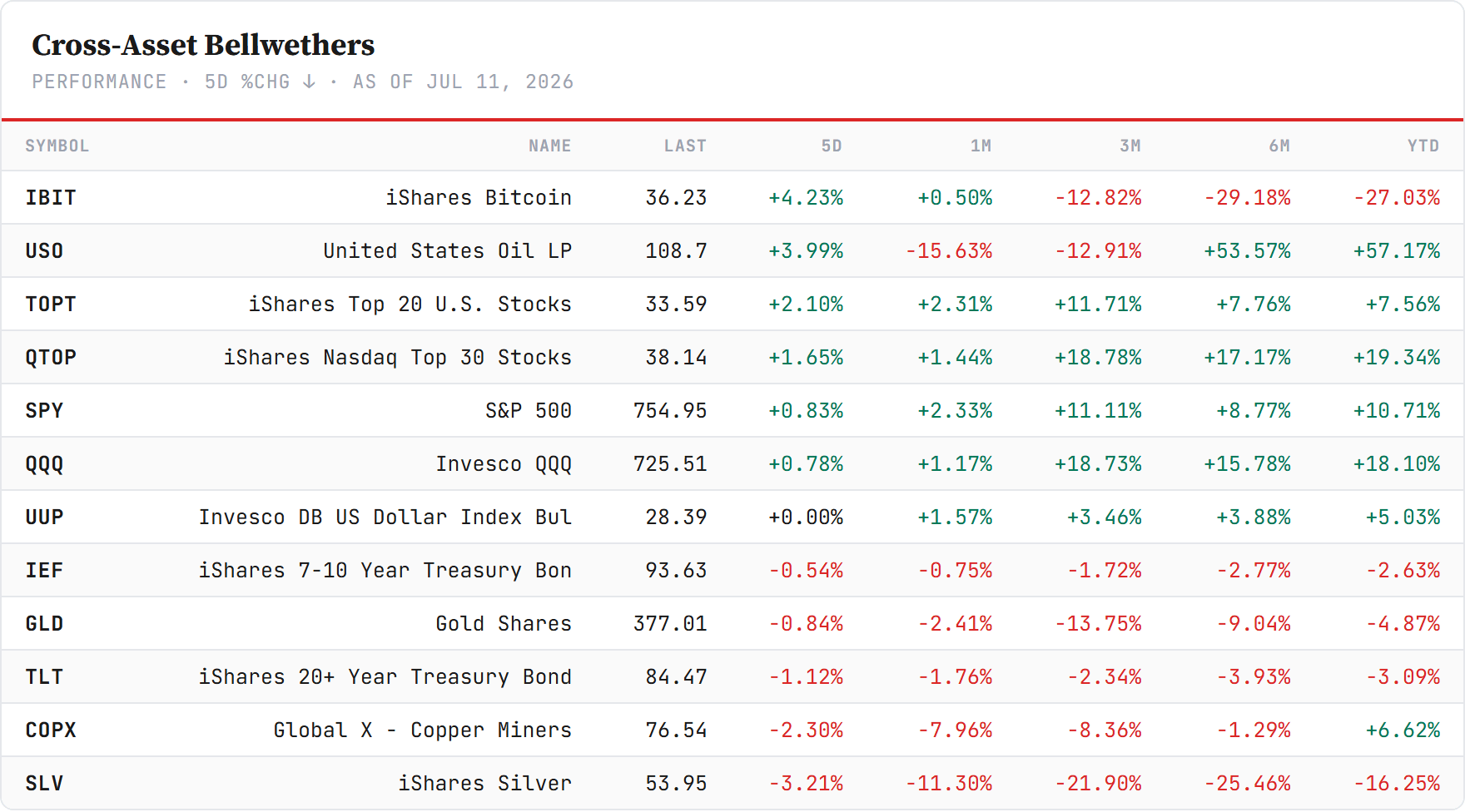
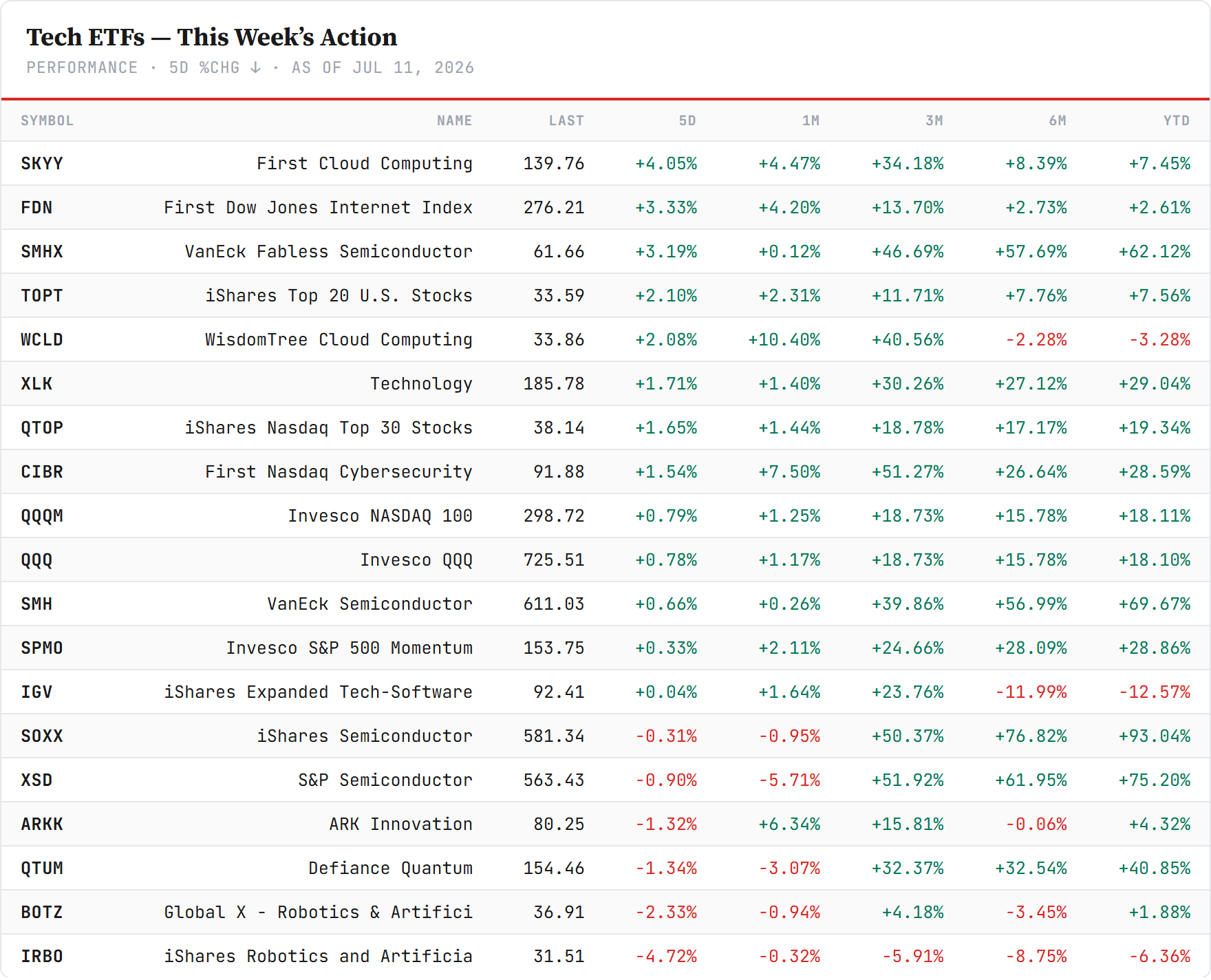
The tech shelf. Two days that belong in a textbook: Monday the semi complex fell 4–5% while software held green — SOXX closing forty cents below the 554 line — and Tuesday the complex reversed hard, SOXX +2.6% back to 567.92, SMH reclaiming 600, with the epicenter itself producing the violence:
SK Hynix from two dollars above its $149 offer price to a post-debut high, up 27% in one session, on hard news — 12-layer HBM4 in mass production and shipping to Nvidia. The shelf’s message: the washout was positioning, not thesis.
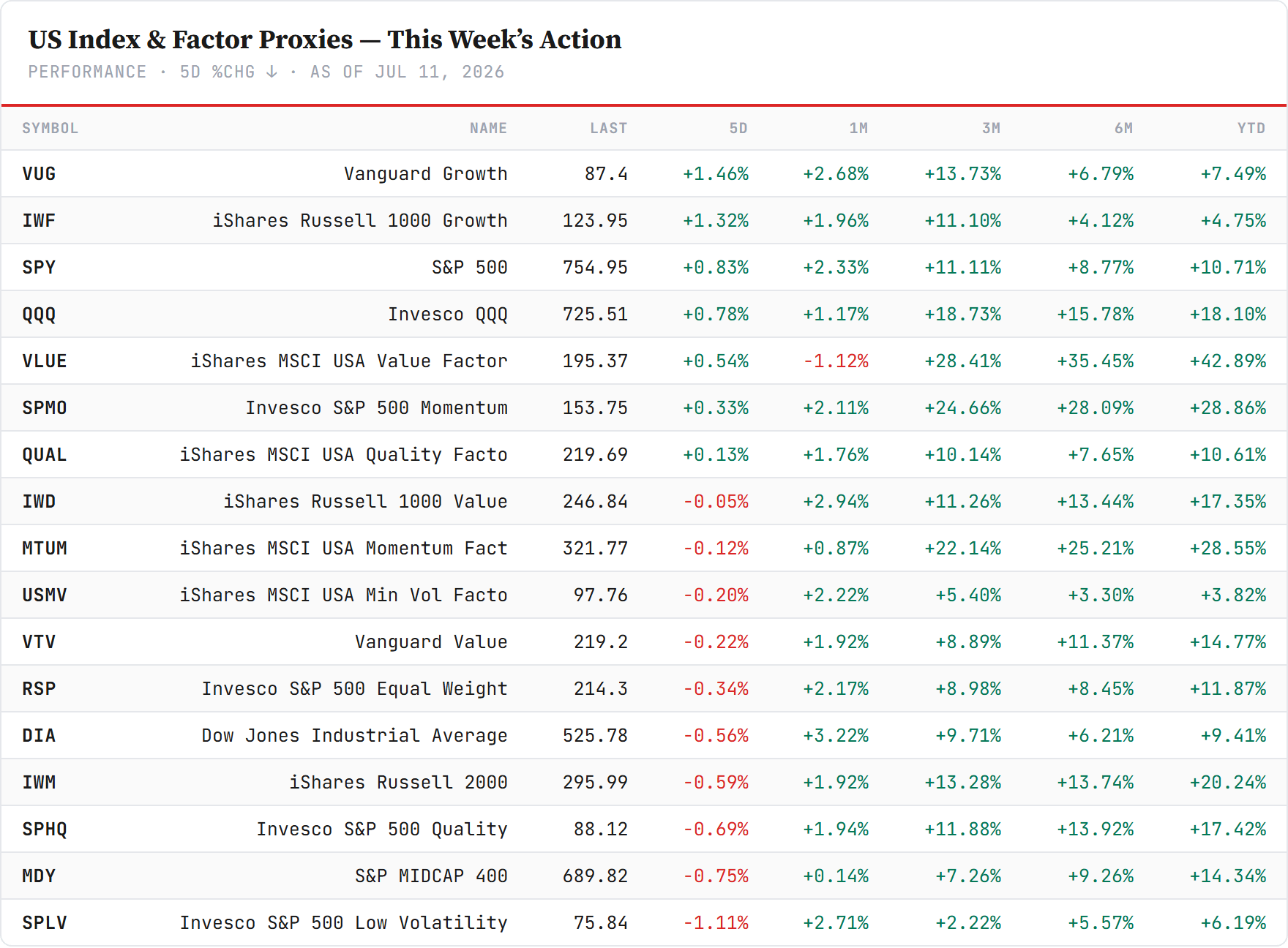
The factor view. The same re-sort one level up: the growth complex caught its bid back, but the year-to-date column still shows the concentration story — the growth factor carried by an ever-narrower list. Hold that thought; it becomes the EDR section below.
Our own board, updated — and the tells resolved. The Rotation Ledger below is the Closelook Directional Flow scan across all four growth buckets, sorted by the 21-day flow delta. Read it against last week’s version and every tell we named has an answer:
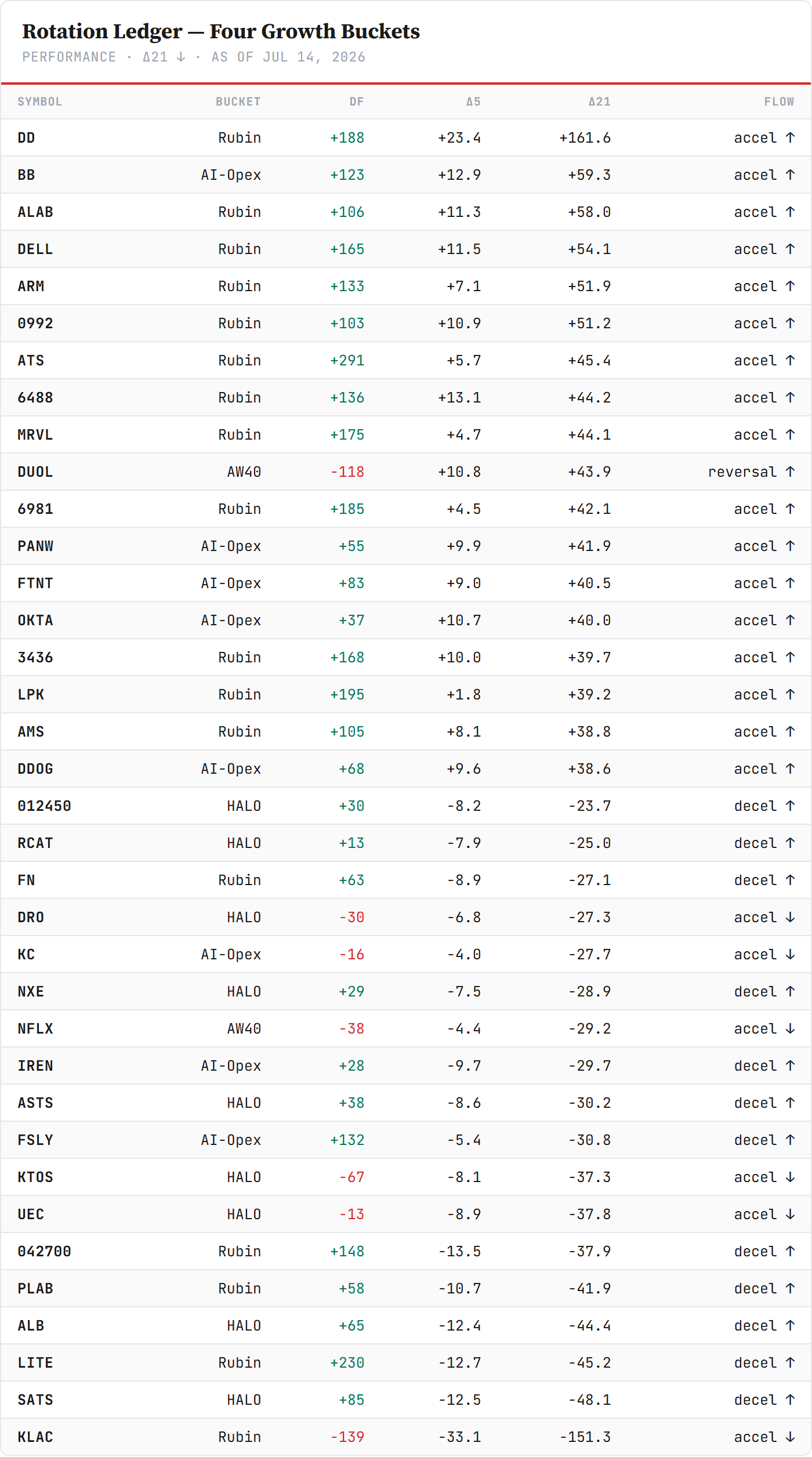
Three resolutions worth naming. The opex persistence held: a second consecutive week with AI-opex the strongest advancing bucket — the security-and-observability cluster (Fortinet, Palo Alto, Datadog, now Okta and CrowdStrike with them) exactly where we said to watch it.
The reversal cluster grew: eighteen of forty agentic winners now flash “reversing-up,” from sixteen — and the bellwether row converted: Duolingo’s 21-day delta is now +44 with flow still deeply negative, the textbook shape of a destroyed name being re-accumulated. And the one warning fired too: KLA — last week’s “single number to watch” — rolled from “stalled” to “accelerating down,” the most negative delta in the scan by a factor of three. One core equipment name is repricing, not resting. The complex bounced without it.
2 · The State
The four buckets, briefly. New readers: we cut the growth trade into four functional indices — Rubin is the AI build-out (~125 names of silicon, memory, packaging, power), AEI the AI-opex layer (~33 names that sell the running of AI — security, observability, data), AW40 the agentic winners (40 application names, the cohort 2026 punished hardest), and HALO functional growth beyond AI.
The year so far: HALO led early, the build-out took the year, the winners were wrecked, the opex layer compounded quietly.
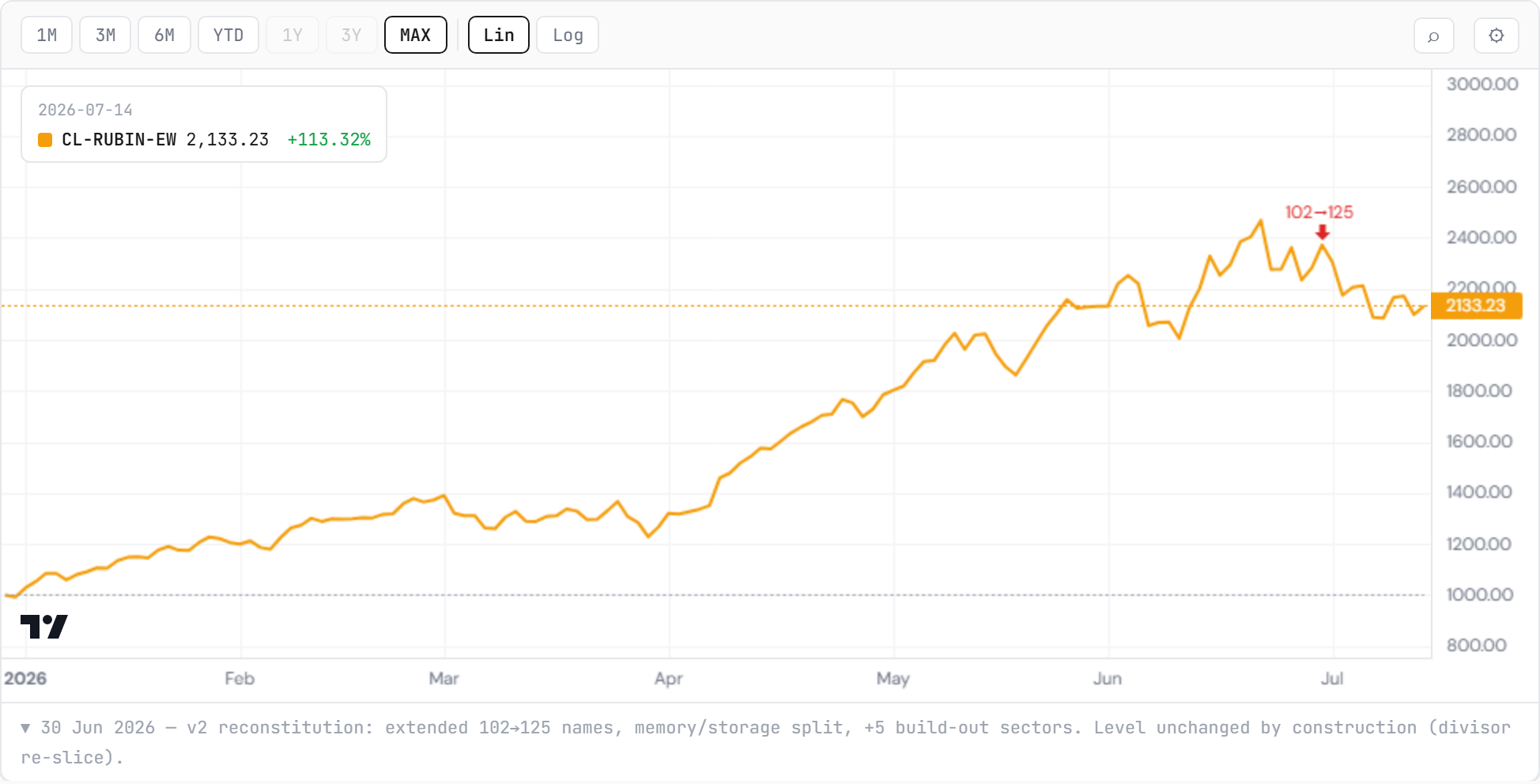
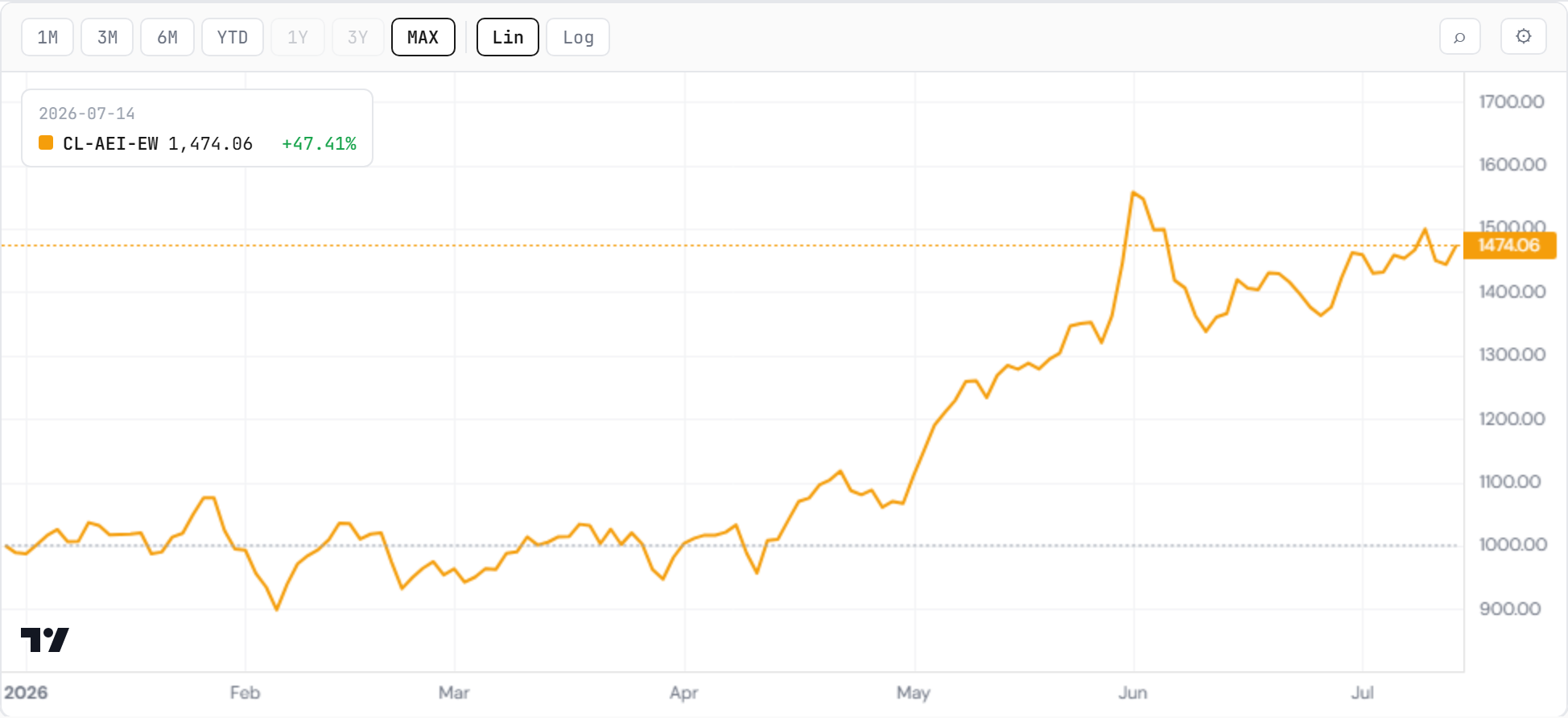

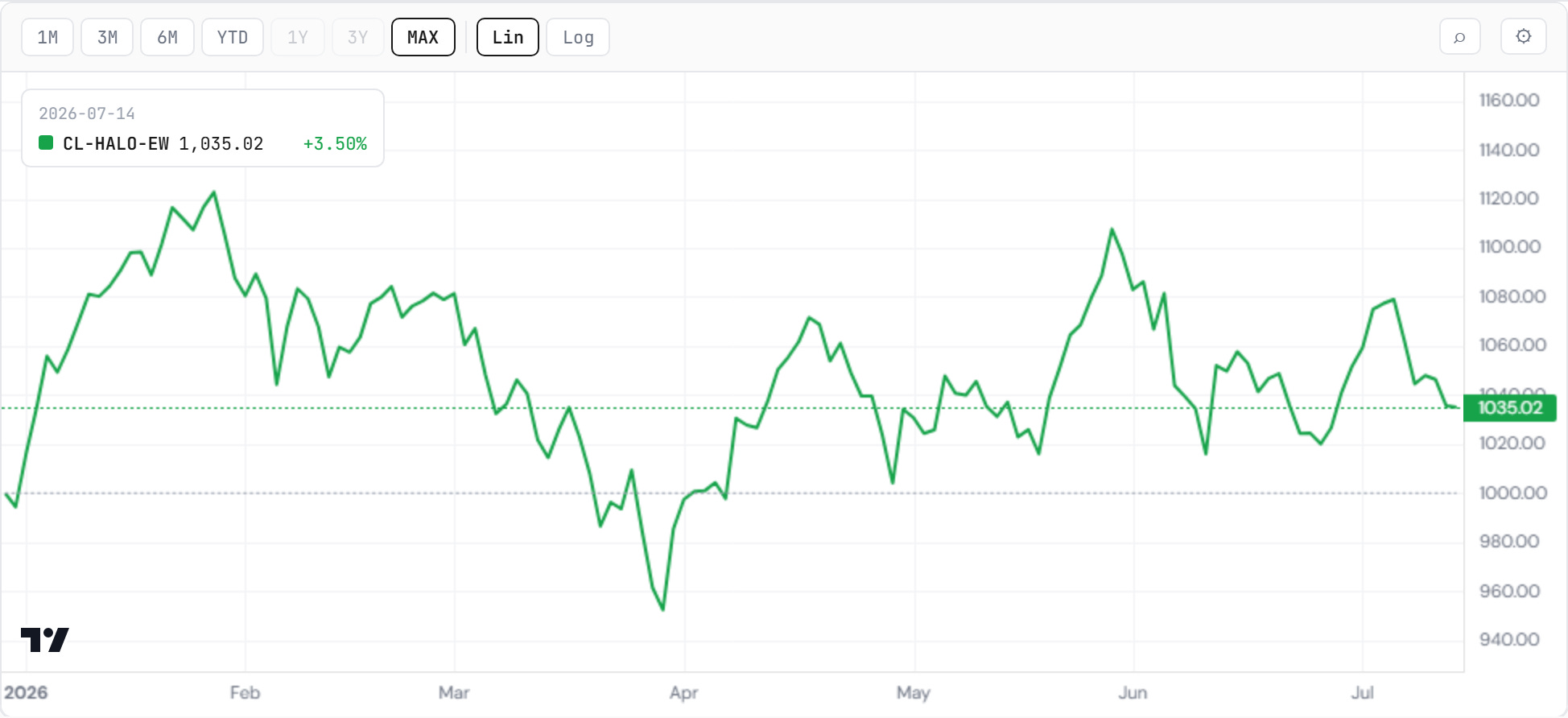
The week the buckets swapped. Two days into this week the scoreboard reads: AEI +1.7% — the only bucket green — after leading Tuesday outright at +2.1%, its best day against the field all summer. Rubin −1.8% after a violent round trip (−3.3% Monday, +1.6% Tuesday). HALO −1.1%, resting. AW40 −0.1% — and read that flat number correctly: the destroyed cohort held its ground through a semi washout that took the leaders down 5%, because money is quietly returning to it. Year-to-date the ladder still reads roughly Rubin +114%, AEI +49%, HALO +4%, AW40 −21% — but the week’s tape is the rotation happening, not pending.
The receipts, in names. Monday’s IBM warning is the cleanest single datapoint the rotation thesis has received. The company named its own killers: customers front-running memory and server price rises — the DRAM squeeze arriving in enterprise budgets — and AI spending cannibalizing legacy IT. Inside the same print, Red Hat grew 11%. The next session completed the sort: ServiceNow −5.8%, Adobe −4.3%, Salesforce −2.1% on the legacy side; CrowdStrike +12% and Okta +11% to records, SentinelOne and Zscaler up 7%, Palo Alto up 7%, Cloudflare through 280 to a record close on the other. The software index — IGV, up 1% — hid an 18-point spread. Every one of those record-setters is an AEI constituent. The index was built for precisely this sort.
The structural read. Our working QQQ count stands: the advance off the late-2022 base as Wave 1 into early 2025, the spring-2025 break as Wave 2, and an ongoing Wave 3 — the stretch where pauses get bought and rotations run internal rather than terminal. Monday-to-Tuesday was that thesis in miniature: a two-day washout bought back inside 24 hours.
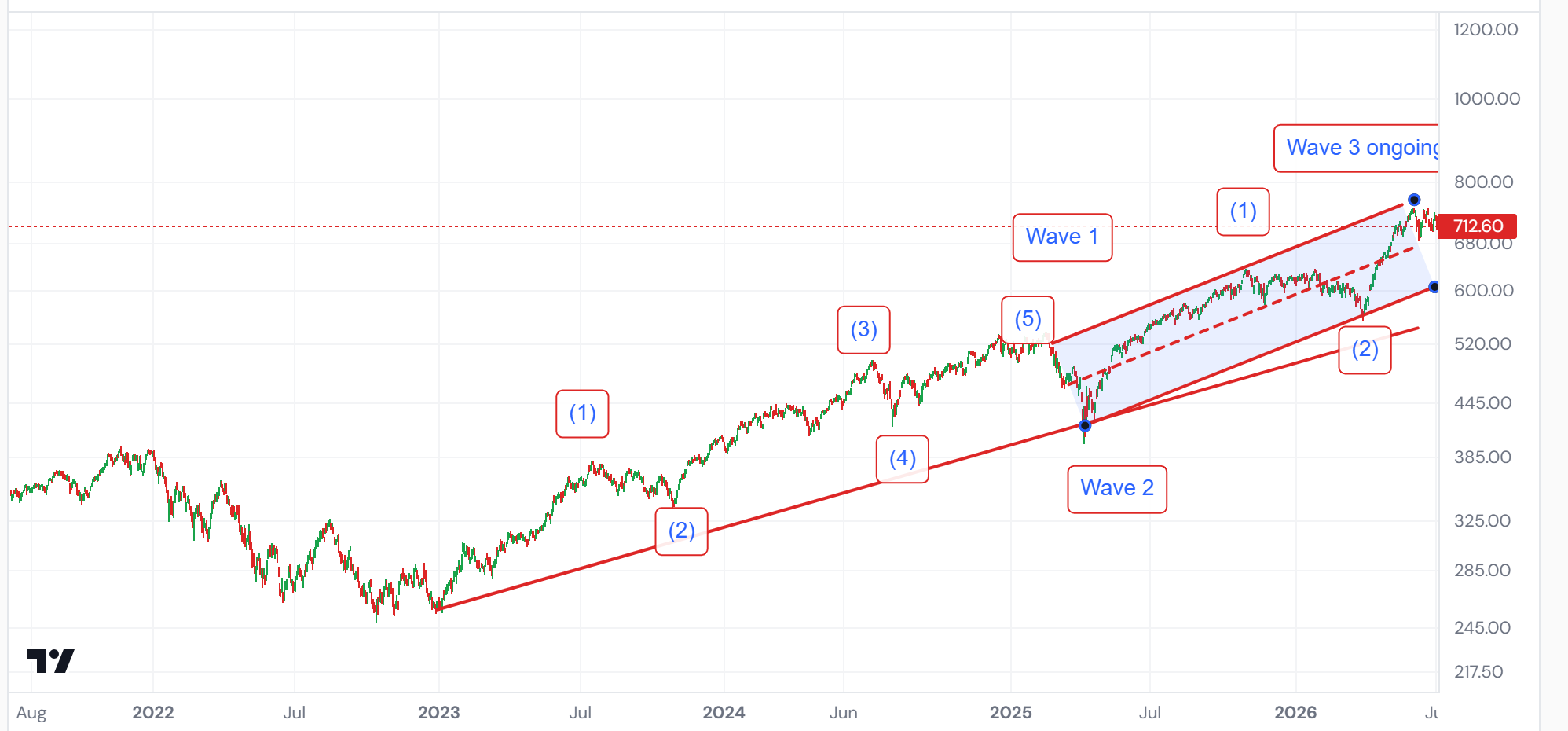
Below the index, last week’s two pattern-watches resolved in opposite directions. The SMH diamond — usually a topping shape — is dissolving upward: the complex reclaimed 600 and the base at 582 never broke, with SOXX’s 554 line surviving its test by forty cents and reclaiming fourteen points the next day. The IGV throwback held and paid: the broken downtrend retested from above was the launchpad for the record-setters inside it.
3 · The Outlook
This morning’s print belongs to the frame. ASML — the toolmaker whose order book referees the whole build-out — beat its own guidance on every line (€9.3 billion sales against €8.4–9.0 guided, 54% gross margin against 51–52%) and, for the second consecutive quarter, printed no bookings number at all. In its place: a plan to add 30% to this year’s EUV capacity for 2027, and a Q3 guide stepping to €11–12 billion. Amsterdam opened it around 7% higher and held most of it. The market accepted machines as the order book’s proxy — you do not build 30% more litho capacity against demand you cannot see.
For the rotation read, that is the constructive configuration: the build-out’s fundamentals keep confirming while its crowded positioning rests — a trade digesting, not dying. TSMC reports tomorrow morning; tools and wafers could confirm each other inside one week.
The Earnings Dispersion Ratio — the promised treatment. The US letter introduced it as a cliffhanger; here is the number in full. The EDR divides aggregate index earnings growth by the median constituent’s growth. Consensus has S&P 500 earnings growing 23–24% this year — with normal beat rates, the second quarter alone could print near 29%, growth the index normally only achieves exiting a recession. Goldman’s strategists carry roughly $340 in index earnings for the year. But the aggregate is profit-dollar-weighted: the Mag7-and-adjacent cohort compounds near 30% while the rest of the index grows perhaps 5%; equal-weighted, the market’s earnings grow 9–13%; the median company, 7–10%.
Divide, and the index’s earnings line is growing about three times faster than its representative member — an EDR around 3.0. The composition underneath: perhaps 50–75 genuine fast-growers, roughly 250 companies in an unremarkable middle, and 150–200 growing not at all or shrinking.
And a slice of the numerator is not operating earnings: Amazon booking valuation gains on its Anthropic stake — Alphabet likely similar — and a build-out in which one side of every dollar is booked as 100% revenue today while the other side depreciates over years. The first real-time reading arrived Tuesday: all five big banks beat — JPMorgan, Wells Fargo, Bank of America, Citi, and Goldman with the largest surprise — and four of the five sold off on the news. Beats are expected now; the bar is the whisper. That is what an EDR near 3.0 feels like from inside earnings season: an index that cannot afford ordinary good news.
Why this letter cares. Concentration is not a short signal — the ratio can stay elevated for years while the fast cohort genuinely compounds. It is a fragility gauge: the higher the EDR, the more the index’s earnings line depends on a handful of prints, and the more each disappointment costs. This week’s IBM day is the mechanism in miniature — when a mega-cap’s earnings break, the repricing is instant and total. We will track the ratio through the season; if aggregate growth converges toward the median (the boom broadening) the growth tape gets safer; if the median converges down toward zero while the aggregate holds, the costume slips.
The macro frame underneath is doing its part — the inflation impulse cresting rather than entrenching is what lets the multiple survive the autumn calendar:

🔒 Be Informed — the rest is for paying subscribers.
