

The Third Impulse
Nasdaq +5.9% on the week, SMH on 10 consecutive up days, and the Tail-70 catching up to the Top-20. The March consolidation was the pause — this is the move.

Edition · April 19, 2026 · KW 16
Thank you for reading this week’s edition of Closelook@US Stock Markets, dated April 19, 2026 👋. The next edition will be published on April 26, 2026.
For the schedule of our other publications, please check the publishing schedule at the end.
Table of Contents
2. Overview: The US Market Map
3. The State
4. The Outlook
5. What May Lie Ahead: Macro Setup
6. What May Lie Ahead: Technical Setup
7. The AI Build-Out Portfolio: What We Did
8. The AI Build-Out Portfolio: What We Plan To Do
10. Upcoming Transactions: Be Informed
11. What May Go Wrong: Risk & Change Triggers
12. Final Words
(1) This Week’s Action
Nasdaq +5.9% on the week, the cleanest momentum signature in two years. And yet — QQQE (equal-weight) is catching up to QQQ. The rally has two pillars now: megacap tech and the Tail-70.
The Week at a Glance
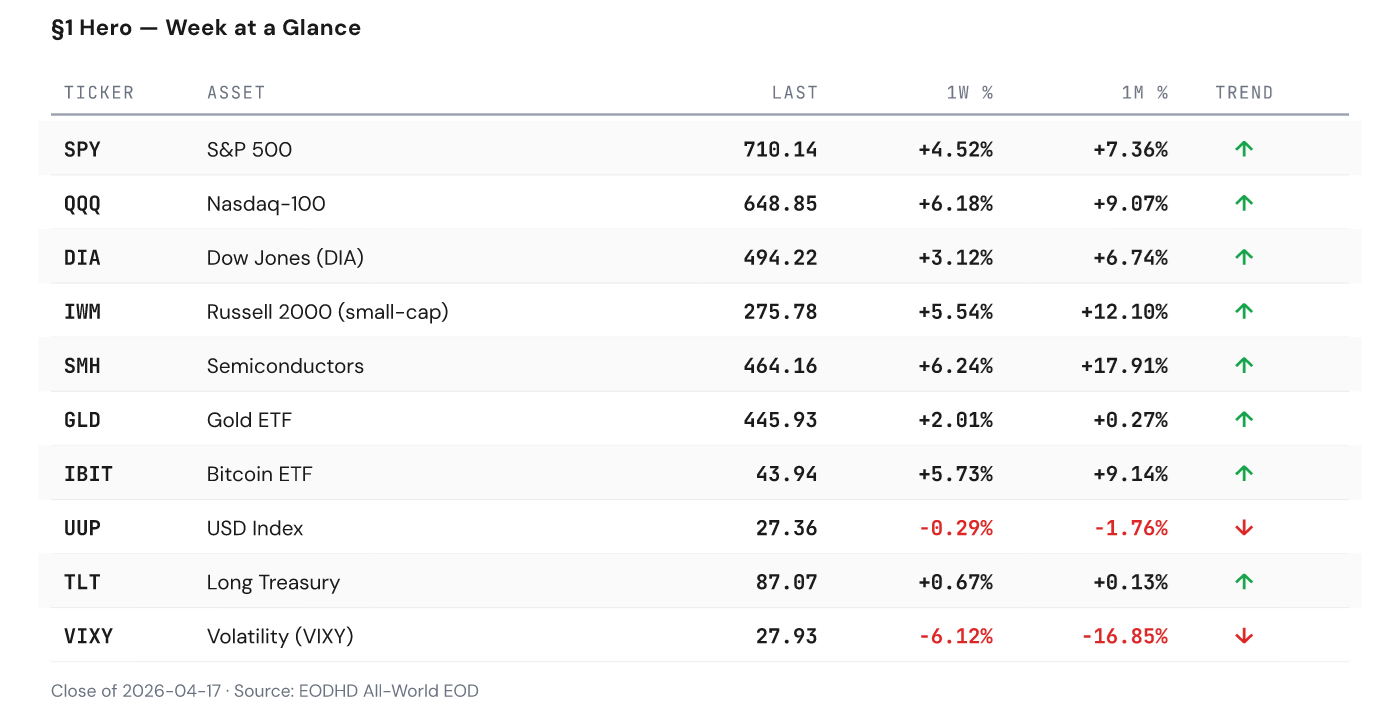
Week at a Glance — hero basket performance table
Chart 1 — QQQ Across Four Timeframes
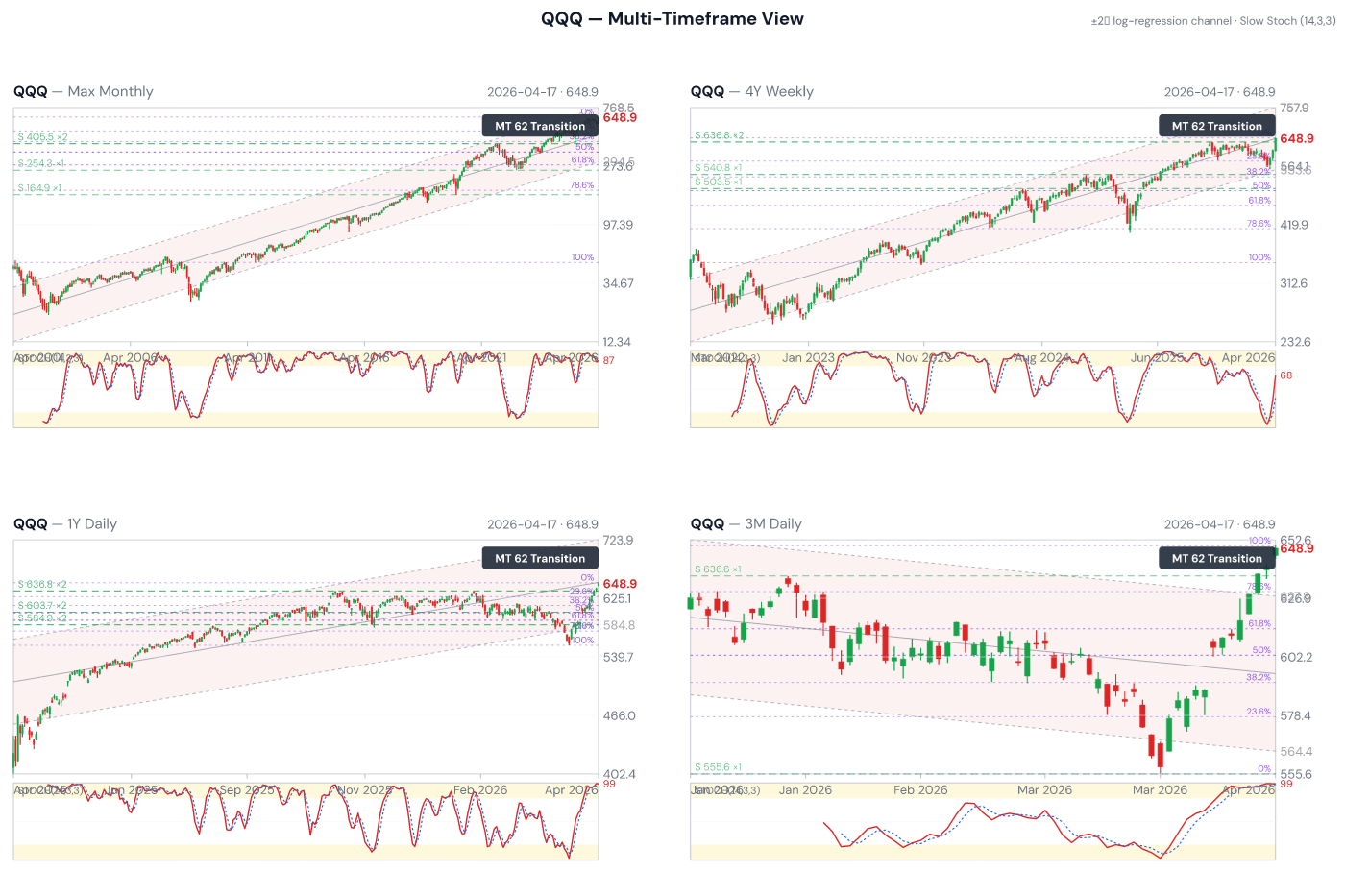
QQQ across four timeframes — log-channel + stochastic + S&R + Fib
Max-monthly / 4Y-weekly / 1Y-daily / 3M-daily. Auto-generated from EODHD closes, updated on each render.
Trend & Momentum Indicators (on QQQ weekly)
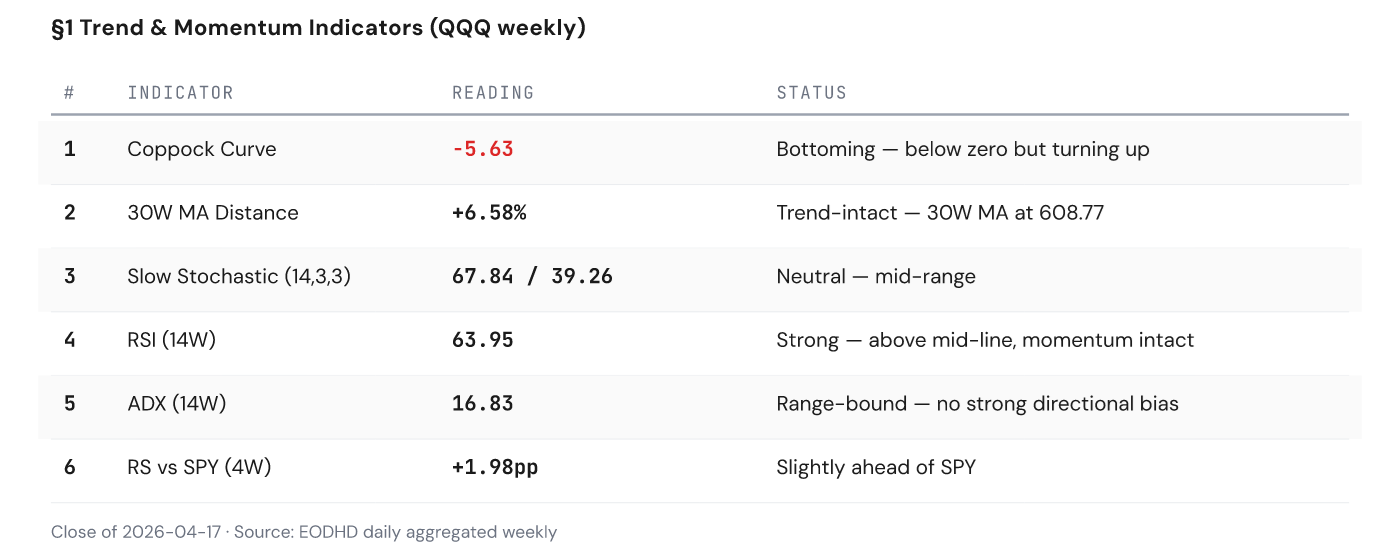
Trend & Momentum Indicators on QQQ weekly
Chart 2 — Index Cuts — Tech vs Ex-Tech × Top-20 vs Tail-70
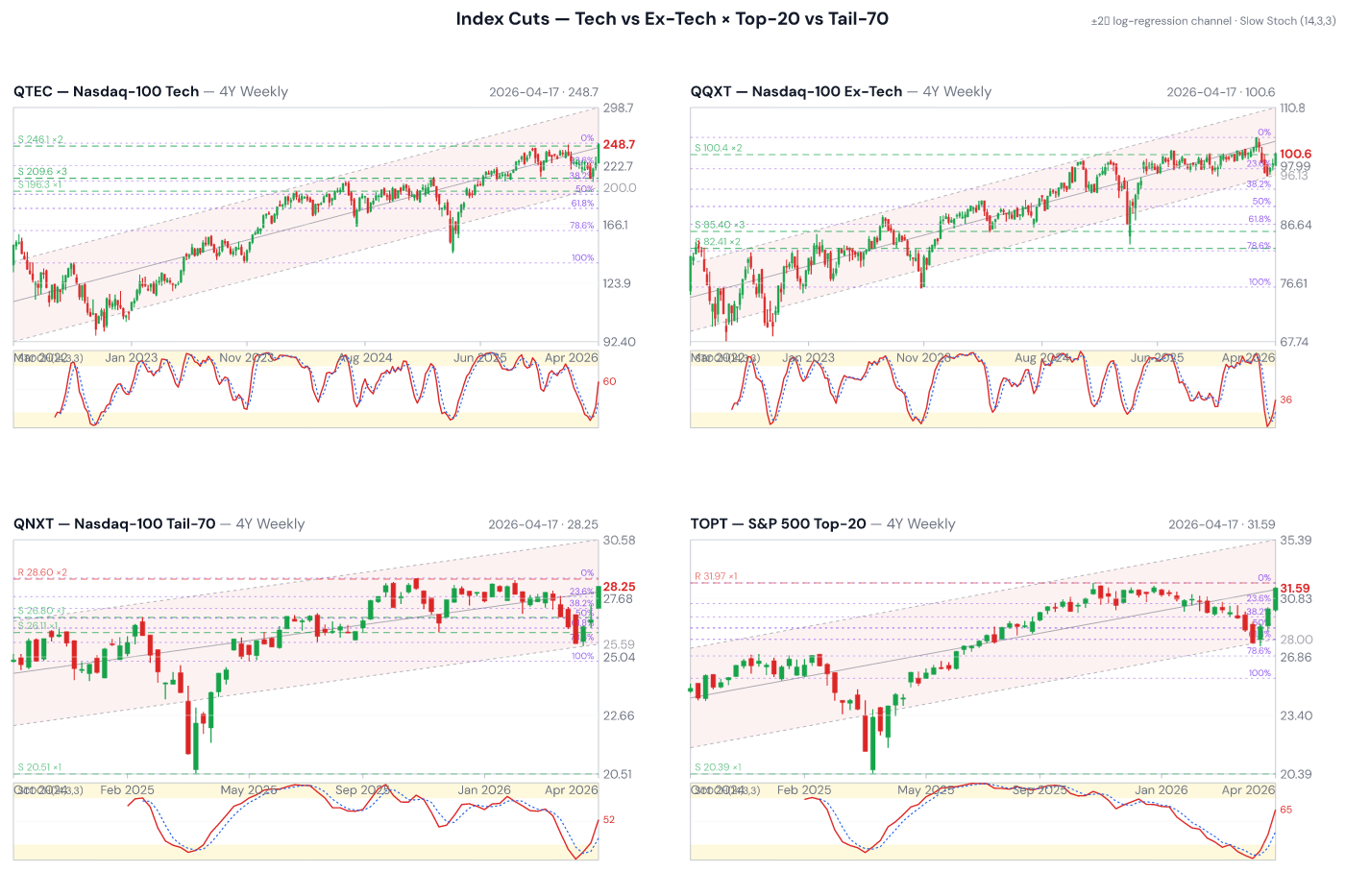
QTEC · QQXT · QNXT · TOPT — Index Cuts — Tech vs Ex-Tech × Top-20 vs Tail-70
Same indicator overlay as Chart 1 (log-regression channel + stochastic + S&R + Fib).
This Week’s Signals
No pattern alerts this week.
What Happened
The S&P 500 gained 4.52% on the week. The Nasdaq-100 gained 6.18%. Those are not relief rally numbers. Those are regime-reset numbers. VIXY collapsed 6.12% on the week, extending its one-month slide to 16.85%. Volatility is not retreating. It is being structurally repriced lower, and that distinction matters. The tape is not healing. It is rotating into a new risk-on phase, and the leadership profile makes that plain.
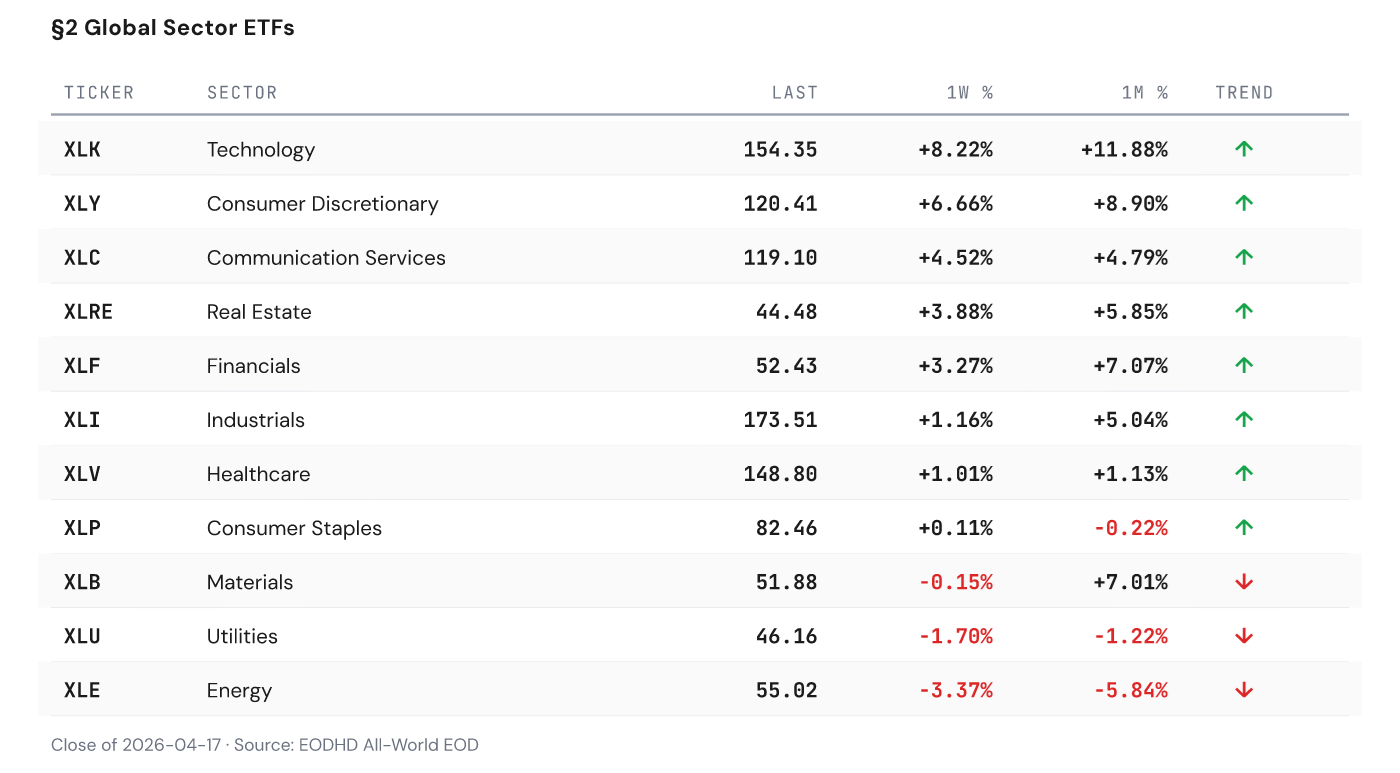
Growth dominated. Defensives did not participate. ARKK led all major ETFs, up 14.35%. IGV Software added 13.94%. CLOU Cloud Computing gained 11.93%. Meanwhile, XLE Energy lost 3.37%. Utilities fell 1.70%. Consumer Staples barely printed green at +0.11%. That divergence is not noise. When speculative growth runs double digits and rate-sensitive defensives bleed, the market is pricing in a structural shift in the rate and liquidity regime, not just a sentiment bounce.
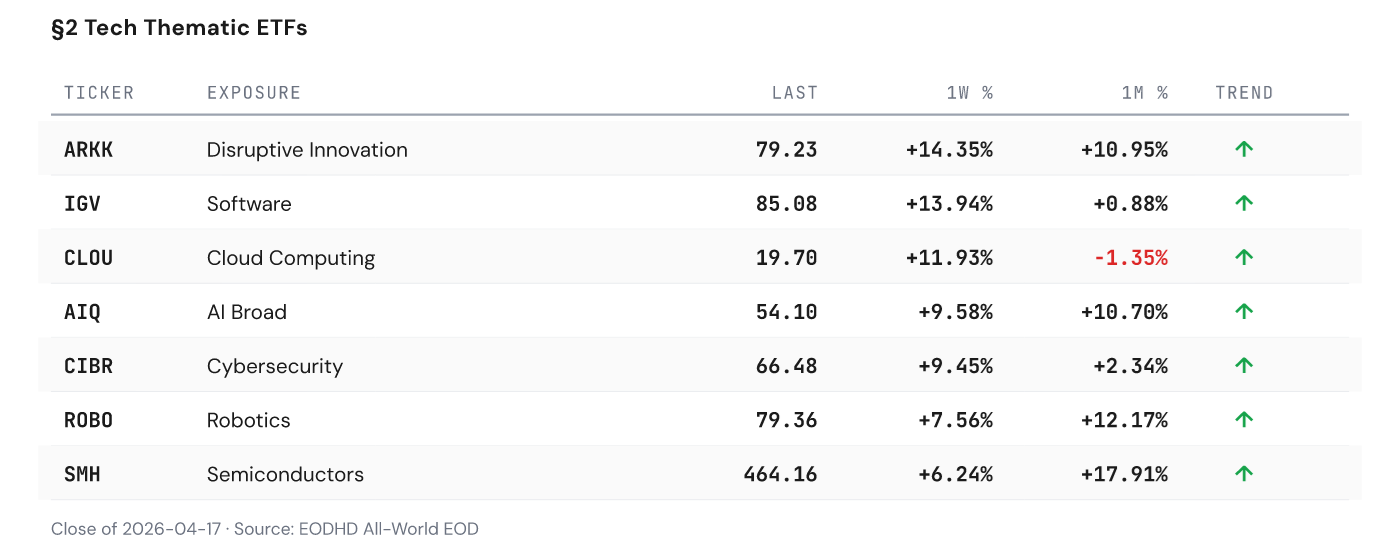
Semiconductors confirmed the thesis. SMH gained 6.24% on the week and 17.91% over the past month. That one-month number is the tell. It means the chip complex was already rebuilding before this week’s surge. AIQ Broad AI gained 9.58%. CIBR Cybersecurity added 9.45%. The AI infrastructure trade is not rotating out. It is rotating up the risk curve, from large-cap AI plays into software, cloud, and disruptive-growth vehicles. QQQ’s 9.07% one-month return lags SMH by nearly nine points. Semis are leading QQQ. That is early-cycle AI infrastructure behavior, not late-cycle multiple expansion.
IWM’s 5.54% weekly gain and 12.10% one-month return deserve attention. Small caps do not outperform over a month unless credit conditions are easing or the market expects them to. The USD Index fell 0.29% for the week and 1.76% for the month. Dollar weakness, small-cap strength, and collapsing volatility are a coherent signal. The §3 thesis will address whether this regime has legs or is running ahead of the macro data that would justify it.
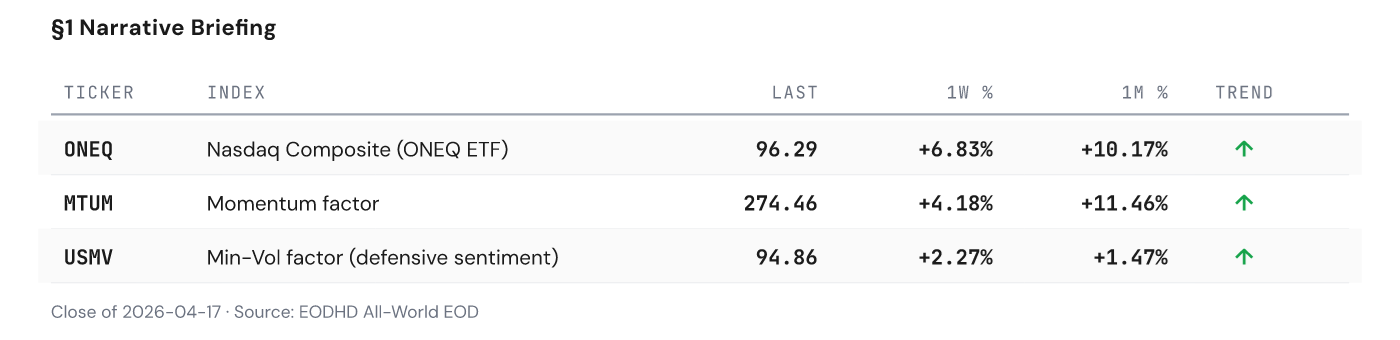
Narrative briefing data — indices mentioned in the week summary
Week Winners
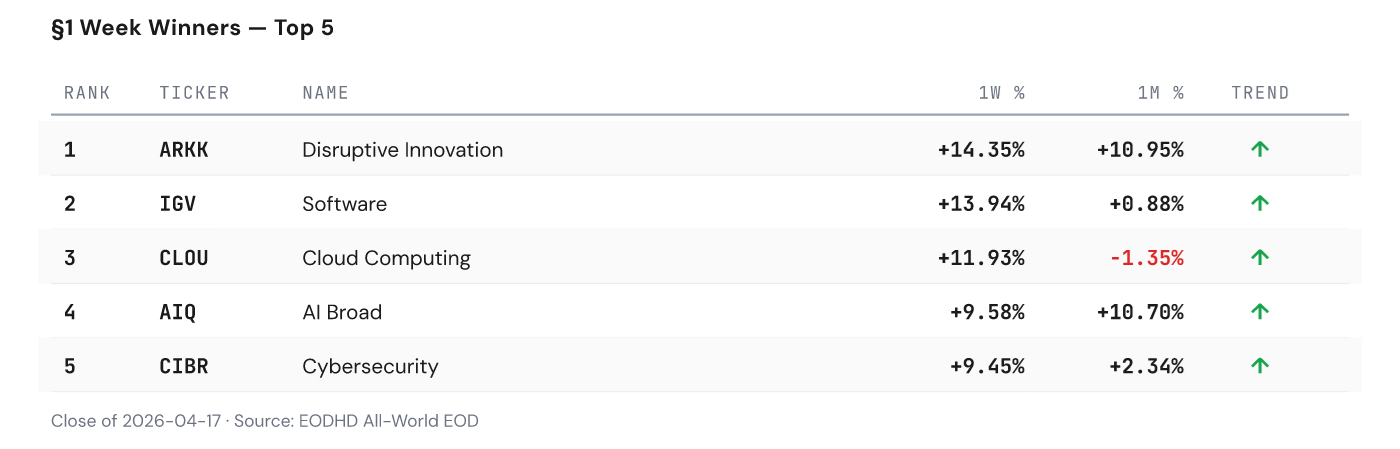
Week Winners — top movers this week
Week Losers
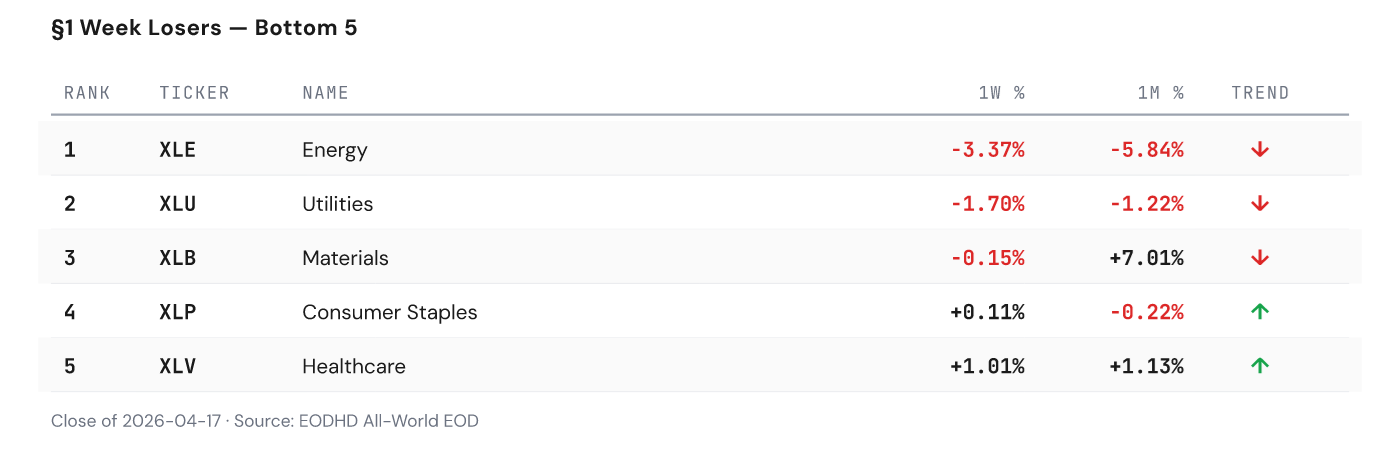
Week Losers — bottom movers this week
(2) Overview: The US Market Map
Sorted by 1W % descending · All returns in USD (unhedged) · Close of 2026-04-17
US Index Levels (ETF Proxies)
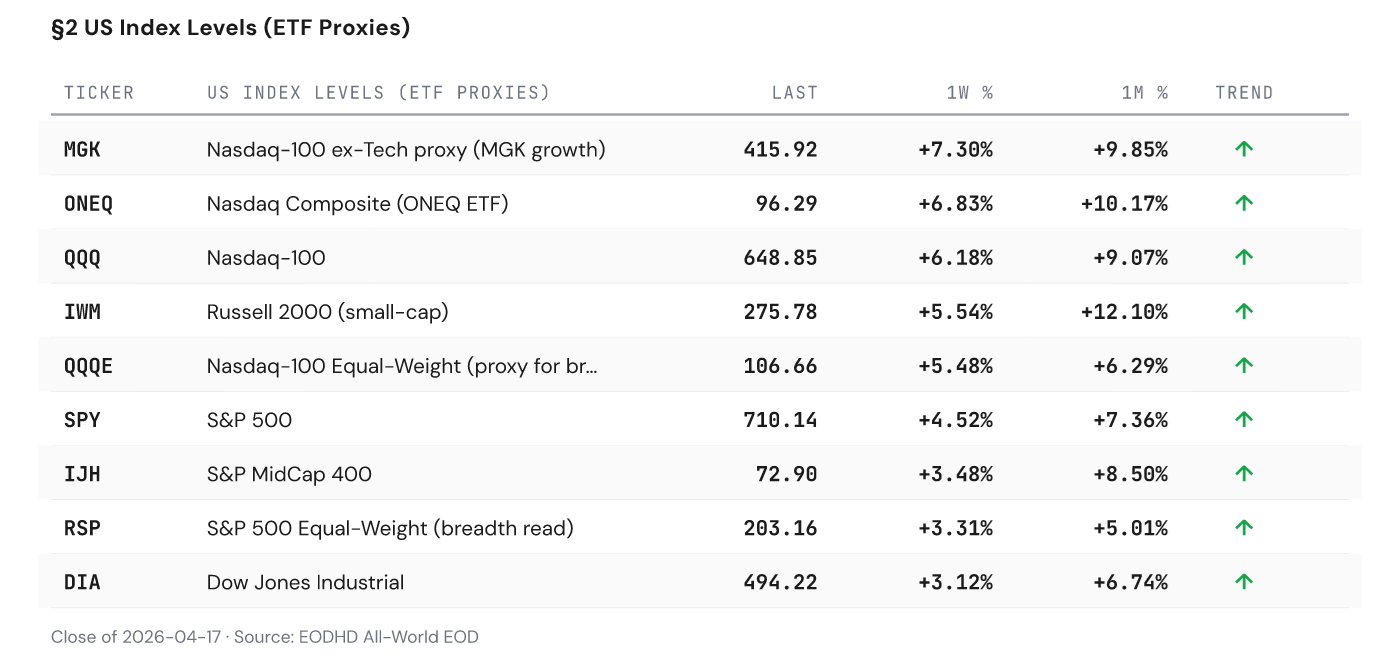
US Index Levels (ETF Proxies)
Sector ETFs
Sector ETFs
Tech Thematic ETFs
Tech Thematic ETFs
Closelook Functional Indices
Closelook Functional Indices
Closelook Lab Read on QQQ
Closelook Lab Read on QQQ
Closelook Lab Grid — Regime Shifts This Week
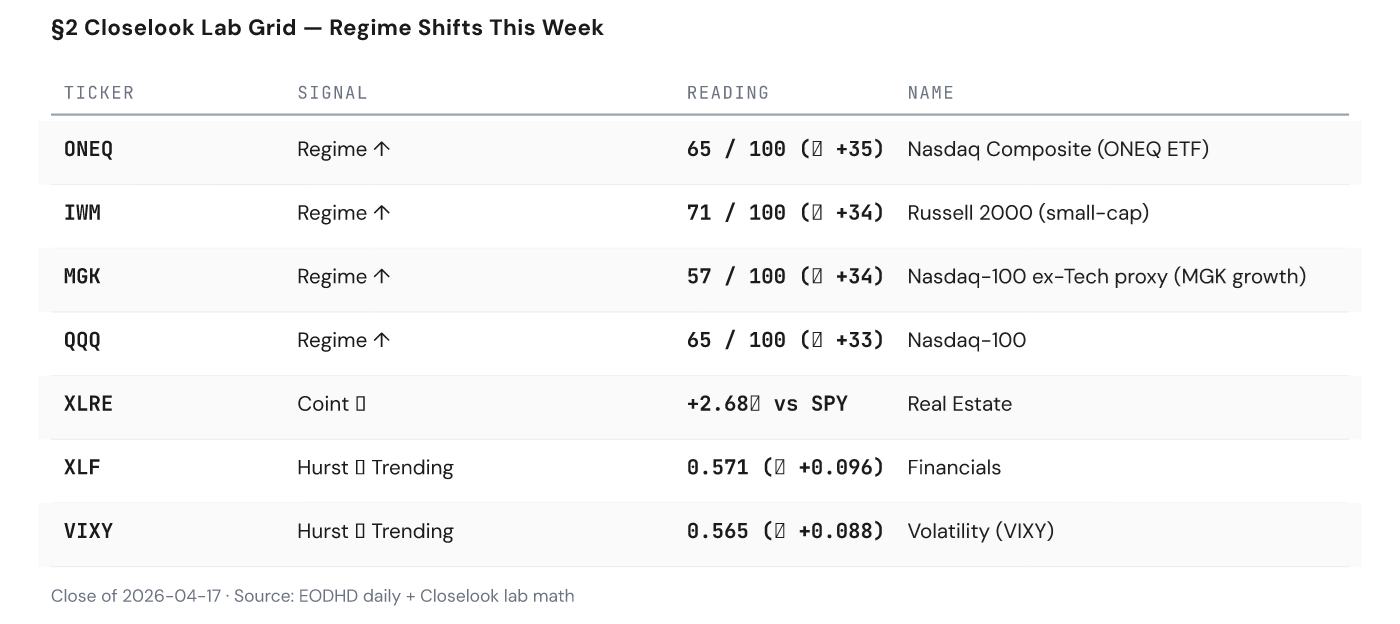
Closelook Lab Grid — regime shifts this week
(3) The State
Where we stand after the Hormuz opening: all four index ETFs at or near 52-week highs, breadth confirming, volatility collapsing to 17.48 on the VIX. Money Temperature moved to 62 — Transition (up-direction). Not euphoria yet, but the warming clock is on.
The Thesis
US indices closed the week at record highs across the board. The trigger was geopolitical: Iran declared the Strait of Hormuz fully open following the Israel-Lebanon ceasefire, WTI collapsed 9.41% on Friday alone to $82.59, and the stagflation tail was removed from the tape.
With the oil-shock premium gone, risk assets broadly repriced. Q1 earnings are reinforcing the move — 88% of S&P 500 reporters beating EPS versus the 5-year average of 78%, aggregate surprises running 10.8% above estimates. What distinguishes this leg from a pure concentration trade is the breadth: QNXT (NDX Tail-70) participated at +4.1% on the week, catching up to the Top-20.
Gold at $4,879, alongside Bitcoin firming to $77,250, is the textbook signature of broad liquidity expansion, not defensive rotation. QQQ is pressing the upper band of its 4Y log-channel with weekly Stochastic at 96+. In a confirmed trend impulse, overbought is sustainable for weeks. The posture is to hold the core, resist pyramiding into the channel roof, and trust the trend past the point where it looks ‘too extended’.
a) QQQ leads SPY by 166 basis points on the week, 6.18% vs 4.52%. That is a tech-forward tape, not a broad-market rally. QQQE’s 5.48% gain confirms the advance has genuine breadth inside the Nasdaq. IWM data is absent this week, so the small-cap read is inconclusive. DIA’s 3.12% trails every major index. Old-economy names are participating, not leading. The regime is growth-over-value, Nasdaq-over-Dow.
b) XLK’s 8.22% weekly gain sets the pace. XLY adds 6.66%. Everything else trails meaningfully. The cyclical-defensive split is stark: XLE dropped 3.37%, XLU fell 1.70%, XLP printed essentially flat at +0.11%. Healthcare managed only 1.01%. Industrials lagged at 1.16%. XLRE’s 3.88% is the one bright spot in the defensive-adjacent print. The sector tilt is unambiguous: risk-on, tech-led, with energy and utilities actively sold.
c) The internal Nasdaq structure shows concentration at work. QQQ’s 6.18% week is pulled higher by the megacap tech cohort, evidenced by XLK’s 8.22% outperformance. QQQE’s 5.48% trails QQQ by 70 basis points, confirming the top of the index is doing the heaviest lifting. The spread is not extreme enough to flag as a red-flag narrowing, but the breadth is not widening either. The equal-weight discount to cap-weight is the structural caution. Risk-on posture is valid. It is not yet broad-based enough to call a clean participation surge.
d) MGK’s 7.30% weekly gain outpaces SPY’s 4.52% by 278 basis points. Megacap growth is driving returns, not suppressing them. At this spread, concentration reads as healthy leadership rather than fragile crowding. Flag it if the gap widens further in the coming weeks.
e) ARKK’s 14.35% week tops the thematic table. IGV follows at 13.94%, CLOU at 11.93%. Speculative and software names are surging together. That is not an AI-native rotation. It is a broad risk-on lift across the growth spectrum. AIQ and CIBR, the more structurally grounded themes, gained 9.58% and 9.45% respectively. SMH lagged the group at 6.24% despite its 17.91% one-month base. The week belongs to speculation and software. AI-native semis are consolidating recent strength rather than extending it.
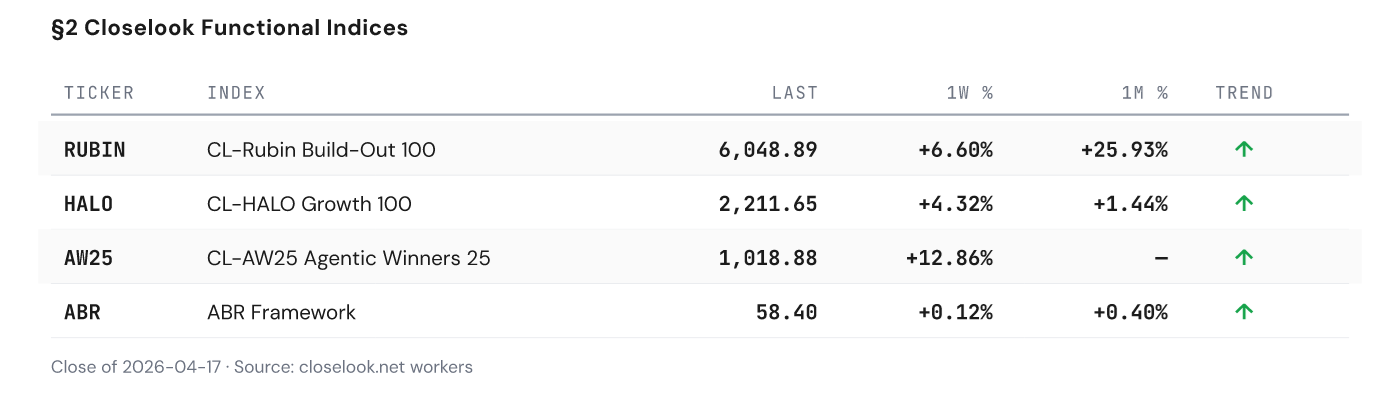
f) AW25 leads all Closelook indices at +12.86% for the week, confirming agentic-AI names as the sharpest edge of the tape. Rubin’s 6.60% week looks strong in isolation. Against its 25.93% one-month return, this deceleration is worth watching. HALO’s 4.32% week versus Rubin’s 6.60% opens a 228-basis-point spread. HALO’s 1.44% one-month return against Rubin’s 25.93% tells the full story: the infrastructure buildout thesis is running hot, broad growth quality is not keeping pace.
Seasonality Setup
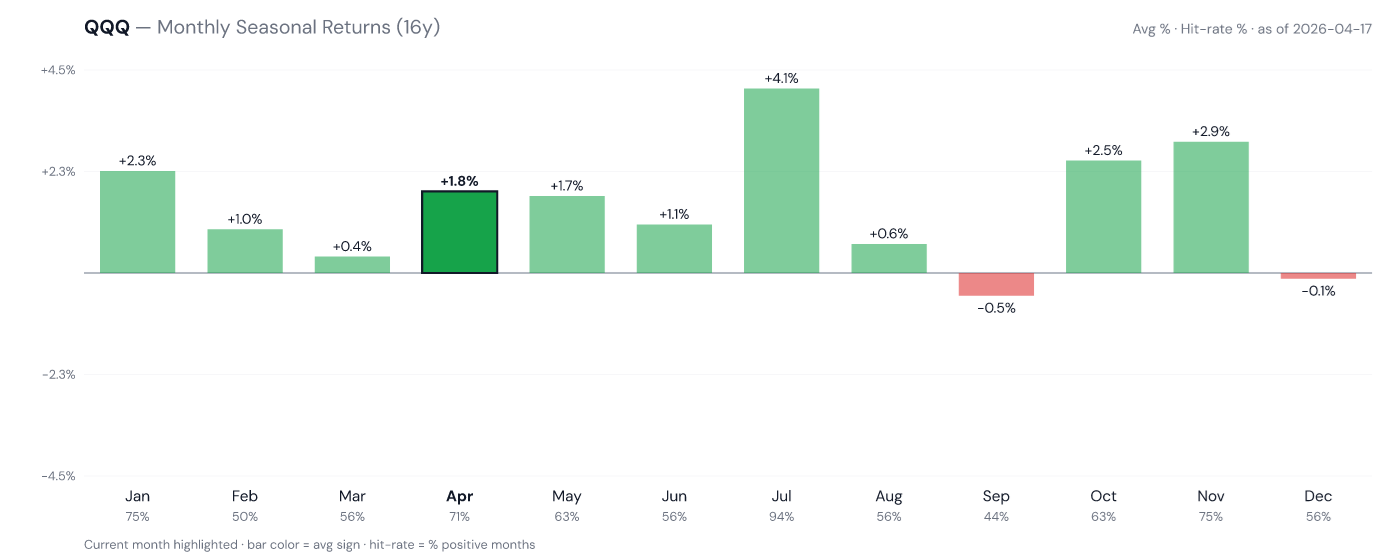
QQQ monthly seasonal returns (16y)

QQQ seasonality — 16-year monthly
Seasonal tape is constructive through May but loses conviction by June — average returns thin to 1.1% on a coin-flip hit-rate. July is the real destination: 4.1% average, 94% hit-rate, the strongest seasonal window QQQ sees all year.
Regime Verdict
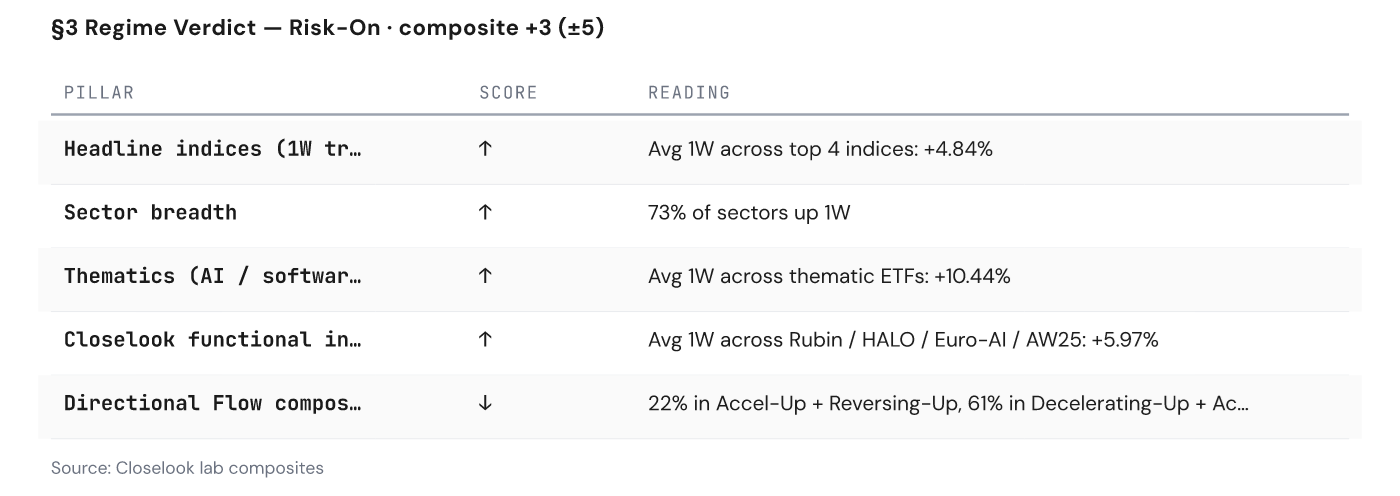
Regime Verdict — composite + 5 pillars
The regime reads Risk-On, but a score of 3 of 4 is not a clean green light. Headline indices averaged +4.84% on the week. Thematics surged +10.44%. Breadth confirmed — 73% of sectors participating. That is the surface. Underneath it, directional flow tells a different story: only 22% of the Rubin universe sits in Accel-Up or Reversing-Up. 61% is either decelerating or accelerating. This is a bounce with thinning internals, not a regime re-acceleration. Position for selective exposure — leadership in AI/software justified, broad beta not. One pillar flip kills the read: directional flow dropping below 15% Accel-Up collapses the composite to neutral or below.
Sector Dispersion — Rubin is not a homogeneous block
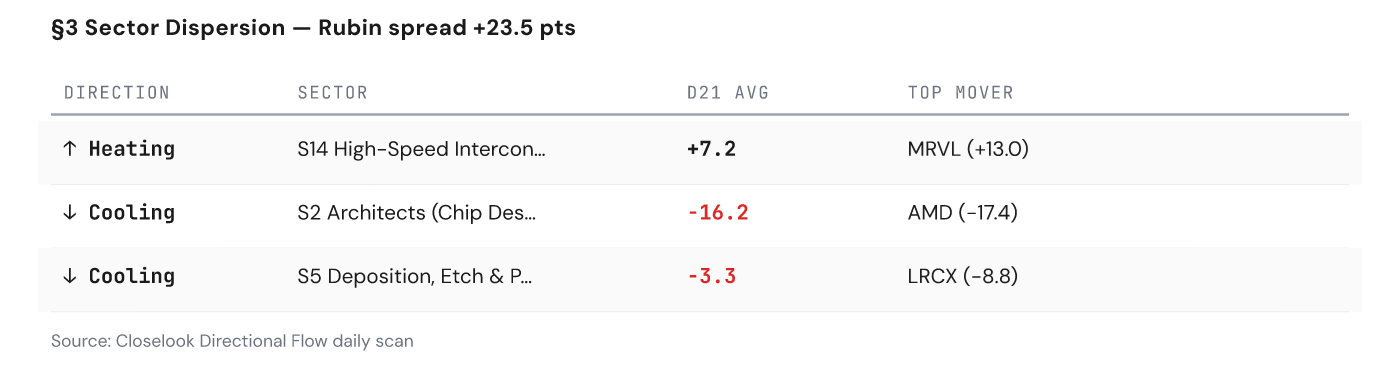
Rubin sector dispersion — heating vs cooling sectors with top movers
Buildout Timeline — which stage leads the cycle?
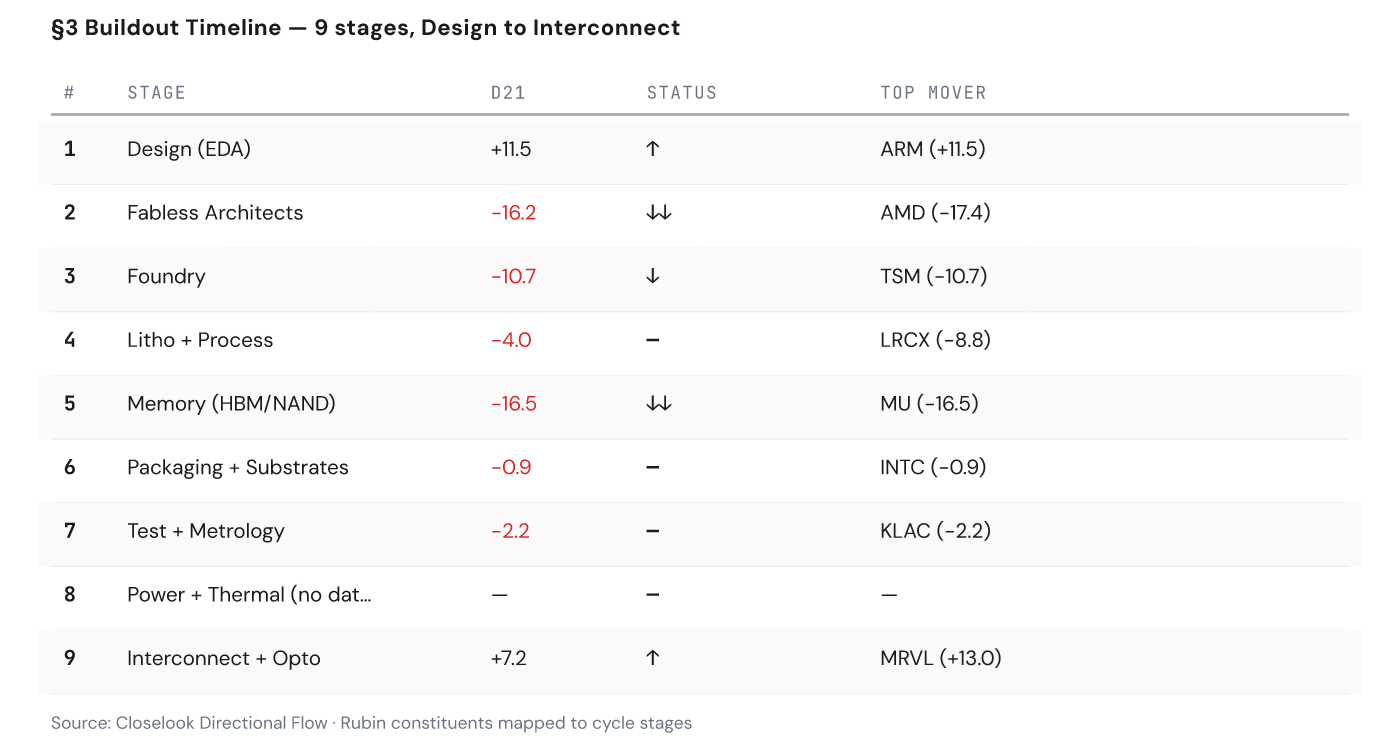
Buildout Timeline — 9 chip-cycle stages with Δ21 flow read
The read is a classic handoff phase: Design (Stage 1) heating at +11.5 signals the next chip cycle is loading, while Fabless (-16.2), Foundry (-10.7), and Memory (-16.5) are all distributing — the current cycle is shipping and those positions are rotating out.
Interconnect (+7.2) heating at the tail confirms it: back-end names see the output flow. Watch Design — if ARM and EDA names keep accelerating over the next 2-3 weeks while Fabless/Memory stabilize, the next leg is loaded 6-9 months ahead of the visible price move.
(4) The Outlook
The outlook rests on three catalysts arriving in the next 10 days: the April 22 ceasefire expiry, the April 25 Core PCE, and the April 28-29 FOMC. Each one can extend or reset the tape. The posture is constructive, the sizing is disciplined.
Forward Reads — Indices, Sectors, Thematics
QQQ leads SPY next week. The 1W spread — XLK +8.22% vs XLI +1.16% — confirms tech is absorbing rotation dollars fastest. IWM lags. Small-caps have no sector tailwind and no thematic catalyst. The index to watch is QQQ pulling away from SPY by at least 150 basis points on any continuation day.
Sector rotation is tilting hard into growth and away from defensives. XLK and XLY are the twin engines — consumer discretionary at +6.66% for the week confirms the risk-on regime is broad enough to include cyclical growth, not just mega-cap tech. XLF at +3.27% holds its bid but trails meaningfully. Watch for XLC to accelerate. Communication Services at +4.52% 1W is building base momentum. The next leg higher in XLC would confirm platform-scale AI monetization is getting priced, not just compute infrastructure.
Thematic leadership is unambiguous: speculative growth and software are running the table together. ARKK +14.35% and IGV +13.94% in a single week is a compressed risk rerating, not a rotation. CLOU at +11.93% with a negative 1M print tells you last week was catch-up compression — real breakout leadership sits in AIQ +9.58% and CIBR +9.45%, which have 1M backing. AI-native over broad software. Speculative names are participating but are not leading on a 1M basis. ARKK’s 1M at +10.95% is the exception — watch it closely for exhaustion signals.
The Closelook index to track this week is CL-AW25 Agentic Winners 25 at +12.86% 1W. It has no 1M baseline yet, which makes it a live discovery index. If AW25 holds its 1W gain into midweek and CL-Rubin Buildout 100 confirms with a 2%+ add-on to its +25.93% 1M base, the agentic infrastructure theme is entering a new leg. HALO Growth at +4.32% 1W is the laggard to watch for mean-reversion signals. ABR Framework at +0.12% is dead weight in this regime — ignore it.
Edition Focus Chart
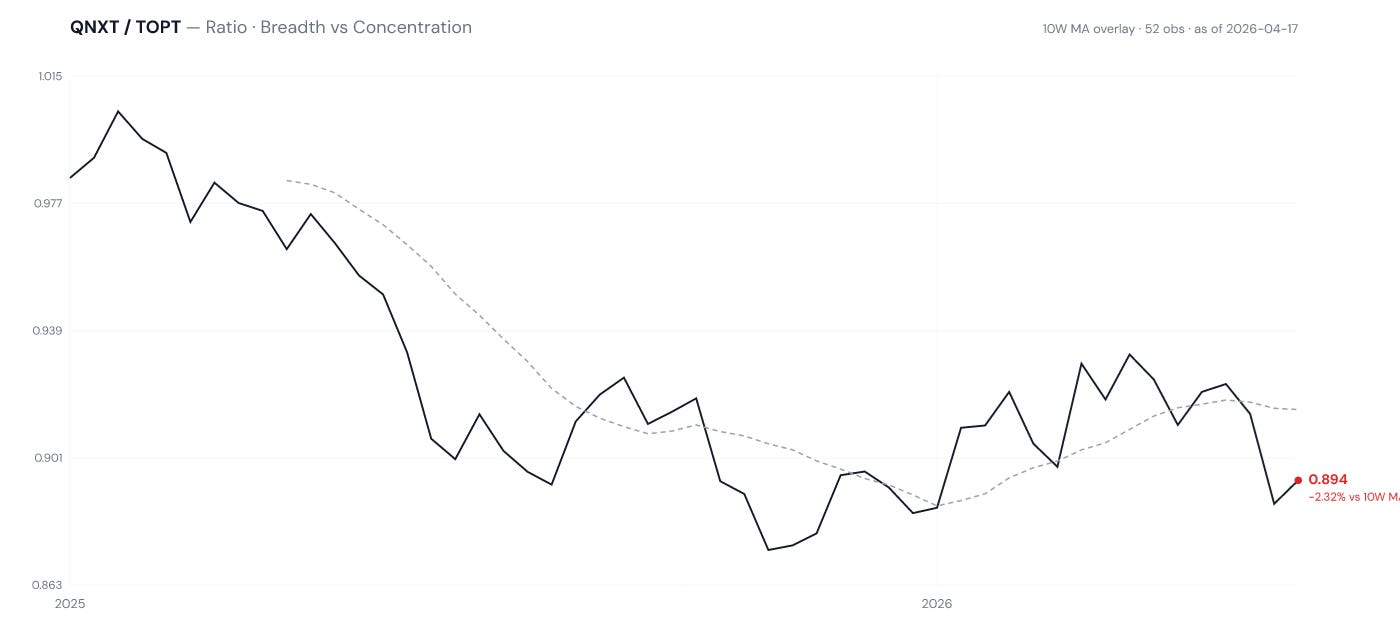
QNXT/TOPT ratio — Breadth vs Concentration
QNXT/TOPT ratio vs 10W MA · 52W window. Default pair — edition can override.
Watchlist — What Would Flip the Read
· QQQ below 455: negates tech leadership call. SPY rotation signal activates. Reduce thematic exposure by 30% and move to XLF/XLI pair.
· IGV fails to hold 1W gain above prior resistance (watch 370 close): software breakout becomes a false start. CLOU and IGV both revert. AI-native thesis narrows to AIQ and CIBR only.
· ARKK two-day close below 57: speculative risk appetite exits. Regime composite drops toward neutral. AW25 agentic call is suspended until 1M data confirms.
(5) What May Lie Ahead: Macro Setup
Macro setup for next week: disinflation print is the single biggest tell. A Core PCE at or below 0.2% MoM extends the risk-on window into FOMC. A hotter print would collapse the dovish-Fed narrative that is partly underpinning current levels.
Money Temperature
Score: 62 🟡 Transition
Composite of 8 macro instruments — rates, credit, FX, commodities. Absorption ratio at 0.50 (5/10 fragility). Snapshot: 2026-04-17.
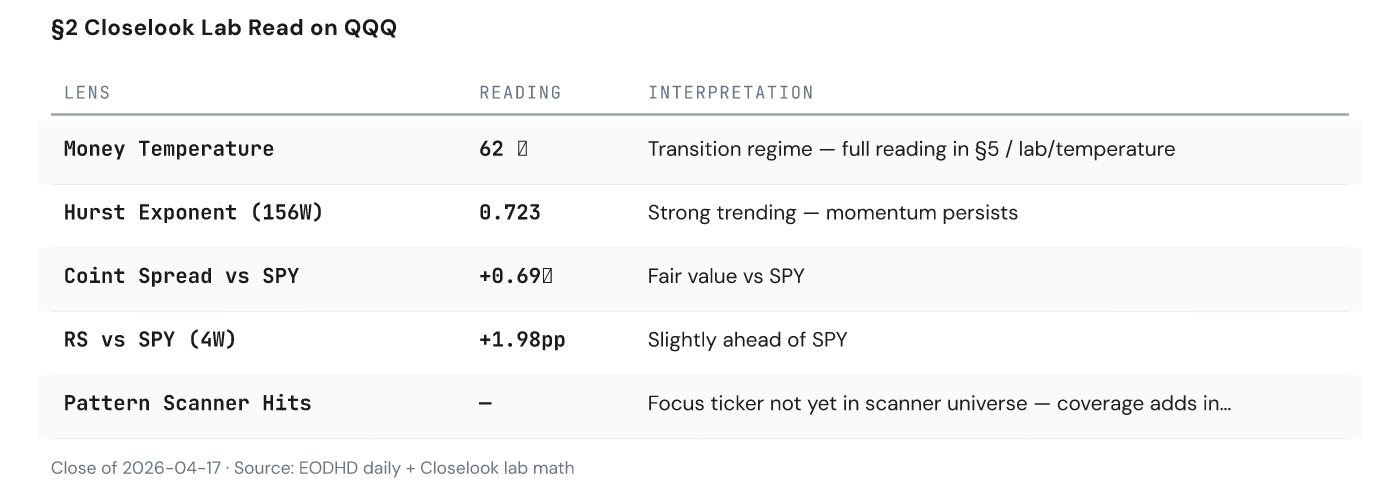
The Money Temperature sits at 62 — Transition zone, warming direction. The composite reflects last week’s macro repricing: WTI collapsed by 9.4% on Friday, compressing commodity stress; credit spreads tightened on risk-on flow; 10Y at 4.24% confirms the disinflationary read; dollar soft (UUP −0.29%). Absorption ratio at 0.50 — 5 of 10 macro instruments in shock-absorbing mode — neutral-to-constructive, not fragile. At 62 warming, we hold the current gross. The trigger for gross reduction is a composite print of 75+. On current pace, 2–3 weeks away. No sizing change this week. The tape is doing the work.
Full dashboard: closelook.net/lab/temperature/
Central Bank Pulse
Fed: The Fed holds at 4.25–4.50%, and the market prices the first cut in July with roughly 65 basis points of easing by year-end. Chair Powell’s April 16 remarks closed the door on a May move, citing persistent services inflation and tariff pass-through risk. The Fed is not pivoting. It is waiting for data that may not arrive on its preferred schedule.
ECB: The ECB cut its deposit rate to 2.25% on April 17, delivering its seventh consecutive reduction. Markets price one more 25-basis-point cut by June, with the terminal rate seen near 1.75%. The divergence with the Fed is now structural, not cyclical. EUR/USD bears have a policy tailwind; the trade is not done.
BoJ: The BoJ holds at 0.50%, and the April meeting produced no new forward guidance toward further hikes. Governor Ueda flagged global trade uncertainty — read: U.S. tariffs — as a reason for caution. Rate differentials keep the yen structurally weak against the dollar. USD/JPY will not break lower without a Fed pivot or a BoJ surprise, and neither is imminent.
PBoC: The PBoC holds its one-year loan prime rate at 3.10% and its five-year at 3.60%, but the easing bias remains intact. Authorities have room to cut; political will to deploy it aggressively is the variable. With export demand under tariff pressure and domestic consumption still soft, further LPR reductions before Q3 are the base case. CNY management remains the primary policy lever in the near term.
Macro Commentary
“Gold printed its all-time high on January 29 — a full month before the Iran strikes opened the current conflict. That means the $3,200→$5,594 run was momentum capital, not sovereign tail-risk hedging.
With the ceasefire in place and oil collapsing, that same capital rotated: out of gold (−14% from ATH), into risk. Bitcoin reclaiming $74k, with open interest up 59% over seven weeks, is the mirror trade: same money, same book, opposite direction from Q4 2025. For US equities, this matters because the liquidity expansion behind SPY 710 and SMH at new highs is the same flow. The positioning is the trade; the next trigger is the Fed.”
— Closelook Daily Pulse, April 20, 2026
The implicit point — positioning is the trade — maps directly to this edition’s thesis. The Rubin Buildout +25.93% 1M against HALO’s +1.44% is not a thematic divergence; it’s a liquidity-routing signature.
The same momentum book that abandoned gold is loading AI-infrastructure names. That flow is constructive through the FOMC window (April 28–29); beyond, it depends on what the Fed does next. A hawkish tilt forces some of that capital back to safety. A dovish hold extends it. The positioning reveals resets on the next catalyst.
(6) What May Lie Ahead: Technical Setup
Technical setup: QQQ is trading at the upper band of its 4Y log channel. The 3M breakout from the 540 base is clean, Alignment Check is confluent bullish, but the distance from the 30W MA is extended. Hold-territory, not add-territory.
The Technical Reading
Third impulse of the post-March advance. Wave 1: mid-March breakout from the 520 base. Wave 2: early-April pause at 595-605. Wave 3: current leg pressing the upper 4Y log-channel band near 649. Invalidation lines: 550 (3M breakout floor — close below ends the wave-3 read, argues consolidation to 520-525); 498 (4Y channel lower band — full structural invalidation). The setup to watch: a print to 585, followed by a rejection to 560 on volume, would activate the 550 test.
Main Chart
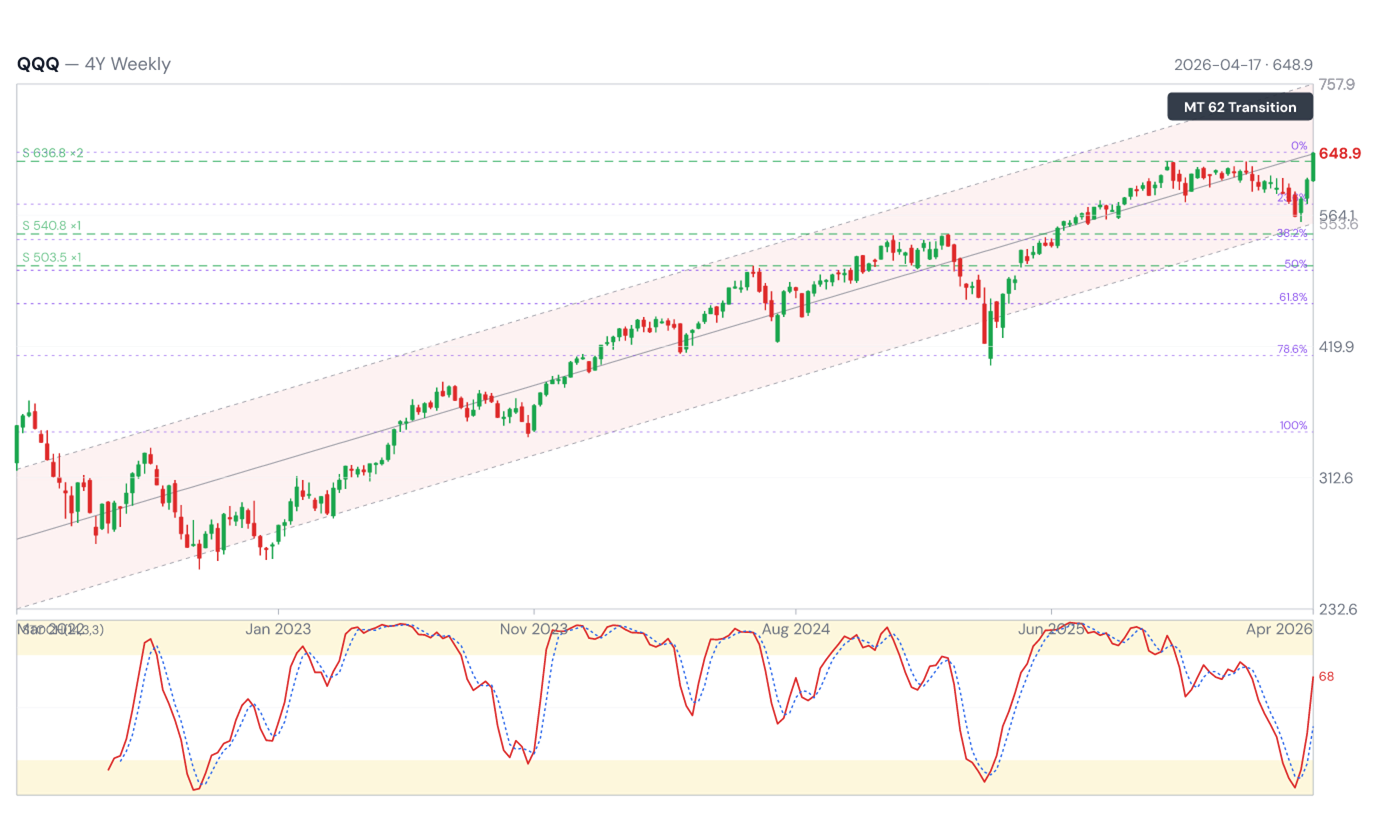
QQQ weekly 4Y with log-channel, S&R, Fib
QQQ weekly 4Y. Wave labels + tactical targets added manually during technical read.
Key Levels
Current: 648.85 · Upper Channel: 650 · Lower Channel: 498 · Horizontal Support: 550 · Fib 1.272: 585 · Fib 1.618: 605
Technical Commentary
§6 Technical Commentary + Indicator Focus Week of April 19, 2026
PART A — Technical Commentary
QQQ at 648.85 is trading without confirmed channel boundaries or active Fibonacci extensions. That absence is itself a read. Price is in structure-discovery mode. The path of least resistance depends entirely on whether 648.85 holds as a base or acts as a ceiling. A weekly close above 648.8, with increasing volume, confirms bid conviction. A failure here, with a close below 640, opens a flush toward the 620–615 range, where prior consolidation left unfilled structural demand.
Until channel walls are reestablished, resistance is air. No technical ceiling exists to slow a breakout move. That makes failed rallies more dangerous, not less. A rejection from current levels, with volume accelerating to the downside, is the primary invalidation of any constructive case. Bulls need QQQ to close the week above 648.85 and hold it on the retest.
Indicator Focus
The Slow Stochastic (14,3,3) prints 67.84 on %K and 39.26 on %D. That spread is wide. %K has run hard; %D has not confirmed. In a trending regime, this gap resolves by %D catching up, producing a bullish cross above 50 and extending the move. In a choppy or mean-reverting regime, it resolves as %K rolls back toward %D, signaling exhaustion.
The tell is the cross direction. A %D push through 50 with %K holding above it is the confirmation bulls need. A %K rollover below 65 before that cross happens ends the setup.
Alignment Check
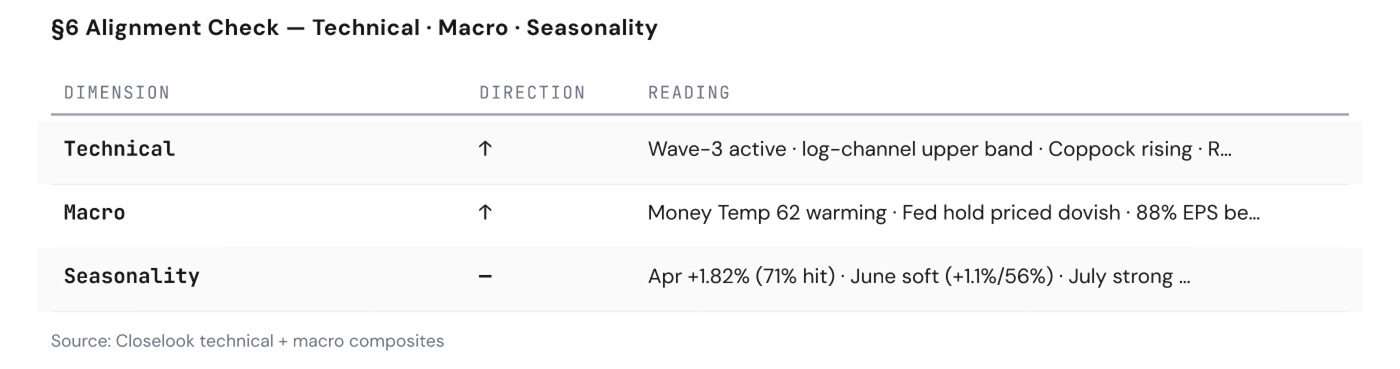
Alignment Check — Technical, Macro, Seasonality dimensions
═══ Confluent Bullish — verdict ═══
Two pillars up, seasonality neutral. The tape has structural support. What to respect: the upper channel at 650 is active resistance; do not pyramid here—what to trust: the trend. Every confirmed bull impulse looks overbought for most of its duration. The risk-off trigger is Money Temp 75+ or a sector-breadth drop below 50% — neither is on this week’s card.
(7) The AI Buildout Portfolio: What We Did
Coming Soon
Portfolio moves + accountability log launch with this edition’s next cycle. Subscribers get real-time push notifications on every adjustment before it appears here.
Join the waitlist → closelook.net/c-plus
(8) The AI Buildout Portfolio: What We Plan To Do
Coming Soon
Forward-plan table with trigger conditions launches alongside §7. C+ subscribers see the candidates ’list before execution.
(9) Knowledge Corner
This Week’s Topic: Why ‘overbought’ gets weaponized against holders in trend regimes
Mean-reversion indicators (Stochastic, RSI) were designed for range markets. In a confirmed trend impulse, they stay pinned at ‘overbought’ for the entire duration of the move. Every secular uptrend in equity history has looked overbought for most of its duration.
The trap: treating mean-reversion signals as exit signals in a trend market. The discipline: Use the Alignment Check first. If Coppock is rising AND ADX is above 25 AND RS vs SPY is positive, you are in a trend regime and Stochastic 95+ is a hold signal, not a sell signal. In a range regime (ADX below 20, Coppock flat), the same reading is actionable. The regime determines the read — the indicator alone does not.
Want earlier Knowledge Corner entries? The Closelook Knowledge archive is at closelook.net/knowledge/ — indexed by topic and framework.
(10) Upcoming Transactions: Be Informed
Two ways to stay close to Closelook’s portfolio moves — one free, one premium.
Free Access
Follow our work at no cost.
· LinkedIn Newsletter (Closelook@US Stock Markets)
· closelook.net — Free tier
Subscribe → closelook.net/subscribe
Coming Soon · Paid
Real-time transaction alerts before they happen.
· Push notifications on portfolio moves
· C+ Premium Substack section
Join waitlist → closelook.net/c-plus
(11) What May Go Wrong: Risk & Change Triggers
The falsification test: what would invalidate Sections 5 and 6 — and how we’d know.
Macro Change Triggers
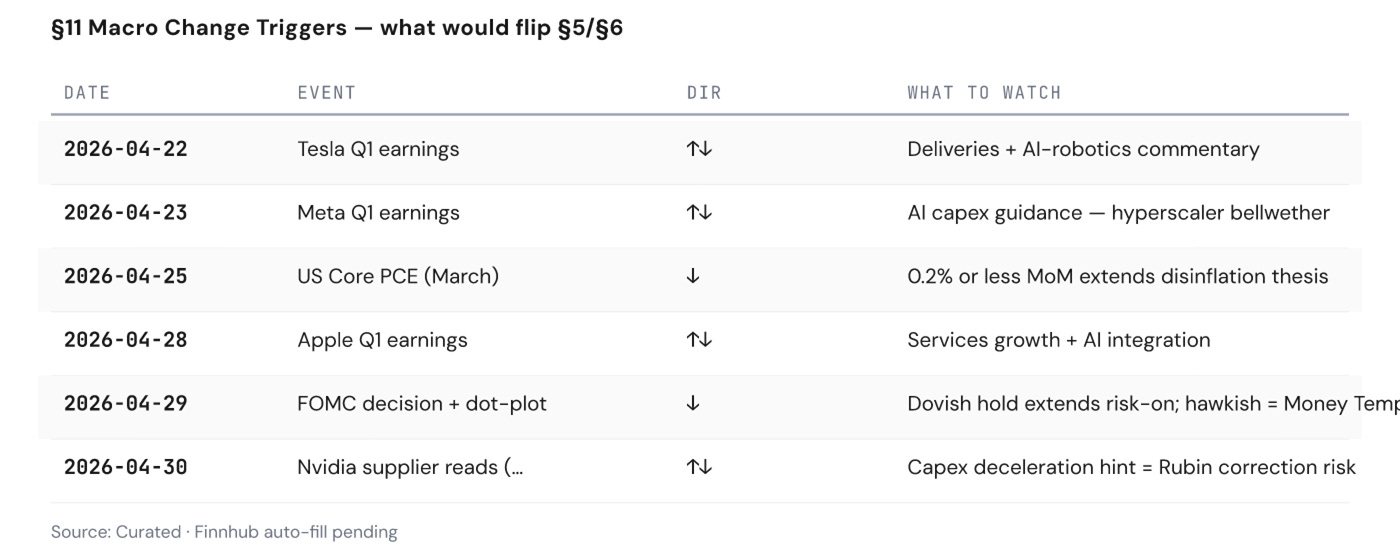
Macro Change Triggers — upcoming dates, events, direction, what to watch
Technical Invalidation Levels
The 3M breakout floor is 550. A weekly close below ends the wave-3 read and argues consolidation into the 520–525 zone. The 4Y log-channel lower band at 498 is the full structural invalidation — below that, the multi-year bull case on QQQ is off the table. Neither is close at the current 648.85, but a rejection at 650, followed by a volume break below 600, puts the 550 test back on the calendar.
Indicator Shift Triggers
· Coppock Curve (currently −5.63, bottoming) — a second monthly print lower cancels the turning-up read and restores the mean-reversion case on the weekly.
· ADX (currently 16.83, range-bound) — a drop below 15 confirms no directional trend; a break above 25 confirms the trend impulse.
· RS vs SPY (4W) (currently +1.98pp) — turning negative ends QQQ-led leadership; triggers a rotation watch into broad-market (SPY/RSP) and small-caps (IWM).
The thesis holds until one of these triggers fires. When they do, the next edition updates the read.
(12) Final Words
“The hard part of bull markets isn’t riding them. It’s trusting them past the point where they look ‘too extended’. Every secular uptrend in equity history looked overbought for most of its duration. The ones who underperform the market are usually the ones who had an early thesis correct and then got scared out at the third extension.”
— Paul Tudor Jones (paraphrased, multiple interviews)
The week closed with the tape at record highs, the AI-infrastructure trade ripping, and every indicator flashing overbought — which, historically, is when the meat of bull markets gets put to the portfolio. The March consolidation was the pause. The third impulse is the move. The Tail-70 catching up to the Top-20 is a broadening signal indicating this leg still has room.
What doesn’t have room is complacency. Money Temperature at 62 warming toward 75 is the clock. The oil-shock tail has been removed but not replaced; a new exogenous shock could reset the setup in a week. Adding risk into the 595-605 QQQ zone is a low-reward, high-regret trade. Staying invested through it — that’s where the edge sits. Ride the bull; don’t chase it into the channel roof.
Thank you for reading. See you next week.
Annex — Further Reading at Closelook
Suggested navigation across Closelook’s own work. Not external — everything below lives at closelook.net.
Indices & Frameworks
· Rubin Build-Out 100 — 100 stocks, 18 sectors, AI infrastructure (closelook.net/indices/rubin)
· HALO Growth 100 — Physical-world growth, AI-safe sectors (closelook.net/indices/halo)
· Euro-AI Sovereign 50 — European AI sovereignty play (closelook.net/indices/euro-ai)
· Agentic Winners 25 — Tactical agentic infrastructure index (closelook.net/lab/agentic)
· Money Temperature — 8-instrument macro regime scoring (closelook.net/lab/temperature)
· Cointegration Monitor — Engle-Granger pairs + cascade tracker (closelook.net/lab/cointegration)
· ABR Framework — Agent Beneficiary Ratio for AI disruption (closelook.net/research/abr-framework)
Portfolios
· Global ETFs — ex-US regional + sector ETF portfolio (closelook.net/portfolios/global-etfs)
· AI Build-Out — Rubin-index-aligned single-stock portfolio (closelook.net/portfolios/ai-buildout) (this newsletter)
· Hypergrowth — 16 AI-native names + covered-calls layer (closelook.net/portfolios/hypergrowth)
· Global Tech 50 — Non-US tech, passive long-horizon (closelook.net/portfolios/global-tech-50)
· Derivatives — Covered calls, cash-secured puts overlay (closelook.net/portfolios/derivatives)
Editorial
· Weekly Signal — 9-dimensional market regime scorecard (closelook.net/weekly)
· Daily Pulse — Daily market notes archive (closelook.net/pulse)
· Research Dossiers — Deep-dive reports on themes and names (closelook.net/research)
· Closelook 101 — Concepts, frameworks, methodology (closelook.net/101)
· Glossary — Terms, definitions, cross-references (closelook.net/glossary)
Publishing Schedule
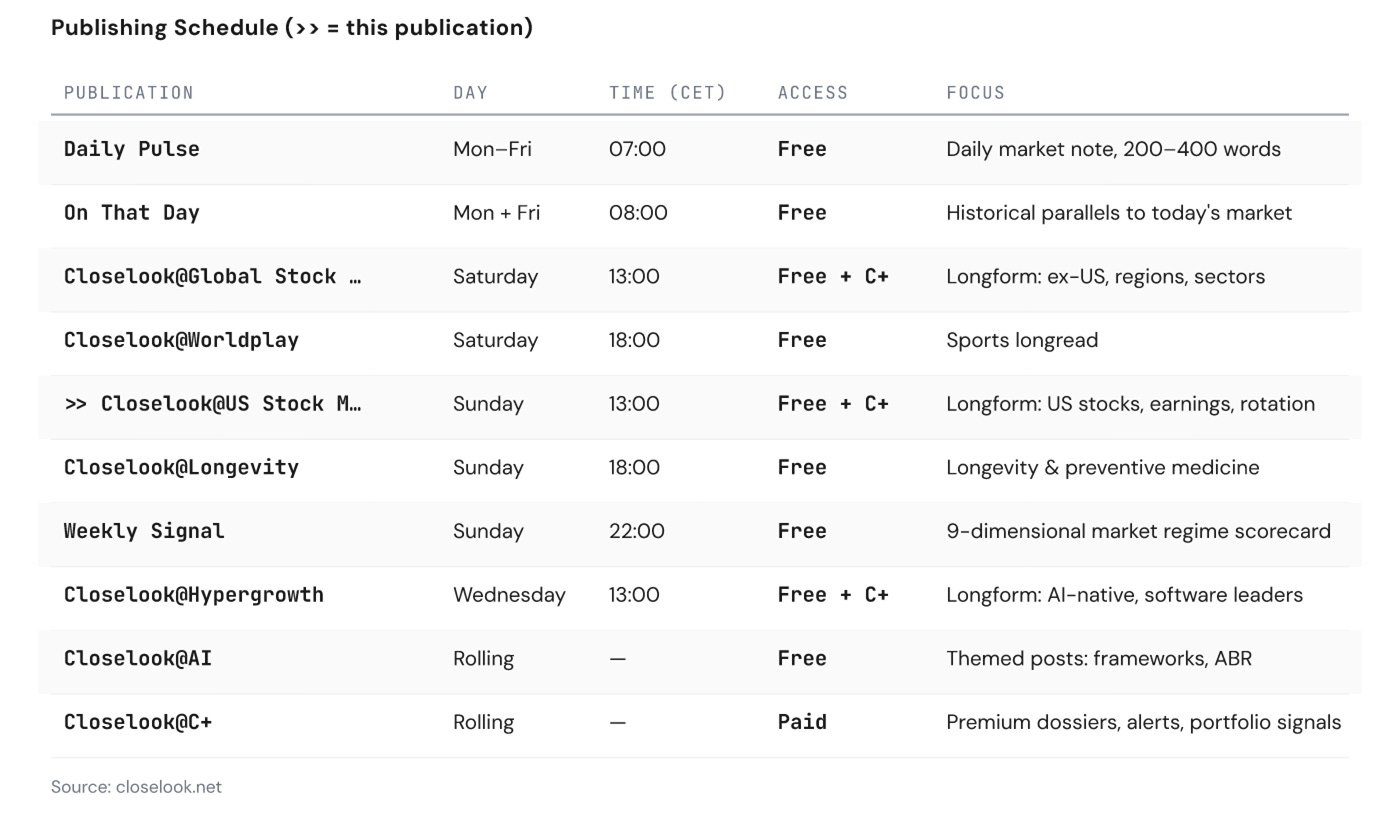
Publishing Schedule — all Closelook publications with current edition marker