The Troops Are Leaving Before the Generals
A short-term top in second-tier semis is likely in place — not the end of the bull, an early-warning shot.
Two semiconductor ETFs are telling two different stories today, and the gap between them is the signal.
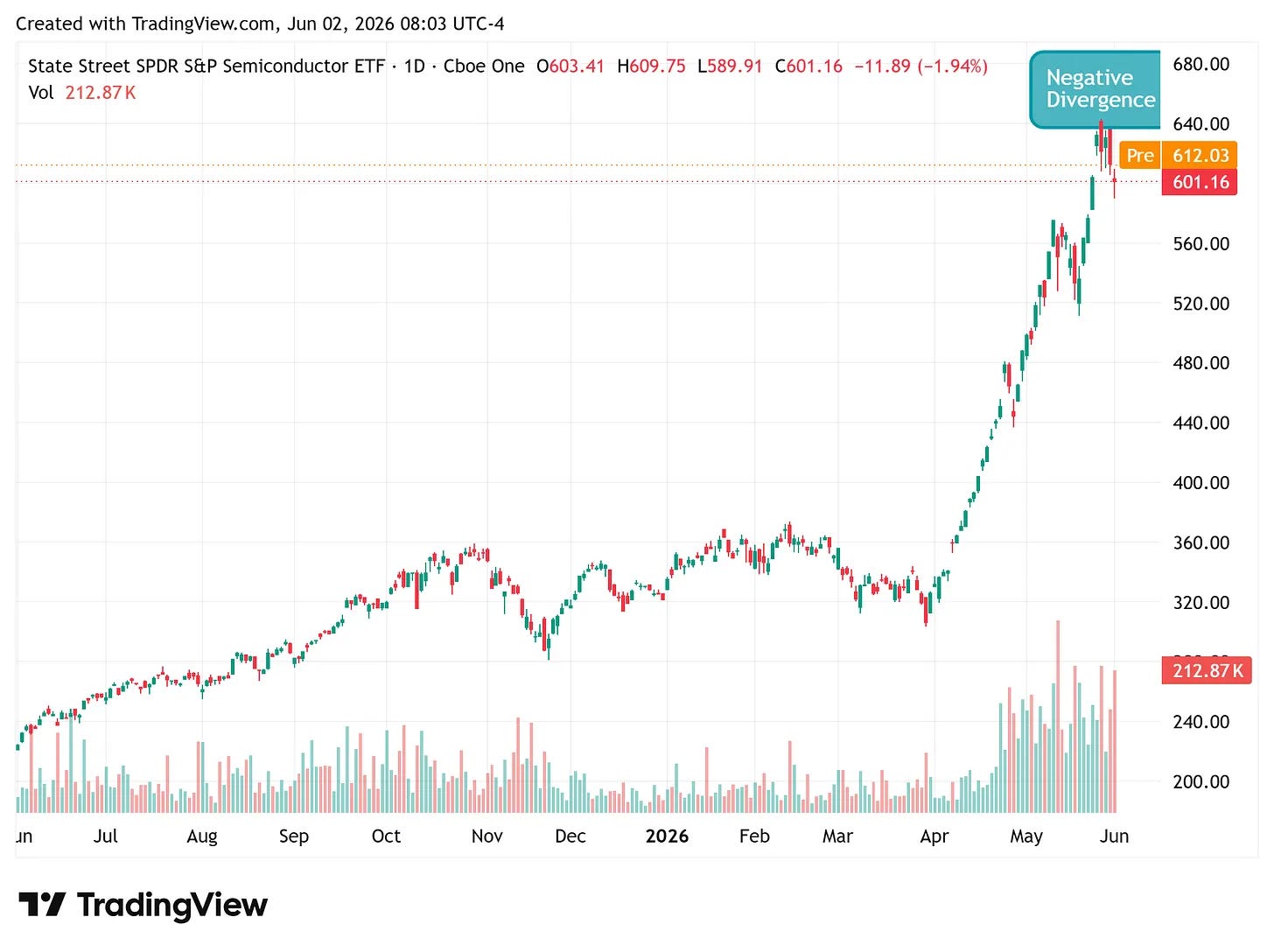
SMH — the cap-weighted complex, carried by the mega-cap names — is still climbing: +5.46% over five days, green on the day. XSD — the equal-weight S&P semiconductor index, where the smaller and second-tier chip names actually carry weight — has rolled over: −0.46% on five days and −1.94% in the last session, last 601.16 into a negative divergence off the April-low high. In a watchlist of twenty-plus tech ETFs, XSD is the only name printing red over five days.
That is not noise. That is breadth. When the equal-weight version of a sector turns down while the cap-weighted version keeps rising, the move is being carried by fewer and fewer names. The generals are holding the line; the troops have already started to retreat.
Why XSD is the cleaner gauge here
SMH is a mega-cap fund — NVIDIA and Broadcom carry it. XSD is the inverse by construction: a modified equal-weight basket of roughly 43 names. The numbers make the point better than any chart can.
NVIDIA = 1.69%. The most important chip company on earth is in the 33rd-largest position in XSD — below Rambus, Penguin Solutions, and Rigetti. The top holding is Maxlinear at 6.24%, weighted roughly 3.7× NVDA.
So XSD doesn’t measure “semis.” It measures the second tier — and the second tier has stopped going up.
XSD — top weights (the second tier that drives it):
And look at what's actually driving XSD. The heavyweights are the high-beta speculatives: Astera Labs (4.09%), Navitas (3.62%), Credo (3.03%), SiTime (3.01%), Rigetti (2.24%), Ambarella, and Wolfspeed. This is exactly the cohort that runs hardest in the everyone-up phase — and breaks first when leadership narrows. When this basket turns red while NVDA-heavy SMH is green, you are watching the marginal buyer leave the riskiest end of the trade.
This is rotation, not collapse.
To be precise about what this is and is not: this is not the end of the semiconductor bull. It is a sign that the easy, everyone-up phase is over, and that the short-term top in the weakest cohort is likely behind us.
The rotation read confirms it. Over the last five days, leadership has moved out of hardware and up the stack into software and applications — cloud (CLOU +15.4%), software (IGV +14.6%), cybersecurity (CIBR +11.7%), AI (AIQ / WTAI ~+10%). Capital isn’t leaving tech. It’s leaving the chip layer and climbing the stack.
The indicator behind the call: Beta Instability
One of my favorite tools for catching a rotation before price makes it obvious is beta instability — a regime-change signal, not a momentum read. Historically, when QQQ rises 1%, SMH might rise 1.3%. When that same SMH suddenly rises only 0.4% on an up day, the ratio can still look fine — but the leadership relationship has quietly broken. I measure it on up days and down days separately.
The alert: XSD’s upside beta to QQQ and SPY has deteriorated sharply. The equal-weight semis have stopped participating on up days — and the weakest components of a broad advance are usually the first to roll.
Coming to the platform. The Beta Instability Toolbox is one of a set of indicators and classifiers arriving on closelook.net — the kind you won’t find on standard financial sites, which still only show classic tech and quant readouts.


