


The count we filed as contrarian now has its evidence. The calendar disagrees. Next week arbitrates.
Closelooknet is a reader-supported publication — to receive new posts and support the work, become a free or paid subscriber.

This week’s edition of Closelook@US Stock Markets, dated August 9, 2026.
Last week’s letter closed with three contracts: the shelf had to hold without the calendar, the flush low had to stay a low, and Monday’s perfect-record print had to survive its own regime. All three paid — and then the week went somewhere none of the contracts anticipated. Palantir was bought 29% on its beat, breaking the sold-beat regime as a class. The Nasdaq took out 694 on Monday and never looked back.
And on Friday morning the payroll report printed minus 23,000 — the first negative jobs number of the entire cycle — and the market’s response was to rally, because within the hour the bond fund that had spent four sessions breaking the trendline this publication calls the veto reclaimed it, and the discount-rate threat that has shadowed every chart since July died at the close.
In between, something happened that has not happened since this letter split the AI trade into layers in June: all three of them were paid in the same week. The applications showed tremendous life — Atlassian up 47% in five sessions, Palantir up 40%. The operating layer rose sharply — Twilio through its 52-week high, Cloudflare and Snowflake bid — with a downturn only where the threat is direct and named. And the chip complex recovered broadly, led by the equal-weight cut, with exactly two exceptions: memory-and-storage, and Tokyo’s capex corner on Friday.
Two weeks ago this letter filed a wave count that requires exactly this configuration — broad, simultaneous, discount-rate-fed — and filed it as contrarian, against the seasonals, adopted by nobody. This week produced the evidence. Next week gets to confirm it or take it away.
1 · This Week’s Action
The tape, day by day. Monday opened the week by answering last week’s biggest question in one session: QQQ closed at 700.07 — through the 694 line that outranked everything on the board — while the semiconductor index defended a three-percent morning break of its 505 floor and closed flat: a failed breakdown at the exact level the bears needed, on day one. Monday night Palantir smashed (revenue +93%, US commercial +149%, a Rule-of-40 score of 155) and Tuesday the market did what it had refused to do for three weeks of sold beats: it paid — +29.4% to 162.66, through the descending line off the November high, and the whole complex ran with it: QQQ +3.4% to 723.85, the chip index +6.8%, Micron +7.6%.
Wednesday the index went nowhere and the market changed horses underneath — the Nasdaq red, gold +4%, the gold miners +7% — while AMD beat every line and round-tripped its week after hours: the first warning that the bid was selective. Thursday was the punishment-phase encore: Datadog beat, raised, and lost 19.0% on the OpenAI in-house-observability overhang — the season’s textbook direct-threat repricing — while the equal-weight chip cut quietly broke the downtrend line it has carried since the June top.
And Friday the macro arrived: payrolls −23k against +80k expected, government jobs −53k, private hiring +30k against 78k expected, wages +0.1% on the month — and the market bought the bad news, because bad news for the labor market is death for the rate-rise scenario. The bond fund reclaimed its line within the hour (close 93.17, above the two-year trendline near 93.1 — the veto’s official death certificate, at Friday’s close). Twilio, which had printed Thursday night, was paid +24.9% through its 52-week high and held it into the close. Atlassian +35.3%. The Nasdaq closed at 723.03 — a five-percent week, parked eighty cents under Tuesday’s high-water close.
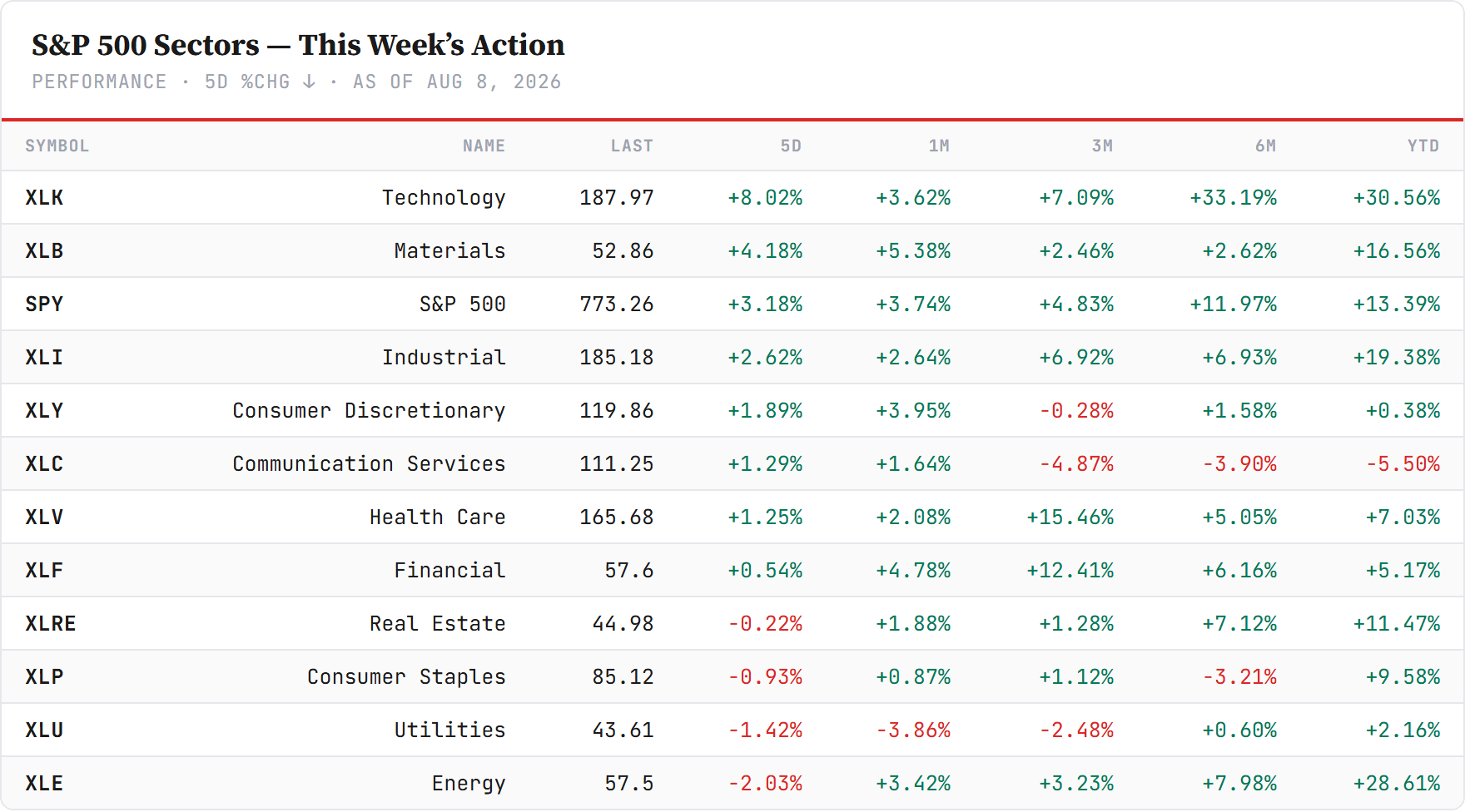
The sector read — eight green, three red, and the red is a sentence. Tech +7.2% on top, and for once the label is accurate: the software complex and the chip complex both live there and both ran. Materials +4.8% behind it — the metals bid at sector degree (the full metals map belongs to Saturday’s Global letter). Then the long middle: discretionary +3.3%, industrials +3.0%, communications +2.8%. The red column: energy −3.4% (oil’s −8.7% week wearing its sector costume), utilities −1.7%, real estate −0.2% — the two bond-proxies and the barrel, and nothing else.
Compare it with last week’s board, where utilities were the worst sector because rates were rising. This week utilities were red while rates fell — because in a week when everything offensive was bid, the defensive yield-proxies were the source of funds. Same sector, bottom of the board two weeks running, two opposite reasons. That is what a regime handoff looks like at sector degree.
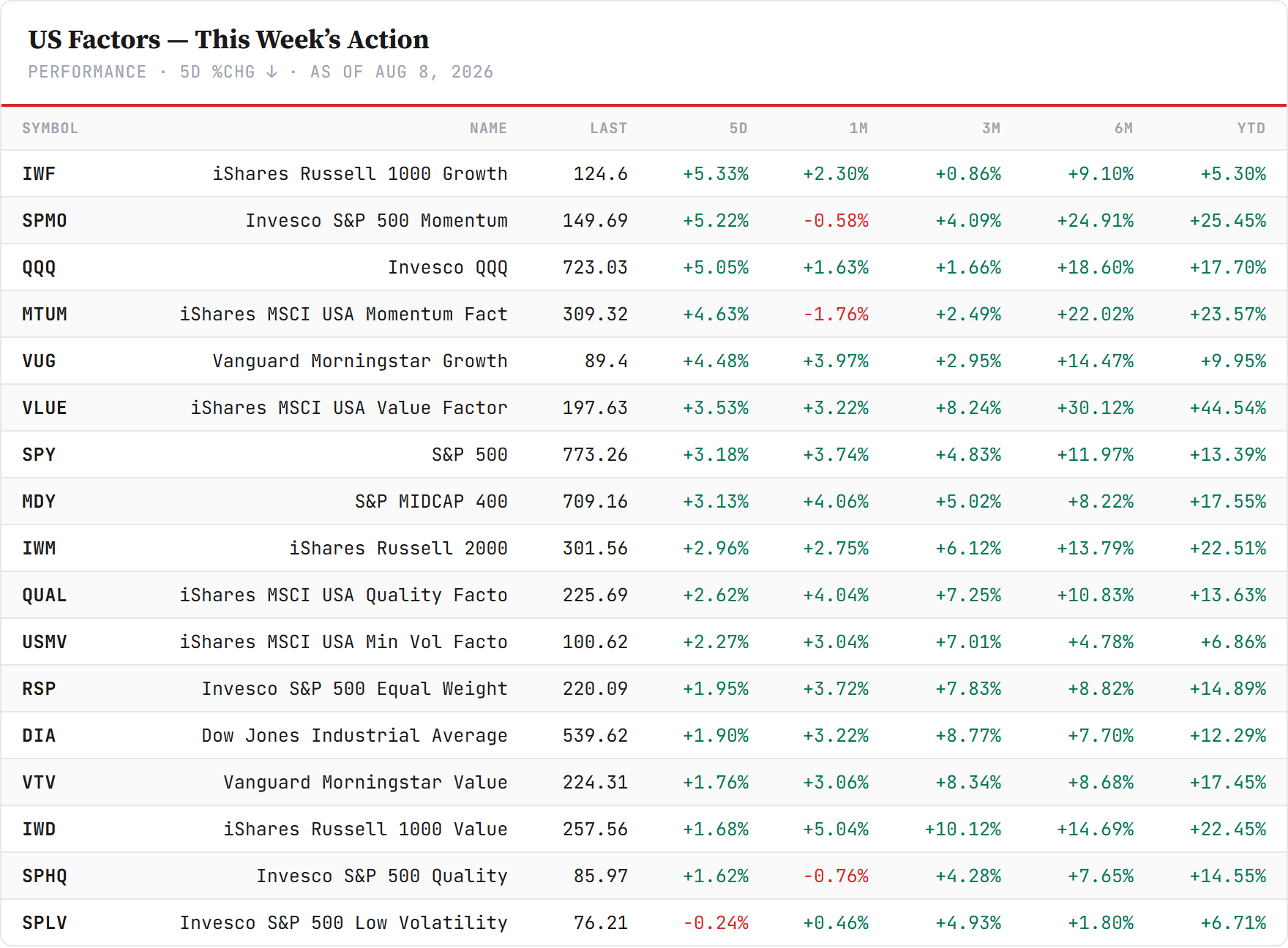
The factor read — participation without exuberance. The S&P +3.5%, the equal-weight +2.4%, small caps +3.6% — everything marched, and the ordering matters more than the levels: small caps beat the cap-weighted S&P in the year’s strongest tech week, which does not happen when a rally is running on six names. And the biggest names ran anyway — NVIDIA +11.6%, Broadcom +9.9% — the traditional megacap chip complex joining the Mag re-rating rather than funding it. Our breadth engine (full readings in §3) confirms what the factor board sketches: the percentage of S&P members above their long-term trend jumped from 68.5% to 74.0% in five sessions, the median member is now up 11.2% on the year — a new high for that reading — and Friday printed eighteen fresh 52-week highs against exactly one new low. Eighteen is not euphoria (the manic markets of memory printed sixty), but it is triple last week’s four. Broad, strengthening, not yet stretched: that is the internals’ verdict, and it is the single most important input to the count in §3.
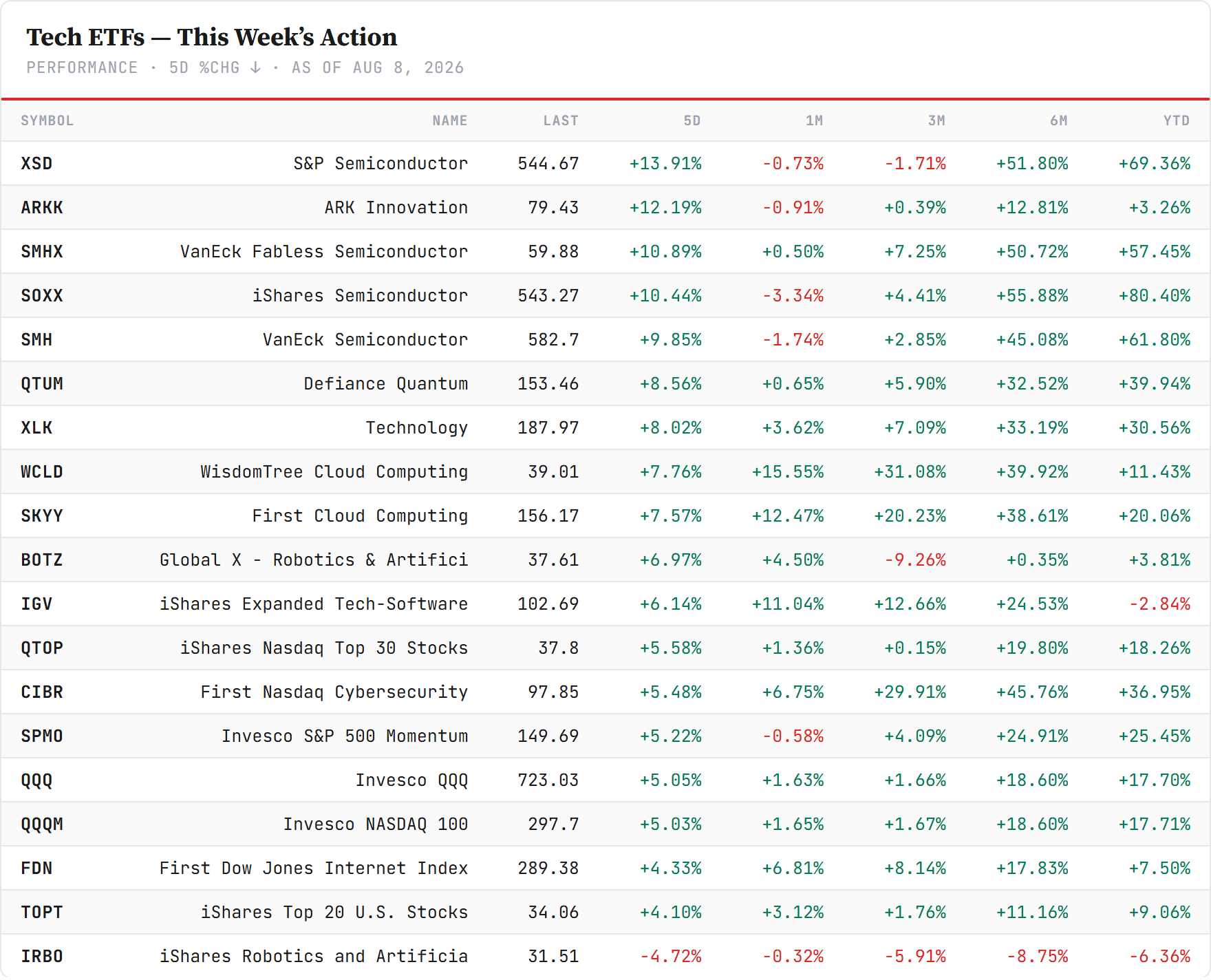
Inside tech — the three-layer bid, printed in the sleeves. For a month this table has been a rotation ledger — one sleeve paid, another charged. This week it is a participation ledger: equal-weight chips +11.7%, broad software +8.6%, cloud software +8.4%, the chip majors +7.8%, the chip index +7.6% — every sleeve up seven percent or more, with the equal-weight cut leading the complex for the first full week of the cycle.
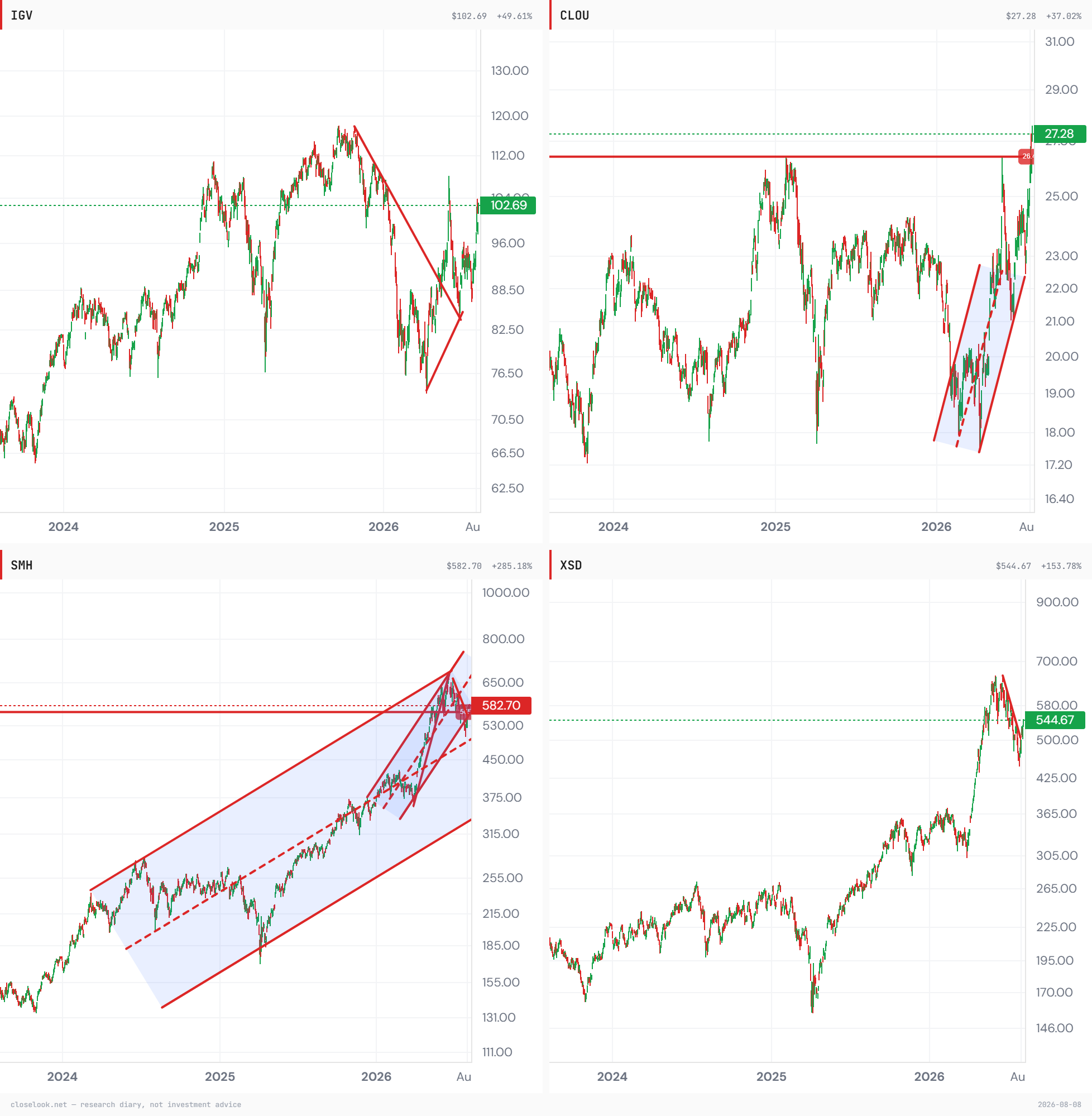
Two structural events hide inside those numbers, both on the grid below. First: IGV at 102.69 has cleared the 96 resistance shelf this letter left it “stuck inside” seven days ago — the operating layer’s waiting room emptied. Second: CLOU at 27.28 is through its June ceiling of 26.38 — a four-year high for the cloud basket (still, for honesty’s sake, well below its 2021 mania peak).
And the exception that proves the bid is discriminating rather than indiscriminate: memory and storage. Western Digital −20.3% on the week, Seagate −5.1%, SanDisk flat with a −3.7% Friday — red inside an eleven-percent equal-weight chip week. The market is not buying “semis.” It is buying the parts of the complex whose margins were never the argument, and refusing the corner where the whole world’s position already lives. Hold that thought for the house desk below — our own index internals make it precise.
2 · The State
The confluence, named. Strip the week to its load-bearing facts and there are three, one per layer. The applications came alive — not drifted, ignited: Atlassian +47.6% in five sessions, Palantir +39.8%, Shopify +29.4%, and the buying was earnings-attached (Palantir’s +93% revenue quarter; Atlassian’s Friday +35% print reaction).
The operating layer rose sharply — Twilio +22.3% on the week and through its 52-week high, Snowflake +12.7% to a 52-week high of its own, Cloudflare +7.6% — with exactly one casualty: Datadog, −12.7%, beaten not by its quarter (it beat and raised) but by the disclosure that its biggest AI customer is building the same product in-house. The market drew the line with a scalpel: platform software was re-rated up while the one name with a named, direct competitive threat was re-rated down nineteen percent in a session.
And the chip complex recovered broadly — +7.6 to +11.7% across the sleeves, led by the equal-weight cut, except the memory-and-storage corner and, on Friday, Tokyo’s capex complex (the laser-annealing and test names sold two to fourteen percent into the weekend while American chips rallied — the one cloud on the week’s hardware sky, and the Global letter’s Asia docket owns its follow-up).
Capex bid, opex bid, apps bid, all at once: this letter has been writing “the layers trade apart” since June. This week they traded together, and that is rarer and more informative than any rotation — because it is what the start of a broad leg looks like, if it holds.
The veto is dead — scored at the close, per the contract. Wednesday’s edition of this publication put it plainly: everyone is watching the software wreck; the line that matters is breaking in bonds. Thursday the intermediate-Treasury fund closed at 92.95, below the two-year trendline it had been fighting for four sessions — the veto, provisionally in force. Friday’s payroll print reversed it inside an hour: IEF reclaimed the line and closed the week at 93.17, above it — and by this book’s own scoring convention, the close is the verdict.
The bond market looked at a negative payroll print, a falling oil price and a 3.2% wage number, and withdrew its objection to the four bullish charts it had been vetoing all week. What remains is the conditional: no rate rise this year is now the market’s working assumption, and next week’s inflation prints are the confirmation hearing. Our own structural-inflation gauge (the desk, §3) sides with the market — but it is the CPI’s courtroom, not ours.
The earnings floor — 47% with an asterisk the size of Alphabet. The reporting season that just passed its peak is the strongest in years: blended S&P 500 earnings growth near 47% year over year, against roughly 29% expected when the season began, with analysts raising estimates into the prints — the reverse of the usual drift. Both halves of the house caveat apply on every citation: the aggregate is heavily skewed by mega-cap outliers whose results carry exceptional non-operating investment gains, and ex-those-outliers the growth rate compresses back toward the high twenties — extraordinary rather than impossible.
The distinction matters now because the composition of the season changes next week: the June-quarter giants are done, and the July-quarter cohort begins — monday.com before Monday’s open, CoreWeave Tuesday, Nebius Wednesday, with the enterprise-software names behind them. The second leg reports into a tape that has already re-rated the entire software complex eight percent in a week. That is the setup — generous and demanding at once — and the name-level map of it is Sunday evening’s Hypergrowth letter.
The natural experiment returned its verdict — entry premium is the variable. Two perfect print records, twenty-four hours apart, opposite outcomes — that was last week’s setup. This week scored it. Datadog: ten-for-ten on earnings and revenue, entered its print 0.6% off its 52-week high, lost 16% then, and this week lost 12.7% more when the competitive overhang surfaced. Twilio: the second perfect ten-for-ten record in the series, entered its print 19.6% below its high — and was paid 24.9%, through the high, holding into Friday’s close. Cloudflare sits between them: a near-perfect record, entered elevated, initially sold, recovered to +7.6% on the week.
The record tells you the company executes; the entry price tells you what the market has already paid itself for that execution. Perfection at the high is fully insured against nothing; perfection at a discount is the cheapest asymmetry the print calendar offers.
Monday delivers the fourth data point, and it is almost too clean: monday.com carries the third perfect EPS record in the series and enters 66.8% below its high. The knowledge corner (§7) formalizes the rule; the record does the predicting, not us.
3 · The Outlook
New this week, and standing from now on: the house desk — our indices, boards and gauges, read in one block. Everything below is Closelook instrumentation; every number is a Monday-to-Friday week.
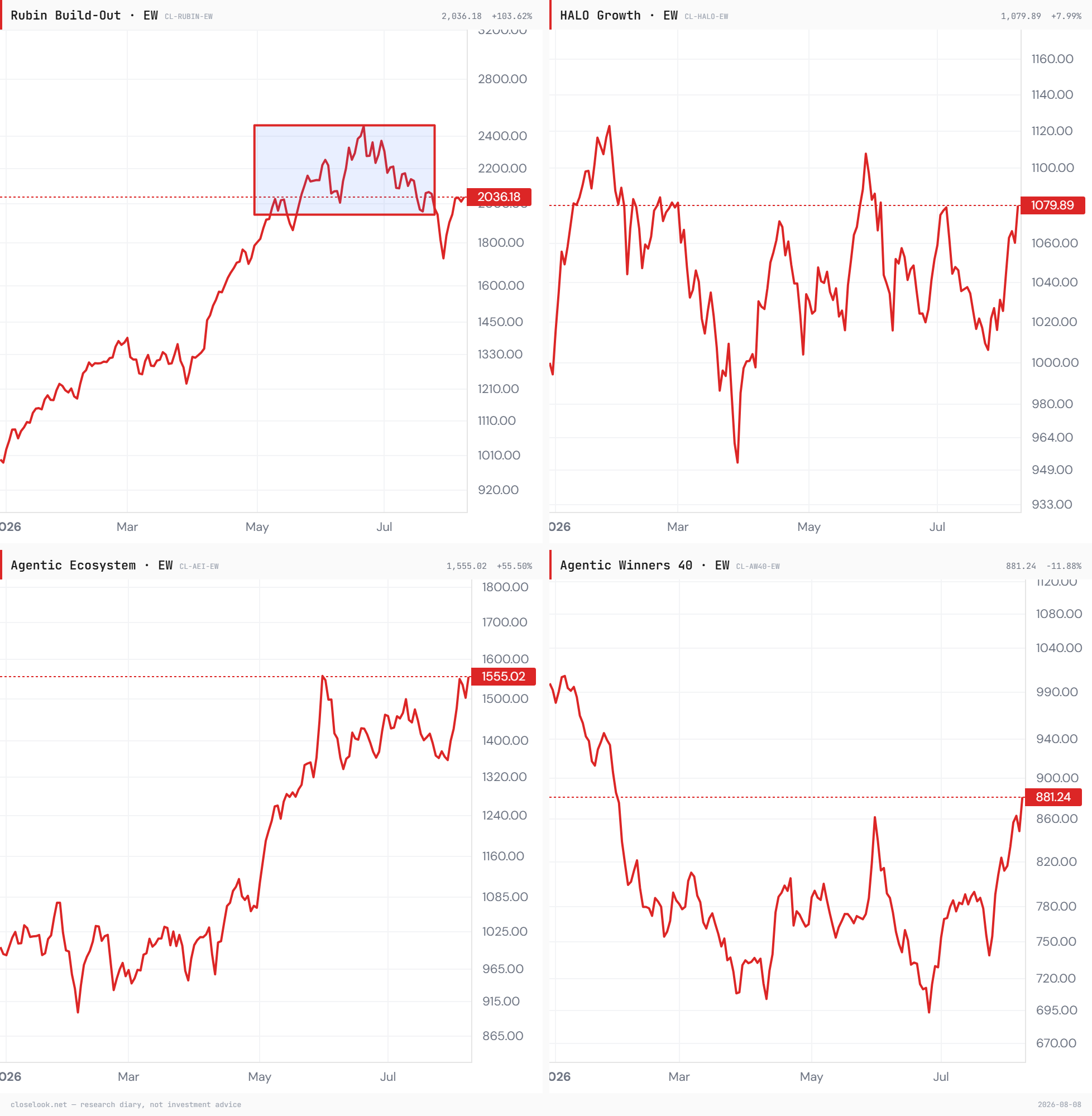
The four indices — all green, first time, and by a lot. The index family printed the confluence in one row: Rubin Build-Out +7.1% (the capex layer; +105% YTD), Agentic Ecosystem +8.9% (the opex layer; +57% YTD), Agentic Winners +8.0% (the application layer; still −11% YTD, and closing that gap at eight points a week), HALO +5.3% (broad growth; +9% YTD) — with Euro-AI +4.7% across the Atlantic.
Since the family launched, every strong week belonged to one layer at the expense of another; the ladder inverted twice in July alone. This is the first week all four rose five percent or more together. When the layers stop competing for the same money, either the money got bigger or the week was borrowed — that is exactly what the follow-through test in §4 exists to decide.
And the levels shout what the weekly changes only whisper — the change in focus, printed on the grid above. The Agentic Ecosystem closed Friday at 1555 — a tenth of a percent from its June record (1557), the first layer back at its high. The Agentic Winners are already through theirs: 881 against a June high of 862 — the cohort 2026 punished hardest is the first to surpass its June mark, even with its January peak still far overhead. And the build side? Rubin sits 17.5% below its June top, and every semiconductor sleeve is 13–18% under its own — SOXX −17%, equal-weight chips −16%, the chip majors −13%. Same trade, same June, three altitudes of recovery: the market has moved its high-water line from the layer that builds the machines to the layers that run and use them. That is the focus change this letter has been mapping since the layers split — no longer as relative performance, but as who is back at record prices and who is not.
Inside the indices — where the week actually happened. The sub-index tables are the week’s best microscope, because they were built before the week needed them. Inside Rubin, the top of the board is one thesis three times over: High-Speed Interconnects +21.6% — the optical-networking complex this publication named name-for-name on Thursday as the new hardware bid — with the whole Connectivity & Materials layer +16.5%, Substrates +12.2%, the chip Architects +11.2%. And the bottom of the same board: Storage −7.9% and HBM Memory −7.2%, the only meaningfully red sub-indices in the entire family — the memory-and-storage exception, isolated by construction.
Inside the Agentic Ecosystem, the ranking reads like a demand report: Models +26.2%, Runtime +12.3%, Compute +11.2% on top — the sleeves closest to raw AI consumption — and Ops +3.0% at the bottom, the observability sleeve where Datadog’s direct threat lives. The index knew where the knife fell.
Inside the Agentic Winners, the Control plane led at +15.6% — the layer the house strategy paper argued owns the choke point (The Control Point) — with Enterprise +9.5% behind it and the consumer sleeve at the rear. And inside HALO, the week’s leader was Defense +15.7% — a bid this letter did not discuss all week and its index caught anyway.
Best and worst week, by name — the whole story in ten tickers. Across the family’s roughly three hundred constituents, the week’s five best: Coherent +44.2%, Applied Optoelectronics +43.8%, Fabrinet +29.2%, Aehr +28.9%, Entegris +27.7% — four optical-interconnect names and a test house, the Rubin S14 complex sweeping the podium. The week’s five worst: Western Digital −20.3%, SK Hynix −17.2%, Samsung −12.0%, Hanmi Semiconductor −10.4%, AppLovin −12.4% — the memory-and-storage corner plus Korea’s flagship large-caps plus the punishment phase’s remaining defendant. Our own index internals thus reproduce, name for name, the global signature Saturday’s letter mapped across countries: the crowded flagships of the last leg sold, everything adjacent to fresh demand bought.
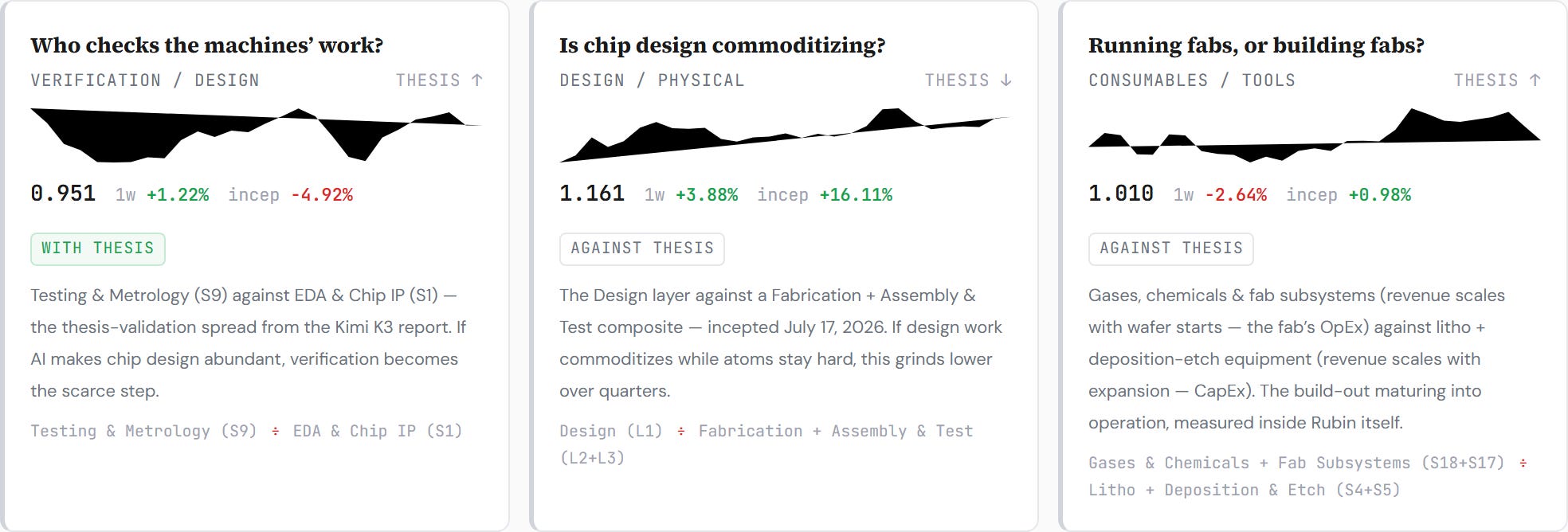
The AI Handoff Board — quiet, and the quiet is the message. After July’s violent re-ratings, the handoff ratios barely moved: use-against-build at 1.41, +0.8% on the week; use-against-operate actually ticked down 0.8%. A handoff gauge measures relative motion between layers — it goes silent precisely when all layers rise together. One ratio did move: beyond-gateways +6.8%, the applications pulling away from their distribution chokepoints — the AW40’s control-plane week expressed as a ratio. The board’s July story was rotation; its August story, one week old, is expansion.
The hyperscaler cohort — the leaders sat out the broadening. The Mag Pulse board’s cleanest reading yet: the hyperscaler cohort (Microsoft, Amazon, Alphabet) gained just +1.9% in the week the market gained 3.5 — trailing the Nasdaq by more than three points — after two weeks in which the same three names were the market. The mega-cap basket overall rose 4.8% to 69.14 and now sits half a percent below the 69.5 shelf that has capped it since the spring; the December pivot at 62.56 is nine points below.
Two readings coexist: the discount-closing thesis paused while the rest of the market caught up (healthy — this is what broadening means from the top down), and the basket faces its trigger level with the tape already warm. A weekly close through 69.5 would put the market’s most-owned names back in new-high territory for the first time in twenty months — the Mag Pulse scores it daily.
Compute tightness — the demand side kept printing. The week’s quietest strong signal: CoreWeave +26.3% into its Tuesday print — buyers front-running a neocloud quarter — while the Agentic Ecosystem’s Compute sleeve rose 11.2% and SpaceX-adjacent compute names ran with it. Add the season’s supply-side testimony (SanDisk guiding bits on allocation beyond 2027; flat-at-record margins across the memory guides) and the reading is unchanged but louder: compute remains the binding constraint, the market pays whoever owns capacity, and the price weakness in memory stocks is a positioning phenomenon arguing with a physical shortage. Both can be true for a while. They cannot be true forever.
Structural inflation — our gauge sides with the bond market. The house inflation composite (the macro lab) reads 49 — “Contained” — with the labor-tightness bucket the loosest on the board (43) and shelter right beside it: the payroll print did not surprise this gauge. The two watch-items it flags: long-run inflation expectations at 62, the one elevated bucket, and supply/energy momentum at 63 — a shock reading its own methodology currently files as “not yet spreading; treat as noise.” Translation for next week: our instrument expects the CPI to cooperate, and tells us exactly which two buckets to blame if it does not.
Breadth and temperature — strong, warming, not stretched. The breadth engine: 74.0% of S&P members above the 200-day (68.5% a week ago), 66.9% above the 50-day, the median member +11.2% on the year — a new high-water for that median — and 18 new 52-week highs against one low. The Money Temperature board warmed from neutral to the low sixties, with the S&P instrument at 87 and the Nasdaq at 79 — individually hot. Read together: participation is the best of the cycle and the tape is no longer cheap on its own thermometer. That combination front-runs nothing; it just tells you the margin for a hot CPI is thinner than the charts feel.
The count — from filed to live. Two weeks ago this letter filed a contrarian count: the pullback complete, the market entering the third wave of the third wave of the third — the segment where everything rises at once and the sold corners get bought hardest — filed, explicitly, not adopted, with its tells listed.
Audit the tells against this week: QQQ through 694 on Monday and never back (tell one). The sold corner — the equal-weight chip cut — leading the whole complex at +11.7% (tell two: the strongest bid where the selling was). All four house indices up together (tell three: no more rotation-funding). Breadth expanding into the move, 74% and climbing (tell four). Even the world index agrees — Saturday’s letter carries the same count on VEU, one cent from its record close, and the total-world index at a new all-time high.
The count is now live — upgraded from filed, still not proven. What it requires next is written in §4, with the level that would kill it. And it proposes to do all this through August and September, the calendar’s two worst months — which is exactly why the follow-through rule does the deciding, not the narrative. Probability, not prophecy.
🔒 Be Informed — the rest is for subscribers. Free: the LinkedIn newsletter + closelook.net. C+ (paid): real-time push on every portfolio move → closelook.net/subscribe/
