


The Fed's first hike since 2023 put the ten-year through five percent on a close for the first time this cycle; the Bank of Japan's took its rate to a thirty-one-year high and the yen fell anyway. Between the two, Monday sorted the AI trade into the chips that were sold and the software that was bought, and Korea's dollar wrapper paid for the sort. The world index closed a second week under the line this letter set — and a first under the one beneath it.

1 · This Week’s Action
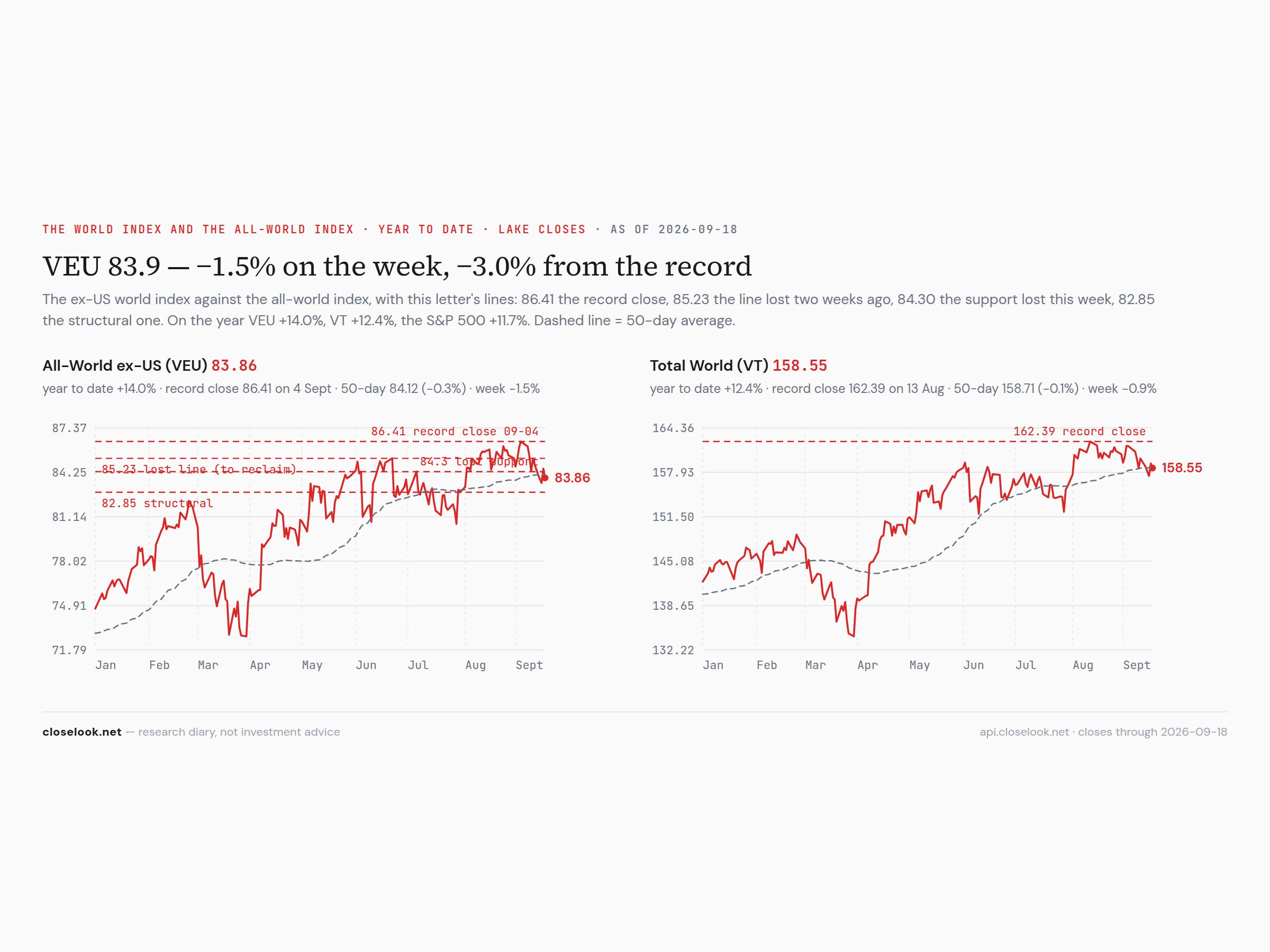
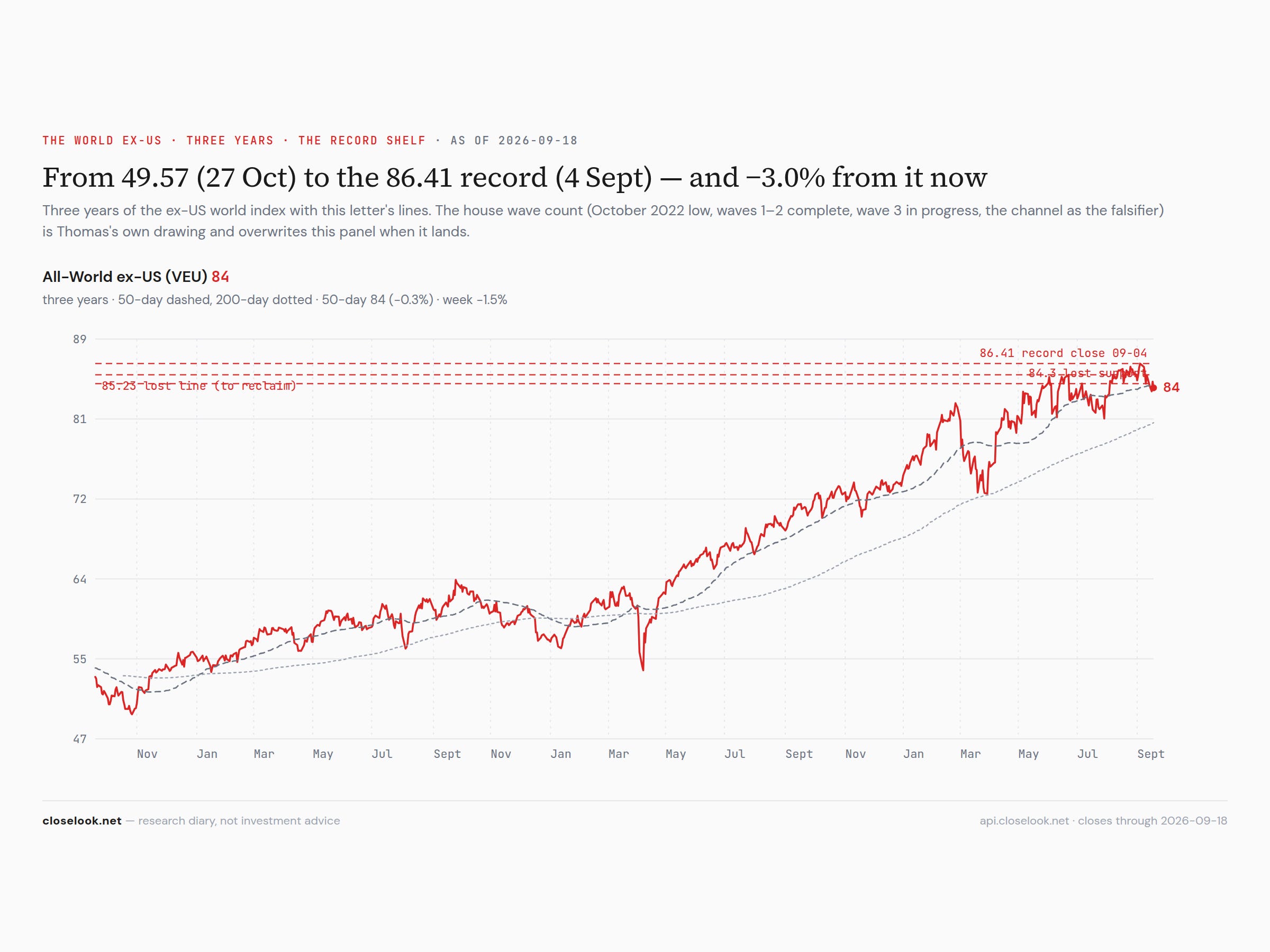
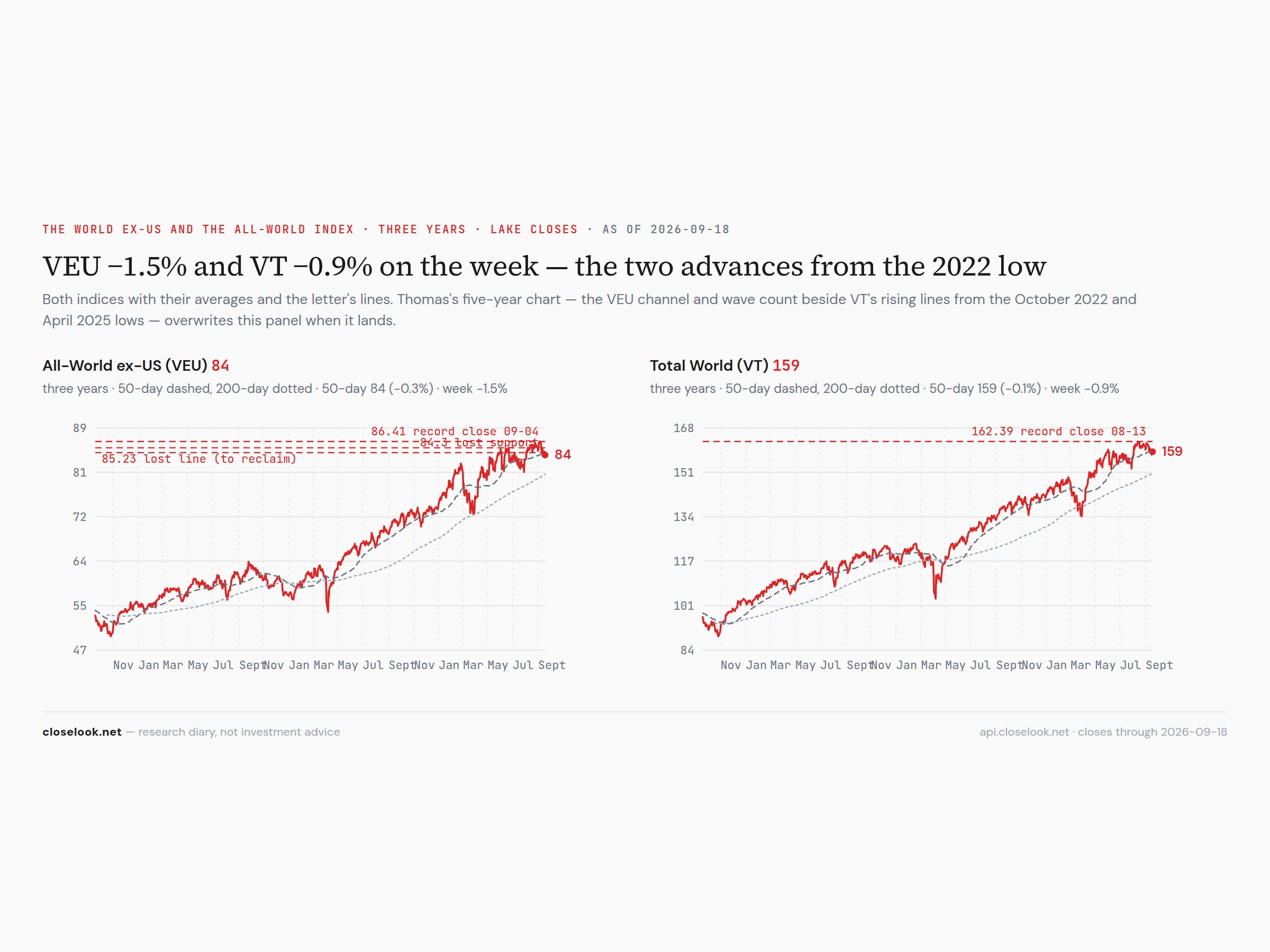
The global view. The ex-US world index closed the week at 83.86, down 1.55% — a second consecutive weekly close under the 85.23 line this letter set on September 5, and the first under 84.30, the support last week’s edition named as the one that “turns the five-cent miss into a structure.” It is a structure now. The path: Monday 84.09 on the AI sort, Tuesday 83.78 with the ten-year printing five percent, Wednesday 83.50 — the low close of the move, on the Fed’s hike — Thursday 84.51 on the bond rally, and Friday 83.86 when the bond rally was given back. The index sits 3.0% under its September 4 record of 86.41. The all-world index closed 158.55, down 0.87%, 2.4% under its August 13 record; the S&P fell 0.34%, the Nasdaq 100 rose 0.94%. Two central banks hiked and the world’s stock index lost a dollar and a third; America’s lost a quarter of a percent and its growth index gained one.
The year’s order held and narrowed again. VEU +14.0% for 2026, VT +12.4%, the S&P +11.7% — the ex-US lead over America is 2.3 points, from 3.7 last week and 4.5 the week before. Two consecutive stay-home weeks, and both came with a central bank in them.
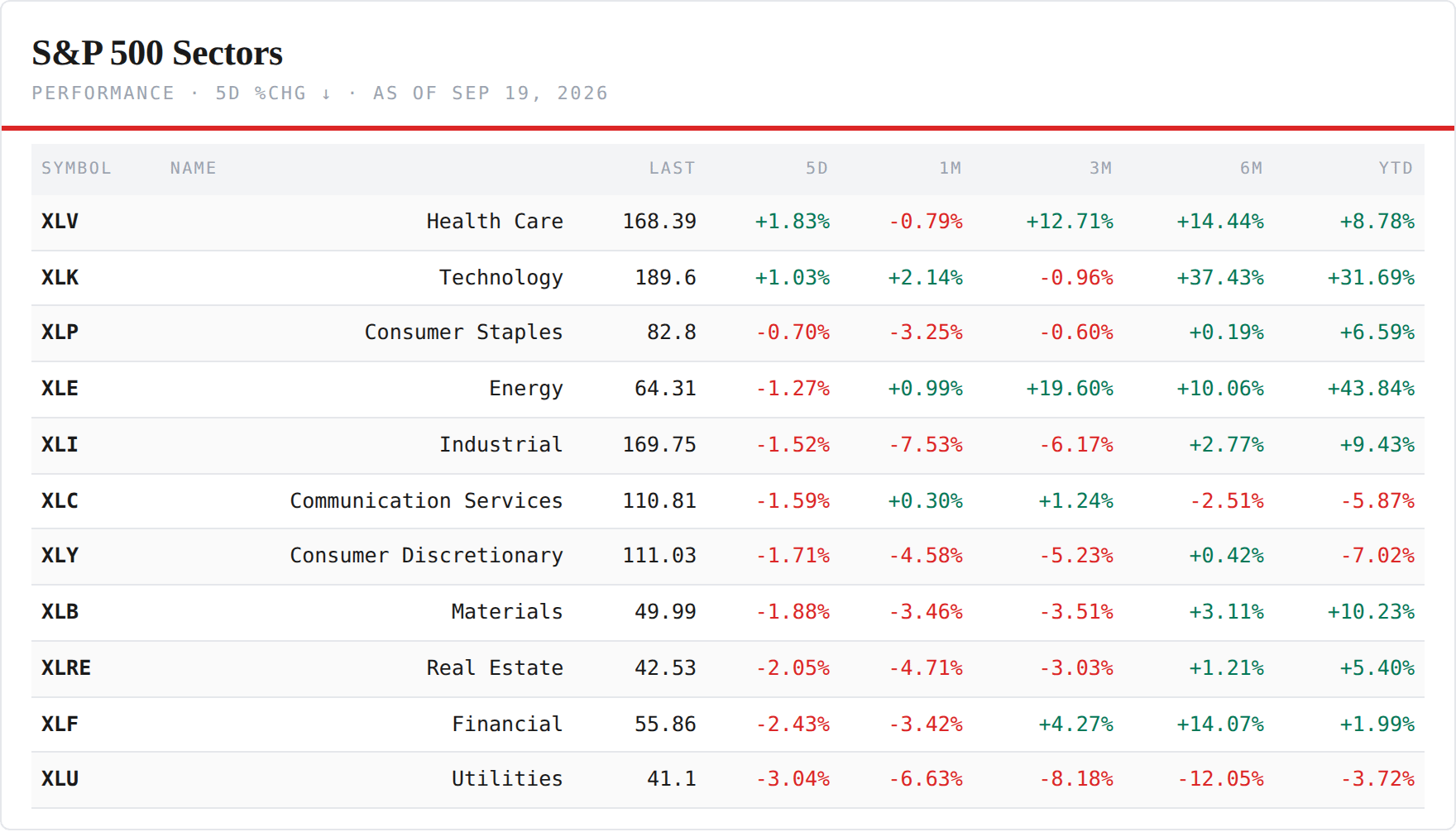
Korea is where the sort landed — and the certificate lost a line on the weekly close. Last Saturday’s frame: hold above 183.46 on the weekly closes, 190.11 the cap, 180 the line that turns a visitor into a failure. The fund closed 181.31, down 3.93% — under 183.46 on the weekly close for the first time since the confirmation, and above 180 by a dollar and thirty-one cents. The week inside: Monday 176.22, a 6.6% session — Seoul had sold the physical layer of the AI trade on the weekend’s pacing letter (the Kospi −3.3%, SK hynix −6.7%, Samsung −4.0%) and New York sold the dollar wrapper harder — Tuesday 176.49, Wednesday 175.54, the low close, Thursday 182.39, Friday 181.31. Three daily closes under 180; none of them the weekly one. In Seoul the week was nearly flat: the Kospi fell 0.2% in won, from 6,910 to 6,894, with a 6,627 close on Tuesday and a 2.7% Friday on SK hynix +6.0% and Samsung +3.5%. Two weeks ago the wrapper had paid for a Seoul rally before it happened; this week it paid for a Seoul sell-off on the day and has not yet been paid for Friday’s recovery — the fund fell 0.6% on Friday while the Kospi rose 2.7%. +86.5% on the year in dollars, from +94.1%.
Behind it the regional board did not flip — for the first time in seven weeks. Last week’s four green of thirty-five became two green of thirty-three red: Taiwan +0.66% and China’s A-shares +0.39%. The bottom: Korea −3.93%, Austria −3.13%, Argentina −3.11%, Southeast Asia −2.77%, France −2.72%, Mexico −2.71%, Poland −2.52% off its September 8 record, Spain −2.51%, Thailand −2.50%. The best-to-worst spread narrowed again, to 4.59 points from 5.60 and 8.07 — the narrowest since this letter began counting in July. Last week the board went red and its spread narrowed, and the letter called it de-grossing rather than dispersing. This week it stayed red, narrowed further, and did not flip. That is the same reading, one week longer, and without the weekly reversal that had resolved every red week since July.
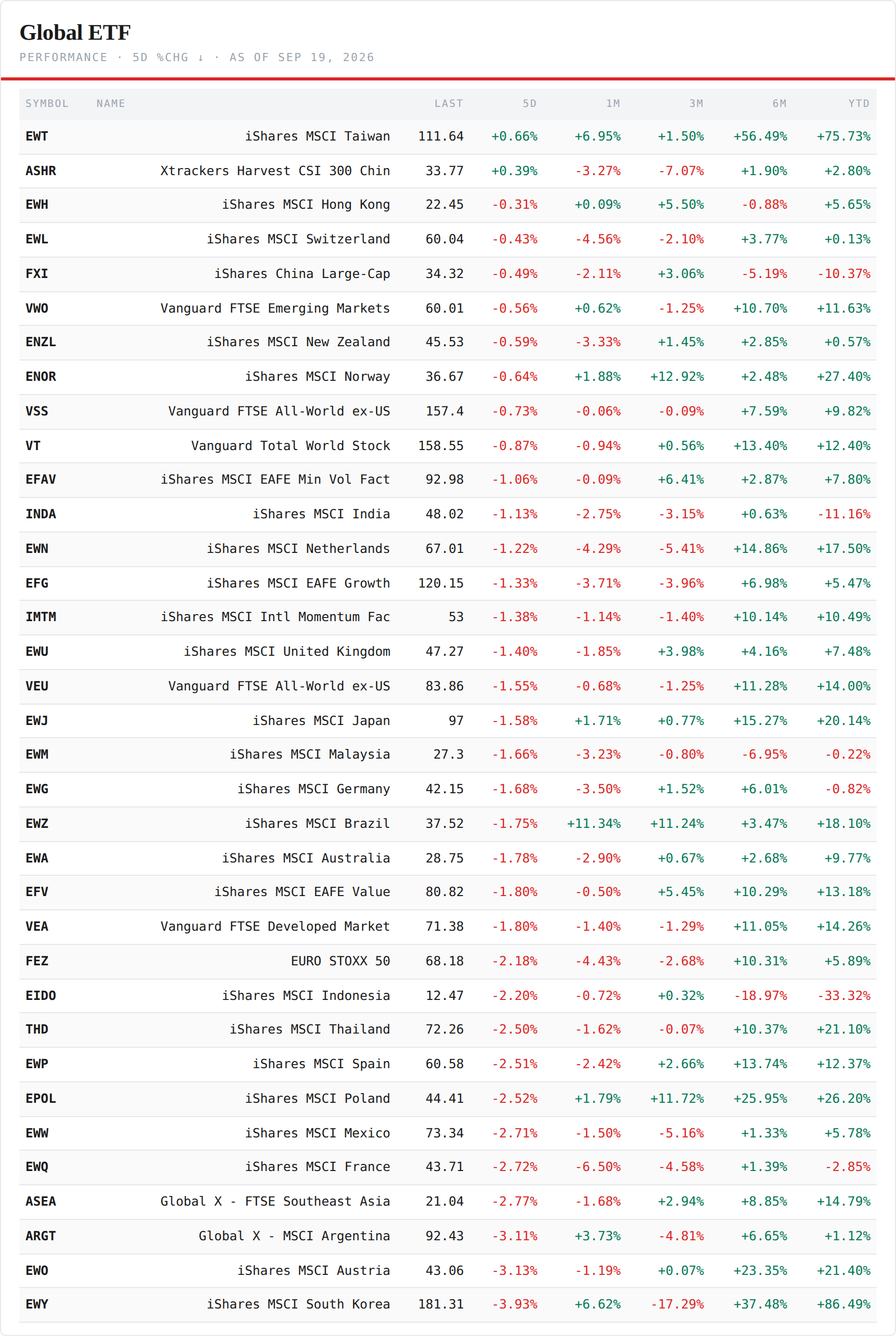
The cross-asset backdrop — the inverse of last week, line for line. Three green and nine red became eight green and four red. The bitcoin fund +5.14% led the board — a 6.3% Friday — silver +3.11%, the two megacap wrappers +1.23% and +1.21%, the dollar +1.14%, the Nasdaq 100 +0.92%, gold +0.60%, the long bond +0.47%. The red four: the belly −0.23%, the S&P −0.34%, oil −0.70%, copper miners −1.41%. After two nine-percent oil weeks, the barrel’s week was a round trip with the wrong end first: the oil fund closed Tuesday at 161.86, a fifty-two-week-high close, and fell 5.0% from there to Friday; Brent went from $104.61 to $98.76, down 5.6%, and closed Friday under $100 for the first time since it went through it on September 9. Both hedges were bought on a week the dollar rose 1.1% and two central banks hiked — which is a sentence last week’s edition could not write. Section 2 says why it can write it now: the hikes were delivered, and the hedges were bought on the delivery.
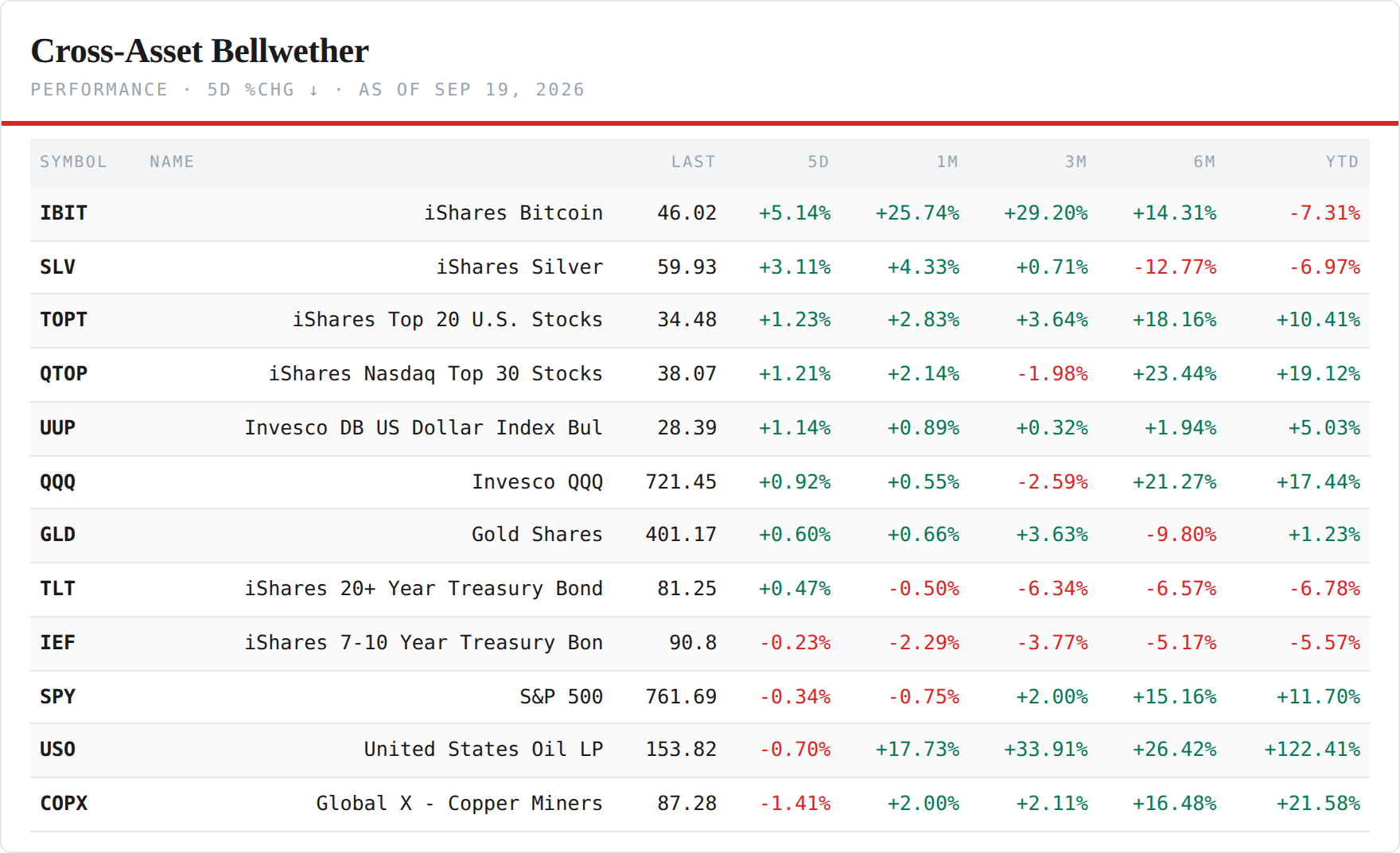
The US sectors. Two of eleven closed green: health care +1.83% — from the worst US sector last week to the best — and technology +1.03%. The bottom: utilities −3.04%, financials −2.43%, real estate −2.05%, materials −1.88%, discretionary −1.71%, communications −1.59%, industrials −1.52%, energy −1.27%, staples −0.70%. Last week’s sort had two floors, commodity inputs and defensives together; this week’s has one, and it is the ten-year at five percent: the three rate-sensitive groups — utilities, financials, real estate — are the bottom three. Health care at the top after a −3.55% week is not a rotation reading either; it is the group with the most to sell last week having the least to sell this week. Sunday’s letter owns the tape beneath it.
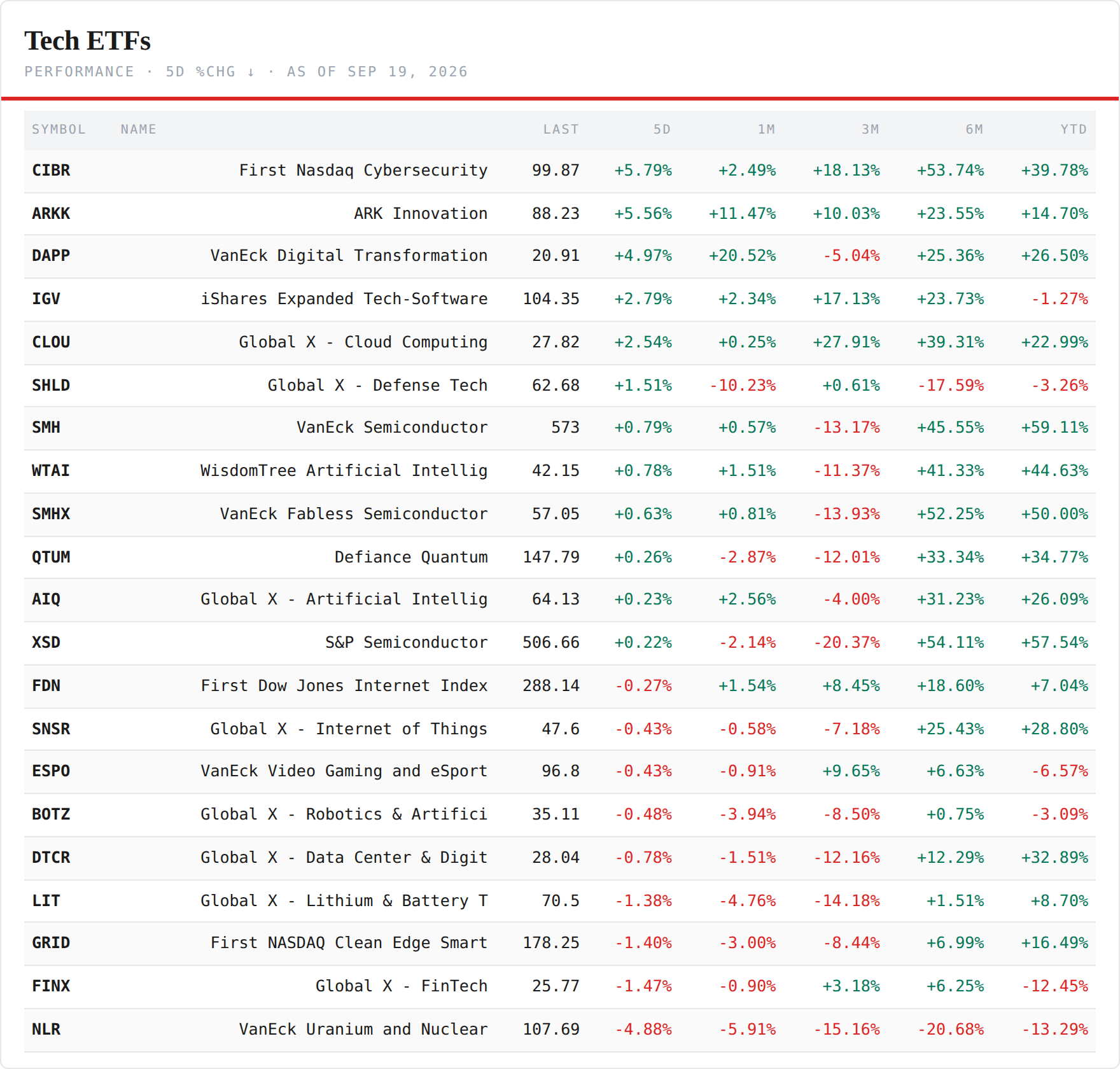
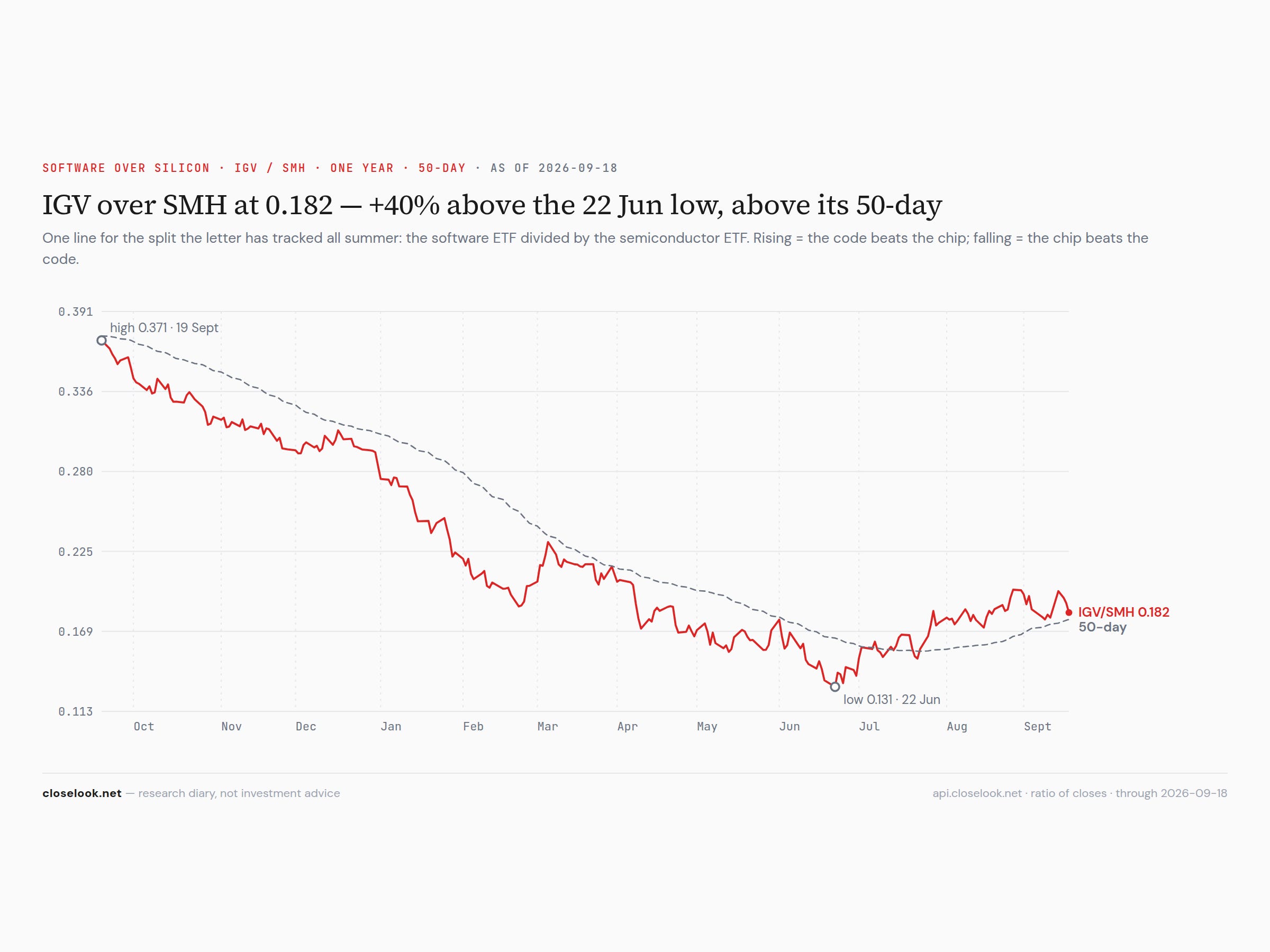
The tech ETFs — software over silicon on the week, silicon over software on Friday. Twelve green of twenty-one, and the top of the board is the layer above the chip: cybersecurity +5.79% led, ARK +5.56%, digital assets +4.97%, software +2.79% — after three consecutive weeks as one of the board’s worst lines — cloud +2.54%, defense tech +1.51%. Then the chips: SMH +0.79%, the AI basket +0.78%, the fabless vehicle +0.63%, the equal-weight semis +0.22%. The red nine: uranium −4.88% — sold with the utilities — fintech −1.47%, the grid fund −1.40%, lithium −1.38%, data centers −0.78%. On the week software beat semis by two points; inside the week the order was the opposite of the total. Monday: software +5.0% to 106.64, its best day of the year, and SMH −4.75%. Friday: SMH +2.2% and software −1.35%. Software made its week in one session and gave a piece back in each of the next four; the chips lost their week in one session and made it back in two. The pair monitor reads the software-to-semis spread at 0.97 standard deviations, from 0.6, and calls it breaking. Sunday’s Hypergrowth letter owns what was sold and bought inside the stack; the geography is that the sort ran through the chip trade twice in five days, in opposite directions, and the second run was on an options-expiry day.
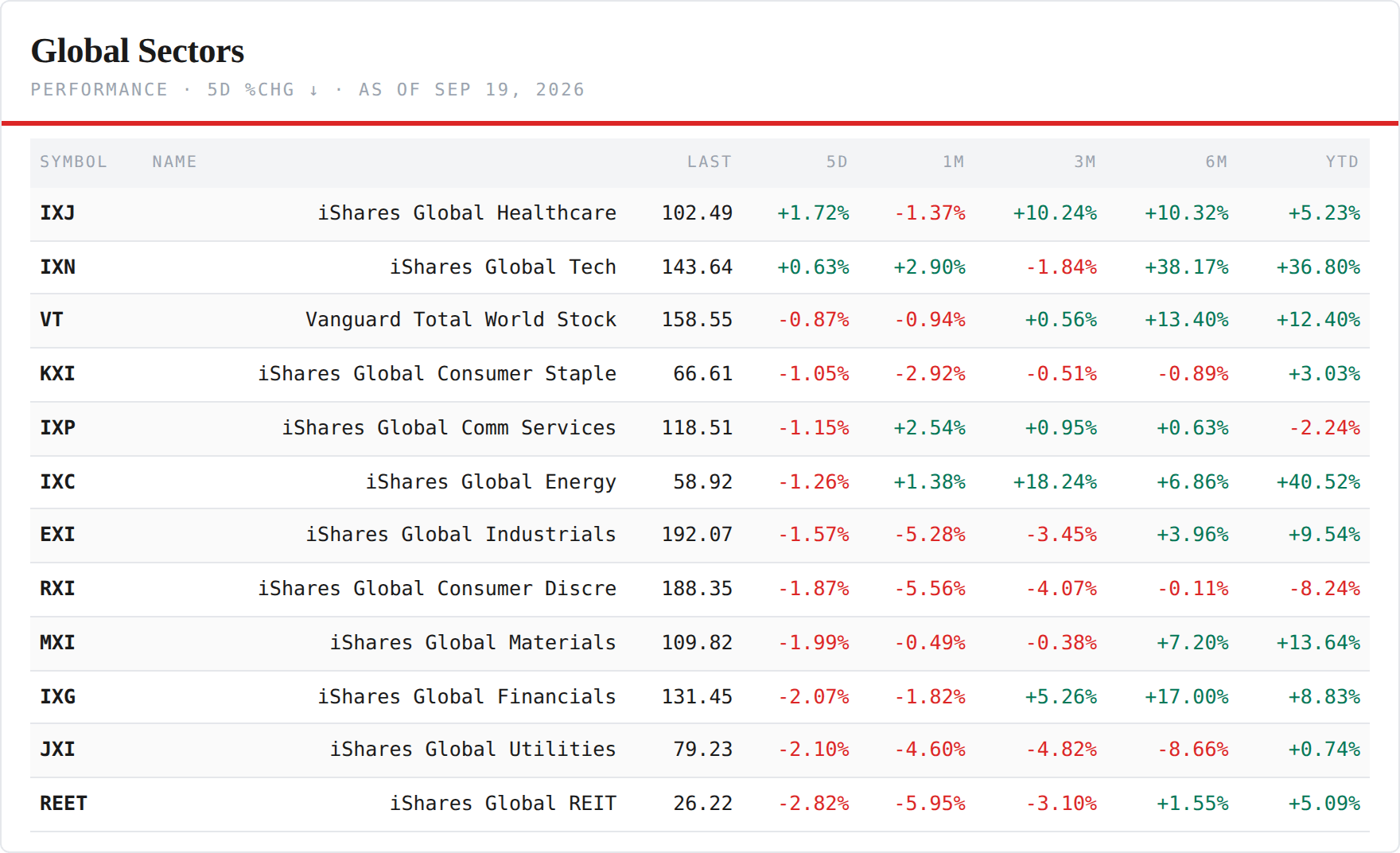
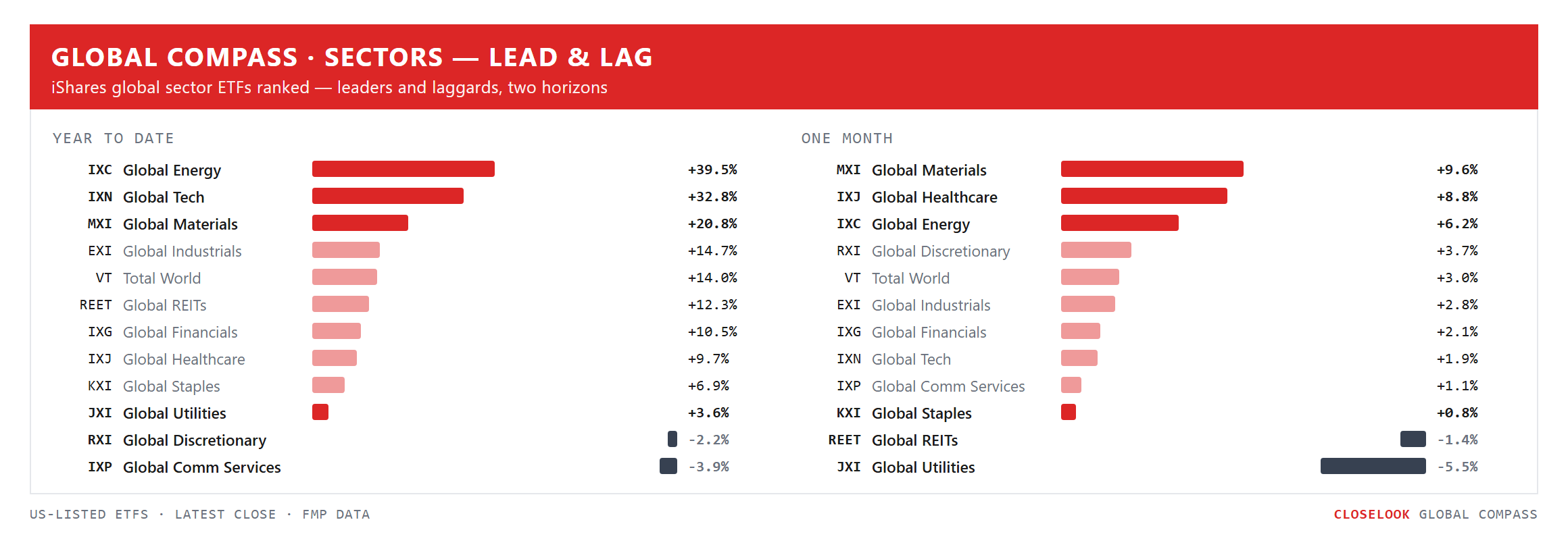
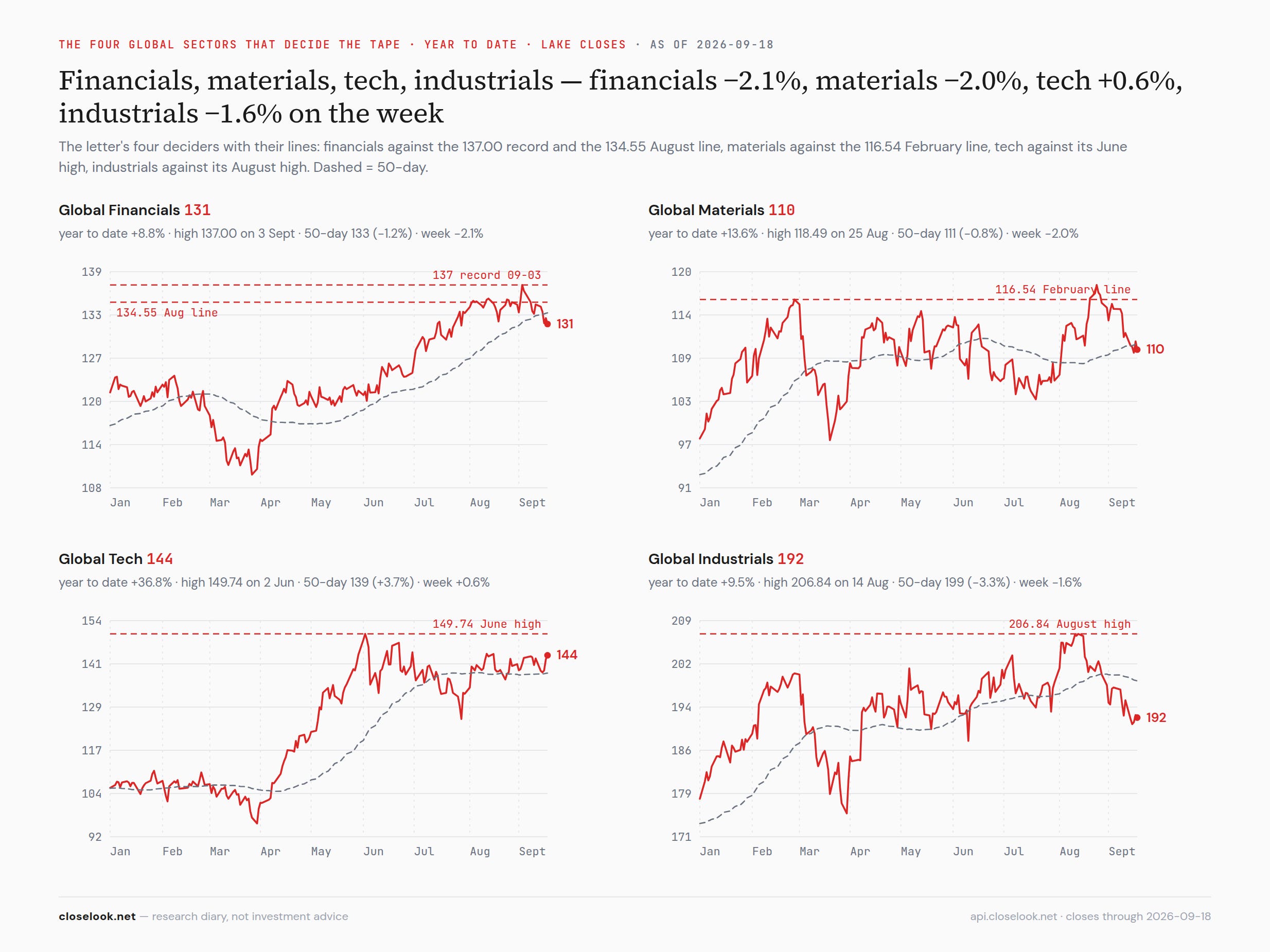
The global sectors. Two green of twelve: health care +1.72% — the best global sector, from the worst — and technology +0.63%. Then the decider this letter has tracked for five editions: global financials fell 2.07% to 131.45 — a second week under the 134.55 August line, 4.1% under the September 3 record. Materials −1.99% to 109.82, under the February line for a fourth week. The bottom: REITs −2.82%, utilities −2.10%, financials −2.07% — the same three rate-sensitive groups as the US board, in the global wrappers. Two weeks ago financials took a record and gave back its line in six sessions; this week it kept going. The pattern this letter has been describing since August — a board that clears lines and cannot hold them — has its follow-through: the un-cleared line was not re-tested. It was left behind.
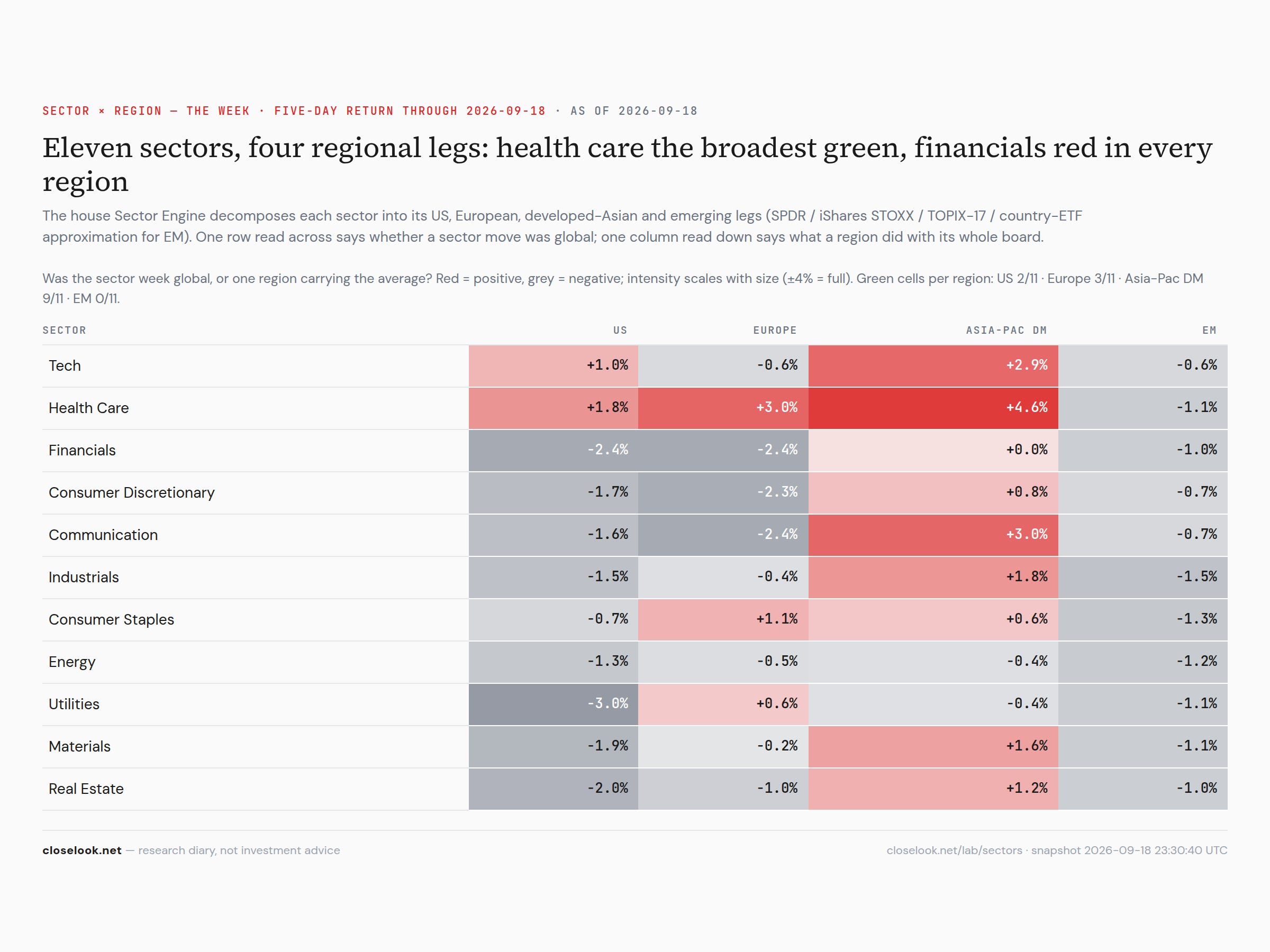
Was the sector week global, or one region carrying the average? The house Sector Engine decomposes each of the eleven sectors into its four regional legs, and this week’s answer has a region in it: thirteen cells green of forty-four, and eight of the thirteen are developed Asia’s. The Tokyo-proxied region was green in eight sectors of eleven — technology +2.9%, health care +4.6%, communications +3.0%, industrials +1.8%, materials +1.6%, real estate +1.2%, discretionary +0.8%, staples +0.6% — the only region on the board with breadth, on the week the yen fell two percent. The US had two green cells (health care +1.8%, technology +1.0%), Europe three (health care +3.0%, staples +1.1%, utilities +0.6%), and emerging markets none — zero of eleven, from one last week and eleven the week before. Health care, red in all four regions last week, was green in three — US +1.8%, Europe +3.0%, developed Asia +4.6% — and red only in EM at −1.1%. And the energy alternation this letter tracked for three weeks ended the way alternations end: energy was red in all four regions — US −1.3%, Europe −0.5%, developed Asia −0.4%, EM −1.2% — on the week the barrel fell 5.6%. Three weeks, three regions owning the same commodity; the fourth week, nobody wanted it. The sharpest cross-region split was utilities, the US cut 3.6 points behind Europe’s.
The Global Compass
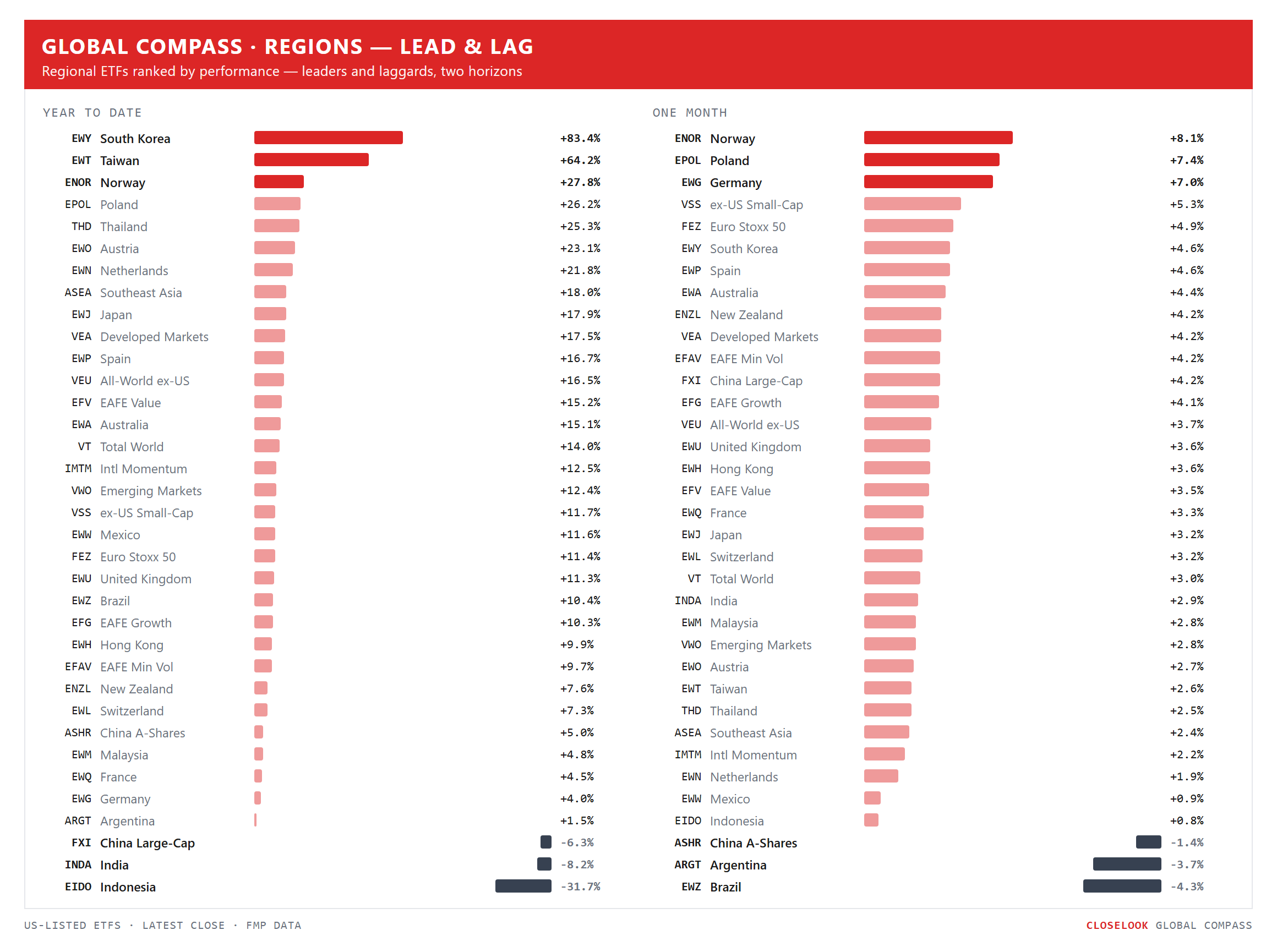
Regions: emerging beat developed again, and the corridor split three ways in the other order. Emerging fell less than developed — VWO −0.56% against VEA −1.80% — the reverse of last week, and this time the composition is the currency, not China: Taiwan +0.66% in dollars and +2.2% in Taipei, the only green country on the board; Korea −3.93% in dollars and −0.2% in won; Japan −1.58% in dollars to 97.00, from a 98.56 record close a week ago, on a week the Nikkei rose 1.6% to 65,019 and the TOPIX 1.6%. Last week Japan made a record in dollars while falling in yen, because the yen rose. This week it lost the record in dollars while rising in yen, because the yen fell 2.1% — from 153.55 to 156.75, through the Bank of Japan’s own hike. The read this letter carried — the corridor’s dollar wrappers are held up by their currencies for exactly as long as the currencies rise — got its second demonstration in a week, from the other side. The won and the yen both rose last week; the yen fell this week, and Japan’s wrapper went with it on an up week in Tokyo.
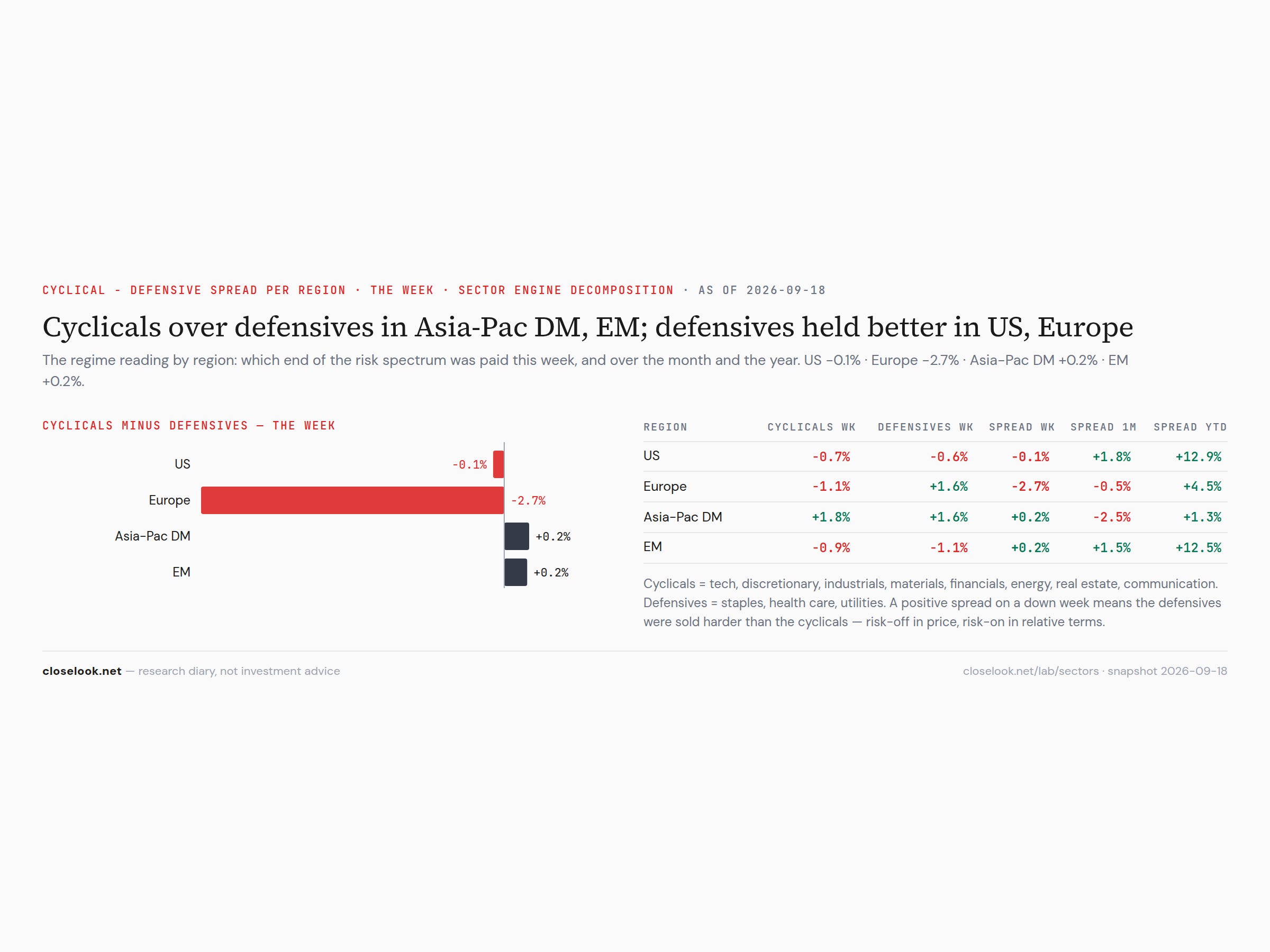
Sectors: the sign flipped — the defensives were bought this time, and hardest in Europe. Last week’s cyclical-defensive spreads carried a sign this letter had not printed in a red week: defensives sold harder than cyclicals. This week: US −0.1% — cyclicals −0.7%, defensives −0.6%, a wash — Europe −2.7% — cyclicals −1.1%, defensives +1.6% — developed Asia +0.2% with both ends up, cyclicals +1.8%, defensives +1.6%; EM +0.2% with both ends down. Europe bought its defensives on a down week the week after it sold them on one. That is the liquidation reading from last week reversing into an ordinary risk-off reading: the groups sold for their gains were bought back for their beta. One week each way; the engine’s next print says which was the noise.
Sectors: the leaders’ bench, restated at the new distances. Financials 131.45, 4.1% under its record, two weeks under its line. Technology 143.64, 4.1% under its June high after +0.63%. Industrials 192.07, 7.1% under August. Materials 109.82, 7.3% under its August 25 record, four weeks under the February line. The two growth sectors and the two commodity sectors are now the same distance apart — about four percent under for financials and tech, about seven for materials and industrials — and the weight of the board, technology, is the only one of the four that rose this week. A board where the closest challengers stop challenging and the leader is the only line up is a board narrowing toward its leader. Two weeks ago this letter said the challengers had cleared and un-cleared their lines, twice, the same way. This week they did not approach them.
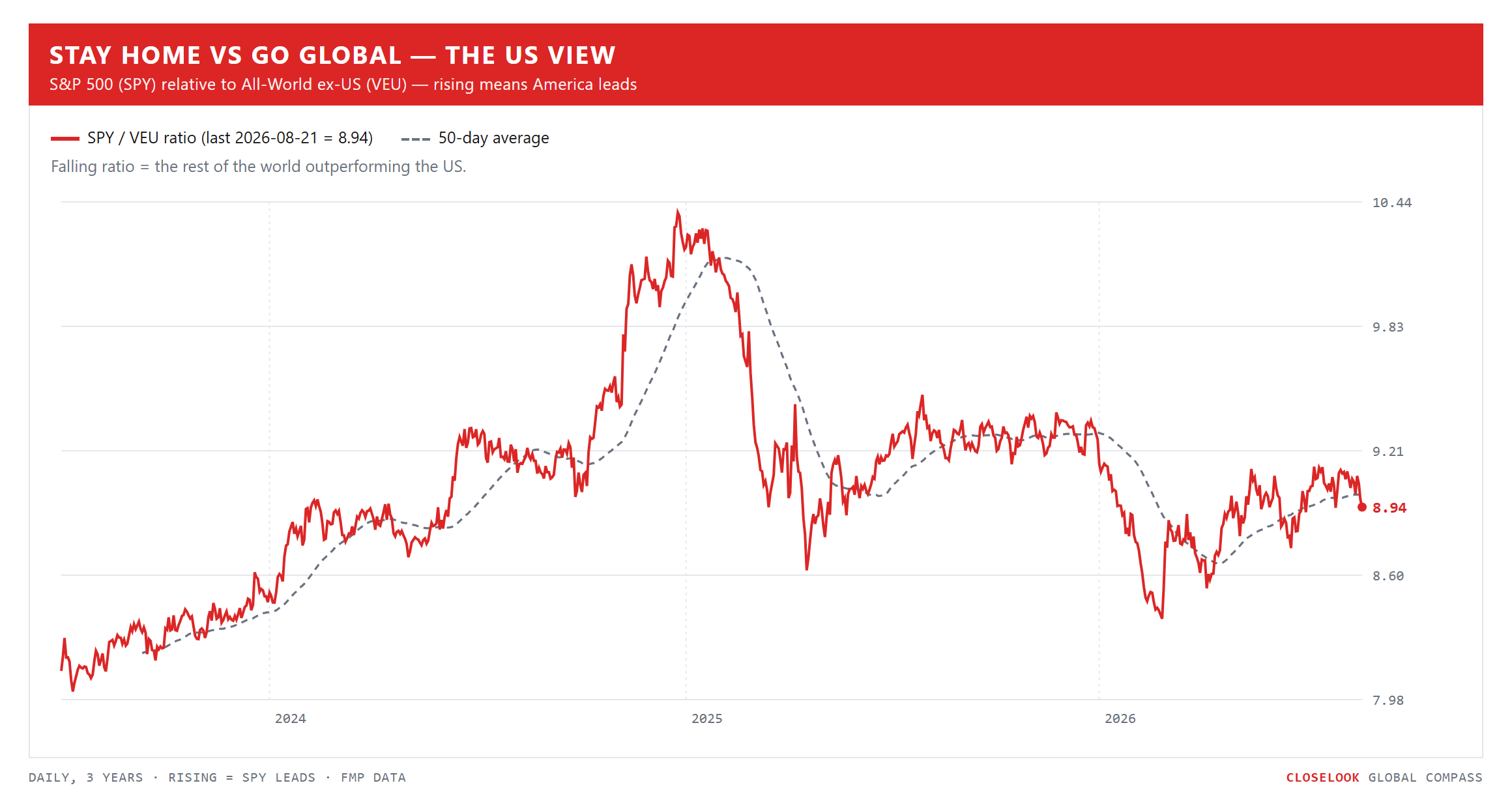
Stay home vs go global — the US view. America lost less for a second week: VEU −1.55%, VT −0.87%, SPY −0.34%. The year reads the other way and less comfortably: +14.0% against +12.4% against +11.7%, ex-US ahead by 2.3 points, from 3.7. Both readings, both honest: the trend is intact and has given back half its margin in two weeks, and the weekly closes on VEU’s board are the record — 86.41 the record, 85.23 the line lost two weeks ago, 84.30 the support lost this week, 82.85 the structural one, 1.2% under the price.
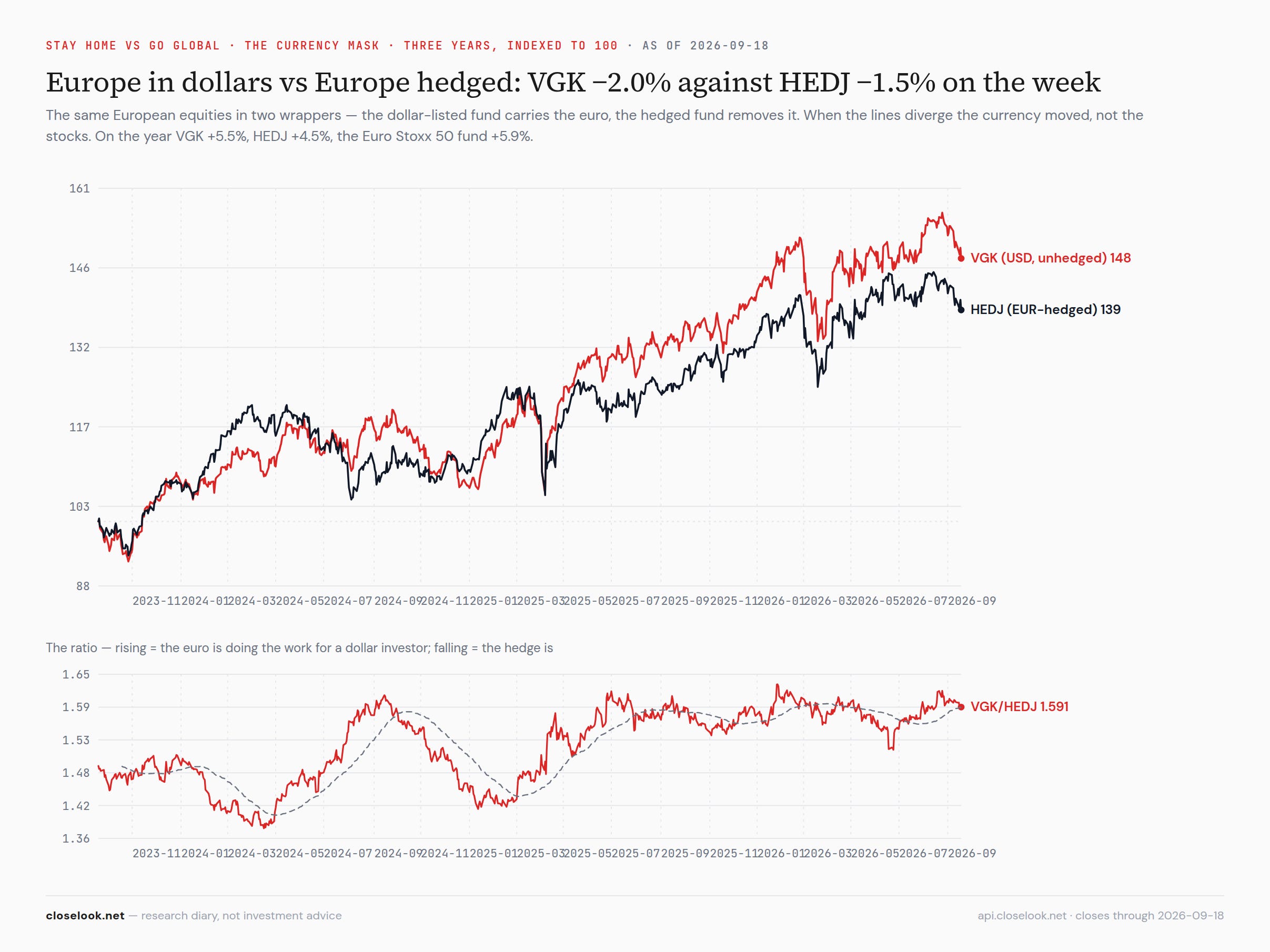
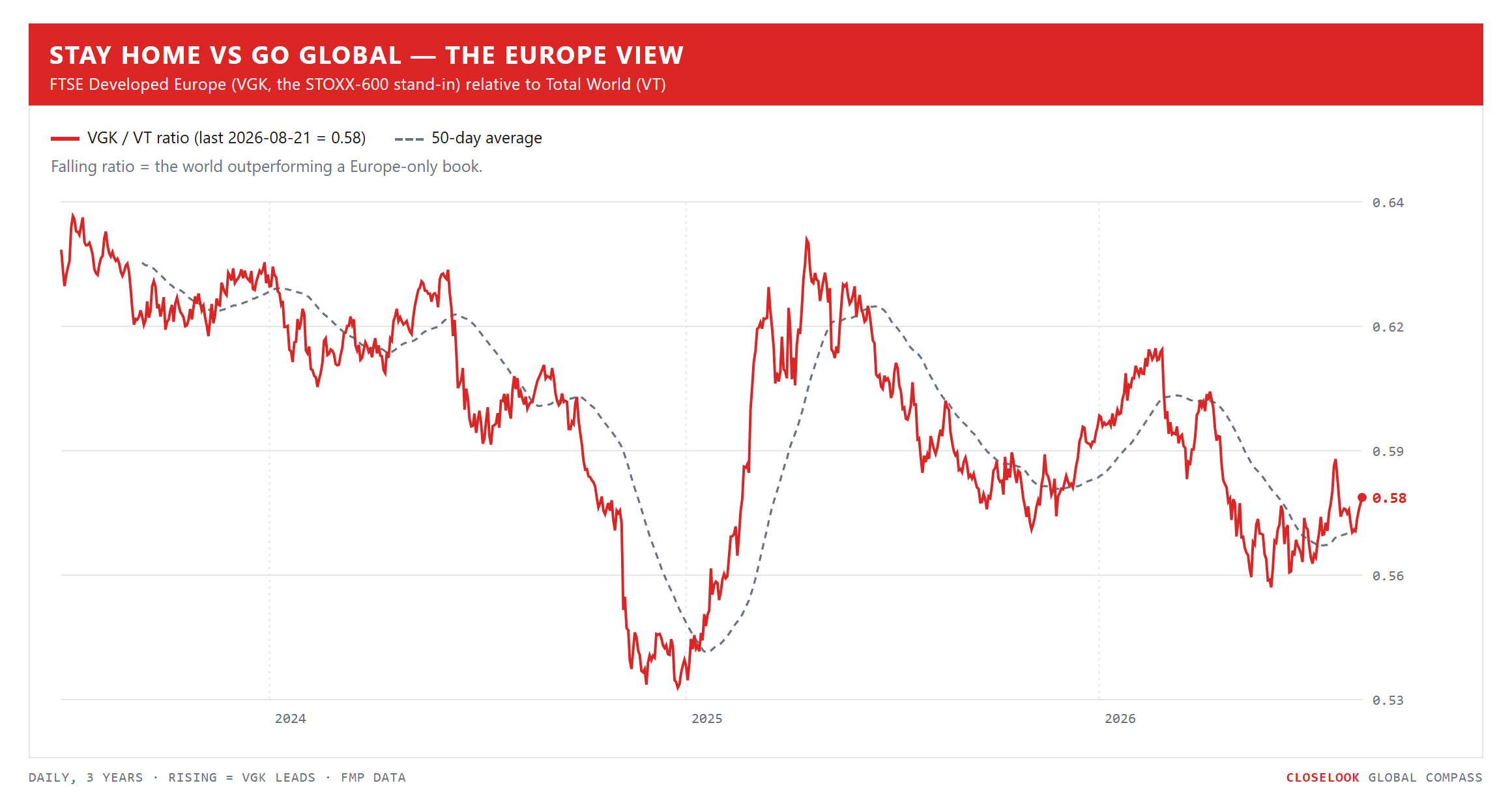
Stay home vs go global — the Europe view: the mask flipped a fifth time. Last week the dollar wrapper fell more than the hedged one by a hair; this week by half a point, and the dollar is the reason: the dollar-listed Europe fund fell 2.01% while the euro-hedged wrapper fell 1.47% — the dollar index rose 1.1% to 100.22 on a hike of its own and one across the Pacific. Underneath: Germany −1.68% in dollars, the DAX −1.0% in euros, from 25,569 to 25,304 after 25,717 on Thursday; the Stoxx 600 −0.5%; the Euro Stoxx 50 −1.4%; France −2.72% in dollars, the CAC −1.4%; Spain −2.51%, the IBEX −1.6%; the UK −1.40% in dollars on a flat FTSE; and Switzerland −0.43% — the best large European market a week after its worst week of the summer. The bond market split by country this time: the Bund’s ten-year closed the week at 3.53%, flat from 3.52%, while France went to 4.57% from 4.45%, up 12 basis points, and Italy to 4.44% from 4.35%, up 9 — the inversion is fourteen basis points now, from ten, from six, from four tenths of one a month ago. The gilt 5.30% from 5.28%. Europe’s core stopped selling this week. Its periphery did not.
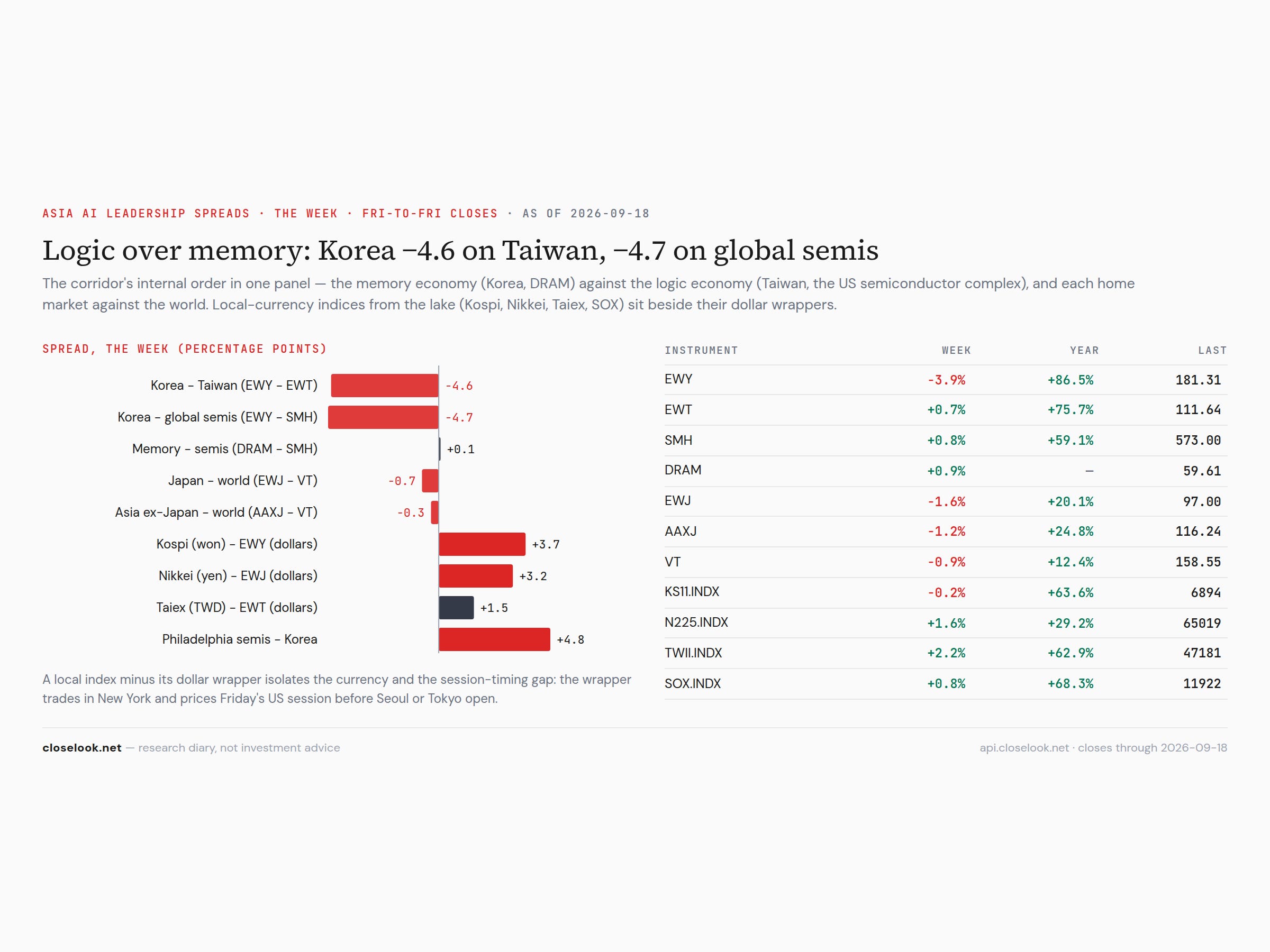
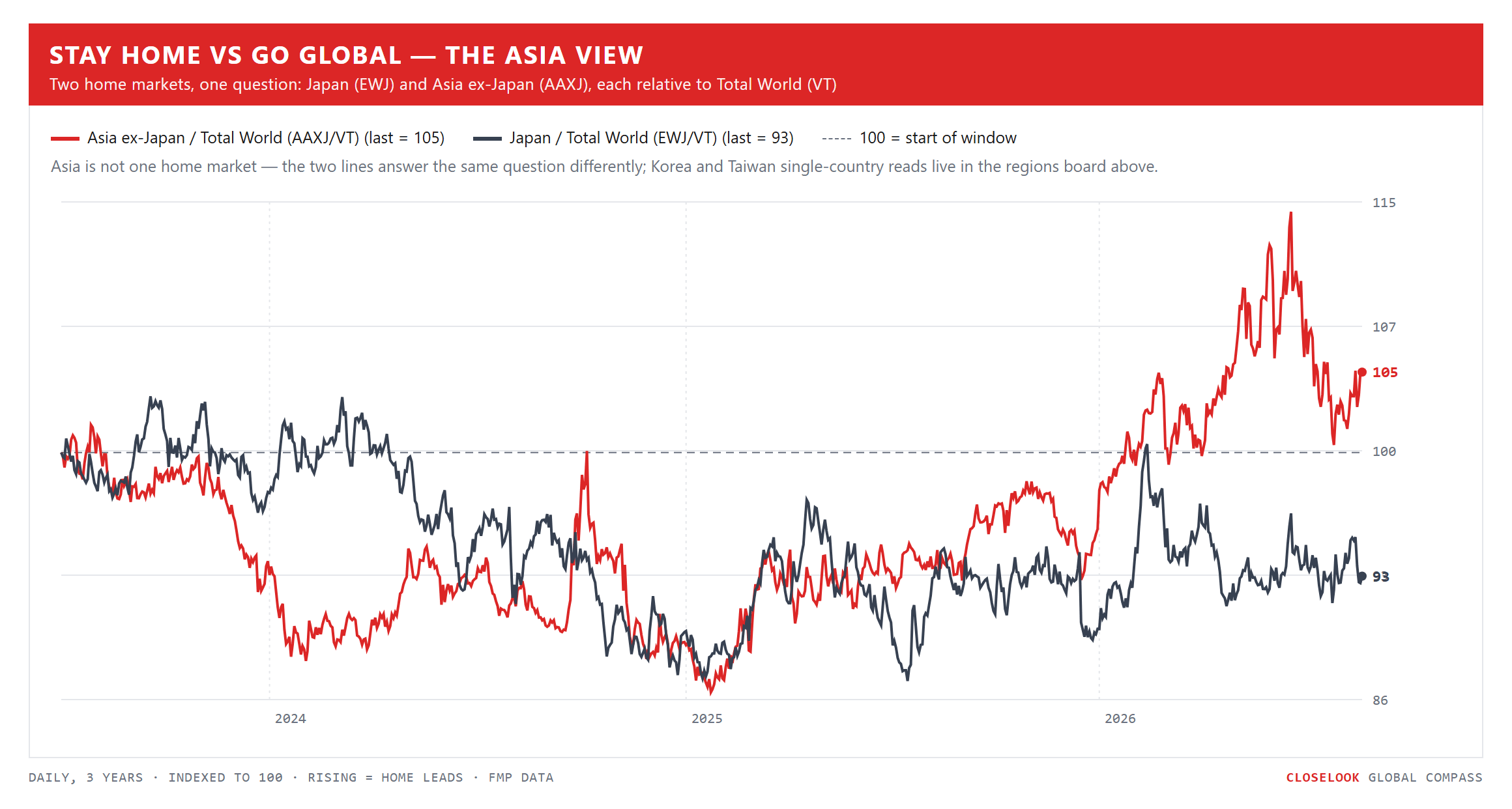
Stay home vs go global — the Asia view: three markets, three answers, and every home market beat its wrapper. Japan: −1.58% in dollars to 97.00 from the 98.56 record, on a week the Nikkei rose 1.6% from 64,011 to 65,019 and the TOPIX 1.6% — because dollar-yen rose from 153.55 to 156.75 through a Bank of Japan hike to 1.25%, the highest policy rate in thirty-one years, that the currency ignored. Korea: −3.9% in New York, −0.2% in Seoul, for the timing reason above — the wrapper paid for Monday’s Seoul session on Monday and has not been paid for Friday’s. Taiwan: +0.66% in dollars to 111.64, half a percent under the September 4 record close; +2.2% in Taipei to 47,181, 1.2% under the June record — the corridor’s logic economy was the only country green on the board, on the week its memory economy was the worst. Korea over Taiwan −4.6 points on the week; Korea over global semis −4.7. Memory over logic broke for the first time in three weeks, and it broke on Monday, when the pacing letter was read as a demand cut for the physical layer and Seoul is where the physical layer lives. The re-rating question from July stays answered in price for Taiwan and, on the weekly close, still for Korea — above 180. The asterisk is now three currencies wide, and one of them fell through a hike.
The engine’s Asia spreads put the wrapper-versus-home gap on one panel: Kospi minus EWY +3.7 points, Nikkei minus EWJ +3.2, Taiex minus EWT +1.5 — all three home markets ahead of their dollar wrappers at once, and the dollar’s +1.1% is most of it. The memory vehicle, DRAM, closed the week at 59.61, up 0.86% — after 54.80 on Monday, under the 58 line for the first time since July, 55.01 Tuesday, 55.33 Wednesday, 57.78 Thursday, and back through the line on Friday with a 3.2% session. Four closes under the line, one weekly close above it. Last week memory held while the wrappers gave ground; this week memory lost its line for four days and its region’s wrapper lost 3.9%, and both were bought back on the last day. Section 3’s Rubin sub-indices say which physical layers went with them.
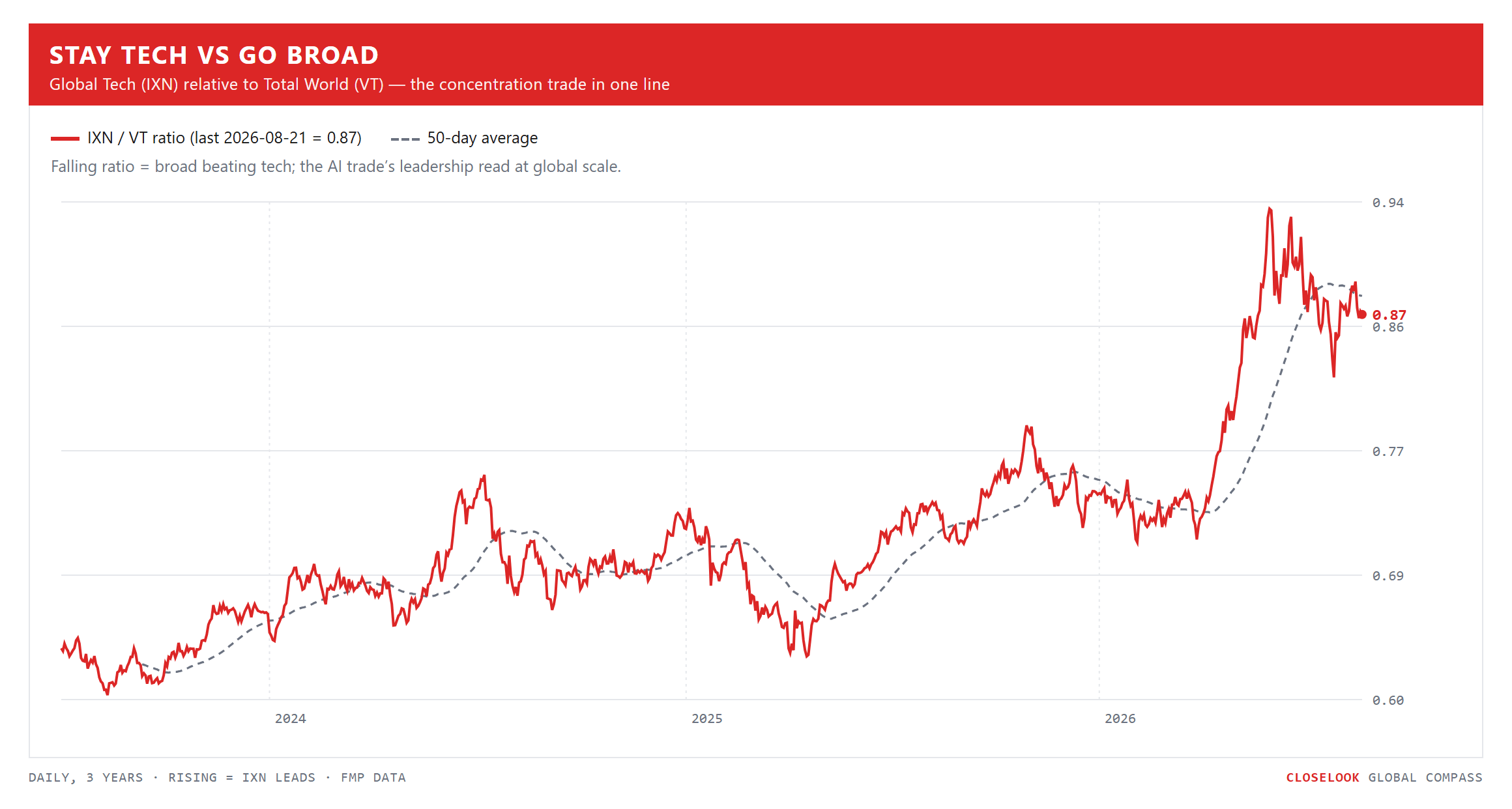
Stay tech vs go broad. Tech led outright this time, at home and abroad. The Nasdaq 100 +0.94% against the S&P’s −0.34%; global tech +0.63% against the world’s −0.87%. Technology the second-best US sector and the second-best global sector; software and security the best tech lines on the week, the chips the best on Friday. Tech led on the week by its code and on Friday by its silicon — the same two halves as last week, in the opposite order, and the aggregate went positive because this time the code’s gain was larger than the chips’ loss and the chips got their loss back. The leadership that narrowed inside the leader last week widened inside it this week — and the equal-weight S&P fell 1.2%, the Russell 2000 1.5%. The leader led. Nothing followed.
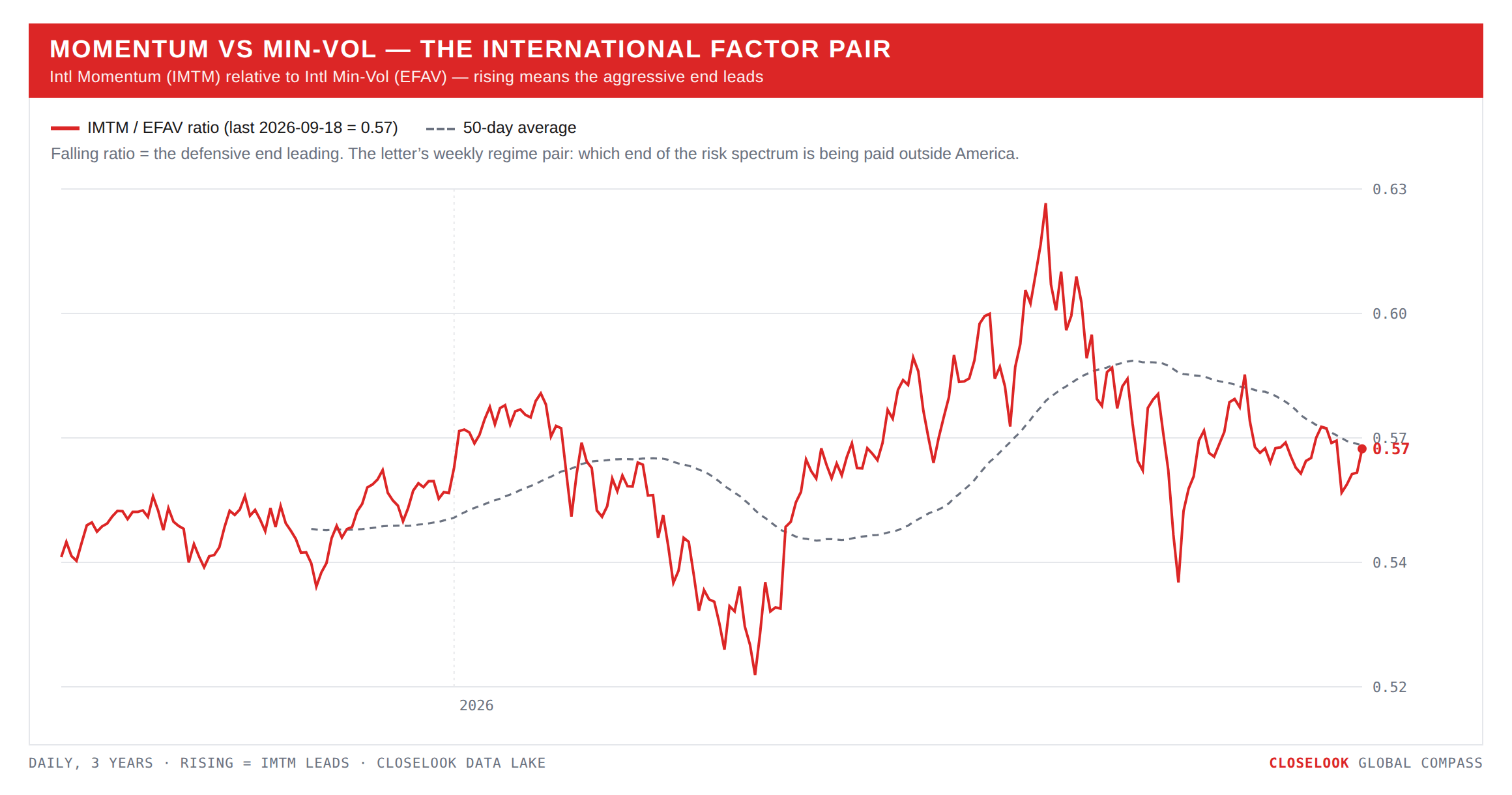
Momentum vs defensive — both ends fell again, and neither made a high. International min-vol fell 1.06% to 92.98, a second week with no high to fail from. International momentum fell 1.38% to 53.00, a dollar sixty-four under the failed August breakout at 54.64, a sixth week below it. Global min-vol −0.83%. On the year momentum still leads min-vol +10.5% against +7.8%; the regime is intact and the week, for a second time, went through it rather than with or against it. Two weeks of the factor pair not sorting the week is a fact about the week, not the pair: a market selling by beta, then buying by beta, does not need a factor to explain it.
One more pair, and it turned. EAFE value −1.80% against EAFE growth −1.33% — growth led value by half a point on a down week, after two weeks of value leading by more than a point. On the year value keeps the argument, +13.2% against +5.5%, the gap 7.7 points from 8.4. Value had led on the two weeks the corridor’s growth wrappers gave ground and the commodity exporters held; this week the commodity exporters gave ground too — Norway −0.64%, Brazil −1.75%, Poland −2.52%, Australia −1.78%, Latin America −2.59% — and the barrel fell 5.6%. The neighborhood the money left last week was growth. This week it left the neighborhood growth had been leaving to.
The Closelook letters — where this one sits. The house thesis, compressed: the stock market is a growing system at the aggregate level in which most constituents slowly fade while a small group massively outperforms — and that group changes dynamically; it never stays static. Own the aggregate, know the current winner group, watch for the rotation. Right now the winner group is the AI stack, and the live question is which of its layers — building, operating, using — earns the next leg. Three letters read that question at three altitudes: Closelook@Global Stock Markets (Saturdays) follows the geography of the money — regions, cross-asset, the core thesis owned through ETFs. Closelook@US Stock Markets (Sundays) reads the tape — the four-layer AI thesis at sector and index degree, the levels, the print records. Closelook@Hypergrowth (Sundays) reads the names — four growth buckets, the flow ledger, the tactical sleeve. Same market, top down. This is the map altitude.
2 · The State
The mechanism, named: two hikes, one sort. Put the week in order. Saturday and Sunday: Anthropic’s chief executive published a letter arguing the frontier labs should pace their own capability growth and give outside evaluators permanent access; OpenAI’s chief agreed within hours and ruled out a listing this year; xAI’s owner endorsed it. Three frontier labs on one page was the week’s opening fact, and Asia read it first: Monday, the Kospi −3.3% with SK hynix −6.7% and Samsung −4.0%, SoftBank −11.3% in Tokyo, Kioxia −6.4% — a demand story for the physical layer. New York did not sell the AI trade. It sorted it: the chip index −5.6% to 497.40, through the 505 line the US letter had set and Thursday’s 517.43, with Astera −9.9%, Arm −8.9%, Lam −7.2%, Marvell −6.3%, SanDisk −6.3%, Micron −5.3%, AMD −4.4%, Nvidia −3.4%; the memory vehicle 54.80, under 58 for the first time since July; and on the other side software +5.0% to 106.64, its best day of the year, the security names +13% to +17% — Zscaler, SentinelOne, CrowdStrike, Palo Alto — and Microsoft, Alphabet and Meta +2% to +3%, the buyers of compute. The S&P fell 0.4%, the Nasdaq 100 0.8%, the house buildout index 5.5% with every layer red. Tuesday the rates day: the ten-year printed 5.008% in the morning, its highest since October 2023, and closed 4.996%; the Dow −0.9%, the Russell −1.2%; the S&P 757.39, under the 757.83 the US letter carries; and Yardeni cut his year-end S&P target to 7,900 from 8,400 on the yield alone. Wednesday, 14:00 in Washington: the Fed hiked — its first since 2023, “in search of a timelier drop in inflation,” with one more signalled before year-end — and the belly sold: the five-year 4.86%, the ten-year closed 5.006%, the first close above five percent of this cycle, while the thirty-year was bought to 5.35%, a bear flattener. The S&P 754.05, a second close under its line; gold sold to 391.74 on the fund; the dollar 100.25. Thursday the reclaim: yields fell six basis points in parallel — the Journal wrote that the Fed had regained the market’s trust — and every line was retaken: the S&P +1.1% to 762.60, the Nasdaq 100 +1.7%, the chip index +3.4% to 519.10, AMD +6.4%, Micron +5.5%, TSMC +3.0%; the equipment names only stopped falling. Friday, Tokyo: the Bank of Japan raised to 1.25%, a quarter point, the highest in thirty-one years, as expected — and the yen fell, to 157.2 in the European morning and 156.75 at the New York close, through the 156 “door” this letter set two weeks ago. The Nikkei +1.6%, Tokyo Electron +4.2%, the Kospi +2.7%, the Taiex +1.9%. Then New York, quadruple witching: the memory vehicle 59.61, back through 58 with a 3.2% session; the chip index 533, through its fifty-day average for the first time since the sort; Applied Materials +6.6%, Lam +7.0%, KLA +4.6% — the equipment three joining a day late; SanDisk +11.0%, Micron +3.9% to its first close above 1,000, Western Digital +4.1%. And underneath a flat S&P, breadth negative: the equal-weight −0.5%, the Russell −0.5%, software −1.1%, Microsoft −0.7%, Oracle −2.0%. The ten-year 4.998%, Thursday’s rally given back to a fifth of a basis point under five. Brent $98.76, under a hundred. The honest name for the week: two central banks hiked, and the market’s answer was a chip sort on Monday and a chip reclaim on Friday, with a bond market that ended two basis points from where it started and a world index that lost a second line. Whether Friday’s reclaim was a close or an expiry is the question Monday answers.
What did choose: the two quiet tells — one against, harder; one for, and it reversed the loop. The bond market first. IEF spent the week under the reclaim line for a sixth consecutive week — 90.93, 90.82, 90.73, 91.25, 90.80 — with Wednesday’s 90.73 a new fifty-two-week-low close, on the hike, and Thursday’s 91.25 the first midweek push in three weeks, given back Friday. That is the sixth failed weekly reclaim and the pattern has now been “trying and failing,” “not trying,” “falling,” and this week “bouncing and failing”: the belly rallied on Thursday’s trust and sold on Friday’s arithmetic. TLT: 80.71 on Tuesday, a new fifty-two-week-low close; 81.78 Thursday; 81.25 Friday — above the 81.2 this letter said the long bond had to reclaim, by five cents. Two weeks, two five-cent margins, one each way; section 7 has the rule for what a margin like that is owed, and it is the same rule as last week. The bond veto over the equity read stays engaged on the belly and goes back to being a dissent on the long end — by a nickel. Then the yen, which chose the other way, and this time on a day its own central bank hiked: dollar-yen rose from 153.55 to 156.75, up 2.1%, its high 157.2 on Friday morning after the Bank of Japan’s decision. Last week’s revised line was “155 is the line, 156 the door back into the carry loop.” It closed above 156. The carry loop is back, one week after the intervention-and-hike loop took over, and it came back through the hike. A currency that falls two percent on the week its central bank raises rates to a three-decade high is a currency pricing the differential, not the level — the ten-year in Washington is at five percent and the ten-year in Tokyo at 2.99%, and the quarter point narrowed that gap by less than the week widened it. The bull’s insurance, the pulse called it on Friday: moderately higher US rates keep the yen cheap to borrow and the corridor funded. Two tells: the belly against, the yen for — and the one for it is the one that was against it last week.
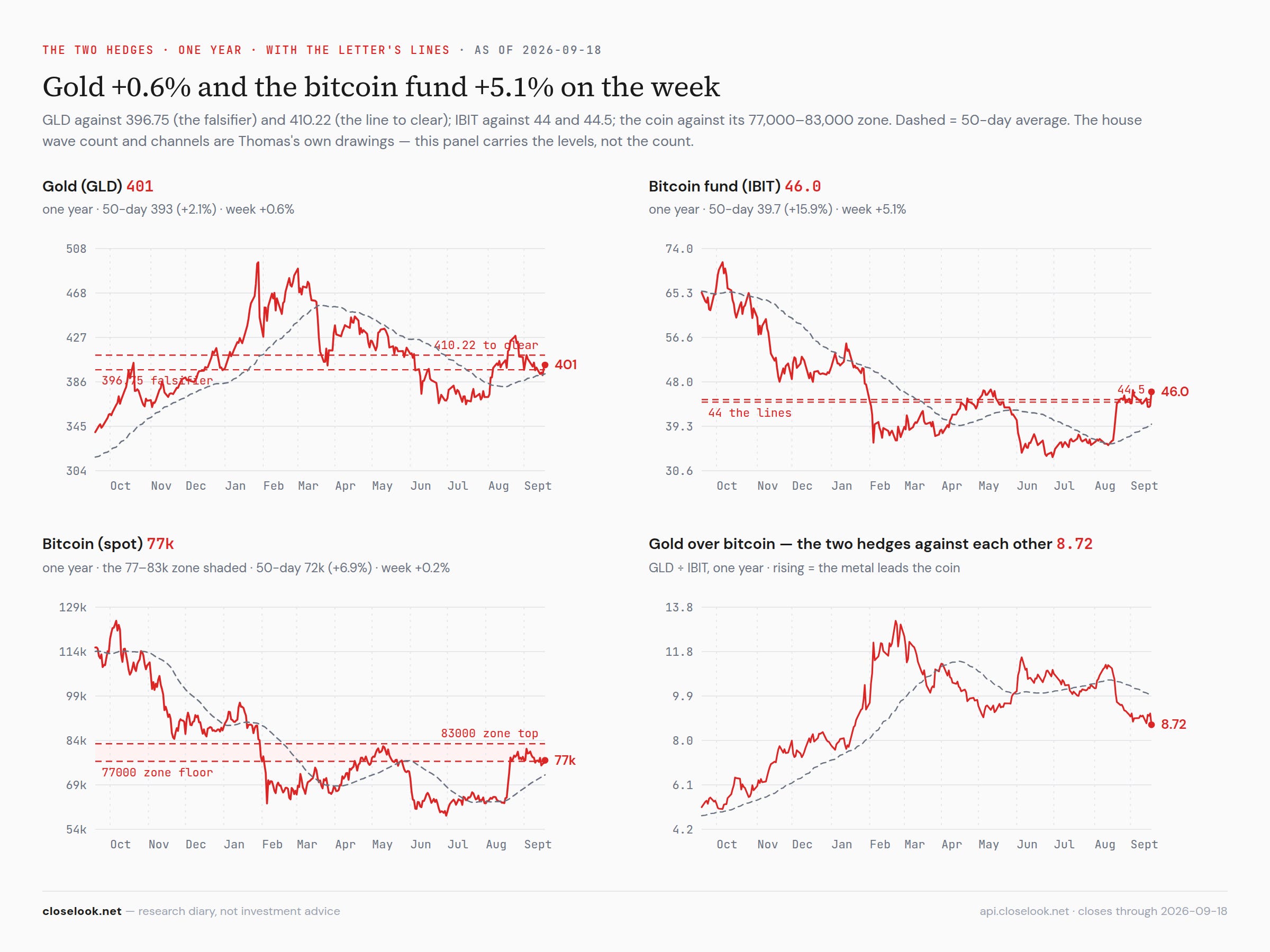
The podium turned twice, and both times the hedges were bought on the delivery. The Fed on Wednesday, the Bank of Japan on Friday, the ECB the Thursday before: three hikes in eight days across the three currencies that matter. The reading the previous three editions carried as the central tension — hard assets priced for an easing cycle against central banks leaning hawkish — resolved for the hawks three weeks running, and this week the hawks stopped leaning and delivered, and the hard assets rose: gold +0.60% on the fund to 401.17, silver +3.11%, the bitcoin fund +5.14%, the coin +0.2% to 77,362; copper miners −1.41%, the dollar +1.14%. The order inside the week is the tell: gold was sold Monday to Wednesday — 392.84, 394.15, 391.74 on the fund, three daily closes under the 396.75 falsifier — and bought back Thursday +1.7% and Friday through 400; the bitcoin fund closed under 44 on Tuesday, Wednesday and Thursday — 43.11, 43.04, 43.30 — and through 44 and 44.5 on Friday at 46.02. Sold into the hikes, bought on them. Last week the same input produced the same trade and both scorecards said no; this week the input arrived and the trade reversed, which is the oldest pattern in the book — the rumour sold, the fact bought — with the caveat that the Fed signalled one more, and one more is a rumour again.
One session, and the pattern with a memory inside it — broken, and replaced. Three Fridays gave this letter a rhyme: a discount rate leaning up on a policy signal buys duration-light quality; on a growth signal, the order book; on an inflation signal, the order book anyway. This Friday the policy signal was not a lean but a delivery — two hikes inside the week — and the market bought the order book harder than on any of the three: the equipment three +4.6% to +7.0%, SanDisk +11%, Micron through 1,000, the chip index through its fifty-day, memory through its line — and sold the layer above it, software −1.1%, the equal-weight −0.5%, the small caps −0.5%. The rhyme is gone. What replaced it is simpler and less comfortable: the market buys the physical layer on any signal, as long as the signal is behind it, and it sells everything that is not the physical layer to fund the purchase. Sunday’s Hypergrowth letter owns the names; the geography is that the physical layer is Korean and Japanese and Dutch, and this week its dollar wrappers were sold on Monday for the same reason its US members were bought on Friday.
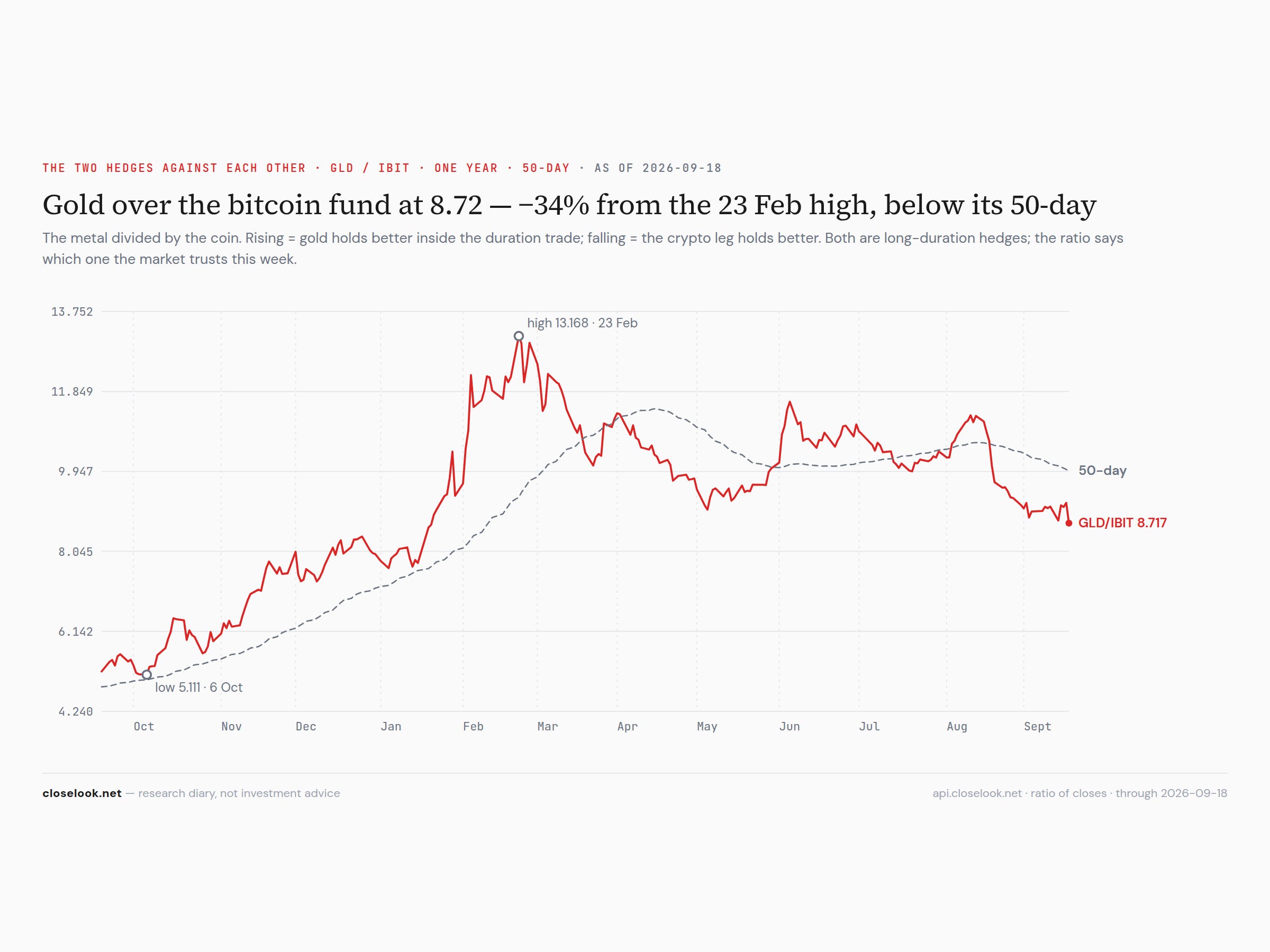
The two hard-asset charts, read the house way. Gold: the count’s leg was retired on the letter’s own standard — last week’s clause was “a second daily close under 396.75 retires it,” and Tuesday’s 394.15 was the second, Wednesday’s 391.74 the third. Then the fund closed 398.36 Thursday and 401.17 Friday, above the falsifier on the week, with a 403.15 weekly high that never approached the 410.22 line to clear. The rule in section 7 applies: the level is not re-negotiated, it is inverted — 396.75 is now the line gold has to hold from above, and the leg is restored only by a weekly close through 410.22, which was the restoration clause stated last week. Bitcoin: the coin closed 78,163 on Monday, back inside the 77,000–83,000 zone, fell to 75,613 on Tuesday, and closed the week at 77,362 — inside the zone by 362 dollars; the fund 46.02, through both lines it lost a week ago. One week ago both hedges had lost their levels and the letter wrote that inside the duration repricing there was no preferred hedge, only a preferred cash position. This week both reclaimed — one cleanly on the weekly close, one after triggering its own retirement clause on the way — and the pair ratio turned back toward the crypto leg. The honest read: a hedge that loses its line in a week and reclaims it the next is not a hedge that has answered. It is a hedge that has been traded.
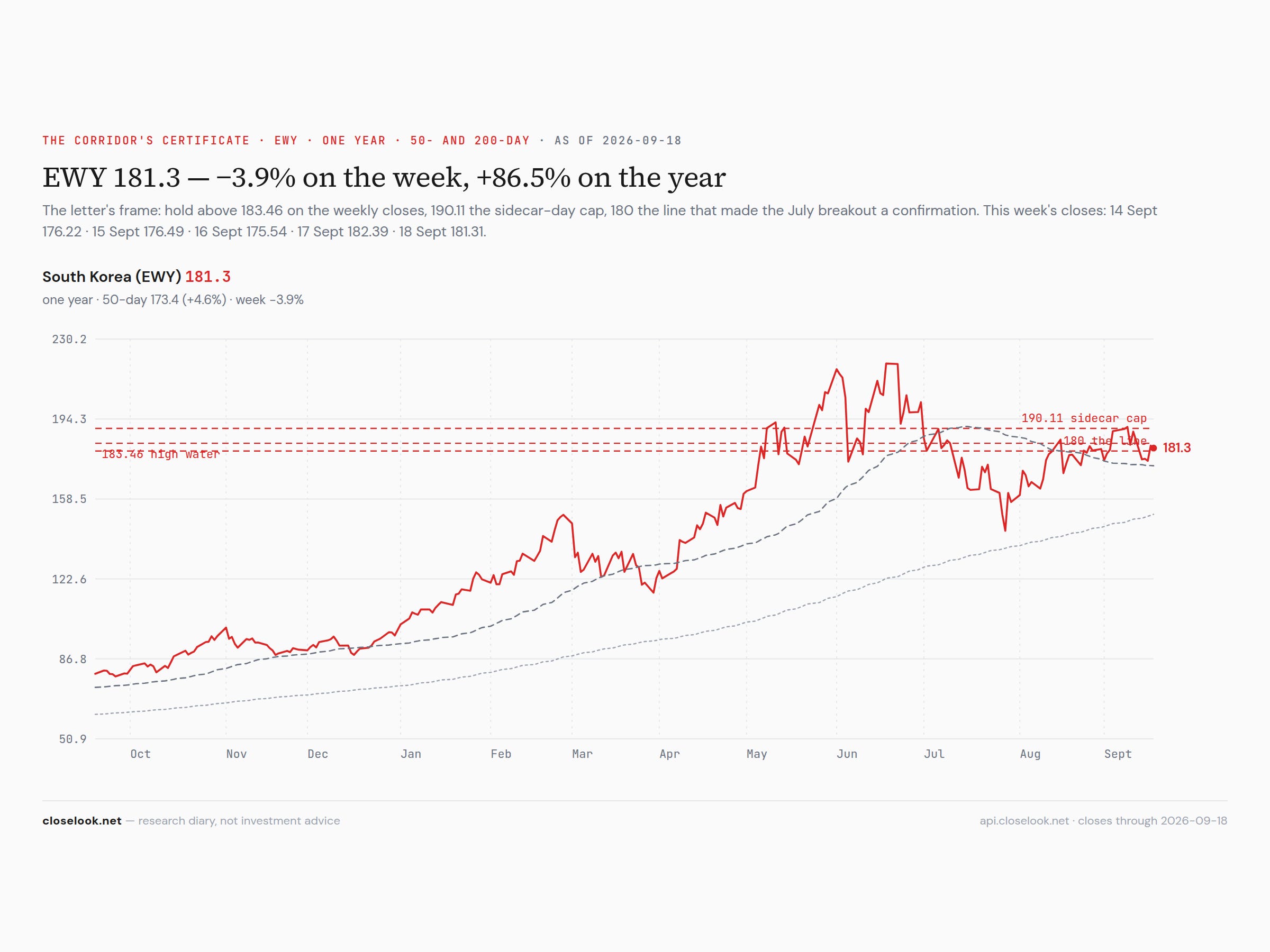
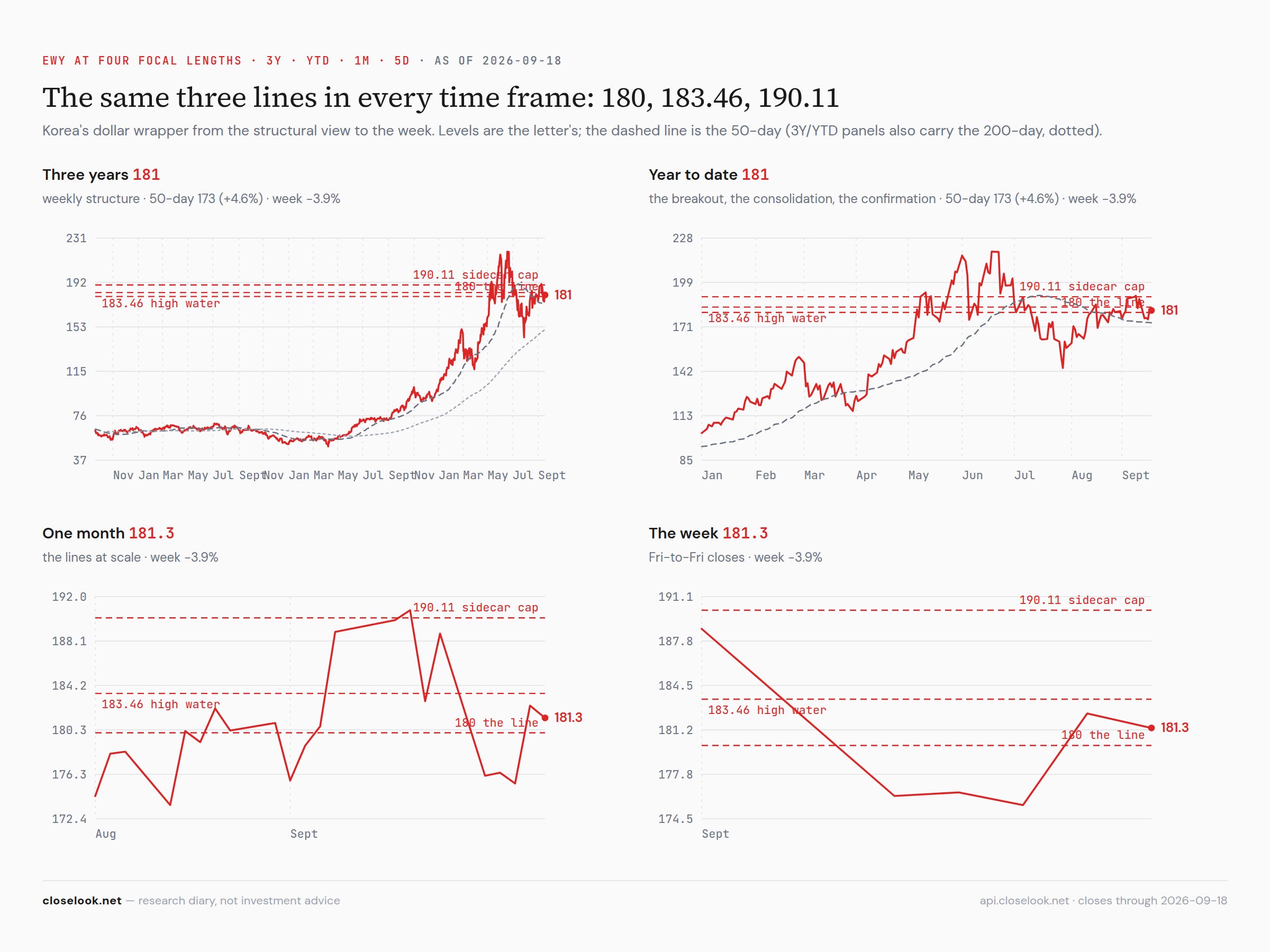
Seoul: the certificate lost its high water on the weekly close, and kept its line. The fund walked 188.72 → 176.22 (the sort, −6.6%) → 176.49 → 175.54 (the low) → 182.39 → 181.31. The structural read from five weeks ago — breakout, consolidation above the broken channel, completed double bottom, resistance at 180 — has its confirmation candle, two held weeks, a daily close through the cap that did not become a weekly close, a daily close under the high water that did — this week, at 181.31 — and three daily closes under 180 that did not become a weekly one. The frame said a weekly close under 183.46 makes the confirmation a three-week visitor; it did. It said 180 turns a visitor into a failure; 181.31 is not that, by a dollar and thirty-one cents. And the currency clause worked the other way this time: Seoul was flat on the week and the wrapper lost 3.9%, because New York sold Monday’s Seoul session in dollars on Monday and has not yet bought Friday’s in dollars at all. The certificate is genuine and co-signed. This week the co-signature cost the dollar investor almost four points that the Seoul investor did not lose.
Europe, two machines, and the periphery moved without the core. The voting machine sold the periphery and bought the defensives: France −2.72% in dollars, Spain −2.51%, Austria −3.13%, Poland −2.52% from its record; Switzerland −0.43% after its worst week of the summer, the engine’s European health care cut +3.0% after −5.5%, staples +1.1%, utilities +0.6%. The weighing machine split by country: the Bund 3.53% from 3.52%, flat on the week and up 25 basis points in twenty-one days; France 4.57% from 4.45%, up 12; Italy 4.44% from 4.35%, up 9; the gilt 5.30% from 5.28%. France over Italy is fourteen basis points now, from ten, from six, from four tenths of one a month ago — the Bund stopped and the periphery kept going. And the sovereign board’s composite did the opposite of its yields: the Sovereign Pressure Index fell to +0.07 from +0.85, with the twenty-one-day baseline at +0.48 — the ten-year leg still hot (z-score 1.3) but the slope leg deeply cold (z-slope −3.2): every G7 curve flattened into its central bank. The equal-weight G7 ten-year yield rose 3 basis points on the week to 4.24%, its path 4.24, 4.26, 4.23, 4.18, 4.24; the pressure gauge’s path 0.45, 0.44, 0.17, 0.00 on Thursday’s rally, 0.07. The levels are as high as they were; the rate of change is gone. And the hemisphere swap this letter tracked in August resumed: the US thirty-year was bought into the Fed, 5.33% from 5.35%, and Japan’s thirty-year sold into the Bank of Japan, 4.08% from 4.05%. The Atlantic long end exhaled on a hike; the Pacific long end inhaled on one. Two central banks, two curves, opposite ends moving.
The macro print. The week’s two prints were decisions, not data, and their geography ran in one direction: the dollar rose on both. The Fed’s hike sold the world index to its low close of the move on the day, 83.50, and bought the dollar to 100.25; the Bank of Japan’s hike sold the yen two figures and bought Tokyo 1.6%, and Japan’s dollar wrapper lost 1.6% on the week for it. Neither hike was bought in the currency of the hiker. Two weeks ago the market paid for a growth number; last week for an inflation number; this week for two rate rises, in the order book, on an expiry day. A market that pays for a hike is telling you it had priced a hawkish one — and the Fed signalled a second, which means the pricing starts again on Monday. Section 6 says what follows if the second one is the one the curve has not paid for.
Hold both halves. The equity boards resolved downward a second week — the world index under a second line, financials further under its August line, breadth two of thirty-five with no flip, three of the five house indices red and one flat to the cent. The funding tells split, and this time two of the four split in the bull’s favour: the belly failed a sixth time at a new low; the long bond reclaimed its line by a nickel; the yen went back through its door the carry way; both hedges reclaimed theirs. Sideways ended three weeks ago upward, two weeks ago downward, and this week it ended downward on the boards and upward on the funding — which is not a resolution. It is the two halves of the tape disagreeing about what two hikes mean.
The structural read — the wave count, five years up, unchanged. Zoom out and the week moves the count’s status again without moving the count. From the October 2022 low the house count on the world ex-US reads waves 1 and 2 complete and wave 3 still progressing — price riding the upper half of a four-year channel, the September 4 record a new high inside an advance whose projection runs to the channel’s top, above 90. On this count the 3.0% from the record is a pause in a third wave, and the channel’s lower line near 72 is a long way under the price. The all-world index, on the same chart, is 2.4% under its August record and above its rising line from April 2025. The September base case this letter stated three weeks ago, about five percent of consolidation, is now 3.0% in on the world index, 2.1% on the S&P from its August high, 2.4% on the all-world — three fifths delivered on the index the letter measures it by. The count says pause; the shelf says the pause has a second floor under it now, at 82.85. Probability, not prophecy.
3 · The Outlook
The three-index read — the money went to the layer that runs, and the builder was the only red line. We read the three together because they are three stages of one spend: capex (Rubin Build-Out, what gets built), opex (Agentic Ecosystem, what it costs to run), applications (Agentic Winners, what gets sold on top).
Capex −0.40% on the week — the only red line of the three, after four weeks as the only green one — and +90.2% on the year. Opex +6.57% and +65.5%. Applications +0.01% and −7.0%. The order inverted, and the week inside says how: the buildout index fell 5.5% on Monday to 1,855 with every layer red, then 1,845, 1,876, 1,905 and a 2.6% Friday to 1,955 — all but four tenths of a percent of the sort recovered in four sessions, the last two of them on the equipment and memory names. Opex rose 4.2% on Monday to 1,597 — the same day, the other side of the same sort — and kept going: 1,602, 1,606, 1,645, 1,633. Applications rose 4.0% on Monday to 946 and gave all of it back — 933, 920, 924, 910 — to finish a cent up on the week. Three layers, one sort: the builder sold and bought back, the runner bought and held, the seller bought and sold. That is the pacing letter rendered in the house’s own instruments: capability paced means the layer that governs, secures and identifies agents has a demand guarantee, the layer that builds them has a demand question, and the layer that sells them has neither.
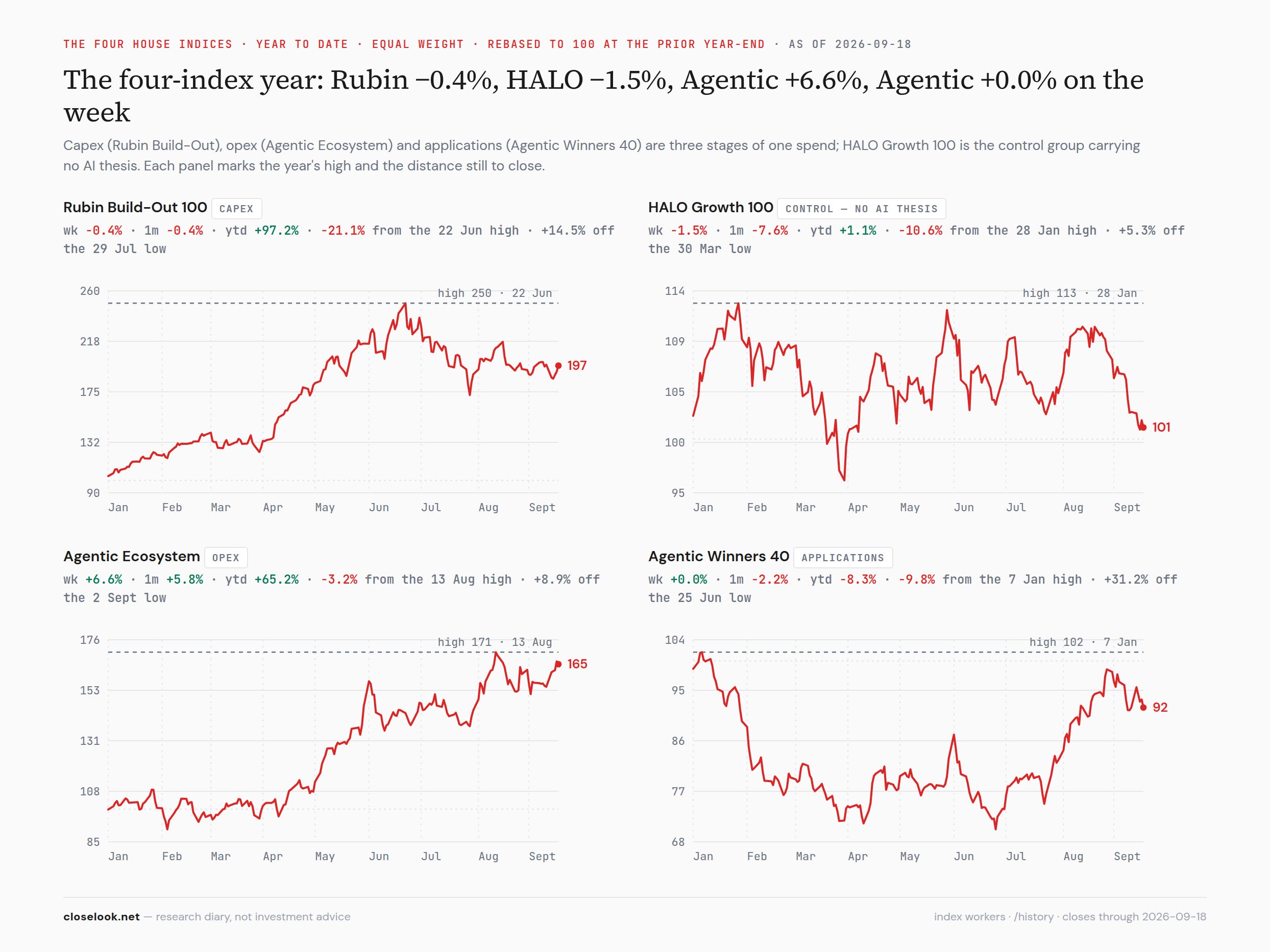
The control group fell while the stack’s middle layer rose six percent. Last week HALO — our growth index carrying no AI thesis — fell 3.54% with the applications layer falling harder and the physical layer escaping. This week HALO fell 1.46% while opex rose 6.57%, applications was flat and capex fell 0.40% — growth sold modestly, the AI stack’s middle layer bought hard, its two ends flat. Put the five weeks together: AI unwind inside a flat growth tape, AI bid inside a growth sell, growth sell with the stack inside it, growth sell led from the top of the stack, and now a growth sell with the middle of the stack going the other way at six percent. The sort that ran through the stack last week — physical over digital — ran through it again this week in a different place: governance over everything. Inside HALO the week was narrow and red — 3 of 23 sub-indices green: med-devices +3.08%, longevity +2.45%, autonomous defense +0.21% — with energy transition −7.00%, speculative −6.50%, the hypergrowth sleeve −5.04%, satellites −4.01% and nuclear −3.94% the casualties, the last of those sold with the utilities on the five-percent ten-year. HALO is −1.1% on the year now, from +0.3%; −7.55% on the month.
Read the three windows together, because the disagreement is still the signal — and it moved. On the year capex leads and it is not close: +90.2% against +65.5% against −7.0%. On the month the leader is opex: +5.8% against capex −0.4% against applications −2.2%. On the week: opex first, applications second, capex last. Two of the three windows now point to the runner; the year still points to the builder. Last week the leadership handoff was “not being contested — it is being liquidated from the top of the stack down.” This week it was contested, from the middle, by the one layer the week’s opening fact was written for. One week is one week. But the month window agreeing with it is not one week.
The correction lows, re-measured. Applications — which bottomed first, on June 25 — is +31.2% off its low, unchanged to the decimal. Capex, off its July 29 low, +14.5% from +15.0%. Opex, off the post-high low it set on September 2 at 1,500, +8.9% from +2.2% — the runner recovered in one week what it had lost in three. The spring pattern — the index that bottoms first goes on to lead — is six weeks confirmed for the applications layer’s low and three weeks dented for its lead. Probability, not prophecy.
The structural line moved the right way for one of four, and by a distance. Opex closed 3.2% below its August 13 high — from 9.1% a week ago; it recovered six points of the gap in five sessions. Applications 9.8% below its January high, from 9.7%. HALO 10.6% below its January high, from 9.3%. Capex 21.1% below June, from 20.8% — the first week in three its distance to the peak grew. The runner is the house index closest to its high now, and a week ago it was the one whose low was newest.
Inside capex: the corridor’s members were bought back, the tools’ suppliers were not. The best lines in the buildout were the Asia-Pacific ex-Japan constituents +5.20% — the Korean and Taiwanese memory and foundry names sold Monday and bought back Thursday and Friday, +139.5% on the year — the architects +5.17%, AI factory systems +4.43%, the design layer +3.34%, storage +2.79% (still +352.9% on the year). The bottom is the equipment’s own supply chain: machine vision and sensing −4.48%, power semiconductors −3.05%, physical AI −3.00%, gases and chemicals −2.98%, fab subsystems −2.96%. Thirteen of thirty-six sub-indices green — from twenty last week; the buildout’s breadth was the family’s best for two weeks and this week it was the family’s worst but one. The equipment three were bought on Friday; the companies that supply the equipment three were not. Same sort, one layer further down, one day later.
Inside opex: everything but the model got bought, and the governors got bought most. Thirteen of fourteen green. Agentic security +14.23%, identity and governance +12.23%, the govern-and-secure layer +12.20%, the US constituents +6.71%, Europe’s +6.64%; then data and memory +3.29%, compute operators +2.43%, the substrate +1.90%, edge and distribution +1.54%. The one red line: foundation models −1.68% — the one-name sub-index, Zhipu, still +488.8% on the year after losing a quarter of its value the week before. The pacing letter was read as a mandate: if the frontier is paced and evaluators get permanent access, the layer that secures, identifies and governs agents is the layer whose demand was just written into the labs’ own public position. The market bought that on Monday, +13% to +17% in the security names, and did not sell it on Friday when it sold the rest of the software complex. That is a sort inside a sort.
Inside applications: the leaders held, the consumer end did not. Five of nine sub-indices green. Application leaders +1.85%, the enterprise layer +1.41%, the megacap gateway +1.15% — still the only sub-index positive on the year, at +12.8% — the control plane +0.71%, the US constituents +0.50%. The bottom: endpoints −4.58%, now −20.9% on the year; consumer −3.52%; Asia’s constituents −1.51%; Europe’s −0.42%. The control plane that lost ten percent last week gained back less than one. The applications layer is −7.0% on the year, unchanged; it rose four percent on Monday and sold for four days, and it is the only house index that finished the week where it started.
Euro-AI, for the ladder’s sake. The sovereign-Europe index fell 0.23% to 1,261.51, +26.2% on the year, 9.3% under its June high after setting a new post-high low on Tuesday at 1,234.42 and recovering 2.2% from it. Four of seven sub-indices green — chip architecture and cloud +2.64%, enterprise AI and data +2.51%, defense +2.16%, medtech +0.44% — with power, grid and cooling −2.63%, the semi-equipment layer −1.18% and industrial AI −1.16% red. The same sort as the US board, in Europe’s names: the code bought, the physical layer’s European suppliers sold, and the Dutch equipment names not yet joined by their Tokyo and California peers’ Friday.
The regime gauge. The Money Temperature instrument board closed the week at 50 — unchanged from a week ago, after 46 Monday, 44 Tuesday, 45 on the Fed, 55 on Thursday’s reclaim and 50 on Friday — with the regime read “mixed / transitional” at low confidence every session, from “risk-on rally” at moderate confidence a week ago. The spread underneath cooled again in every direction but one: risk appetite +9 from +19, speculation +10 from +12, dedollarization −19 from −13, duration −8 from −16. The duration spread narrowing from −16 to −8 on a week the belly made a new low and the ten-year closed above five percent is the same awkward internal as last week, one notch further: money is leaving long bonds more slowly than the price of long bonds implies. And the dedollarization spread widening to −19 on a week the dollar rose 1.1% is the gauge saying the dollar’s bid was the hikes, not the flows. Per instrument: the dollar warmest at 68, the Nasdaq 100 59, bitcoin 58, the S&P 49, EM 47, the long bond 41, gold 40, the world ex-US 40 — the coldest instrument on the board, tied with gold. The world index is as cold as the hedge that lost its leg. That is the week’s geography in one row.
4 · What May Lie Ahead
Levels and tripwires — VEU first, and the ladder moves down a rung. The marks: 86.41 the record close (September 4), 85.23 the line lost two weeks ago on a five-cent miss, 84.30 the support lost this week on a weekly close of 83.86 — the close that last week’s edition said “turns the five-cent miss into a structure.” It is a structure: two weekly closes under the first line, one under the second, the low close of the move at 83.50 on the Fed. The ladder restated from below: 84.30 is the first line to reclaim on a weekly close, and a weekly close above it says the structure was a two-week visitor; 85.23 restores the record’s status as an intact advance; 86.08 and 86.41 retire the whole episode. Below: 83.50, Wednesday’s close, is the first support; 82.85 the structural one, 1.2% under the price; then the 80.73–78.77 confluence band as the hard tripwire, unchanged. A weekly close under 82.85 is the September base case delivered in full, on the index the letter measures it by. Four weeks of the line being tested; one week of it holding by a cent, one of it missing by a nickel, one of the next line going. The next decisive weekly close inherits two lost lines and a floor.
IEF 90.80 — the sixth failure, a new low on the hike, and the long bond back above its line by a nickel. Sixth consecutive week under 93.17, the first in three with a midweek push: 90.93, 90.82, 90.73 on Wednesday, the low close of the year and of the past twelve months, on the Fed, 91.25 Thursday, 90.80 Friday. TLT 80.71 on Tuesday, a new fifty-two-week-low close; 81.78 Thursday; 81.25 Friday — above 81.2 by five cents. 93.17 remains the line that retires the break on the belly; 81.2 is the long bond’s line and the long bond is on the right side of it, barely. The bond veto over the equity read is engaged on the belly and back to a dissent on the long end, and the ten-year has now closed above five percent once, on the hike, and a fifth of a basis point under it on Friday. Five percent is not this letter’s line. It is the market’s round number, and the market has closed on both sides of it inside three sessions. Sunday’s letter carries the ladder.
EWY 181.31 — the high water lost on the weekly close, the line kept by a dollar. Hold above 183.46 on the weekly closes: lost (181.31). 190.11 the cap: not approached; the high close of the week 182.39. 180 the line: held on the weekly close by 1.31, with three daily closes under it — 176.22, 176.49, 175.54. The frame, restated: a weekly close back above 183.46 says the visitor stayed; a weekly close under 180 is the failure the frame has named since August; 190.11 stays the cap. The currency clause is now a timing clause: Seoul rose 2.7% on Friday after New York’s Thursday, and the wrapper fell 0.6% on Friday before Seoul’s Monday — the fund opens the week owed a Seoul session, all else equal, and all else is rarely equal on a Monday after an expiry. The Kospi opens at 6,894, under 7,000 for a second week.
USDJPY 156.75 — through the door, and the loop is the carry loop again. The line was 155, the door 156, and last week’s edition said a weekly close back above 156 “re-opens the summer’s range.” It closed at 156.75, its high 157.2 on Friday morning after the Bank of Japan raised to 1.25%. The house line, revised a third time: 156 is the line from above, 160 the door to the next range, and a weekly close back under 155 returns the intervention-and-hike loop. The hike has been delivered; the ministry’s answer to 157 has not. This is still the most important single line on the funding side of the global tape, and it has now crossed the same two figures in opposite directions in two weeks, on two central-bank decisions, the second of which was supposed to send it the other way. The corridor’s dollar wrappers lost their currency tailwind this week — Japan’s the most visibly — and whoever borrowed in yen to own them got the week’s cheapest funding back.
DRAM 59.61 — the line lost for four closes and reclaimed on the fifth. The memory vehicle rose 0.86%, closed under 58 on Monday, Tuesday, Wednesday and Thursday — 54.80, 55.01, 55.33, 57.78 — and through it Friday with a 3.2% session. 58 stays the line, bent on the daily standard and held on the weekly; the June high at 80.72 the reference above; a weekly close under 58 returns the corridor’s internal contradiction, and Monday’s close says whether Friday’s reclaim was memory or the expiry. Last week’s asterisk — the memory names not bought back when the rest of the stack was — resolved this week in memory’s favour, a week and four lost closes later: SanDisk +11%, Micron through 1,000, Western Digital +4.1% on Friday. Micron reports next week, the first order-book fact of the resolution month. The date is confirmed before any window is minted.
The four global sectors that decide the tape. Financials at 131.45 — a second week under the 134.55 August line, 4.1% under the 137.00 record. Materials at 109.82, a fourth week under the 116.54 February line, 7.3% under the August 25 record, with copper miners at 87.28. Tech +0.63% to 143.64, 4.1% under June; industrials −1.57% to 192.07, 7.1% under August. The configuration: the two challengers that cleared and un-cleared have stopped approaching their lines; the weight is the only one of the four that rose; the two commodity sectors are seven percent under their records and the two growth sectors four. 134.55 on financials and 116.54 on materials are the lines to reclaim; 137.00 and 118.49 the records above them; 149.74 on tech and 206.84 on industrials the highs. Financials un-resolving inside a week said the rates tailwind became a rates cost somewhere between 4.8% and 5.0% on the ten-year. The ten-year closed above five percent on Wednesday and financials fell 2.4% in the US and 2.1% globally. The cost is on the board now.
The hard assets on the board. Gold 401.17 on the fund with three daily closes under 396.75 — Monday, Tuesday, Wednesday — which retired the count’s leg on the clause stated last week, and a weekly close four dollars above the line that does not un-retire it. The marks, inverted: 396.75 is the line gold holds from above now; 410.22 the weekly close that restores the leg; 391.74, Wednesday’s close, the first support below. The bitcoin fund closed 46.02, through 44 and 44.5 on Friday’s 6.3% session after three closes under 44; the coin shut the week at 77,362, inside the 77,000–83,000 zone by 362 dollars, after 75,613 on Tuesday. The marks: 44.5 is the line the fund holds from above; 77,000 the floor of the zone again; 83,000 the ceiling; 72,000 the first shelf below and June’s 58,559 the structural reference. Silver 59.93, +3.1% on the week and −7.0% on the year; copper miners 87.28, −1.4%. Two weeks ago one hedge had answered and one had stayed a question; last week both answered no; this week both answered yes, one of them after answering no on Tuesday. A level that is answered every week in alternation is a level the market is trading, not deciding. The falsifiers stand, and they are close enough to be answered again by Wednesday.
The non-tech growth focal areas — the calendar read, revised a fourth time. Four weeks ago this letter named global materials and health care; then software, financials and security; then energy alone. This week: health care was the best sector on earth — +1.72% globally, green in three regions of four, +4.6% in developed Asia — a week after being the worst in all four; energy fell with its barrel for the first time in three weeks, −1.27% US and −1.26% global on a 5.6% oil drop, red in all four regions; financials fell further under its line; software rose 2.8% and security 5.8%, and the house opex index’s security layer 14%. Honest revision: the focal-area list has rotated every week for five weeks, which means the sort is by news and not by sector, and a weekly letter naming a sector is naming last week’s news. The two candidates that survive the week’s facts: security and governance, which the week’s opening fact wrote a demand case for and the market bought on Monday and kept on Friday; and health care, which is a reversal off a liquidation until it is a second week. Energy stays on the list only as long as Brent stays a premium, and Brent closed under $100. The weak-dollar tailwind is a headwind now; the dollar rose 1.1%. Probability, not prophecy.
The September frame — the base case, three weeks in. Three weeks ago this letter stated its expectation so it could be scored: a consolidation continuation with a decline of about five percent is what an ordinary September in this configuration would deliver — the base case, not the bear case; anything better is constructive. Week one beat it with a record. Week two: the record given back, the first line lost. Week three: the world index 3.0% under the record and under its second line; the S&P 2.1% under its August high, from 1.8%; the all-world 2.4%; the house indices three red, one flat, one up six. Three fifths of the base case delivered on the index the letter measures it by, with two weeks of the month left. Last week the letter said the next trigger was a decision, and that “a hike that lands with the tape already off its high and the belly at a low is the ordinary September.” It landed, with a second one signalled. The tape fell to the low close of the move on the day and recovered a dollar the next, and the belly made its low on the hike. That is the ordinary September, in progress, on schedule. The next trigger is not a decision either: it is an expiry release on Monday and an order book from the memory economy after that. Probability, not prophecy.
Next week’s docket. Monday: the expiry release — Friday’s reclaim put the memory vehicle through 58, the chip index through its fifty-day and the S&P back above its line on a quadruple-witching session; Monday’s close says which of those were held and which were the expiry. The Kospi opens at 6,894 with Friday’s 2.7% not yet in the dollar wrapper. Micron reports next week — the first order-book fact of the resolution month for the memory economy and the equipment names; the date is confirmed before this letter or Sunday’s mints a print-record window. The ten-year opens at 4.998%, a fifth of a basis point under five; the yen at 157 with the Bank of Japan done and the ministry of finance not yet heard from; Brent under $100 for the first time in two weeks. Five sessions, no central bank, one order book, and an expiry to release.
5 · The ETF Portfolio — Global ETFs
▤ Portfolio table as published — the live book is at /portfolios/global-etfs/.
What we did this week: nothing — a ninth consecutive zero-transaction week, two dividend reinvestments aside: 0.44 units of the Nasdaq top-30 line and 0.49 of the US top-20 line. The July rebuild remains the decision; sitting with it remains the follow-through. Saturday’s Pulse carries the equity books’ ledger — Hypergrowth bought Nebius back thirteen dollars cheaper and wrote four calls, the derivatives book closed its Cloudflare put — and this book, which owns the corridor, the hedges and the world through its wrappers, was flat to the dollar on a week its wrappers’ home markets were not.
The book, marked — the sixty-eight-dollar week. The fifteen-position book closed Friday at a market value of $336,755 — down $68, or 0.02%, from last Friday’s $336,823. Unrealized gains +7.94% on cost against +7.96%; realized gains unchanged at $42,599; a headline return of +27.0% on the $250,000 deposited, from +26.8% a week ago. Nine of fifteen lines green, six red, and the two columns cancelled: the book was flat on a week the world index fell 1.55%, the all-world 0.87% and the S&P 0.34%.
What the week paid it — and what it charged. The hedge paid for the corridor. The bitcoin fund +5.14% (+$900, the book’s best), XLK +1.03% (+$290), the top-30 line +$273, the top-20 line +$253, QQQM +$252, the fabless vehicle +$178, Taiwan +$146, US momentum +$135, gold +$96 — $2,523 in. The charges: Korea −3.93% (−$741, the book’s worst), VEU −1.55% (−$596), Latin America −2.59% (−$470), Poland −2.52% (−$460), India −1.13% (−$220), the Swiss fund −0.63% (−$105) — $2,592 out. Last week the defensives, the hedges and the core all lost together and the two most cyclical lines made the money; this week the hedges and the American growth lines made it, and the corridor’s memory economy, the world core and the periphery lost it. That is the two-hikes week applied to a book built to own both sides: the dollar side paid, the non-dollar side charged, and the net was sixty-eight dollars. A book that owns the world through its wrappers will always be charged for the dollar’s week. This week it was paid back by the one line that is not a wrapper on anything.
What we plan to do: nothing on Monday. The watch-items are the levels above — VEU against 84.30 from below and 82.85 from above, Korea against 183.46 from below and 180 from above, the bitcoin fund holding 44.5 from above, the gold fund holding 396.75 from above, the memory vehicle holding 58 after four closes under it, the yen at 157 with 156 behind it. Three of last week’s watch-items resolved this week — the world index lost its next line, the bitcoin fund reclaimed both of its, Korea lost its high water — and the memory vehicle did both things inside one week. None of them is a reason for this book to trade before Monday says whether Friday was a close or an expiry.
The four tradable books, open for inspection. Alongside the reference portfolios documented on this site, the four Closelook-companion wikifolios — the tactical stock book, the AI-cycle thesis book, the ETF distribution core, and the non-tech growth compounder — publish their own ledgers on the wikifolio platform: every transaction in each of the four is visible there, trade by trade, at Closelooknet, AI Cycle 2030, ETF Generation and The Compound. How the vehicles work — the issuer, the fee, the separation — lives on the Trade the Look page. Same diary, harder currency. As always: a research diary made investable for its author — not a recommendation to follow it.
6 · What May Go Wrong
One: the second hike is the one the curve has not paid for. The Fed delivered the hike the curve had priced and signalled another before year-end; the five-year rose 6.5 basis points on the week, the ten-year closed above five percent once and a fraction under it on Friday, and the belly made its low on the decision. The market bought the delivery. It has not yet priced the signal: the belly’s sixth failure at a new low says the pricing has started, and a seventh at a lower low says it is done. The falsifier is stated: the world index under 82.85 on a weekly close with IEF under 90.73 is the base case delivered in full by the end of the month, and a five-percent ten-year that has become a floor rather than a round number.
Two: the yen loop reverses on a sentence that is not the bank’s. The Bank of Japan hiked and the yen fell two figures, because the market prices the differential and the differential widened. What reverses that is not another hike; it is the ministry of finance answering 157 the way it answered the yen’s slide in July, or an American easing surprise, or a growth shock. Any of the three flips the loop inside a session — the corridor’s dollar wrappers rally on the currency and whoever funded them in yen sells them to pay for it, which is often the same investor. The two precedents the pulse named on Friday, August 2024 and 2007–08, were both carry unwinds that started with a currency and ended with a stock index. This week the currency went the comfortable way. Comfortable is not the same as safe.
Three: the sort was expired, not closed. Monday sold the physical layer on a demand story and bought the governance layer on the same story; Friday bought the physical layer back on a quadruple-witching session, with the equipment three joining on the last day and the memory vehicle reclaiming its line on the last close. An expiry session is a session in which positions are closed, not opened. If Monday gives back the memory vehicle’s 58, the chip index’s fifty-day and the S&P’s line, then Friday was the sort’s expiry and not its resolution, and the week that starts with Micron’s order book starts with the physical layer’s lines lost a second time. The house opex index’s +14% security week does not reverse on Monday either way; it is the only part of the sort that was bought and held.
Four: the board did not flip, and the money went to the hedges rather than to cash. Six weeks of weekly breadth reversals ended this week with the board staying red: two green of thirty-five after four the week before, the spread narrowed to 4.59 points, no flip. De-grossing without the reversal that had resolved every prior red week is de-grossing that has not found its buyer — and the sign that it was de-grossing rather than rotating, last week, was the narrowing spread; this week the spread narrowed again while both hedges were bought five and six percent. Money that leaves the equity board for gold and bitcoin has not gone to cash. It has gone to the two assets that lost their lines a week ago and reclaimed them this week on a hike — which is a floor made of the same material as the ceiling. The docket has no central bank in it. It has an expiry release and an order book, and in a market that sorts by news, an order book is the news.
7 · Knowledge Corner
Why a rate rise can weaken a currency — the hike the yen ignored. The Bank of Japan raised its policy rate to 1.25% on Friday, the highest in thirty-one years, and the yen fell 2.1% on the week to 156.75 per dollar. Readers who learned that higher rates strengthen a currency are owed the three reasons that rule broke, because all three are about levels versus differentials. First, a currency prices the gap, not the rate. The carry trade borrows in yen at 1.25% and lends in dollars at five; the quarter point narrowed that gap by 0.25 on a week the American ten-year rose and the Fed signalled another hike — the gap widened by more than the hike closed it, and the trade got cheaper to hold, not dearer. Second, a hike that is fully priced is not news on the day, and what a currency does on a priced hike is what the positioning does: the market had positioned for a yen rally into the meeting — last week’s close under 155 was that positioning — and when the meeting delivered exactly the expected amount and no more, the positioning unwound, which is a sale of yen. Third, what actually moves the yen is not the policy rate but the three things that can close the gap from the other side: an American easing surprise, a growth shock that pulls the dollar’s rates down, or the ministry of finance — not the bank — selling dollars into 157 the way it did in July. That is why this letter watches 155, 156 and 160 rather than the policy rate, and why it calls the yen the funding side’s variable rather than Japan’s: the currency that funds the corridor is priced in Washington’s curve as much as Tokyo’s. The framework side lives in /101/market-regime/; the dollar side in /glossary/dxy/.
8 · Final Words
Two central banks raised rates inside four days and the market read them as one event. The Fed’s hike put the ten-year through five percent on a close for the first time this cycle and the belly of the curve at a new low. The Bank of Japan’s put its rate at a thirty-one-year high and the yen fell two figures through it. Between the two, Monday sorted the AI trade — the chips sold five and a half percent, the software bought five, the governors bought fourteen — and Friday bought the chips back on an expiry.
The world index closed a second week under the line this letter set and a first under the one beneath it. Korea’s wrapper lost its high water on a flat week in Seoul. Japan’s lost its record on an up week in Tokyo. Financials kept going under their line; health care went from the worst sector on earth to the best; the regional board stayed red for the first time in seven weeks and narrowed again. Both hedges reclaimed their lines — one of them after retiring its own leg on Tuesday.
September’s base case — about five percent of consolidation, stated three weeks ago so it could be scored — is three fifths delivered on the index that measures it, with two weeks left. Its trigger was a decision, and the decision landed, with a second one signalled.
Price is the only truth. This week it said: the hikes are paid for, the sort is not. The weekly closes — 84.30 reclaimed or 82.85 lost, 180 held or 183.46 retaken, 58 kept on Monday, 156 or 155 on the yen, a seventh failure on the belly or a first reclaim — will say which of the two the market meant.